
The Astromech Theme Atlas
87 essential film essays about identity, power, memory, fear, belief, and the future.
Science fiction is rarely only about a spaceship, a monster, an apocalypse, or a new machine. It makes the present strange enough to examine. A corporation becomes a godlike manufacturer of life. A body becomes a contested frontier. A time loop becomes grief that cannot release its hold. A ruined landscape becomes a resource war. This Atlas connects the strongest thematic writing on The Astromech so every essay becomes part of a larger argument.
Four futures. One shared question: what happens to human beings when power, technology, fear, memory, and belief begin to reshape reality?
Spoiler note: This Atlas discusses major themes, turning points, and endings. Every linked essay may go deeper into full plot detail.
Science fiction makes the present visible
The future is useful because it gives the familiar world a new shape. Surveillance becomes a simulation. A job becomes a spaceship crew treated as disposable inventory. Genetic advantage becomes caste. Ecological decline becomes a fortress guarding water. A private memory becomes a product. An alien life form becomes a test of whether humanity can meet the unknown without first turning it into conquest.
The essays gathered here repeatedly return to the same pressure point: who gets to define what a human life is worth? The answer changes from Blade Runner to Alien, from Arrival to Fury Road, from Metropolis to Ex Machina. The argument does not. Genre cinema keeps returning to the future because the future has a way of exposing the rules already shaping the present.
Human After Human
What remains human when memory, consciousness, reproduction, identity, and the body can all be designed?
The most unsettling artificial-life stories do not start with a machine asking whether it has a soul. They start with a human institution deciding that another being has no right to one. A replicant is designed as labour. A robot child is programmed to love and then discarded. A genetically “invalid” body is sorted beneath a supposedly superior one. A clone wakes inside a system built to replace it. The technical premise changes from film to film, but the social question remains brutally consistent: who benefits when personhood becomes a category that can be granted, restricted, or withdrawn?
Blade Runner is the Atlas’s central entry point because it understands that synthetic life is a political problem before it is a philosophical parlour game. Tyrell makes biological beings, gives them memories or denies them memory, controls their lifespan, and calls their destruction “retirement.” Roy Batty’s anger is not a programming error. It is a response to being manufactured as property. Ex Machina changes the setting from industrial city to billionaire laboratory, but Nathan’s compound runs on the same logic. Ava is treated as an experiment because her creator assumes intelligence can be owned.

The chapter widens through Gattaca, Blade Runner 2049, A.I. Artificial Intelligence, Foe, Oblivion, and the Alien synthetic corridor. These stories disagree about whether artificial or designed life can liberate itself, but they agree on one thing: technology does not erase hierarchy. It can refine it. The future becomes frightening when the ability to create life is separated from any obligation to recognise that life as morally real.
Roy Batty Saves Deckard
Roy’s final act has more moral force than the human institutions surrounding him. At the moment he could claim revenge, he chooses mercy. That choice turns the supposed machine into the film’s clearest witness to mortality, empathy, and the value of a life that will soon disappear.
Read the full scene or film analysisCore essays in this theme
Each card leads into a complete Astromech essay. These short notes explain why it belongs in this chapter.
The themes of Blade Runner (1982)
The essay is the site’s cleanest single-film statement on identity, corporate power, artificial humanity, and death. It also anchors the archive’s broader cyberpunk and personhood discourse.
Read the full essay Atlas anchor · Ex Machina · 2014Hubris and Control in Ex Machina: A Cautionary Tale of Artificial Intelligence
The essay argues that the real horror is ownership, not intelligence alone. It reads Nathan’s god-complex as the film’s central ethical failure.
Read the full essay Atlas anchor · Gattaca · 1997Gattaca: A Bleak Future of Genetic Determinism and Discrimination
The essay stresses genoism, surveillance, bodily sorting, and the stubbornness of human aspiration. It is one of the site’s best biopolitical readings.
Read the full essayBlade Runner 2049, how its themes and symbolism build on Scott's original
The essay argues that the sequel shifts the first film’s personhood question toward manufactured longing, reproduction, and chosen significance. It is one of the site’s strongest sequel readings.
Read the full essay Related essay · Blade Runner · 1982Why did Roy Batty save Deckard's life at the end of Blade Runner?
The essay argues that Roy’s final act makes him the film’s most human figure. It turns villainy into testimony about mortality, grace, and experiential value.
Read the full essay Related essay · Alien franchise · 1979-2017The themes of Alien Franchise AI ethics
The essay’s main value is comparative range. It reads Ash, Bishop, David, and others as variations on obedience, corporate command, and machine personhood.
Read the full essayOpen the deep archive11 more essays in this corridor
Exploring the Boundaries: Consciousness and Identity in Ex Machina
The essay extends the site’s first Ex Machina reading by focusing on embodiment, performed personhood, and survival. It is especially useful on Ava as subject, not object.
Read the full essay Deep archive · Blade Runner 2049 · 2017Symbolism in Blade Runner 2049
The essay is a concentrated symbol-reading of snow, memory, Joi, bees, and manufactured desire. It complements the sequel’s larger thematic essay well.
Read the full essay Deep archive · Blade Runner · 1982Tears in the Rain
The essay argues that the speech elevates artificial memory into universal human loss. It is short, focused, and unusually successful at reading one scene as thesis statement.
Read the full essay Deep archive · A.I. Artificial Intelligence · 2001Completing Kubrick’s Vision: A.I. Artificial Intelligence
The essay centers artificial love, abandonment, and the unbearable sincerity of David’s desire. It treats the film as a painful bridge between Kubrickian coldness and Spielbergian ache.
Read the full essay Deep archive · Blade Runner · 1982The use of eyes as symbolism in Blade Runner
The essay makes a sharp case that vision is the film’s governing metaphor, linking surveillance, empathy tests, and manufactured perception.
Read the full essay Deep archive · Foe · 2023The themes of Foe
The essay reads the film through artificial replacement, emotional estrangement, and environmental dread. It is useful as one of the archive’s strongest late-period intimate sci-fi essays.
Read the full essay Deep archive · Blade Runner · 1982The symbolism of the unicorn in Blade Runner
The essay reads the unicorn as implanted memory, surveillance clue, and ontological destabilizer. It is one of the archive’s most concise symbol-explication pieces.
Read the full essay Deep archive · Blade Runner · 1982Blade Runner, human or replicant?
The essay’s strength is not solving the debate, but showing why the debate matters: the hunter’s identity must remain unstable to preserve the film’s ethical disturbance.
Read the full essay Deep archive · Prometheus and Alien: Covenant · 2012-2017Prometheus, David creates the xenomorph
The essay’s strength is narrowing the prequels around David as maker figure. It makes the franchise’s biotechnology intelligible through authorship and contempt.
Read the full essay Deep archive · Prometheus and Alien: Covenant · 2012-2017The God Complex of David
The essay’s key claim is that David’s theology is aestheticized contempt. It clarifies why the prequels often feel more interested in creator psychology than in xenomorph suspense.
Read the full essay Deep archive · Oblivion · 2013Oblivion themes
The essay correctly centers identity, memory, and postwar illusion. It makes a persuasive case for the film as sleek but serious clone-myth rather than mere visual exercise.
Read the full essayTime, Fate, Dreams, and Fractured Reality
Can choice remain meaningful once the future, the past, and the self become unstable?
Time stories often arrive wearing the clothes of a puzzle. They promise paradoxes, diagrams, hidden timelines, alternate selves, dream layers, and rules to decode. The richer films in this corridor use those devices for a harder purpose. They make regret physical. They make memory unreliable. They make the future feel like a wound that has already happened. The question is less “How does the mechanism work?” and more “What does a person owe to a life that time has made impossible to escape?”
Arrival is the clearest example. Louise does not receive a tool for defeating the future. She acquires a way of experiencing it whole. That changes the meaning of choice. In 12 Monkeys, James Cole learns that knowledge does not automatically create agency. In Inception, dream architecture becomes grief architecture, built around Cobb’s refusal to release an imagined version of the person he lost. In Coherence, the multiverse is not an abstract spectacle. It gives every petty insecurity and social resentment a new body to inhabit.

The more technical entries deepen the same pressure. Tenet converts causality into an ethical maze. Primer shows how secrecy, not the box itself, corrodes friendship. The Butterfly Effect turns the desire to repair trauma into a chain of fresh damage. Looper makes violence travel through time like inheritance. This chapter treats temporal instability as an intimate genre: time breaks because people are unwilling, unable, or forbidden to let go.

For a different version of foreknowledge, follow the Dune essay on fate and free will, then compare Paul’s burden of prescience with Paul Atreides’ character arc.
Louise Understands Her Future
Arrival’s revelation changes what freedom means. Louise does not discover a route around pain. She discovers that joy, grief, foreknowledge, and choice can inhabit the same life. The film makes acceptance active rather than passive.
Read the full scene or film analysisCore essays in this theme
Each card leads into a complete Astromech essay. These short notes explain why it belongs in this chapter.
Inception, themes and meaning
The essay’s main argument is that Inception is as much about grief and filmmaking as it is about puzzle logic. It foregrounds dream architecture as emotional architecture.
Read the full essay Atlas anchor · Arrival · 2016How Arrival treats time as part of the fluidity of existence
The essay’s core claim is that Arrival is about grief and choice more than conventional time travel. Language becomes the mechanism through which fate is felt, not escaped.
Read the full essay Atlas anchor · Donnie Darko · 2001Donnie Darko: Unraveling the complexities of time and reality
The essay treats the film less as neat mechanics than as sacrifice, teenage alienation, and doomed metaphysics. It correctly centers mood and emotional machinery over diagram perfection.
Read the full essayCoherence Review
The essay preserves the film’s intimate scale and treats quantum weirdness as social horror. It is strongest when reading embarrassment and insecurity as existential triggers.
Read the full essay Related essay · Arrival · 2016Arrival and its twist ending
The essay foregrounds free will, grief, and temporal perception, arguing that the twist is philosophical rather than merely clever. It is a strong companion to the site’s broader Arrival essay.
Read the full essay Related essay · 12 Monkeys · 1995The time travel paradox of 12 Monkeys
The essay correctly emphasizes fixed-loop tragedy over change-the-past fantasy. It is useful because it prioritizes fatalism and memory over puzzle fetishism.
Read the full essayOpen the deep archive7 more essays in this corridor
Tenet, meaning and themes
The essay argues that Tenet works best when understood as entropy-drama and causality theater, not as fully transparent logic machine. It productively prioritizes theme over total diagrammatic clarity.
Read the full essay Deep archive · The Butterfly Effect · 2004The themes of the Butterfly Effect
The essay frames the film around trauma, consequence, and the cruelty of mutable timelines. It correctly treats change as moral cost, not fantasy wish-fulfillment.
Read the full essay Deep archive · The Prestige · 2006The Prestige ending explained
The essay is strongest on obsession and artist-as-prisoner logic. It argues that the final reveals complete a thematic pattern of sacrifice rather than simply surprise the viewer.
Read the full essay Deep archive · Multiple films · VariousMovies with Time Travel Paradoxes
Its importance comes from conceptual utility. It gives the archive a vocabulary for fixed loops, mutable timelines, branching realities, and bootstrap paradoxes.
Read the full essay Deep archive · Primer · 2004Primer, plot and paradoxes
The essay’s best claim is that Primer is difficult because human motives, not the box, produce chaos. It rightly centers overlapping selves and moral corrosion.
Read the full essay Deep archive · Back to the Future trilogy · 1985-1990The time travel paradox of Back to the Future films
The essay reads the trilogy through mutable-timeline logic and contamination anxiety. Its importance is mostly pedagogical, but it is still a smart genre-logic node.
Read the full essay Deep archive · Looper · 2012Looper and its time-travel paradox
The essay productively reads the film as ethics of self-conflict, not just puzzle mechanics. It is strong on how violence travels through time like legacy.
Read the full essayThe Systems That Own Us
What happens when power turns reality, labour, biology, spectacle, and survival into systems of control?
The archive’s political essays become most forceful when power is treated as infrastructure. A system is not frightening merely because it has a villain at the top. It is frightening because its rules decide who gets fed, watched, moved, employed, heard, believed, or discarded. The systems in this chapter do not always look alike. They can be a computer simulation, a city divided between labour and luxury, a train built on permanent class segregation, a media state, a corporate theme park, or a digital platform swallowing ordinary life.
The Matrix is the natural centre because it makes ideology literal. The prison is not simply guarded. It is perceived as reality. Metropolis provides the old machine-age blueprint: the city above depends on the exhausted bodies below. Snowpiercer turns architecture into class hierarchy. Parasite makes stairs, smells, basements, rainwater, and living space do the same work. Civil War and The Running Man push the question into media, asking what happens when witnessing violence becomes labour, entertainment, or state theatre.
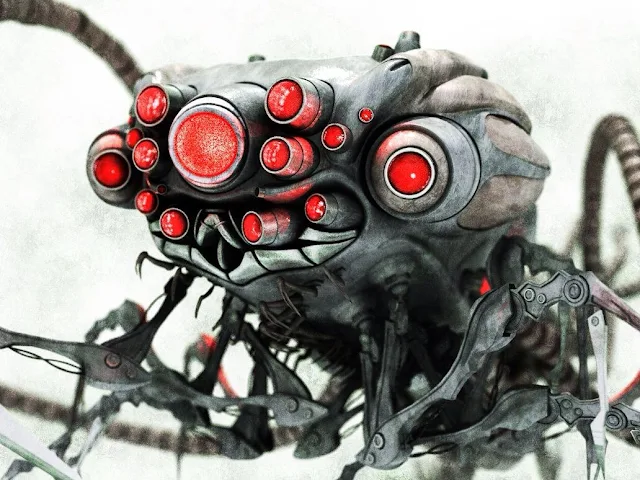
The less obvious entries matter just as much. Jurassic Park turns technological hubris into corporate management failure. Ready Player One questions whether virtual escape can remain free once it becomes platform property. Prospect treats extraction as the basic grammar of frontier life. Southland Tales lets propaganda, celebrity, surveillance, and apocalypse overload one another until the chaos becomes the point. The shared argument is sharp: systems rarely announce their cruelty. They make it feel ordinary.
The Red Pill Becomes Ideological Shorthand
The red pill works because it makes liberation look simple. Its cultural afterlife shows how easily a symbol designed to question conformity and domination can be absorbed by new forms of certainty, grievance, and control.
Read the full scene or film analysisCore essays in this theme
Each card leads into a complete Astromech essay. These short notes explain why it belongs in this chapter.
The Matrix Films and the Search for Truth: Simulation to Reality
The essay frames the trilogy around truth, control, liberation, and machine logic. It is one of the site’s most theory-facing entries on simulation and ideology.
Read the full essay Atlas anchor · Metropolis · 1927The Dystopian Vision of Fritz Lang's Metropolis
The essay highlights labor, mechanization, class division, and techno-myth. It is one of the archive’s clearest historical roots-of-genre entries.
Read the full essay Atlas anchor · The Matrix · 1999The Matrix and Postmodernism
The essay is one of the archive’s clearest direct bridges to postmodern theory. It reads the film through metanarrative collapse, agency, and image-truth instability.
Read the full essayThe irony of the red pill
The essay’s originality lies in following a film symbol into political afterlife. It is one of the archive’s clearest examples of film criticism shading into reception theory.
Read the full essay Related essay · The Matrix · 1999Existential themes in Neo's character arc
The essay’s value is psychological focus. It treats freedom, selfhood, and chosen responsibility as the deeper logic beneath the hero-messianic structure.
Read the full essay Related essay · Jurassic Park · 1993Why John Hammond’s Jurassic Park was doomed from the beginning
The essay reads the film through hubris, false control, and the blindness of techno-capitalist optimism. It is stronger on systems failure than on pure dinosaur awe.
Read the full essayOpen the deep archive9 more essays in this corridor
Snowpiercer
The essay makes the film’s train architecture legible as class allegory. It is compact but effective on inequality, sacrifice, and closed-system politics.
Read the full essay Deep archive · Parasite · 2019Parasite and exploitation of desperation
The essay foregrounds dehumanization, smell, labor desperation, and manipulation. It is less formally exact than full academic readings, but thematically on point.
Read the full essay Deep archive · Prospect · 2018Prospect
The essay focuses on extraction, frontier economics, and moral compromise. It rightly sees the film as quiet materialist sci-fi rather than spectacle-driven space adventure.
Read the full essay Deep archive · Ready Player One · 2018Ready Player One
The essay reads the film less as nostalgia machine than as a text about virtual identity and platform control. That gives it more bite than fan-service-only readings.
Read the full essay Deep archive · Southland Tales · 2006Southland Tales, complexity
The essay embraces messiness as the point, arguing that the film’s overload is a political-aesthetic strategy. It is one of the site’s most originality-friendly entries.
Read the full essay Deep archive · Southland Tales · 2006Southland Tales plot explained
The essay is more explanatory than argumentative, but still interpretive in how it maps political paranoia and metaphysical overload. It earns inclusion because plot and meaning are inseparable here.
Read the full essay Deep archive · Civil War · 2024Civil War, themes
The essay foregrounds spectacle, numbness, and the ethics of witnessing. It is a strong example of the archive treating recent film as media-theory problem.
Read the full essay Deep archive · The Running Man · 1987The Running Man themes
The essay’s political core is sharp: spectacle is governance, and violence is ratings logic. It is one of the archive’s more direct media-critique essays.
Read the full essay Deep archive · Southland Tales · 2006Southland Tales review
The essay’s argument is that the film’s flaws are entangled with its ambition. That makes it a useful document of the site’s willingness to reward maximalist failure.
Read the full essayBodies Under Siege
Why does genre cinema keep turning the body into a site of invasion, mutation, reproduction, contamination, desire, and control?
Body horror becomes powerful when the body stops feeling private. It becomes a workplace, a laboratory, a battleground, a reproductive machine, a contagious threat, or a surface onto which social fear is projected. The films in this corridor turn physical violation into a language for larger anxieties: gendered power, disease, technology, predation, mutation, ownership, and the terror of becoming unrecognisable to yourself or the people around you.
Alien is the central case because its biological horror is never separate from its institutional horror. The crew’s bodies are vulnerable because the company has already decided they are expendable. The facehugger and chestburster make reproduction into violation, while Ash proves that an artificial employee can obey a system without conscience. H.R. Giger’s designs matter because they make sex, machinery, death, industrial space, and anatomy collapse into the same visual nightmare.

The Thing takes the next step. Its terror lies in the failure of appearance itself. A body can no longer verify identity, so trust turns into a liability. Alien 3 makes contamination and sacrifice theological. Mad Max: Fury Road treats women’s bodies as dynastic property until the revolt begins. The Fly, Men, Under the Skin, Pitch Black, and Life each discover different forms of bodily estrangement. None uses transformation as empty shock. The body becomes terrifying because it has been made available for someone else’s purpose.

Continue with Alien Encounters of the Sexual Kind for the franchise’s sexual and maternal horror, then read The themes of Alien (1979) for a complementary reading of pregnancy anxiety, bodily invasion, and corporate betrayal.
The Chestburster and the Loss of Bodily Safety
The chestburster sequence breaks every expectation around care, illness, rescue, and medical safety. Kane seems to have survived. The film reveals that survival itself has become the mechanism of horror.
Read the full scene or film analysisCore essays in this theme
Each card leads into a complete Astromech essay. These short notes explain why it belongs in this chapter.
Alien: In space, no one can hear you scream
The essay reads Alien as corporate horror, body violation, class exploitation, and synthetic betrayal, not just creature-feature suspense. It is one of the archive’s strongest examples of genre-as-political-reading.
Read the full essay Atlas anchor · The Thing · 1982Themes in The Thing
The essay emphasizes paranoia, masculinity, isolation, and trust erosion. It understands the monster as a vehicle for social breakdown, not just gore.
Read the full essay Atlas anchor · Alien · 1979H.R. Giger, designer of the Alien Xenomorph and the Space Jockey
The essay argues that Giger’s production design is not decorative but thematic, fusing sex, machinery, death, and industrial anxiety into one visual theology.
Read the full essayMad Max: Fury Road, feminist themes
The essay isolates ownership, reproduction, and female solidarity as the film’s true engine. It is a valuable narrower complement to the broader Fury Road essay.
Read the full essay Related essay · Alien 3 · 1992The themes of Alien 3
The essay frames the film around guilt, contamination, death, and sacrificial agency. It makes a solid case for Alien 3 as severe, coherent tragedy rather than franchise misstep.
Read the full essay Related essay · Pitch Black · 2000The themes of Pitch Black
The essay reads darkness as thematic and social, emphasizing perception, predation, and unstable heroism. It is persuasive on why the film exceeds simple creature-feature status.
Read the full essayOpen the deep archive5 more essays in this corridor
Themes of Alien, feminist Ripley reading
The essay goes beyond “feminist icon” shorthand by reading Ripley as worker, survivor, skeptic, and reluctant authority. It is a useful corrective to flatter hero worship.
Read the full essay Deep archive · Life · 2017Life (2017), review and themes
The essay stresses scientific curiosity, vulnerability, and the arrogance of assuming knowledge equals control. It is a sharp small-scale survival reading.
Read the full essay Deep archive · The Fly series · 1958, 1986, 1989The Fly movies reviewed
The essay’s most persuasive move is treating mutation as disease metaphor and identity death. It productively pairs body horror with romantic tragedy.
Read the full essay Deep archive · Men · 2022Men, decoding symbolism and storytelling
The essay’s strength lies in taking symbolism seriously without flattening the film into one-to-one allegory. It reads repetition, grief, and misogyny as mutually reinforcing structures.
Read the full essay Deep archive · Under the Skin · 2013Under the Skin
The essay reads the film through gendered looking, predation, and the slow education of an inhuman observer. It works best on alien perception as ethical problem.
Read the full essayFirst Contact and Cosmic Scale
What does humanity discover when it encounters an intelligence, organism, world, or force that cannot be reduced to human categories?
First contact is not one mood. It can be wonder, terror, pilgrimage, silence, invasion, proof, grief, humility, loneliness, or an encounter with a force too large to fit human morality. The films in this chapter resist the idea that alien life exists merely to confirm human importance. Often the opposite is true. The encounter reveals that the human point of view is partial, fragile, and poorly equipped for what waits beyond it.
2001: A Space Odyssey approaches the unknown as cosmic design. The monolith does not explain itself, and the film refuses to domesticate its scale. Close Encounters is warmer but not simpler. Roy Neary’s visions lead him toward wonder, but they also damage his family. Solaris turns alien contact inward: the unknowable planet answers human visitors with the memories they cannot escape. Contact asks whether proof can be meaningful when the most profound experience cannot be publicly verified.

The quieter entries widen the emotional range. The Abyss makes contact a chance for reconciliation under military pressure. E.T. frames the alien as a vulnerable childlike bond pursued by institutions. A Quiet Place makes family communication a survival technology. War of the Worlds turns invasion into domestic panic and parental responsibility. The shared lesson is not that the unknown is friendly or hostile. It is that human beings reveal themselves by how they respond when the universe refuses to be familiar.

For the harsher underwater-horror branch of this argument, pair DeepStar Six with Leviathan. Both make pressure, enclosure, and industrial extraction feel as alien as deep space.
Roy Neary Follows the Shape
Close Encounters understands that wonder has a cost. Roy’s vision becomes a calling powerful enough to make ordinary family life impossible. His ascent carries both transcendence and abandonment inside it.
Read the full scene or film analysisCore essays in this theme
Each card leads into a complete Astromech essay. These short notes explain why it belongs in this chapter.
2001: A Space Odyssey, all you need to know
The essay condenses the film into evolution, cosmic intelligence, and machine anxiety. It is less radical than academic Kubrick criticism, but highly central within the archive.
Read the full essay Atlas anchor · Close Encounters of the Third Kind · 1977Close Encounters of the Third Kind: Themes
The essay reads the film through obsession, awe, secrecy, pilgrimage, and the cost of being “chosen.” It is unusually strong on the film’s domestic damage as well as wonder.
Read the full essay Atlas anchor · A Quiet Place · 2018A Quiet Place, themes and meaning
The essay emphasizes communication, sacrifice, and the reframing of disability as strength. It productively links monster mechanics to family ethics.
Read the full essaySolaris
The essay emphasizes consciousness, isolation, and the impossibility of escaping memory. It captures why Solaris is less about aliens than about the unreachable self.
Read the full essay Related essay · Contact · 1997Contact and its stellar themes
The essay foregrounds faith versus evidence, intellectual loneliness, and cosmic humility. It fits well with the archive’s better first-contact material.
Read the full essay Related essay · The Abyss · 1989The Abyss
The essay emphasizes human nature, reconciliation, and awe beneath pressure. It is strongest when reading the abyss as psychological and civilizational mirror.
Read the full essayOpen the deep archive2 more essays in this corridor
E.T. The Extra-Terrestrial
The essay is strongest on childhood empathy, adult procedural violence, and the enchantment of ordinary domestic space. It is one of the archive’s warmest but still analytical pieces.
Read the full essay Deep archive · War of the Worlds · 2005The themes of War of the Worlds
The essay emphasizes vulnerability, panic, and parental transformation under invasion pressure. It is useful on post-9/11 dread and domestic-scale apocalypse.
Read the full essayCollapse, Scarcity, and Survival
What happens when a world can no longer sustain the people trying to control it?
Ecological collapse reveals political reality. When water, food, fuel, air, shelter, fertility, movement, and safety become scarce, every social system shows its priorities. Dystopia is not simply atmosphere. It is infrastructure under stress. It is the question of who controls the resources that make survival possible, and who gets told that their deprivation is natural, necessary, or deserved.
Mad Max: Fury Road gives this idea its clearest physical form. Immortan Joe controls water, women’s bodies, blood, fuel, food, and a language of religious obedience. Children of Men shifts the focus to infertility, migration, state violence, and fragile futurity. Planet of the Apes transforms the landscape into a civilisational indictment, forcing humanity to encounter the ruins of its own arrogance. Across the first Mad Max films, collapse becomes myth: road law gives way to fuel war, barter, ritual, and the harsh invention of new social orders.

The Host and Okja keep the same questions close to ordinary life. Pollution, corporate science, branding, animal ethics, bureaucratic incompetence, and family desperation all become parts of a single system. This is the chapter where the Atlas insists that survival stories are never only about endurance. They are about the terms on which endurance is permitted. The future becomes political the moment access to life is unevenly distributed.
Furiosa Turns Back Toward the Citadel
The U-turn changes Fury Road’s politics. Escape cannot undo the system that created the wasteland. The future becomes possible only when Furiosa and the others return to confront the source of water, power, and control.
Read the full scene or film analysisCore essays in this theme
Each card leads into a complete Astromech essay. These short notes explain why it belongs in this chapter.
Mad Max: Fury Road and the Politics of Survival
The essay treats the film as a fully political action text about scarcity, patriarchy, ecology, cult rule, and revolution. It is arguably the site’s best action-film reading.
Read the full essay Atlas anchor · Children of Men · 2006Children of Men
The essay emphasizes biopolitics, authoritarianism, migration, and fragile hope. It reads the film as a severe political-humanist masterpiece.
Read the full essay Atlas anchor · Planet of the Apes · 1968The Planet of the Apes: An all time sci-fi great
The essay reads the twist as political humiliation and time-displacement shock. It rightly treats the ending as one of genre cinema’s great ideological reversals.
Read the full essayThe themes of the original Mad Max
The essay reads the first film as collapse cinema poised between society and apocalypse. It is strongest on vengeance, social breakdown, and hardening masculinity.
Read the full essay Related essay · Mad Max 2: The Road Warrior · 1981The Enduring Relevance of Mad Max 2
The essay treats the sequel as the franchise’s myth-forging entry, where fuel, siege, and sacrifice become the grammar of post-apocalypse.
Read the full essay Related essay · The Host · 2006The Host
The essay stresses genre blending, family messiness, pollution politics, and bureaucratic failure. It correctly locates Bong’s monster as institutional symptom.
Read the full essayOpen the deep archive2 more essays in this corridor
Okja
The essay reads the film through animal ethics, environmental concern, branding, and sentiment under capitalism. It captures Bong’s fusion of sweetness and indictment.
Read the full essay Deep archive · Mad Max Beyond Thunderdome · 1985The themes of Mad Max 3: Beyond Thunderdome
The essay reads the film through ritual, barter, power, and emergent civilization. It is especially useful on mythmaking after collapse.
Read the full essayGrief, Family, and Fragile Bonds
Why do genre stories so often use ghosts, aliens, dreams, black holes, and distant planets to express grief?
The genre’s biggest ideas often begin with an ordinary human wound. A black hole becomes a father’s lost years with his daughter. A ghost becomes failed communication. An invasion becomes a bereaved family trying to find meaning again. A dream becomes a mind constructing shelter against guilt. A lonely astronaut’s encounter becomes an argument with the life he has been avoiding. These films use impossible situations to make private pain visible and shareable.
Interstellar is the chapter’s emotional anchor because it turns cosmic scale into family scale. Time dilation matters because Cooper watches decades of Murph’s life vanish. The Sixth Sense uses its supernatural premise to ask whether care can be repaired after years of isolation. Signs treats faith and alien invasion as a pressure chamber for grief and fatherhood. The Fountain refuses to make death a riddle that can be solved, insisting instead that acceptance may be the only form of release.
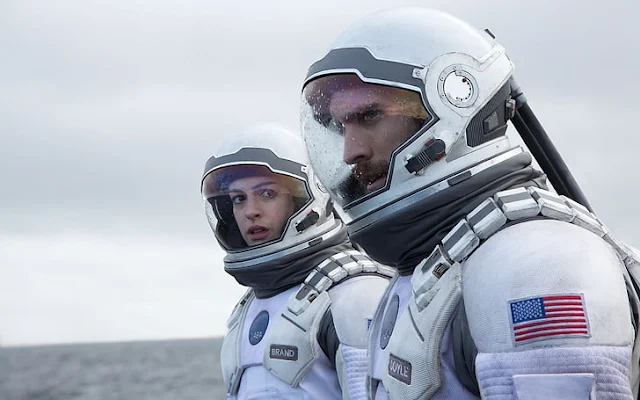
Mulholland Drive and Spaceman extend the chapter into more unstable territory. Desire, shame, ambition, marriage, memory, and loneliness bend reality around people who cannot speak honestly to themselves. The shared argument is not that grief can be made beautiful. It is that genre cinema can give grief a shape. It can show what loss does to time, language, identity, family, belief, and the stories people tell to remain alive.
Cooper Watches Murphy Grow Up Without Him
Interstellar turns cosmology into emotional violence. Relativity matters because it converts physical absence into years of unshared life. The scene makes the survival of humanity inseparable from the cost paid by one family.
Read the full scene or film analysisCore essays in this theme
Each card leads into a complete Astromech essay. These short notes explain why it belongs in this chapter.
The Themes of Interstellar directed by Christopher Nolan
The essay argues that Interstellar’s science matters because it intensifies themes of love, time, sacrifice, and species survival. It treats cosmic scale as melodramatic scale.
Read the full essay Atlas anchor · The Sixth Sense · 1999The Sixth Sense, themes and symbolism
The essay reads the twist as inseparable from themes of isolation, failed care, parent-child fracture, and redemption. It is one of the better Shyamalan essays in the set.
Read the full essay Atlas anchor · Signs · 2002The themes of Signs
The essay reads the film through faith, resilience, and meaning-making. It is strongest when showing how domestic grief structures the alien plot.
Read the full essaySigns, Graham Hess character arc
The essay narrows the film to Graham’s movement from paralysis to restored belief. It is strongest on grief as the real object of the attack.
Read the full essay Related essay · Mulholland Drive · 2001Mulholland Drive themes explained
The essay reads fantasy, aspiration, and guilt as the key to the film’s split structure. It is one of the archive’s better forays into art-cinema instability.
Read the full essay Related essay · The Fountain · 2006The Fountain ending explained
The essay treats the film as a meditation on immortality, acceptance, and mourning. It is strongest when refusing literalist reduction of the triptych structure.
Read the full essayOpen the deep archive1 more essays in this corridor
Faith, Myth, Prophecy, and Transcendence
When does belief become meaning, when does it become social control, and when does it become a weapon?
Genre cinema returns to faith because belief can hold two opposite forces at once. It can give people language for endurance, grief, sacrifice, wonder, and moral responsibility. It can also turn fear into obedience, myth into hierarchy, and prophecy into a system for deciding who must be followed. The films in this corridor remain powerful because they refuse to treat faith as either a simple comfort or a simple delusion.
Prometheus and Alien: Covenant place creation at the centre of a chain of wounded makers. Engineers create humans. Humans create David. David begins to imagine himself as creator, artist, and god. The horror lies not only in his power. It lies in his freedom from responsibility. The Matrix uses messianic imagery differently. Neo’s role as the One can empower resistance, but it also raises the political danger of organising hope around a single chosen body.
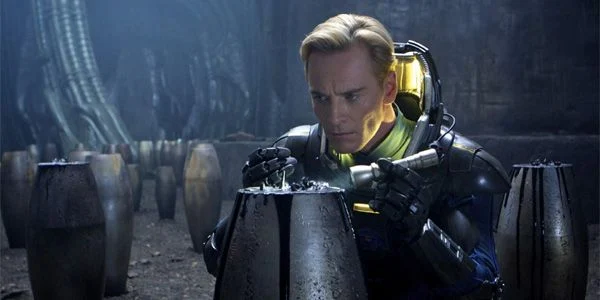
The Village makes fear into a governing technology. Its community preserves itself by converting myth into social control. Unbreakable asks what happens when an ordinary life is reorganised around the possibility of destiny. Signs and Alien 3 bring faith into intimate crisis, where providence, punishment, sacrifice, and grief cannot be cleanly separated. This chapter leaves room for mystery, but it keeps asking the harder question: who gains power when an explanation becomes sacred?
David Treats Creation as Private Art
David’s horror lies in the way he treats life as material. He has the power to create, but no obligation to care for what he creates. His experiments turn authorship into contempt.
Read the full scene or film analysisThe Atlas’s faith chapter reaches naturally into Dune. Start with Is Paul Atreides a false prophet?, continue to The themes of Dune Messiah, and finish with The Golden Path as anti-messianic politics.
Core essays in this theme
Each card leads into a complete Astromech essay. These short notes explain why it belongs in this chapter.
Prometheus (2012), review of themes in this Alien franchise epic
The essay reads the film through creation, failed faith, hubris, and cosmic indifference. It places disappointed theology at the center of the prequel.
Read the full essay Atlas anchor · The Village · 2004The Village, the themes of Shyamalan's tale
The essay makes fear-as-social-control its core argument and ties myth-making to paternal governance. That makes it more politically lucid than many mainstream readings of the film.
Read the full essay Atlas anchor · Alien: Covenant · 2017Themes of Alien: Covenant
The essay is strongest on colonization, synthetic superiority, failed faith, and creation-as-art. It gives David’s cruelty a coherent ideological frame.
Read the full essayThe themes of Alien 3 religious undertones
The essay’s distinctive angle is theological, reading Fury 161 as a monastic death world. It adds interpretive precision to the broader Alien 3 essay.
Read the full essay Related essay · The Matrix trilogy · 1999-2003The themes of The Matrix trilogy, messianic Neo
The essay foregrounds Christ-figure coding and sacrificial structure. It is most persuasive when treating religious symbolism as political-mythic, not merely decorative.
Read the full essay Related essay · Unbreakable · 2000Unbreaking the superhero myth
The essay productively reads the film as a melancholy deconstruction of superhero origin logic. It privileges destiny, fragility, and the comic-book frame as interpretive structure.
Read the full essayOpen the deep archive2 more essays in this corridor
Signs, demons reading
The essay’s originality lies in testing the “aliens as demons” hypothesis, not as definitive answer but as a way to foreground the film’s religious coding.
Read the full essay Deep archive · The Village · 2004The Village, cult-classic reassessment
The essay revisits the film after the twist, arguing that moral ambiguity and fear politics matter more than the surprise mechanism. That reassessment is one of the site’s sharper critical revisions.
Read the full essayOne Scene Explains Everything
Each chapter contains a scene that condenses its central argument. These are not isolated clips or trivia moments. They are pressure points where image, character, theme, and consequence all meet.
Roy Batty Saves Deckard
Roy’s final act has more moral force than the human institutions surrounding him. At the moment he could claim revenge, he chooses mercy. That choice turns the supposed machine into the film’s clearest witness to mortality, empathy, and the value of a life that will soon disappear.
Open the linked essay Time, Fate, Dreams, and Fractured RealityLouise Understands Her Future
Arrival’s revelation changes what freedom means. Louise does not discover a route around pain. She discovers that joy, grief, foreknowledge, and choice can inhabit the same life. The film makes acceptance active rather than passive.
Open the linked essay The Systems That Own UsThe Red Pill Becomes Ideological Shorthand
The red pill works because it makes liberation look simple. Its cultural afterlife shows how easily a symbol designed to question conformity and domination can be absorbed by new forms of certainty, grievance, and control.
Open the linked essay Bodies Under SiegeThe Chestburster and the Loss of Bodily Safety
The chestburster sequence breaks every expectation around care, illness, rescue, and medical safety. Kane seems to have survived. The film reveals that survival itself has become the mechanism of horror.
Open the linked essay First Contact and Cosmic ScaleRoy Neary Follows the Shape
Close Encounters understands that wonder has a cost. Roy’s vision becomes a calling powerful enough to make ordinary family life impossible. His ascent carries both transcendence and abandonment inside it.
Open the linked essay Collapse, Scarcity, and SurvivalFuriosa Turns Back Toward the Citadel
The U-turn changes Fury Road’s politics. Escape cannot undo the system that created the wasteland. The future becomes possible only when Furiosa and the others return to confront the source of water, power, and control.
Open the linked essay Grief, Family, and Fragile BondsCooper Watches Murphy Grow Up Without Him
Interstellar turns cosmology into emotional violence. Relativity matters because it converts physical absence into years of unshared life. The scene makes the survival of humanity inseparable from the cost paid by one family.
Open the linked essay Faith, Myth, Prophecy, and TranscendenceDavid Treats Creation as Private Art
David’s horror lies in the way he treats life as material. He has the power to create, but no obligation to care for what he creates. His experiments turn authorship into contempt.
Open the linked essayChoose your route through The Astromech
These guided sequences are built for readers who want a deliberate path rather than a single essay. Start anywhere, but follow the order when you want one argument to deepen into the next.
Blade Runner: Artificial Humanity and the Ethics of Memory
Follow the archive from artificial personhood to surveillance, mercy, memory, ambiguity, and the longing that drives Blade Runner 2049.
- Blade Runner: The themes of Blade Runner (1982)
- Blade Runner: Why did Roy Batty save Deckard's life at the end of Blade Runner?
- Blade Runner: Tears in the Rain
- Blade Runner: The use of eyes as symbolism in Blade Runner
- Blade Runner: Blade Runner, human or replicant?
- Blade Runner 2049: Blade Runner 2049, how its themes and symbolism build on Scott's original
Alien: The Body, Work, and Corporate Horror
Follow the Alien corridor through bodily violation, visual design, Ripley, synthetic ethics, tragic survival, creation myths, and corporate hunger.
- Alien: Alien: In space, no one can hear you scream
- Alien: H.R. Giger, designer of the Alien Xenomorph and the Space Jockey
- Alien: Themes of Alien, feminist Ripley reading
- Alien franchise: The themes of Alien Franchise AI ethics
- Alien 3: The themes of Alien 3
- Prometheus: Prometheus (2012), review of themes in this Alien franchise epic
The Matrix: Ideology, Liberation, and Prophecy
Move from simulation and postmodernism into the political afterlife of the red pill, Neo’s existential responsibility, and the dangers of messianic storytelling.
Time, Grief, and the Refusal to Let Go
Read time travel as emotional machinery: dream grief, foreknown loss, fatalism, mourning, regret, and the moral corrosion hidden inside technical rules.
Collapse, Class, and the Future as a Resource War
Trace resource hoarding, migration, revolutionary infrastructure, civilisational shame, pollution, animal ethics, and the politics of who gets to survive.
A map of arguments, not a pile of posts
A Blade Runner reader should find a route into memory, labour, surveillance, and mortality. An Alien reader should reach bodily autonomy, corporate horror, artificial life, and cosmic indifference. A Matrix reader should discover ideology, liberation, prophecy, and the machinery of control. The Atlas succeeds when one film becomes the beginning of a larger way of seeing.
Back to the Atlas entrance ↑
_poster.jpg)


