
Mad Max: Fury Road and the Politics of Survival
Water, blood, guzzoline, bodies, and the road back to humanity
Mad Max: Fury Road is more than a chase film. It is a two-hour act of rebellion staged across dust, engines, blood, and stolen water.
Mad Max: Fury Road, directed by George Miller, takes the basic grammar of action cinema and strips it down to pure myth. A man with no home. A woman with a mission. A tyrant who owns the water. A fortress full of bodies turned into resources. A war rig carrying the future out of hell.
Released in 2015, the film follows Max Rockatansky, played by Tom Hardy, as he is dragged into the escape led by Imperator Furiosa, played by Charlize Theron. Furiosa turns against Immortan Joe, steals his Five Wives, and drives into the desert in search of the Green Place. What follows is not simply pursuit. It is an argument about what survival is worth if the soul has already been surrendered.
The film’s themes are direct and brutal: survival, freedom, gender, environmental collapse, trauma, bodily ownership, and the possibility of redemption. Fury Road is a film where almost every object is symbolic because almost every object is scarce. Water is power. Blood is fuel. Milk is industry. Women are treated as property. Engines become gods. The road becomes the only place where change is still possible.

Survival in a world that has become machinery
The Citadel // War Boys // Blood bags // GuzzolineFury Road is set deep in the aftermath of The Collapse, when the old world has been broken into resource fortresses, road tribes, cult armies, and scavenger economies. Civilization has not vanished completely. It has curdled. The Citadel still has agriculture, water systems, repair crews, military command, medical knowledge, and political ritual. The horror is that all of those systems serve one tyrant.
Survival in this world is not romantic. It is bodily. Max is captured and turned into a blood bag for the ailing War Boys. The Wives are held because their fertility is valuable to Joe’s dynastic fantasy. The milk mothers are industrialized. The poor at the base of the Citadel wait for water as if waiting for grace from a false god.
That is the film’s first great theme. The wasteland does not merely kill people. It repurposes them. Everyone becomes a function in Joe’s machine, unless they can break free of the category assigned to them.
Wasteland economy
Water, fuel, bullets, blood, milk, wombs, engines, and belief are all treated as resources to be controlled.
Max’s position
Max begins as property, strapped to Nux’s car as living medical equipment. His arc starts at total dehumanization.
Immortan Joe turns scarcity into religion
Aqua Cola // Valhalla // V8 worship // The tyrant as supplierImmortan Joe is one of modern science fiction cinema’s most efficient tyrants because his power is material before it is symbolic. He controls water. He controls food. He controls the War Boys. He controls fertility. Then he wraps that control in theatre, costume, ritual, and fake divinity.
The Citadel’s water release is one of Fury Road’s clearest political images. Joe opens the valves and the desperate crowd below reaches upward as water pours down for a few brief moments. He then tells them not to become addicted to it. That is the cruelty of power disguised as wisdom. He manufactures scarcity, then lectures the starving about dependence.
The War Boys show the same structure in spiritual form. They are sick, short-lived, and disposable, but Joe gives them a story that makes their suffering feel holy. Chrome spray, V8 worship, steering wheel altars, and Valhalla rhetoric are not random weirdness. They are a death cult built to turn exploited boys into willing weapons.
Joe’s method
He controls necessity, then converts dependency into worship.
War Boy tragedy
The War Boys are victims and enforcers at once, dying for a ruler who treats them as replaceable parts.
Furiosa, the Wives, and the refusal to be things
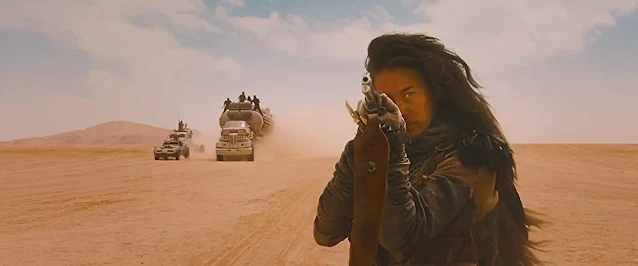
Feminist rebellion // Bodily autonomy // The stolen futureFury Road stands out because its rebellion begins with women rejecting the system that has defined them as property. The Wives are not passive cargo. They are escaping a reproductive prison. Their message, “We are not things,” is the film’s simplest and most powerful political statement.
Furiosa is central because she understands Joe’s system from the inside. She has rank, skill, trust, and access. She uses those tools against him. That makes her rebellion more than personal revenge. She steals Joe’s future from the heart of his empire.
The film’s gender politics work because they are embedded in the worldbuilding. Joe’s tyranny depends on controlling women’s bodies, controlling reproduction, and treating fertility as dynastic infrastructure. Furiosa’s act of rescue attacks the whole structure. She does not just flee the Citadel. She removes the thing Joe thinks guarantees his continuation.
Core phrase
“We are not things” turns the entire film into a revolt against ownership.
Furiosa’s role
She is not simply helping the Wives escape. She is sabotaging the reproductive machinery of Joe’s empire.

The environment is not scenery, it is judgment
The Green Place // Toxic storms // Water control // Ecological debtFury Road is often described as a desert chase, but the desert is not just empty space. It is the visible wound of the old world. The landscape has been blasted, dried, poisoned, and stripped. This is the ecological endpoint hinted across the franchise, from the road decay of the original film to the fuel wars of The Road Warrior and the methane economy of Beyond Thunderdome.
The Green Place is the key. Furiosa believes she is driving toward a living alternative, a place of water, growth, and female community. When she learns it has become a poisoned bog, the film’s ecological argument sharpens. There is no untouched refuge left. The damage has spread too far.
That discovery changes the shape of the film. The characters cannot simply flee to paradise. They have to turn back and reclaim the Citadel. Fury Road’s environmental politics are therefore practical, not sentimental. You cannot escape the world you have ruined. You have to take responsibility for the place where life can still be made possible.
Green Place meaning
It represents Furiosa’s lost home and the wider loss of sustainable life after The Collapse.
Citadel meaning
The Citadel is corrupt, but it has water and soil. That makes it the only viable ground for revolution.
The U-turn is the whole movie
Escape fails // Return becomes revolution // The road reversesThe most important structural choice in Fury Road is the U-turn. For much of the film, the goal seems simple: escape the Citadel and reach the Green Place. Then that fantasy collapses. The Green Place is gone, the desert ahead offers only more death, and the characters realize the only possible future lies behind them.
That is why Max’s suggestion to return matters. He is not taking over Furiosa’s story. He is recognizing the tactical truth. The Citadel is vulnerable because Joe has taken his army away from it. The water, food, and height are back there. The future is back there. The road to freedom is not forward into fantasy. It is backward into confrontation.
This is where Fury Road becomes more than a chase. The film’s shape becomes its argument. Liberation is not escape alone. Liberation means returning to the source of power and changing who controls it.
Story function
The U-turn transforms the film from flight into revolution.
Thematic function
The characters stop chasing refuge and start reclaiming infrastructure.
Related Astromech reading
Max and Furiosa are both chasing redemption
Haunted survivor // Failed rescuer // Blood freely givenMax and Furiosa are not the same kind of hero, but they are both haunted by failure. Max is pursued by the dead he could not save. Furiosa is trying to repair a stolen life by saving others from the same machinery that consumed her. Neither character speaks in grand emotional confessions. Their pain is carried through movement, glances, scars, and choices.
Max’s arc is especially sharp because he begins the film as a body used by others. He is a blood bag, a captive, a thing. By the end, he gives his blood to Furiosa freely. That reversal matters. Blood taken by force is exploitation. Blood given by choice is solidarity.
Furiosa’s redemption is not sentimental either. She cannot restore the Green Place. She cannot undo the years inside Joe’s empire. She cannot save everyone. But she can turn the Rig around, kill Joe, and open the water to the people below. In Fury Road, redemption is not purity. It is action taken after damage.
Max’s redemption
He moves from isolated survival to chosen responsibility.
Furiosa’s redemption
She turns personal escape into collective liberation.
Nux shows how a death cult can be broken
Witness me // Capable // Failed martyrdom // Chosen sacrificeNux begins as one of Joe’s most tragic creations: a sick young man convinced that dying violently for his ruler will make him eternal. His need to be “witnessed” is not only comic or strange. It is heartbreaking. He wants his pain to mean something because the Citadel has taught him that his only value lies in spectacular sacrifice.
His shift begins when he is no longer useful to Joe. Failure breaks the spell. Capable then sees him not as a weapon, but as a person. That is all it takes to crack the ideology. Nux does not need a lecture. He needs to be seen outside the role assigned to him.
His final sacrifice matters because it is no longer for Joe’s approval. It is for people he has chosen to protect. The same act, dying on the road, changes meaning completely. Under Joe, death is consumption. With Furiosa’s group, sacrifice becomes love.
Nux at the start
A disposable War Boy trying to turn sickness into glory.
Nux at the end
A person who chooses his final act for others, not for the tyrant who used him.
The thematic engine of Fury Road
Fury Road works because every major theme is built into the film’s machinery. The chase is not separate from the politics. The vehicles, bodies, costumes, engines, water systems, wounds, and road tactics all express the same question: what remains human when every human thing has been turned into fuel?
Why Fury Road still matters
Modern myth // Practical cinema // The wasteland as warningFury Road remains vital because it feels ancient and modern at the same time. It is built like myth, staged like a silent film, edited like a war drum, and loaded with anxieties that still feel close: ecological collapse, resource hoarding, reproductive control, cult politics, masculine violence, and the conversion of people into economic units.
The film also sits beautifully inside the wider Mad Max saga. The original Mad Max shows law losing the road. The Road Warrior shows fuel becoming war. Beyond Thunderdome shows civilization returning as barter, methane, and spectacle. Fury Road shows the mature wasteland, where resources have become theology.
The later prequel Furiosa: A Mad Max Saga deepens this reading by showing how Furiosa’s rebellion was formed across years of loss, captivity, observation, and tactical patience. Fury Road is the payoff. It is the moment the machine finally turns against its master.
Continue through The Astromech’s Mad Max coverage
Conclusion: the road back to humanity
Mad Max: Fury Road is a film about survival, but it does not worship survival for its own sake. Joe survives. His empire survives. His systems survive. That is the problem. The film asks whether survival can become moral again.
Furiosa, Max, the Wives, Nux, and the Vuvalini answer that question by refusing the roles assigned to them. They stop being property, weapons, blood bags, breeders, ghosts, and relics. They become a temporary community moving at impossible speed across a dead world.
That is why Fury Road still roars. It understands that the apocalypse does not end humanity all at once. It turns humanity into inventory. The film’s rebellion begins when people look at each other and say, in action rather than words, that they are more than things.

_poster.jpg)


