
Feminist Themes in Mad Max: Fury Road
“We are not things,” and the rebellion against the Citadel’s body economy
Mad Max: Fury Road is one of modern action cinema’s clearest feminist blockbusters because its rebellion begins with a simple refusal: women are not property, bodies are not inventory, and survival without autonomy is another kind of prison.
Mad Max: Fury Road, directed by George Miller, is set in a wasteland where every resource has been seized, renamed, rationed, and ritualized. Water becomes Aqua Cola. Fuel becomes guzzoline. Blood becomes battlefield medicine. Milk becomes industrial production. Fertility becomes dynastic property. That is the world Furiosa drives out of, and that is the world the Five Wives are trying to escape.
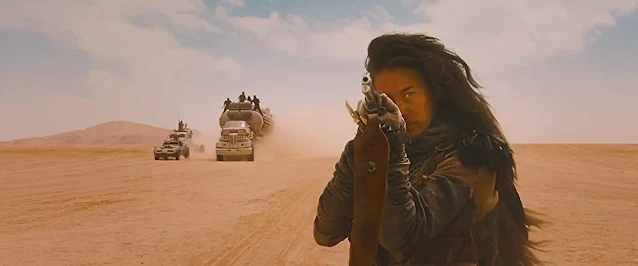
The film follows Imperator Furiosa, played by Charlize Theron, as she turns against Immortan Joe and helps his enslaved wives flee the Citadel. That plot could easily have been handled as rescue fantasy. Miller makes it sharper. Furiosa is not delivering passive victims to safety. She is leading a revolt against a society that has reduced women to reproductive machinery.
The irony is worth noting. Fury Road was directed and co-written by men, including George Miller, yet it became one of the most discussed feminist action films of the 2010s. That raises a fair question about authorship and representation. The film’s strength lies in how carefully its feminist ideas are embedded into the world itself. Its politics are not pasted over the action. They are built into the Citadel, the War Rig, the Wives’ escape, the Green Place, and the final return to the source of power.

Furiosa turns rank into rebellion
Imperator // Driver // Defector // RevolutionaryFuriosa is powerful because she understands Joe’s empire from within. She is not an outsider looking at the Citadel with clean hands. She has rank. She has access. She commands the War Rig. She knows the trade routes, the war parties, the fuel logistics, the risk of the canyon pass, and the value Joe places on the Wives. Her rebellion works because she has spent years learning the system well enough to exploit its blind spots.
That makes her a very different action hero from the lone avenger model. Furiosa’s strength is strategic as much as physical. She knows when to lie, when to wait, when to drive, when to fight, and when to trust. Her feminism is expressed through action rather than speeches. She takes a machine built to serve Joe’s economy and turns it into a vehicle of escape.
Her missing arm also matters. The film never treats disability as weakness, decoration, or tragic symbolism. Furiosa’s prosthetic is part of her labour, combat, and identity. She is not presented as powerful despite her body. She is powerful through the body she has, the tools she uses, and the choices she makes under pressure.
What Furiosa attacks
She attacks Joe’s future by stealing the women he treats as reproductive property.
Why she works
She is both warrior and tactician, using the Citadel’s own infrastructure against it.
Related Astromech reading
“We are not things” is the film’s thesis
The Wives // Bodily autonomy // Reproductive controlThe Wives are central to Fury Road’s feminist meaning because the film refuses to treat them as background stakes. They are escaping sexual slavery, reproductive control, and dynastic captivity. Immortan Joe calls them his property because his regime depends on turning women’s bodies into future heirs, status symbols, and controlled resources.
The words “We are not things” cut through the entire Citadel system. The phrase rejects ownership, objectification, breeding logic, and the idea that survival gives the powerful the right to use the vulnerable. It also rejects the old action-film habit of treating endangered women as plot devices for male heroism. The Wives are frightened, inexperienced, and exposed, but they are also active moral agents.
Angharad, Capable, Toast, Cheedo, and the Dag each represent a different response to captivity. Angharad is defiant and visibly political. Capable is emotionally perceptive, which becomes vital in Nux’s transformation. Toast is practical and alert to violence. Cheedo’s fear reveals how hard it is to leave an abusive system. The Dag carries the future literally and symbolically through pregnancy. Together, they make liberation feel uneven, human, and earned.
Core theme
The film frames bodily autonomy as the first condition of freedom.
Key reversal
The Wives begin as Joe’s supposed treasures, then become the political reason his empire falls.
The Vuvalini give feminism a history
The Green Place // Older women warriors // Memory after collapseThe Vuvalini matter because they prevent the film’s feminism from being limited to young women escaping male power. They are older, weathered, practical, funny, dangerous, and grief-struck. They carry the memory of the Green Place, which means they also carry the memory of a different social order.
That is a major lore point. The Green Place was not only a location. It was a living alternative to the Citadel. Where Joe’s world hoards water, the Green Place implied ecological knowledge. Where Joe’s world treats fertility as property, the Vuvalini represent matriarchal continuity. Where Joe’s world turns bodies into functions, the Vuvalini keep names, seeds, stories, and riding skills alive.
The tragedy is that their home is gone. Furiosa’s hoped-for refuge has become toxic swamp. That loss changes the film’s feminist argument. Safety cannot be found by retreating to a hidden paradise. The survivors have to return to the captured infrastructure of the Citadel and change who controls it.
What they add
The Vuvalini make the rebellion generational, tying young escapees to older survivors and lost ecological memory.
Why it matters
Their failure to preserve the Green Place makes the final return to the Citadel necessary.
Immortan Joe is patriarchy as infrastructure
Water, wombs, blood, milk, worshipImmortan Joe is more than a cruel man at the top of a fortress. He is patriarchy given plumbing, agriculture, medical classification, military doctrine, costume, ritual, and branding. His power comes from controlling life systems. He controls water. He controls food. He controls reproduction. He controls the War Boys’ idea of death. He controls who gets to live long enough to matter.
This is why Fury Road’s feminism is stronger than a simple “strong female character” reading. The film is not only interested in whether women can fight. It is interested in the systems that decide what women are for. Joe’s world sorts female bodies into categories: wives, milk producers, genetic stock, old women, useless bodies, dangerous bodies. Furiosa’s rebellion attacks that sorting system.
The milk mothers are especially important here. They appear briefly, but they show how literal the body economy has become. Female biology is industrialized. The Citadel does not need to hate women in order to exploit them. It only needs to define them by output.
Joe’s rule
He turns scarcity into hierarchy and hierarchy into religious obedience.
Feminist reading
The film critiques ownership of bodies, reproductive coercion, and the politics of controlled dependency.

Max’s masculinity is rebuilt through humility
Blood bag // Reluctant ally // Man beside the revolutionMax is vital to the film, but Fury Road refuses to make him the owner of the story. He begins as a captive, a blood bag, a man reduced to his body’s usefulness. That is a sharp reversal for an action hero. Max has no command, no plan, and no heroic entrance. He is dragged into the story as property.
His relationship with Furiosa changes the terms of his masculinity. He does not have to dominate her to matter. He does not have to rescue her in the old-fashioned sense. He earns trust by listening, fighting, sharing weapons, accepting her leadership, and offering a tactical idea at the right moment. The film’s famous sniper scene says plenty. Max misses, hands the rifle to Furiosa, and lets her take the shot.
That moment works because it is practical, not preachy. Max recognizes competence. He does not feel diminished by it. Fury Road imagines masculinity as something that can survive without ownership, control, or ego. In a world poisoned by Joe’s model of patriarchal power, Max becomes useful by refusing to repeat it.
Max’s role
He becomes an ally to the rebellion rather than its replacement hero.
Why it matters
The film separates strength from domination and heroism from control.
Nux shows how patriarchy consumes men too
War Boys // Witness me // Capable // The death cult cracksFury Road’s feminist power also comes from the way it shows Joe’s system damaging men. The War Boys are not beneficiaries in any stable sense. They are sick, disposable, indoctrinated young men trained to turn their own deaths into praise for Joe. Their masculinity is built around sacrifice, speed, violence, and the desperate need to be witnessed.
Nux is the clearest example. At first, he believes every word of the Citadel’s death cult. He wants to die historic on the Fury Road. He believes Valhalla will redeem his failing body. Then he fails, and the ideology starts to break. Capable’s kindness gives him something Joe never offered: recognition without use.
His arc strengthens the film’s feminist argument because it shows that liberation is not a private escape from men. It is a break from a whole system of hierarchy, ownership, violence, and bodily exploitation. Nux’s final sacrifice matters because he chooses it for others, not for Joe’s glory.
War Boy tragedy
Joe turns sick young men into weapons by giving their pain a holy script.
Nux’s shift
He moves from being witnessed by power to being seen by another person.
The Green Place is hope and hard truth
Lost homeland // Ecological feminism // Return to the CitadelThe Green Place is one of Fury Road’s most important symbols. It represents more than safety. It represents a world organised around life rather than extraction. Furiosa remembers it as home, the Wives imagine it as freedom, and the Vuvalini carry it as a lost inheritance.
Its destruction changes the moral direction of the film. The characters discover that paradise has been poisoned. The hoped-for matriarchal refuge is gone. That could have become despair, but Fury Road makes it a turning point. There is no distant sanctuary left. The only future lies in returning to the Citadel and taking control of the water.
That is why the U-turn is politically loaded. Escape becomes revolution. The women cannot simply flee patriarchy’s fortress. They have to seize the resources that made the fortress powerful. The film’s feminism becomes infrastructural: who controls water, food, birth, memory, and the means of survival?
Symbolic role
The Green Place represents ecological memory and the possibility of life outside Joe’s system.
Story role
Its loss forces the characters to stop running and begin reclaiming power.

The film avoids the easy “strong female character” trap
Agency // Vulnerability // Difference // Collective actionFury Road’s women are strong, but the film does not flatten strength into one type. Furiosa is strategic and hardened. Angharad is openly defiant. Capable is empathetic. Toast is practical. Cheedo is afraid and tempted to return. The Dag is strange, sharp, and prophetic. The Vuvalini are older, experienced, funny, and lethal. Their differences matter.
This is where the film improves on weaker forms of action-film feminism. It does not simply give women guns and call the job done. It shows fear, disagreement, grief, pregnancy, age, trauma, desire, and doubt. It lets the women be capable without pretending liberation is clean or simple.
Cheedo’s near-return to Joe is especially important. Escaping captivity is psychologically difficult. The film understands that oppressive systems train people to confuse captivity with safety. Her moment of fear adds realism to the escape. Liberation requires more than opening the door. It requires unlearning the world that told you the cage was natural.
Character range
The women are not one symbolic unit. They represent different responses to captivity, fear, hope, and resistance.
Why it works
The film treats vulnerability as part of agency rather than the absence of it.
Authorship, male creators, and feminist meaning
George Miller // Representation // Collaboration // Result on screenBecause Fury Road was directed and co-written by men, its feminist reputation deserves scrutiny rather than automatic praise. Male authorship does not guarantee failure, and it does not guarantee insight. What matters is the work itself, the collaborators involved, the care taken with perspective, and whether the film gives women agency within the story rather than simply using feminist imagery as decoration.
Fury Road earns much of its reputation because its feminist ideas are structurally central. Remove the Wives’ escape, Furiosa’s betrayal, the Green Place, the Vuvalini, and Joe’s reproductive control, and the film no longer functions. Feminism is not an accessory to the plot. It is the plot.
The film also benefits from performance, editing, design, costuming, and physical staging that make the women feel embodied rather than theoretical. Charlize Theron’s Furiosa is not a slogan. She is tired, furious, tactical, wounded, and disciplined. The Wives are not treated as interchangeable beauty objects once the chase begins. Their fear and choices keep shaping the action.
Fair question
Who tells feminist stories matters, especially in blockbuster filmmaking.
Fair answer
Fury Road’s feminist themes are built into plot, character, production design, and worldbuilding.
Reception and impact
Action cinema // Feminist film analysis // Pop culture legacyMad Max: Fury Road received major critical acclaim for its action, design, editing, visual clarity, and thematic force. Its feminist reading became a large part of the cultural conversation because the film arrived in a genre often built around male protagonists, male revenge, and female vulnerability as motivation.
The film did not invent feminist action cinema. Alien and Ellen Ripley, the Terminator films and Sarah Connor, and many earlier genre works had already helped carve the path. Fury Road’s achievement was different. It made feminist politics the engine of an enormous practical-action blockbuster without slowing the film into a lecture.
Its influence can be seen in how often Furiosa is now discussed alongside the great genre heroines. She is not powerful because the script tells us she is powerful. She is powerful because the entire movie’s survival depends on her competence, moral clarity, and willingness to risk everything.
Genre impact
Fury Road showed that action spectacle and feminist analysis can occupy the same frame without weakening each other.
Legacy
Furiosa became one of the defining action heroines of modern science fiction cinema.
The feminist engine of Fury Road
Fury Road works as feminist cinema because its politics are physical. The film is about bodies under control, bodies in motion, bodies refusing ownership, and bodies choosing solidarity. Its chase is a political act because every kilometre puts more distance between the Wives and the man who claims to own them.
Why the ending matters
Return // Reclamation // Water released // Power reversedThe ending of Fury Road is crucial to its feminist meaning. The characters do not simply run forever. They turn around. They return to the Citadel. They kill Joe. They lift Furiosa upward. They release the water. This matters because the film understands that freedom is not only movement away from oppression. Freedom also requires control of the conditions that make life possible.
The final lift is one of the film’s clearest reversals. Furiosa, wounded and nearly dead, is raised by the people below the Citadel. The same vertical structure Joe used to dominate the masses becomes the image of his replacement. Power moves from false god to wounded liberator, from hoarder to distributor, from ownership to shared survival.
Max disappearing into the crowd completes the idea. He helps, then leaves. He does not claim Furiosa’s revolution. He does not rule the Citadel. He does not become the centre of the new order. Fury Road’s feminist clarity depends on that restraint. The future belongs to those who took back the water.
Political meaning
The ending shifts power from male ownership to collective access.
Character meaning
Furiosa’s personal escape becomes public liberation.
Continue through The Astromech’s Mad Max coverage
Conclusion: Fury Road’s feminism is built into the machine
Mad Max: Fury Road remains a landmark feminist action film because it makes liberation practical, bodily, and cinematic. It does not simply announce that women are strong. It shows what happens when women trapped inside a system of ownership seize transport, cross the desert, build alliances, reject shame, grieve their losses, and return to take the source of power.
The film’s feminism is not separate from its action. The chase exists because women are escaping reproductive slavery. The War Rig matters because it carries stolen autonomy. Max matters because he learns to support a revolution he does not own. Nux matters because he shows how Joe’s violent patriarchy consumes young men too. The Vuvalini matter because they connect rebellion to memory, age, ecology, and lost community.
Fury Road’s final image of Furiosa rising above the Citadel endures because it completes the film’s central reversal. The woman who was taken from one green world returns to reclaim the water of another. Joe’s empire turned bodies into things. Furiosa’s rebellion turns things back into people.


_poster.jpg)


