
Neo character and lore analysis
Neo begins as a man who cannot name what is wrong with his world. He ends by exposing the lie inside prophecy itself, choosing love over a machine-designed destiny and forcing two civilisations to imagine peace.
Neo's first act of rebellion happens before he swallows the red pill. Thomas Anderson already lives two lives. By day, he writes code for a corporation that owns his time. By night, he uses a chosen name, follows forbidden questions and searches for a truth he cannot yet describe. The Matrix has supplied him with a job, an identity and an apparently complete reality. He feels none of them fit.
That unease makes Neo more than a conventional action hero. Across The Matrix, The Matrix Reloaded, The Matrix Revolutions and The Matrix Resurrections, his story moves through several competing explanations of who he is. Morpheus calls him a prophesied liberator. The Oracle treats him as a person who must understand his own choices. The Architect identifies him as the remainder of an equation. Smith sees him as an opposite that must be consumed. The Analyst reduces him to a renewable emotional resource.
Every system gives Neo a role. His character arc is defined by the roles he accepts, the ones he outgrows and the ones he refuses.
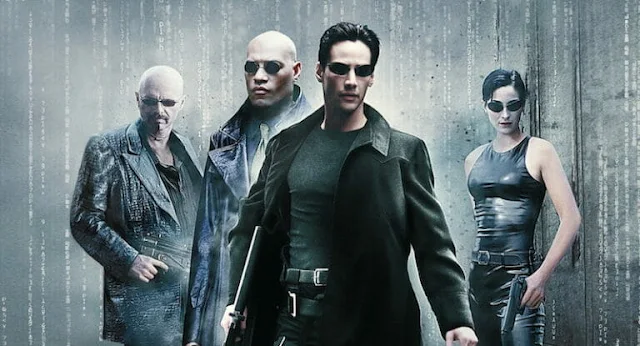
What does Neo represent?
Neo represents the struggle to turn an imposed identity into a chosen life. His ability to alter the Matrix literalises a deeper human act: recognising that rules presented as natural may have been written by somebody with an interest in obedience.
His importance also rests on a paradox. Neo is genuinely the One, but the prophecy of the One is part of the machines' control system. He becomes revolutionary only when he stops performing the destiny prepared for him.
Thomas Anderson and Neo: the identity assigned and the identity chosen
Thomas A. Anderson is Neo's legal identity inside the simulation. It belongs to employment files, tax records, authority figures and the corporate hierarchy. His manager uses it while warning him that the company believes he has a problem with authority. Agent Smith repeats “Mr Anderson” as an act of domination, trying to force the dissident back into the identity recognised by the system.
Neo is a name Thomas chooses before he understands the Matrix. It means new, evokes rebirth and rearranges into One. The word contains both transformation and destiny, although the films eventually complicate both ideas. He is new because he remakes himself. He is the One because the machines have a technical category for his anomaly. Those meanings overlap without being identical.
The name Thomas also invites an association with the biblical Doubting Thomas, the disciple who needs direct evidence before he believes in resurrection. Neo begins as a doubter and later becomes the figure who dies and returns. Anderson is sometimes read symbolically as “son of man.” That reading is thematic and distinct from the name's literal etymology. The films surround Neo with Christian language while refusing to confine him to one religious model.
Why Smith insists on “Mr Anderson”
Smith's choice of name is ideological. Thomas Anderson is legible to the Matrix: employee, citizen, criminal record and controllable body. Neo is self-authored. Every repetition of the old name attempts to restore the system's ownership over him.
Neo's final rejection of that address in the original film marks a shift from uncertainty to self-recognition. He wins the confrontation only after he claims the name he chose.
Neo is born twice before he becomes the One
The red-pill extraction is staged as a violent birth. Neo wakes naked in fluid, his body threaded with cables. A machine disconnects the tube from his throat, releases the restraints and flushes him from the pod. The Nebuchadnezzar retrieves him through a long mechanical line that resembles an umbilical cord.
Liberation arrives stripped of glamour. Neo's muscles have atrophied. His eyes hurt because he has never used them. His body bears sockets that permanently record his former captivity. Awakening gives him truth and trauma at the same moment.
The scene also refuses the fantasy that knowledge alone solves oppression. Neo learns the truth in a few minutes, while rebuilding his body and retraining his instincts takes sustained work. Decades of conditioning remain active beneath conscious belief when he attempts the jump between buildings.
The red pill is consent to disruption
The red and blue pills have become the franchise's most portable symbols, which is also why they are so easily stripped of context. The blue pill offers a return to the familiar narrative. The red pill enables the resistance to locate Neo's physical body and makes his awakening possible.
The red pill marks a willingness to lose a comforting framework. Neo chooses it before Morpheus has proven his account, knowing only that the answer may dismantle the life he recognises. Any claim to superior insight must come later and survive continued questioning.
That makes the scene a test of agency. Morpheus explains the options, then leaves the act to Neo. The Agents use threats, bodily violation and coercion. Morpheus states the cost of the exit and lets Neo decide. The difference between those methods matters as much as the colour of the pills.
The metaphor's later political appropriation often turns awakening into a badge of ideological certainty. The original scene presents awakening as the start of a destabilising education whose questions keep multiplying. The cultural reversal is explored further in the irony of what the red pill came to mean.
There is no spoon: Neo's power is perception applied to code
Neo's powers are sometimes described as magic, but their logic is rooted in the nature of the Matrix. The simulated world supplies rules for mass, gravity, speed, injury and death. Connected minds accept those rules because they experience them as reality.
The spoon boy shows Neo the decisive shift. Trying to overpower the spoon still grants it the status of an independent physical object. Recognising that both spoon and body are code changes the problem. Neo replaces force within the accepted rules with a revised understanding of the system itself.
This explains why training matters even after knowledge is downloaded into his brain. Technical skill can be installed. Freedom from unconscious limits must be experienced. Morpheus's sparring program, the failed jump, the woman in the red dress and the Oracle's waiting room each expose another assumption Neo has carried into the simulation.
The same principle explains why death inside the Matrix can kill the physical body. The brain makes the experience real enough for the body to follow. The simulation's power comes from interpretation, and Neo's power comes from learning to intervene at that level. The full philosophical significance of the lesson is examined in the meaning of “there is no spoon”.
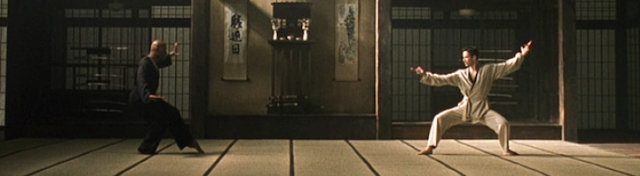
What the One actually is
Morpheus gives Neo a sacred version of the story. A man born inside the Matrix could remake it at will, freed the first rebels and would one day return to end the war. Zion turns this memory into prophecy, and Morpheus devotes his life to finding its promised figure.
The Architect supplies the buried technical account in The Matrix Reloaded. Human choice creates a persistent imbalance in the simulation. Most people accept the Matrix when allowed a choice at a nearly unconscious level. A minority rejects it, and the accumulating error eventually concentrates in a person carrying the anomalous code.
Neo is the sixth such One. Five predecessors reached the Source before him. Each accepted the Architect's bargain, allowing the Matrix to reload and selecting 23 people to rebuild Zion after the machines destroyed it. The prophecy directs rebellion towards the procedure that maintains the system.
How the machines use the One
- Some human minds reject the Matrix and escape to Zion.
- The unresolved anomaly accumulates in the person called the One.
- The Oracle and the prophecy guide that person towards the Source.
- The machines destroy Zion while the One returns the anomalous code.
- The Matrix resets and 23 selected survivors rebuild the resistance.
- The next Zion believes it is humanity's first and only rebellion.
The revelation changes the meaning of Neo without erasing him. He possesses real and unique capabilities, yet the system has anticipated a use for them. The One is simultaneously a liberator in human mythology and a maintenance function in machine design.
Neo becomes historically different when he rejects the expected choice. His predecessors respond to a general attachment to humanity and return to the Source. Neo chooses Trinity. The Architect dismisses that love as a dangerous specificity. That specificity breaks the cycle.
The existential reversal inside the chosen-one story
A conventional prophecy declares the hero's essence in advance. Neo's most important acts occur when that guarantee has been withdrawn. He rescues Morpheus while believing the Oracle has ruled him out, and he breaks the cycle after learning that the sacred role was engineered.
His identity emerges through commitment. The title “One” describes a system function; Neo gives that function a new meaning through what he chooses to value.
Neo's goals change in every Matrix film
The original draft of Neo's story can sound like one continuous mission to free humanity. The films give him a more complicated evolution. Each chapter dismantles the goal established by the previous one.
Find the answer, then choose responsibility
Neo begins by asking what the Matrix is. After awakening, his concern shifts towards whether he is the One. The Oracle removes the protection of certainty, leaving him convinced that Morpheus will die unless Neo sacrifices himself.
His decision to rescue Morpheus is the real turn. He acts before believing himself invincible. Ability follows ethical commitment: he begins dodging bullets, faces Smith instead of running and finally sees the Matrix as code.
Understand the prophecy, then refuse its purpose
Neo now has enormous power but no clear understanding of what the One is meant to do. His dreams of Trinity's death turn salvation into a conflict between humanity as an abstraction and one irreplaceable person.
The Architect expects him to repeat the cycle. Neo leaves the Source to save Trinity, catching her after she falls and restarting her heart inside the Matrix. He chooses a human bond over the machine's arithmetic of acceptable loss.
Replace victory with peace
Neo's initial promise to destroy the Matrix becomes impossible and morally inadequate. Programs have desires, loyalties and families. Humans depend upon machines, while machines depend upon humans. Smith threatens both worlds.
Neo travels to the Machine City and negotiates. He offers to stop Smith in exchange for peace, then allows Smith to assimilate him so the Source can purge the rogue program through their connection. Coexistence becomes his final goal. Afterwards, Sati creates a radiant sunrise inside the restored Matrix in Neo's memory, allowing a program's act of beauty to serve as the first memorial to a human who died saving both species.
Recover a stolen life and free Trinity
The Analyst has converted Neo's history into a video game franchise and returned him to the identity of Thomas Anderson. His memories are treated as creative material, delusion and corporate property. Neo's new struggle begins with trusting his own experience after years of chemical and psychological suppression.
He chooses awakening again and recognises that Trinity is a person whose decision must be her own. Their liberation becomes mutual, and their final power reaches towards remaking the Matrix beyond inherited prophecy.
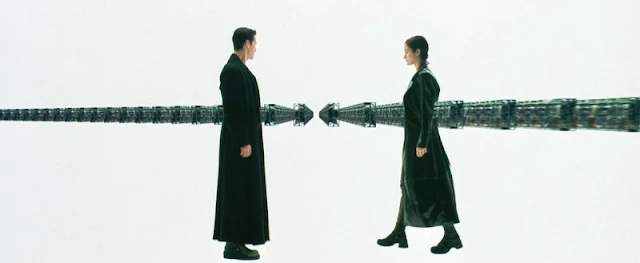
Smith is Neo's negative reflection
Neo and Smith develop as linked anomalies. Neo moves from imposed identity towards chosen relationship. Smith moves from programmed purpose towards limitless self-replication.
In the first film, Smith envies the freedom he imagines will come after Zion is destroyed. Neo enters and destroys him, but that contact changes Smith. He returns unplugged from the system, capable of copying himself into programs and human minds. Freedom without relationship becomes appetite. Smith can escape his assigned role only by making everything identical to himself.
Smith's overwrite of Bane carries that conflict into the physical world. A human body leaves the Matrix with Smith's consciousness in control, reversing the usual movement of a connected mind into a digital body. After Bane blinds Neo, Neo's golden vision perceives the machine pattern occupying him. Their opposition has moved beyond the simulation because both now carry an abnormal connection across its boundary.
The contrast appears in their use of other people. Neo becomes more powerful through attachments that preserve difference: Morpheus, Trinity, the Oracle, Niobe and eventually machine allies. Smith abolishes difference through assimilation. One says that other lives matter enough to alter a plan. The other turns every life into another Smith.
The Oracle also permits Smith to absorb her. Her presence gives him foresight, but that apparent advantage helps guide him towards the encounter she has prepared. Smith's multiplicity converts greater force into further reproduction. Neo chooses surrender on his own terms. Smith absorbs him, completing the connection that allows the Source to destroy the infection. Neo's apparent defeat becomes an act of agency because he understands the purpose of surrender while Smith sees only conquest.
Messiah imagery, prophecy and the deconstruction of the chosen one
Neo's story deliberately invokes religious traditions. He dies and rises in the first film. His final body in Revolutions forms a cross-like silhouette as machine light passes through him. He enters the enemy's city, offers himself for the survival of others and secures a new covenant between human and machine.
Christian imagery is only one layer. Neo's awakening from illusion recalls Buddhist and Hindu ideas concerning ignorance, attachment and maya. The repeating Ones evoke cycles of death and return. The Oracle belongs to Greek traditions of prophecy while operating as a computer program concerned with choice. Zion, Trinity, the Nebuchadnezzar and the name Morpheus place biblical and classical symbols inside a cyberpunk machine world.
The films use that sacred language and then expose how sacred language can be engineered. The One is a genuine anomaly wrapped in a prophecy designed to manage Zion. Belief gives Morpheus courage, but the machines have already incorporated that belief into their system.
Neo's messianic significance therefore comes from disobedience. He matters because he departs from the saviour script. He chooses Trinity over the Source, negotiation over destruction and respect for choices that belong to other people. This tension between sacred imagery and systemic control is central to Neo's messianic meaning as the One.
Love is the variable the Architect undervalues
The Architect can model human attachment at the level of species. Earlier Ones preserve humanity in the abstract. Neo's love for Trinity concentrates that attachment into one person, creating a choice that looks irrational within the Architect's equation.
Love changes which losses Neo is willing to accept. It gives particular lives a value that resists being reduced to vague magic or interchangeable units. That is why his choice of Trinity threatens a system built on repeating populations, replaceable Zions and functionally equivalent Ones.
Trinity also prevents Neo's story from becoming pure solitary self-actualisation. Her faith helps revive him in the first film. Her endangered life leads him away from the Source in the second. Her death strips the third film of an easy personal reward. Her reawakening in Resurrections reveals powers the Analyst assumed belonged to Neo alone.
The Analyst discovers that Neo and Trinity generate extraordinary energy when held close enough to desire one another and far enough apart to remain frustrated. His Matrix runs on managed longing, anxiety and emotional activation. Their reunion converts the system's fuel back into resistance.
Free will inside a machine that predicts choice
The Matrix saga rejects the simplest versions of both destiny and freedom. Characters operate inside systems that forecast behaviour, frame available options and conceal consequences. Their choices still matter.
The Oracle often speaks as though decisions have already been made. Her purpose is to help people understand why they made them. That distinction moves free will away from random selection. Freedom grows through self-knowledge: a person becomes more capable of choosing when they understand the desires and fears governing them.
The Architect embodies the opposite approach. He reduces choice to predictable input and channels rebellion into a stable output. His two doors present Neo with an apparently complete decision tree. Neo's choice of Trinity has also been anticipated, but the consequences extend beyond the Architect's preferred model.
Neo's freedom operates within causation. Love, prophecy, trauma, hope and machine design all shape him. His agency appears in the meaning he gives those forces and the commitments he forms through them. The films ask whether freedom can exist within determined conditions, then answer through practice: limited choices can still rupture systems when people understand what those systems expect.
Reality, illusion and the danger of a second certainty
The original film resembles Plato's cave. Humanity mistakes an engineered display for the whole world, and the liberated prisoner must adjust painfully to a reality beyond it. It also recalls Descartes' suspicion that sensory experience could be generated by a deceiving intelligence.
Neo keeps a contraband disk inside a hollow copy of Jean Baudrillard's Simulacra and Simulation. The prop signals a world in which signs and models can replace contact with reality. It functions as a philosophical provocation rather than an instruction manual for the plot. Baudrillard objected that the film restores a fairly clear boundary between false simulation and damaged real world, while his account of simulation makes that boundary harder to recover.
The sequels move closer to the more unsettling problem. Zion's people have escaped the sensory illusion but remain trapped inside a fabricated history. Their prophecy, origin story and understanding of the war have been curated. Leaving the Matrix provides access to another reality, while certainty about that reality remains vulnerable to manipulation.
Resurrections adds memory to the problem. Neo's true experiences are repackaged as fiction, making factual recollection look like narcissistic identification with a game character. The system no longer needs to hide every truth. It can neutralise truth by presenting it as content.
This progression deepens the franchise's search for truth across simulation and reality. The hardest prison may be the explanation that teaches a liberated person to stop questioning.
Neo's body proves that the virtual world still has consequences
The films refuse a clean split between mind and body. A connected person can move through a digital body called a residual self-image, yet injury to that image can kill the organic body. Neo's liberation remains marked in flesh through plugs, scars, weakness and pain.
After visiting the Source in Reloaded, Neo can sense and disable Sentinels in the physical world. Once Bane, carrying Smith's copied consciousness, blinds him, Neo perceives machines and their energy as golden light. The films leave the mechanism partly unexplained. The strongest lore-based inference is that Neo's encounter with the Source gives him an ongoing connection to the machine network, allowing his anomalous awareness to operate beyond the ordinary Matrix interface.
That ambiguity serves the theme. The supposedly separate real and virtual worlds are connected by bodies, signals and power. Human beings contain machine hardware. Programs cross into human minds. Neo's vision becomes least dependent on biological sight after his eyes are destroyed.
Transformation and the trans reading of Neo
Neo's movement from Thomas Anderson towards a chosen identity has long carried particular force for transgender viewers. He knows the life attached to his official name is wrong before he possesses language that can explain why. Authority figures insist upon the old name. His ordinary appearance is revealed as a projection, and awakening allows him to reconstruct how he moves through the world.
Lilly Wachowski has discussed the story's desire for transformation as emerging from a closeted creative perspective. She also explained that Switch was originally conceived with different gender presentations inside and outside the Matrix. The reading is supported by the films' recurring concern with names, bodies, self-knowledge and the violence involved when systems define people against their own experience. Lilly Wachowski discusses that trans reading here.
The films remain broader than a one-to-one allegorical code. Neo can embody trans self-recognition while also carrying philosophical, religious, political and technological meanings. Those readings reinforce one another around a shared question: who has the authority to say what a person truly is?
The system learns how to sell rebellion back to Neo
Thomas Anderson's office in the first film reduces people to cubicles, deadlines and interchangeable labour. His manager's speech treats time as corporate property. The machine world literalises that logic by turning living humans into harvested resources.
Resurrections updates the critique. Neo's revolutionary history has become a successful entertainment product. His employer orders another Matrix game because a corporate parent demands it. Designers reduce the story to marketable features while focus groups repeat empty words such as choice, transgression and bullet time.
This is control through absorption. A system can survive criticism by turning the criticism into a brand. The red pill becomes merchandise, rebellion becomes intellectual property and Neo becomes an exhausted creator forced to reproduce the event that once liberated him.
The Analyst's new Matrix likewise prefers emotional management to rigid suppression. Fear, desire and frustration produce more power than simple contentment. People remain controllable because their attention is kept moving between what they have and what they almost possess. The comparison with Delos and narrative control in The Matrix and Westworld becomes especially sharp here: both systems study desire in order to turn apparent choice into predictable behaviour.
Resurrections changes the meaning of the One
The title Resurrections is plural. Neo and Trinity have both been rebuilt by machines. Their relationship has been resurrected. The Matrix franchise exists inside the film as a commercial property being forcibly revived. Lana Wachowski has also described returning to Neo and Trinity as a source of comfort during personal grief, giving the film's revival a meaning rooted in loss rather than franchise mechanics alone.
Even while trapped, Neo has unknowingly prepared part of his own rescue. He creates a modal that endlessly rehearses Trinity's discovery of Neo from the original film. Inside it, an experimental program combines traits associated with Morpheus and Smith. Bugs extracts that program, and the new Morpheus later helps extract Neo. The symbolism is precise: Neo's imprisoned mind rebuilds both his mentor and his enemy, then turns their combined pattern into a guide back towards consciousness.
Neo also discovers that his sacrifice produced more than a temporary pause. The human city of Io is shared with sympathetic machines known as synthients. Its inhabitants grow food, repair the damage inherited from Zion and treat cooperation as a practical technology. The truce eventually fractures, but it creates relationships the old war had declared impossible.
Neo initially struggles to reproduce his former abilities. Trinity becomes the first of them to fly during their escape. That reversal corrects Morpheus's singular language without making Neo irrelevant. The One was always supported by a collective: Trinity, Morpheus, the Oracle, the crews who reach the Source, Sati and even machines willing to change sides.
The fourth film makes that dependence impossible to overlook. Neo creates the conditions for Trinity's choice and leaves the awakening itself to her. Their final confrontation with the Analyst belongs to both of them, and their proposed remaking of the Matrix shifts creative authority away from the controller who weaponised their bond.
Neo's mature power is therefore relational. He begins the saga wanting one man to give him an answer. He ends it beside a woman whose freedom matters enough that he will accept her answer even if she chooses a life without him.
What the wider Matrix canon adds to Neo
Neo becomes a guide for a teenager who senses that his world is false. The Kid awakens through self substantiation and credits Neo with saving him. Neo replies that the Kid saved himself. The exchange shows that Neo has learned Morpheus's most important lesson: each person must participate in their own liberation.
Runner Dan Davis pushes beyond the Matrix's physical limits and briefly awakens through extraordinary effort. His experience separates unusual perception from the specific function of the One. Neo's importance rests on the convergence of anomalous code, choice and historical position.
Niobe and Ghost's parallel missions reveal the network of sacrifices required to deliver Neo to the Source. His story appears solitary only when the labour of the wider resistance remains outside the frame.
The game was originally presented as a continuation after Revolutions. Morpheus becomes obsessed with recovering Neo's body, while factions dispute the meaning of the truce. Its uncertain status after Resurrections makes it useful continuity-adjacent context, with limited authority over Neo's later fate.
Questions about Neo's character and powers
Is Neo genuinely the One?
Yes. The Architect confirms that Neo carries the systemic anomaly associated with the One. The deception concerns the purpose of the prophecy. The machines expect the One to reset the Matrix and rebuild Zion, while Neo breaks that cycle.
Is Neo human, a program or both?
Neo is biologically human. His mind carries anomalous code produced by the Matrix's unresolved problem of choice. The description “human and code” captures his function. The theory that he is a disguised computer program has no confirmation in the films.
How can Neo affect machines outside the Matrix?
The films leave the exact mechanism open. His abilities appear after he reaches the Source, and his golden machine vision suggests an ongoing connection to the machine network. A wireless or Source-mediated connection is the strongest inference. Explicit technical confirmation never arrives.
Does the Oracle lie to Neo?
She lets Neo conclude that he is not the One and gives him information designed to produce self-understanding. Her method relies on omission, ambiguity and manipulation. Her forecasts are motivational interventions shaped around the choices people need to understand.
Does Neo free every human from the Matrix?
No. His sacrifice secures a truce, and the Architect agrees that those who choose to leave will be freed. Many humans remain connected. Resurrections reveals that the peace later fractures and a new Matrix is built by the Analyst.
Is Trinity also the One?
The films leave the formal title with Neo. Resurrections gives Trinity reality-changing power and shows that the Analyst's system depends upon her bond with Neo. The film deliberately moves beyond the idea that liberation belongs to one isolated saviour.
Neo's complete thematic meaning
Neo begins as a questioner, becomes a believer, discovers that belief has been engineered and then chooses what remains worth defending after certainty collapses.
His arc joins several themes that cannot be separated cleanly. Truth requires the courage to lose a familiar world. Identity develops through chosen names and relationships. Free will operates inside conditions people did not choose. Love resists systems that count lives as interchangeable units. Technology extends human power while reproducing human domination. Revolution fails when it follows the route designed for it.
Most importantly, Neo's growth changes the meaning of freedom. In the first film, freedom looks like waking up and defeating the Agent. In Reloaded, it means recognising that even rebellion can be programmed. In Revolutions, it means creating peace with an enemy whose existence can no longer be reduced to evil. In Resurrections, it means recovering a self after trauma while respecting another person's right to choose her own awakening.
That is why his journey endures. The fantasy of stopping bullets is spectacular. The deeper fantasy is the possibility that an identity, history or future imposed by an overwhelming system can still be recognised, challenged and rewritten.
Return to the complete Matrix story
Rewatch Neo's journey from his first encounter with Morpheus through the revelation of the Architect and the truce at the Machine City.
View The Matrix collection

_poster.jpg)


