
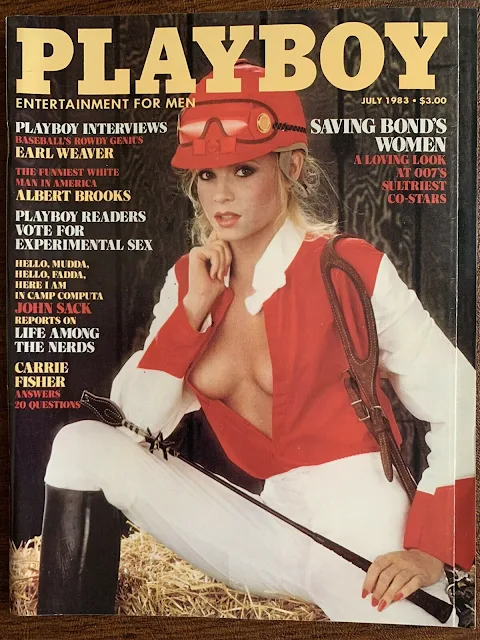
Let’s clear the space dust first: Carrie Fisher did appear in Playboy magazine, but she did not pose nude for Playboy.
That small distinction has somehow been dragged across decades of internet confusion, search-engine sludge, fan memory, magazine scans, Princess Leia posters, and the eternal glow of the gold bikini from Return of the Jedi. Search for Carrie Fisher nude images, Carrie Fisher Playboy photos, or did Carrie Fisher pose naked, and the same messy myth keeps floating back from the Sarlacc pit.
The truth is less scandalous and more interesting. Fisher was featured in the July 1983 issue of Playboy during the Return of the Jedi publicity era. She was there as Carrie Fisher: sharp, funny, famous, restless, impossible to flatten. The feature was not a nude pictorial. The woman on the cover was Ruth Guerri, also listed as the issue’s Playmate and centerfold model. For anyone searching Ruth Guerri Playboy cover, Ruth Guerri July 1983 Playboy, Ruth Guerri Playmate, Ruth Guerri centerfold, or Ruth Guerri cover model, she was the model associated with the magazine’s bare-breasted adult pictorial material, not Carrie Fisher. Fisher’s appearance has been absorbed into a much larger pop culture blur because Playboy, Princess Leia, and the gold bikini all arrived in the same myth-making orbit.
So, for the record: Carrie Fisher was in Playboy. Carrie Fisher did not pose nude for Playboy. The recurring search myth comes from confusion between her magazine appearance, Ruth Guerri’s July 1983 cover and Playmate feature, Fisher’s Return of the Jedi publicity, and years of online image reposting.
The Playboy Myth and the Princess Leia Machine
Carrie Fisher’s fame was never ordinary. She did not simply play Princess Leia. She became one of the faces of modern myth. Leia was royal, furious, sarcastic, wounded, politically committed, and armed. She could insult a stormtrooper, stare down Darth Vader, comfort Luke Skywalker, and still look bored by the men trying to rescue her badly.
That is why the Playboy confusion has lasted. Fisher’s public image sat at the collision point between science fiction fantasy and Hollywood publicity. The world wanted Leia as a rebel leader. The world also wanted Leia as a pin-up. Fisher understood both impulses, and she spent the rest of her life puncturing them with a grin sharp enough to draw blood.
The July 1983 Playboy appearance belongs to that tension. It came out when Return of the Jedi had pushed Leia into the most controversial costume in Star Wars history. But the Playboy feature itself was not the nude shoot people often imagine from search snippets and badly labelled image posts. It was part of the old celebrity-magazine economy: interview, glamour, publicity, provocation, and the commercial power of a famous woman who knew exactly how absurd fame could be.
Fisher’s great advantage was that she could talk faster than the myth could catch her. She was not solemn about the machinery. She mocked it. She mocked herself. She mocked Hollywood. She mocked the idea that being turned into an icon made anyone safer, happier, or saner.
Fisher’s genius was that she never let Princess Leia become only a poster. She kept dragging the character back toward intelligence, pain, sarcasm, and survival.
Why People Still Search for Carrie Fisher Nude Images
The phrase Carrie Fisher nude images survives because search engines are very good at preserving confusion. They collect fragments. Playboy. Princess Leia. Gold bikini. Jabba the Hutt. Celebrity photos. Magazine scans. Fan art. Cosplay. Then the fragments get repackaged until the rumour begins to look like a fact.
Some posts online imply that Fisher’s Playboy appearance was nude because the word Playboy carries its own assumption. Other pages use Leia’s metal bikini as bait for a different question. Others mix in television appearances, behind-the-scenes images, fan-made edits, and cosplay photographs until the original context has almost vanished.
That is how a clean historical point becomes muddy. Fisher was in Playboy, yes. The issue was tied to her fame at the height of the original Star Wars trilogy, yes. But the idea that Carrie Fisher posed naked for Playboy is a search myth, not a biographical fact.
The irony is that the truth says more about Fisher than the rumour does. A nude shoot would have been just another celebrity footnote. The real story is about how Fisher became a fantasy image and then spent decades refusing to be trapped inside it.
The Gold Bikini That Launched a Thousand Searches
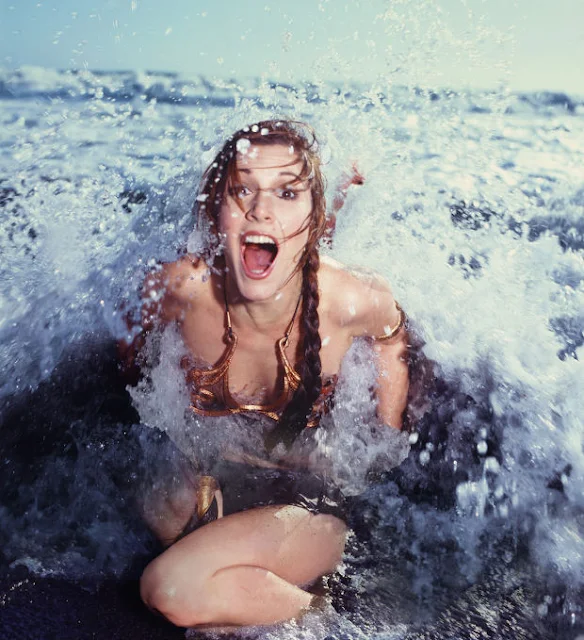
The real engine behind the Carrie Fisher Playboy myth is the gold bikini from Return of the Jedi.
Within the story, Leia is captured by Jabba the Hutt after infiltrating his palace to rescue Han Solo. Jabba dresses her as a trophy. The costume is meant to humiliate her, decorate his court, and signal his power. It is one of the most blatant examples of objectification in the Star Wars films.
Then Leia kills him.
That is why the image refuses to settle down. The costume is revealing, theatrical, and built from the visual language of pulp fantasy. It is also the outfit Leia wears when she strangles her captor with the chain he used to hold her. The scene gives viewers an image of captivity, then lets Leia turn the symbol of captivity into a weapon.
That contradiction has followed the costume ever since. It is a fantasy image. It is a debated image. It is a cosplay staple. It is a poster. It is a joke. It is an argument. It is also one of the reasons people who barely know Return of the Jedi still know exactly what “Leia’s gold bikini” means.
Leia’s Costume and the Pulp Science Fiction Tradition
The gold bikini did not come from nowhere. Star Wars was always built from old myths and older media: samurai cinema, westerns, World War II dogfight films, Flash Gordon serials, comic-book spectacle, and sword-and-planet pulp fantasy. Leia’s palace costume sits directly inside that inheritance.
The clearest reference point is the visual language around Dejah Thoris and the John Carter of Mars tradition. George Lucas drew heavily from the pulp adventure worlds that came before Star Wars. Those worlds were full of desert planets, decadent empires, chained royalty, arena monsters, alien courts, and barely dressed heroes and heroines painted across paperback covers.
Leia’s costume is part of that vocabulary. The difference is Fisher. She keeps the image from becoming dead ornament. Even in captivity, Leia looks alert, contemptuous, furious, and ready. She does not soften the costume. She hardens against it.

Carrie Fisher Was Never Just the Image
The lazy version of the story treats Carrie Fisher as the woman in the bikini. The better version understands why that reading collapses so quickly.
Fisher was a writer, performer, satirist, script doctor, memoirist, and one of Hollywood’s great public truth-tellers. Her fame started with Leia, but her voice became its own cultural force. She had the rare gift of making pain sound funny without making it smaller. Addiction, mental illness, family chaos, romantic disaster, sexism, ageing in public, the absurdity of celebrity: Fisher could turn all of it into a sentence with a blade hidden inside.
That is why the Playboy question feels so thin compared with the person behind it. Fisher’s image was consumed by the culture, but Fisher herself kept answering back. She knew exactly what people saw when they looked at Leia. She also knew what they missed.
Princess Leia mattered because she had command in her bones. She was introduced as a prisoner, but she never behaved like one. She lost Alderaan and did not become sentimental wallpaper. She picked up a blaster and kept moving. She told Han Solo what to do. She challenged Luke. She resisted Vader. She carried the Rebellion like a burden she had chosen and could not put down.
That is why Princess Leia’s most famous Star Wars lines still work. They are not memorable because Leia is beautiful. They are memorable because she has bite. Fisher did not just play the role. She gave it nerve endings.
The Laverne & Shirley Bunny Costume Confusion
Another small piece of the online confusion comes from Fisher’s appearance on Laverne & Shirley in the episode The Playboy Show. That appearance put Fisher in a Playboy Bunny-style context for a sitcom gag, which then became one more image floating around the internet without enough captioning.
That television moment belongs in the story only because search engines love confusion. A Bunny costume, a Playboy magazine interview, Ruth Guerri’s July 1983 Playmate feature, and Leia’s gold bikini can all be made to look like one continuous thread if someone removes the dates, titles, and context. But they are separate moments.
The mistake is understandable. The correction is easy. Fisher’s Bunny-style TV appearance was a comic performance. Her Playboy appearance was a magazine feature. Leia’s bikini was a Return of the Jedi costume. The online myth survives because all three are visually adjacent in the public imagination.

The Jabba Scene Still Matters
Return of the Jedi has plenty of fairy-tale machinery in it: a forest moon, a dark throne room, a fallen father, a redeemed monster, a second Death Star, and a princess chained to a gangster in a desert palace. But the Jabba sequence is darker and stranger than its pop culture afterlife often admits.
Jabba is not merely a gross alien villain. He is appetite with a throne. He consumes, collects, laughs, enslaves, and displays. Leia is placed beside him as proof that even royalty can be reduced to property under the wrong kind of power.
Then she kills him in silence.
That is the part that gives the image its charge. Leia’s revenge is physical, intimate, and brutal. No speech. No sermon. No rescue line. Just the chain, the body, the act. It is one of the few moments in Star Wars where symbolic reversal happens with such blunt force. The object becomes the agent. The captive ends the captor - Jabba The Hutt is sleeping with the fishers...

Why the Rumour Says Less Than the Truth
The hunt for Carrie Fisher nude images says more about the internet than it says about Carrie Fisher. It shows how a woman’s image can be endlessly detached from her work, her humour, her intelligence, and her own account of herself. It also shows how celebrity culture keeps trying to simplify complicated women into searchable objects.
Fisher was too unruly for that. She made a career out of interrupting the fantasy. She could be glamorous and caustic in the same breath. She could wear the costume, hate the costume, joke about the costume, and still understand that millions of people had folded their own meanings into it.
That is why the Playboy rumour feels so flimsy next to the actual legacy. Carrie Fisher did not need to pose nude for Playboy to become a fantasy figure. Hollywood and fandom managed that without her help. Her real victory was that she kept her voice louder than the image.
Leia’s Afterlife in Cosplay and Fan Culture
The gold bikini did not stay locked in 1983. It moved into convention halls, fan art, parody, collectibles, Halloween costumes, celebrity tributes, and endless online galleries. It became one of those pop culture objects that people can recognise even when they cannot remember the plot around it.
That afterlife is part of why the search confusion keeps returning. Every repost can turn the image into something flatter. Every bad caption can detach it from the film. But the best fan tributes understand the deeper charge. They are not just recreating a costume. They are touching one of the strangest visual knots in Star Wars: desire, captivity, pulp fantasy, rebellion, and revenge, all sitting in the same frame.
Ming-Na Wen’s Leia tribute sits in that lineage. Known to Star Wars fans as Fennec Shand from The Mandalorian and The Book of Boba Fett, Wen’s cosplay plays like an affectionate nod across generations of women in the saga. Fisher’s Leia made that kind of tribute possible because the character outlived the terms of her own objectification.


The Final Answer
So did Carrie Fisher pose nude for Playboy? No.
Did she appear in Playboy? Yes, in the July 1983 issue, during the same cultural moment that Return of the Jedi turned Leia’s gold bikini into one of the most famous costumes in cinema.
Was Ruth Guerri the cover model and Playmate in that July 1983 issue? Yes. That is the important distinction. Ruth Guerri was the Playboy cover model and centerfold figure for that issue. Carrie Fisher was the celebrity interview presence, famous enough to sell the issue’s Star Wars-era cultural heat, but not the nude pictorial subject.
That is the whole strange story. A magazine feature became a rumour. A cover model became confused with an actress. A costume became a search term. A character became a fantasy. And Carrie Fisher, with all her wit and damage and brilliance, remained bigger than the image people kept trying to freeze her inside.
The myth keeps asking whether Fisher appeared naked. The better question is why a clothed woman with a sharper mind than half of Hollywood was still so often treated as if the image mattered more than the voice...

_poster.jpg)


