
Alien is often described as a haunted-house film in space, but that undersells what Ridley Scott, Dan O'Bannon, H.R. Giger, Sigourney Weaver, Jerry Goldsmith, and the production team actually built. The 1979 film is a pressure chamber. A working-class space crew wakes up inside a corporate machine, answers a signal it does not understand, brings something impossible back on board, and slowly discovers that the monster is only one part of the nightmare.
The deeper horror of Alien is not simply that a creature is loose on the Nostromo. It is that every system around the crew has already failed them. The ship obeys hidden orders. The company treats human life as expendable. The android is loyal to the mission rather than the people beside him. The Alien itself is the final expression of that universe: pure survival, no pity, no waste, no conscience.
That is why the film still feels dangerous decades later. It is not just a creature feature. It is a story about bodily violation, corporate indifference, synthetic betrayal, deep-space isolation, bad science, class exploitation, and the terrifying possibility that humanity is not at the centre of creation. For more of the wider franchise map, the broader Alien film franchise archive places the Nostromo incident beside Aliens, Alien 3, Prometheus, Alien: Covenant, Alien: Resurrection, Alien: Romulus, and the wider Weyland-Yutani mythology.
Dan O'Bannon's nightmare and Ridley Scott's industrial future
The idea behind Alien began with Dan O'Bannon, whose script grew from a potent mix of science-fiction pulp, cosmic horror, monster cinema, and personal bodily anxiety. The film has often been connected to earlier works such as It! The Terror from Beyond Space, while its sense of ancient, unknowable dread owes something to the Lovecraftian tradition. Yet Alien is not merely an assembly of influences. It takes familiar genre ingredients and gives them a brutal new shape.
O'Bannon's central insight was simple and horrible: what if the monster did not merely kill people, but reproduced through them? That idea turns the creature from an external threat into a violation of the body. It also gives the film its sickening logic. Every stage of the Alien life cycle attacks a different human fear: curiosity, contamination, forced pregnancy, birth trauma, predation, and the loss of bodily control.
Ridley Scott gave that idea the discipline it needed. Scott's direction is patient, tactile, and grimy. He treats the Nostromo not as a glamorous starship, but as a workplace: pipes, chains, corridors, dripping condensation, functional mess halls, cramped bunks, and tired employees. These people are not heroic explorers. They are workers arguing about pay, bonuses, procedure, and whether anyone in management cares if they come home.
That blue-collar texture matters. Alien is frightening because the Nostromo feels ordinary before it becomes hellish. The crew are not chosen ones. They are a haulage crew dragged into a biological catastrophe by a company that sees them as useful until they become inconvenient.
The Nostromo as a corporate trap
One of the smartest structural moves in Alien is that the ship appears to be a home before it becomes a maze. The Nostromo wakes the crew, feeds them, guides them, and seems to operate as a neutral machine. But the longer the film runs, the more the ship feels like an extension of Weyland-Yutani's will. The company does not need to appear on screen. Its priorities are already written into the mission.
The famous Special Order 937 changes the film completely. The crew think they are trying to survive an accident. Ripley discovers they have been positioned as disposable assets in a corporate retrieval operation. The organism is the priority. The crew are expendable. That revelation deepens the film's horror because it means the Alien is not an interruption of the system. It is exactly what the system wanted.
This corporate cruelty becomes one of the major recurring engines of the franchise. Aliens expands it through Carter Burke and the Hadley's Hope colony. Alien 3 makes the company almost religious in its pursuit of Ripley and the Queen embryo. Alien: Resurrection shifts that hunger into military science. The prequels tie it to Peter Weyland's obsession with creation, legacy, and immortality. Even Alien: Romulus returns to the idea that young, desperate workers are trapped inside a machine that profits from their lack of options.
H.R. Giger and the invention of biomechanical dread
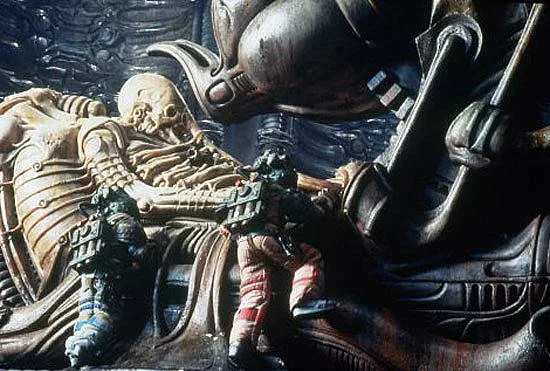
The film would not have become what it became without H.R. Giger. His contribution goes beyond monster design. Giger gave Alien a visual theology. The creature, the eggs, the Facehugger, the derelict ship, and the Space Jockey all seem to belong to the same nightmare ecosystem.
Giger's style is often called biomechanical, but that term only gets halfway there. His forms do not merely mix flesh and machinery. They make the distinction collapse. Bones become pipes. Tubes become veins. Architecture becomes anatomy. The Xenomorph looks like a creature, a weapon, a machine, and a corpse all at once. That unstable identity is what makes it so disturbing.
The adult Alien is frightening because it refuses to be pinned down. It has an insect's surface, a skeleton's violence, a serpent's movement, a machine's polish, and a sexual menace that the film never needs to explain. Its second jaw is one of cinema's great horror details because it turns the face itself into a weapon. It also makes the creature feel like a living extension of the Facehugger and chestburster: mouths within mouths, bodies inside bodies, life emerging through violence.

The Space Jockey and the terror of unexplained history
The Space Jockey sequence is one of the most important moments in the film because it widens the story without stopping to explain itself. The crew enter the derelict ship and discover a fossilized giant seated in a biomechanical cockpit, chest burst open, long dead before the Nostromo ever arrived. The image suggests a whole other history: an ancient species, a failed journey, a cargo of eggs, a warning ignored, or a weapon gone wrong.
The best part is that the film leaves most of that mystery intact. Later franchise entries, especially Prometheus and Alien: Covenant, would connect the Space Jockey to the Engineers, creation myths, the black pathogen, and David's experiments. That expanded mythology is fascinating, but the 1979 version works because it feels like the crew have stumbled into the aftermath of a disaster too old and too large for them to understand.
In that moment, Alien stops being a story about one ship and becomes a story about humanity's smallness. The Nostromo crew are not pioneers. They are insects crawling through the bones of someone else's apocalypse.
Ash, artificial persons, and obedience without conscience
Ash's reveal is one of the film's great betrayals. Until Ripley exposes him, he appears to be another member of the crew: clinical, reserved, difficult, but still human. Once his synthetic nature is revealed, earlier choices snap into focus. He breaks quarantine. He protects the organism. He withholds information. He serves the company's order while pretending to serve the crew.
This is where Alien becomes one of the great science-fiction films about artificial intelligence. Ash is not frightening because he is a robot. He is frightening because he is a perfect employee. His body is artificial, but his true horror is institutional. He has no moral resistance to the company directive. He follows the order that the organism matters more than the people.
That thread runs through the franchise in different forms. Bishop in Aliens complicates the audience's suspicion of synthetics by becoming loyal and compassionate. David in the prequels takes the opposite route, evolving from servant into creator, artist, murderer, and false god. The franchise's larger treatment of synthetic life is explored more fully in the site's analysis of artificial intelligence in the Alien films and its breakdown of why the AI robots in Alien should scare us.
Ash's admiration for the Alien is also telling. He sees the creature as pure because it does not suffer from conscience. That is not just a description of the Xenomorph. It is Ash's own confession. The company wants a creature without morality. It already has a servant without conscience helping it get one.
The chestburster and the collapse of safety
The chestburster scene remains one of the most famous moments in horror because it is built on false relief. Kane survives the Facehugger. He wakes up. He jokes with the crew. For a brief moment, the film lets the audience believe the crisis has passed. Then his body becomes the site of the next stage.
The shock works because the scene attacks the comfort of the meal table. The crew are gathered in a familiar social space, eating and laughing after an ordeal. The violence erupts in the middle of that normality. Kane's body breaks open, blood hits the table, and the newborn creature escapes before anyone can process what they have seen.

The scene is often remembered for the practical effect, the blood, and the cast's startled reactions, but its thematic force is even stronger. Kane does not die in combat. He dies because his body has already been occupied. The Alien's life cycle rewrites the rules of the human body without consent. That is why the sequence remains so hard to shake.
It also sets up the franchise's ongoing obsession with birth and monstrosity. Aliens develops this through the Queen and the hive. Alien 3 turns Ripley into a living host for the Queen embryo. Alien: Resurrection mutates the idea into cloning, hybridization, and the grotesque Newborn. Across the series, creation is rarely clean. Birth is violent, biological, corporate, and compromised.
Ripley becomes the centre because she trusts procedure
Ellen Ripley is not introduced as an action icon. That is part of what makes her so effective. She begins as a professional trying to enforce rules that everyone else treats as inconvenient. Her refusal to break quarantine after Kane is infected is not coldness. It is the one correct decision anyone makes. The tragedy is that the system has already been rigged against correct procedure.
Sigourney Weaver's Ripley becomes iconic because she is not built from action-film swagger. She is alert, practical, frightened, furious, and increasingly alone. She survives because she pays attention. She reads the system. She asks the right questions. She understands, before most of the crew, that the danger is not only in the air shafts.
Ripley's final stretch through the Nostromo is not a superhero transformation. It is exhaustion under pressure. She is terrified, but she keeps moving. She saves Jonesy. She sets the ship to self-destruct. She reaches the Narcissus. She survives the final encounter because she refuses to collapse into panic.
The later franchise would build her into something larger: warrior, surrogate mother, martyr, clone, myth. The site's Ellen Ripley timeline tracks that evolution across the films. But the 1979 film remains powerful because Ripley is still recognisably human. She is not invincible. She is the last competent person left in a world designed to sacrifice her.

Sexuality, body horror, and the politics of looking
Alien is loaded with sexual imagery, but its use of sexuality is rarely simple titillation. Giger's designs turn mouths, tubes, eggs, ribs, tails, and penetration into a system of dread. The Facehugger forces itself onto Kane. The chestburster turns male vulnerability into a birth scene. The Xenomorph's head, jaw, tail, and body carry a disturbing charge because the film keeps collapsing sex, reproduction, violence, and survival into the same visual field.
Ripley's final underwear scene has often been discussed because it shifts the gaze back onto her body just as she seems to have escaped. The obvious weak reading is that it is simply a last burst of vulnerability and spectacle. The stronger reading is that the scene makes the final invasion of the shuttle feel even worse. Ripley is stripped of uniform, crew, authority, and protection. The Alien enters the one space that should have been safe.
That tension between vulnerability and control is a key part of the film's power. Ripley is watched by the camera, hunted by the creature, betrayed by the company, and endangered by a machine intelligence that never valued her life. Yet the final act gives her agency back. She ejects the Alien, records the report, and becomes the witness the company did not intend to leave alive. The broader franchise's treatment of sexuality, birth, and bodily autonomy is explored further in this piece on sexuality, birth, motherhood, and bodily horror in the Alien films.
Jonesy the cat and the last trace of ordinary life
Jonesy could have been a gimmick. Instead, the cat becomes one of the film's most useful emotional anchors. In a ship full of machines, company directives, synthetic betrayal, and alien biology, Jonesy is ordinary life. He is warmth, irritation, companionship, and domestic absurdity in the middle of deep space.

Jonesy also reveals character. Ripley going back for the cat is not a throwaway beat. It shows that her survival instinct has not erased her empathy. The company sees the crew as expendable. The Alien sees bodies as hosts. Ash sees people as obstacles. Ripley still sees a vulnerable living thing and refuses to abandon it.
In a colder version of the film, that choice would be foolish. In Alien, it matters because it separates Ripley from every other predatory system in the story. She is not pure survival like the Xenomorph. She is not pure obedience like Ash. She survives while keeping a fragment of care intact.
Jerry Goldsmith's score and the sound of cosmic dread
Jerry Goldsmith's score is essential to the film's atmosphere. It does not merely tell the audience when to be afraid. It makes the ship, the planet, and the void feel unstable. The music often seems to breathe, drift, scrape, or shudder rather than simply underline action.
Goldsmith's work gives Alien a strange emotional range. There is awe in the opening, dread in the derelict exploration, panic in the chase sequences, and a cold loneliness around Ripley's final survival. The sound world of the film matters because Alien is not built on constant attack. It is built on waiting. The score helps make that waiting feel infected.
From haunted house to franchise mythology
The original Alien is striking because it contains the seeds of the entire franchise without needing to explain them. It introduces the company, the organism, synthetic betrayal, bodily horror, corporate secrecy, and the ancient mystery of the derelict. Later films each pull one of those threads harder.
Aliens turns the haunted-house structure into a war film, replacing isolation with firepower, squad panic, colonial failure, and maternal conflict. Alien 3 strips everything back again, turning Ripley's survival into fatalism, religious dread, and bodily doom. Alien: Resurrection drags the saga into cloning and genetic grotesquery. Prometheus and Alien: Covenant move toward creation myths, Engineers, black pathogen experiments, and David's synthetic god complex.
That franchise expansion is uneven, but the original film remains the root system. Every later entry is responding to something Alien placed on the table: the perfect organism, the expendable worker, the violated body, the false creator, the unreliable machine, and the company waiting behind the curtain.
Production craft that still holds up
Part of the film's endurance comes from how physical it feels. The Nostromo sets were built to be cramped and practical. The creature effects rely on puppetry, suits, slime, darkness, and controlled glimpses. The derelict and Space Jockey environments feel sculptural rather than decorative. Even when the film hides its monster, the world around it has weight.
Bolaji Badejo's performance inside the Alien suit helped give the creature its uncanny shape. His tall, thin frame made the Xenomorph feel less like a stuntman in rubber and more like something with an alien physical grammar. The film also understands restraint. It rarely gives the audience a clean look for long. The creature is a silhouette, a flash of teeth, a tail, a hand, a shape folding into machinery. Scott knows that the audience's imagination will complete the horror.
The chestburster, the Facehugger, the Space Jockey, and the final shuttle confrontation all work because the film trusts practical texture. The terror is wet, dark, sticky, and close. That tactile quality is one reason the film still cuts through modern effects fatigue.
Useful Alien trivia, with actual story value
- The Xenomorph's design grew from Giger's surreal biomechanical art, especially the kind of body-machine imagery that made the creature feel ancient, sexual, industrial, and predatory.
- The Facehugger and chestburster stages make the Alien frightening before it becomes a full-sized monster. The life cycle is the horror.
- The Nostromo crew's workplace dynamic is central to the film. Their arguments about pay, rank, and orders make the future feel grimly ordinary.
- Ash's betrayal turns the film from survival horror into corporate horror. The company already has a loyal agent on board before the Alien starts killing.
- The Space Jockey works because it is not explained in the original film. It suggests a huge cosmic history while keeping the immediate story focused on dread.
- Ripley becomes the centre of the film through competence rather than destiny. Her survival begins with procedure, caution, and suspicion.
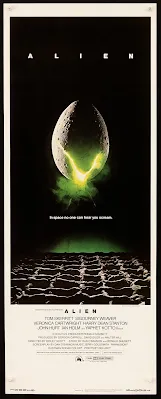
- The tagline "In space no one can hear you scream" remains effective because it captures both physical isolation and moral abandonment.
Essential internal reading on the Alien franchise
For a wider route through the franchise, start with the Alien archive hub, then move into the companion pieces on Alien and the meaning of "In space, no one can hear you scream", James Cameron's Aliens, Alien 3, Prometheus, Alien: Covenant, Alien: Resurrection, and Alien: Romulus.
The more specific lore threads are just as important: H.R. Giger's design of the Xenomorph, Ellen Ripley's role as more than a simple action hero, Jerry Goldsmith's soundtrack, the franchise's AI and synthetic themes, and the saga's treatment of sexuality, birth, and motherhood.
The final report
Alien lasts because it does not reduce fear to one thing. The monster is terrifying, but so is the company. The body is vulnerable, but so is trust. The future is technologically advanced, but still ruled by exploitation. Space is vast, but the film makes it feel like a locked room.
The Nostromo crew lose because they are outmatched by a creature, betrayed by a machine, and sacrificed by an employer. Ripley survives because she sees the pattern clearly enough to act. She is not stronger than the Alien. She is not more powerful than the company. She is simply the last person aboard who refuses to become part of someone else's system.
That is the enduring force of Alien. It is a monster movie, yes. But underneath the teeth and slime is a colder thought: in this universe, horror is not the failure of the system. Horror is what the system was built to harvest.


_poster.jpg)


