Movies with Time Travel Paradoxes: Do They Actually Make Sense?
I was watching the second season of Star Trek: Picard recently, and the final stretch of the story did what Star Trek time travel so often does. It made the ending work by closing a causal loop.
The Borg Queen’s riddle says there must be two Renées, one who lives and one who dies. The answer is not that Renée Picard literally splits into two people. Tallinn disguises herself as Renée and dies in her place, while the real Renée survives long enough to join the Europa mission. The loop only works because Picard and his crew already know a future that depends on Renée making that flight. The past has to be protected so the future can exist.
While Borg Queens are cool and all, that ending naturally gets the mind drifting back to The Terminator, Star Trek: First Contact, Star Trek IV: The Voyage Home, 12 Monkeys, Primer, and the long history of movies that use paradoxes to turn cause and effect into drama.
Time travel stories can be wonderful, infuriating, elegant, ridiculous, or all four at once. The trick is understanding what kind of paradox a film is using. Some movies use a mutable timeline, where the past can be changed. Some use a fixed timeline, where every attempt to change the past was always part of history. Some create branching alternate realities. Some create bootstrap loops, where information, people, or objects appear to have no true origin.
Once you know the model, the movie usually becomes easier to judge. The question is not “does this obey real physics?” Most time travel films do not. The better question is: does the movie obey its own rules?
So What Is a Time Travel Paradox?
A time travel paradox occurs when a story’s time travel creates an apparent contradiction in cause and effect. The contradiction might involve a person preventing their own birth, information causing itself, a future event creating its own past cause, or an attempt to change history that only makes history happen.
The most famous example is the grandfather paradox. A traveler goes back in time and prevents their grandfather from meeting their grandmother. That means the traveler is never born. But if the traveler is never born, they cannot go back in time to prevent the meeting. The story folds into a logical contradiction.
Movies avoid or exploit that contradiction in different ways. Some say the past can change. Some say it cannot. Some say the universe branches. Some say time self-corrects. Some say the traveler was always part of the original chain of events.
| Paradox type | What it means | Good film examples | Logic check |
|---|---|---|---|
| Grandfather or consistency paradox | A traveler changes the past in a way that prevents the traveler’s own action from happening. | Back to the Future, The Butterfly Effect | Works best in mutable timeline stories where changes ripple into the present. |
| Bootstrap paradox | An object, person, or piece of information exists because it was sent back from the future, with no clear original source. | The Terminator, Predestination, Arrival | Works if the story accepts a closed causal loop. |
| Predestination or self-consistency loop | A traveler’s attempt to change the past causes the very event they wanted to prevent. | 12 Monkeys, Timecrimes, Tenet | Works if the past is fixed and the traveler’s actions were always part of it. |
| Branching timeline | Changing the past creates a new reality instead of overwriting the original one. | Avengers: Endgame, Source Code | Works if the film makes clear that the old timeline still exists somewhere. |
| Time dilation | Different observers experience time at different rates because of relativity. | Interstellar | Not really a paradox by itself, but it can create emotionally paradoxical consequences. |
A useful correction
Not every time travel movie contains a true paradox. Interstellar contains gravitational time dilation, which is real physics rather than a logical contradiction. Its paradox comes later, when Cooper becomes the source of the messages that led him to NASA. Source Code looks like a repeated simulation at first, but its ending suggests an alternate reality rather than a simple rewind. Getting those distinctions right makes the whole genre easier to read.
20 Movies with Great Time Travel Paradoxes
1. Back to the Future (1985)
Screenwriters: Robert Zemeckis and Bob Gale
In Back to the Future, Marty McFly travels from 1985 to 1955 and accidentally interferes with the first meeting between his parents. The paradox is clear: if George and Lorraine never fall in love, Marty will never be born. If Marty is never born, he cannot travel back to interfere with them.
The film uses a mutable timeline. The past can be changed, and those changes slowly ripple into the present. The fading family photograph visualizes the instability. Marty is not instantly erased because the film gives causality a kind of dramatic delay, which gives him time to repair the romantic conditions that produce his own birth.
Logic check: The movie is not using a strict fixed timeline. It is using a flexible ripple model. Within that model, the paradox is internally consistent enough to work as comedy, suspense, and family drama.
2. Back to the Future Part II (1989)
Screenwriters: Robert Zemeckis and Bob Gale
The sequel complicates the original logic when Old Biff steals the DeLorean, travels back to 1955, and gives his younger self the sports almanac. That act creates the nightmare alternate 1985 where Biff is wealthy, corrupt, and effectively rules Hill Valley.
The paradox is not Marty’s existence this time. It is timeline contamination. Future knowledge is used to change the past, producing a corrupted present. Marty and Doc must then return to 1955 to undo Biff’s interference without disrupting Marty’s first adventure from the original film.
Logic check: The film behaves as if changing the past rewrites the present rather than creating a fully separate branch. It is messy but coherent as long as you accept Back to the Future’s mutable timeline rules.
3. Primer (2004)
Screenwriter: Shane Carruth
Primer is the most aggressively technical time travel film on this list. Aaron and Abe build boxes that allow travel backward across the duration in which the box has been running. To go back six hours, a traveler must spend six hours inside the machine. There is no clean jump. There is no instant reset.
The paradox arises because each trip creates overlapping versions of the same person in the same stretch of time. The earlier self still exists. The traveled self now also exists. When Aaron and Abe start interfering with their own actions, the timeline becomes a maze of duplicate motives, hidden recordings, fail-safe boxes, and versions trying to outmaneuver other versions.
Logic check: Primer is not random. It is dense because the machine rules are rigid. The chaos comes from human behavior inside those rules. The box works. The men do not.
4. Donnie Darko (2001)
Screenwriter: Richard Kelly
Donnie Darko is less a traditional time travel film than a metaphysical alternate-reality film. Donnie is caught inside a Tangent Universe, an unstable branch of reality that must be corrected before it collapses and destroys the Primary Universe.
The jet engine that crashes into Donnie’s room is the key paradox object. It appears without a normal origin inside the primary timeline. Donnie’s task is to return the artifact to where it belongs, closing the Tangent Universe. His death restores the main reality.
Logic check: Donnie Darko is a time travel movie that arguably features no conventional time traveler. Its logic is symbolic and mythological rather than mechanical, but the tangent-universe structure is consistent if you accept its own rules.
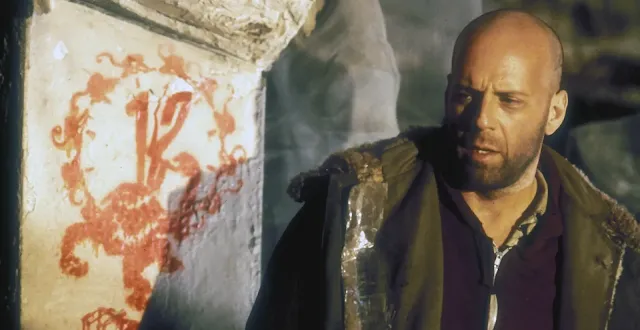
5. 12 Monkeys (1995)
Screenwriters: David Peoples and Janet Peoples
In 12 Monkeys, James Cole is sent back from a devastated future to gather information about the virus that wiped out most of humanity. The important correction is this: Cole does not cause the virus to be released. He fails to stop it, and his presence in the past becomes part of the history he already remembers.
The film’s central image, the shooting at the airport, is not a changed event. It is the traumatic childhood memory Cole has carried all along. When he reaches that moment as an adult, he realizes he is not escaping the loop. He is inside it.
Logic check: 12 Monkeys is a fixed timeline story. Cole’s journey does not rewrite history. It completes the history that produced him. The tragedy is that knowledge does not equal freedom.
6. The Butterfly Effect (2004)
Screenwriters: J. Mackye Gruber and Eric Bress
The Butterfly Effect follows Evan Treborn, who discovers he can revisit traumatic moments from his past and alter them. Each change rewrites the present, but every attempted repair creates a new form of damage.
The paradox is not one loop. It is accumulated instability. Evan wants to fix suffering by changing causes, but the new effects are unpredictable. The film dramatizes the butterfly effect: small changes can create huge consequences.
Logic check: The film uses a mutable timeline model. The logic is brutal but clear: the past can be changed, but Evan cannot control the full consequences of changing it. The alternate ending arguably makes the causal logic cleaner by making Evan remove himself from the chain entirely.
7. Timecrimes (2007)
Screenwriter: Nacho Vigalondo
Timecrimes is a tight Spanish-language thriller about a man who travels back in time and tries to fix a frightening situation, only to discover that his own interventions caused the situation in the first place. The masked figure he fears is connected to his own later actions.
The film is a strong predestination loop. The protagonist tries to prevent events, but each attempt pushes the pieces into the positions he was trying to avoid. The horror comes from realizing that panic itself is part of the machinery.
Logic check: Timecrimes is internally sound because it uses a fixed-loop model. The protagonist cannot escape the chain because his efforts to escape are the chain.
8. About Time (2013)
Screenwriter: Richard Curtis
About Time uses time travel as romantic and emotional fantasy. Tim can revisit moments from his own life, usually to correct awkwardness, improve relationships, or savor ordinary happiness. The story seems gentle, but its rules become sharper when parenthood enters the plot.
The key paradox involves children. Once Tim has a child, returning to a point before conception risks creating a different child, because the exact circumstances of conception may change. That gives the film a surprisingly strict causal rule beneath the warmth.
Logic check: The film’s logic is sound because it narrows the traveler’s power. Time travel can fix small personal moments, but it cannot let Tim endlessly rewrite life without cost. Eventually, he must stop using time travel as avoidance and live forward.
9. Predestination (2014)
Screenwriters: Michael Spierig and Peter Spierig
Predestination may be the most extreme bootstrap paradox in modern science fiction cinema. The film is based on Robert A. Heinlein’s short story All You Zombies, and its central figure becomes trapped in a causal loop involving their own identity, birth, recruitment, and future.
The paradox is not just that an object or message causes itself. A person becomes their own cause. The loop creates a closed identity system where the protagonist is parent, child, recruit, agent, and target within the same causal structure.
Logic check: Predestination is absurd if judged by ordinary biology and linear causality, but as a closed bootstrap loop, it is remarkably consistent. Its horror comes from the absence of an origin point.
10. The Time Traveler’s Wife (2009)
Screenwriter: Bruce Joel Rubin
The Time Traveler’s Wife treats time travel as a condition rather than a machine. Henry involuntarily moves through time, often appearing at emotionally crucial points in Clare’s life. This creates a relationship where cause and memory are unevenly distributed. Clare knows Henry before Henry properly knows Clare.
The paradox is relational. Their romance is shaped by future meetings that influence past attachment. Clare’s love is partly formed by visits from a man whose own younger self has not yet lived those moments.
Logic check: The story leans toward a fixed timeline. Henry does not freely rewrite history. He appears inside events that already shaped the people who later experience them.
11. Interstellar (2014)
Screenwriters: Jonathan Nolan and Christopher Nolan
Interstellar is often discussed as a time paradox film, but its famous Miller’s planet sequence is not a paradox. It is gravitational time dilation. Time passes differently near Gargantua, so minutes on the planet equal years for those farther away.
The real paradox comes later. Cooper enters the tesseract and communicates with Murph across time. He becomes the “ghost” that helped set his own journey in motion. Future or higher-dimensional humanity appears to create the conditions for its own survival by enabling Cooper to pass information into the past.
Logic check: Miller’s planet is relativity, not contradiction. The tesseract material is closer to a bootstrap or self-consistency loop. Cooper’s actions were always part of Murph’s history, which makes the film logically closer to a closed-loop story than a timeline-changing one.
12. Arrival (2016)
Screenwriter: Eric Heisserer
Arrival is not about physical time travel. Louise Banks learns the Heptapods’ language and begins to experience time nonlinearly. What first appear to be memories of her daughter are actually future memories.
The paradox comes when Louise uses future knowledge to alter the present. General Shang gives her his private number and his wife’s dying words in the future because Louise used that information in the past to stop a global crisis. The information causes its own transmission.
Logic check: Arrival is a clean bootstrap loop built around information, not machinery. Louise does not change the future. She fulfills the future she has already perceived. The emotional question is whether foreknowledge destroys choice or deepens it.
13. Source Code (2011)
Screenwriter: Ben Ripley
Source Code begins with Captain Colter Stevens repeatedly reliving the last eight minutes before a train bombing. At first, the premise looks like a simulation or memory reconstruction. Stevens is not supposedly changing the past. He is gathering information to prevent a second attack.
The ending changes the logic. Stevens appears to create or enter a reality where the train does not explode and the passengers survive. That means the Source Code is not just a replay. It may be an alternate-reality generator or a gateway to a branching world.
Logic check: Source Code is cleaner if read as alternate-reality branching rather than simple time travel. Stevens does not undo the original bombing in his home reality. He saves another version of the train in another reality.
14. Time After Time (1979)
Screenwriter: Nicholas Meyer
Time After Time imagines H.G. Wells using a real time machine to pursue Jack the Ripper into the late twentieth century. The film is less paradox-heavy than many entries here, but it uses time displacement to create moral and romantic conflict.
The paradox is personal rather than mechanical. Wells belongs to the past, but his values are tested in the future. If he stays, he changes his own life and removes himself from his original historical context. If he returns, he abandons the future he has come to understand.
Logic check: This is more time-displacement romance than causal paradox. Its inclusion works best as an example of time travel creating ethical and identity conflict rather than a strict logical contradiction. Meyer would later write Star Trek II: The Wrath of Khan.
15. Time Bandits (1981)
Screenwriters: Terry Gilliam and Michael Palin
Time Bandits follows a young boy and a gang of time-traveling thieves who move through historical periods using a stolen map of temporal holes. The film treats history less like a strict causal machine and more like a surreal playground designed by a distracted deity.
The paradoxes are intentionally loose. The bandits steal from history, but the film is more interested in myth, imagination, greed, and cosmic absurdity than timeline mechanics.
Logic check: Time Bandits is not trying to be Primer. Its logic is fairy-tale logic. The time travel works because the film’s universe is theological, comic, and surreal. For more Gilliam, see Brazil and 12 Monkeys.
16. Peggy Sue Got Married (1986)
Screenwriters: Jerry Leichtling and Arlene Sarner
Peggy Sue Got Married sends Peggy Sue back to her teenage years, giving her the chance to revisit choices, relationships, and regrets. The time travel is not heavily mechanized. It functions as emotional wish fulfillment and midlife reflection.
The paradox is whether Peggy Sue can change the emotional shape of her life while still becoming the person who had reason to travel back in the first place. If she changes too much, the future self who returns may never exist in the same way.
Logic check: The film is deliberately soft on mechanics. It works as a nostalgia paradox: can you correct the past without losing the self formed by that past?
17. The Terminator (1984)
Screenwriters: James Cameron and Gale Anne Hurd
The Terminator is one of the cleanest bootstrap paradoxes in blockbuster cinema. Skynet sends a Terminator back to kill Sarah Connor before she can give birth to John Connor. The human resistance sends Kyle Reese back to protect her.
Kyle becomes John Connor’s father. That means John sends his own father back in time, creating the very conditions for John’s birth. Skynet’s assassination attempt also helps create the future war it is trying to win.
Logic check: The original film works beautifully as a closed loop. The future causes the past, and the past produces the future. “No fate” becomes emotionally powerful because the plot itself feels fatalistic.
18. Terminator 2: Judgment Day (1991)
Screenwriters: James Cameron and William Wisher Jr.
Terminator 2 complicates the original loop by revealing that Cyberdyne Systems studied the remains of the first Terminator. That research helps create Skynet. In other words, Skynet’s attempt to change the past gives the past the technology needed to create Skynet.
The film then tries to break the loop. Sarah, John, and the reprogrammed T-800 destroy Cyberdyne’s research and the remaining Terminator components, apparently delaying or preventing Judgment Day.
Logic check: Terminator 2 shifts from closed-loop fatalism toward mutable timeline hope. That is why the film feels philosophically different from the original. The first film says the loop is closed. The second says the loop can be broken. We will skip T3 for the moment. No fate but what we make, eh?
19. Frequently Asked Questions About Time Travel (2009)
Screenwriters: Jamie Mathieson and Gareth Roberts
Frequently Asked Questions About Time Travel is a comedy built around exactly the sort of paradoxes that usually make viewers reach for diagrams. A group of friends discover a time portal in a pub and begin running into future versions, past versions, and consequences of conversations they have not yet had.
The paradox is comic self-contamination. The characters keep learning things because they later tell themselves those things. Their attempts to understand the situation become part of the situation.
Logic check: The film uses closed-loop comedy. Its paradoxes work because the tone allows absurdity, but the basic causal loop structure remains understandable.
20. Looper (2012)
Screenwriter: Rian Johnson
Looper imagines a future where criminals send victims back in time to be killed by assassins in the past. Eventually, each looper must kill their older self, “closing the loop.”
The paradox sharpens when Old Joe escapes and tries to prevent the future that ruined his life. His actions in the past may help create the violent conditions that produce the Rainmaker. Young Joe finally realizes the loop is not just mechanical. It is moral. Violence keeps producing itself.
Logic check: Looper’s time travel rules are not perfectly tidy, especially with bodily changes echoing instantly across time. But thematically the logic is strong: the future cannot be healed by repeating the violence that damaged it.
Bonus: Avengers: Endgame and the Branching Timeline Model
Avengers: Endgame deserves separate mention because it deliberately rejects the Back to the Future model. The Avengers do not change their own past directly. Instead, traveling into the past creates branch realities when major changes occur.
This is why the Infinity Stones have to be returned. Returning them is not about preventing every tiny disturbance. It is about preventing the creation of unstable branch timelines where a missing Stone causes catastrophic damage.
Endgame logic check
The MCU model is closer to branching timelines than mutable single-timeline rewriting. That means killing Baby Thanos would not erase the Avengers’ present. It would create a separate branch where Thanos died earlier. This is why Rhodey’s simple “go back and kill Thanos” idea does not work under the film’s stated rules.
Bonus: Star Trek and the Many Models of Time Travel
Star Trek has used almost every form of time travel logic at some point. Star Trek: First Contact is a timeline-protection story. The Borg go back to 2063 to stop Zefram Cochrane’s first warp flight, preventing the chain of events that leads to the Federation. Picard and the Enterprise crew follow them to preserve the history they know.
Star Trek IV: The Voyage Home is more relaxed, sending the crew back to the 1980s to bring humpback whales into the future. Its paradox pressure is lighter, but the logic still involves removing living beings from the past to repair a future ecological crisis.
Star Trek: Picard season 2 combines timeline repair with emotional self-consistency. The mission is to protect Renée Picard’s future, but Q’s deeper purpose is forcing Jean-Luc to confront the emotional past he has carried all his life. The time travel mechanics are serving character therapy as much as timeline logic.
More Astromech time travel reading
- Time Travel in Science Fiction Films
- Movies with Time Travel Paradoxes: Do They Make Sense?
- What Kind of Time Travel Paradoxes Can Movies Use?
- The Bootstrap Paradox, Time Loops, and Science Fiction
- What Is the Butterfly Effect?
- The Time Travel of Back to the Future
- The Time Travel Plot of Primer Explained
- Dark: The Time Travel Paradoxes Explained
- Star Trek: Chronological Timeline Order
How Viewers Can Judge a Time Travel Paradox
Viewers do not need a physics degree to judge whether a time travel movie works. The most useful question is whether the story plays fair with its own rules.
- Identify the model. Is the film using a fixed timeline, a mutable timeline, or branching realities?
- Track what changes. Does changing the past overwrite the present, create a new branch, or simply fulfill what always happened?
- Separate paradox from physics. Time dilation, as used in Interstellar, is not automatically a paradox. It becomes narratively paradoxical only when communication or causality loops back.
- Watch for bootstrap objects or information. If something has no clear origin because it was passed back from the future, the story is using a bootstrap loop.
- Check the emotional logic. Some films are mechanically loose but thematically strong. Looper is a good example. Its rules wobble, but its moral loop is sharp.
Final Thought: The Best Paradoxes Are Not Just Clever
The best time travel paradoxes are not there only to confuse the audience. They reveal character. Marty wants to go home. Cole wants to stop the plague. Sarah Connor wants her son to live. Louise Banks chooses love despite foreknowledge. Cooper reaches across time because he cannot let Murph go. Abe and Aaron discover that intelligence without trust becomes poison.
That is why these stories keep working. Time travel turns cause and effect into a dramatic instrument. It lets movies ask whether we can fix our mistakes, whether fate can be resisted, whether knowledge makes us free, and whether the past is something we can change or only something we can finally understand.
The paradoxes matter because they turn the genre’s biggest question back on us: if you had the power to change time, would you make things better, or would you simply become the reason everything went wrong?

_poster.jpg)