
Coherence is a unique and intriguing film that blends science fiction with psychological horror to create a captivating and suspenseful experience. It takes the classic Twilight Zone style setup and pushes it into a raw, intimate chamber piece where cosmic theory and human panic collide.
The film begins with Emily (Emily Foxler) and Kevin (Maury Sterling) driving to a dinner party hosted by their friends. As the night goes on, strange things start to happen, including power outages, broken cell phones, and objects disappearing. What begins as awkward small talk gradually mutates into dread as the comet’s presence exerts a kind of gravitational pull on reality.
The film begins with Emily (Emily Foxler) and Kevin (Maury Sterling) driving to a dinner party hosted by their friends. As the night goes on, strange things start to happen, including power outages, broken cell phones, and objects disappearing. What begins as awkward small talk gradually mutates into dread as the comet’s presence exerts a kind of gravitational pull on reality.
The group soon realizes that they are experiencing parallel realities, and their doppelgangers from other universes are also attending the same dinner party. What Byrkit stages is not just sci fi puzzle solving. It is a pressure cooker where multiple versions of the same people expose the fractures already inside them.
As the group struggles to make sense of the situation, tensions rise, and secrets are revealed. Identity starts to slip. Loyalties blur. Even the house they stand in becomes unreliable, one front door leading to a version of the night that feels almost the same but never entirely right.
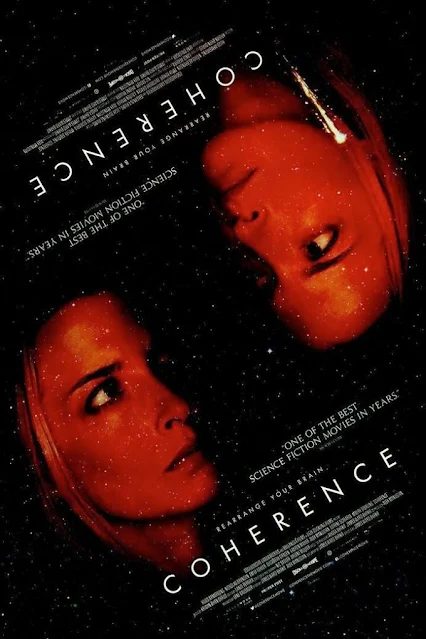
Coherence's plot is a masterclass in tension building and slow burn paranoia. Byrkit weaves timelines together with the patience of a filmmaker who trusts the audience to notice the clues. Every misplaced object, every jump in mood, every duplicate glowstick carries weight. The result is a story that feels both tightly controlled and frighteningly unstable.
Byrkit's direction gives the film a restless, lived in texture. Handheld cameras and natural lighting make the house feel like a trap the characters can never fully escape. The actors had minimal rehearsal and no full script, which lets the tension breathe. Their confusion feels real because the production itself was built to generate it.
The cinematography is bare and intimate. A muted color palette reinforces the sense that the world is fading at the edges. Close ups and the occasional Dutch angle destabilize every conversation. The lighting is often just candles or the beam of a flashlight. Shadows become characters. Corners of the frame carry threat.
The sound design is subtle. Most of the audio is simply voices in a quiet house, footsteps across wood floors, the hum of a night that feels off kilter. When music does appear, it is atmospheric and unsettling. Silence becomes one of the film’s strongest tools.
Coherence digs into themes of identity, free will, and the consequences of seemingly small decisions. The dinner party becomes a battleground where every choice creates ripples. The film’s exploration of parallel realities is ultimately a study of how people behave when confronted with the version of themselves they fear most. It fits neatly alongside the butterfly effect, using it not as a lecture but as a dramatic engine that keeps tightening until it snaps.
Coherence's plot is a masterclass in tension building and slow burn paranoia. Byrkit weaves timelines together with the patience of a filmmaker who trusts the audience to notice the clues. Every misplaced object, every jump in mood, every duplicate glowstick carries weight. The result is a story that feels both tightly controlled and frighteningly unstable.
The film's execution is top notch. A viewer who listens closely and watches faces as much as doors and shadows will never feel lost. Coherence rewards attention, and it punishes distraction in the best possible way.
The film’s foreshadowing is sly. Early conversations about trust, missed opportunities, and alternate paths become loaded once the multiverse fractures open. What emerges is a story where the science fiction premise amplifies the characters’ internal fears. The comet does not change them. It simply multiplies them until the worst possible versions step forward.
The main characters are Emily, Kevin, Mike (Nicholas Brendon), Laurie (Lauren Maher), Lee (Lorene Scafaria), Hugh (Hugo Armstrong), Amir (Alex Manugian), and Beth (Elizabeth Gracen). Each represents a different pressure point in the ensemble. Old grudges. half healed relationship wounds. Professional envy. The film never spells these out. It lets them surface naturally as reality splinters. This is part of its power. The multiverse is not treated as an abstract concept. It becomes a mirror that reflects every insecurity hiding under the polite dinner party surface.
The main characters are Emily, Kevin, Mike (Nicholas Brendon), Laurie (Lauren Maher), Lee (Lorene Scafaria), Hugh (Hugo Armstrong), Amir (Alex Manugian), and Beth (Elizabeth Gracen). Each represents a different pressure point in the ensemble. Old grudges. half healed relationship wounds. Professional envy. The film never spells these out. It lets them surface naturally as reality splinters. This is part of its power. The multiverse is not treated as an abstract concept. It becomes a mirror that reflects every insecurity hiding under the polite dinner party surface.
Byrkit's direction gives the film a restless, lived in texture. Handheld cameras and natural lighting make the house feel like a trap the characters can never fully escape. The actors had minimal rehearsal and no full script, which lets the tension breathe. Their confusion feels real because the production itself was built to generate it.
The cinematography is bare and intimate. A muted color palette reinforces the sense that the world is fading at the edges. Close ups and the occasional Dutch angle destabilize every conversation. The lighting is often just candles or the beam of a flashlight. Shadows become characters. Corners of the frame carry threat.
The sound design is subtle. Most of the audio is simply voices in a quiet house, footsteps across wood floors, the hum of a night that feels off kilter. When music does appear, it is atmospheric and unsettling. Silence becomes one of the film’s strongest tools.
Coherence digs into themes of identity, free will, and the consequences of seemingly small decisions. The dinner party becomes a battleground where every choice creates ripples. The film’s exploration of parallel realities is ultimately a study of how people behave when confronted with the version of themselves they fear most. It fits neatly alongside the butterfly effect, using it not as a lecture but as a dramatic engine that keeps tightening until it snaps.
Here's some trivia about Coherence
1. The actors were given only a small paragraph describing their goals for each scene instead of a script. This produced genuine reactions and organic tension.
2. The movie was made on a budget of just 50000 dollars and shot over five nights in a single location with largely improvised dialogue.
3. Alex Manugian, who plays Amir, is also the co writer. He acted as a quiet guide if the actors drifted too far from the intended direction.
4. The set had only five crew members. Two sound technicians, the director of photography, the director, and producer Lene Bausager.
5. Emily Baldoni, who plays Em, was given a note to stop Kevin from leaving the house during a key scene while Kevin’s note told him to leave. This manufactured real friction between the characters.
6. The director used his own house for filming. His wife agreed only if he could finish in five days because she was eight and a half months pregnant and wanted a home birth.
7. During filming of a scene that required total darkness in the neighborhood, a Snickers commercial was shooting nearby using massive lights and hundreds of crew.
8. Three rental cars were used for breaking glass. The windows were replaced before returning the vehicles.
9. The story took a year to write.
10. The cameras were deliberately kept loose and shaky to let the actors move freely.
11. The filmmakers spent 8000 dollars on a wig that matched Lorene Scafaria’s hair after she changed it during reshoots.
12. The comet was created using a practical on set effect, though the crew has never said how.
13. The opening phone conversation was recorded live with both sides speaking together rather than edited separately.
14. Only two cameras were used for most of the shoot except the dinner sequence, which added one more.
15. The story began as an attempt to tell a contained, single location narrative that could still deliver cosmic scale tension.


_poster.jpg)


