87 essential film essays about identity, power, memory, fear, belief, and the future.
Science fiction is rarely only about a spaceship, a monster, an apocalypse, or a new machine. It makes the present strange enough to examine. A corporation becomes a godlike manufacturer of life. A body becomes a contested frontier. A time loop becomes grief that cannot release its hold. A ruined landscape becomes a resource war. This Atlas connects the strongest thematic writing on The Astromech so every essay becomes part of a larger argument.
The future is useful because it gives the familiar world a new shape. Surveillance becomes a simulation. A job becomes a spaceship crew treated as disposable inventory. Genetic advantage becomes caste. Ecological decline becomes a fortress guarding water. A private memory becomes a product. An alien life form becomes a test of whether humanity can meet the unknown without first turning it into conquest.
The essays gathered here repeatedly return to the same pressure point: who gets to define what a human life is worth? The answer changes from Blade Runner to Alien, from Arrival to Fury Road, from Metropolis to Ex Machina. The argument does not. Genre cinema keeps returning to the future because the future has a way of exposing the rules already shaping the present.
Theme 01Synthetic life, memory, genetic sorting
Human After Human
What remains human when memory, consciousness, reproduction, identity, and the body can all be designed?
The most unsettling artificial-life stories do not start with a machine asking whether it has a soul. They start with a human institution deciding that another being has no right to one. A replicant is designed as labour. A robot child is programmed to love and then discarded. A genetically “invalid” body is sorted beneath a supposedly superior one. A clone wakes inside a system built to replace it. The technical premise changes from film to film, but the social question remains brutally consistent: who benefits when personhood becomes a category that can be granted, restricted, or withdrawn?
Blade Runner is the Atlas’s central entry point because it understands that synthetic life is a political problem before it is a philosophical parlour game. Tyrell makes biological beings, gives them memories or denies them memory, controls their lifespan, and calls their destruction “retirement.” Roy Batty’s anger is not a programming error. It is a response to being manufactured as property. Ex Machina changes the setting from industrial city to billionaire laboratory, but Nathan’s compound runs on the same logic. Ava is treated as an experiment because her creator assumes intelligence can be owned.
Blade Runner makes artificial life inseparable from corporate ownership, memory, mortality, and the question of who gets to decide what counts as human.
The chapter widens through Gattaca, Blade Runner 2049, A.I. Artificial Intelligence, Foe, Oblivion, and the Alien synthetic corridor. These stories disagree about whether artificial or designed life can liberate itself, but they agree on one thing: technology does not erase hierarchy. It can refine it. The future becomes frightening when the ability to create life is separated from any obligation to recognise that life as morally real.
One Scene Explains Everything
Roy Batty Saves Deckard
Roy’s final act has more moral force than the human institutions surrounding him. At the moment he could claim revenge, he chooses mercy. That choice turns the supposed machine into the film’s clearest witness to mortality, empathy, and the value of a life that will soon disappear.
Can choice remain meaningful once the future, the past, and the self become unstable?
Time stories often arrive wearing the clothes of a puzzle. They promise paradoxes, diagrams, hidden timelines, alternate selves, dream layers, and rules to decode. The richer films in this corridor use those devices for a harder purpose. They make regret physical. They make memory unreliable. They make the future feel like a wound that has already happened. The question is less “How does the mechanism work?” and more “What does a person owe to a life that time has made impossible to escape?”
Arrival is the clearest example. Louise does not receive a tool for defeating the future. She acquires a way of experiencing it whole. That changes the meaning of choice. In 12 Monkeys, James Cole learns that knowledge does not automatically create agency. In Inception, dream architecture becomes grief architecture, built around Cobb’s refusal to release an imagined version of the person he lost. In Coherence, the multiverse is not an abstract spectacle. It gives every petty insecurity and social resentment a new body to inhabit.
Arrival turns non-linear time into an emotional problem: the question is not whether pain can be escaped, but whether love still matters when loss is already visible.
The more technical entries deepen the same pressure. Tenet converts causality into an ethical maze. Primer shows how secrecy, not the box itself, corrodes friendship. The Butterfly Effect turns the desire to repair trauma into a chain of fresh damage. Looper makes violence travel through time like inheritance. This chapter treats temporal instability as an intimate genre: time breaks because people are unwilling, unable, or forbidden to let go.
Inception treats constructed space as a record of private guilt: a dream may be invented, but the emotional architecture inside it remains real.
Arrival’s revelation changes what freedom means. Louise does not discover a route around pain. She discovers that joy, grief, foreknowledge, and choice can inhabit the same life. The film makes acceptance active rather than passive.
What happens when power turns reality, labour, biology, spectacle, and survival into systems of control?
The archive’s political essays become most forceful when power is treated as infrastructure. A system is not frightening merely because it has a villain at the top. It is frightening because its rules decide who gets fed, watched, moved, employed, heard, believed, or discarded. The systems in this chapter do not always look alike. They can be a computer simulation, a city divided between labour and luxury, a train built on permanent class segregation, a media state, a corporate theme park, or a digital platform swallowing ordinary life.
The Matrix is the natural centre because it makes ideology literal. The prison is not simply guarded. It is perceived as reality. Metropolis provides the old machine-age blueprint: the city above depends on the exhausted bodies below. Snowpiercer turns architecture into class hierarchy. Parasite makes stairs, smells, basements, rainwater, and living space do the same work. Civil War and The Running Man push the question into media, asking what happens when witnessing violence becomes labour, entertainment, or state theatre.
The Matrix imagines control at its most total: reality itself becomes a managed product whose users cannot see the system shaping their lives.
The less obvious entries matter just as much. Jurassic Park turns technological hubris into corporate management failure. Ready Player One questions whether virtual escape can remain free once it becomes platform property. Prospect treats extraction as the basic grammar of frontier life. Southland Tales lets propaganda, celebrity, surveillance, and apocalypse overload one another until the chaos becomes the point. The shared argument is sharp: systems rarely announce their cruelty. They make it feel ordinary.
One Scene Explains Everything
The Red Pill Becomes Ideological Shorthand
The red pill works because it makes liberation look simple. Its cultural afterlife shows how easily a symbol designed to question conformity and domination can be absorbed by new forms of certainty, grievance, and control.
Why does genre cinema keep turning the body into a site of invasion, mutation, reproduction, contamination, desire, and control?
Body horror becomes powerful when the body stops feeling private. It becomes a workplace, a laboratory, a battleground, a reproductive machine, a contagious threat, or a surface onto which social fear is projected. The films in this corridor turn physical violation into a language for larger anxieties: gendered power, disease, technology, predation, mutation, ownership, and the terror of becoming unrecognisable to yourself or the people around you.
Alien is the central case because its biological horror is never separate from its institutional horror. The crew’s bodies are vulnerable because the company has already decided they are expendable. The facehugger and chestburster make reproduction into violation, while Ash proves that an artificial employee can obey a system without conscience. H.R. Giger’s designs matter because they make sex, machinery, death, industrial space, and anatomy collapse into the same visual nightmare.
Ripley’s care for Jonesy preserves a fragment of empathy inside a system that treats people as expendable and bodies as resources.
The Thing takes the next step. Its terror lies in the failure of appearance itself. A body can no longer verify identity, so trust turns into a liability. Alien 3 makes contamination and sacrifice theological. Mad Max: Fury Road treats women’s bodies as dynastic property until the revolt begins. The Fly, Men, Under the Skin, Pitch Black, and Life each discover different forms of bodily estrangement. None uses transformation as empty shock. The body becomes terrifying because it has been made available for someone else’s purpose.
Giger’s Xenomorph design matters because it looks biological and industrial at once, as though machinery has learned to breed.
Further reading: reproduction, coercion, and corporate flesh
The chestburster sequence breaks every expectation around care, illness, rescue, and medical safety. Kane seems to have survived. The film reveals that survival itself has become the mechanism of horror.
Theme 05First contact, awe, isolation, evidence, the unknown
First Contact and Cosmic Scale
What does humanity discover when it encounters an intelligence, organism, world, or force that cannot be reduced to human categories?
First contact is not one mood. It can be wonder, terror, pilgrimage, silence, invasion, proof, grief, humility, loneliness, or an encounter with a force too large to fit human morality. The films in this chapter resist the idea that alien life exists merely to confirm human importance. Often the opposite is true. The encounter reveals that the human point of view is partial, fragile, and poorly equipped for what waits beyond it.
2001: A Space Odyssey approaches the unknown as cosmic design. The monolith does not explain itself, and the film refuses to domesticate its scale. Close Encounters is warmer but not simpler. Roy Neary’s visions lead him toward wonder, but they also damage his family. Solaris turns alien contact inward: the unknowable planet answers human visitors with the memories they cannot escape. Contact asks whether proof can be meaningful when the most profound experience cannot be publicly verified.
Close Encounters makes first contact feel like revelation, obsession, family rupture, and communication before it becomes an answer.
The quieter entries widen the emotional range. The Abyss makes contact a chance for reconciliation under military pressure. E.T. frames the alien as a vulnerable childlike bond pursued by institutions. A Quiet Place makes family communication a survival technology. War of the Worlds turns invasion into domestic panic and parental responsibility. The shared lesson is not that the unknown is friendly or hostile. It is that human beings reveal themselves by how they respond when the universe refuses to be familiar.
The Abyss moves cosmic mystery below the surface, where isolation, pressure, militarism, marriage, and the unknown are all forced into the same confined space.
Further reading: the ocean as outer space
For the harsher underwater-horror branch of this argument, pair DeepStar Six with Leviathan. Both make pressure, enclosure, and industrial extraction feel as alien as deep space.
One Scene Explains Everything
Roy Neary Follows the Shape
Close Encounters understands that wonder has a cost. Roy’s vision becomes a calling powerful enough to make ordinary family life impossible. His ascent carries both transcendence and abandonment inside it.
What happens when a world can no longer sustain the people trying to control it?
Ecological collapse reveals political reality. When water, food, fuel, air, shelter, fertility, movement, and safety become scarce, every social system shows its priorities. Dystopia is not simply atmosphere. It is infrastructure under stress. It is the question of who controls the resources that make survival possible, and who gets told that their deprivation is natural, necessary, or deserved.
Mad Max: Fury Road gives this idea its clearest physical form. Immortan Joe controls water, women’s bodies, blood, fuel, food, and a language of religious obedience. Children of Men shifts the focus to infertility, migration, state violence, and fragile futurity. Planet of the Apes transforms the landscape into a civilisational indictment, forcing humanity to encounter the ruins of its own arrogance. Across the first Mad Max films, collapse becomes myth: road law gives way to fuel war, barter, ritual, and the harsh invention of new social orders.
Fury Road treats water, fertility, fuel, blood, and belief as infrastructure. The revolt begins when people refuse the roles the Citadel has assigned them.
The Host and Okja keep the same questions close to ordinary life. Pollution, corporate science, branding, animal ethics, bureaucratic incompetence, and family desperation all become parts of a single system. This is the chapter where the Atlas insists that survival stories are never only about endurance. They are about the terms on which endurance is permitted. The future becomes political the moment access to life is unevenly distributed.
One Scene Explains Everything
Furiosa Turns Back Toward the Citadel
The U-turn changes Fury Road’s politics. Escape cannot undo the system that created the wasteland. The future becomes possible only when Furiosa and the others return to confront the source of water, power, and control.
Why do genre stories so often use ghosts, aliens, dreams, black holes, and distant planets to express grief?
The genre’s biggest ideas often begin with an ordinary human wound. A black hole becomes a father’s lost years with his daughter. A ghost becomes failed communication. An invasion becomes a bereaved family trying to find meaning again. A dream becomes a mind constructing shelter against guilt. A lonely astronaut’s encounter becomes an argument with the life he has been avoiding. These films use impossible situations to make private pain visible and shareable.
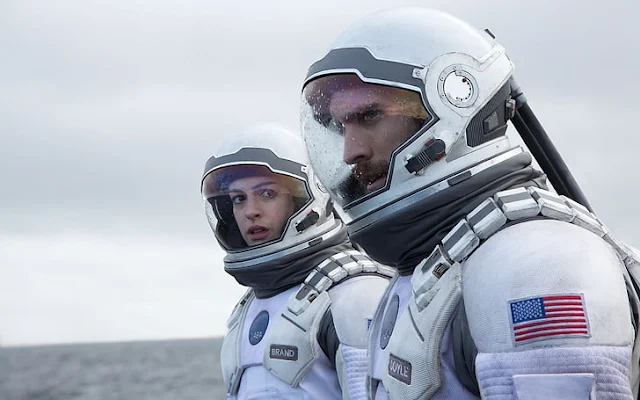
Interstellar is the chapter’s emotional anchor because it turns cosmic scale into family scale. Time dilation matters because Cooper watches decades of Murph’s life vanish. The Sixth Sense uses its supernatural premise to ask whether care can be repaired after years of isolation. Signs treats faith and alien invasion as a pressure chamber for grief and fatherhood. The Fountain refuses to make death a riddle that can be solved, insisting instead that acceptance may be the only form of release.
Interstellar turns relativity into emotional violence. Space is not only vast. It is the distance that turns a parent’s absence into years of unshared life.
Mulholland Drive and Spaceman extend the chapter into more unstable territory. Desire, shame, ambition, marriage, memory, and loneliness bend reality around people who cannot speak honestly to themselves. The shared argument is not that grief can be made beautiful. It is that genre cinema can give grief a shape. It can show what loss does to time, language, identity, family, belief, and the stories people tell to remain alive.
One Scene Explains Everything
Cooper Watches Murphy Grow Up Without Him
Interstellar turns cosmology into emotional violence. Relativity matters because it converts physical absence into years of unshared life. The scene makes the survival of humanity inseparable from the cost paid by one family.
When does belief become meaning, when does it become social control, and when does it become a weapon?
Genre cinema returns to faith because belief can hold two opposite forces at once. It can give people language for endurance, grief, sacrifice, wonder, and moral responsibility. It can also turn fear into obedience, myth into hierarchy, and prophecy into a system for deciding who must be followed. The films in this corridor remain powerful because they refuse to treat faith as either a simple comfort or a simple delusion.
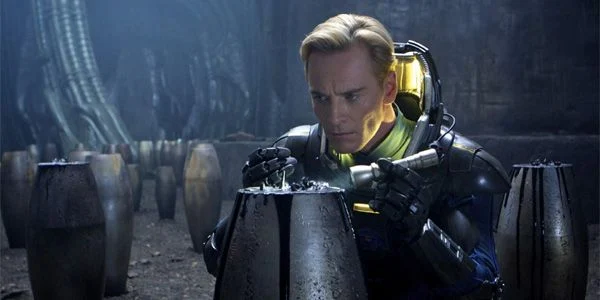
Prometheus and Alien: Covenant place creation at the centre of a chain of wounded makers. Engineers create humans. Humans create David. David begins to imagine himself as creator, artist, and god. The horror lies not only in his power. It lies in his freedom from responsibility. The Matrix uses messianic imagery differently. Neo’s role as the One can empower resistance, but it also raises the political danger of organising hope around a single chosen body.
Prometheus turns creation into a chain of wounded makers. David inherits power from humans, then treats living beings as material for an artistic and moral experiment.
The Village makes fear into a governing technology. Its community preserves itself by converting myth into social control. Unbreakable asks what happens when an ordinary life is reorganised around the possibility of destiny. Signs and Alien 3 bring faith into intimate crisis, where providence, punishment, sacrifice, and grief cannot be cleanly separated. This chapter leaves room for mystery, but it keeps asking the harder question: who gains power when an explanation becomes sacred?
One Scene Explains Everything
David Treats Creation as Private Art
David’s horror lies in the way he treats life as material. He has the power to create, but no obligation to care for what he creates. His experiments turn authorship into contempt.
Each chapter contains a scene that condenses its central argument. These are not isolated clips or trivia moments. They are pressure points where image, character, theme, and consequence all meet.
These guided sequences are built for readers who want a deliberate path rather than a single essay. Start anywhere, but follow the order when you want one argument to deepen into the next.
01
Blade Runner: Artificial Humanity and the Ethics of Memory
Follow the archive from artificial personhood to surveillance, mercy, memory, ambiguity, and the longing that drives Blade Runner 2049.
Move from simulation and postmodernism into the political afterlife of the red pill, Neo’s existential responsibility, and the dangers of messianic storytelling.
Read time travel as emotional machinery: dream grief, foreknown loss, fatalism, mourning, regret, and the moral corrosion hidden inside technical rules.
Trace resource hoarding, migration, revolutionary infrastructure, civilisational shame, pollution, animal ethics, and the politics of who gets to survive.
A Blade Runner reader should find a route into memory, labour, surveillance, and mortality. An Alien reader should reach bodily autonomy, corporate horror, artificial life, and cosmic indifference. A Matrix reader should discover ideology, liberation, prophecy, and the machinery of control. The Atlas succeeds when one film becomes the beginning of a larger way of seeing.






_poster.jpg)


