
Science fiction lives and dies on internal consistency. A film can ask us to accept faster-than-light travel, time loops, or a planet ruled by sound, and we will follow it anywhere, on one condition: that it obeys the laws it writes for itself.
The breach that wounds a science fiction film is rarely a failure of real-world physics.
It is the moment a film states a rule in one scene and then, for the sake of an ending or an emotional beat, quietly contradicts it in another.
The breach that wounds a science fiction film is rarely a failure of physics. It is the moment a film states a rule and then quietly contradicts it.
What follows is a survey of the most conspicuous offenders, each one examined for how the rule is established, where it is broken, and the paradox (as it were) left behind.
The Matrix Trilogy
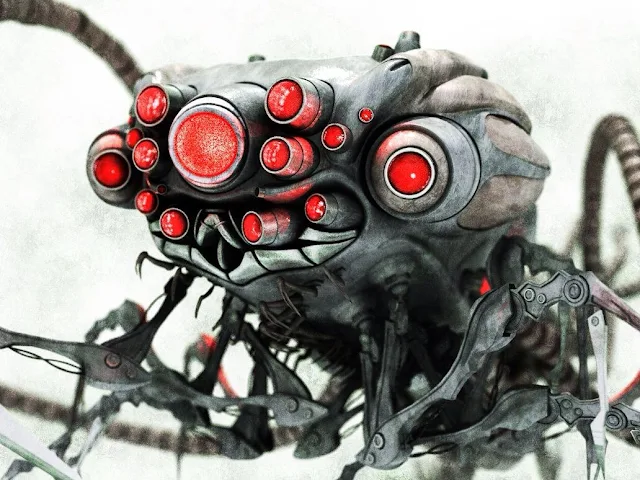
Sentinels. In the real world, unplugged, Neo should never have been able to stop them.
The first film is careful to draw a hard border between two realities. Morpheus walks Neo through the construct and the training programs, and lays down the governing principle in a single line: some of the rules of the Matrix can be bent, others can be broken, because the Matrix is software and the mind inside it is editing code. The body, by contrast, is real and bound by ordinary physics. Trinity's "Dodge this" on the rooftop, the leap program, the dojo sparring, all of it dramatises one rule: superhuman ability is a property of the simulation, not of the flesh.
In Revolutions, after Neo is blinded in the real world, he reaches out and stops a swarm of attacking Sentinels with a gesture, frying them where they hover. This happens in reality, with Neo unplugged, nowhere near a simulation. Nothing in the established rules permits it.
The moment collapses the border the trilogy was built on. If Neo can manipulate machines outside the Matrix, then either the "real" world is itself another layer of simulation, a reading the films flirt with but never confirm, or his power has no defined source at all. The rationalist scaffolding gives way to unexplained mysticism. The much-mocked "humans as batteries" premise sits in the same category, since a civilisation able to run the Matrix would never choose a thermodynamically losing power source over the processing-power concept the script originally used.
Back to the Future
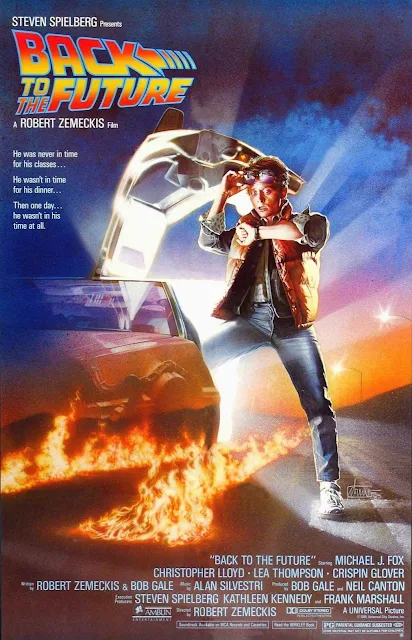
Two theories of time in one trilogy, and neither applied consistently.
Doc Brown's mechanics are loose, but the trilogy commits to one clear rule: change the past and you change the future, continuously and causally. The photograph in Marty's wallet is the proof. As his teenage parents drift apart, his siblings vanish from the image one by one, and Doc warns that Marty himself is being erased from existence. At the Enchantment Under the Sea dance, Marty's own hand begins to fade as George fails to make his move.
The erasure is gradual, paced to the drama rather than to its own logic. By the causal rule the film just established, the instant his parents' history diverged, Marty's conception would be undone and he would vanish at once, not on a countdown timed to a guitar solo. Part II compounds the problem: when old Biff steals the almanac and returns to the future, he arrives back in the original 2015, when the branching logic the film elsewhere uses would have deposited him in the corrupted timeline he created.
The trilogy runs on two incompatible theories of time at once, a single mutable timeline (the fading photo) and a branching multiverse (the alternate 1985), and applies neither consistently. The grandfather question, how Marty can exist in order to travel back and nearly prevent his own existence, is raised and then dropped.
The Terminator Series

Sarah Connor again, in a timeline every sequel quietly overwrites.
The first film is a sealed causal loop. Kyle Reese is sent back, fathers John Connor, and dies; the Terminator's severed arm and chip are recovered and, as T2 confirms, become the very technology Cyberdyne reverse-engineers into Skynet. The future is fixed and self-creating. Sarah driving into the gathering storm, pregnant with the son who sent his own father to her, seals the loop.
Terminator 2 introduces a new creed, that there is no fate but what we make, and has its heroes destroy Cyberdyne to prevent Judgment Day. The future, suddenly, is changeable. Every subsequent film rewrites the timeline again: Genisys spins off a parallel reality, Dark Fate erases everything after T2, and each instalment contradicts both the original loop and the others.
The franchise cannot hold a single theory of causation. If the loop is closed, Judgment Day cannot be averted. If it can be averted, then the loop that built Skynet never happens, which should erase the Terminators and Reese, which should erase John Connor. Each sequel papers over the contradiction by declaring a fresh ruleset and hoping no one cross-references it against the last.
Star Wars: The Last Jedi
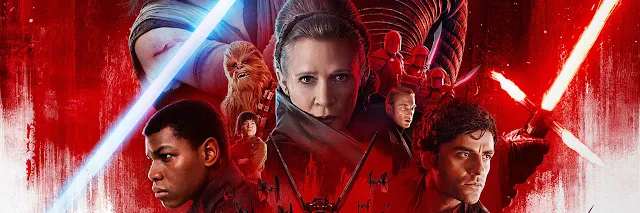
The Holdo manoeuvre: the silent cut that retroactively broke fifty years of space warfare.
Across half a century of the saga, hyperspace is a means of travel between fixed points and combat is fought with cannons, fighters, and capital ships. The unstated but ironclad rule is that you do not simply jump a starship through an enemy to destroy it, or the galaxy's wars would all be fought that way. The film leans on this rule for its entire second act: the Resistance fleet cannot escape because it is low on fuel and the First Order can track it through hyperspace, so the two fleets crawl along at sublight in a slow-motion chase.
Admiral Holdo turns the cruiser Raddus about and jumps to lightspeed directly through Snoke's flagship, the Supremacy, shearing it and the surrounding fleet apart in a single silent, white-screened shot.
If one crewed ship at lightspeed can gut a dreadnought, then the entire military doctrine of the galaxy is irrational. Every battle ever fought, the trench runs, the fleet engagements, both Death Star assaults, could have been won by pointing a hyperdrive at the target. The manoeuvre retroactively breaks fifty years of on-screen space warfare. Later material strains to reclassify it as a one-in-a-million fluke, but the film itself presents no such caveat in the moment of the kill.
As for "Somehow Palpatine Returned" in The Rise of Skywalker, well....
Star Trek (2009)

Transwarp beaming should have made the starship, and most of Starfleet, obsolete.
The transporter has always had range limits. You beam from orbit, across a planet, ship to ship at close quarters. Starships exist because the distances between stars are too vast to cross any other way. This is bedrock across the whole franchise.
Spock Prime hands Scotty the equation for "transwarp beaming," and Kirk and Scott beam themselves onto the Enterprise while it is travelling faster than light, light-years away. Into Darkness doubles down by having Khan beam from Earth all the way to the Klingon homeworld.
If you can beam across interstellar space onto a ship moving at warp, starships are obsolete and so is most of Starfleet. You could beam a photon torpedo onto any enemy vessel or transport an invasion force anywhere instantly. The film introduces a technology that dissolves the necessity of its own setting, then quietly shelves it. The same film also has Spock watch Vulcan implode from the surface of neighbouring Delta Vega, a sight that is spatially impossible at the distances involved.
Edge of Tomorrow
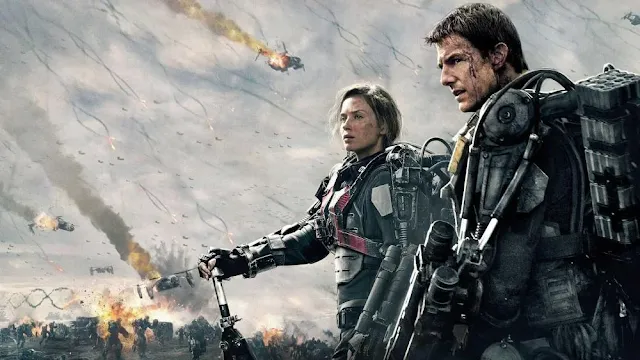
Live, die, repeat, until the film breaks its own rule for one last reset.
Cage acquires the enemy's time-loop ability by being soaked in the blood of an Alpha Mimic; each death resets the day to the same morning. The rule is stated plainly and demonstrated: lose the blood and you lose the power. Rita had the ability once and forfeited it after a battlefield transfusion, and when Cage is given blood mid-film, his resets stop. The loop is controlled by the Omega.
In the finale, Cage destroys the Omega beneath the Louvre and is drenched in its blood as he dies, triggering one last reset, this time to a point before the invasion, with the Omega already dead and Cage's memories intact.
Two of the film's own rules forbid this. Destroying the source should end all looping, not grant one more, and Cage had effectively been stripped of the power earlier. The final reset has no mechanism and conveniently rewinds further than any loop the film allowed, depositing Cage in a fresh, peaceful timeline that the established mechanic never permitted. The ending is emotionally satisfying at the direct cost of the system the film spent two hours teaching us. If you want the mechanics in full, here is the deep dive on how the time loop works.
Signs
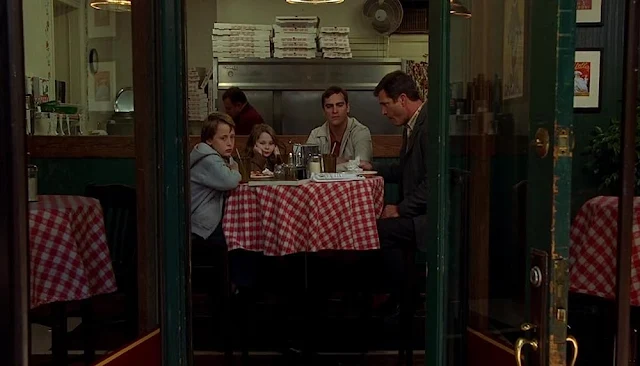
A threat that a passing rainstorm should have routed.
The alien menace is established as physical and, in the late reveal, fatally vulnerable to water. The Hess family survives the home invasion partly because the creatures can be burned by it.
In the climax, Merrill swings a baseball bat into the glasses of water that the daughter left standing around the house, splashing the alien, which sears like acid. The reveal also exposes the flaw baked into the premise itself: a species lethally allergic to water has chosen to invade a planet that is seventy per cent ocean, wreathed in cloud and rain, where the dominant lifeform is mostly water, and they walk its surface unclothed and unprotected.
The central threat is incoherent the instant its rule is spoken. The invasion is suicidal; a passing rainstorm would rout the fleet. This is less a single broken scene than a premise that detonates the moment the film hands us the rule, retroactively rendering the entire attack nonsensical. Defenders argue the visitors may be demonic rather than extraterrestrial, but the film codes them firmly as aliens.
Independence Day
The invaders are technologically godlike. Their ships are the size of cities, their force fields shrug off everything humanity can throw, and a direct nuclear strike on a destroyer over Houston simply bounces off. The rule is explicit: the gap between their technology and ours is unbridgeable.
David, armed with a 1990s Apple laptop, writes a computer virus and uploads it to the alien mothership, disabling the entire fleet's shields long enough to be destroyed.
A human laptop interfacing with, and then infecting, an alien operating system requires shared hardware architecture, compatible file formats, and a common interface, none of which should exist between species that evolved on different worlds. The film established the technological chasm as the very thing that made the threat terrifying, then bridges it with consumer software to win. The rule that gave the danger its weight is discarded at the moment of victory.
Avengers: Endgame

The film mocks the single-timeline model, then needs it to put Steve on that bench.
The film goes out of its way to reject the Back to the Future model. Banner explains in the diner that changing your own past does not work that way, and the Ancient One tutors him directly: altering the past only spawns a divergent branch timeline, and removing an Infinity Stone splinters that branch unless the stone is returned to its exact moment.
In the epilogue, Captain America returns the stones and then elects to remain in the past to live a full life with Peggy Carter, reappearing as an old man on a bench in the original, prime timeline to hand his shield to Sam.
Under the branching rule the film itself laid down, a Steve who lived out his days in the past would have done so in a divergent branch, and old Steve should be waiting there, not in the prime timeline. The ending only functions on the single-timeline logic the film spent its runtime mocking. The directors and writers later offered competing explanations, a secret branch, a quiet return, but the film as presented breaks the precise rule it invented to distinguish itself from older time-travel stories.
Looper
Assassins kill targets sent back from the future, and the film demonstrates one strict causal rule with brutal clarity: alter a person in the present and their future self changes in real time. When the younger Seth is captured and mutilated piece by piece, the older Seth, on the run, loses fingers, then limbs, then collapses, and a message carved into the young man's arm surfaces as old scars on the old man's skin.
This instant-rewrite rule is then applied selectively. Old Joe retains his memories and his agency throughout, even as young Joe's choices continuously reshape the timeline. If the Seth rule were universal, old Joe should be flickering and rewriting from one second to the next. The film half-admits the inconsistency in dialogue, when old Joe refuses to explain the mechanics because, he says, they would be there all day drawing diagrams.
The film shows us one ironclad law of cause and effect, then exempts its leads from it so the plot can run. The ending, young Joe shooting himself to erase old Joe, obeys the Seth logic, but the two hours preceding it depend on old Joe being immune to exactly that logic.
Prometheus and Alien
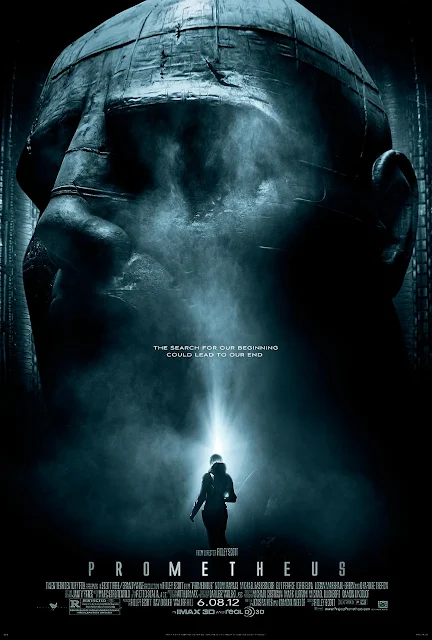
The lifecycle that anchored the 1979 horror becomes infinitely negotiable.
The 1979 original gave the xenomorph a tight, fixed lifecycle, and it was the engine of the horror: a facehugger implants an embryo, a chestburster erupts after a defined gestation, and the creature matures into the adult drone through coherent stages. Kane's infection, the dinner-table birth, and the rapid but consistent growth aboard the Nostromo establish biology you can rely on.
The prequels and sequels let the lifecycle mutate to suit each scene. Prometheus gives us the trilobite and the Deacon; Covenant introduces spore-borne neomorphs and a back-bursting creature that reaches full adult size in minutes. Gestation periods, growth rates, and morphology change from film to film with no governing rule.
The creature's defined biology was the franchise's anchor, the thing that made it predictable enough to be frightening. Making the lifecycle infinitely variable removes the rules that gave the monster its menace, so the threat no longer has a fixed logic. The prequels simultaneously overwrite the origin itself, from Engineers to black goo to David's bioengineering, repeatedly rewriting the rule of where the alien even comes from.
Tenet

So rule-dense that every lapse reads as a break rather than licence.
Inversion reverses an object's flow of entropy, so an inverted person moves backward through time relative to the world. The film front-loads its rules in the laboratory briefing: inverted people cannot breathe ordinary air and must wear a respirator, fire burns cold so an inverted body freezes near a flame, and you must reach a turnstile to change direction. The temporal-pincer doctrine governs the set pieces.
The rules are then honoured unevenly. Characters fight, interact, and survive across mixed forward and inverted environments in ways the briefing forbids; inverted and non-inverted combatants exert direct force on each other; the respirator rule is observed in some scenes and ignored in others; the freeway sequence has forward and inverted objects exchanging momentum that the stated physics does not allow.
Because Tenet is so unusually rule-dense, every lapse registers as a break rather than as stylistic licence. Its hard determinism, what happened happened, also sits awkwardly beside characters straining to alter outcomes. The sheer number of stated rules makes the inconsistencies conspicuous, where a looser film might have got away with them.
Minority Report

If a future can be averted, Pre-Crime jailed people for murders that might never have happened.
Pre-Crime arrests citizens for murders foreseen by three precogs, and the system's legitimacy rests entirely on the future being certain. The opening intercept dramatises the rule: Anderton's team races to stop a crime of passion in the final seconds and arrests the would-be killer before he strikes, the engraved ball naming a man for an act he has not yet committed.
The "minority report," a dissenting vision from the precog Agatha that shows an alternative outcome, proves the foreseen future is not inevitable. Anderton, prophesied to murder a stranger named Leo Crow, is confronted with the vision and then chooses not to kill, demonstrating in the moment that the future can be averted.
If futures can be averted, then everyone Pre-Crime ever arrested was imprisoned for a murder that might never have happened. The institution's founding rule, that the future is fixed, is disproven by its own core technology. This is the film's deliberate theme rather than an accidental slip, so it is a contradiction examined in good faith, but the in-universe agency still operated for years on a premise its own data refuted.
The Butterfly Effect
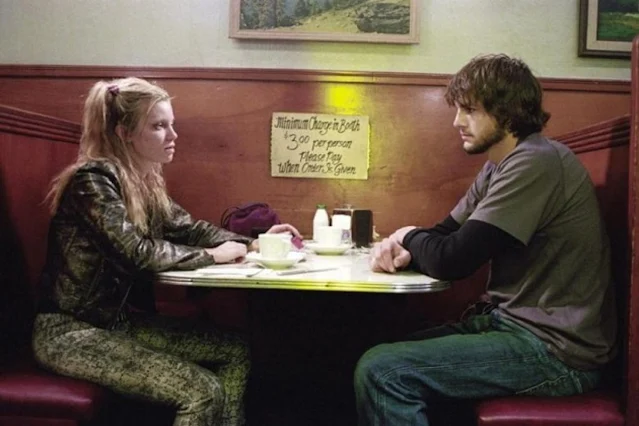
Everyone resets but Evan, with no stated reason why.
Evan can return to pivotal moments in his past by reading his childhood journals and consciously change what he does, after which the present reshapes around the new choice. The film reframes his childhood blackouts as the moments his future self was inhabiting. The first deliberate jump is the demonstration: he reads an entry, is pulled into a memory, acts differently, and snaps back into a transformed present of new relationships and new circumstances.
The rule for what persists across timelines is wildly inconsistent. Evan keeps his complete adult memory and identity through versions of his life that diverged entirely, including one in which he has no arms and another in which he is institutionalised, while everyone else is fully reset with no awareness of the timelines that came before. The trigger, reading, and the exclusivity, that only he can do it, are never grounded, and the question of how an adult mind survives the total rewrite of its own history is never raised.
Evan alone is exempt from the causal rewrite that reshapes the entire world, with no stated mechanism. His body and biography change, yet his consciousness behaves as a fixed point that observes the changes from outside. The film stacks alteration on alteration without ever settling a theory of identity, so the cumulative logic cannot hold. The director's cut ending, in which he prevents his own birth, leans into the contradiction by erasing the protagonist outright, which only sharpens the question of how he was ever the one doing the erasing.
Star Trek Into Darkness
Death in this universe carries ordinary dramatic finality, and Starfleet medicine has limits. The film plants its loophole early by establishing Khan as an engineered superhuman whose blood has regenerative properties. McCoy injects a sample into a dead tribble, which later stirs back to life on the table.
Kirk dies of radiation exposure realigning the warp core, and McCoy uses synthesised Khan blood to bring him back, resurrecting a clinically dead man.
If a transfusion of engineered blood can raise the dead, then death is effectively curable, which transforms the stakes of every story Starfleet will ever tell and rewrites the whole of its medicine. The film treats the cure as a single-use device to undo Kirk's death, then never industrialises it, mentions it again, or reckons with it. The rule it introduces, that the dead can be revived, is far too large to leave lying on the floor, and leaving it there breaks the universe's settled relationship with mortality.
Interstellar
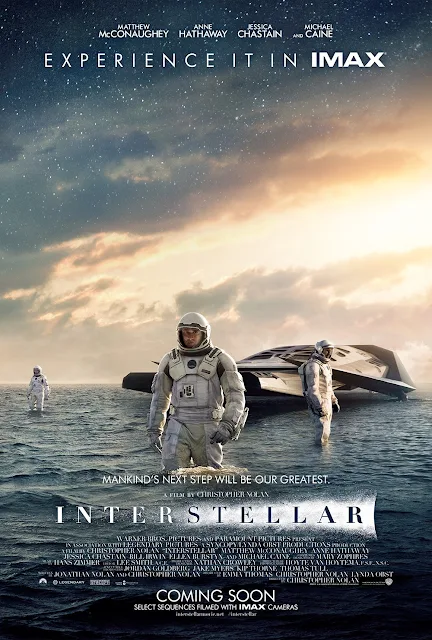
Hard physics for two hours, then a bootstrap loop and love as a measurable force.
The film stakes its identity on rigorous physics: relativity, gravitational time dilation near the black hole Gargantua, the traversable wormhole, all of it built on consulted science. Miller's planet is the concrete demonstration of the rule, where a short visit at the surface costs twenty-three years aboard the orbiting Endurance, an emotionally devastating dramatisation of relativity obeyed to the letter.
The climax changes register entirely. Cooper falls into Gargantua, enters a tesseract, a higher-dimensional construct built by future humans, and communicates with the young Murph across time by manipulating gravity behind her bookshelf, nudging books and encoding the data she needs into the second hand of a watch.
The film slides from physical law into a self-causing loop, a bootstrap paradox dressed as hard science: future humans build the tesseract that lets Cooper transmit the data that saves humanity so that it can evolve into the future humans who build the tesseract. The emotional resolution leans on Brand's earlier claim that love is a measurable, trans-dimensional force, an appeal to sentiment the film's own rationalism elsewhere resists. The break is one of tone and rule together, a hard-SF universe reaching for mystical convenience when it needs a way home.
A Quiet Place

Any sound means death, except when a waterfall says otherwise.
The world is overrun by blind, near-indestructible creatures that hunt by sound and kill anything that makes noise. The Abbott family survives through total silence: sand paths, bare feet, sign language, soundproofed spaces. The opening enforces the rule without mercy when the youngest child's battery-powered toy chirps and he is taken almost instantly, establishing both the lethality of sound and the precision of the creatures' hearing.
The film then bends its own rule for survival. The family discovers that the roar of a waterfall masks their voices, so loud constant noise is demonstrably safe, and yet the rest of the film wrings unbearable tension from the smallest sounds, implying near-total sensitivity. The decision to have a newborn in a silence-or-death world, and the selective question of which sounds actually summon the creatures, never resolve into a consistent threshold.
The governing rule, that any sound means death, is applied for dramatic effect rather than with consistency. If masking noise works, then vast stretches of the world near rivers, coasts, and wind would be liveable, which undercuts the apocalyptic premise. If every small sound is genuinely fatal, the characters should have died many times over before the film began. The threat survives only because the film decides, scene by scene, which sounds count.
A Note on Intent
Not every entry here is an accident. Minority Report makes its contradiction the subject of the film, and Interstellar's loop is a deliberate bootstrap rather than a mistake. The distinction worth holding onto is between a film that examines its own paradox and a film that hopes you will not notice it. The first kind uses the broken rule as a theme. The second kind needs the rule broken to reach an ending it could not otherwise justify, and trusts the momentum of the final act to carry you past the seam. The most interesting cases, as ever, are the ones where it is genuinely hard to tell which is which.

_poster.jpg)


