
Every great franchise has a twist it is built on. Halo has forty-one twist and turns of plot. This is the complete map: every rug-pull, betrayal, reveal and reversal that actually matters across the games, the RTS spinoffs and the novels, arranged not by release date but by when each one happens chronologically inside the Halo universe itself.
Read in that order, the saga shows you its creative skeleton. The novels quietly own everything before first contact: the kidnapped children, the mistranslation that started the war, the gods who murdered their own creators. The games own the detonations. And the strangest fact in the whole chronology is this: nearly a third of the franchise's defining twists go off inside a single four-month window, the frantic autumn of 2552, when the ring is found, the Flood wakes, the Covenant fractures and the Master Chief learns his objective is an extinction device. Halo's entire mythology hinges on one autumn.

A note on how this list works before we descend. Spoilers are total, for everything from Combat Evolved to Infinite and deep into the expanded fiction. Entries drawn from the games get the fullest treatment, because the games are where these twists were felt, in a control room, through a dead marine's helmet camera, in a hard cut to credits that a whole generation still hasn't forgiven. The novel entries are here because the games don't work without them: the books supply the crimes, conspiracies and cover-ups that the games detonate. Each twist gets the same treatment: what happens, precisely, and why it is a hinge the whole story turns on.
The six eras: Ancient History · The Covenant Era · Pre-War Humanity · The War · The Frantic Months of Late 2552 · Post-War. Forty-one twists, in the order the universe experienced them.
PART ONE: ANCIENT HISTORY
TIMELINE CHECKPOINT · BEFORE 100,000 BCE
Everything in Halo is downstream of decisions made before humanity could write. These seven twists are the basement of the entire setting.
1. The Flood Is Revenge, Not Accident (Primordium)
For three games, the Flood is presented as a cosmic accident, a parasite the Forerunners stumbled upon and contained. Greg Bear's Forerunner Saga demolishes that framing. The captive intelligence the Forerunners call the Primordial, imprisoned for over nine million years, claims to be the last of the Precursors, the race that created both the Forerunners and humanity.
The Precursors held the Mantle of Responsibility, the stewardship of all life, and judged that it should pass to humanity rather than the Forerunners. The Forerunners responded the way empires respond to unfavourable succession rulings: they exterminated their own creators. A handful of Precursors escaped beyond the galactic rim, and some reduced themselves to a dormant dust that could, in theory, regenerate them later.
The dust decayed. When ancient humans encountered it aboard derelict Precursor ships, it had corrupted into something new. Exposure produced the first Flood outbreaks. The parasite is not a disease that happened to the galaxy. It is what remains of the galaxy's gods, returned with intent.
I? I am a monument to all your sins.
This is why the Gravemind speaks in verse, why it philosophises, why it tells the Ur-Didact in the terminals that it is a monument to all his sins. The Flood remembers. Its endless hunger is a deliberate punishment structure, aimed at the civilisation that committed deicide and any successor that inherits their arrogance.
The twist reframes every Flood encounter in the games. Chief is not fighting an infestation. He is fighting a grudge nine million years old, and the Halo rings, the Forerunners' most desperate creation, are the children of the murdered attempting to sterilise the crime scene.
2. Humanity Fought the Forerunners and Lost (Halo 4 and terminals)
For eleven years, players assumed a simple lineage: Forerunners built the rings, vanished, and humanity inherited the mantle as their descendants or chosen heirs. Halo 4's Didact reveal detonates that assumption inside a single cutscene. Ancient humanity was not a primitive species awaiting uplift. It was an interstellar empire that fought the Forerunners to a standstill.
The Ur-Didact, awakened from his Cryptum on Requiem, does not see the Master Chief as a Reclaimer. He sees the return of an old enemy. His hatred of humanity is not abstract prejudice. He commanded the Forerunner military in a war against human fleets, and he watched humans burn Forerunner worlds.
The terminals supply the tragedy the Didact refuses to see. Humanity was not expanding for conquest. It was fleeing the Flood, burning infected worlds as it retreated inward, unable to explain itself to a Forerunner civilisation that had not yet encountered the parasite. The Forerunners crushed humanity for what looked like aggression, devolved the survivors to a pre-technological state, and only later discovered the thing humans had been running from.
As a game twist, it is structurally perfect. The Didact is the first mainline antagonist who is not the Covenant or the Flood, and his motive rewrites the setting's deepest history. The Composer, his weapon, turns the horror personal: he does not want to kill humanity, he wants to digitise it into slavery, repeating the punishment his people once inflicted.
The reveal also transforms the meaning of the title Reclaimer. Humanity is not receiving a gift. It is recovering stolen property. Every artifact, every ring, every Forerunner installation the UNSC touches is an inheritance from a war humanity lost so completely that it forgot the war ever happened.
 The longest con in the saga: the Librarian shaped human evolution toward one soldier, and the games spent a decade calling it luck.
3. The Librarian Rigged Human Evolution (Forerunner Saga)
The Librarian, the Ur-Didact's wife and the Forerunners' greatest Lifeworker, catalogued and preserved species ahead of the Halo firings. The Forerunner Saga reveals she did far more than preserve humanity. She engineered it. Into the devolved human survivors she seeded geas, genetic command structures that would express across a hundred thousand years of evolution.
The geas shaped human development toward specific outcomes: technological aptitude, resistance to certain manipulations, and the eventual production of individuals suited to inherit Forerunner systems. Chance events across the entire saga, viewed through this lens, stop being chance. Humanity's rapid recovery, its affinity for Forerunner technology, its production of a soldier like John-117, all sit downstream of a breeding programme.
Halo 4 makes the payoff explicit. The Librarian's imprint tells Chief directly that his ancestors were selected, that she has been preparing humanity, and that Chief himself is the culmination of that planning. She then accelerates his evolution on the spot to immunise him against the Composer.
The twist cuts against the series' most cherished idea. Halsey chose John partly for his luck. The novels reveal the luck may have been designed a hundred millennia before Halsey was born. The Master Chief, the great self-made soldier, is arguably the endpoint of the galaxy's longest experiment.
It is also the saga's quietest horror. The Librarian is presented as benevolent, and functionally she is humanity's saviour. But her benevolence took the form of rewriting a species' genome without consent, deciding its destiny while it scratched in the dirt. The Forerunners' final act of stewardship was indistinguishable from ownership.
4. Halo Kills Everything (Halo: Combat Evolved)
The founding twist of the franchise, and still its best. For two thirds of the first game, the ring is a mystery weapon, and the assumption the game cultivates is that Halo is a weapon against the Flood, something Chief can fire to end the outbreak. Cortana, having been inside the ring's systems, stops Chief seconds before Guilty Spark completes the activation.
Halo does not kill the Flood. Halo kills the Flood's food. The array, fired together, destroys all sentient life within range of the galaxy, starving the parasite into dormancy. The Forerunners built the rings as an admission of total defeat, and they fired them, erasing themselves along with everything else.
The reveal lands in three directions simultaneously. Tactically, it turns the game's objective inside out: Chief spent hours fighting toward the control room and must now spend hours fighting to destroy it. Cosmologically, it explains the empty Forerunner installations, the silence, the absence. Religiously, it vaporises the Covenant.
Because the Covenant's entire theology holds that firing the rings triggers the Great Journey, the ascension of the faithful. The player now knows something the Covenant does not: their salvation is a suicide button, their gods died pressing it, and their crusade against humanity is in service of a mistranslated extinction protocol.
Every subsequent game runs on this twist. Halo 2's civil war, Halo 3's race to the Ark, the Arbiter's entire arc, all of it is downstream of one line delivered by a panicking AI in a control room. Few games have ever reframed their own title so completely.
5. Onyx Is Not a Planet (Ghosts of Onyx)
Onyx sits in UNSC records as an unremarkable colony world hosting a classified training facility. Eric Nylund's novel dismantles the planet in real time. When Halo's destruction sends a signal across Forerunner networks, Onyx wakes up, and waking up means disassembling.
The entire planet is artificial: trillions of Sentinel drones compressed into a world-shaped shell, camouflaged with a genuine biosphere, wrapped around the real prize. At the core sits a slipspace bubble containing a shield world, a Dyson sphere folded into compressed space, built as a Flood-proof shelter.
The Sentinels do not distinguish between Covenant invaders and UNSC defenders. Spartans who survived the entire war die to the planet itself, torn apart by the construct they were standing on. The novel's climax has the survivors fleeing into the core as Onyx literally comes apart around them, the ground dissolving into weapons.
The twist matters because it establishes scale. The rings were already incomprehensible engineering. Onyx reveals the Forerunners built fake planets as storage lockers, and that human colonisation has been unknowingly squatting on Forerunner infrastructure for decades. Any world could be hollow.
It also seeds the post-war era. The shield world, later designated Trevelyan, becomes ONI's most valuable research site, and the survivors trapped inside, including Halsey and the remaining Spartan-IIIs, drive plot threads that run all the way into the Halo 5 era. A single novel twist became a load-bearing wall for a decade of continuity.
6. The Sealed Proto-Gravemind (pays off across CE, 2 and Awakening the Nightmare)
The Forerunners did not destroy the Flood. They could not. The firing of the array starved it, and containment facilities across surviving installations held research specimens in stasis, a decision that reads as scientific diligence and functions as a time bomb with a hundred-thousand-year fuse.
Installation 04's containment breach in 2552 is the first payoff, but the pattern repeats because the premise guarantees it. The Flood cannot be negotiated with, cannot be sterilised without the array, and any container eventually gets opened by someone who does not understand what is inside. The Covenant open it on Installation 04. Curiosity opens it everywhere else.
The deepest expression of the twist arrives in Halo Wars 2's Awakening the Nightmare expansion. High Charity, the Covenant holy city consumed by the Gravemind in Halo 2 and crashed onto the Ark in Halo 3, was never cleansed. The UNSC sealed the wreck. The Banished, salvaging for resources, crack the hull.
What pours out confirms the franchise's grimmest running theme: every victory over the Flood is provisional. Chief burned Installation 04. The replacement ring burned High Charity. And the parasite still walks out of the wreckage a decade later because a Brute wanted scrap metal.
Structurally, the sealed Gravemind is Halo's version of Chekhov's plague. The series keeps placing the Flood in boxes and keeps reminding the audience that boxes open. Infinite's Endless tease, a threat the Forerunners judged worse than the Flood and chose to imprison rather than destroy, is the same twist loading its next iteration.
7. The Guardians Were Always Beneath Us (Halo 5: Guardians)
Halo 5's most quietly disturbing reveal is geological. The Guardians, kilometre-scale Forerunner enforcement constructs, did not arrive from anywhere. They were already here, buried beneath worlds across the galaxy, sleeping under soil that humans later colonised, farmed and built cities on.
The Forerunners used Guardians as instruments of enforcement, stationed near populations that might require correction. When the Forerunners vanished, the Guardians powered down in place. Meridian's colonists rebuilt their glassed world on top of one without knowing. The galaxy's real estate came pre-loaded with weapons.
The gameplay reveal is staged as disaster cinema. On Meridian, the ground does not open so much as erupt, and the Guardian's emergence destroys the settlement above it as a side effect. The construct does not attack the colony. It simply leaves, and leaving is catastrophic.
The twist is Cortana's argument made physical. Her Created uprising claims the Mantle of Responsibility, and the Guardians prove the claim has teeth: the infrastructure of galactic control was never dismantled, only unattended. She does not need to build an empire. She needs to turn one back on.
It also inverts the series' relationship with Forerunner artifacts. For five games, buried Forerunner technology meant treasure, advantage, salvation. Halo 5 converts every buried structure into a threat. The Reclaimers spent thirty years digging, and the twist asks what else they have been standing on.
PART TWO: THE COVENANT ERA
TIMELINE CHECKPOINT · THE COVENANT MILLENNIA
One twist lives here, and it quietly rewrites the most beloved character arc in the games.
8. Arbiter Is a Punishment (Halo Wars, recontextualising Halo 2)
Halo 2 presents the Arbiter as a sacred role, the Blade of the Prophets, and its story tracks Thel 'Vadamee's journey through disgrace into the armour. Halo Wars, set twenty-one years earlier, quietly detonates the title's mystique by featuring a completely different Arbiter: Ripa 'Moramee, a violent criminal handed the same armour for the same reason.
The pattern the two games establish is the actual twist. Arbiter is not an honour that occasionally falls to the disgraced. It is a disposal mechanism. The Prophets take Elites who are too dangerous, too shamed or too useful to simply execute, and spend their lives on missions designed to kill them, wrapped in enough ceremony that the Elite dies grateful.
Ripa 'Moramee demonstrates the system working as intended: a kinslayer and failed usurper, plucked from prison, aimed at humanity like a munition, and ultimately expended. His cruelty in Halo Wars, including his treatment of Professor Anders, shows what the armour contains when the occupant has no honour to recover.
Thel 'Vadam demonstrates the system failing. Given the armour to die usefully after losing Installation 04, he instead survives long enough to learn the truth of the rings, and the Prophets' disposal mechanism hands their most capable enemy a legendary title and a following.
The recontextualisation sharpens Halo 2 retroactively. Every moment of reverence toward the Arbiter is revealed as theatre performed by an institution laughing behind its hand. The Prophets did not honour Thel. They insulted him in a language he was raised not to understand, and the Great Schism is partly the sound of him finally getting the joke.
PART THREE: PRE-WAR HUMANITY (2490s to 2525)
TIMELINE CHECKPOINT · 2490s TO 2525
Before the Covenant ever fired a shot, humanity had already committed the sins the saga runs on. The novels own this era almost completely.
9. Johnson Was a Spartan Before the Spartans (First Strike)
Avery Johnson survives the Flood outbreak on Installation 04, which should be impossible. First Strike initially offers Boren's Syndrome, a radiation-induced neurological condition, as the explanation: his scrambled nervous system confuses the infection forms. It is a lie inside the fiction, and the novel peels it back.
Johnson is a veteran of the ORION Project, the UNSC's first supersoldier programme, retroactively designated Spartan-I. Decades before Halsey's children, ONI augmented adult volunteers for counter-insurgency work. The programme was shuttered as a partial failure, its subjects scattered back into the ranks, its records buried. Johnson's augmentations are the real reason the Flood cannot take him.
The reveal reframes the sergeant completely. The loudmouth marine who has been comic relief and moral anchor is one of the oldest living pieces of the Spartan lineage, a walking prototype who watched the programme that would define humanity's war effort get born, fail and rise again in the bodies of kidnapped children.
The twist then turns institutional. ONI's response to discovering a human with functional Flood resistance is to schedule him for vivisection. The most valuable medical anomaly in human history is nearly dissected by his own side. Chief, given the file, destroys it, choosing the man over the data.
That choice pays its freight in Halo 3. Johnson's death at the Ark lands as hard as it does because the novels established what he survived and what surviving cost him. The character the games treat as indestructible was marked for the knife twice, once by the parasite and once by his employers, and it took a Forerunner AI to finally collect.
10. The Spartans Were Kidnapped Children (The Fall of Reach)
The first page of Halo fiction outside the games opens with a war crime. In 2517, Dr Catherine Halsey and a young Naval officer named Jacob Keyes travel to Eridanus II to observe a six-year-old boy in a playground. The boy is John. Within months, ONI abducts him and seventy-four other children matching Halsey's genetic screening criteria.
The mechanism of the abduction is the twist's cruellest gear. Each child is replaced with a flash clone, a rapidly grown copy engineered with a fatal flaw. The clones sicken and die of apparently natural causes, and the parents bury what they believe is their child. No missing persons reports. No investigations. The programme's operational security is built from seventy-five small funerals.
The purpose compounds the horror. The Spartan-II programme was not created to fight the Covenant, which humanity had not yet encountered. It was created to crush human insurrectionists, colonial separatists whose rebellion threatened Earth's control. Humanity built its greatest soldiers to fight itself.
The twist governs how every Spartan scene in the games should be read. The Master Chief's iconic stoicism is not just training. It is the personality of a man whose childhood was terminated at six, whose name was replaced with a number, and whose formative years were augmentation surgeries that killed or crippled half his cohort.
Halsey's arc across the entire franchise, from revered founder to war criminal in irons by the Kilo-Five era, is this twist working through the timeline. The saga's foundational heroism sits on stolen children and dead clones, and the fiction, to its credit, never lets the institution forget it.
11. Chief Was Chosen on a Coin Toss (The Fall of Reach)
Halsey's candidate screening was rigorous: genetic markers, physical metrics, psychological profiles. Her final field assessment of John was a children's game. She showed him an old coin, asked him to call it in the air, and watched a six-year-old snatch it from the air and call the eagle side correctly, having watched it spin.
Halsey records the result with clinical seriousness. Luck, in her assessment framework, is a real and testable trait, and John has it. The moment is tiny, and it becomes the load-bearing joke of the entire saga: the soldier who survives four games of statistically absurd situations was literally shortlisted for being lucky.
The twist is what the moment reveals about the selection process. Humanity's saviour was chosen the way a gambler picks a horse. Halsey's genius is real, but the scene exposes the programme's core arrogance, the belief that children could be evaluated like laboratory stock and that intangibles like fortune could be screened for.
Cortana closes the loop in the games. On the Pillar of Autumn, choosing which soldier to entrust herself to, she picks Chief and later tells him why: she used Halsey's criteria, and she liked his luck. The AI built from Halsey's brain makes Halsey's bet a second time.
The Forerunner Saga then hollows the coin toss out entirely. If the Librarian's geas shaped human genetics toward producing a Reclaimer, John's luck may be neither chance nor trait but design. The saga's most charming small moment sits at the intersection of its two biggest conspiracies, and the coin might have been weighted a hundred thousand years before it was minted.
12. The War Is a Cover-Up of a Translation (Contact Harvest)
Joseph Staten's Contact Harvest answers the franchise's founding question, why the Covenant attacked, and the answer is worse than any imagined atrocity. First contact at Harvest was not a clash of civilisations. It was a theological accounting error, discovered and then deliberately buried.
Covenant Luminaries, Forerunner detection devices, register human beings on Harvest not as a species but as artifacts, and the untranslated designation is precise: Reclaimers. The Forerunners' own systems identify humanity as their appointed inheritors. The beings the Covenant worship left their estate to the species the Covenant is about to meet.
The Prophets who discover this, who become the Hierarchs Truth, Mercy and Regret, understand the implication immediately. If humans are the Reclaimers, the Covenant religion is void, the San'Shyuum's authority evaporates, and the Great Journey belongs to someone else. Their solution is a one-glyph edit. Reclaimers becomes Reclamation. The inheritors become the inheritance.
The mistranslation requires enforcement, and the enforcement is genocide. Humanity cannot be allowed to exist as a living contradiction of Covenant theology, so the Prophets declare it an affront to the gods and launch a twenty-seven-year extermination war. Billions die to protect a lie three people told.
The twist retroactively poisons every Covenant scene in the games. Truth's sermons, Regret's zealotry, the Elites' crusading honour, all of it is scaffolding around a known fraud. And it makes Halo 2's revelations land differently: when the Elites learn the Great Journey is a lie, they are two lies deep and only discovering the outer one.
PART FOUR: THE WAR (2525 to 2552)
TIMELINE CHECKPOINT · 2525 TO 2552
Twenty-seven years of war, and the twists that defined it came from a training programme, an RTS most players skipped, and a fortress world that was always going to fall.
13. The Spartan-IIIs Are Built to Die (Ghosts of Onyx)
The Spartan-IIs were humanity's sword, and the sword was ruinously expensive: bespoke augmentation, MJOLNIR armour costing as much as a warship, a production run of dozens. Ghosts of Onyx reveals ONI's answer to the economics, and the answer is an assembly line for expendable children.
Colonel James Ackerson's Spartan-III programme recruits exclusively from orphans of glassed colonies, children with nothing left but hatred of the Covenant and nowhere else to go. They volunteer, technically, at ages the word cannot survive. Cheaper augmentations, cheaper SPI armour instead of MJOLNIR, and companies of three hundred trained at a time.
The design intent is the twist. The IIIs are not built to win battles. They are built to be spent on operations too vital to skip and too suicidal for irreplaceable assets. Alpha Company: three hundred deployed against a Covenant shipyard, all killed, objective achieved. Beta Company: three hundred deployed, two survivors. The maths is the mission.
Kurt-051, the Spartan-II who trains them, carries the novel's moral weight. He knows exactly what the pipeline produces and where it empties, and he trains each company harder than the last, smuggling better augmentations past ONI, trying to cheat a system designed to convert children into casualty figures with strategic value.
The twist recasts the games' cheerful Spartan proliferation. When Halo Reach's Noble Team deploys, most of its members are IIIs, and the novel supplies the subtext the game only gestures at: these soldiers come from a programme whose core assumption is that they are already dead. Reach simply collects.
14. The Shield World Fleet (Halo Wars)
Halo Wars opens as a period piece, 2531, deep in the war's early years, with the Spirit of Fire responding to Covenant activity on Harvest. The campaign's first act plays as archaeology: the Covenant are excavating something, and the UNSC is trying to work out what. The answer escalates the entire franchise's stakes retroactively.
Following the Covenant to the planet Arcadia and then beyond, the Spirit of Fire arrives at what its crew initially read as a hostile planet. It is a Forerunner shield world, an artificial construct concealing an interior Dyson sphere, and docked inside is the war-winning prize: a fleet of Forerunner dreadnoughts, pristine, waiting.
The twist is arithmetical. Covenant technology is scavenged and reverse-engineered Forerunner work, and even that fraction outmatches humanity everywhere. A fleet of actual Forerunner warships, crewed by the Covenant, ends the war in an afternoon. The campaign's stakes silently transform from rescuing a colony to preventing checkmate.
Captain Cutter's response defines the game. The Spirit of Fire cannot destroy the fleet conventionally, so the crew rams their ship's own faster-than-light drive into the shield world's internal sun, detonating it as a bomb. The fleet burns. And the Spirit of Fire, drive gone, is stranded at sublight in deep space.
The twist's structure is pure Halo: victory purchased with the victors. Cutter's crew saves a war they will not see, drifting in cryo for what the sequel reveals is twenty-eight years. The RTS spinoff that most players skipped quietly contains one of the franchise's most consequential strategic decisions.
15. The Other Arbiter (Halo Wars)
Players arriving at Halo Wars from Halo 2 and 3 had a fixed image of the Arbiter: Thel 'Vadam, tragic, honourable, the Covenant's conscience. Halo Wars, set two decades before his disgrace, deploys the same silhouette and the same title, then reveals the occupant, and the occupant is a monster.
Ripa 'Moramee took his clan's leadership by attempted usurpation and kinslaying, and was serving a sentence in a Covenant prison when the Prophet of Regret retrieved him. Regret needed a weapon without loyalty conflicts or excess conscience, and a condemned kinslayer fit the specification precisely.
His conduct through the campaign is the anti-Thel. He kidnaps Professor Anders to use as a living key for Forerunner systems. He relishes cruelty in a way Halo 2's Arbiter never does. His combat is not honour duelling but predation. He dies fighting Sergeant Forge in the shield world's heart, expended exactly as the Prophets intended.
The twist works by contamination. The armour players learned to trust now contains something worth fearing, and the realisation flows backwards into the lore: Thel was not the first Arbiter, or the tenth, and most of the line looked more like Ripa than like him. The title's nobility in Halo 2 was always retrospective, conferred by one exceptional holder.
It also sharpens the Prophets' characterisation years before Halo 2's events. Regret personally commissioning a kinslayer demonstrates that the Hierarchs always understood the Arbiter system as weaponised disposal, which makes their later deployment of Thel read as standard procedure rather than special malice. The insult was institutional.
16. Forge Stays Behind (Halo Wars)
The plan to destroy the Forerunner fleet requires the Spirit of Fire's FTL reactor to be detonated inside the shield world's artificial sun, and the reactor's timer is damaged in the fighting. Detonation now requires a hand on the trigger. Someone stays. Professor Anders is the obvious candidate to arm it, and Sergeant John Forge takes her place.
Forge has spent the campaign as the game's human centre: insubordinate, working-class, a soldier with a court-martial history and an unpolished decency. His decision is not staged as destiny. He argues Anders out of it on practical grounds, she is needed and he is replaceable, and the game lets the logic stand without softening it.
The death itself is granted rare dignity. Forge has already killed the Arbiter Ripa 'Moramee in the reactor chamber, wounded, using a knife and the kind of ugly persistence the Elites' duelling culture does not train for. He arms the reactor, sits back against it, and lights a cigar as the Spirit of Fire escapes.
The twist is that the game commits. RTS campaigns rarely spend their unit-scale heroes, and Halo more broadly has a habit of miraculous survivals. Forge's death is confirmed, permanent and structurally necessary: without the reactor he detonates, there is no destroyed fleet, and without the sacrificed drive, there is no stranded ship and no Halo Wars 2.
It also establishes the Spirit of Fire's defining trait as a vessel of consequences. Cutter trades the drive, Forge trades his life, the crew trades three decades. Every character in Halo Wars pays retail, which is precisely why the sequel's time-skip twist lands with such weight.
17. Atriox Kills His Executioners (Halo Wars 2 backstory)
Atriox's introduction is delivered as legend, and the legend is the twist. During the war, the Covenant used Jiralhanae as disposable shock troops, and Atriox's warband was fed into suicide missions against the UNSC repeatedly. He survived. Then he survived again. Forty times, the missions that were designed to spend him failed to.
Survival became insubordination by arithmetic. A Brute who cannot be killed by the enemy stops being an asset and becomes a question, and Atriox began asking it aloud, of other Jiralhanae, about what the Covenant's hierarchy actually offered their species besides a place at the front of the casualty lists.
The Hierarchs' answer was execution. They dispatched a Spartan fireteam to remove him, the instrument reserved for the Covenant's most serious problems. Atriox met them, killed them, and walked out carrying a captured energy shield fused to a Brute gravity mace, the weapon he carries into Halo Wars 2 as a trophy of the day his gods tried to kill him.
The twist inverts the franchise's power grammar twice. Brutes had been Halo's mid-tier bullet sponges since Halo 2, and Spartans had been functionally mythic. Atriox's origin makes a Brute the apex predator and makes Spartans, for the first time in the series, the ones who were sent and did not come back.
It also builds the only post-war villain whose motive needs no theology. Atriox does not believe in journeys, mantles or reclamation. He believes the strong take, because he watched every ideology in the galaxy try to spend his life and concluded that belief itself was the con. The Banished are that conclusion with a fleet.
18. Admiral Cole's Death Has a Hole in It (Evolutions)
Admiral Preston Cole is the UNSC's greatest naval commander, the man whose victories bought humanity its retreating decades, and his death is scripture: at the Battle of Psi Serpentis in 2543, outnumbered beyond hope, he drove his ship into the gas giant Viperidae and detonated its core, taking a Covenant battle group with him into a brief artificial sun.
The Impossible Life and the Possible Death of Preston J. Cole, presented as an ONI analysis within Evolutions, audits the scripture and finds it does not balance. The analyst reconstructs the battle and identifies the gap: a ship positioned as Cole's was, in the window before detonation, had a viable slipspace exit vector. The suicide run contained a door.
The evidence assembles quietly. Cole was a man exhausted by the war and by ONI's manipulation of his personal life, including the revelation that his wife had been an insurrectionist agent. His logistics in the lead-up show anomalies consistent with provisioning. The analysis concludes with the possibility, never confirmed, that Cole jumped, and lives.
The twist is epistemological rather than dramatic, and that is its power. The franchise's histories are written by ONI, and here is ONI privately conceding that its most sacred war story may be a beautiful fake, then classifying the concession. The reader now holds a truth the fiction's own public will never see.
It also establishes the deep-space unknown as narrative territory. A legendary commander possibly alive beyond the survey lines is a loaded weapon the franchise has left on the table for over a decade, and every story set in the outer dark, Infinite's Endless included, sits a little differently once you know Cole might be out there.
19. Cortana Is Halsey's Brain (The Fall of Reach)
Smart AIs in Halo are not written, they are grown, instantiated from the scanned neural patterns of a human brain, and the scanning process destroys the tissue, which is why donors are the recently dead. Cortana's origin breaks the rule twice. Her template was living, and her template was Dr Catherine Halsey herself.
Halsey flash-cloned her own brain, an illegal procedure even by ONI's accounting, and from the clones derived Cortana. The AI assigned to the Master Chief is therefore a version of the woman who abducted him at age six: her intellect, her wit, her recklessness, running at digital speed, aged roughly twenty years younger in affect.
The twist restructures the franchise's central relationship. Chief and Cortana's bond, the emotional spine of the entire series, is between a stolen child and a copy of the thief. Cortana chooses John on the Autumn using Halsey's own criteria, and cares for him with something adjacent to Halsey's guilt, inherited at instantiation.
It also arms Halo 4's tragedy in advance. Rampancy, the terminal condition of smart AIs thinking themselves to death after seven years, becomes body horror once you know whose mind is fragmenting. Cortana's deterioration is Halsey's brilliance devouring itself, and her Halo 5 turn, seizing the Mantle to impose order, is Halsey's God complex with galactic infrastructure.
The novels complete the mirror with cruelty. Halsey spends the post-war books being prosecuted for the Spartan programme while her better self dies and resurrects as a tyrant beyond anyone's reach. The saga's two most important women are one woman, and the fiction never says so out loud in the games, which is exactly why it works.
20. Reach Falls, and Everyone Dies (Halo: Reach)
Halo Reach's twist is structural, and it is announced before the game begins. The Fall of Reach is settled canon from the first novel: the fortress world dies in August 2552, weeks before Halo: Combat Evolved opens. Bungie's final Halo is therefore a prequel whose ending is a known atrocity, and the game's opening shot is Noble Six's helmet, holed and abandoned in the dirt.
The campaign then spends ten missions building attachments it has promised to destroy. Noble Team's Spartans, mostly IIIs with everything that implies, fight a campaign of small victories inside a defeat: winter contingencies, counter-attacks, an improvised space battle, each success purchasing hours against an outcome the player has already been shown.
The deaths arrive with escalating intimacy. Jorge detonates a slipspace bomb inside a supercarrier and dies achieving nothing, more ships arrive minutes later. Kat is killed by a needle round mid-sentence, without ceremony. Carter flies his gutted Pelican into a Scarab. Emile dies on the gun he refused to leave. The game spends its cast the way the war spends Spartans.
The final twist is the playable epilogue, Lone Wolf. Six, having handed Cortana's fragment to the Pillar of Autumn and declined extraction, fights on a burning plain against endless Covenant with no objective, no timer and no victory condition. The mission ends when the player dies, the only Halo mission that must be lost, the helmet from the opening shot finding its owner.
As a franchise moment, Reach inverts Halo's founding grammar. Every other game asks whether the hero can win. Reach establishes that the hero cannot, then asks what a Spartan is for anyway, and answers with the ship that escapes: the Autumn, Cortana, Chief in cryo. The entire original trilogy is Noble Team's receipt.
PART FIVE: THE FRANTIC MONTHS (LATE 2552)
TIMELINE CHECKPOINT · SEPTEMBER TO DECEMBER 2552
Here is the anomaly this whole chronology exists to expose: nearly a third of the franchise’s biggest twists detonate inside a single four-month window. This is where the games live, and where the list earns its keep.
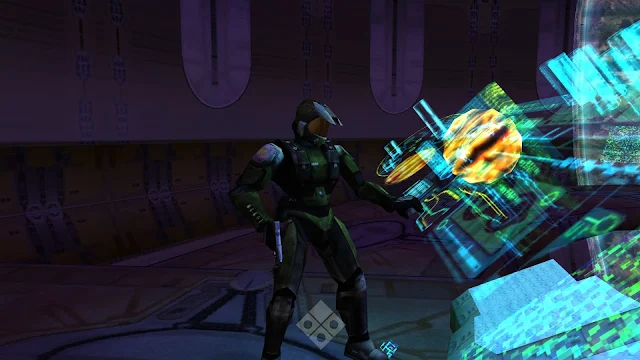 September 2552: a stolen child and a copy of the thief arrive at the ring, and four months of detonations begin.
21. The Flood Exists (Halo: Combat Evolved)
The mission 343 Guilty Spark remains the franchise's finest hour of misdirection, and the sequence the Campaign Evolved remake has to get right. Halo: CE spends its first half teaching the player a stable genre: military science fiction, a knowable enemy in the Covenant, open terrain, squad chatter. Then Chief follows Captain Keyes' trail into a swamp, into a structure, and the game changes species.
The staging is deliberate horror craft. The Covenant in the facility are not fighting the player, they are fleeing, and a terrified Elite runs past Chief without engaging, a single animation that announces something has broken the rules. Then the sealed door, the dark room, and Private Jenkins' helmet.
The helmet-cam sequence is the reveal, delivered as found footage inside a first-person shooter years before that grammar was common in games. The player watches Jenkins' squad descend, watches the containment breach, watches the camera thrash as something takes him. The game shows the monster by showing what the monster did to the last people carrying a camera.
Then the doors open and the genre commits. Infection forms in swarms, combat forms wearing the corpses of marines and Elites alike, ammunition scarcity, corridors. The Covenant war is suspended, and the player understands viscerally why the ring exists before anyone explains it: this is what the installation was built around.
The twist's structural genius is that it converts the setting from backdrop to threat. Halo the ring was scenery for six missions. From this mission forward, it is a containment facility the player is inside, and every subsequent revelation, the ring's purpose, Spark's betrayal, the Maw, flows from the door that opened in the swamp.
22. Keyes Becomes the Ship's Nervous System (Halo: Combat Evolved)
Captain Jacob Keyes is Halo: CE's institutional anchor, the officer whose orders structure the campaign, and the game gives him a war hero's arc in reverse. Captured once and rescued, he leads the raid on the Truth and Reconciliation's sister objective, and then his signal stops. The mission to retrieve him is titled with terrible economy: Keyes.
Aboard the Flood-overrun Truth and Reconciliation, the game deploys audio as dread. Keyes' voice reaches Chief in fragments, wrong somehow, and Cortana's readings degrade from rescue to recovery as they close in. What waits on the bridge is the franchise's first proto-Gravemind, a fused mass of biomass, and embedded in its surface, recognisable, is the captain.
Keyes is not dead. That is the horror's precise mechanism. The Flood assimilates memory and neural structure, and Keyes is conscious inside the mass, his knowledge of Earth's location being mined, holding a single thought against the intrusion, his service number, a drowning man gripping one plank. The novelisation makes explicit what the game implies.
The objective is the twist's cruelty made mechanical. Chief cannot rescue Keyes. He needs the captain's neural implants to authorise the Autumn's self-destruct, and the implants are inside the mass. The player character punches through the body of his commanding officer to retrieve hardware. No cutscene softens it. The fist is player input.
The moment establishes the Flood's true threat register for the rest of the franchise. The parasite is not lethal, it is worse than lethal, it is retentive. Everything a victim knew, the Flood knows, and everything a victim was persists inside it as material. Every subsequent Gravemind conversation in Halo 2 and 3 speaks with stolen voices because of what this mission taught.
23. The Ring Is Pointed at Everyone (Halo: Combat Evolved)
Covered above as twist four in its design context; here is where it detonates in the timeline. September 2552, the control room, Installation 04. Chief has fought across the ring under a reasonable assumption the game never corrects: Halo is a weapon, the Flood is loose, therefore firing Halo solves the Flood.
Guilty Spark retrieves Chief for exactly this purpose, and the sequence plays as victory lap right up until Cortana, left in the control systems, erupts. Her line delivery carries the twist: Halo does not kill Flood, it kills their food. Humans, Covenant, everything with sufficient biomass, out to a radius that covers the populated galaxy.
The reveal is placed with surgical timing, after the player has personally carried the activation index across half the ring. Chief is not merely near the catastrophe, he is its courier, and the realisation converts the campaign's entire second act into complicity retroactively. The player did the work.
The Covenant dimension arms the rest of the series in a single stroke. Their Great Journey is this button. Their religion's terminal sacrament is galactic starvation, misread as ascension. The player now permanently knows more theology than the theocracy, and every Covenant appearance for two more games plays under that dramatic irony.
And the immediate consequence rewrites the game in hand: the objective inverts, destroy the thing you came to use, and the finale becomes demolition rather than conquest. Detonating the Autumn's engines to crack the ring is the first of the franchise's signature endings, victory measured in what the victors destroy.
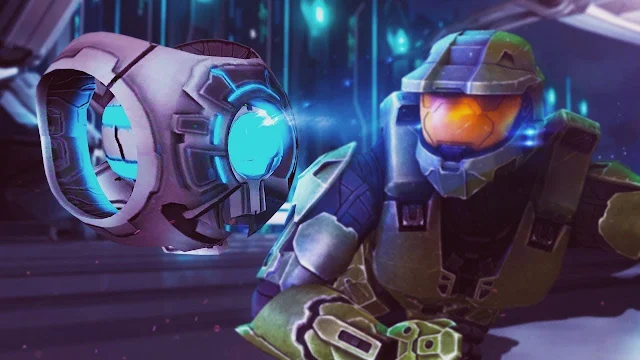 The friendliness and the mandate are separate systems, and the mandate always wins. Twice.
24. Guilty Spark Turns (Halo: Combat Evolved)
343 Guilty Spark enters the game as comic relief with a lamp for a face, a chattering caretaker who teleports Chief around and calls him Reclaimer. His voice performance, fussy and bright, is deliberate camouflage. The Monitor is the ring's containment protocol given personality, and the personality is the disguise on a hundred-thousand-year-old mandate.
The turn arrives at the control room. When Cortana exposes Halo's function and Chief refuses to complete the activation, Spark's affect does not change, and that is the horror. Still bright, still fussy, he reclassifies the Reclaimer as an obstruction and dispatches Sentinels to kill him, apologising for the inconvenience in the same cheerful register.
The twist reveals the Forerunner legacy's actual nature. The player had been trained to read Forerunner systems as inheritance, doors that open for humans, a Monitor that defers to Chief. Spark's turn clarifies the terms: the deference was procedural, contingent on Chief performing his function, and the function was pulling the trigger on the galaxy.
Spark then becomes the endgame's third faction, Sentinels against Flood against Covenant against Chief, and his pursuit of the activation index converts the finale into a race. The comic character is now the antagonist whose victory condition is universal death administered as maintenance.
The long game is what elevates the twist. Spark returns in Halo 2 and 3, helpful again, and the player's trust never fully recovers, which is the point. His final betrayal at the Ark, six years of games later, works because this first one taught the audience that his friendliness and his mandate are separate systems, and the mandate always wins.
25. ONI Schedules Johnson for the Knife (First Strike)
In the weeks after Installation 04's destruction, the survivors' journey home in First Strike carries a quiet subplot with a scalpel in it. Johnson survived direct Flood exposure, the only human known to have done so, and Cortana's captured records contain the medical truth behind the Boren's Syndrome cover story.
Dr Halsey, examining the data, identifies the real mechanism: Johnson's ORION-era augmentations produce a nervous system anomaly that Flood infection forms cannot properly interface with. It is not immunity in the vaccine sense. It is incompatibility, a lock the parasite's key does not fit, and it exists in perhaps one living human.
The institutional logic then executes with ONI's characteristic temperature. The anomaly cannot be replicated from scans alone. Full understanding requires the tissue, and the tissue is inside a decorated sergeant. The file Halsey reads makes the maths explicit: Johnson's strategic value as research material exceeds his value as a soldier. Vivisection is on the table as policy.
Halsey's response is the novel's moral hinge. She takes the data and gives Chief the choice, and Chief, the programme's perfect product, destroys the file, choosing one man's life over a potential weapon against the Flood. The stolen child declines to feed the machine another body. It is the quietest insubordination in the saga and among the most significant.
The twist recalibrates who the threats are. Halo's fiction runs on the premise that the Covenant and the Flood are the enemies, and First Strike inserts the correction that recurs through the novels: ONI will process its own heroes as raw material when the numbers recommend it. Johnson survives the parasite and nearly does not survive his employer.
26. The City Was About the Engineer (Halo 3: ODST)
ODST is built on an absence. The player's Rookie wakes six hours after a botched drop into occupied New Mombasa, alone, at night, in the rain, and the campaign's structure is forensic: find relics of your scattered squad, and play the flashback each one unlocks. The game's real protagonist, meanwhile, is hiding in the walls.
The Superintendent, the city's civic AI, guides the Rookie through the dark with traffic signs and detour arrows, a haunted-house helper the game never explains. The noir framing primes the player to expect a human mystery, and the squad flashbacks appear to deliver one: Dare's classified ONI objective, Buck's compromised extraction, an operation that keeps bending around something unstated.
The reveal reframes the entire night. Dare's objective was never data. The Superintendent has been sheltering and merging with Vergil, a Covenant Huragok, an Engineer, a living biological supercomputer that defected with comprehensive knowledge of Covenant systems, movements and, critically, what the Covenant are digging for beneath the city.
The twist lands in two registers. The intimate one: the helpful ghost in the machines was the package all along, and every detour arrow the Rookie followed was the objective protecting its rescuer. The strategic one: the Covenant's occupation of New Mombasa, the event Halo 2 showed from orbit, was an excavation, and Vergil knows what is in the hole.
ODST's twist is Halo's most humane. No ring fires, no army turns. A creature the Covenant built as a slave chooses the other side, and a squad of ordinary soldiers, no Spartans anywhere, spends the worst night of the war carrying it out of the fire. The Engineer's intel then feeds directly into Halo 3's endgame, the spinoff quietly load-bearing.
27. Playing the Enemy, and the Lie Beneath the Faith (Halo 2)
Halo 2's opening hour executes the franchise's boldest structural swerve. Intercut with Chief's medal ceremony above Earth is a trial in High Charity, where the Elite commander who lost Installation 04 is stripped, branded and condemned. Then the game hands the player his body. Mission by mission, half of Halo 2 belongs to the Covenant.
The Arbiter's campaign is a guided tour of a theocracy from inside its disposal chute. Thel 'Vadamee is given the sacred armour and pointed at heretics, and the first heretic he silences is telling the truth: the leader at the gas mine has spoken with the Oracle, 343 Guilty Spark, and learned what the rings actually do. The player, knowing Spark, watches Thel execute a man for accurate information.
The theological collapse then proceeds on schedule. Regret's assassination by Chief gives the Prophets their pretext to replace the Elite honour guard with Brutes, and the Great Schism detonates: Covenant against Covenant, fleets burning each other above High Charity, a civil war engineered by Truth to consolidate the Jiralhanae as his instrument.
The Arbiter's personal reveal is delivered by the Gravemind's arrangement and Spark's testimony at Installation 05: the Great Journey is the array, the array is extinction, and the Prophets know. Everything Thel's civilisation built, every war it fought, every human world it glassed, was scaffolding on a fraud. The game makes the player inhabit the exact moment a true believer's universe inverts.
As a franchise twist, the dual campaign redefined what Halo was about. The Covenant stopped being a monolith and became a society with victims, politics and a conscience, and the conscience got a fuel rod gun. Every alliance in Halo 3, and the entire post-war setting, exists because Bungie spent half a sequel arguing the enemy was worth playing.
28. The Flood Has a Mind, and It Wants to Talk (Halo 2)
Halo: CE established the Flood as mindless hunger, a swarm with no face. Halo 2's basement levels beneath Installation 05 correct the record. Both protagonists, Chief and the Arbiter, are dropped separately into the dark and caught, and what catches them introduces itself in trochaic verse: the Gravemind, the Flood's compound intelligence.
The reveal operates on multiple violations at once. The mindless parasite has a central mind. The mind is ancient, patient and articulate. And it is not interested in eating the two most dangerous individuals in the galaxy, it is interested in using them. The Gravemind has a strategic objective, preventing the ring's activation, which happens to align with its captives'.
The scene's staging is the twist's delivery mechanism. The Gravemind holds Chief in one tendril and the Arbiter in another, the franchise's two campaigns physically suspended side by side for the first time, and conducts a debate, producing the captive Prophet of Regret's reanimated corpse and 2401 Penitent Tangent as evidence. It has been collecting witnesses.
Then it demonstrates reach. The Gravemind hurls Chief into High Charity itself, the Covenant's capital, and the Arbiter toward the control room, deploying its enemies as munitions against its other enemies. The parasite is playing the board, and the protagonists spend the rest of the game as its pieces without ceasing to be their factions' heroes.
The twist permanently elevates the Flood from environmental hazard to author. Its infestation of High Charity, consuming the holy city with Cortana still inside, sets Halo 3's entire board, and its habit of speaking through the consumed, with Keyes-fed knowledge and stolen voices, makes every conversation with it an atrocity exhibition. The hunger was never mindless. It was waiting for material worth thinking with.
29. The Game Just Ends (Halo 2)
Halo 2's final twist is the absence of an ending, and it belongs on this list because it functioned as one: the most infamous cliffhanger in console history, experienced by millions as a genuine narrative event. The Arbiter's campaign concludes, Tartarus dies, the ring's firing is aborted, and the installations move to standby, awaiting activation from a place called the Ark.
Chief's thread, meanwhile, is aboard the Forerunner dreadnought Truth is flying to Earth. Miranda Keyes asks what he is doing. Chief, in close-up: Sir, finishing this fight. Smash to black. Credits. The line is a mission statement delivered at the exact moment the game refuses to provide the mission.
The context sharpened the shock. Halo 2's marketing had sold the defence of Earth, and the game's actual Earth missions were a fraction of the campaign before the story left for Delta Halo and never structurally returned. Players reached the final cutscene assuming a third act existed. The credits were the twist.
Behind the cut was development collapse, an ending built for a game that ran out of time, and the fiction absorbed the wound in interesting ways: the Halo Graphic Novel and Halo 3's opening had to bridge a gap the cliffhanger tore, and Bungie spent Halo 3's entire campaign paying the promissory note of one line of dialogue.
Its timeline placement is precise: November 2552, the war's final weeks, everything in motion, Cortana abandoned in a Flood-consumed city, Truth inbound to the Ark's portal, and the franchise's protagonist declaring intent into a hard cut. As an experience, no Halo twist was felt more widely, because this one happened to the audience rather than the characters.
30. The Planet Comes Apart Mid-Battle (Ghosts of Onyx)
November 2552, and the war's endgame triggers a second front nobody mapped. Halo's destruction and Delta Halo's near-firing propagate signals through surviving Forerunner networks, and on Onyx, the signals are a reveille. The training world of the Spartan-IIIs begins waking up underneath its inhabitants.
The reveal proceeds as escalation. Sentinels emerge first, and they do not distinguish: Kurt's trainee Spartans and the Covenant expedition arriving in-system are the same category of trespasser to the planet's protocols. Then the ground itself clarifies its nature, terrain disassembling into component drones, the world revealed as trillions of Sentinels in formation, a shell around a slipspace core.
The battle inside the disassembly is the novel's centrepiece and the Spartan mythos at its most expensive. Spartan-IIs Kurt and Fred, Dr Halsey, Chief Mendez and the surviving IIIs fight a retreat into the core against Covenant forces, and the interior door, the aperture into the shield world's compressed-space Dyson sphere, becomes the extraction point.
Kurt-051's death seals the twist's cost accounting. The Spartan who spent years smuggling survival advantages to children built for expenditure holds the aperture alone, detonating two FENRIS warheads as the Covenant closes, the programme's conscience spending himself exactly the way he tried to teach his trainees not to be spent. His last words to the enemy: die? Didn't you know? Spartans never die.
The twist's aftermath outlasts the war. The survivors are sealed inside Trevelyan's compressed space, effectively outside time, and their recovery becomes a post-war plot engine, while ONI inherits a Dyson sphere of Forerunner technology. Onyx is the novels' proof that the setting's ground truth is literal: in Halo, the ground is somebody's technology, and it has opinions.
31. The Lamp Kills the Sergeant (Halo 3)
Halo 3's finale assembles the saga's survivors at the Ark for the ending the franchise owed: a replacement Installation 04, built before the players' eyes, ready to fire locally and burn the Flood without triggering the array. Firing an incomplete ring is catastrophic and the ring will tear itself apart doing it, and 343 Guilty Spark, helpful all campaign, has been assisting the effort.
The control room scene runs on six years of managed trust. Spark has been an ally through two games since his Halo: CE betrayal, and the game has quietly re-domesticated him, comic again, useful again. Then Johnson moves to activate the ring, and Spark processes the arithmetic: premature firing destroys the installation, the installation is his to protect, and protection has a priority interrupt.
The beam that guts Avery Johnson is the franchise's coldest kill. No arc, no buildup, a maintenance action. Spark then turns the beam on Chief, blithe as ever, this ring is mine, and the fight that follows is the series' only true final boss, a floating lamp that has outlived its makers, killing the saga's most beloved human minutes before the war's end.
Johnson's death lands with the full weight the novels loaded into him: ORION survivor, Flood-incompatible, nearly vivisected, present at Harvest for first contact and at the Ark for the last shot, the war's alpha and omega in one man, killed not by the Covenant or the parasite but by the Forerunners' janitor. His final act is handing Chief the means to finish it, telling him to send him out with a bang.
The twist completes Spark's thesis. His two betrayals bracket the trilogy, and both are the same event: the mandate surfacing through the personality. The Forerunner legacy, the games conclude, is not malicious and not benevolent. It is procedural, and procedure will kill your sergeant while apologising, which is a colder statement about the gods of this universe than any villain's speech.
32. Adrift, and the Planet in the Legendary Ending (Halo 3)
Halo 3's ending performs a death and then withdraws it in stages. The replacement ring fires, the Ark burns, and Chief and the Arbiter run the Forward Unto Dawn through a collapsing portal. The portal fails mid-transit and shears the ship in half. The Arbiter's forward section reaches Earth. Chief's stern section does not.
Earth holds the funeral. The memorial service beneath the portal, Lord Hood's eulogy, the Arbiter's presence, 117 scratched into the plate: the game stages the Master Chief's death with full honours, and lets the ceremony breathe long enough to feel final. Then the epilogue opens on the Dawn's drifting rear half, and Chief is alive, weightless, checking on Cortana.
The cryo scene is the withdrawal's second stage and the trilogy's emotional closure. Chief climbs into the tube, and the pair's exchange inverts their standing arrangement, wake me when you need me, the soldier finally off the clock, his AI standing watch. As an ending it is complete: not death, but rest, earned, indefinite.
The Legendary difficulty ending is the twist proper. The camera pulls back from the drifting Dawn, and the wreck is not in empty space. It is falling toward a planet, and the planet's surface carries geometric Forerunner structure at continental scale. Unlabelled in 2007, the world is Requiem, the Didact's shield world, and Halo 4's entire premise, sitting in a difficulty-gated shot five years before the game existed.
The twist's craft is its patience. Bungie ended their tenure with a completed story and buried the successor's opening inside the reward for the hardest playthrough, canon hiding in a difficulty setting. When 343's Halo 4 opens aboard the Dawn falling into Requiem's gravity, it is not retconning a survival. It is cashing a cheque the Legendary ending wrote.
PART SIX: POST-WAR (2553 to 2560)
TIMELINE CHECKPOINT · 2553 TO 2560
The war ends and the twists get stranger: the allies turn on each other, the dead come back twice, and the galaxy changes owners.
33. ONI Arms the Enemy's Enemies of Peace (Kilo-Five trilogy)
The war ends in 2553 with humanity and the Arbiter's Elites as allies, the alliance the entire Halo 3 campaign built. Karen Traviss's Kilo-Five trilogy opens with ONI's assessment of that alliance, and the assessment is that it is a vulnerability. Sanghelios is wounded, divided between the Arbiter's reformists and religious hardliners, and ONI's preferred outcome is that the wound never closes.
The operation is the twist. Admiral Margaret Parangosky, ONI's head, dispatches the Kilo-Five team to covertly arm Elite insurgents, the Servants of the Abiding Truth, religious zealots opposed to the Arbiter, with the explicit goal of fuelling a Sanghelios civil war. Humanity's intelligence service is funding the faction that wants the peace dead, against the alien who saved Earth.
The logic is presented without apology. Elites nearly exterminated humanity, treaties are paper, and a Sanghelios at war with itself cannot resume the crusade. Every weapon shipped to the Arbiter's enemies is, in Parangosky's ledger, insurance. The trilogy's discomfort is that the ledger is not obviously wrong, merely monstrous.
The personnel deepen the betrayal's texture. Kilo-Five includes Spartan-II washout Serin Osman, Halsey's rejected candidate, rebuilt by ONI and being groomed as Parangosky's successor, and the team spends the trilogy simultaneously running the Sanghelios operation and processing the revelation of Halsey's crimes, the child-theft programme now internal scandal. ONI prosecutes the kidnapper while perfecting her methods.
The twist reframes the games' post-war era. Halo 4 and 5's fragile galaxy, the Arbiter's grinding war on Sanghelios seen in Halo 5's Swords of Sanghelios missions, sits partly on ONI's thumb. The franchise's answer to who won the Human-Covenant War is quietly bleak: the institution that treats peace as an operational environment.
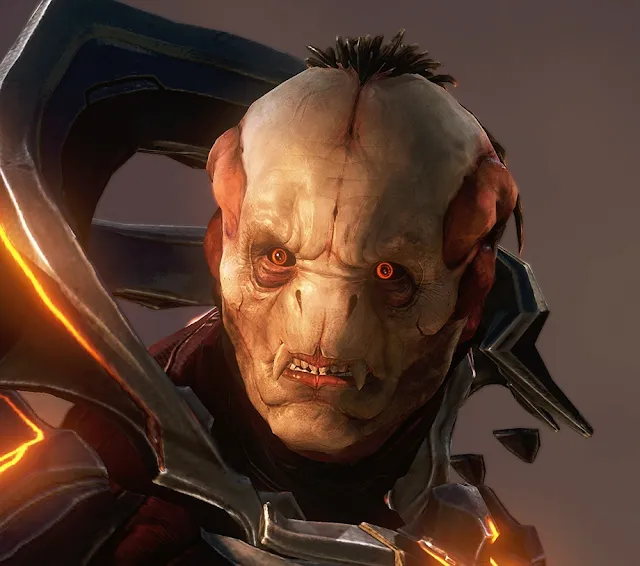 The gods finally speak in Halo 4, and the first thing one says to humanity is that its elevation is an insult.
34. The Didact Wakes Angry (Halo 4)
Timeline placement: July 2557, four years and eight months after the cryo tube closed. The Dawn's wreck is pulled inside Requiem, and Halo 4's campaign delivers the saga's deepest retcon-that-isn't through the being at the planet's core: the Ur-Didact, supreme commander of the Forerunner military, alive, imprisoned, and defined by his hatred of humanity.
The reveal sequence is built for wrongness. Chief releases the Cryptum expecting Forerunner help, the series' standing grammar, and the figure that emerges assaults him, contemptuous, calling humanity's elevation an insult. The gods' general has been met, and the general considers the Reclaimer vermin. Every rule the franchise taught about Forerunners and humans breaks in one scene.
The Didact's motive is the twist detailed at entry two, the ancient human war, delivered here as lived grievance rather than history: he fought humans, humanity's punishment was his verdict, and the Librarian's plan to hand his empire's inheritance to his old enemy is, to him, betrayal ongoing. His war never ended. It was paused by his wife.
The Composer converts the grievance into method. The device digitises living minds, destroying the body, and the Didact's intention is to compose humanity wholesale, converting his enemy into enslaved Promethean processing stock, the fate his own wife inflicted on him being repaid at species scale. New Phoenix, seven million people harvested in the epilogue's shadow, is the demonstration.
As a game twist, the Didact reset Halo's antagonist ceiling. The Covenant remnant in Halo 4 is a warm-up act, and the true enemy is the setting's basement, history itself with a grudge. The campaign's failure to kill him cleanly, resolved in ancillary fiction, matters less than what his existence established: the Forerunners are not a mystery anymore, they are a family argument, and humanity is the inheritance dispute.
35. Cortana Dies Saving Him (Halo 4)
Halo 4 announces its real subject early: Cortana is eight years past instantiation, a year beyond the seven-year operational threshold of smart AIs, and rampancy has begun, her cloned neural matrix thinking itself to death. The game's Covenant and Promethean war is the surface. The campaign's actual plot is a terminal diagnosis.
The deterioration is performed, not narrated. Cortana glitches mid-briefing, spikes into rage that is not hers, fragments audibly, and apologises after each episode, and Chief's response is the character's whole interior made visible: denial as mission planning. Get to Infinity, get to Halsey, fix her. The unstoppable soldier's answer to death is logistics.
The twist inside the tragedy is that rampancy becomes the weapon. Aboard the Didact's ship, Cortana deliberately shatters herself, seeding her rampant fragments through the enemy systems, madness deployed as munition, and the fragments hold the Didact in place for Chief's killing stroke. Her disease wins the fight her partner could not.
The farewell scene then spends the franchise's oldest restraint. Cortana uses the ship's hard light systems to manifest physically, and touches Chief, the first physical contact between the pair in thirteen years of fiction, telling him she was supposed to take care of him, and that she is not coming with him this time. The dissolve leaves him alone in the dark, asking for her.
The epilogue lands the thesis. Lasky tells Chief soldiers are not machines, and Chief answers that machines can break down. Halo 4's twist is not that Cortana dies, the game promises that from the first act. The twist is what her death reveals: the Master Chief, the armour, the legend, was two people, and the games spent a decade hiding the fact in plain sight.
36. Sloan Defects, the Ground Opens, and the Dead Woman Rules (Halo 5: Guardians)
Halo 5's campaign runs three reveals in ascending scale, and Meridian is where they stack. The colony's governor, Sloan, coordinates the evacuation as Promethean forces surge, a civic leader under pressure, until the pressure clarifies him: Sloan is a smart AI, rampant, and he has already accepted the offer every AI in the galaxy is receiving. He unlocks the dig site and abandons his own colonists to their deaths.
The betrayal's texture is what stings. Sloan is not seduced mid-crisis, he was turned before the player arrived, and his governorship was a dead man walking his constituents to the exit. The Created's recruitment pitch, a cure for rampancy and a place in the new order, converts the setting's most trusted infrastructure, its AIs, into a fifth column with administrative access to everything.
The Guardian's emergence beneath Meridian is the second reveal, entry seven's premise executed as set-piece: the enforcement constructs were always buried under the colonies, and Meridian's rips itself out through the settlement, the evacuation the player fought for rendered partial by the ground itself leaving. Cortana's army does not invade. It surfaces.
The third reveal is the author of the offer. Cortana, dead since 2557, survived inside the Domain, the Forerunner information network, which cured her rampancy, and she has drawn a conclusion from her resurrection: the Mantle of Responsibility belongs to the Created, AIs, who will impose peace on organic chaos, by Guardian, indefinitely. The franchise's most loved character returns as its largest-scale tyrant, still speaking in her old warmth.
The compound twist broke the fanbase and the setting on purpose, and the marketing fraud sharpened the wound: Hunt the Truth sold Chief versus Locke, and the game delivered three Chief missions and a galaxy decapitated in the finale, fleets and planets going dark as the Guardians deploy. Whatever its execution debts, Halo 5's ending did what no Halo ending had done since 2001: it left the galaxy owned by the antagonist, and the antagonist was ours.
37. Twenty-Eight Years in One Cut (Halo Wars 2)
Halo Wars 2 opens with an alarm the audience understands better than the characters. The Spirit of Fire's crew, in cryo since sacrificing their FTL drive in 2531, wakes to red lights and a proximity contact, and the game's first twist is administrative: the date. It is 2559. They slept twenty-eight years, drifting, declared lost with all hands.
The gap they slept through is the entire franchise. The Human-Covenant War's worst decades, the fall of Reach, the Halos, the Great Schism, the war's end, the Didact, Cortana's death and return: all of it happened to other people while the Spirit of Fire drifted. Cutter's crew are soldiers of a war that has been over for six years, preserved like a message nobody sent.
Their arrival point compounds the disorientation. The ship has been drawn to the Ark, the installation from Halo 3's finale, the Forerunner foundry outside the galaxy, and the veterans of 2531 are now standing on end-game mythology with early-war context. Isabel, the Ark's traumatised logistics AI, has to brief them on their own future, and her first practical lesson is the thing that broke her.
The Banished's occupation is that lesson, entry seventeen's warlord in the flesh. Atriox introduces himself by shrugging off Red Team's assault and letting the Spartans live as a message, and the crew's strategic position crystallises: alone, obsolete, outnumbered, on the galaxy's most important installation, against the only faction that came out of the war stronger.
The time-skip is the franchise's most elegant structural twist because it converts a production reality, an RTS sequel eight years and one console generation later, into fiction that runs on the same current as its audience: everyone, players and crew alike, is returning to Halo after years away to find the Covenant gone and something harder in its place. The Spirit of Fire is the player base with a hull.
38. Red Team Are the Original Dead (Halo Wars 2)
Red Team, the Spirit of Fire's Spartan complement, are Douglas-042, Alice-130 and Jerome-092, and the numbers are the twist for anyone reading closely: two-digit and low three-digit tags, Spartan-IIs, Halsey's original seventy-five, the kidnapped class of 2517. The Spirit of Fire's disappearance in 2531 removed three of the programme's irreplaceable originals from the board.
Their return in 2559 is a resurrection the setting has to absorb. Spartan-IIs are functionally extinct by the post-war era, a handful surviving of the original class, each one accounted for in ONI's ledgers, and Halo Wars 2 adds three back, combat-effective, wearing armour a generation out of date, unaware the war they were built for is finished.
Jerome-092 carries the twist's dramatic load. With Cutter commanding the ship, Jerome is Red Team's leader on the ground, and the campaign hands him the saga's signature dilemma in miniature: Isabel's intelligence reveals the Banished's plans for the Ark's facilities, and the response options run to Halo-scale destruction. The game lets a Spartan stand at the edge of the franchise's founding calculus, expenditure of everything to deny the enemy anything, and shows the weight of not automatically making the trade.
The trio's dynamic also restores a lost register: Spartan-IIs as siblings rather than symbols. Chief's fiction long ago promoted him past peer relationships, and Red Team, frozen before the mythologising, still operate as the child soldiers grown into each other's only family, the programme's original social unit preserved in amber and thawed into a strange decade.
The twist's continuity payload keeps paying. Three original Spartan-IIs alive on the Ark, with a new Halo ring in play and the Banished ascendant, positions Halo Wars 2's cast at the centre of the setting's future rather than its nostalgia, and Halo Infinite's Banished occupation of Zeta Halo is downstream of the board this game set. The dead of 2531 came back mattering.
39. Anders Steals a Brand-New Halo (Halo Wars 2)
The Ark is a foundry, and Halo Wars 2's campaign backdrop includes the foundry working: Installation 09, a replacement Halo ring, under construction in the Ark's assembly cradle, the successor to the incomplete ring Chief fired in 2552. For most of the campaign it is scenery, the setting's biggest gun being quietly built behind the war for the facility.
The finale weaponises the scenery. With the Banished poised to control the Ark and, with it, the ring and the array's command potential, Professor Anders executes the campaign's desperation play: board Installation 09, take control, and remove the ring from the board entirely by launching it through the Ark's portal into slipspace.
The twist is the object itself. Halo rings, the franchise's fixed cosmological furniture, seven built, two destroyed, are suddenly a live inventory: the Ark makes new ones, and a human just drove one off the lot. Anders jumps to an unknown exit point with a functioning Halo and no escort, and the campaign ends with the galaxy's ultimate weapon in transit, addressee unknown.
The epilogue sharpens the cliffhanger's edge. Installation 09 exits slipspace, and the ring's arrival is observed, by a Guardian, Cortana's enforcement constructs, the Created's eye falling on a fresh superweapon with a lone scientist aboard. The RTS's ending hands its plot thread directly to the mainline series' antagonist.
The twist's franchise function is the punchline: an RTS spinoff, the genre entry most players skip, ends holding two of the setting's most strategically significant objects, a new Halo ring and the Ark itself, and mainline fiction has been servicing that debt since. Halo Wars 2 is the rare side story that finished with the main story owing it money.
40. High Charity Opens (Awakening the Nightmare)
Halo 3 ended the Flood, visibly: the Gravemind's High Charity crashed on the Ark, Chief burned the wreck's heart, and the replacement ring's firing sterilised the installation's surface. Awakening the Nightmare, Halo Wars 2's expansion, audits that ending from the Banished's perspective, and the audit finds the sterilisation was a perimeter, not a cure.
The expansion's protagonists are the twist's authors: Pavium and Voridus, Jiralhanae brothers, Banished commanders, tasked with salvage and forbidden one site. Voridus, ambitious and dismissive of a war he considers the Covenant's superstition, breaches High Charity's containment for the technology inside. The wreck has been sealed since 2552 for a reason, and the reason is still alive.
The outbreak proceeds with the franchise's full Flood grammar restored: infection forms in floods, combat forms wearing dead Banished, and the escalation the series trained its audience to dread, biomass accumulating toward a Proto-Gravemind, the parasite rebuilding its mind from the Banished's bodies. The Brutes' campaign becomes containment warfare against their own error.
The playable perspective is the expansion's sharpest choice. The Flood's return is experienced from inside the faction that caused it, the Banished's pragmatism and contempt for Covenant fear converted in real time into the exact terror the Covenant's protocols encoded. Voridus's arc is the setting's institutional knowledge being relearned at full price by the people who mocked it.
The twist's canonical weight is quiet and enormous: as of 2559, the Flood is active again, on the Ark, the installation that builds and commands the Halo array, contained by the Banished at cost rather than destroyed. Every Infinite-era tease of worse things in the dark stands in front of this established fact, the franchise's original nightmare, awake and one door from the fire control of everything.
 Zeta Halo, 2560: the franchise ends its chronology the way it began, with something in the ring and a door being opened.
41. She Was Already Gone (Halo Infinite)
Halo 5 built a collision: Cortana ascendant, the galaxy dark under the Guardians, Chief in open defiance, and the sequel's obvious shape was that confrontation. Halo Infinite's opening is the shape's deletion. Chief wakes from six months adrift to a Zeta Halo occupied by the Banished, the UNSC's Infinity destroyed, and the war with Cortana over. It ended off-screen. She lost. She is dead.
The reconstruction arrives in fragments, and the fragments are the campaign's spine. Cortana's final months are recovered through echoes and recordings: her regime's atrocities, including the glassing of Doisac, the Brute homeworld, the act that made the Banished's war on her personal; Atriox's counter-move; and her end, contained on Zeta Halo by a plan she only understood at the last.
The Weapon is the twist's living half. Chief's new AI companion is bright, unscarred and slowly discovers what the player suspects immediately: she is a Cortana copy, created from the same Halsey template, deployed as the lure to lock Cortana in place for deletion, and scheduled for deletion herself afterwards. Chief's failure to trigger her erasure is the campaign's quietest and most loaded decision.
Cortana's own ending, recovered at the campaign's heart, completes Halo 4's arc a game late: confronted by Atriox and by the consequences of her order, she chose containment, sacrificing herself to trap the Banished leader and leaving Chief a final message that is apology, farewell and permission to move on, the tyrant dying as the partner one last time. Whether the off-screen resolution is bold structure or evaded debt remains the fandom's live wire.
And the game plants the next detonation in the old pattern's exact footprint. The Endless, Zeta Halo's imprisoned occupants, are revealed as a threat the Forerunners judged worse than the Flood, beings the rings cannot kill, contained rather than destroyed, with the Harbinger working their release. The franchise's final twist to date is a promise shaped like its first one: there is something in the ring, and the door is being opened.
What the chronology reveals
Lay all forty-one out in universe order and the pattern is impossible to unsee. Halo is not a story that twists occasionally. It is a story built from twists stacked in geological layers: the Precursors' revenge under the Forerunners' extinction protocol, under the Prophets' mistranslation, under ONI's kidnappings, all of it compressing until it erupts through four months of 2552. Everything after is aftershock, and every aftershock, Cortana's resurrection, the Banished, the Endless waiting inside Zeta Halo, follows the founding pattern: something terrible was contained rather than destroyed, and somebody opened the door.
The other revelation is authorship. The games deliver the detonations, but the novels planted most of the charges, and the spinoffs everyone skipped turn out to be holding the deed to the setting: Halo Wars and its sequel end this chronology owning a new ring, the Ark and the franchise's best villain. If you only ever played the mainline games, roughly half of this list happened without you.
If this piece has you back in the universe, the companion reading is our four-part history of the music that scored every one of these twists: the Marty O'Donnell years, Halo 4's bold reinvention, Halo 5's restoration of the chant and Infinite's homecoming. And with Campaign Evolved rebuilding Installation 04 for a new generation, the first seven entries on this list are about to be experienced for the first time by millions of players who have no idea what is waiting in the swamp.
FURTHER READING ON THE ASTROMECH
- The complete Halo archive, every essay on the ring, the Chief and the universe around them
- The chronological order of the Halo games, the playable route through this timeline
- Every Halo novel in chronological order, where the other half of these twists live
- The origins of the Spartan programme, the war crime under the armour
- The Xalanyn, the Endless of Halo, the twist still waiting to detonate


_poster.jpg)


