

Enemy Mine: Themes of War, Humanity, Friendship, and Tolerance
"Enemy Mine" explores profound themes such as the complexities of war, the nature of humanity, and the power of friendship.
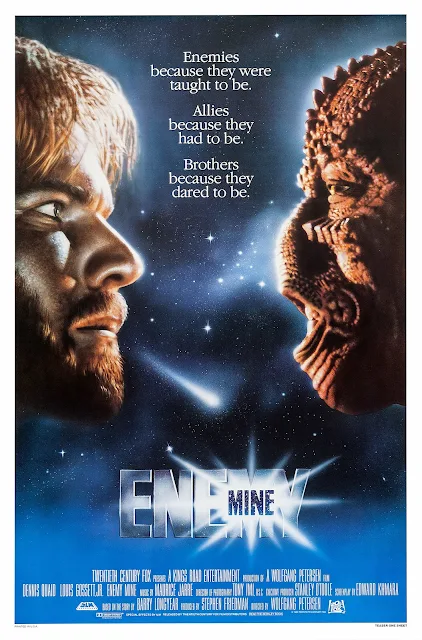 |
The War and Conflict with the Dracs
In "Enemy Mine," the film presents a futuristic setting where humanity is engaged in a fierce intergalactic war against an alien race known as the Dracs."Enemy Mine" delves into the dehumanizing effects of war on both sides. The film portrays how war strips away the humanity of the soldiers, reducing them to mere pawns in a larger game. Initially, Davidge and Jeriba view each other as enemies based on their respective races and the indoctrination they received during their military training.
The film also conveys a sense of the futility of conflict.
Identity and Humanity (a classic sci-fi theme when aliens are involved)
In "Enemy Mine," both Davidge and Jeriba grapple with their individual identities and the perceptions imposed upon them by their respective societies. Davidge, representing humanity, initially views himself as superior to the alien Dracs, considering them to be the enemy."Enemy Mine" boldly challenges the notion of 'us versus them' by presenting a story that transcends boundaries and stereotypes.
Throughout the film, Davidge and Jeriba undergo significant growth and transformation. Initially driven by their respective prejudices, they gradually shed their preconceived notions and develop a deep bond based on trust, respect, and friendship.
 |
| Davidge and Jeriba |
The real treasure was the friends we made along the way...
"Enemy Mine" portrays an unlikely friendship between Davidge and Jeriba, two individuals from opposing sides of a war. Initially driven by hostility and mistrust, their circumstances force them to depend on each other for survival. Through shared experiences and hardships, a genuine friendship begins to form.The bond between Davidge and Jeriba transcends the barriers of race, culture, and language. Despite their initial differences and prejudices, they discover common ground and begin to communicate and understand each other on a profound level. Through this connection, the film challenges the notion that true friendship can only exist within one's own social or cultural group. It demonstrates that genuine relationships can be formed even in the most unlikely of circumstances, breaking down the barriers that divide them.
"Enemy Mine" showcases the transformative power of friendship when confronted with adversity. As Davidge and Jeriba face numerous challenges and life-threatening situations, their friendship becomes a source of strength and resilience. They learn to rely on and support each other, overcoming their initial animosity and growing together as individuals.
Tolerance and Acceptance
"Enemy Mine" presents a powerful portrayal of tolerance and acceptance by challenging preconceived notions and biases. The film confronts the audience with characters who initially fear and distrust each other due to their differences. However, as Davidge and Jeriba are forced to coexist and depend on one another, they learn to see beyond their dissimilarities and embrace acceptance.The film showcases the characters' progression from fear and prejudice to understanding and acceptance. Both Davidge and Jeriba confront their own biases and learn to let go of their preconceived notions about each other. Through their shared experiences and the genuine connection they develop, they come to appreciate and value their differences. The film portrays their transformation as a gradual process, reflecting the complexity of overcoming deeply ingrained prejudices.
"Enemy Mine" serves as a compelling invitation for viewers to introspect and challenge their own biases.
Conclusion about the themes of Enemy Mine
"Enemy Mine" is a thought-provoking film that delves into profound themes such as the complexities of war, the nature of humanity, the power of friendship, and the importance of tolerance. It examines the backdrop of intergalactic war, highlighting the dehumanizing effects of conflict and the futility of perpetuating division."Enemy Mine" remains significant and relevant due to its exploration of timeless themes. Its portrayal of the destructive nature of war, the potential for growth and understanding, and the transformative power of friendship resonates across cultures and generations. The film serves as a poignant reminder of the importance of empathy, compassion, and breaking down the barriers that divide us. Its themes hold enduring relevance, urging viewers to reflect on their own prejudices and biases, and inspiring them to strive for a more inclusive and harmonious society.
For viewers interested in thought-provoking science fiction narratives, "Enemy Mine" is a must-watch. Its exploration of profound themes and its ability to challenge societal norms and biases make it a captivating and intellectually stimulating experience. The film combines elements of science fiction with heartfelt storytelling, creating a powerful and memorable narrative. It encourages viewers to engage in critical thinking, question their own perspectives, and embrace the power of empathy and understanding.
"Enemy Mine" is a science fiction film released in 1985, directed by Wolfgang Petersen. Set in the distant future, the movie tell...
Read Article →
Mad Max 3: Beyond Thunderdome: Themes of Power, Hope, and Environmental Consequences
Mad Max Beyond Thunderdome Themes Explained
Bartertown, power, myth, children, ecology, and the strange rebirth of civilization
Mad Max Beyond Thunderdome is the odd one in the original trilogy, but dismissing it as the softer Mad Max film misses what makes it useful. It is the entry where the wasteland stops being only a road and starts becoming society again.
Mad Max Beyond Thunderdome, also known as Mad Max 3, was released in 1985 and directed by George Miller and George Ogilvie. It followed the raw collapse of Mad Max and the full wasteland grammar of Mad Max 2: The Road Warrior. Where those earlier films focused on road violence, fuel scarcity, revenge, and convoy survival, Beyond Thunderdome asks a different question: what comes after chaos starts organizing itself?
That is the real value of the film. Bartertown is not just a weird settlement with pig methane and gladiator law. It is a failed civilization trying to stand up on broken legs. It has trade, hierarchy, energy production, spectacle, political theater, law, punishment, propaganda, and a ruler with an actual civic imagination. Aunty Entity is dangerous because she does not merely survive the wasteland. She tries to govern it.
The other half of the film, Max’s time with the lost children of the Crack in the Earth, pushes the saga into folklore. The children preserve fragments of the old world through story, chant, prophecy, and misremembered history. Between Bartertown and Tomorrow-Morrow Land, Mad Max 3 becomes a film about how civilization dies, how it returns, and how easily memory turns into myth.

Why Mad Max 3 matters in the series
The mistake is treating Beyond Thunderdome as a disposable bridge between The Road Warrior and Fury Road. It is messier than those films, yes. The tonal split between Bartertown and the child tribe is real. The first half is grimy, funny, political, and theatrical. The second half turns toward myth, innocence, and rescue. That split has always made the film divisive.
But the split is also the point. Beyond Thunderdome is a film about competing answers to collapse. Bartertown says civilization returns through trade, energy, law, spectacle, and violence. The children say civilization survives through memory, hope, story, and faith in a promised place. Max stands between those answers, suspicious of both, useful to both, and finally unable to remain untouched by either.
In the wider Mad Max saga, the film helps connect the stripped-down fuel war world of The Road Warrior to the fortress economies of Fury Road and Furiosa. Bartertown is a forerunner to the Citadel. It is not as grand, not as militarized, not as religiously complete, but it already shows the same pattern: whoever controls energy controls society.
Core thesis: Beyond Thunderdome is about civilization trying to regrow after collapse, but regrowing in distorted forms.
Why it matters: the film expands Mad Max lore beyond road gangs and oil scarcity into trade, myth, law, children, energy systems, and political memory.
Bartertown and the theme of rebuilt civilization
Bartertown is one of George Miller’s best pieces of worldbuilding because it makes the post-apocalypse social again. The Road Warrior gives us a fortified refinery community under siege. Beyond Thunderdome gives us a town. It has markets, rules, crowds, workers, entertainments, slogans, punishments, and a ruler trying to hold a dirty system together.
The name matters. Bartertown is not Idealtown. It is not Democracytown. It is built around exchange. Everything has value because everything is scarce. Goods, labour, water, methane, muscle, spectacle, and violence all circulate through its economy. It is ugly, but it is not random. This is the wasteland beginning to develop institutions.
That makes Bartertown a key step in Mad Max lore. The franchise often shows collapse through resource control. In The Collapse, fuel scarcity and institutional failure break the old world. In The Road Warrior, gasoline becomes the central object of war. In Beyond Thunderdome, energy becomes the foundation of a settlement. In Fury Road, water, fuel, bullets, milk, blood, wombs, and belief become an entire system of rule.
Bartertown is therefore not a side quest. It is the first draft of wasteland civilization.
Aunty Entity is not just a villain
Aunty Entity, played by Tina Turner, is one of the most interesting figures in the Mad Max films because she is not simply a raider queen or tyrant. She is a builder. That does not make her good, but it makes her more complicated. She wants power, and she knows power requires more than brute force. It requires rules, performance, punishment, loyalty, image, and control of resources.
Her line about starting with nothing and building Bartertown matters because it gives her a civic psychology. Aunty remembers enough of the old world to want something larger than wandering survival. She wants a place that works. She wants authority. She wants people to obey a structure. In a franchise full of wreckers, she is a founder with blood on her hands.
That is why her conflict with Master Blaster is so important. Aunty has the public face of power, but Master Blaster controls the energy beneath the town. Bartertown literally depends on Underworld, the pig-methane system that keeps the settlement running. Aunty can rule above ground only if the power below ground keeps flowing.

Master Blaster and the politics of energy
Master Blaster is not only a memorable character gimmick. He is the film’s clearest symbol of split power. Master provides the intelligence and technical control. Blaster provides the physical force. Together, they run Underworld, where methane from pig waste powers Bartertown.
That is classic Miller. The joke is grotesque, but the logic is serious. Civilization returns through sewage. Energy is produced from waste. The polished authority above ground depends on the filth below ground. Bartertown’s social order literally rests on what it tries not to look at.
This makes Beyond Thunderdome much more interesting than a simple survival adventure. It is about infrastructure. Aunty needs Master Blaster because he controls the town’s energy system. Master Blaster needs Bartertown because power has no meaning without a society to leverage it against. Max is recruited because Aunty wants to break that dependency without openly admitting how fragile her authority is.
This theme continues into later Mad Max lore. Immortan Joe controls water at the Citadel. Gas Town controls fuel. The Bullet Farm controls ammunition. Beyond Thunderdome gets there first in rougher form: control the energy, control the town.
Bartertown’s dirty secret: its law and glamour are powered by pig waste, forced labour, and political dependency.
Mad Max logic: after collapse, every form of power becomes material. Fuel, methane, water, bullets, bodies, and engines are politics.
Thunderdome turns law into spectacle
The Thunderdome itself is the film’s most famous idea, and it remains one of the great post-apocalyptic images: a caged arena where disputes become entertainment and justice is reduced to combat. The rule is brutally simple: two men enter, one man leaves.
That line works because it sounds like law after civilization has forgotten ethics. It is easy to remember, easy to chant, and easy to enforce. It gives Bartertown the illusion of order while feeding the crowd’s appetite for violence. Nobody needs legal nuance. Nobody needs due process. The slogan turns murder into civic ritual.
This is where the film becomes sharply satirical. Bartertown has rebuilt a justice system, but the justice system is theater. The crowd wants spectacle. Aunty gets legitimacy. The fighters become symbols. The law becomes a show. That is a much more sophisticated idea than the film often gets credit for.
Thunderdome also reveals Max’s moral boundary. He enters as a mercenary willing to do Aunty’s dirty work, but he refuses to finish Blaster once he recognizes Blaster’s vulnerability. That refusal matters. Max may be damaged, cynical, and self-interested, but he is not fully absorbed by the wasteland’s logic. Some human line remains.

Max’s redemption is quieter than people remember
Max begins Beyond Thunderdome as a scavenger again, robbed of his vehicle and animals by Jedediah and his son. He arrives in Bartertown not as a savior but as a man trying to recover what was stolen from him. That is important. Max is rarely noble at the beginning of these stories. He is pulled into moral action almost against his will.
In Bartertown, he is hired as a weapon. In the Crack in the Earth, he is mistaken for a figure from prophecy. In both places, other people try to assign him a role. Aunty wants him to be an assassin. The children want him to be Captain Walker, the pilot who will lead them to Tomorrow-Morrow Land. Max resists both myths because he knows he is neither clean killer nor promised savior.
That gives the film one of its best themes: redemption without self-importance. Max helps, but he does not become king. He saves the children, but he does not found the new society. He sacrifices escape so others can reach safety, then returns to the wasteland as the same haunted drifter he has always been.
This links directly to The Road Warrior, where the Feral Kid remembers Max as a mythic figure. Beyond Thunderdome continues that idea. Max becomes meaningful because others remember what he did after he has already vanished.
The children and the power of oral history
The lost children in the Crack in the Earth are where Beyond Thunderdome becomes most mythic. They preserve the story of Captain Walker, the plane crash, the old world, and the promised Tomorrow-Morrow Land through ritualized memory. Their “Tell” is not accurate history in a modern sense. It is survival history, shaped into story so a community can keep going.
This is crucial Mad Max lore. After collapse, official history disappears. Governments fall. Schools fail. Records vanish. Books decay. People remember through chant, symbols, tattoos, fragments, and myth. Later, Furiosa gives us the History Man, who carries knowledge on his own body. Beyond Thunderdome gets there earlier through the children’s oral tradition.
The children’s mistake is also revealing. They turn Max into Captain Walker because they need him to be. Their hope is powerful, but it is also dangerous. It almost leads them into the desert unprepared. The film does not mock hope, but it does question blind hope. A myth can keep people alive, and it can get them killed.

Savannah Nix and the risk of hope
Savannah Nix is easy to underrate, but she gives the children’s storyline its urgency. She believes in the journey to Tomorrow-Morrow Land with a force that Max cannot simply dismiss. She is wrong in practical terms, but not wrong in moral terms. She understands that a community cannot live forever inside fear, repetition, and waiting.
Her role complicates the film’s idea of hope. Max is right that the children are not ready to cross the wasteland. Savannah is right that staying hidden forever is another kind of death. The film’s emotional force comes from that tension. Hope without survival knowledge is dangerous. Survival without hope becomes a slow burial.
This theme fits the broader Mad Max saga. The refinery settlers in The Road Warrior need hope to leave. Furiosa needs hope to search for the Green Place. The Wives need hope to flee the Citadel. But every hope in these films has to be tested against the road. The wasteland punishes fantasy, but it also punishes surrender.
Environmental collapse and the wasteland as warning
Beyond Thunderdome continues the franchise’s environmental concerns, but it expresses them through absence and waste. The world is dry, stripped, and scavenged. Bartertown survives on methane because conventional energy systems are gone. The children live in a hidden pocket of life because the wider world is too hostile. Water, food, shelter, and fuel are no longer background resources. They are destiny.
The film is not as visually ecological as Fury Road, where water politics and the poisoned Green Place dominate the story. But its environmental warning is still clear. The old world has consumed itself, and what remains is a society forced to run on scraps, excrement, barter, salvaged vehicles, and improvised myth.
This is where the film’s strangeness becomes useful. Bartertown’s methane economy is grotesque, but it is also a practical ecological joke. The town survives by recycling waste. That is funny until you realize it is also one of the only sustainable systems left in the film.
Environmental theme: Beyond Thunderdome shows a world where industrial civilization is gone, but the need for energy remains.
Wasteland irony: Bartertown is brutal, but its pig-methane system is one of the franchise’s clearest examples of post-collapse recycling.
Tribalism, community, and the return of social order
Mad Max 3 is deeply interested in tribe. Bartertown is a tribe organized as a market-state. The children are a tribe organized around memory and prophecy. Max is a tribe of one, which is why the film keeps pushing him toward groups that need him despite his resistance.
The film does not pretend community is automatically noble. Bartertown is a community, and it is exploitative. The child tribe is a community, and it is vulnerable to mythic delusion. Community can preserve people, but it can also trap them inside bad stories, bad laws, and bad power structures.
That makes Beyond Thunderdome more thoughtful than its reputation suggests. It is not simply saying people must come together. It is asking what kind of coming together is worth building. A society can rebuild through trade and spectacle, like Bartertown. It can rebuild through memory and belief, like the children. The better future likely needs both practical systems and humane stories.
The film’s lighter tone has a purpose
Beyond Thunderdome is less savage than Mad Max and less brutally perfect than The Road Warrior. That is not only a weakness. Its broader, more theatrical tone fits its subject. Bartertown is performative. Aunty Entity is performative. Thunderdome is performative. The children’s history is performative. This is a film about societies staging themselves back into existence.
George Ogilvie’s theatrical background likely contributes to this feel. The movie often plays like wasteland theater: chants, costumes, arenas, ritual speeches, child liturgies, public punishments, and mythic roles. That can make the film feel less lean than the earlier entries, but it also gives it a different kind of texture.
The best way to read Beyond Thunderdome is not as a failed repeat of The Road Warrior. It is a sequel asking what happens when the chase stops long enough for people to build towns, laws, myths, and power systems out of the wreckage.
Main themes in Mad Max Beyond Thunderdome
- Survival after collapse: Max, Bartertown, and the children all represent different survival strategies.
- Power and resource control: Aunty Entity rules above ground, but Master Blaster controls the energy below.
- Law as spectacle: Thunderdome turns justice into public violence and political theater.
- Oral history and myth: the children preserve the old world through story, but their memory is distorted.
- Hope and danger: Tomorrow-Morrow Land gives the children purpose, but blind belief nearly destroys them.
- Community and tribalism: the film contrasts market civilization, child prophecy, and Max’s lonely survival.
- Environmental warning: scarcity, waste recycling, desertification, and resource dependence shape every society in the film.
Why Beyond Thunderdome still matters
Mad Max Beyond Thunderdome matters because it expands the franchise’s imagination. It asks what happens after the road war. It imagines a wasteland where people are no longer merely scavenging, but organizing. Badly, violently, foolishly, sometimes beautifully, but organizing all the same.
Bartertown points toward the Citadel. Master Blaster points toward the resource engineers and war economies of later films. Aunty Entity points toward the idea that post-collapse rulers are not always mindless brutes. The children point toward the saga’s obsession with memory, myth, and the stories survivors tell after Max disappears.
The film’s flaws are real. Its two halves do not always lock together cleanly. Its tone is broader. Its child-tribe material can feel less dangerous than the Bartertown material. But the thematic ambition is stronger than the film’s reputation. Beyond Thunderdome is the Mad Max entry that asks whether civilization deserves to come back, and what shape it might take if it does.
Continue through The Astromech’s Mad Max coverage
Conclusion: Beyond Thunderdome is about what comes after survival
The core question of Mad Max Beyond Thunderdome is not simply whether Max can survive another wasteland adventure. He can. The deeper question is what kind of world survives around him.
Bartertown survives through barter, methane, power, violence, and spectacle. The children survive through memory, story, innocence, and dangerous hope. Aunty survives by building a system. Max survives by refusing to belong to any system for too long. The film places all of these survival models beside each other and asks which one might carry humanity forward.
That is why Mad Max 3 deserves more respect as a thematic chapter in the saga. It may not have the raw menace of the first film, the lean perfection of The Road Warrior, or the operatic force of Fury Road, but it gives the franchise one of its most important ideas: after the apocalypse, people do not stop making civilization. They rebuild it from waste, fear, memory, violence, trade, children’s stories, and whatever hope is left.
Wasteland File // Mad Max Beyond Thunderdome, Bartertown, Aunty Entity, Master Blaster, and the children of Tomorrow-Morrow Land...
Read Article →
Alien Resurrection: Exploring Themes of Cloning, Motherhood, and Identity
Directed by Jean-Pierre Jeunet (City of Lost Children) and written by Joss Whedon, it serves as the fourth installment in the Alien franchise, taking place two centuries after the events of Alien 3. The movie delves into a future where a team of scientists attempts to clone Ellen Ripley (portrayed by Sigourney Weaver) in order to extract the alien queen growing inside her chest.
The plot takes a twisted turn when the aliens manage to escape their confinement, wreaking havoc throughout the spaceship.

One of the most prominent themes in Alien Resurrection is the concept of cloning. The movie thoroughly examines the ethical and moral implications associated with creating clones for various purposes, such as scientific experiments and military applications. Ripley herself serves as a clone, a creation designed by scientists to retrieve the alien queen residing within her body.
Another pivotal theme in Alien Resurrection is motherhood, which is intricately woven into the narrative through Ripley's character and her relationship with the alien queen. Ripley, having been cloned and endowed with a hybrid alien-human DNA, forms a complex maternal bond with the alien queen, who proceeds to give birth to a human-alien hybrid. This bond transcends the boundaries of species and challenges conventional definitions of motherhood.
The film also delves into the empowering and destructive aspects of motherhood. While Ripley's maternal instincts drive her to protect her "child," the repercussions are catastrophic for those in her vicinity. The theme of motherhood in Alien Resurrection subverts traditional notions of femininity as well, juxtaposing Ripley's strength as a warrior with her nurturing instincts as a mother figure.

Identity and self-discovery emerge as a central theme in Alien Resurrection. Throughout the movie, various characters grapple with understanding their true selves and finding their purpose. Ripley, in particular, confronts her own identity as a clone of her former self, struggling to accept the realization that she is no longer entirely human.
By exploring these themes, Alien Resurrection invites audiences to reflect on their personal experiences of self-discovery and serves as a reminder that one's identity is in a constant state of flux.
Furthermore, the film delves into humanity's relationship with technology, offering insights into how advanced technology shapes our lives and influences our future. Ripley's character, with her hybrid DNA, raises questions about the ethical implications of genetic engineering and the potential consequences that arise when humanity takes on the role of a deity through scientific manipulation.
The use of advanced technology in creating Ripley also sparks concerns about our dependency on it and the potential for manipulation and control over individuals. The film further explores this theme through the portrayal of synthetic androids (a classic Alien film trope), who oscillates between being helpful and dangerous to humans throughout the story. Ultimately, examining humanity's relationship with technology in Alien Resurrection serves as a cautionary tale, urging us to contemplate the impact of our own advancements on society as a whole.
Gender and sexuality constitute another significant theme in the film (as was the same in Alien 3's themes). Alien Resurrection features a female protagonist, Ripley, who possesses genetically engineered alien DNA. This blurring of traditional gender roles prompts questions about the very essence of humanity. Sexuality also plays a prominent role, particularly through the character of Call, portrayed by Winona Ryder. Call is revealed to be an android with a sexual attraction towards Ripley, challenging conventional understandings of desire.
The film's depiction of the alien creatures themselves can be interpreted as a commentary on gender and sexuality, as they are highly sexualized beings that employ their reproductive systems as weapons against their prey. The exploration of gender and sexuality in Alien Resurrection adds depth to the film's overarching examination of what it means to be human in a world where genetic engineering has become commonplace.
In conclusion, the enduring impact of the themes explored in Alien Resurrection continues to captivate audiences and shape popular culture. The film's exploration of genetic engineering, cloning, and the ethical dimensions of scientific experimentation resonates with ongoing discussions surrounding biotechnology and bioethics. Additionally, the portrayal of strong and complex female characters in science fiction has become a defining aspect of the genre since the release of the original Alien film in 1979.
The blending of horror and science fiction genres, as seen in Alien Resurrection, remains a prevalent trend in contemporary cinema. The movie's examination of identity and self-discovery through Ripley's transformation into an alien-human hybrid continues to inspire discussions on the essence of humanity. Ultimately, Alien Resurrection remains relevant today due to its exploration of timeless themes that continue to captivate audiences long after its initial release.
Alien Resurrection, is a science-fiction horror film that was released in 1997. Directed by Jean-Pierre Jeunet ( City of Lost Children ) and...
Read Article →
The Enduring Relevance of Mad Max 2: Themes in a Post-Apocalyptic Masterpiece
Analyzing the themes within a post-apocalyptic setting holds significant importance as it provides a lens through which we can explore the human condition in extreme circumstances. In a world stripped of civilization and order, individuals are pushed to their limits, revealing both the darkest and noblest aspects of human nature.

Contextual Background of Mad Max
Mad Max 2: The Road Warrior was released in 1981, a time marked by social and political unrest, economic recession, and Cold War tensions. The film resonated with audiences by tapping into the fears and anxieties of the era, reflecting a sense of societal disillusionment and a bleak outlook for the future. Its gritty and desolate depiction of a post-apocalyptic world struck a chord with viewers who were grappling with their own uncertainties and concerns.Mad Max 2 serves as a sequel to the original Mad Max film, released in 1979. While the first film introduced us to the character of Max Rockatansky and the deteriorating world he inhabits, it is in Mad Max 2 that the franchise truly solidified its identity and established the post-apocalyptic setting that would become synonymous with the series. Mad Max 2 built upon the foundation laid by its predecessor, expanding the narrative and delving deeper into the themes of survival, redemption, and the battle for resources.
Mad Max 2 takes place in a post-apocalyptic wasteland where civilization has collapsed, leaving behind a lawless and unforgiving landscape. The scarcity of resources, particularly gasoline, drives the relentless pursuit of power and survival. This setting serves as a metaphorical backdrop that heightens the film's themes and allows for the exploration of human nature in extreme conditions.
In this barren world, where the remnants of society cling to survival, the struggle for power becomes more pronounced. The scarcity of resources amplifies the tensions and conflicts among different groups, highlighting the lengths to which individuals will go to secure their survival. Additionally, the post-apocalyptic setting creates a sense of isolation and desolation, intensifying the feelings of despair and the need for hope that permeate the film.
The setting also provides a canvas for examining the fragile nature of societal structures. In the absence of traditional institutions and laws, new forms of governance and social order emerge. Mad Max 2 examines the dynamics of these makeshift societies, exploring the potential for both cooperation and exploitation.
By grounding its themes within a post-apocalyptic world, Mad Max 2 presents a heightened reality that serves as a reflection of our own society's vulnerabilities and the moral dilemmas we face. It invites audiences to consider the implications of our actions and the potential consequences of unchecked greed and violence.
Survival and Desperation
Survival is a central theme in Mad Max 2, as characters are forced to navigate a harsh and lawless world where resources are scarce. The film explores the depths to which individuals will go in order to stay alive, highlighting the primal survival instinct that drives their actions. Desperation becomes a defining characteristic of the characters, as they are willing to engage in ruthless acts and make sacrifices to ensure their own survival.
Throughout the film, we witness the portrayal of desperate characters who have been pushed to their limits. The inhabitants of the wasteland are driven to extreme measures, such as scavenging, raiding, and forming alliances, to secure the necessary resources for survival. These actions reveal the brutal reality of a world devoid of societal norms and moral boundaries, where survival often comes at the expense of others.
Max Rockatansky, the film's protagonist, exemplifies the struggle for survival. Haunted by his past and driven by his instinct to survive, Max is a lone wanderer who initially prioritizes his own well-being above all else. However, as the story unfolds, Max undergoes a transformation, gradually embracing a more altruistic side. He becomes entangled in the conflict between a group of settlers and a gang of marauders, and his personal survival becomes intertwined with the survival of others.
Max's struggle for survival not only tests his physical endurance but also challenges his moral compass. As he forms bonds with the settlers and develops a sense of responsibility, his actions begin to reflect a selfless determination to protect the weak and fight against oppression. Max's journey serves as an exploration of the transformative power of survival, illustrating how the dire circumstances of the post-apocalyptic world can shape and redefine one's character.
Ultimately, the theme of survival and desperation in Mad Max 2 highlights the primal nature of human beings when pushed to the edge. It examines the moral complexities that arise in the pursuit of survival, raising questions about the limits of empathy, the potential for redemption, and the choices individuals make when faced with life-or-death situations.
Hope and Redemption
Mad Max 2 explores the theme of hope and redemption in the midst of a bleak and desolate world. In a setting where survival is a constant struggle, the film presents glimpses of hope that emerge against all odds, offering characters a chance at redemption or a sense of purpose.
Throughout the narrative, Mad Max 2 presents small but significant glimmers of hope. Whether it's the discovery of an untouched oasis or the possibility of escaping the wasteland, these moments provide a ray of light in an otherwise dark and despairing world. These instances of hope serve as reminders that even in the most dire circumstances, there can still be room for optimism and the belief in a better future.
Several characters in the film are driven by a desire for redemption or a quest for purpose. The character of Max himself experiences a journey of redemption as he evolves from a self-interested survivor to someone willing to fight for the greater good. Max's acts of bravery and sacrifice reflect his newfound sense of purpose and his belief in a world where justice and fairness can exist.
The Feral Kid, a prominent character in Mad Max 2, represents the embodiment of hope and redemption. Initially portrayed as a wild child living among a tribe of survivors, the Feral Kid is eventually taken under Max's wing. Through their relationship, the Feral Kid finds a surrogate family and a purpose beyond mere survival. The bond between Max and the Feral Kid demonstrates the transformative power of compassion and connection, offering a glimmer of hope for both characters in an unforgiving world.

The theme of hope and redemption in Mad Max 2 underscores the resilience of the human spirit. It emphasizes the capacity for change and growth, even in the harshest of circumstances. By portraying characters who seek redemption or find a sense of purpose, the film highlights the importance of holding onto hope as a driving force for personal and collective transformation.
In a world stripped of civilization and order, where survival seems bleak, the theme of hope and redemption serves as a reminder that even the smallest acts of kindness and the pursuit of a better future can make a significant impact. It challenges the notion that despair and nihilism must be the prevailing outlook, offering a glimmer of light amidst the darkness and an exploration of the human capacity for resilience and renewal.
Environmentalism and Resource Scarcity
Mad Max 2 delves into the theme of environmentalism and resource scarcity, presenting a world where the depletion of resources has led to the collapse of society and widespread conflict. The film offers a stark commentary on the consequences of environmental degradation and the ruthless pursuit of resources.
The scarcity of resources, particularly gasoline, plays a central role in Mad Max 2. In this post-apocalyptic world, the shortage of essential commodities has resulted in a ruthless battle for control over what remains. The pursuit of resources becomes a driving force behind conflicts, as different factions vie for power and control over scarce supplies. This portrayal reflects the harsh reality of resource scarcity and the lengths to which individuals and groups will go to secure their survival and dominance.
Moreover, Mad Max 2 serves as a cautionary tale, offering a commentary on the destructive consequences of environmental degradation. The film presents a world ravaged by ecological collapse, where the pursuit of resources has led to the devastation of the natural environment. The barren wasteland and the scarcity of resources serve as a stark reminder of the consequences of unchecked human exploitation and the disregard for environmental sustainability.
By depicting the consequences of resource scarcity and environmental degradation, Mad Max 2 raises important questions about the future of our own planet. It serves as a warning about the potential consequences of overconsumption, resource depletion, and the exploitation of natural resources without considering long-term sustainability.
Furthermore, the film explores the moral complexities that arise when resources become scarce. It challenges the notion of a purely altruistic pursuit of resources, as characters are driven to engage in ruthless acts and disregard ethical considerations in their desperation for survival. This portrayal invites viewers to reflect on the delicate balance between self-preservation and collective well-being in a world of limited resources.
Mad Max 2's emphasis on environmentalism and resource scarcity underscores the urgent need for responsible resource management and environmental stewardship. It prompts viewers to consider the impact of their own actions on the environment and the potential consequences of unchecked exploitation. By weaving these themes into the fabric of the narrative, the film offers a thought-provoking exploration of the interconnectedness between humanity, the environment, and the pursuit of resources.
Masculinity and Identity
Mad Max 2 explores the theme of masculinity and identity within a post-apocalyptic context, examining the complex dynamics and power struggles that emerge in this harsh environment. The film presents an exploration of traditional notions of masculinity, the struggle with identity, and the representation of gender dynamics.
In the world of Mad Max 2, traditional markers of masculinity are magnified and distilled. The film portrays a hyper-masculine society, where physical strength, aggression, and survival skills are highly valued. The gang members, including the iconic character of Lord Humungus, exude a menacing and hyper-masculine presence, emphasizing their dominance and power in this lawless world.

Interestingly, the film also incorporates elements of homoerotic moments among the gang members. This inclusion challenges traditional notions of masculinity and invites viewers to question the boundaries of gender and sexuality. The homoerotic undertones disrupt conventional expectations and stereotypes, underscoring the fluidity and complexity of human identity in a world stripped of societal norms.
Or it was just the gay ''men are the bad guys'' trope in play.
Max's struggle with his identity and role serves as a focal point within the film. He is a character haunted by his past, wrestling with his own inner demons while navigating the hostile environment. Max's journey encompasses an exploration of his own masculinity, as he confronts his own vulnerabilities and finds the strength to redefine his identity. His transformation throughout the film reflects a departure from the rigid confines of traditional masculinity, allowing for a more nuanced understanding of what it means to be a hero in this post-apocalyptic landscape.
Mad Max 2 also represents gender dynamics and power struggles within its narrative. While women play significant roles in the film, they often find themselves positioned in vulnerable or marginalized positions. However, there are instances where female characters challenge these power dynamics and assert their agency, showcasing resilience and resourcefulness in the face of adversity. This exploration of gender dynamics serves as a critique of traditional power structures and invites audiences to question and reimagine gender roles in society.
By delving into the theme of masculinity and identity, Mad Max 2 challenges stereotypical notions of gender and offers a more complex understanding of the human experience. It encourages viewers to reconsider traditional expectations and power dynamics associated with masculinity, inviting them to reflect on the construction of gender identities and the potential for transformation and growth.
Conclusion:
In conclusion, Mad Max 2 (The Road Warrior) delves into several compelling themes that resonate throughout the film's narrative. We have explored the themes of Survival and Desperation, examining the survival instinct in a harsh world, the portrayal of desperate characters, and Max's struggle for survival and its effects on his character. The theme of Hope and Redemption has also been discussed, highlighting the identification of glimmers of hope, analysis of characters seeking redemption or purpose, and the significance of the Feral Kid's relationship with Max. Additionally, we delved into the theme of Environmentalism and Resource Scarcity, examining the scarcity of resources and its impact on society, the film's commentary on environmental degradation, and the pursuit of resources as a driving force behind conflicts. Lastly, we explored the theme of Masculinity and Identity, analyzing masculinity in a post-apocalyptic context, Max's struggle with his identity and role, and the representation of gender dynamics and power struggles.
Mad Max 2 holds significant importance in the realm of post-apocalyptic cinema. Its gritty and immersive portrayal of a lawless and resource-deprived world set a benchmark for the genre. The film's innovative and visually striking depiction of the post-apocalyptic setting, along with its exploration of complex themes, have made it a classic and influential work within the genre. Mad Max 2's success paved the way for subsequent post-apocalyptic films and helped shape the aesthetic and narrative conventions of the genre.
The themes explored in Mad Max 2 continue to resonate and maintain their relevance today. The film's examination of survival, hope, redemption, environmental degradation, and gender dynamics provides a lens through which we can reflect upon our own world and the challenges we face. The themes serve as a commentary on the fragility of our societal structures, the consequences of our actions, and the potential for transformation and growth even in the most dire circumstances. The enduring relevance of these themes speaks to the universal nature of human experiences and the timeless exploration of moral complexities.
In conclusion, Mad Max 2 stands as a landmark film in post-apocalyptic cinema, offering a gripping narrative that explores themes of survival, hope, environmentalism, and identity. Its impact on the genre and its enduring relevance continue to captivate audiences and invite deeper reflections on the human condition. Through its exploration of these themes, Mad Max 2 provides a thought-provoking and unforgettable cinematic experience.
Mad Max 2, also known as "The Road Warrior," is a dystopian action film released in 1981, directed by George Miller. It is the sec...
Read Article →
Themes of the original Mad Max (1979)
Its main themes revolve around the collapse of society, the struggle for survival and the loss of humanity, the pursuit of revenge, the exploration of masculinity and gender roles, and the examination of societal themes.
And Mel Gibson just being freakin' cool.

The collapse of society and the dystopian world of Mad Max
"Mad Max" paints a vivid picture of a desolate and post-apocalyptic landscape, where the remnants of society cling to survival. The film portrays a world that has suffered from resource shortages, environmental degradation, and the breakdown of law and order. The streets are dominated by violent gangs, who vie for control and scarce resources.The scarcity of necessities such as fuel and water exacerbates the sense of desperation and lawlessness. This setting effectively conveys the complete decay and imminent collapse of the once-functioning society, leaving its inhabitants to fend for themselves in a harsh and unforgiving world.
The main gain is led by Toe Cutter, a bit of a manic. He was played by Hugh Keays-Byrne who eventually would play Immortan Joe in Mad Max: Fury Road.
The struggle for survival and the loss of humanity
At the heart of "Mad Max" is the character of Max Rockatansky, brilliantly portrayed by Mel Gibson. Max's journey serves as a metaphorical transformation from a law enforcer to a survivor. As the film progresses, Max is pushed to his limits and forced to adapt to the brutal reality of the world around him. In order to survive, he must shed his moral ideals and embrace a more ruthless and pragmatic approach. This transformation reflects the theme of the struggle for survival and the lengths individuals go to in order to stay alive.The film also delves into the loss of humanity that occurs in this harsh world. The characters in "Mad Max" are confronted with extreme circumstances that challenge their moral compasses. They must make difficult choices, often sacrificing their values and resorting to violence and self-preservation. This loss of morality and the dehumanization of characters are powerful portrayals of the erosion of ethical boundaries in a society teetering on the edge of collapse.
The pursuit of revenge and its consequences
Revenge serves as a compelling motivator throughout "Mad Max." Many characters in the film are driven by a desire to seek retribution for the injustices committed against them. Max himself is pushed to the brink of vengeance after a personal tragedy.
This pursuit of revenge leads to a cycle of violence and brutality, with characters caught in a never-ending spiral of bloodshed and destruction. The film explores the consequences of seeking revenge, emphasizing that such actions often result in further pain and suffering for both the perpetrators and the victims. This theme raises thought-provoking questions about the nature of justice and whether the pursuit of revenge truly brings about resolution or perpetuates a cycle of violence.
The exploration of masculinity and the portrayal of gender roles in Mad Max
"Mad Max" provides an intriguing examination of masculinity, particularly through the character of Max. Max is depicted as a stoic and rugged individual who embodies traditional masculine traits of strength, resilience, and self-reliance. His journey is defined by his physical prowess, resourcefulness, and ability to survive in a hostile world. This representation of masculinity aligns with societal expectations of the time, presenting a heroic figure who triumphs through sheer determination.In contrast, the portrayal of female characters in "Mad Max" is somewhat limited. Women often occupy secondary roles, serving as victims, love interests, or objects of desire. While they do exhibit moments of strength and agency, their overall agency is somewhat constrained.
This portrayal reflects the gender norms and power dynamics prevalent during the era the film was made. However, it is important to note that subsequent films in the "Mad Max" franchise, such as "Mad Max: Fury Road," have expanded and subverted these traditional gender roles, presenting stronger and more complex female characters.
Conclusion
In conclusion, the original "Mad Max" film tackles a range of themes that continue to captivate audiences. It paints a stark and harrowing picture of a collapsing society, where survival necessitates difficult choices and compromises that challenge the boundaries of humanity. The pursuit of revenge is examined, revealing the destructive consequences it brings to individuals and society as a whole.
The film also provides insight into masculinity and traditional gender roles, reflecting the social norms of its time. Despite its release over four decades ago, the impact of "Mad Max" endures, as it pioneered the dystopian genre and continues to inspire subsequent films. Its exploration of societal themes and cultural significance make it a landmark in cinematic history.
The original "Mad Max" film, directed by George Miller and starring Mel Gibson , was released in 1979 and holds a significant pla...
Read Article →
'The Road' -Themes of Desperation, Compassion, and Meaning
Cormac McCarthy, one of America’s literary titans, left an indelible mark on modern literature with his haunting novel The Road.
Born in 1933, McCarthy is celebrated for his unparalleled ability to craft stark, evocative landscapes and delve into the raw depths of the human psyche. His body of work includes masterpieces like Blood Meridian and No Country for Old Men, and these narratives resonate with a visceral power, unflinchingly exploring themes of violence, morality, and survival.
Garnering accolades such as the Pulitzer Prize for Fiction and the National Book Award, his genius lies in transforming the bleakest realities into works of profound beauty and introspection.
In The Road, McCarthy paints a harrowing yet tender portrait of a post-apocalyptic world where a father and his son traverse a barren, ash-covered wasteland. Amidst the ruin of civilization, their journey becomes a meditation on humanity’s tenacity and the unyielding spark of hope that survives even in the darkest times.
Through sparse yet poetic prose, McCarthy examines the fragility of morality, the fierce bonds of love, and the enduring question of what it means to carry "the fire" of human decency. It is a story that grips the soul and refuses to let go, reminding us of the resilience of the human spirit even in the face of utter desolation.

Survival and Desperation
"The Road" paints a bleak and desolate post-apocalyptic world, where the remnants of civilization have crumbled. The landscape is charred and barren, with ashen skies and a pervasive sense of hopelessness. Nature itself seems to have withered away, reflecting the devastation that humanity has wrought upon the planet. This setting serves as a haunting backdrop that intensifies the characters' struggle for survival.
The characters in "The Road" face an unrelenting battle for survival. The unnamed father and son encounter an extreme scarcity of resources, including food, clean water, and shelter. They scavenge through abandoned houses and stores, constantly on the move to evade danger and find sustenance. McCarthy portrays the relentless pursuit of survival as a primal instinct that drives the characters to endure unimaginable hardships.
In their desperate quest to stay alive, the father and son are confronted with moral dilemmas and the need to make difficult choices. They encounter other survivors, some of whom resort to cannibalism or engage in violent acts to ensure their own survival. McCarthy explores the depths to which people can sink when pushed to the brink, blurring the line between morality and self-preservation.
One powerful scene that exemplifies this theme is when the father and son discover an underground bunker filled with imprisoned captives who are being kept for food. This horrifying revelation underscores the lengths to which some individuals are willing to go in order to survive. Additionally, the father's decision to steal from other survivors, even at the risk of endangering himself and his son, highlights the desperate measures they must take in a world stripped of societal norms.
Through these harrowing moments, McCarthy underscores the inherent human instinct to survive, while also provoking introspection on the moral complexities that arise when faced with extreme desperation.
From father to son: love and compassion
The relationship between the father and son serves as the heart of "The Road." In a world consumed by despair, their bond becomes a beacon of hope and humanity. The father's unwavering love for his son drives his actions, and the son's innocence and trust in his father provide emotional support amidst the bleakness. Their relationship is portrayed as a source of solace and strength in the face of overwhelming adversity.
McCarthy explores the power of familial love and the lengths to which individuals will go to protect and care for their loved ones. The father's primary goal is to ensure the survival and well-being of his son, even at the expense of his own life. Their connection serves as a contrast to the desolation of their surroundings, emphasizing the importance of human relationships and the capacity for love to transcend even the harshest circumstances.
Throughout their journey, the father and son make profound sacrifices for each other. The father endures physical hardships, constantly putting himself in harm's way to shield his son from danger. He also makes difficult decisions, such as refusing to abandon his son even when death seems inevitable. The son, on the other hand, provides emotional support and serves as a reminder of goodness and hope, which helps the father find the strength to carry on.
Despite the brutality and desperation that permeate their world, McCarthy portrays instances of compassion and acts of kindness. The father and son encounter individuals who, despite their own struggles, show empathy and offer assistance. These encounters, though rare, provide glimpses of the enduring goodness that can exist within humanity, even amidst the devastation.
One notable example of compassion is when the father and son encounter an old man on the road, who shares his meager provisions and imparts wisdom to them. This encounter reminds the characters and the readers that even in the face of despair, compassion and acts of kindness can restore faith in humanity.
Hope and Meaning
Hope emerges as a powerful force that sustains the characters amidst despair. It serves as a guiding light, offering solace and motivation in a world that seems devoid of purpose. McCarthy explores the significance of hope, demonstrating its ability to uplift and provide a sense of meaning even in the bleakest of circumstances.
The characters in the novel grapple with the search for meaning in a world stripped of civilization and traditional values. They face the existential question of whether life is worth living in such desolation. Through their actions and interactions, McCarthy portrays their yearning for purpose and their struggle to find meaning in the face of overwhelming devastation.
Faith and spirituality play a significant role in maintaining hope throughout the novel. The father imparts religious teachings to his son, instilling in him a belief in a higher power and an afterlife. These beliefs serve as a source of comfort and solace, providing a framework for understanding the chaos and suffering around them. The characters' faith allows them to hold onto a glimmer of hope, even when all seems lost.
McCarthy employs various moments and symbols to represent hope and meaning in the novel. One such symbol is the image of fire, which recurs throughout the story. Fire serves as a metaphor for survival, warmth, and the enduring human spirit. It represents the flicker of hope that persists in the characters' hearts, symbolizing their determination to overcome the darkness.
Additionally, the recurring image of the "good guys" mentioned by the father and son embodies their belief in the existence of benevolent individuals who choose compassion over brutality. This notion reinforces their hope for a better future and the possibility of rebuilding a more compassionate and just society.
Furthermore, the ending of the novel, with the father's death and the son's encounter with a kind stranger, hints at the continuation of hope and the passing on of the torch to future generations. It suggests that even in the face of immense loss, hope can endure and inspire others to carry on the pursuit of meaning and a better world.
Through the exploration of hope and the search for meaning, McCarthy emphasizes the resilience of the human spirit and the significance of holding onto hope even in the most dire circumstances.
Morality and Ethical Dilemmas
The Road confronts its characters with numerous moral choices in their struggle for survival. The post-apocalyptic setting presents a harsh environment where traditional moral frameworks are challenged, and individuals are pushed to their limits. The characters are forced to grapple with decisions that test their ethical compasses and reveal the complexities of morality in desperate circumstances.
McCarthy skillfully presents a series of ethical dilemmas throughout the characters' journey. These dilemmas often arise from the clash between self-preservation and moral responsibility. For instance, the father must decide whether to help or leave behind other struggling survivors, balancing the desire to protect his son with the moral obligation to assist those in need. Such dilemmas force the characters to navigate the blurred lines between right and wrong in their pursuit of survival.
The novel explores the tension between survival instincts and moral values. The characters are confronted with situations that challenge their sense of right and wrong, leading them to question the limits of their morality. The father often grapples with the dichotomy of preserving their humanity while simultaneously resorting to morally ambiguous actions, such as theft or violence, in order to ensure their survival.
The consequences of the characters' choices weigh heavily on their humanity. The father, in particular, feels the burden of his decisions and their impact on both his own conscience and his son's perception of morality. McCarthy highlights the moral complexities that arise in extreme circumstances, raising questions about the fragility of ethics and the potential erosion of moral values when faced with the desperation of survival.
By portraying the characters' moral choices and ethical dilemmas, McCarthy prompts readers to contemplate the boundaries of morality and the intricate interplay between survival instincts and moral responsibility. The exploration of these themes serves to challenge conventional notions of right and wrong, offering a thought-provoking examination of the human capacity for morality in the face of dire circumstances.
Conclusion
Throughout this essay, we have explored several central themes in Cormac McCarthy's "The Road." These themes include survival and desperation, love and compassion, hope and meaning, and morality and ethical dilemmas. Through vivid storytelling and compelling characters, McCarthy delves into the depths of the human experience in a post-apocalyptic world, shedding light on the profound challenges and complexities that arise in the face of devastation.
"The Road" holds significant importance in its exploration of these themes. McCarthy's haunting depiction of a world stripped of civilization and the struggle for survival serves as a poignant reflection on the human condition. The novel prompts readers to question the boundaries of morality, contemplate the enduring power of love and compassion, and ponder the significance of hope and meaning in the midst of despair.
The enduring impact of the novel's themes lies in its ability to resonate with readers long after the final page. McCarthy's exploration of the human spirit in the face of adversity reminds us of the strength, resilience, and capacity for both darkness and goodness within us. It compels us to reflect on our own moral choices, the importance of human connection, and the profound significance of hope, even in the most dire circumstances.
In conclusion, "The Road" by Cormac McCarthy delves into the preservation of humanity, the struggle for survival, the moral complexities of desperate circumstances, and the enduring power of love and hope amidst despair. Through its gripping narrative and thought-provoking themes, the novel leaves an indelible mark on readers, challenging them to contemplate the depths of the human experience and the choices we make in the face of overwhelming adversity. In the midst of darkness, "The Road" offers a glimmer of light, reminding us of the enduring power of the human spirit and the potential for hope, compassion, and meaning in even the harshest of environments.
Cormac McCarthy , one of America’s literary titans, left an indelible mark on modern literature with his haunting novel The Road . Born in...
Read Article →
Themes and Social Commentary in Philip Reeve's "Mortal Engines" Post-Apocalyptic Reflections
"Mortal Engines," written by Philip Reeve, is far more than an imaginative dystopian novel; it's a profound and savage critique of history, consumerism, and the cycles of violence that define human civilization. Set in a post-apocalyptic world where cities have become mobile predators, the story uses its fantastical premise to ask deeply resonant questions about our own world. Published in 2001, the novel’s exploration of power, memory, and survival has cemented its place in the young adult literary canon.

Municipal Darwinism: A Philosophy of Consumption
The novel's central conceit is Municipal Darwinism, a philosophy that serves as a brilliant and brutal satire of unchecked capitalism and colonialism. In this world, the powerful traction city of London doesn't just trade for resources; it literally hunts, captures, and consumes smaller towns. The city's "Gut" is a vast, mechanized disassembly line where captured towns are rendered down for fuel and scrap, and their citizens are absorbed into London's rigid class structure. This isn't just world-building; it's a stark metaphor for a society where the powerful thrive by devouring the weak.
This social commentary is reflected in London's internal hierarchy. The wealthy elite reside at the top tiers of the city, literally looking down on the lower-class workers who toil in the smoke and grime of the engine rooms. Reeve uses this physical structure to critique societal inequality, showing how systems of power not only exploit others but also create vast disparities within their own populations.

The Scars of History: Memory, Vengeance, and Redemption
The themes of history and memory are embodied by the novel's two protagonists. Tom Natsworthy, a naive Historian's Apprentice, initially sees history as a collection of interesting artifacts. His journey through the Out-Country forces him to realize that history is a living, breathing force with devastating consequences. He evolves from a passive observer to an active participant, challenging the historical narrative that London has built to justify its predatory existence.
Conversely, Hester Shaw is a character literally scarred by the past. Her disfigured face is a constant, physical reminder of the violence wrought by London's charismatic leader, Thaddeus Valentine. Her quest for vengeance is not just a personal vendetta; it's a rebellion against a powerful figure who seeks to control and erase history for his own benefit. Hester’s journey toward redemption and her capacity for compassion, despite her trauma, explores whether it's possible to heal from the wounds of the past.
This theme is further explored through the terrifying Stalker, The Shrike. A resurrected cyborg soldier from a long-forgotten war, Shrike is a "Remembering Machine," a living relic driven by broken memories of love and loss. He is the ultimate symbol of history's undead weight, a haunting presence that shows how the past can never truly be left behind.

Technology as a Cycle of Destruction
The central plot revolves around Thaddeus Valentine's secret project: rebuilding MEDUSA, a superweapon from the "Sixty Minute War" that caused the apocalypse centuries ago. This isn't just a plot device; it's a powerful statement on humanity's relationship with technology. Despite living among the ruins of a technologically advanced civilization that destroyed itself, the leaders of this new world are not learning from the past. Instead, they are actively seeking to rediscover and reuse its most destructive creations.
MEDUSA represents the theme of cyclical violence. The desire for absolute power leads Valentine to unearth a weapon that will inevitably lead to the same kind of devastation that created their broken world in the first place. It serves as a potent cautionary tale about the dangers of unchecked technological ambition without moral wisdom.
Reception and Lasting Influence
"Mortal Engines" has garnered immense critical acclaim, winning the Nestlé Smarties Book Prize and the Guardian Children's Fiction Prize. Its success led to a full quartet and a series of prequels, solidifying its influence within the YA and science fiction genres. The 2018 film adaptation, produced by Peter Jackson, brought the story's stunning visuals to a wider audience.
Ultimately, the novel's enduring power lies in its masterful use of a fantastical setting to explore very real human truths. It holds a mirror to our own society, questioning our insatiable consumption, our relationship with history, and our frightening capacity to repeat our most devastating mistakes. It is a thrilling adventure with a deeply resonant and thought-provoking heart.
"Mortal Engines," written by Philip Reeve , is far more than an imaginative dystopian novel; it's a profound and savage crit...
Read Article →
_poster.jpg)


