
Furiosa · a mad max saga ·
George Miller's Furiosa: A Mad Max Saga returns to the Wasteland with a slower, crueler kind of momentum. Mad Max: Fury Road was a three-day detonation, a chase movie stripped down to myth, diesel, sand, blood, and redemption. Furiosa stretches the same world across years of theft, captivity, endurance, disguise, and revenge. It turns the roar of Fury Road into an origin wound.
The film follows Furiosa from the Green Place of Many Mothers to the Citadel, through the warlord economies of Gastown and the Bullet Farm, and into the brutal machinery that will one day make her Imperator Furiosa. The plot is direct enough: a child is stolen, her mother is killed, her way home is lost, and the woman she becomes eventually prepares the escape that opens Fury Road. The symbolism is richer. Every object in the film carries memory. The peach pit. The tattooed star map. Dementus's teddy bear. The War Rig. The History Man's body of facts. Furiosa's severed arm. Each one asks the same question: what survives after a world forgets how to be human?
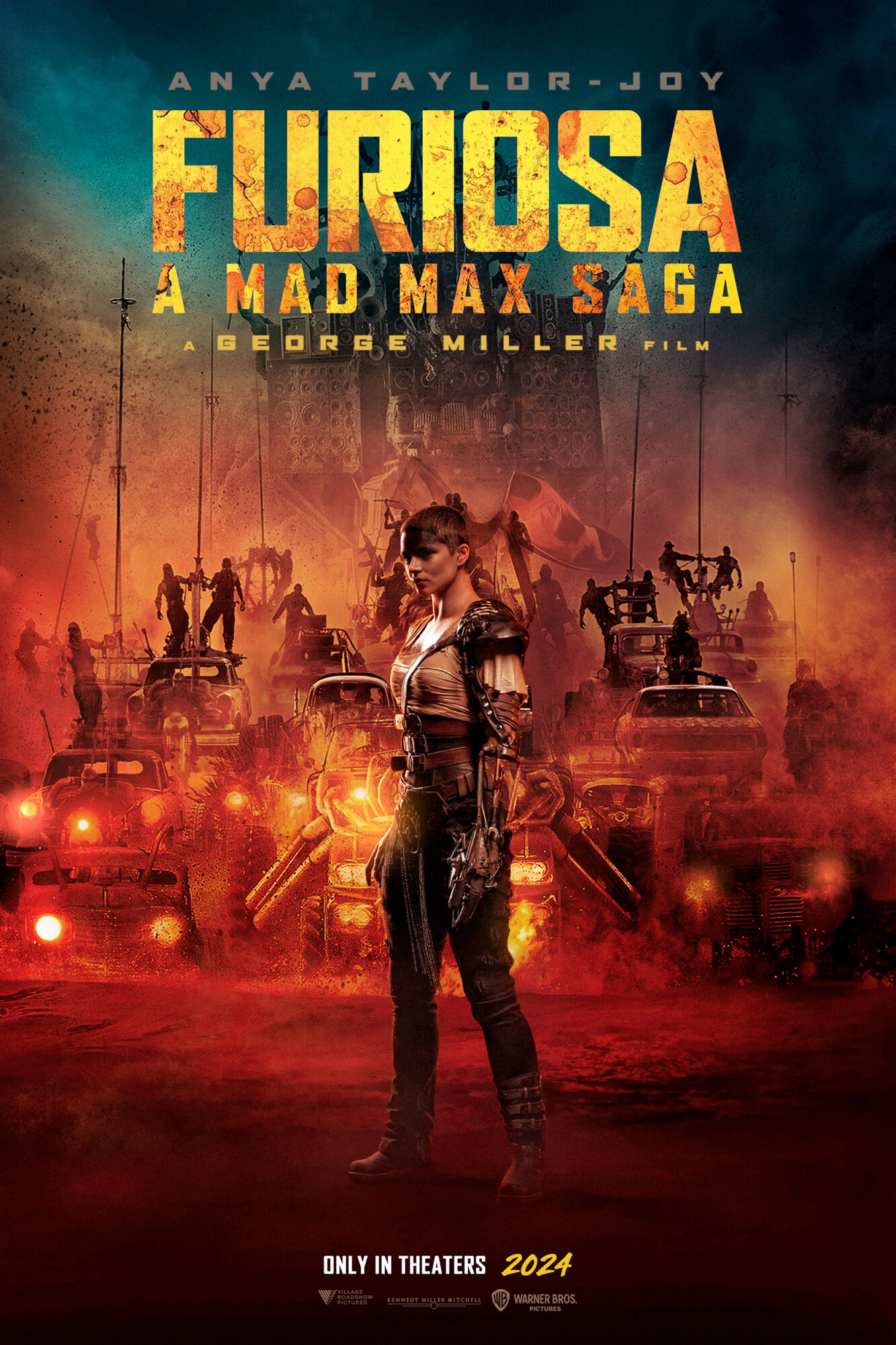
The Green Place as Eden, Memory, and the Last Moral Centre
The Green Place of Many Mothers is one of the most important symbols in Furiosa. In Fury Road, it exists first as a lost dream. Furiosa drives across the desert believing she can return to the place that was taken from her, only to discover from the Vuvalini that it has become poisoned and uninhabitable. In Furiosa, Miller lets us see why that loss matters. The Green Place is lush, hidden, fertile, matriarchal, and almost impossible to reconcile with the rest of the Wasteland.
Its visual language is deliberately different from the Citadel and Gastown. The Green Place has shade, water, fruit, soil, communal knowledge, and women who know how to live with the land rather than dominate it. The young Furiosa picking peaches is a simple image, yet it carries the whole tragedy of the film. She begins in abundance. The Wasteland teaches her scarcity.
That contrast gives the peach pit its symbolic power. Mary Jabassa does not leave Furiosa with a weapon or a crown. She leaves her with a seed. It is the smallest possible inheritance, yet it carries the memory of an entire lost ecology. The peach pit becomes a portable homeland, a private relic, and eventually a form of judgment. Furiosa cannot carry the Green Place physically, so she carries it as a promise.
Mary Jabassa and the Inheritance of Survival
Mary Jabassa is central to Furiosa's moral formation. Her pursuit of the raiders is one of the film's most important early action passages because it defines the difference between violence used for domination and violence used for protection. Mary is lethal, tactical, silent, and focused. She rides into danger with the precision of someone who knows the Wasteland can only be survived by speed, stealth, and resolve.
Her death becomes the foundational wound in Furiosa's life. Dementus forces the child to witness not only the murder of her mother, but the conversion of love into spectacle. This is how the Wasteland teaches power: it turns suffering into theatre. Furiosa's entire arc can be read as a refusal to let Mary's death become meaningless. She does not simply want revenge. She wants the world to remember what was stolen.
This gives the film one of its strongest links to Fury Road. When the older Furiosa risks everything to free Immortan Joe's wives, she is continuing Mary's act of rescue under different conditions. Mary tries to save one child from Dementus. Furiosa later tries to save five women from Immortan Joe. The gesture repeats, expands, and becomes myth.
Dementus as False Father, Failed Revolutionary, and Wasteland Clown-King
Chris Hemsworth's Dementus is one of Miller's great Wasteland grotesques. He enters like a prophet of chaos, riding before a horde of bikers and promising freedom from the existing order. Yet Dementus is hollow at the centre. He has charisma without discipline, grief without wisdom, and appetite without vision. That makes him a sharp contrast with Immortan Joe.
Dementus presents himself as a liberator, but his politics collapse into plunder. He can take Gastown, yet he cannot manage it. He can gather followers, yet he cannot build a functioning society. His rule burns through whatever it captures. That matters because Furiosa is partly about the difference between revolution and replacement. Dementus defeats one form of power only to become another form of predation.
The teddy bear attached to Dementus is a brilliant piece of symbolism. It suggests a buried wound, perhaps the loss of his own family, while also exposing the childishness beneath his warlord performance. He is a man trapped inside trauma and theatrics. He understands pain, then chooses to reproduce it. In that sense, he becomes Furiosa's darkest possible mirror. Both characters are shaped by loss. Furiosa turns loss into purpose. Dementus turns loss into entitlement.
Immortan Joe and the Theology of Control
If Dementus is chaos in motion, Immortan Joe is tyranny turned into architecture. The Citadel is more than a fortress. It is a vertical religion. Joe controls water from above, bodies from within, and belief through ritual. The War Boys do not merely serve him. They worship him. Their white-painted bodies, steering wheels, V8 chants, and dreams of Valhalla turn machinery into a death cult.
Furiosa deepens the lore of Joe's empire by showing the Citadel as part of a wider Wasteland economy. The Citadel has water and crops. Gastown has fuel. The Bullet Farm has ammunition. Together they form a brutal supply chain, with human life crushed between resource extraction and warlord bargaining. This is where the film's world-building becomes thematic. Power in the Mad Max universe is not abstract. It is pumped, refined, hoarded, rationed, traded, and weaponized.
Furiosa's captivity inside this system is especially cruel because Joe recognizes her value before she can define it herself. She is treated as property, moved through alliances, hidden among men, and eventually absorbed into the Citadel's machinery. Her later rebellion in Fury Road gains more weight because Furiosa shows how long she had to study Joe's world from inside its walls.

The War Rig as Moving Fortress, Womb, and Escape Machine
The War Rig is one of the strongest symbols across both Furiosa and Fury Road. In Fury Road, it becomes the vehicle of liberation. In Furiosa, we see how it earns that meaning. It is first introduced as a practical machine, a heavily defended trade vehicle built to move resources through a world where every road is a battlefield. Then it becomes Furiosa's school.
The Stowaway sequence is the film's great middle movement. Furiosa hides beneath the machine, survives the Octoboss's airborne assault, and proves herself through instinct, courage, and mechanical intelligence. This is where Miller fuses action choreography with character development. Furiosa does not become important because a prophecy names her. She becomes important because she can read a battlefield, fix a machine, improvise under pressure, and refuse panic when panic would kill her.
The War Rig also creates one of the strongest callbacks to Fury Road. In that film, Furiosa's command of the Rig feels absolute. Here, we watch that relationship being built. The machine becomes her shelter, weapon, trade route, prison, and finally her path toward rebellion. By the time the wives hide inside it at the end, the Rig has changed meaning completely. It is no longer Joe's supply vehicle. It has become Furiosa's ark.
Praetorian Jack and the Brief Possibility of Trust
Praetorian Jack matters because he gives Furiosa something almost absent from the Wasteland: trust without possession. Their bond is deliberately restrained. Miller avoids turning it into a conventional romance. Instead, Jack becomes a mentor, co-driver, and witness. He recognizes Furiosa's skill and treats her as a person with agency, which makes him unusual in a world built on ownership.
Jack's symbolic function is also practical. He teaches Furiosa the road. He helps her understand the codes of convoy warfare, the rhythms of the War Rig, and the survival logic of the Citadel's trade network. He is one of the bridges between the stolen child of the Green Place and the future Imperator of Fury Road.
His death is devastating because it kills more than affection. It kills Furiosa's last believable path home. The scene where Dementus has Jack dragged to death while Furiosa is forced to watch echoes the earlier murder of Mary Jabassa. Dementus repeats the same symbolic violence: he makes Furiosa witness the destruction of the person trying to save her. The pattern is deliberate. Furiosa is forged through repeated scenes of enforced spectatorship, then later becomes the woman who refuses to watch suffering continue.
The Severed Arm and the Price of Becoming Myth
Furiosa's lost arm is one of the most important continuity links to Fury Road, but Miller gives it more than explanatory value. Her arm carries the tattooed map back to the Green Place. When she loses it, she loses the literal route home. That makes the amputation symbolic as well as physical. Furiosa survives by cutting herself free, yet the cost is the destruction of the map that has guided her inner life for years.
This is one of the film's cruelest ideas. Survival can require the sacrifice of the very thing that made survival meaningful. Furiosa keeps breathing, but the girl trying to return to the Green Place dies in that escape. The shaved head and mechanical prosthetic that follow are not mere visual steps toward Charlize Theron's Furiosa. They mark the creation of a new self built from loss, metal, discipline, and rage.
The prosthetic arm also ties Furiosa to the larger Mad Max tradition of bodies becoming machines. Max's leg brace, the War Boys' damaged bodies, Joe's breathing apparatus, and Furiosa's arm all belong to a world where survival is often mechanical. Flesh fails. Metal extends it. The Wasteland mutilates people, then forces them to engineer a way forward.
The Peach Tree and the Dark Symbolism of Revenge
The ending of Furiosa is one of Miller's strangest and most poetic images. Furiosa does not simply kill Dementus in a clean heroic release. The History Man offers multiple versions of what may have happened, which fits the franchise's long-standing habit of turning events into legend. The most haunting version is the one where Dementus is kept alive as the human soil for the peach tree grown from Mary Jabassa's seed.
The image is grotesque, funny, biblical, and deeply Mad Max. Furiosa turns Dementus into a resource. The man who consumed lives becomes the ground from which life grows. The warlord who destroyed her family is forced to feed the symbol of the home he stole from her. It is vengeance reshaped as cultivation.
Yet the tree does not heal Furiosa in any easy sense. Miller is too sharp for that. The fruit does not restore the Green Place, resurrect Mary, or bring Jack back. It gives Furiosa one living thing inside the Citadel's dead moral order. That is enough. The peach she later brings to the wives becomes a quiet pledge: there was a better world once, and another escape is possible.
The History Man and the Power of Story in the Wasteland
The History Man is one of the film's most important additions to Mad Max lore. His body is covered in knowledge, names, facts, fragments, and remembered systems from before the fall. In a world where books, institutions, and stable history have largely collapsed, his own skin becomes an archive.
This matters because Furiosa is framed as a saga. The film does not simply tell us what happened. It asks how stories survive, who tells them, and how truth mutates into legend. That connects Furiosa to Max himself. Across the franchise, Max often functions less like a conventional protagonist and more like a wandering mythic figure who appears at moments of collapse, helps others cross a threshold, then disappears into the wasteland again.
Furiosa receives the same treatment here. Her life is remembered in chapters, like an oral epic: the stolen child, the road warrior's apprentice, the lost map, the severed arm, the vengeance beyond vengeance, the women hidden in the Rig. The title A Mad Max Saga is doing real work. This is a story about how the Wasteland turns pain into legend because legend is one of the few things it cannot ration.
Feminist Survival and the Rejection of Ownership
Furiosa extends one of the central themes of Fury Road: the rejection of ownership over women's bodies. Immortan Joe's wives are treated as reproductive property. Furiosa is traded, hidden, disguised, and nearly absorbed into the same system. The film's feminist power comes from watching her evade every category the Wasteland tries to impose on her.
She cuts her hair. She passes among the War Boys. She learns machinery. She earns command. She uses silence as camouflage. These choices are survival strategies, but they also expose the logic of the Citadel. In Joe's world, gender is sorted according to usefulness: breeders, milk mothers, warriors, mechanics, corpse-bound zealots. Furiosa refuses the system by becoming unreadable to it.
That refusal is why her later rescue of the wives in Fury Road feels so powerful. She knows exactly what Joe's empire does to women because she has spent years slipping through its categories. Her rebellion is intimate, informed, and specific. It is not abstract heroism. It is memory weaponized against the house that tried to consume her.
Environmental Collapse and the Religion of Scarcity
The Mad Max films have always treated environmental collapse as moral collapse. The Road Warrior made fuel the centre of its conflict. Fury Road made water, milk, blood, and fertility part of its symbolic economy. Furiosa expands that logic across the Citadel, Gastown, and the Bullet Farm.
Gastown is especially important because it reveals Dementus's emptiness as a ruler. Fuel alone cannot sustain a civilization. The place is smoke, heat, extraction, and disorder. The Bullet Farm is another variation on the same idea, a landscape where ammunition is industry and violence is output. The Citadel, by contrast, survives because it controls water and food. Joe's power rests on ecology as much as military force.
This is where the Green Place becomes more than nostalgia. It represents a form of life the Wasteland has almost entirely lost: sustainable abundance. The tragedy is that even Furiosa cannot truly return to it. By Fury Road, the Green Place has become another casualty of the world's poisoning. The home she seeks is already doomed, which makes her eventual turn back toward the Citadel so important. Liberation is no longer found by escaping history. It has to be forced inside the ruins.
Call Backs to Fury Road and the Making of Imperator Furiosa
Furiosa is packed with callbacks that deepen Fury Road rather than merely pointing at it. We see the origins of her arm. We understand her knowledge of the War Rig. We understand why the Green Place has such emotional force. We see the earlier versions of Joe's empire, the People Eater's political usefulness, the Organic Mechanic's place in the warlord ecosystem, and the resource logic that makes the Citadel such a prize.
The final movement locks directly into Fury Road. Furiosa has become Imperator. The wives are hidden inside the Rig. The peach from her tree has become a symbol of trust. Joe's fortress, once the place that swallowed her, is about to become the place she betrays from within. That is the elegance of the prequel. It does not simply answer how Furiosa lost her arm or gained her rank. It explains why her rebellion had to take the form it did.
This also helps explain why Mad Max lore has endured. Miller's Wasteland is not built around tidy continuity. It works like myth, with recurring shapes: the road, the convoy, the stolen resource, the tyrant, the damaged wanderer, the impossible escape, the fragile community trying to survive beyond the engines. Furiosa adds another shape to that myth: the stolen child who becomes the architect of liberation.

Furiosa's Real Theme: Memory Against Oblivion
The deepest theme of Furiosa: A Mad Max Saga is memory. The Wasteland is a place of amnesia. It forgets the old world, forgets morality, forgets language, forgets kinship, forgets what water and fruit once meant when they were ordinary. Dementus remembers only pain. Joe rewrites suffering as religion. The War Boys remember slogans instead of history. The History Man tries to preserve facts on his own flesh because there is almost nowhere else left to put them.
Furiosa survives because she remembers differently. She remembers her mother. She remembers the Green Place. She remembers the shape of the stars on her arm. She remembers Jack. She remembers what Joe's system does to women. That memory becomes strategy. Then strategy becomes rebellion.
By the time Fury Road begins, Furiosa is no longer trying to save only herself. She is carrying the dead forward. Mary Jabassa, the Green Place, Praetorian Jack, and every stolen year inside the Citadel are present in that War Rig. That is why Furiosa works as more than an origin story. It makes Fury Road feel heavier, stranger, and sadder. The escape across the desert is no longer just a burst of defiance. It is the final movement of a promise made beside a peach tree in a world that had almost forgotten how anything grows.

_poster.jpg)


