
Ryland Grace Project Hail Mary
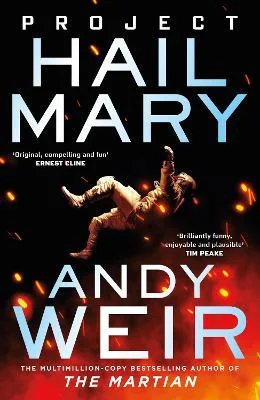
Project Hail Mary, Andy Weir's hard science fiction survival novel, begins with one of the cleanest nightmare openings in modern SF: Ryland Grace wakes aboard a spacecraft, alone, medically confused, surrounded by dead crewmates, and with no memory of who he is or why he has been sent across interstellar space.
That setup could have been a simple puzzle-box thriller. Weir turns it into something sharper. Grace's story is not only about solving the mystery of the Hail Mary mission. It is about reconstructing a self from fragments, shame, instinct, scientific memory, and moral pressure. The man who wakes in space is not the whole Ryland Grace. He is the stripped-down version. The rest of the novel shows what remains when fear, ego, and comfort are removed.
At the plot level, Grace is trying to save Earth from astrophage, a microscopic organism feeding on stellar energy and threatening to dim the Sun. At the character level, he is trying to become someone capable of living with the truth of why he is there. This essay explores Ryland Grace's character arc, how it drives the major themes of the novel, and why his final choice gives Project Hail Mary its emotional punch.
The Beginnings of Ryland Grace
Ryland Grace first appears as a consciousness without context. He does not know his name. He does not know where he is. He does not even understand that he is on a spacecraft. The opening chapters use amnesia as suspense, but it also works as a brutal character device. Grace begins the novel without the story he tells himself about himself.
As his memories return, the picture becomes more complicated. Grace was once a molecular biologist whose scientific career stalled after his controversial theories about life and water. He later became a junior high school science teacher, which is one of the smartest details in Weir's characterization. Grace is not written as a swaggering astronaut or a mythic chosen one. He is a teacher, a skeptic, a scientist, a bit of a smart-mouth, and a man who likes explaining difficult things clearly.
That teaching background matters throughout the book. Grace survives because he can break impossible problems into teachable steps. He observes. He tests. He simplifies. He translates complexity into action. It also makes him emotionally accessible. He is brilliant, but not remote. He is funny, frightened, practical, and often overwhelmed. His competence is real, but so is his panic.
A Hero Built from Reluctance
The most important thing about Grace's heroism is that it is not clean. He is not the person who volunteers nobly from the first page of his remembered life. His past reveals fear, resistance, and moral failure. When Eva Stratt and the international scientific effort identify him as one of the few people who can survive the coma required for the Hail Mary mission, Grace does not stride toward destiny. He recoils from it.
That is what gives the arc bite. Grace is not merely recovering his memory. He is recovering a truth about himself that he does not want to face. He was placed on the mission because of his rare biological suitability, but he did not embrace the sacrifice willingly. This buried shame becomes one of the novel's strongest engines. The man who wakes aboard the Hail Mary has forgotten his cowardice, but the story has not.
Weir's choice here gives Grace more moral texture than a standard science-fiction savior. He is capable of selfishness. He is capable of fear. He is capable of refusing the burden. The ending matters because it answers that earlier failure. Grace does not become heroic because the book insists he is heroic. He earns that status by making a harder choice when no one is left to force him.
Navigating Isolation and Survival
A major portion of the novel follows Ryland Grace's solitary existence aboard the Hail Mary, travelling toward Tau Ceti in the hope of solving a stellar plague that Earth barely understands. The isolation is physical, psychological, and existential. Grace is not simply far from home. He is cut off from any human future he can realistically expect to rejoin.
The Hail Mary itself becomes a pressure chamber for character. Grace wakes among the dead bodies of the other crew members. He has limited resources, incomplete knowledge, and a mission whose details return only in fragments. Every discovery sharpens the horror. Earth is in danger because astrophage is draining the Sun's energy. Venus, the Petrova line, Tau Ceti, and the strange survival of one unaffected star all become pieces of a cosmic biological mystery.
Grace survives by treating terror as data. That is one of the great pleasures of the novel. Weir turns scientific method into action storytelling. Grace tests assumptions, revises models, builds tools, wrecks plans, panics, recalculates, and keeps moving. He is not calm because space is safe. He is calm in flashes because thinking is the only lever he has left.
This is where Grace's identity as a teacher and scientist fuses with the survival plot. He explains the world in order to survive it. The novel's science is full of orbital mechanics, chemistry, biology, radiation, energy transfer, and alien environments, but those details are not decoration. They are the language of Grace's endurance.
Rocky and the Expansion of Grace's World
Grace's arc changes completely when he meets Rocky, the Eridian engineer. Until that point, the novel can be read as one man against the void. Rocky changes the story into something larger, stranger, and warmer. Grace discovers that humanity is not the only species facing extinction from astrophage. The Eridians, from the 40 Eridani system, are trapped in the same cosmic crisis.
Rocky could easily have been a gimmick: the helpful alien sidekick, the weird voice in the room, the problem-solving partner with funny biology. Instead, Weir makes him the emotional equal of Grace. Rocky has his own intelligence, culture, engineering genius, grief, loyalty, and desperation. His species experiences the universe differently, especially through sound and pressure, but his fears are painfully recognizable.
The Grace-Rocky relationship gives the book its heart. Their friendship begins through experiment and translation. They learn each other's languages. They build systems. They compare biology. They solve problems neither species could solve alone. The barrier between them is immense, but the bridge is practical trust. That is why their bond feels earned. It is not sentimental first. It becomes sentimental because it begins as work.
This relationship also exposes one of the novel's central ideas: intelligence is not enough by itself. Survival requires cooperation across difference. Grace and Rocky do not need to become the same. They need to understand enough of each other to act together. That is a more interesting version of alien contact than simple wonder. It is contact as labor, translation, risk, patience, and care.
Rediscovering Purpose and Identity
As the narrative unfolds, Ryland Grace gradually pieces together the true purpose of his mission. He is not on a grand exploratory voyage. He is the last working part of a desperate planetary gamble. Earth has sent the Hail Mary because astrophage is dimming the Sun, destabilizing the climate, and pushing humanity toward collapse.
This knowledge changes the meaning of Grace's survival. Staying alive is no longer only personal. His body carries the mission. His memory carries the missing context. His scientific ability carries Earth's chance of understanding the organism well enough to fight it. The stakes do not make him instantly noble. They make him trapped inside responsibility.
Grace's rediscovery of identity is therefore double-edged. On one side, he remembers his skills, his students, his work, and the global crisis that led to the mission. On the other, he remembers the more uncomfortable truth: he was afraid. He was not the pure volunteer hero the situation seems to require. The novel keeps returning to that tension between usefulness and courage. Can a person who failed once still become the person others need?
By making Grace both necessary and reluctant, Weir avoids flattening him into a wish-fulfillment genius. Grace's arc is about becoming morally worthy of his own abilities. He has the mind for the mission from the beginning. The question is whether he can grow the soul to match it.
Collaborative Problem-Solving as Character
Grace's defining talent is problem-solving, but Weir makes it more than a mechanical skill. Grace's method reveals his character. He observes before declaring. He tests before assuming. He admits error when the data turns against him. He is willing to look foolish if looking foolish gets him closer to the truth.
That flexibility is vital once Rocky enters the story. Grace has to stop thinking only as a human scientist. Rocky's body chemistry, atmosphere, pressure needs, communication style, and engineering assumptions all force Grace to stretch beyond familiar models. He learns that intelligence can take forms that are not human, not visual, not Earthlike, and not intuitive to him.
The novel's best science-fiction lore grows out of this contrast. Astrophage is not magic fuel, even though humans learn to use it that way. It is a living organism with a reproductive cycle, energy behavior, and ecological vulnerabilities. Taumoeba is not a convenient cure-all, but another organism with its own environmental limits. The solution to the crisis depends on understanding life as systems within systems. Grace's growth mirrors that scientific model. He survives by widening the frame.
That is why the collaboration with Rocky feels thematically right. Earth's survival and Erid's survival depend on two minds accepting that neither has the full answer alone. Weir's optimism is not naive here. It is grounded in work. Cooperation is not treated as a slogan. It is built out of shared tools, shared danger, shared mistakes, and shared grief.
Sacrifice and Redemption
Grace's arc reaches its full force when the mission becomes a choice rather than an assignment. The earlier version of Grace had to be forced into sacrifice. The later version chooses it. That is the spine of the character arc.
The ending asks Grace to decide what kind of person he is when there is no audience, no commander, no Stratt, no human institution, and no Earthly reward. He can return home with the knowledge that may save humanity, or he can risk everything to save Rocky and the Eridians from disaster. The choice is devastating because both sides matter. Earth matters. Rocky matters. Two worlds hang in the balance, and Grace is no longer able to think of one as real and the other as expendable.
That is where redemption enters the novel. Grace does not erase his earlier fear. He answers it. He becomes capable of acting from love, loyalty, and moral imagination, not merely from orders or survival instinct. His friendship with Rocky expands his definition of duty. By the end, saving another species is not an abstract ethical puzzle. It is personal.
The power of the ending comes from this reversal. Grace begins as a man who did not want to die for humanity. He ends as a man willing to give up Earth itself for the chance to save another people. That is not a small character shift. It is the entire novel made human.
Contribution to Themes and Ending
Ryland Grace's character arc carries nearly every major theme in Project Hail Mary. His resilience gives the survival story its momentum. His scientific curiosity gives the plot its method. His guilt gives the emotional structure bite. His friendship with Rocky gives the novel warmth. His final sacrifice gives the ending its moral shape.
The novel is often praised for its science, and fairly so, but its real strength is that the science keeps revealing character. Astrophage, Tau Ceti, the Hail Mary, Eridian engineering, and the search for Taumoeba all matter because they force Grace into decisions. Weir understands that a good science-fiction problem should not only ask, "How does this work?" It should also ask, "What does this demand from the person trying to solve it?"
Grace's actions do not create a simple alliance between humans and astrophage. Astrophage remains the crisis organism and the energy source humanity learns to exploit. The deeper connection is between humans and Eridians, made possible by Grace and Rocky's trust. The novel's final emotional payoff comes from that bridge. Two species survive because two isolated beings chose patience, cooperation, and loyalty over fear.
That is why the ending lands. It resolves the plot, but it also resolves Grace. The man who wakes up alone in a spaceship without memory becomes someone defined by memory, friendship, and chosen responsibility. He does not simply recover who he was. He becomes better than the man he remembers being.
Conclusion
In Project Hail Mary, Andy Weir crafts one of his strongest protagonists in Ryland Grace, not because Grace is the smartest man in the room, but because his intelligence is constantly tested by fear, shame, loneliness, and love. He is a scientist, a teacher, a survivor, and finally a friend whose loyalty reaches beyond species.
Grace's transformation gives the novel more weight than a clever extinction-avoidance plot alone could carry. His friendship with Rocky turns the story from survival fiction into contact fiction. His scientific work gives the book its engine. His final choice gives it its soul.
For readers interested in how character can drive hard science fiction rather than simply decorate it, Ryland Grace stands as one of Andy Weir's best creations. His arc is central to Project Hail Mary because it proves the novel's deepest idea: survival is not only about staying alive. It is about deciding what kind of life is worth preserving, and who else deserves to share the future.

_poster.jpg)


