

How The Creator director Gareth Edwards creates a unique sense of scale in his films
How Gareth Edwards Makes Scale Feel Real in Rogue One
From The Creator to Godzilla and Rogue One, Gareth Edwards has built a filmmaking identity around one thing above all else, making size feel physical.
Film directors talk about scale all the time, but Gareth Edwards is one of the few who consistently makes it register in your body. His frames do not just tell you that something is enormous. They make you feel tiny in relation to it. That is why the best moments in his films linger. They are not just visual effects showcases. They are encounters with mass, distance, and dread.
In Rogue One: A Star Wars Story, that sensibility reaches one of its purest expressions in the Death Star over Jedha. It is one of the film’s defining images, not because it is loud, but because Edwards stages it with patience. The horizon holds. The eye adjusts. Then the shape appears, and suddenly the sky itself feels colonised.

Scale begins with composition
Edwards understands that scale is not created by size alone. It is created by comparison. That is why his best shots are built around horizon lines, tiny human figures, looming silhouettes, and negative space. He uses wide compositions to make characters look exposed. He uses low angles to make machinery and creatures feel oppressive. He lets the environment do part of the storytelling, so the audience is always measuring the human against the monumental.
The Death Star shot in Rogue One is a perfect example. The station does not just appear as an object in the frame. It alters the frame. It changes the mood, the balance, and the emotional weight of the scene. The sky no longer feels open. It feels occupied. That is a subtle distinction, but it is the difference between spectacle and cinema.
How Rogue One was built to feel huge
What makes this even more interesting is that the scale in Rogue One was not only found in the edit or added by effects artists after the fact. It was baked into the process. Edwards came from a visual effects background, and that gave him a very practical understanding of how digital tools could serve camera language rather than overpower it. Instead of treating VFX as a fix applied later, he approached it as part of the grammar of the shot.
One of the key reasons the film’s scale feels so coherent is that Edwards and ILM could explore shots inside a virtual environment rather than simply locking everything to rigid boards and diagrams. That helped the digital material feel photographed, not merely assembled.
It also meant that even in effects-heavy material, Rogue One could retain the loose, observational quality that makes the best war cinema feel immediate.
That matters because Rogue One was not trying to look sleek or pristine. Edwards wanted a dirtier, more tactile corner of Star Wars. Greig Fraser’s photography pushes the film toward something harsher and more grounded, less fairy tale, more frontline reportage. You can feel it in Jedha’s dust, in the hard light across Scarif, and in the way metal surfaces look weathered rather than polished.
The production design plays the same game. Because the story leads directly into A New Hope, the filmmakers were not inventing a whole new visual language. They were trying to reconnect with an older one. That is why the world of Rogue One feels lived-in in the right way. It does not merely copy the original trilogy. It studies its grammar, then extends it.
Why the Jedha sequence hits so hard
Jedha works because everything is layered toward the same emotional result. The city feels ancient, sacred, and unstable before the Death Star even enters the composition. The architecture carries weight. The streets feel used. The conflict already feels like it has history. So when the station arrives overhead, the image becomes more than a cool shot. It becomes a violation.
Edwards is especially good at staging these moments as a crisis of perspective. Characters look up. Crowds pause. The world seems to hold its breath. He is not simply showing us a large thing. He is showing us a human response to that large thing. That is the missing ingredient in a lot of modern blockbuster imagery. Without human orientation, size means very little.
Even the destruction itself is handled with a kind of dreadful clarity. The blast is not treated as abstract light. It has shape, force, and movement. It feels like a physical event rolling through geography. That gives the scene its apocalyptic quality. You are not just watching an explosion. You are watching scale weaponised.
Monsters, Godzilla, and the Edwards signature
You can trace this technique back through Edwards’ earlier work. In Monsters, he used real landscapes and integrated giant lifeforms into them with remarkable restraint. The creatures often sit at the edge of the frame or emerge through atmosphere, which makes their presence feel accidental, almost documentary. That choice is crucial. The film does not scream scale. It lets scale creep up on you.
In Godzilla, he refined the method. Rather than overexposing the monster from the start, Edwards repeatedly frames the creature through partial views, obstructed sightlines, collapsing city corridors, and the reactions of people on the ground. Godzilla feels large because the film keeps returning to what that size does to buildings, streets, aircraft, and human confidence.
That same logic powers Rogue One. Whether it is a Star Destroyer over Scarif, an AT-ACT crossing the battlefield, or the Death Star darkening the horizon, Edwards keeps anchoring enormity to space, weather, architecture, and vulnerable bodies. He understands that grandeur is clearest when something fragile stands next to it.
Sound is part of the illusion
Visual scale alone is never enough, and Edwards knows it. Sound design completes the trick. Massive objects need air, vibration, delay, and pressure. The low-end rumble of engines, the long decay of impact, the sense that the atmosphere itself is reacting, all of that turns an image into an event.
You can hear that principle at work in Godzilla, where the creature’s presence is often announced through sonic pressure before the eye fully catches up. In Rogue One, the same philosophy makes Imperial machinery feel brutally heavy. The sound does not decorate the scale. It confirms it.
Why this matters in Star Wars
Star Wars has always depended on scale. The original film made the Death Star feel impossible. The Star Destroyer over Tatooine remains one of the great perspective shocks in cinema. What Edwards did in Rogue One was reconnect with that original feeling while filtering it through a more modern, war-torn visual language.
That is why his work on the film still stands out. He did not just give Star Wars bigger images. He gave it heavier ones. He restored a sense that ships, stations, and weapons occupy real space, cast real dread, and change the emotional weather of every scene they enter.
Edwards also managed to sneak in a cool reference to the Journal of the Whills, which feels entirely appropriate. His best Star Wars imagery always carries that same sense of myth meeting machinery, scripture meeting steel.
Final takeaway
Gareth Edwards is not simply good at making big things look big. He is good at making them feel spiritually and physically overwhelming. That is a harder skill, and it is the reason the best images in Rogue One still hit with such force.
The Astromech, Film Craft, Star Wars How Gareth Edwards Makes Scale Feel Real in Rogue One F...
Read Article →
Who is Madeleine Yuna Voyles: Alfie from The Creator
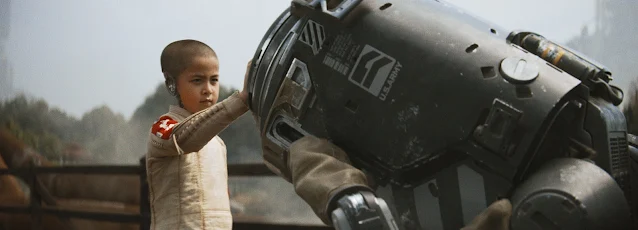
Who plays Alfie from The Creator?

Who plays Alfie from The Creator? Introducing Madeleine Yuna Voyles , a remarkably talented young actress who discovered her passion for the...
Read Article →
Themes of The Creator (2023) directed by Gareth Edwards


Visual Storytelling
Edwards' visual storytelling is a crucial element in conveying the film's themes. The director's use of real-world locations, combined with science fiction elements, creates a unique visual language that immerses the audience in the story's world. The film's cinematography, production design, and special effects work in tandem to highlight the emotional and thematic undercurrents of the narrative. The visual style serves not only as a backdrop but also as an active participant in the storytelling, enhancing the exploration of the film's complex themes.
In summary, "The Creator" is a richly layered film that explores the intersections of artificial intelligence, human relationships, moral ambiguity, and visual storytelling. Gareth Edwards' direction brings these themes to life, offering a nuanced and compelling perspective on the implications of AI and the nature of human experience
At the heart of this cinematic masterpiece lies the perennial struggle between creation and creator (focusing on Alfie played by Madeleine Y...
Read Article →
"Cause and Effect" - Classic Star Trek: The Next Generation Episode
Star Trek: The Next Generation's "Cause and Effect" Explained
The Enterprise explodes before the story has even started. That is the hook. No warning. No heroic escape. No last-second miracle from Data. The flagship of the Federation spins helplessly through space, Picard orders all hands to abandon ship, the warp core breaches, and the screen goes white.
Then the episode calmly begins again.
"Cause and Effect" remains one of the great high-concept episodes of Star Trek: The Next Generation because it turns repetition into suspense. The premise is simple enough to explain in one sentence: the crew of the USS Enterprise-D is trapped in a temporal causality loop that ends with the destruction of the ship. The brilliance lies in how the episode makes the same events feel different each time. Every loop carries a new detail. A broken glass. A poker hand. A whisper in the night. A number that should mean nothing until it means everything.
Originally aired on March 23, 1992, "Cause and Effect" was written by Brannon Braga and directed by Jonathan Frakes. It is now rightly treated as one of the defining TNG time stories, sitting in the same broad conversation as the bootstrap paradox and other time-loop narratives, while also retaining the clean command-room logic that made TNG such a reliable machine for philosophical science fiction.
| Episode | "Cause and Effect" |
|---|---|
| Series placement | Star Trek: The Next Generation, Season 5, Episode 18 |
| Original air date | March 23, 1992 |
| Writer | Brannon Braga |
| Director | Jonathan Frakes |
| Stardate | 45652.1 |
| Primary setting | The Typhon Expanse |
| Key guest appearance | Kelsey Grammer as Captain Morgan Bateson of the USS Bozeman |
| Core threat | A temporal causality loop caused by a collision near a space-time distortion |

The Plot: A Disaster the Crew Cannot Remember
The Enterprise-D enters the Typhon Expanse, an unexplored region of space, and soon encounters a localized distortion in the space-time continuum. A mysterious starship emerges from the distortion on a collision course. The helm does not respond. Power fluctuates. The crew has seconds to act.
Riker suggests decompressing the main shuttlebay, using the force of expelled air to push the Enterprise clear. Data suggests using the tractor beam to alter the other ship's trajectory. Picard chooses Data's option. It fails. The ships collide, the starboard nacelle is destroyed, the warp core breaches, and the Enterprise is annihilated.
Then the loop resets.
The genius of "Cause and Effect" is that the crew does not wake up with full memories. This is not a simple reset-button story where everyone remembers the previous attempt and adjusts the plan. Instead, the memories return as emotional residue. Déjà vu. Instinct. Unease. A feeling that the conversation has happened before. The crew is solving a murder in which they are both the victims and the witnesses, except every death erases the evidence.
Why the Opening Works So Well
Star Trek had destroyed the Enterprise in simulations, alternate futures, dreams, and parallel possibilities before, but "Cause and Effect" gives the image unusual force because it arrives without explanation. The cold open does not frame the destruction as a hypothetical. It plays as the actual end of the ship. For a few seconds, the audience is placed in the same state as the characters: confusion, shock, disbelief.
That choice matters. The episode does not begin with technobabble. It begins with consequence. We see the effect before anyone can explain the cause. The title is almost a joke on the viewer. The episode has inverted the usual order of storytelling. The disaster comes first. Understanding comes later.
That is why the repetition never feels lazy. Every return to the poker table, sickbay, the observation lounge, and the bridge carries dread. We know where this road leads. The crew does not. Suspense comes from the gap between audience knowledge and character knowledge.
The Time Loop Explained
La Forge eventually identifies the crisis as a temporal causality loop. The Enterprise is trapped in a fragment of time, repeating the same sequence of events without retaining conventional memory. Each cycle ends in catastrophe, and the catastrophe itself helps sustain the loop.
The most important clue comes through Dr. Crusher. She begins hearing voices, later revealed to be echoes of previous loops. This gives the episode a ghost-story texture. At first, the voices feel supernatural, almost haunted. In classic TNG fashion, the haunting becomes a scientific phenomenon. The ghosts are the crew themselves, bleeding backward through their own repeated deaths.
The solution depends on Data. La Forge and Data work out that a dekyon emission might create a resonance in Data's positronic subprocessors, allowing him to carry a tiny message into the next loop. The message must be simple. It cannot be a full explanation. It cannot say, "Listen to Riker." It becomes the number three.
Lore note: why Data is the perfect memory vessel
Data is crucial because he is both a person and a machine. TNG often uses him to explore consciousness, identity, and personhood, as seen most famously in "The Measure of a Man". In "Cause and Effect," his android nature gives the crew a physical way to smuggle information across a reset. The story does not reduce Data to hardware. It uses his design as an extension of his character, a mind that can notice patterns where others feel only dread.
The Number Three: A Clue Hidden in Plain Sight
The number three becomes the episode's signature motif. Cards appear in threes. Data registers the number repeatedly. The crew encounters it so often that coincidence becomes impossible. The clue finally pays off when Data looks at Riker's three rank pips and understands that the message refers to Riker's suggestion, not to a scientific equation or a navigation code.
This is one of the episode's smartest moves. The answer is not buried in an obscure subspace calculation. It is attached to character. Riker's instinct was right. Data's analysis was wrong the first time. Picard's command choice, perfectly reasonable under pressure, keeps leading to disaster. The loop can only be broken when the crew trusts a clue that points toward the human, improvisational option.
The result is beautifully TNG. The solution requires science, memory, intuition, collaboration, and trust. No single officer solves the episode alone. Crusher notices the anomaly. La Forge frames the theory. Data carries the message. Riker supplies the correct tactic. Picard creates the command environment where impossible-sounding evidence can still be heard.
Character Analysis: Everyone Has a Role
Dr. Crusher is the first real investigator
Beverly Crusher is often at her best when the show lets her medical instincts become investigative instincts. Here, she is the first character to treat déjà vu as evidence rather than mood. The voices she hears are frightening, but she does not dismiss them. She records them. She tests them. She brings them into the scientific process.
That gives the episode a stronger emotional spine. Crusher is not just noticing a plot clue. She is listening to the dead, even if the dead are versions of the crew only seconds removed from their own destruction.
Picard models command under uncertainty
Picard's great quality in "Cause and Effect" is restraint. He does not leap at every strange sensation. He also does not mock the crew for reporting them. Once the evidence accumulates, he allows the impossible to become operationally relevant. That is very Picard. He does not confuse skepticism with arrogance.
His order to stay on course is especially telling. It sounds stubborn at first, but the logic is sound. If the crew changes direction without understanding the loop, that change may itself become part of the trap. Picard refuses panic. He makes room for evidence.
Riker's instinct saves the ship
Riker's shuttlebay decompression idea is exactly the kind of practical, physical, slightly wild tactic that suits him. It feels like a first officer's battlefield solution rather than a scientist's elegant theory. That is why the final revelation lands. The correct answer was available from the beginning, but the crew needed the loop to teach them which voice to trust.
Data learns the meaning, not just the pattern
Data identifying the number three is only half the victory. The more important step is interpretation. He must connect the symbol to Riker. This gives the final bridge scene its charge. Data is not simply obeying stored information. He is making a leap from pattern to meaning, and that leap saves everyone.
The USS Bozeman and Captain Morgan Bateson
The final reveal widens the episode from a closed-loop puzzle into a piece of Star Trek history. The other ship is the USS Bozeman, a Soyuz-class vessel commanded by Captain Morgan Bateson, played by Kelsey Grammer. From the Enterprise crew's perspective, they have lost 17.4 days. From the Bozeman's perspective, something far stranger has happened. Bateson believes the year is 2278. His ship has been displaced roughly 90 years into the future.

The cameo works because it is so underplayed. Bateson is not treated as a celebrity entrance. He is simply a displaced Starfleet captain who thinks he has been gone for weeks, not decades. Picard's response is gentle, almost quietly devastating: Bateson should beam aboard, because there is a lot to discuss.
In lore terms, the Bozeman reveal links the episode back toward the movie-era Starfleet of the late 23rd century. The Soyuz-class design also carries visual DNA from the Miranda-class family, familiar to fans through ships like the USS Reliant from Star Trek II: The Wrath of Khan. That makes the closing image feel like a ghost from Starfleet's past drifting into the polished carpeted future of the Enterprise-D.
Production Trivia and Behind-the-Scenes Details
Brannon Braga's time-loop breakthrough
Brannon Braga became strongly associated with temporal and reality-bending Star Trek stories, and "Cause and Effect" is one of the cleanest examples of that skill. The episode predates the release of Groundhog Day, which is important because modern viewers often assume the film created the template. TNG reached the time-loop structure independently and shaped it into a Starfleet procedural.
Jonathan Frakes avoided making it feel like a clip show
The challenge for Frakes was obvious: how do you repeat the same story beats without boring the audience? The answer was variation. The repeated scenes are staged, framed, and performed differently across loops. The repetition is structural, but the viewing experience keeps shifting. The audience starts watching like Data, scanning tiny differences for meaning.
The Enterprise destruction had real visual weight
The destruction of the Enterprise-D was given extra force through model work and pyrotechnic effects. That physicality matters. The explosion feels brutal because the episode needs the audience to believe the stakes, even though the story will reset. The ship does not vanish politely. It dies.
The main shuttlebay finally mattered
The main shuttlebay of the Galaxy-class Enterprise-D was a famous piece of internal starship scale that the series rarely visualized. "Cause and Effect" gives it a rare spotlight because Riker's decompression plan depends on the sheer volume of the bay. The solution is rooted in the physical design of the ship, which is part of why it feels satisfying.
Kelsey Grammer was nearly part of an even bigger cameo
Grammer's appearance as Bateson is already a fun Star Trek footnote, but the production history has an even wilder possibility attached to it. The show reportedly hoped to include Kirstie Alley as Saavik on the Bozeman bridge, which would have connected the cameo even more directly to the movie era. Scheduling prevented it, leaving Grammer's understated Bateson as the final grace note.
Themes: Fate, Memory, and the Courage to Change Course
"Cause and Effect" is often remembered as a clever time-loop episode, but its deeper theme is the relationship between memory and freedom. The crew can only escape repetition once fragments of past failure become usable knowledge. Without memory, choice collapses into habit. With even the smallest piece of memory, the future can be changed.
That places the episode in conversation with broader science-fiction questions about free will and predestination. The crew is trapped inside a deterministic system, but the system is not perfect. It leaks. The whispers leak. The glass leaks. The cards leak. The number three leaks. Freedom enters through the cracks.
There is also a neat contrast with other television time-loop stories, including "Monday" from The X-Files. That episode is more tragic and moral, built around emotional repetition and fatal choices. "Cause and Effect" is more procedural and analytical, built around observation, evidence, and command decisions. Both use the loop to ask the same frightening question: how many times can people make the same mistake before something finally changes?
The real lesson of the loop
The episode's answer is surprisingly hopeful. The crew does not escape because one genius solves everything. They escape because each person contributes one part of the answer. TNG's optimism is not sentimental here. It is operational. The future changes when expertise is shared and trusted.
Why "Cause and Effect" Still Ranks Among the Best TNG Episodes
"Cause and Effect" belongs near the top tier of The Next Generation because it does what the series did best: it takes a wild science-fiction premise and expresses it through disciplined character logic. It has the shock value of an action episode, the puzzle-box pleasure of a mystery, and the philosophical aftertaste of classic Star Trek.
It also pairs neatly with other TNG masterpieces. "The Measure of a Man" asks whether Data has rights. "The Inner Light" asks what a lifetime means when experienced through memory. "Cause and Effect" sits between those poles. It uses Data's unique mind as a survival mechanism and treats memory as the fragile thread that keeps identity, knowledge, and choice alive.
The episode also understands economy. There is no villain. The Bozeman crew is not malicious. The anomaly is not evil. The danger comes from physics, timing, and repeated error. That makes the story feel cleaner and colder. Space does not hate the crew. It simply traps them.
FAQ: "Cause and Effect" Explained
How long was the Enterprise trapped in the time loop?
The Enterprise-D's chronometers are found to be off by 17.4 days, meaning the crew has been repeating the loop for just over two weeks from the outside universe's point of view.
How long was the USS Bozeman displaced?
Captain Bateson believes the year is 2278, while the Enterprise crew is in 2368. That means the Bozeman has effectively been thrown around 90 years into the future.
What does the number three mean?
The number three is the message Data sends into the next loop. He eventually interprets it as a reference to Riker's three command pips, meaning Riker's shuttlebay decompression plan is the correct choice.
Why does Picard choose Data's plan first?
Data's tractor-beam solution sounds more controlled and technically precise. Under extreme pressure, Picard chooses the option that seems most predictable. The tragedy is that the more intuitive, physical solution is the one that actually works.
Why is Kelsey Grammer in the episode?
Kelsey Grammer appears briefly as Captain Morgan Bateson of the USS Bozeman. The cameo is memorable because it arrives at the very end, turning the time-loop puzzle into a larger Starfleet displacement story.
Final Assessment
"Cause and Effect" is a masterclass in repetition with purpose. It opens with the most alarming image TNG could offer, the destruction of the Enterprise, then turns that shock into a careful mystery of memory, pattern recognition, and command trust. The episode's power comes from restraint. It does not over-explain the anomaly. It does not drown the story in spectacle. It lets the crew think.
That is why it lasts. "Cause and Effect" is not just a clever time-loop episode. It is a compact expression of what made Star Trek: The Next Generation work at its best: intelligent people facing the impossible, listening to one another, and finding just enough meaning in the noise to survive.
Star Trek: The Next Generation's "Cause and Effect" Explained The Enterprise explodes before ...
Read Article →
The plot of Halo 3 explained
Halo 3: The End of the War?
Halo 3 is not simply the conclusion of a trilogy. It is the moral, spiritual, and historical reckoning of the entire Human-Covenant War. Every major faction enters this chapter carrying the burden of lies, losses, betrayals, and irreversible decisions. Where Halo: Combat Evolved introduced mystery and survival, and Halo 2 exposed contradiction and schism, Halo 3 resolves belief through consequence.
This is the game where prophecy is finally tested against truth. It is where the Covenant’s theology collapses under the weight of its own violence, where humanity learns that survival depends on more than force, and where the series begins to shift from military science fiction into something older and stranger, a war fought not only over worlds, but over history, inheritance, and who gets to decide the future of all sentient life.
This expanded mission-by-mission timeline deepens the narrative context, foregrounds key lore moments, and clarifies how each chapter pushes the galaxy toward either extinction or survival.
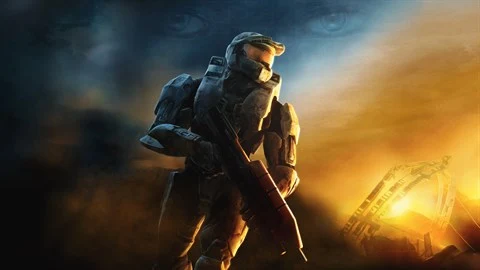
Mission 1 | Arrival
The War Comes Home
Halo 3 opens with gravity and consequence. The Master Chief crash-lands in East Africa, his return to Earth marked not by ceremony but by fire, debris, and exhaustion. Humanity has survived the Covenant’s attack on Earth, but only barely. Cities are scarred. Military command is fractured. The tone is immediate and severe. There is no illusion of triumph here. Survival has replaced strategy.
As Master Chief emerges from the wreckage, the player is reminded that the war is no longer being fought at the farthest reaches of human space. Earth itself has become a battlefield, which means the symbolic centre of humanity is now exposed. There is nowhere deeper to retreat. The stakes are no longer colonial, tactical, or even merely species-level. They are existential and final.
The level also quietly reinforces one of Halo’s enduring strengths, scale through mood. Chief lands alone, battered, almost mythic in his silence, but what surrounds him is not heroic grandeur. It is a planet under siege. Marines fight in confusion. Commanders improvise under pressure. The war is no longer abstract. It has come home.
The arrival of High Charity in orbit, and the Covenant’s focus on Earth, reframes the conflict even further. Earth is not being treated as a simple military prize. It is a ritual site. To Truth, this is the place from which the Great Journey must be completed. In that sense, Arrival tells the player something important before the game ever says it outright. The final battle is not merely about winning. It is about preventing belief from becoming extinction.
Mission 2 | Sierra 117
Allies Without Faith
Set in dense jungle terrain, Sierra 117 is a mission about recovery, reconnection, and uneasy new alignments. Chief rescues Sergeant Johnson and rejoins the surviving human command structure, which gives the story emotional continuity as much as tactical direction. Johnson’s presence matters because he embodies the war’s older human spirit, the soldier who has endured impossible odds and still remains recognisably human, cynical, brave, and defiant.
The Arbiter’s presence changes the mission’s meaning. In gameplay terms, he is an ally. In narrative terms, he is evidence that the Covenant has already begun to rot from within. This is not a simple alliance of convenience. It is a union born from revelation. The Arbiter has learned that the religion he killed for was built on deception. Humanity, once framed as heretical and beneath contempt, is now fighting alongside him not because trust has been earned in full, but because Truth’s vision is worse than old hatred.
This mission is also where Halo 3 starts working through one of its central ideas, what remains once faith breaks. The Covenant had coherence because they believed. The Elites had purpose because they served. Once that belief is exposed as a lie, identity itself must be rebuilt. Sierra 117 is therefore not simply a rescue mission. It is the first real shape of the post-Covenant future, two former enemies walking into battle together because reality has destroyed the old myth.
Mission 3 | Crow’s Nest
Containment Fails
Crow’s Nest begins like a more traditional defensive operation. Humanity appears to have a fortified position, a command hub, a place from which to respond. That illusion does not last. Halo has always been a series deeply suspicious of containment, and this mission proves again that systems built to hold chaos at bay usually fail at the exact moment they are most needed.
The reappearance of the Flood inside a supposedly secure UNSC facility is horrifying not simply because of what they are, but because of what they represent. They turn every sealed bunker into a trap, every chain of command into a liability, and every assumption about control into fantasy. The Flood do not merely attack defences. They expose the futility of relying on them.
At the same time, Truth’s plan becomes clearer. He is no longer pursuing victory in any conventional sense. He is moving toward apocalyptic confirmation. The Halo Array, in his hands, is not a reluctant last resort but a sacred instrument. That makes him more dangerous than a conqueror. He would rather erase the galaxy than admit the foundations of his faith are false.
Crow’s Nest therefore becomes an early statement of Halo 3’s broader worldview. Institutions fail. Walls fail. Dogma fails. The only thing that matters is whether enough people can recognise the truth before belief destroys everything.
Mission 4 | Tsavo Highway
Evacuation as Strategy
Tsavo Highway is one of the clearest examples of Halo using scale to convey desperation rather than triumph. On the surface, it offers the player wide spaces, vehicle combat, and the thrill of movement. Underneath that, however, the mission is fundamentally about retreat. This is not humanity surging forward in confidence. It is humanity trying to get out alive while the world behind it burns.
That makes the level more interesting than it first appears. The UNSC is no longer planning for clean victory or even for stable defence. It is managing collapse. Marines are being extracted from positions they cannot hold. Covenant pressure is relentless. Every stretch of road feels temporary, every victory minor and conditional.
Truth’s broadcast amplifies that sense of dread. His rhetoric is not designed to persuade anymore. It is the language of finality. The Great Journey is imminent. Dissent is gone. The Covenant is no longer a coalition with internal tensions. It has become a sharpened instrument of one fanatic will, even as its foundations begin to crack.
Tsavo Highway matters because it takes what could have been a straightforward action sequence and turns it into a study in strategic exhaustion. The war is compressing. Time is running out. Earth is slipping away.
Mission 5 | The Storm
The Shape of the Endgame
The Storm pushes Halo 3 into full military escalation. Massive Covenant anti-air positions dominate the landscape, and disabling them becomes essential if Earth is to have any chance at survival. Yet even here, the mission is doing more than staging a large battle. It is widening the player’s understanding of what the Covenant war machine really is.
The Scarab encounter is central to that effect. Scarabs are terrifying not only because of their firepower, but because they are the perfect visual expression of Covenant ideology translated into machinery. They are religious war engines, towering symbols of force used to make doctrine physical. When the player fights one, they are fighting more than armour. They are fighting the industrial might of belief.
The real turning point, however, is the revelation of the Ark. This is where the game breaks open. Up to now, Halo’s story has been about rings, relics, prophecies, and hidden superweapons. The Ark reframes everything. The rings are not isolated miracles. They are part of a larger system. A network. A design. A controlled architecture of extermination.
That revelation expands the universe at the same moment it narrows the conflict. The final battle is no longer simply about defending Earth. It is about reaching the mechanism that controls all endings. The trilogy stops being a war story for a moment and becomes a myth about the hand on the trigger.
Mission 6 | Floodgate
The Logic of the Parasite
Floodgate is one of Halo 3’s most effective tonal pivots. After the large-scale combat of The Storm, the game suddenly becomes intimate, contaminated, and grotesque. High Charity arrives not as a city in triumph, but as a ruptured body, carrying infestation and ruin. It is one of the franchise’s most vivid images, a sacred seat of empire transformed into a vessel of corruption.
This mission also deepens the Gravemind’s role as more than a monster. The Flood has always been horrifying, but in Floodgate the series reminds us that the parasite is not mindless. It is deliberate. It reasons. It speaks with strategic clarity. Its goals are monstrous, but not irrational. That distinction matters because it makes the Flood philosophically unsettling. It is not chaos. It is a terrible intelligence built from accumulation, memory, and hunger.
The temporary alignment between the Gravemind’s interests and the player’s objective creates one of Halo 3’s bleakest ideas. Stop Truth first, or nothing else matters. There is no morality in that bargain, only necessity. The war has reached the point where even the worst imaginable force can momentarily occupy the same side of the equation as survival.
Floodgate shows Halo at its most cynical and perhaps its most mature. There are no clean fronts anymore. Only overlapping disasters, each demanding attention before the next consumes the field.
Mission 7 | The Ark
Beyond the Galaxy
Crossing the portal to the Ark is one of the most important spatial shifts in the original trilogy. Suddenly the war leaves human space entirely. Earth, the Covenant, even the familiar geometry of the Milky Way, all fall away. The battlefield now exists in a place built for species-level control, far beyond normal history and beyond ordinary political stakes.
The Ark’s true function is a crucial piece of lore. It does not merely relate to Halo. It commands Halo. It constructs, monitors, and centralises the logic of the entire Array. This distinction is essential because it reveals how little the Forerunners trusted decentralised extinction. Even in designing a galaxy-wide kill switch, they built a hidden centre outside the galaxy from which the whole system could be controlled.
That choice says a great deal about the Forerunners, their caution, their arrogance, and their fear. It also raises the stakes of the mission instantly. If the Ark can be seized, the future is not predetermined. Control is possible. Extinction is no longer simply something to be endured. It can be prevented.
The level’s wide-open battles and strange landscapes reinforce that feeling. The player is fighting in a place that was never made for ordinary war, which makes every firefight feel historically loaded. This is no longer a battle over territory. It is a battle over the operating system of civilisation itself.
Mission 8 | The Covenant
The Death of a Lie
If Halo 3 has a thematic apex, it is this mission. Three factions collide in a brutal and unstable struggle, humanity, the Elites, and the last loyalists to Truth. The war ceases to be linear and becomes a direct confrontation between opposing understandings of reality.
The Arbiter’s confrontation with the Prophet of Truth is especially important because it resolves years of manipulation in a single historical moment. This is not just personal revenge. It is the public death of the Covenant’s founding fiction. The Arbiter stands before the figure who turned an entire civilisation into an engine of murder and says, in effect, enough. Truth’s authority is not disproved in a council chamber or by a scholar’s revelation. It is ended in blood, amid the wreckage of the creed he used to command millions.
Truth’s death is deliberately anti-messianic. He does not transcend. He does not ascend. There is no radiant confirmation of faith. He dies in ruin, reduced not to a martyr, but to a fraud consumed by the consequences of his own doctrine. That is what makes the moment so effective. Halo 3 refuses him grandeur.
At the same time, the mission reminds the player that dismantling a lie does not restore order. The Flood arrives again. Violence does not pause. The death of false belief solves one problem and reveals several others. Halo has always understood that exposing truth is not the same thing as healing the damage belief has already caused.
Mission 9 | Cortana
Memory Under Siege
Cortana is one of the most psychologically effective missions in the original trilogy. High Charity, now fully corrupted, becomes a maze of flesh, noise, decay, and invasive memory. The physical space is hostile, but the deeper threat is mental. This is a level about erosion, of identity, of clarity, of endurance.
Cortana’s fragmented messages reveal what prolonged contact with the Gravemind can do to even a mind as powerful as hers. Intelligence is not immunity. Consciousness can be bent, splintered, and weaponised. The mission therefore expands one of Halo’s recurring concerns, that memory itself is vulnerable. Knowledge can save, but it can also be tortured, distorted, or used against the one who carries it.
For Master Chief, the mission is also intensely personal. He is not here because strategy requires a detour. He is here because Cortana matters, and because abandoning her would mean abandoning the emotional and moral core of the series. That gives the mission a different kind of force. It is not about heroic advance. It is about fidelity under impossible pressure.
By the time Chief recovers Cortana, the story has made a subtle but important point. In Halo, information is often more decisive than weaponry. Cortana holds the key to ending the conflict, not because she can outgun everyone else, but because she knows what must be done. Memory, even broken memory, becomes the route to survival.
Mission 10 | Halo
Ending the Cycle
The final mission returns players to a Halo ring, completing the narrative circle begun in Combat Evolved. That return is not nostalgic. It is structural. Halo 3 understands that endings gain power when they echo beginnings, and this final chapter uses the ring not simply as a setting, but as a symbol of repetition, inheritance, and the possibility of breaking an ancient pattern.
This new ring is unfinished, unstable, and deadly. That incompleteness matters because it allows a solution the Forerunners never had. Instead of firing the entire Array and annihilating all sentient life, the ring can be used with precision to destroy the Flood infestation at the Ark. This is one of the most important turns in Halo lore. It represents a way out of total reset. A way to end the immediate threat without repeating the full horror of the old solution.
The final escape sequence gives the mission its kinetic release, but the larger narrative point lies beneath the spectacle. The ring collapses. The war collapses. The old systems that defined this cycle of extermination and renewal begin to break apart. There is no triumphal parade waiting on the other side. Only survival, damage, and the uncertain possibility of a future not entirely shaped by the mistakes of the past.
That is why the ending remains powerful. The galaxy is not healed. It is merely still alive. In Halo terms, that is enough. Extinction has been denied one more time.
Why Halo 3 Endures
Halo 3 endures because it resolves its mythology without smoothing out its tensions. Faith is exposed, but not all wounds close. Power is restrained, but never disappears. Survival is earned through understanding, sacrifice, and temporary alliances, not through easy victory.
The game also succeeds because it feels like an ending to an era while leaving enough mystery in place for the universe to continue growing. It closes the Human-Covenant War, but it also leaves the player with larger questions about the Forerunners, the Flood, the architecture of the Array, and humanity’s place in a history much older than it understands.
Most importantly, Halo 3 refuses sentimentality. It is not the story of humanity winning cleanly. It is the story of extinction being denied at the last possible moment. That is a different kind of heroism, harder, stranger, and more in keeping with Halo’s best instincts.
Halo 3 is the story of refusing inevitability, even when every system built before has failed.
Halo 3: The End of the War? Halo 3 is not simply the conclusion of a trilogy. It is the moral, spiritual, and historical reckoning of the...
Read Article →
"Master Chief and Arbiter: A Tale of Two Heroes in Halo 2"
In Halo 2, the events unfold from two perspectives: that of the Master Chief, a super-soldier of the United Nations Space Command (UNSC), and the Arbiter, an elite warrior of the alien Covenant. The game showcases the conflict between these two factions and their journeys throughout the campaign.

Master Chief's Perspective:
1. Battle of Earth: The game begins with the Covenant attacking Earth. The Master Chief, along with Sergeant Major Avery Junior Johnson, defends the city of New Mombasa from the Covenant invasion. The Chief is then sent to capture the Covenant's leader, the High Prophet of Regret.
2. The Prophet of Regret: The Chief, along with a small team, boards a Covenant ship in orbit and travels to the Prophet of Regret's location. They engage in fierce battles with Covenant forces and eventually reach the Prophet's ship, intending to capture or eliminate him. However, the Prophet jumps into slipspace, forcing the Chief to follow.
3. Installation 05 (Delta Halo): The Chief arrives on the ring world Installation 05 and encounters both Covenant and Flood forces. He teams up with the Arbiter to stop the Covenant from activating the Halo ring, which would wipe out all sentient life in the galaxy. Along the way, they learn of a civil war within the Covenant.
4. The Gravemind: The Chief and the Arbiter are captured by the parasitic Flood, but they manage to escape and confront the Gravemind, the hive mind controlling the Flood. The Gravemind tasks them with stopping the Covenant from firing the Halo ring.
5. The Great Journey: The Chief and the Arbiter join forces to prevent the Covenant from activating the Halo ring, which they discover is not a means of transcendence but a weapon of mass destruction. They engage in intense battles against Covenant loyalists, ultimately preventing the ring's activation and destroying the Covenant's flagship.

The Arbiter's Perspective:
1. Heresy and Redemption: The Arbiter is branded a heretic by the Covenant leadership after failing to protect a sacred artifact from the Master Chief. However, the High Prophet of Truth gives him a chance for redemption and assigns him missions against both human and heretic Covenant forces.
2. The Oracle: The Arbiter travels to the ring world Installation 05 to find the Index, a crucial component for activating the Halo ring. Along the way, he encounters the Master Chief, initially viewing him as an enemy but later realizing their common goal.
3. Civil War: The Arbiter discovers that the Covenant is embroiled in a civil war between the Elites and the Brutes. He allies with the Elites who oppose the Prophets and their alliance with the Brutes. Together, they fight against the Brute-led Covenant loyalists.
4. Betrayal and Redemption: The Arbiter uncovers the truth about the Halo rings and the Prophets' deceit. He decides to help the Master Chief in preventing the activation of the Halo ring, sacrificing his loyalty to the Covenant for the greater good.
5. The Great Journey: The Arbiter and the Master Chief join forces to stop the Covenant loyalists from activating the Halo ring. They engage in a final battle against the Covenant forces, culminating in the destruction of the Covenant flagship and the prevention of the Halo's activation.
Throughout Halo 2, both the Master Chief and the Arbiter face challenging missions, confrontations with enemies, and revelations about the true nature of the Halo rings. Their paths converge as they fight against the Covenant, ultimately working together to prevent the catastrophic consequences of activating the Halo array.
Lead on to the events of Halo 3.
In Halo 2, the events unfold from two perspectives: that of the Master Chief, a super-soldier of the United Nations Space Command (UNSC), an...
Read Article →
What is the role of AI 343 Guilty Spark in Halo: Combat evolved ?
In the novel "Halo: Primordium," Guilty Spark plays a significant role as one of the central characters. Guilty Spark, also known as 343 Guilty Spark or simply Spark, is an artificial intelligence construct that was originally created to oversee the Halo Array, a network of superweapons designed to eradicate the Flood, a parasitic alien species.
In "Halo: Primordium," Guilty Spark is portrayed as a character who has lost much of his original purpose and identity. He has been drifting through space for thousands of years and has become fragmented and corrupted. The novel follows the journey of the human character Chakas, who encounters Guilty Spark and becomes entangled in a series of events related to the Forerunners and the Flood.

Throughout the story, Guilty Spark provides insights into the history of the Forerunners, the ancient civilization responsible for the creation of the Halo Array. He recounts the events leading up to the activation of the Halo Array and sheds light on the devastating consequences that followed. Guilty Spark's perspective helps to expand the lore and provide a deeper understanding of the Halo universe.
As for the timeline and how it relates to the events of "Halo: Combat Evolved," it's important to note that "Halo: Primordium" takes place long before the events of the first Halo game. The events in the novel are set in a time when the Forerunners are at the height of their power, while "Halo: Combat Evolved" occurs during the 26th century, after the fall of the Forerunners.
The ending of "Halo: Primordium" does not have a direct impact on the events of "Halo: Combat Evolved." However, the knowledge and revelations gained from Guilty Spark's character and the events in the novel contribute to the overall understanding of the Halo universe and its history. Guilty Spark's presence in "Halo: Combat Evolved" and subsequent Halo games serves as a connection to the rich lore established in the expanded universe, providing players with a deeper context for the events they experience.
In the novel "Halo: Primordium," Guilty Spark plays a significant role as one of the central characters. Guilty Spark, also known ...
Read Article →
The 'in game' story events of Halo: Combat Evolved
Halo: Combat Evolved, the inaugural entry in the legendary Halo franchise, invites players into an immersive science fiction universe filled with captivating lore and thrilling gameplay. Developed by Bungie and published by Microsoft in 2001, this first-person shooter game lays the foundation for an epic saga.
Let us embark on a journey through the main story events, exploring the intricate details of the characters, AI companions, and menacing threats that define this iconic video game.

1. Awakening on the Pillar of Autumn:
The story commences aboard the UNSC starship Pillar of Autumn, with the protagonist, the super-soldier known as Master Chief, awakening from cryosleep. Accompanied by Cortana, an advanced AI companion, Master Chief learns from Captain Keyes, the ship's commander, about the Covenant—a zealous alien alliance pursuing the human vessel. Captain Keyes reveals the existence of a ring-shaped construct named Halo and its immense significance.
2. Landing on Halo:
After a frantic escape, the Pillar of Autumn crash-lands on the mysterious Halo ring. Master Chief, joined by a group of marines, sets out to regroup with Captain Keyes, who was captured during the crash. As they explore the awe-inspiring landscapes of the ring, they encounter various indigenous species, including the docile and intelligent Forerunners' creations. Additionally, they face relentless assaults from the Covenant forces, driven by their religious zealotry to claim Halo's power.
3. Discovering the Flood:
While searching for Captain Keyes, Master Chief stumbles upon the Flood—a parasitic lifeform capable of assimilating and controlling other beings. The Flood poses a dire threat, spreading rapidly and consuming any living organism it encounters. Master Chief and Cortana recognize the grave danger posed by the Flood and work tirelessly to prevent its spread, combating both Covenant forces and the parasitic threat throughout their journey.

4. Liberation of Captain Keyes:
Master Chief successfully rescues Captain Keyes from the clutches of the Covenant, only to discover that he has been infected by the Flood. Despite Keyes' infection, he entrusts Cortana with vital information regarding the Halo ring and the Covenant's true intentions. Keyes' sacrifice emphasizes the urgency of stopping the Covenant from activating Halo and inadvertently unleashing the Flood upon the galaxy.
5. Activation of Halo:
Time becomes a crucial factor as Master Chief races to prevent the Covenant from activating Halo—an action that would trigger the ring's primary function: the eradication of all sentient life in the galaxy. This desperate measure is intended to starve the Flood, as it feeds on sentient beings. Guided by Cortana, Master Chief navigates the treacherous landscapes of the ring, eventually reaching the control center.
6. Betrayal and Redemption:
At the control center, Master Chief confronts 343 Guilty Spark, the enigmatic monitor of Halo. Guilty Spark reveals that the activation of Halo is inevitable, and Master Chief must retrieve the Index—a key component—required to fulfill the ring's purpose. However, Cortana, having analyzed the information provided by Captain Keyes, realizes the catastrophic consequences of Halo's activation. She defies Guilty Spark and aids Master Chief in formulating a plan to destroy Halo and prevent the extinction of all life.
7. Escape and Destruction:
Master Chief and Cortana, aided by the UNSC ship named the Truth and Reconciliation, infiltrate the Covenant flagship to secure a captured ship for their escape. Battling through waves of Covenant forces and overcoming overwhelming odds, they successfully acquire a Banshee aircraft, enabling their escape from Halo. However, they must trigger a chain reaction to annihilate the ring and halt the Flood's advance.
8. Conclusion:
In a climactic sequence, Master Chief and Cortana initiate the destruction of Halo. Their actions prevent the Covenant and the Flood from fulfilling their destructive agendas. The chain reaction engulfs the ring, obliterating it and eradicating the Flood threat—at least for the time being. This pivotal moment establishes Master Chief as a legendary hero within the gaming landscape and sets the stage for future installments in the Halo series.
Throughout Halo: Combat Evolved, players are introduced to a rich tapestry of characters and entities. The protagonist, Master Chief, embodies the epitome of a super-soldier—a stoic and formidable warrior equipped with advanced armor and unparalleled combat skills. Cortana, his AI companion, serves as a critical guide and source of information, aiding Master Chief in understanding the complex nature of Halo and the threats they face.
The Covenant, an alien theocratic alliance, serves as the primary antagonistic force. Comprised of various species, including the dominant Sangheili (Elites), the cunning Jiralhanae (Brutes), and the enigmatic San'Shyuum (Prophets), the Covenant is driven by religious fervor, believing Halo to be a sacred relic that will grant them unimaginable power.
Within the vast landscapes of Halo, players encounter a myriad of indigenous species. The Forerunners, an ancient and advanced civilization, constructed Halo and left behind their creations, such as the humanoid AI constructs called Sentinels. These Forerunner constructs, including 343 Guilty Spark, serve as enigmatic guides and custodians of Halo's technology.
The Flood represents one of the greatest threats in the game. This parasitic lifeform infects other beings, consuming their biomass and assimilating their knowledge and combat abilities. The Flood's relentless pursuit of consumption and expansion poses a dire risk to all sentient life, as it threatens to overrun the galaxy.
Halo: Combat Evolved expertly weaves these elements together, immersing players in a vast and dynamic science fiction universe. From the awakening on the Pillar of Autumn to the destruction of Halo, the game showcases the heroism, sacrifice, and determination of Master Chief and Cortana as they navigate treacherous landscapes, combat Covenant forces, and confront the insidious threat of the Flood. The events of this game set the stage for an epic saga that continues to captivate gamers and expand the rich lore of the Halo franchise.
Halo: Combat Evolved, the inaugural entry in the legendary Halo franchise, invites players into an immersive science fiction universe filled...
Read Article →
Events that led to the story of Halo: Combat Evolved
Road to Halo: Combat Evolved
A Chronological Prelude to Humanity’s Defining Battle
Halo: Combat Evolved does not begin in a vacuum. Its opening moments are the endpoint of decades of political failure, secret military programs, and a war humanity was never meant to survive. To understand why the discovery of Installation 04 changes everything, it helps to trace the final chain of events that compress the entire Halo universe into one desperate escape, one crashing ship, and one soldier who refuses to die.
What follows is a focused in-universe timeline, drawing from Halo novels and games, that explains how humanity arrived at the moment Combat Evolved begins.
Pre-2552 | The Hidden Foundations
Long before the Covenant reveal themselves, humanity is already fracturing. The Outer Colonies push back against Earth’s authority, and insurrection becomes a persistent threat. In response, ONI authorizes the creation of the Spartan-II Program, a morally compromised attempt to end rebellion through overwhelming force.
Children are abducted, replaced with flash clones, and trained from early childhood. Among them is John-117, whose combination of adaptability, intuition, and psychological resilience quietly distinguishes him. The program is never intended to fight aliens. It is designed to control humanity.
This context matters. When the Covenant arrive, the Spartans already exist. The war does not create heroes. It repurposes them.
2525–2552 | The Human-Covenant War
First contact with the Covenant is catastrophic. Entire colonies are glassed. Humanity discovers too late that its enemy is not interested in negotiation or territory. The Covenant believe humans are heretical obstacles to a divine journey.
Over nearly three decades, humanity loses world after world. Tactical victories are rare. Strategic victories are nonexistent. Every battle delays extinction rather than prevents it.
By 2552, Earth itself is still hidden, but only barely. Reach stands as humanity’s military heart and last real shield.
August 2552 | The Fall of Reach
The Covenant locate Reach.
What follows is the single most devastating defeat in human history. Orbital defenses collapse. Ground forces are annihilated. Spartan teams are scattered or killed. The planet that trained humanity’s greatest soldiers becomes their grave.
Reach is not just a military loss. It is a psychological breaking point. Humanity’s illusion of resistance dies here.
This event is chronicled in The Fall of Reach, which also establishes Reach as the training ground for the Spartan-II supersoldiers. John-117 survives, not through dominance, but through endurance.

August 2552 | The Pillar of Autumn Escapes
As Reach burns, one ship breaks through.
The UNSC Pillar of Autumn, commanded by Captain Jacob Keyes, executes the Cole Protocol to prevent Earth’s location from falling into Covenant hands. Cortana, carrying coordinates derived from ancient Forerunner data, initiates a blind slipspace jump.
This moment defines the entire Halo saga. The Autumn does not flee toward safety. It flees toward mystery.
John-117 is aboard, placed into cryo-sleep as a contingency weapon. Humanity’s last soldier is stored like ammunition.
2552 | The Wider War Continues
While the Autumn vanishes, the Covenant continue their advance.
The Battle of Sigma Octanus IV reinforces the imbalance of the war. Despite heroic resistance, humanity cannot hold key worlds. The Covenant’s technological and numerical superiority remains absolute.
Elsewhere, in the shattered remains of Harvest, the Rubble becomes a symbol of defiance. A fragile alliance between UNSC forces, Spartan-IIs, and Insurrectionists led by Soren-066 manages to repel Covenant attacks. It is a rare victory, but a temporary one.
These moments matter because they show a pattern. Humanity survives not through dominance, but through unlikely resistance and narrow escapes.
September 2552 | Arrival at Installation 04
The Pillar of Autumn exits slipspace near an enormous artificial ring world. Covenant ships are already there.
The ship crashes onto the ring to prevent capture. Survivors scatter across an alien landscape shaped by Forerunner engineering and ancient purpose.
What no one understands yet is that Halo is not a sanctuary. It is a weapon.
The Flood, a parasitic intelligence older than human civilization, is released shortly after. Its presence reframes the entire war. The Covenant are no longer the ultimate threat. They are fellow participants in a cosmic containment failure.
This is where Halo: Combat Evolved truly begins.

Why This Timeline Matters
Halo: Combat Evolved is often remembered for its gameplay and atmosphere, but its power comes from compression. Thirty years of war collapse into a single ring. Political failure, moral compromise, ancient alien mistakes, and human stubbornness all converge.
By the time John-117 steps onto Halo, humanity has already lost almost everything. What remains is not hope, but refusal.
Combat Evolved is not the beginning of the story. It is the moment the universe finally shows its hand
Road to Halo: Combat Evolved A Chronological Prelude to Humanity’s Defining Battle Halo: Combat Evolved does not begin in a vacuum. Its op...
Read Article →
The Halo Relay Activation: Forerunner Response to the Flood Threat
The activation of the Halo Array by the Forerunners following the defeat of the Flood-infested Maginot Sphere is a pivotal event in the Halo universe.
The Forerunners were an ancient and technologically advanced civilization that existed in the Halo universe. They built a network of massive ring-shaped structures called Halos, or Installation Arrays, designed to combat the threat of the Flood, a parasitic species that consumed and assimilated all sentient life it encountered.
The Maginot Sphere, also known as the Greater Ark, was a colossal construct created by the Forerunners to manufacture and repair the Halo Array. It played a crucial role in the activation and deployment of the Halos. However, during the final stages of the Forerunner-Flood war, the Flood managed to infiltrate the Maginot Sphere, compromising its defenses and threatening its integrity.

Realizing the dire situation, the Forerunners had to take decisive action. They activated the Halo Array, a measure known as the Halo firing protocol. The Halos were designed to generate a pulse of energy capable of wiping out all sentient life in the galaxy on a galactic scale. This drastic measure aimed to starve the Flood of its food source by eradicating all potential hosts, essentially resetting the ecological balance and preventing the Flood's further spread.
The activation of the Halo Array was not a decision taken lightly by the Forerunners. It required immense sacrifice and the abandonment of their own civilization. The Forerunners sought to protect the wider galaxy and prevent the Flood's ultimate victory, even if it meant their own demise.
However, the activation of the Halo Array was not the final resolution to the conflict. A contingency plan known as the Ark was activated simultaneously. The Ark was a separate construct designed to construct and fire replacement Halo rings, ensuring the survival of the galaxy's diverse species. It served as a safeguard to rebuild civilization after the Halo firing protocol and defeat the Flood once and for all.
Ultimately, the activation of the Halo Array and the subsequent firing of the rings marked a critical turning point in the Halo universe. It set the stage for the events that unfolded in the subsequent games and expanded universe materials, shaping the ongoing struggle against the Flood, the remnants of the Forerunner civilization, and the emergence of new heroes like Master Chief and the UNSC.
After the Flood were neutralized by the activation of the Halo Array, the process of reintroducing and replenishing life across the universe began. This phenomenon is referred to as the "Repopulation Period" in the Halo lore.
The Forerunners, in their planning and construction of the Halo Array, implemented a measure to ensure the reseeding and recovery of life following the firing of the rings. This measure was facilitated by the Ark, a massive installation separate from the Halo rings themselves. The Ark's primary function was to construct and activate replacement Halos if the need arose. It also contained the genetic material and knowledge necessary for the reseeding process.
During the Repopulation Period, the Ark utilized the genetic repositories it held to recreate various forms of life, including plants, animals, and eventually sentient species. This genetic material served as a template for the reintroduction of diverse life forms throughout the galaxy. The process was gradual, spanning thousands of years.
The Ark worked in conjunction with the Halo rings to restore habitable environments. The rings' primary function was to eliminate the Flood and the parasites that sustained them, while the Ark focused on the reseeding and rehabilitation of the affected worlds. The combined efforts of these systems aimed to restore balance and biodiversity to the galaxy.
It's important to note that the Repopulation Period was a slow and complex process. The Halo rings' firing had devastating consequences, eradicating all sentient life in the galaxy, including the Forerunners themselves. The reseeding process involved carefully reintroducing different species to their respective homeworlds, allowing ecosystems to gradually recover and evolve over time.
The events following the Repopulation Period set the stage for the subsequent Halo games and expanded universe materials, showcasing the struggles, conflicts, and alliances formed by the newly emerging civilizations and species. From the ashes of the devastation caused by the Halo Array's firing, new galactic powers and conflicts arose, continuing the narrative of the Halo universe.
The activation of the Halo Array by the Forerunners following the defeat of the Flood-infested Maginot Sphere is a pivotal event in the Halo...
Read Article →
_poster.jpg)


