The Gom Jabbar test in "Dune: Part 2" presents a unique narrative divergence from Frank Herbert's seminal work, offering a layered examination of Feyd-Rautha Harkonnen's character, much as the novel scrutinizes its protagonists and antagonists with equal rigor.
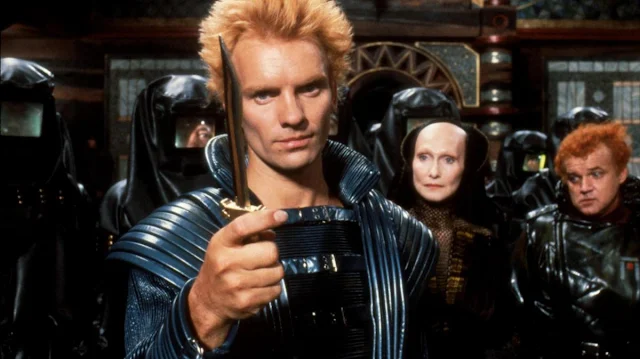
In the original Dune novel and each film of Lynch and Villenue, Paul Atredies undergoes the test at the has of the Reverend Mother of the Bene Gesserit.
Dune 2 features a scene not in the novel in which a somewhat bewitched Feyd-Rautha under the spell of Margot Fennering who gives Austin Butler's character the same test.
This deviation from the novel not only enriches the cinematic adaptation but also extends the thematic exploration of pain, power, and prescience that pervades the Dune saga.
By analyzing Feyd-Rautha's confrontation with the Gom Jabbar, one can discern how the filmmakers have woven these themes into his character arc, mirroring and contrasting Paul Atreides' journey, while also adhering to the intricate dynamics of power, discipline, and human nature examined in Herbert's universe.
The film's very subtle portrayal of Feyd-Rautha as a quasi-Kwisatz Haderach, one generation removed from the culmination of the Bene Gesserit breeding program, injects a fascinating parallel to Paul Atreides.
This notion is subtly underscored by Feyd's self professed dream of Margot Fenring, an element that somewhat mirrors Paul's prescient dreams about Chani which were focussed on in Dune Part One.
Such parallels are not mere narrative conveniences but deliberate attempts to illustrate the duality of potential futures and the role of prescience within the universe of Dune.
Prescience, in this context, serves as both a gift and a curse, offering foresight while also ensnaring individuals within the confines of destiny and expectation.
Feyd's hinted but somewhat limited prescience indicates a latent potential that could have unfolded differently under another set of circumstances.
Pain, Pleasure, and Power - how Feyd-Rautha survived Fenring's Gom Jabbar test
The film adaptation adds depth to Feyd-Rautha's character by highlighting his unique relationship with pain.
Statements from characters in the film suggest that Feyd not only endures pain but derives pleasure from it.
This characteristic is crucial in understanding his ability to survive the Gom Jabbar test.
Feyd-Rautha's survival is depicted as stemming from a masochistic enjoyment of pain, coupled with a formidable mental discipline. For Feyd, pain is not a barrier but a means to demonstrate his superiority and resilience, reflecting the brutal ethos of House Harkonnen.
Feyd-Rautha's discipline and self-control are highlighted as traits that distinguish him from other members of House Harkonnen.
Villenueve's film subtly suggests that these qualities are what enable him to endure the Gom Jabbar.
In a universe where the ability to maintain control over one's instincts is a measure of humanity, Feyd's discipline underlines his capabilities as a leader and a warrior. This aspect of his character aligns with the Bene Gesserit's criteria for humanity, albeit twisted by his sadomasochistic tendencies.
The broader thematic elements of the Harkonnen ethos—power, control, and the capacity for self-discipline—are crucial to understanding Feyd-Rautha's survival of the Gom Jabbar.
The Harkonnens are depicted as power-hungry, yet capable of calculated restraint to achieve their goals. Feyd-Rautha embodies this principle, demonstrating that even within the framework of villainy, there exists a nuanced spectrum of ambition and capability.
His ability to survive the Gom Jabbar, therefore, is not merely a testament to his physical endurance or a sadomasochistic inclination towards pain but a reflection of his adherence to the Harkonnen principle of power at any cost.
The X-Men film series stands as a monumental achievement in the realm of superhero cinema, blending compelling narratives with a rich tapestry of characters that resonate deeply with audiences. This series, more than just a collection of action-packed spectacles, delves into the complexities of identity, discrimination, and the essence of humanity, setting it apart from its counterparts. Its chronological progression not only charts the evolution of its characters but also mirrors the shifting landscape of societal issues, making each film relevant in its own right.
From the groundbreaking debut in 2000 starring Halle Berry (Cloud Atlas) and Hugh Jackman (The Fountain) that heralded a new era of superhero films to the more introspective and character-driven narratives in later installments, the X-Men series has consistently pushed the boundaries of the genre.
Navigating through the X-Men movies in chronological order offers a unique lens through which to experience the growth and challenges of its characters, akin to moving through the pages of a living comic book. This approach not only enriches the viewer's understanding of the X-Men universe but also highlights the series' virtues: its ability to blend high-stakes drama with the personal journeys of its characters, and its courage to tackle complex social issues through the allegory of mutants.
The Complete X-Men Chronology
The entire live-action saga presented in its in-universe chronological order.
1. X-Men: First ClassReleased: 2011
Timeline: 1962
The story begins by focusing on a young Charles Xavier and Erik Lehnsherr as they discover their powers against the backdrop of the Cuban Missile Crisis. This film lays the groundwork for the X-Men and the Brotherhood of Mutants, exploring the origins of their friendship and the ideological schism that would come to define their relationship.
Lore Note: Actress January Jones, who played Emma Frost, took the role to do something different from her 1960s-set TV show Mad Men, only to discover First Class was also set in the '60s.
2. X-Men: Days of Future PastReleased: 2014
Timeline: 1973 (past) & 2023 (dystopian future)
Connecting the original trilogy's cast with their younger counterparts, this film sees Wolverine's consciousness sent back to 1973 to prevent an assassination that leads to the creation of the Sentinels, mutant-hunting robots that have created a dystopian future. The film effectively reboots the timeline, paving the way for a new series of events.
Lore Note: In the film's universe, President John F. Kennedy was secretly a mutant. His assassination is re-contextualized as a conspiracy against mutants, adding a layer of historical fiction to the lore.
3. X-Men Origins: WolverineReleased: 2009
Timeline: 1845 - 1979
This film delves into Logan's extensive backstory, beginning with the discovery of his powers in 1845 and chronicling his life through various wars alongside his brother, Victor Creed. The main plot, set around 1979, details his recruitment into Team X, the brutal Weapon X program where he gets his adamantium skeleton, and the beginning of his memory loss.
Lore Note: The screenplay was co-written by David Benioff, who would later co-create HBO's Game of Thrones. He intended for the film to be a darker, more brutal R-rated story.
4. X-Men: ApocalypseReleased: 2016
Timeline: 1983
Following the timeline reset of Days of Future Past, this installment is set in 1983. It introduces En Sabah Nur, the world's first and most powerful mutant, who awakens after millennia. Disillusioned with the modern world, he recruits four powerful mutants, including a grief-stricken Magneto, to cleanse humanity and create a new world order.
Lore Note: This film features the third on-screen appearance of Nightcrawler, this time played by Kodi Smit-McPhee. The character was previously portrayed by Alan Cumming in X2.
5. X-Men: Dark PhoenixReleased: 2019
Timeline: 1992
Set in 1992, about a decade after Apocalypse, the X-Men are national heroes. During a rescue mission in space, Jean Grey is struck by a cosmic force that dramatically amplifies her powers but also makes her dangerously unstable. The film focuses on her internal struggle and the X-Men's conflict over how to save their friend from the entity that threatens the universe.
Lore Note: This is the first mainline X-Men film that does not feature Hugh Jackman as Wolverine in any capacity, marking a significant shift for the franchise.
6. X-MenReleased: 2000
Timeline: Early 2000s
The film that started it all. Set in the "near future," it introduces a world where mutants are a reality and feared by many. Logan and Rogue are drawn into the conflict between Professor Xavier's X-Men, who seek peaceful coexistence, and Magneto's Brotherhood, who believe in mutant supremacy.
Lore Note: In the original comics, Sabretooth was introduced as an Iron Fist villain and didn't have a connection to Wolverine until nearly a decade after his first appearance. The film cemented their intertwined history in pop culture.
7. X2: X-Men UnitedReleased: 2003
Timeline: Shortly after X-Men
Picking up after the first film, the X-Men are forced to team up with Magneto's Brotherhood to stop Colonel William Stryker, a military scientist who leads an assault on Xavier's school and plans a global genocide of mutants using his own version of Cerebro.
Lore Note: The iconic "Danger Room" was supposed to be featured, and the set was even built, but the sequence was cut from the final film due to budget and time constraints.
8. X-Men: The Last StandReleased: 2006
Timeline: After X2
A "cure" for mutation becomes available, dividing the mutant community. The conflict escalates with the resurrection of Jean Grey as the all-powerful and unstable Phoenix, leading to a final, devastating confrontation between the X-Men, the Brotherhood, and human forces.
Lore Note: With a budget of $210 million, The Last Stand was briefly the most expensive film ever made at the time of its production.
9. The WolverineReleased: 2013
Timeline: After The Last Stand
Set after the events of The Last Stand, a guilt-ridden Logan is living in self-imposed exile. He is summoned to Japan by an old acquaintance, where he is drawn into a deadly conflict involving the Yakuza and a conspiracy that forces him to confront his own mortality when his healing factor is compromised.
Lore Note: Director James Mangold released an extended, unrated version called the "Unleashed Extended Edition," which features 12 extra minutes of footage, including a longer, more brutal battle with the ninjas.
10. DeadpoolReleased: 2016
Timeline: 2016
While its timeline is notoriously flexible due to the main character's fourth-wall-breaking nature, the film is set squarely in the modern era. It follows Wade Wilson's transformation from a wisecracking mercenary into the disfigured but indestructible anti-hero Deadpool as he hunts down the man who ruined his life.
Lore Note: The costume was designed with fake muscle padding, but when Ryan Reynolds arrived on set, he was so muscular that the padding had to be removed because it made the suit look too bulky and ridiculous.
11. Deadpool 2Released: 2018
Timeline: Late 2020s (relative to Deadpool)
Continuing Deadpool's chaotic adventures, this sequel introduces the time-traveling soldier Cable and the young, volatile mutant Russell Collins (Firefist). To protect the boy, Deadpool forms the X-Force, a team of mostly expendable mutants. The film further plays with the X-Men universe's timeline and conventions.
Lore Note: The footage of the main X-Men team (McAvoy, Peters, etc.) closing the door on Deadpool was shot on the set of Dark Phoenix and sent over to the Deadpool 2 production.
12. The New MutantsReleased: 2020
Timeline: Late 2020s
This horror-tinged installment is set in the contemporary era. It follows five young mutants who are held in a secret medical facility against their will. As they grapple with the traumatic origins of their powers, they must band together to escape their captors and the demonic entities haunting them.
Lore Note: The film is the thirteenth and final installment in the Fox X-Men film series due to Disney's acquisition of 20th Century Fox, which led to the integration of the X-Men characters into the Marvel Cinematic Universe.
13. LoganReleased: 2017
Timeline: 2029
Set in a bleak 2029 where new mutants have not been born for 25 years, an aging and weary Logan cares for an ailing Professor X. Their attempts to hide from the world are upended when they encounter Laura, a young girl with powers eerily similar to Wolverine's, who is being hunted by dark forces. The film serves as a powerful and emotional conclusion to Logan's journey.
Lore Note: The film's gritty, character-driven tone was heavily inspired by classic Westerns like Shane (1953) and dramas like The Wrestler (2008), a departure from typical superhero movie tropes.
The story picks up with Ellen Ripley, the saga's heroine, crash-landing on Fiorina "Fury" 161, a desolate planet housing a penal colony where the prisoners practice their faith. The film introduces new challenges for Ripley, including the revelation of a Xenomorph presence on the planet and a devastating personal discovery.
A central mystery in "Alien 3" revolves around why the alien takes an unusually long time to gestate within Ripley compared to previous hosts. This anomaly is not just a minor plot detail but a significant element that affects the character's journey and the movie's storyline.
The extended gestation period contributes to the suspense and the emotional depth of the narrative, raising questions about the biology of the Xenomorphs and the fate of Ripley.
The extended gestation period is pivotal for several reasons. It influences the pace and tension of the story, allowing Ripley time to interact with other characters and to confront her situation. Moreover, this aspect of the plot is crucial for deepening the thematic layers of the Alien series, touching on themes of life, death, and the cycle of creation and destruction.
Before "Alien 3", Ripley faces the Xenomorph threat in "Alien" and "Aliens", surviving against all odds. These encounters showcase her resilience and deepen her understanding of the Xenomorph species, setting the stage for her ultimate confrontation in "Alien 3".
The Xenomorphs are characterized by a complex life cycle, starting from an egg that releases a facehugger, which then implants an embryo into a host. The embryo gestates before emerging as a chestburster.
Prior to "Alien 3", this process typically progresses rapidly, but Ripley's case deviates from the established norm.
In-universe explanations suggest Ellen may be infected with a queen xenomorph and such an embryo's uniqueness might account for the prolonged gestation.
That is if it was a queen in Ripley...
The extended gestation period serves the film's narrative by allowing Ripley to develop further as a character and to face her destiny. It adds a layer of tragic inevitability to her journey, highlighting themes of sacrifice and the relentless cycle of life and death.
We can dance around the point forever but ultimately, the timing of the gestation period is dictated by the needs of the plot.
"Alien 3" is designed to bring Ripley's saga to a close, with her sacrifice embodying the themes of the series. The gestation timeline serves this narrative purpose, emphasizing that in the Alien universe, human experiences and struggles are intertwined with the incomprehensible life cycles of the Xenomorphs.
Ripley's prolonged gestation and eventual fate underscore the series' exploration of survival, sacrifice, and the complex interplay between human and alien life.
In the world of filmmaking, assigning working or production titles is a well-established tradition. These codenames offer privacy and secrecy to high-profile projects that might otherwise attract unwanted speculation. The Star Wars franchise, with its passionate fan base and significant cultural impact, has particularly benefited from this practice.
From the famously misleading "Blue Harvest" to the playful "Space Bear," the working titles of Star Wars films have not only helped conceal the productions but have also become a part of the lore and mystique surrounding the series. The transition from a production title to the final release title is a process fraught with strategic considerations, balancing marketing needs with narrative secrecy.
In the sprawling expanse of Frank Herbert's universe, few characters capture the imagination quite like Lady Jessica. She is the linchpin in a narrative that intricately weaves the political, the personal, and the mystical.
As a Bene Gesserit, a secret sisterhood with advanced mental and physical abilities aiming to guide human evolution, Lady Jessica embodies the tension between the roles assigned to her and the choices she independently makes. These choices often have far-reaching consequences for the galaxy. Her journey from a dutiful acolyte of the Bene Gesserit to a matriarch who defies the very foundations of her training for love and familial loyalty offers a rich canvas to explore themes of power, identity, and maternal influence.
"Dune," since its publication in 1965, has stood as a monumental work in science fiction. It is celebrated not just for its ambitious world-building but for its intricate exploration of the human condition amidst the backdrop of an interstellar feudal society. Within this universe, Lady Jessica's character arc is particularly significant for its embodiment of the series' exploration of complex themes.
Lady Jessica navigating the intrigues of the Bene Gesserit.
Her decision to bear a son, Paul Atreides, against the explicit commands of the Bene Gesserit, sets into motion the tumultuous events of the series. This act of defiance, rooted in love, not only catalyzes the transformation of her family's destiny but also marks the beginning of her personal transformation and the deepening complexity of her character.
This essay posits that Lady Jessica's character arc exemplifies the "Dune" series' intricate examination of power, identity, and maternal influence. Through her, we witness the evolution of a figure who navigates her path between predetermined roles and personal agency. She becomes a pivotal force whose actions and decisions ripple through the cosmos.
I. Character Genesis and Initial Portrayal
Lady Jessica’s journey in the "Dune" saga begins with her deep-rooted affiliation with the Bene Gesserit, a secretive and influential sisterhood with a long-term breeding program aimed at producing a superhuman being, the Kwisatz Haderach. Trained in the ways of the Bene Gesserit, Lady Jessica is adept in manipulation, both physical and emotional. She possesses abilities that make her a formidable figure in the intricate political landscape of the universe.
However, it's her inner turmoil and the moral ambiguities she faces that define her initial portrayal. This complex foundation is crucial for understanding her character arc. It highlights the conflict between her duties to the Bene Gesserit and her personal desires.
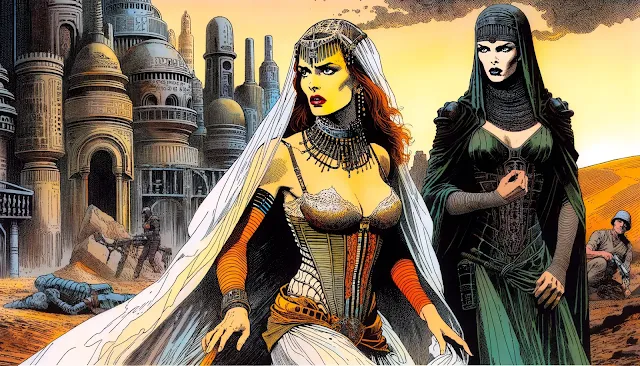
Bene Gesserit ceremonial attire.
As the concubine of Duke Leto Atreides, Lady Jessica is thrust into the heart of the political intrigue that defines the universe of "Dune." Despite not being his legal wife, her relationship with Leto is one of deep love and mutual respect. This is a rarity in the strategic marriages of their society. This relationship introduces readers to Lady Jessica’s capacity for deep emotional connections, setting her apart from the often cold and calculating Bene Gesserit archetype.
One of the most defining aspects of Lady Jessica’s character is her decision to bear a son, Paul Atreides, defying the Bene Gesserit's command to produce a daughter. This decision is not merely a personal one. It is a pivotal moment that alters the course of the "Dune" saga. It reflects her strength and independence, showcasing her willingness to prioritize her love for Leto and her visions for her family’s future over the mandates of the Bene Gesserit.
II. Evolution Through the Novels
Lady Jessica's journey through the "Dune" series is marked by her incredible ability to adapt to rapidly changing circumstances. Following the tragic fall of House Atreides and the assassination of Duke Leto, Lady Jessica's initial role as a consort and advisor transforms significantly.
On the run with her son Paul in the unforgiving deserts of Arrakis, she demonstrates an unparalleled capacity to navigate the perilous landscape and the complex social dynamics of the Fremen, the planet's indigenous population. Her adaptability is not just a survival tactic. It becomes a transformative force, reshaping her from a figure of nobility to a key player in the Fremen resistance.
One of the most pivotal moments in Lady Jessica's evolution is her decision to undergo the spice agony to become a Reverend Mother of the Fremen. This act of ingesting a lethal dose of the spice melange and surviving signifies not only a physical and spiritual transformation but also marks her as a figure of immense wisdom and power among the Fremen. This transition is emblematic of her willingness to embrace the unknown for the sake of her new people and her family, further distancing herself from the conventional paths laid out by the Bene Gesserit.
Throughout the novels, Lady Jessica's role as a mother profoundly influences the direction of the narrative and the development of key characters, particularly Paul and Alia. Her teachings and guidance prepare Paul for his future as a leader and the Kwisatz Haderach. However, her relationship with Alia is more complex, marked by Alia's struggle with the powers and voices of the past—a struggle that Lady Jessica feels responsible for. Her departure from Arrakis and her eventual return underscore her enduring impact on her children and the broader narrative.
However, as the series progresses, Lady Jessica's true power emerges from her capacity for love, adaptation, and moral resilience. This evolution challenges the traditional perceptions of power in the "Dune" universe, highlighting the strength in compassion and the influence of personal ethics over rigid institutional loyalty.
Duke Leto and Lady Jessica.
The theme of identity is equally critical to understanding Lady Jessica's character. Her identity is fluid, shaped by her roles as a Bene Gesserit, consort, mother, and leader among the Fremen. Each role demands a part of her, yet she defies being defined by any single one. Her journey is a testament to the complexity of self-definition in the face of external pressures and expectations. Through Lady Jessica, Herbert explores the idea that true identity is not a static condition but a dynamic process of growth, choice, and change.
Conclusion: Adaptability as Strength
The theme of adaptability and evolution is central to Lady Jessica's character arc and the "Dune" series as a whole. Her ability to adapt to changing circumstances—from the political intrigue of the Imperium to the harsh desert life of Arrakis—demonstrates a remarkable resilience and flexibility. This adaptability is not just a survival mechanism but a form of evolution, as she continually learns and grows from her experiences.
Through Lady Jessica, Herbert suggests that adaptability is a key to survival and success, reflecting the broader evolutionary themes of the series. Her evolution, from a member of the Bene Gesserit to a figure of significant influence and power in her own right, mirrors the ecological and social evolution themes within "Dune." Just as Arrakis itself undergoes a transformation through the series, so too does Lady Jessica, embodying the series' exploration of change, growth, and the potential for transformation inherent in all beings.
In the intricate tapestry of Frank Herbert's "Dune," Lady Jessica emerges as a profound embodiment of the series' exploration of power, identity, and the dynamics of maternal influence. Her journey from a Bene Gesserit disciple to a revered figure in the Fremen society, and her impactful decisions that shaped the destinies of her offspring and the socio-political landscape of the universe, illuminate her as a character of deep complexity and significance.
This series marks a significant moment for science fiction enthusiasts and a broader audience intrigued by the blend of historical events and speculative fiction. The adaptation process involves expanding the novel's narrative scope to suit the episodic nature of a television series, necessitating creative liberties, including the introduction of new characters and the deepening of existing backstories.
The transition from page to screen for "The Three-Body Problem" involves a collaborative effort spearheaded by notable figures in the entertainment industry. David Benioff and D.B. Weiss, best known for their work on "Game of Thrones," serve as the show's creators, bringing a wealth of experience in adapting complex narratives.
Their involvement promises a series that is both faithful to the source material and expansive, introducing new layers to the story. The show's production also benefits from the insight of Liu Cixin and Ken Liu (the translator of the English edition of the novel), who are involved as consulting producers, ensuring that the adaptation remains true to the original's spirit and intent.
The first episode opens with a profoundly impactful portrayal of the Cultural Revolution in China, setting a historical backdrop that adds depth and gravitas to the narrative. This tumultuous period is not merely a setting but a catalyst for the series' unfolding events, influencing the characters' motivations and the story's trajectory.
The depiction of the Cultural Revolution is visceral, capturing the chaos, fervor, and ideological fervency of the time. This grounding in real historical events provides a stark contrast to the speculative elements that later come into play, making the series all the more compelling.
Adapting "The Three-Body Problem" for television necessitated certain changes to accommodate the medium's demands and to reach a wider audience. One of the most significant alterations is the introduction of new characters not found in the book. Auggie Salazar's character appears to be the lead thus far.
These characters serve various narrative functions, including providing new perspectives on the story's events, enhancing the emotional depth of the series as it transitions (in part) from China to a more Eurocentric location.
Moreover, the series takes liberties in fleshing out the backgrounds and motivations of characters from the novel, offering viewers a more immersive experience. While these additions and alterations may initially surprise fans of the novel, they contribute to a more nuanced and layered adaptation whilst retaining the essential themes of the story.
The hard boiled detective (of a kind) Da Shi is still there, played by an at this point, curious Benedict Wong.
Netflix's "The Three-Body Problem" emerges as a bold and imaginative adaptation of Liu Cixin's novel, inviting both newcomers and long-time fans to experience a multifaceted story of cosmic proportions.
This first episode balances the fidelity to the source material with creative expansions, enriching the narrative and deepening its thematic explorations.
The real science fiction of the story is yet to come...
Cailee Spaeny could be in line to play Ellen's daughter. Coming hot after Priscilla and Civil War, playing this gig is one way to sci fi legendary status!
Romulus is set between Ridley Scott's 1979 classic and the James Cameron directed Aliens sequel so there is real potential Amanda could feature in this film.
At The Astromech, you can expect to find a variety of articles, reviews, and analysis related to science fiction, including books, movies, TV, and games. From exploring the latest news and theories to discussing the classics, I aim to provide entertaining and informative content for all fans of the genre.
Whether you are a die-hard Star Trek fan or simply curious about the world of science fiction, The Astromech has something for everyone. So, sit back, relax, and join me on this journey through the stars!