
Lady Jessica: The Bene Gesserit Who Broke the Future
Lady Jessica is not merely the mother of Paul Atreides. She is the emotional fracture inside the Bene Gesserit plan, the woman who turns a breeding program into a dynasty, a dynasty into a religion, and a religion into a future no one can fully control.
In the sprawling expanse of Frank Herbert’s universe, few characters carry as much consequence with as little open sovereignty as Lady Jessica. She does not rule the Imperium. She does not command the Sardaukar. She does not control CHOAM, the Spacing Guild, or the spice monopoly. Yet her decisions alter every one of those systems. Jessica’s story is the story of a woman trained to serve a secret design who chooses, at the decisive moment, to obey love instead.
That choice is not sentimental decoration. It is the first crack in the machinery of the Bene Gesserit. Jessica is a disciple of a sisterhood that has spent generations manipulating bloodlines, planting religious myths, guiding political marriages, and preparing for the birth of the Kwisatz Haderach. Her duty is clear. She is to bear Duke Leto Atreides a daughter. Instead, she gives him a son.
That son is Paul Atreides. Through Paul come Muad’Dib, the Fremen jihad, the collapse of the Corrino order, the rise of a religious empire, the tragedy of Dune Messiah, the crisis of Children of Dune, and finally the long shadow of Leto II’s Golden Path in God Emperor of Dune. Jessica does not design all of this. That distinction matters. But without her first rebellion, none of it arrives in the form Herbert gives us.
Dune, since its publication in 1965, has stood as a monumental work of science fiction because it treats power as a system, not a costume. Ecology, religion, genetics, prophecy, colonial extraction, feudal violence, and family loyalty all grind against each other on Arrakis. Jessica stands at the centre of that pressure. Her arc moves from Bene Gesserit acolyte to Atreides consort, from fugitive mother to Fremen Reverend Mother, from absent matriarch to grim witness of the wreckage left by Paul’s empire.
Jessica’s importance comes from complexity. She is loving, but manipulative. Loyal, but disobedient. Brilliant, but often blind to the emotional consequences of her own survival choices. She is not a saintly mother standing outside history. She is one of history’s makers. Her tragedy is that almost every choice she makes for love becomes useful to power.
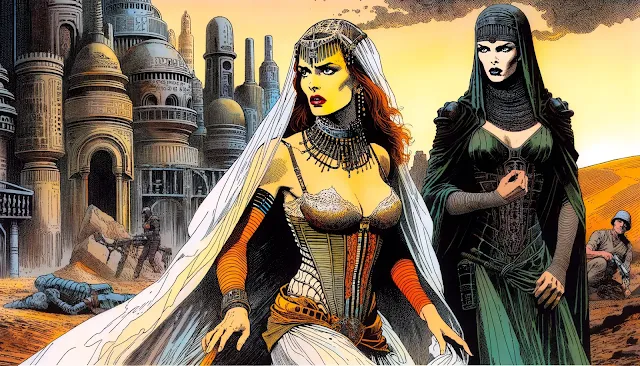
Jessica Before Arrakis: A Woman Made by the Bene Gesserit
Jessica’s story begins before the reader meets her. She is a product of the Bene Gesserit, the secretive sisterhood whose power lies in patience. The Sisterhood does not rule openly because open rule invites open attack. Instead, it places women inside courts, bloodlines, marriages, myths, and private chambers. Its power is intimate. It moves through advice, seduction, childbirth, memory, observation, and timing.
Jessica has been trained in the classic Bene Gesserit arts. She reads bodies. She controls her own. She uses tone, breath, rhythm, and command through the Voice. She understands fear as a bodily process to be mastered, not merely an emotion to be endured. The Bene Gesserit have made her into an instrument of exquisite discipline.
But Herbert gives Jessica a dangerous human surplus. She is not perfectly reducible to her training. She loves Duke Leto. That love does not erase her Bene Gesserit conditioning, but it distorts it. It makes her choose against institutional command. The Sisterhood wants a daughter from Jessica and Leto, a daughter who could later be used in a controlled genetic union with the Harkonnen line. Jessica gives Leto the son he wants.
That act is often read as romantic defiance, and it is. But it is also pride. Jessica believes she can manage the consequences. She believes her son can be protected, trained, and guided. She may even believe, somewhere below the surface, that she has brought the Sisterhood closer to its dream rather than shattering it. This is one of Herbert’s sharper insights. Catastrophe often begins with intelligent people overestimating the reach of their own control.
Duke Leto and Jessica: Love Inside a Feudal Trap
Jessica’s relationship with Duke Leto Atreides is one of the emotional anchors of Dune. She is his concubine rather than his wife, a political arrangement that preserves Leto’s marital availability in the calculations of noble diplomacy. Yet the relationship itself is not cold. Leto loves her. Jessica loves him. Their bond carries intimacy, trust, restraint, and sadness.
That distinction matters because Jessica is surrounded by institutions that treat bodies as instruments. The Bene Gesserit see her womb as part of a breeding program. The Landsraad sees marriage as alliance. The Emperor sees House Atreides as a threat to be managed. The Harkonnens see bodies as things to degrade, exploit, and discard. Against that background, Jessica and Leto’s love has moral weight.
It also has limits. Leto does not fully escape the paranoia of his world. The possibility that Jessica may be the traitor inside House Atreides wounds her because it exposes the final loneliness of political life. Even love cannot entirely overcome the logic of espionage. In the Atreides household, loyalty is real, but suspicion is also rational.
When House Atreides falls on Arrakis, Jessica loses not only the man she loves but the social identity that gave her power. She is no longer the consort at the centre of a noble household. She is a pregnant widow in the desert, hunted by the Harkonnens, dependent on training, instinct, and a son whose abilities are beginning to exceed her own comprehension. The fall of House Atreides strips Jessica down to the one thing the Bene Gesserit built in her most thoroughly:
survival.
Mother of Paul: Training the Future Catastrophe
Jessica’s motherhood is not soft background detail. It is one of the engines of the saga. Paul is not shaped by Jessica alone. He is trained by Duncan Idaho, Gurney Halleck, Thufir Hawat, Duke Leto, and the brutal curriculum of Arrakis itself. Yet Jessica gives him something no one else can: Bene Gesserit interior discipline.
She teaches Paul control of the body, alertness to minute human signals, the management of fear, and the use of voice as a weapon. She gives him access to a mode of perception that turns politics into readable flesh. Every twitch, pause, tone, smell, and hesitation becomes evidence. This is one reason Paul becomes so dangerous. His later prescience is extraordinary, but his first gift is attention.
The Gom Jabbar test shows the agony of Jessica’s divided role. Reverend Mother Gaius Helen Mohiam tests Paul for humanity through pain and mortal threat. Jessica knows the logic of the test. She also fears for her son. She stands outside the door as a Bene Gesserit who understands the ritual and as a mother who cannot stop it. The scene compresses her whole tragedy into one moment: the Sisterhood’s methods are inside her, but the person being tested is her child.
Paul’s rise later becomes one of the great warnings in science fiction. The shape of his story resembles heroic destiny, but Herbert steadily reveals the trap. The boy Jessica trains becomes Muad’Dib, the prophet-warrior whose gifts help unleash holy war. For a deeper reading of Paul’s transformation, Paul Atreides’ full character arc shows how the Caladan heir becomes a messianic ruler trapped by his own vision.
Jessica prepares Paul to survive. She also prepares him to become usable by myth. That is the terrible double edge of her motherhood. She gives him tools of discipline and perception, but once those tools meet Fremen expectation, spice saturation, political collapse, and the dream of revenge, they become the instruments of history.
The Harkonnen Bloodline: Jessica’s Hidden Inheritance
Jessica’s arc becomes even more complicated once her ancestry is revealed. She is the daughter of Baron Vladimir Harkonnen. This is not a minor twist. It turns the Atreides and Harkonnen conflict into a family horror. Paul is not simply the noble Atreides heir fighting the monstrous Harkonnens. He is the product of both lines.
That revelation matters because Dune is obsessed with inheritance. Blood does not determine moral destiny in a crude way, but it carries consequence. The Bene Gesserit breeding program depends on the belief that bloodlines can be arranged into desired outcomes. Jessica’s hidden Harkonnen ancestry proves the reach of that program, but it also exposes its grotesque intimacy. Enemies, lovers, heirs, and monsters are not as separate as they pretend to be.
Jessica’s Harkonnen blood also deepens Alia’s tragedy. The ancestral presence of the Baron becomes a real danger in Alia’s inner life. What is hidden in Jessica returns in her daughter as invasion. Herbert turns genealogy into haunting. The past is never past in Dune. It waits in the blood.

Jessica in the Desert: The Survivor Reborn
After the fall of Arrakis, Jessica and Paul enter the desert as fugitives. This is one of the great transformations in Dune. Jessica begins the novel as a woman of halls, chambers, guarded rooms, political whispers, and noble ceremony. The desert takes all of that away. It does not care about titles. It does not care about breeding programs. It kills the unadapted.
Jessica survives because she adapts. Her Bene Gesserit training, once tied to courtly usefulness, becomes immediate and physical. Breath, balance, attention, pain control, and psychological command keep her alive. She is pregnant, grieving, displaced, and hunted, yet she remains fiercely alert.
This is where her character becomes especially interesting. Jessica is not Fremen, and Herbert does not pretend she instantly becomes one. She survives among the Fremen by reading them, learning from them, and using the myths already waiting for her. Arrakis transforms her, but it also gives her an arena in which Bene Gesserit preparation becomes sacred authority.
The Fremen are not merely background warriors in Jessica’s story. They are a culture built out of exile, ecological discipline, water law, Zensunni inheritance, and generations of survival under exploitation. Jessica enters that world with fear and calculation, but also with awe. The complex social dynamics of the Fremen force her to become more than a noble fugitive. She becomes a participant in the culture her son will soon lead, exploit, and transform.
The Zensunni background of the Fremen also matters here. Jessica is not walking into an empty prophetic container. She is entering a people with their own memory of persecution, discipline, migration, and religious endurance. The tragedy is that Bene Gesserit myth has already been folded into that world, waiting for someone like Jessica to unlock it.
The Missionaria Protectiva: Jessica and the Weaponized Myth
Jessica’s rise among the Fremen depends on one of the most morally troubling Bene Gesserit inventions: the Missionaria Protectiva. The Sisterhood has seeded vulnerable cultures with legends, prophecies, phrases, and religious expectations that can later protect a Bene Gesserit sister in danger. It is a survival system disguised as sacred tradition.
When Jessica recognizes these patterns among the Fremen, she uses them. She has to. She and Paul are exposed, hunted, and dependent on gaining acceptance. The mythic language planted by the Sisterhood becomes a bridge into Fremen belief. Jessica understands enough to step into the role prepared for her.
Yet this is where necessity becomes contamination. The myths Jessica uses do not remain tactical cover. They gather force. They cling to Paul. They give religious shape to his survival. The Lisan al-Gaib expectation, the off-world mother, the signs of prophecy, the Fremen dream of liberation, and the Bene Gesserit plan all converge around the Atreides fugitives.
Jessica does not invent the Fremen longing for deliverance. She does not create their oppression. She does not force the Imperium to exploit Arrakis. But she helps activate a mythic structure that turns Paul from survivor into messiah. That is why her arc belongs beside the wider question of whether Paul is a liberator, ruler, or false prophet in the Dune universe.
Herbert’s critique is sharp because he makes Jessica’s action understandable. She is not casually playing with religion from a safe distance. She is protecting herself and her children. But Dune keeps asking what happens when a survival lie becomes a civilization’s truth. The Bene Gesserit gambit works too well, and that is the horror of it.
The Spice Agony: Jessica Becomes a Fremen Reverend Mother
Jessica’s decision to undergo the spice agony is one of the defining moments of her evolution. The ritual is not a ceremonial promotion. It is a biological and spiritual ordeal. She must transform a lethal poison, survive what should kill her, and awaken into a new order of memory. By doing so, she becomes a Reverend Mother among the Fremen.
The act changes her status. She is no longer merely a Bene Gesserit woman using Fremen myth. She becomes part of Fremen religious life. She inherits ancestral memory through the female line. She becomes a vessel of continuity, carrying voices and knowledge from the dead into the living present.
This transformation connects Jessica to one of Dune’s deepest ideas: memory as power. In Herbert’s universe, history is not safely behind anyone. It is stored in bodies, rituals, breeding records, ancestral presences, and ecological scars. Jessica’s Reverend Mother transformation gives her access to a kind of wisdom, but also places her inside a terrifying continuity. The self is no longer solitary.
The original article linked Jessica’s transformation to Reverend Mother lore, and that remains useful because the ritual is not just plot mechanics. It marks Jessica’s passage from trained political instrument to sacred figure. It also creates the most tragic consequence of her arc: Alia.
Alia: Jessica’s Darkest Consequence
Jessica undergoes the spice agony while pregnant. This is the crucial point. Alia is transformed before birth. She becomes pre-born, awakened into consciousness and ancestral memory before she has formed an ordinary self. She enters life already crowded by the dead.
This is one of the most haunting consequences in the Dune saga. Jessica’s decision is made under pressure. She does not calmly choose to endanger Alia from a place of comfort. But consequence does not disappear because the decision was understandable. Herbert is merciless on this point. Survival can still leave damage. Necessary choices can still create victims.
Alia becomes powerful, frightening, isolated, and spiritually vulnerable. She is a child with adult awareness, a holy figure to some, an abomination to others, and later a regent whose inner life becomes a battleground. In Children of Dune’s themes of inheritance and possession, Alia’s tragedy is not simply that she has power. It is that she has too many selves pressing against her own.
Jessica’s relationship with Alia is therefore more painful than her relationship with Paul. Paul is the son she trains and gradually loses to history. Alia is the daughter she changes before birth and later cannot save. Jessica’s absence from Arrakis after Paul’s victory deepens the wound. The one person who might have best understood Alia’s condition leaves her behind inside a political and religious machine.
When Jessica returns in Children of Dune, she sees what Alia has become. Her suspicion is accurate. Her judgment is necessary. It is also brutal. Jessica recognizes signs of Abomination, but she is not an innocent observer. Alia’s danger began with Jessica’s survival. The mother who once carried her through the spice agony returns as the woman who can name what is wrong with her.
Jessica and Chani: The Limits of Maternal Power
Jessica’s relationship with Chani is often quieter than the larger political story around them, but it matters. Chani and Jessica both love Paul, but they belong to different worlds. Jessica is Bene Gesserit-trained, aristocratic, calculating, and shaped by the politics of the Imperium. Chani is Fremen, desert-born, direct, and bound to the lived reality of Arrakis.
Chani becomes Paul’s intimate anchor after his transformation among the Fremen. Jessica remains his mother and first teacher, but she can no longer contain the scale of what he is becoming. Paul is no longer only her child. He is Usul, Muad’Dib, the Lisan al-Gaib, military leader, prophet, and future emperor. His identity multiplies beyond maternal reach.
This is where Jessica’s arc becomes more mature and more painful. She has shaped Paul, but she cannot own him. She has trained him, but she cannot govern the consequences of that training. Chani does not take Paul away from Jessica. History does.
The web of female influence around Paul is one of Herbert’s most important structures. Jessica, Chani, Irulan, Mohiam, and the wider Bene Gesserit all shape the terms of Paul’s rise. A broader view of this pattern appears in Dune: The Women Who Shaped Paul Atreides, but Jessica remains the decisive starting point. She is the one who breaks the timetable.
Paul’s Victory and Jessica’s Withdrawal
After Paul takes the Imperial throne, Jessica withdraws from the centre of Arrakis politics and returns to Caladan. This is one of the more revealing choices in her arc. She has survived the fall of House Atreides. She has become a Fremen Reverend Mother. She has helped Paul rise. Yet she does not remain as the constant matriarch of his empire.
Her withdrawal can be read in several ways. It may be exhaustion. It may be grief. It may be a recognition that Paul’s new order is no longer a family story she can guide. It may be another form of avoidance, especially regarding Alia. Herbert leaves enough space for discomfort.
What is clear is that Jessica’s absence matters. Paul’s empire hardens without her as a daily presence. Alia grows inside power without the stabilizing influence of the mother who understands both Bene Gesserit memory and Fremen religious authority. The Fremen themselves begin to change as victory, wealth, bureaucracy, pilgrimage, and ecological transformation alter the desert culture that made Paul’s rise possible.
Jessica’s departure from Arrakis does not end her influence. It makes that influence more ghostly. She has already done what history needed her to do. She has produced Paul, survived the desert, entered Fremen sanctity, and birthed Alia into pre-born consciousness. The consequences can now move without her.
Power and Identity: Jessica’s Many Selves
Lady Jessica’s narrative arc serves as a profound exploration of the themes of power and identity within the Dune series. Her power is rarely formal. She is not a crowned ruler. She does not command a Great House in her own name. Yet she possesses forms of power that Herbert treats as more intimate and often more durable: genetic power, maternal power, religious power, psychological power, and the power of training.
Jessica’s identity is equally layered. She is Bene Gesserit, but she disobeys the Bene Gesserit. She is Leto’s concubine, but functions emotionally as his wife. She is Paul’s mother, but also one of the forces that makes him politically dangerous. She is a Fremen Reverend Mother, but also an outsider who reaches that status through a myth system planted by her own order. She is Alia’s mother, but also the source of Alia’s pre-born condition.
That fluidity is what makes Jessica one of Herbert’s richest creations. She is never allowed the comfort of a single identity. Every role carries another underneath it. Every loyalty compromises another loyalty. Her journey reflects the nuanced dynamics of power in Dune, where family, religion, ecology, and empire cannot be cleanly separated.
Herbert uses Jessica to challenge easy readings of strength. Her strength is real, but it is not pure. Her love is real, but it is not harmless. Her adaptability saves lives, but it also helps activate systems that consume whole populations. Jessica is one of the clearest examples of Dune’s refusal to separate virtue from consequence.
Jessica Returns in Children of Dune
By the time Jessica returns in Children of Dune, the world has changed. Paul is gone into the desert. Alia rules as regent. Leto II and Ghanima, Paul and Chani’s twins, carry the Atreides future inside their own dangerous inheritance. The Fremen victory has begun to curdle into imperial bureaucracy and cultural loss.
Jessica returns not as the desperate fugitive of Dune, but as an older and harder political mind. She is more cautious. More suspicious. More aware of what the Atreides myth has cost. Her presence threatens Alia because Jessica can see what others cannot, or will not. She recognizes the signs of possession, instability, and Abomination.
This section of her arc is crucial because it shows Jessica facing consequences rather than initiating them. In Dune, she acts under pressure and changes history. In Children of Dune, she returns to inspect the history that has grown from those acts. The heroic aura has thinned. The religious empire is decaying. The Fremen are changing. The children of Paul are no ordinary heirs, but pre-born figures carrying the terror of ancestral memory.
Jessica’s role with Leto II and Ghanima is complex. She sees danger in them, but also possibility. They are not simply grandchildren to be loved in private. They are political and genetic events. They inherit Paul’s prescience, Chani’s Fremen line, Jessica’s Bene Gesserit legacy, and the vast inner burden of ancestral consciousness.
This is where Jessica’s story touches the decline of the culture that saved her. The Fremen rise through Paul, then begin losing the old desert severity that made them powerful. The greening of Arrakis, the dream of Liet-Kynes, and the imperial exploitation of Fremen identity all contribute to a bitter reversal. That tragedy is central to the fall of the Fremen through terraforming, empire, and cultural erosion.
Jessica and the Trap of Prescience
Jessica is not prescient in the way Paul and Leto II are, but her arc is inseparable from the problem of prescience. She gives birth to the figure who sees the future too clearly. Paul’s visions do not free him. They narrow him. He sees paths of horror and tries to choose among them, only to find that knowledge itself becomes a corridor.
This matters for Jessica because she represents the pre-prescient form of control. The Bene Gesserit plan through breeding, memory, myth, and politics. Paul and Leto II move into a more terrifying form of control, the attempt to navigate time itself. The Sisterhood tries to create the Kwisatz Haderach as a controlled superbeing. Jessica’s disobedience produces him outside their schedule. The result is instability on a universal scale.
The tragedy of prescience is explored more fully in how prescience removes choice in Dune. Jessica’s connection to that theme is indirect but essential. She creates the condition by which Paul’s gift arrives too early, outside the Sisterhood’s desired controls, inside the volatile religious ecology of Arrakis.
That is why Jessica is so important to the saga’s architecture. She does not see the future, but she gives birth to the crisis of seeing. She does not choose the Golden Path, but she makes possible the bloodline that will confront it.
Jessica and the Golden Path
Calling Jessica the architect of the Golden Path can be powerful as a title, but the argument needs precision. She is not the conscious designer of Leto II’s program. She does not choose the sandtrout skin. She does not impose the long tyranny. She does not engineer the Scattering. Those belong to Leto II, whose terrible acceptance of the Golden Path defines God Emperor of Dune.
Jessica’s role is earlier and more tragic. She is the breach that makes the later necessity possible. By bearing Paul, she brings the Kwisatz Haderach into being ahead of the Bene Gesserit’s intended schedule. Through Paul come the jihad, the empire, the prescient trap, and the children who inherit what he cannot bear to complete.
Paul sees the horror of the Golden Path and turns away from its fullest demand. Leto II accepts it. The grandson becomes the tyrant-savior, the worm-god who imprisons humanity for millennia so that humanity might eventually escape all future cages. Jessica is gone from the narrative centre by then, but her original defiance still echoes inside the event.
This is Dune’s brutal sense of causality.
No one owns the consequences of their actions once those consequences enter history. Jessica chooses a son for Leto. That son becomes Paul. Paul becomes Muad’Dib. Muad’Dib creates the imperial and religious crisis. Leto II inherits the impossible answer. The private decision becomes species-level destiny.

Jessica’s Final Place in the Dune Saga
Frank Herbert does not give Lady Jessica a grand death scene in the original six novels. Her direct canonical role effectively ends with Children of Dune. That absence can feel strange because she is so important to the first and third novels. Yet the lack of dramatic closure also suits the saga. Jessica’s significance is not measured by her final scene. It is measured by the future she leaves behind.
By the time of God Emperor of Dune, Jessica is gone, but her consequences remain embedded in the universe. The Atreides bloodline has become the axis of human survival and tyranny. The Bene Gesserit have learned, or should have learned, that breeding for control can produce forces beyond control. The Fremen have risen, conquered, softened, and begun losing themselves to the very ecological dream that once sustained them.
Jessica’s end is therefore historical rather than personal. She passes out of the story, but not out of causality. Paul, Alia, Ghanima, and Leto II all carry her forward in different ways. Paul carries her defiance. Alia carries her guilt. Ghanima carries her discipline and concealment. Leto II carries the final monstrous consequence of the Atreides line she made possible.
Conclusion: The Mother of Consequence
The theme of adaptability is central to Lady Jessica’s character arc, but adaptability alone is too neat a summary. Jessica adapts, yes. She survives court politics, the fall of House Atreides, desert exile, Fremen ritual, religious transformation, maternal grief, and the political wreckage of Paul’s empire. But survival is only half the story.
The deeper truth is consequence. Jessica’s most intimate decisions become historical forces. She chooses love over instruction and gives Leto a son. She trains Paul in disciplines that help make him extraordinary. She uses Fremen prophecy to survive and helps activate the myth that will elevate him. She undergoes the spice agony and changes Alia before birth. She withdraws from Arrakis, then returns to find that the Atreides future has become stranger and more dangerous than any ordinary dynasty.
That is why Lady Jessica remains one of the most important characters in the Dune universe. She is not simply Paul’s mother, Leto’s lover, or a Bene Gesserit rebel. She is the point where private love punctures institutional design. Through her, Herbert turns motherhood into politics, bloodline into prophecy, and family into a force that can bend the fate of civilizations.
Jessica is never only noble, and never only guilty. She is too intelligent for innocence and too human for cold villainy. She is proud, loving, manipulative, courageous, frightened, and often correct only after the damage has begun. Her life illuminates one of Dune’s harshest truths: no one controls the future simply because they helped create it.
Lady Jessica does not merely give birth to Paul Atreides. She gives birth to the future the Bene Gesserit wanted, feared, and failed to command.


_poster.jpg)


