

The 5 Best Tenet Film Meaning Theories
Film Theory / Christopher Nolan
Christopher Nolan refuses to confirm any of them, and that is exactly why they will not die. From an ancient Latin word puzzle to a grown-up son sent back through time, here are the five readings that crack Tenet open.
When Stephen Colbert sat Christopher Nolan down and asked, more or less, whether the man who made Tenet actually understood everything in it, the answer was almost gleeful in its evasion. You are not meant to understand everything in Tenet, Nolan told him. It is not all comprehensible.
Most directors would treat that as an admission of failure. Nolan treats it as a design principle. Tenet is a 150 minute palindrome built out of two engines, temporal inversion (reversing an object's entropy so it runs backwards through time) and the causal loop (a chain of cause and effect that bites its own tail). Feed a film that dense to a clever audience and it does not produce understanding so much as theories. Endless, competing, gloriously obsessive theories. They are not a bug. They are the afterlife the film was engineered to have.
If you need a refresher on the plot before we go spelunking, our full breakdown of what Tenet actually means lays out the vocabulary. Otherwise, strap in. Here are the five biggest theories, ranked loosely from "almost certainly the blueprint" to "magnificently unhinged."
1. The Sator Square Is the Whole Blueprint
Start with the one that is less a theory than a skeleton key. The film's title is lifted from the Sator Square, a first-century Latin word puzzle scratched into walls everywhere from Pompeii to medieval churches. Arrange its five words into a grid and it reads identically forwards, backwards, top to bottom and bottom to top: a perfect four-way palindrome.
AREPO
TENET
OPERA
ROTAS
Every word turns up in the film as a load-bearing element. Sator is Kenneth Branagh's dying oligarch villain. Arepo is the unseen art forger whose fakes give Kat her leverage. Tenet is both the secret organisation and the title, a literal palindrome standing in for the ten-minutes-forward, ten-minutes-back temporal pincer movement at the heart of every set piece. Opera is the Kyiv opera house siege that opens the picture. And Rotas, Latin for wheels, is the name of the Freeport security firm, a quiet nod to the rotating turnstiles that flip a character's entropy.
The catch is knowing where to stop. The square is a structuring device, a thematic frame Nolan hangs the whole film on, not a hidden code that decrypts the plot if you stare hard enough. Some corners of the internet have tried to wring secret timelines out of the Latin, and that way madness lies. Verdict: not really a fan theory at all, but the foundation the other four are built on. Get this and the rest of Tenet stops looking like chaos and starts looking like architecture.

2. Neil Is Max, All Grown Up
This is the big one, the theory that has launched a thousand Reddit threads. It proposes that Neil, Robert Pattinson's wry and bottomless agent, is really Max, the young son of Kat and Sator, grown up and sent hurtling back through time. The load-bearing clue is the small red string tied to Neil's backpack, the same marker we glimpse on the masked figure who saves the Protagonist at the opera and, hours of runtime later, on the dead soldier who unlocks the final door at Stalsk-12 so the world can be saved.
Add the circumstantial pile. The Protagonist spends the back half of the film as a father figure to Kat and Max, and the film's final shot is Kat walking towards Max's school. There is even a palindrome flourish: if the boy's full name is Maximilien, spell it backwards and squint and you arrive at something close to Neil. In a film this committed to mirror images, that is hard to wave away.
The catch is the arithmetic. Inversion is not teleportation, so for Max to become Neil he would need to spend something like a decade living in reverse, breathing canned air the whole way, an enormous journey the film never shows. Neil also displays no flicker of recognition around the younger Kat, which is a strange way to film a son meeting his mother. We took the full case apart, evidence and counter-evidence, in our deep dive on the red-string theory. Verdict: the most popular and the most emotionally devastating reading, almost certainly not the literal truth, and somehow the better story anyway.
Read it this way and Tenet stops being a film about a weapon and becomes a film about a man unknowingly raising the friend who will one day die for him.
3. Red Means Reverse: The Maxwell's Demon Reading
Here is the theory that quietly makes the whole film legible on a rewatch. Nolan colour-codes time. Red signals the normal, forward-running world; blue signals the inverted, backward-running one. Once you clock it, you can always tell which way time is flowing in a frame, right up to the final battle, where a red team attacks moving forwards while a blue team attacks moving back, the two halves of the pincer closing on the same moment.
The clever leap is that this is a visual nod to Maxwell's Demon, a real thermodynamics thought experiment. Picture a tiny demon controlling a door between two chambers of gas, sorting fast particles from slow ones and so reversing the natural slide of entropy towards disorder. That is precisely what the turnstiles do in Tenet: they are the demon's door, the membrane between the red system and the blue one, the device that lets the two interact and rewrite each other. Barbara, the scientist who first explains inversion, even hands the audience the film's truest instruction, which is to stop trying to understand it and just feel it.
The catch is that the red and blue coding is unmistakably deliberate, while the Maxwell's Demon link is the interpretation laid on top. Nolan never names the experiment. Verdict: the most useful theory on this list. It will not blow your mind so much as let you actually follow the second viewing, which for a lot of people is the bigger gift.
4. The Bootstrap Paradox: Nobody Was Ever Going to Lose
Three words carry the philosophical weight of the entire film: what's happened, happened. By the end we learn that the Protagonist himself founds the Tenet organisation in the future and recruits his own agents back into the past, including, eventually, recruiting himself. The mission was therefore always going to succeed, because a future version of the Protagonist had already guaranteed it. The timeline is a closed, unbreakable loop, an effect that is its own cause, the classic bootstrap paradox.
This is the engine humming under every other theory here. It is also where Tenet gets quietly bleak, because if the outcome is fixed, what happens to free will? Nolan's answer, voiced by Neil, is that "what's happened, happened" is not an excuse to do nothing. It is a statement of faith in the mechanics of the world, an argument that you act anyway, that the choosing still matters even inside a loop you cannot break. We pulled this knot apart in our piece on the closed-loop logic of Tenet, and the tension between determinism and choice runs through everything Nolan is doing here, a thread we traced in our look at the film's themes of perception, reality and the power of choice.
The catch, if you want one, is that a story where the ending is preordained risks draining its own suspense. Nolan's counter is that the suspense was never about whether they win. It was about watching them understand how. Verdict: not the flashiest theory, but the one that explains why the film feels the way it does, like a trap closing in slow motion.
5. The Afterlife Theory: He Died at the Opera
And now the magnificent swing for the fences. This theory holds that the Protagonist genuinely dies in the opening Kyiv siege. Cornered, he bites down on his cyanide capsule rather than betray his team, and everything that follows is not the rest of his life but his afterlife, a purgatorial proving ground where he is given a second chance to save a world he failed to protect the first time.
The evidence is one deliciously on-the-nose line. He swallows the pill, the screen goes dark, and he wakes on a ship to be told, flatly, welcome to the afterlife. From there the film reads like a soul being tested: a mysterious recruiter, a single word for a password, a mission with the entire world at stake and no memory of how he got there. The whole structure of inversion, of moving against the current of time, starts to feel less like physics and more like a man trying to undo his own death.
The catch is that the film immediately undercuts it. We learn the cyanide pill was a fake, a loyalty test to see whether the Protagonist would die to protect the operation, and that passing it is precisely what gets him recruited. "Welcome to the afterlife" is a line with a wink in it, not a literal map of the plot. Verdict: almost certainly wrong, completely unprovable, and exactly the kind of beautiful overreach a film this slippery invites. Nolan built a movie about death, time and second chances, then dared you not to read it as a ghost story.
The point of a film you cannot finish solving
Notice what every theory on this list has in common. Not one of them can be confirmed, because Nolan will not confirm anything. He has said he no longer lets himself comment on fan theories, and he clearly means it. That refusal is not stinginess. It is the whole trick. A film you can fully solve is a film you stop thinking about. A film you cannot is one that keeps generating arguments years after the credits, which is to say it keeps living.
Film Theory / Christopher Nolan Christopher Nolan refuses to confirm any of them, and that is exactly why they will not die. From an anc...
Read Article →
Tenet - Red String Theory: Why Fans Think Neil Is Max
Film Theory / Christopher Nolan / Tenet
The Red String Theory: Is Tenet's Neil Actually Kat's Son?
Tenet hides its emotion inside structure. The Neil-is-Max theory argues that the film's biggest secret is not the Algorithm, inversion, or the temporal pincer. It is the identity of the man with the red string.
Christopher Nolan's Tenet is full of loops, reversals, and delayed revelations, but no fan theory has stuck harder than this one: Neil is actually Max, Kat's young son, grown up and sent backward through time.
The theory matters because it gives the film a hidden emotional spine. If Neil is Max, then his bond with the Protagonist is not only professional friendship. It is the result of a childhood rescue, a future recruitment, and a sacrifice made by a son whose mother never learns what he becomes.
The theory: Neil is Max, Kat's son. The Protagonist saves Max and Kat from Sator, later recruits the grown Max into Tenet, and Max eventually becomes Neil, the agent who protects the Protagonist across the film's inverted timeline.
Why fans think Neil is Max
The theory starts with Neil's red string. The marker appears on the backpack of the masked figure who saves the Protagonist at the Kyiv opera siege. It appears again on the soldier seen at the locked gate inside Stalsk-12. The reveal is clear: Neil has been moving through the Protagonist's life before the Protagonist understands who he is.
That alone does not prove Neil is Max. It proves Neil's story runs across the film in a different order. The leap comes from the final stretch of the movie, where Kat and Max become the emotional point of everything the Protagonist chooses to protect.
Kat's son is not incidental. Sator controls Kat through Max. Her freedom depends on keeping her child away from the man who treats family as property. When the Protagonist protects Kat, he is also protecting Max's future. That final image of Kat walking toward her son is not just domestic relief. It is the human future Tenet has been fighting to preserve.
The theory says that future has a name: Neil.
The Protagonist as Max's unseen protector
The final scene changes the Protagonist. He kills Priya before she can eliminate Kat. That act shows him becoming the founder figure Neil has already known. He is no longer only reacting to Tenet's war. He is starting to shape it.
If Neil is Max, this is where the loop quietly begins. The Protagonist saves the boy from Sator's orbit. Years later, he may return to that boy, reveal the truth, and recruit him into the war that made his survival possible.
That would make the Protagonist both saviour and recruiter. It would also make the theory morally uncomfortable. Kat fights to free Max from Sator's violence. If the Protagonist later pulls Max into Tenet, then Max escapes one dangerous inheritance only to enter another.
That is the sharpest version of the theory. It does not simply turn Neil into a secret son. It asks whether the Protagonist, while trying to protect Kat's child, eventually decides what that child's future must become.
The name clue: Max, Maximilien, Neil
The name argument is clever but weak. Tenet is built around the Sator Square, with Sator, Rotas, Opera, Arepo, and Tenet all woven into the film. Nolan clearly wants the audience thinking about palindromes, reversals, and names that read against themselves.
That is why some fans argue that Max may be short for Maximilien, and that the name can be bent backward toward Neil. The logic fits the mood of the movie. The evidence does not quite hold. The film never confirms Max is Maximilien. The reversal is not exact. It is a nice piece of fan pattern-making rather than a smoking gun.
Still, the theory gains force because Tenet trains the viewer to look for this kind of hidden symmetry. A film that names its villain Sator and his company Rotas cannot be surprised when audiences start reading every name as a clue.

The theory works because Tenet is already a film about mirrored identities, hidden causes, and friendships experienced in opposite directions.
Neil's farewell is the real emotional evidence
The strongest evidence is not the name. It is Neil's goodbye.
At the end, Neil tells the Protagonist that for him, their friendship is ending. For the Protagonist, it is only beginning. That line reframes the entire film. Neil has already lived years of trust with a man who has barely started to know him.
Neil does not die in that farewell scene. That matters. He is alive when he says goodbye. He is choosing to go back into the Stalsk-12 event, where his later inverted self will unlock the gate and take the bullet. The body seen at the gate is Neil's future endpoint, not the Neil standing in front of the Protagonist during the farewell.
This distinction makes the theory stronger, not weaker. Neil is not simply revealed as a corpse. He is revealed as a man who understands exactly where his path leads and walks toward it anyway.
If Neil is Max, then the farewell becomes devastating. The Protagonist is saying goodbye to the man he will one day recruit. Neil is saying goodbye to the man who may have saved him as a child. Neither can speak the full truth without damaging the loop.
In the Neil-is-Max reading, the final goodbye is not only the end of a friendship. It is the closing of a debt that began when the Protagonist saved Kat's son.
The case for Neil being Max
The red string
The marker links Neil to the Protagonist's survival before the Protagonist knows him. Neil has already been placed inside the hero's past.
Max is the protected future
Kat's son is the emotional reason the Protagonist keeps pushing beyond the mission. Max is not background. He is the future made personal.
The final scene
The film ends with Kat returning to Max while Neil's voiceover frames the meaning of unseen sacrifice. That pairing invites a connection.
The Protagonist's future role
The Protagonist will found Tenet and recruit Neil. The theory argues that he does so because he has already saved Max and watched over him.
Neil's hidden past
Neil knows far more than he says. The film withholds his origin, which leaves room for Max to be his buried identity.
The emotional logic
The theory gives Neil's sacrifice personal force. He is preserving the chain of events that saved his mother and made his own life possible.
The case against Neil being Max
The theory has one major weakness: the film does not need it.
The clean reading already works. Neil is a future recruit of the Protagonist. The Protagonist meets him after the events of the film, builds years of friendship with him, and sends him into the past. Neil's red string proves his loop with the Protagonist, not his blood connection to Kat.
The age problem is also serious. Inversion in Tenet is not instant time travel. To go backward through time, a person must live through that duration in reverse. For Max to become Neil, he would need to grow up, enter Tenet, then spend years moving backward to reach the film's events. It is possible inside the rules, but it is a huge unseen burden.
Neil's behaviour around Kat also works against the theory. He does not look at her like a son seeing his mother. He does not show private distress. He does not seem emotionally pulled toward her. He treats her safety as important, but largely through the Protagonist's concern and the mission's needs.
That can be explained away. Neil may be disciplined. He may know that revealing anything could break the pattern. But the film does not give us a decisive look, line, object, or moment that makes the connection unavoidable.
The name clue is the weakest plank. Max is never identified as Maximilien. Neil is not a clean reversal. A theory this large needs more than wordplay.
What the theory does for Kat
Kat's story is about reclaiming her son from Sator. Sator treats Max as leverage. Kat treats Max as life itself. That contrast gives the theory its emotional charge.
If Max becomes Neil, Sator's son becomes everything Sator was not. Sator wants to destroy the future because he cannot own it. Neil protects the future even though no one will thank him for it. Sator turns time into revenge. Neil turns time into service.
That is the best thematic reason to like the theory. It makes Neil the moral answer to his father. It turns Max from a rescued child into the man who helps rescue everyone else.
The problem is Kat. Her victory is supposed to mean escape. If Max becomes Neil, then her son never truly leaves the war behind. He inherits it. That makes the ending more tragic, but also less clean. The theory gives the movie a deeper ache while taking some of Kat's hard-won peace away from her.
So, is Neil Max?
Probably not, at least as literal plot.
The film gives us enough to understand Neil without making him Max. The Protagonist recruits him in the future. Neil moves backward through the mission. He saves the Protagonist at the opera, helps him through the temporal pincer, then chooses to enter the tunnel because the loop requires it. His friendship with the Protagonist is already tragic without adding hidden parentage.
But the theory survives because it feels emotionally right. It turns the abstract mechanics of Tenet into a family wound. It makes Max the future, Neil the cost of protecting that future, and the Protagonist the man caught between saving a child and creating a soldier.
The verdict
Neil is probably not Max. The case is built on implication, symmetry, and emotional logic rather than hard proof. The simpler explanation fits the film better.
Yet the theory works because it understands what Tenet is really doing. This is a film about unseen sacrifice, hidden causes, and relationships that only make sense when read backward. Neil does not need to be Max for the ending to hurt. But if he is Max, then the film's cold machinery suddenly has a secret heart.
The red string is not proof of identity. It is proof of connection. The question is how far that connection reaches.
Further Tenet and Nolan reading on The Astromech
- Tenet: What is the meaning of Christopher Nolan's misunderstood sci-fi mind melter?
- Themes of Tenet by Christopher Nolan: Perception, Reality, and the Power of Choice
- What's Happened, Happened: Explaining the closed-loop logic of Tenet
- The Bootstrap Paradox: Time Loops and Causal Conundrums in Science Fiction Films
- Movies with Time Travel Paradoxes: Do They Make Sense?
Film Theory / Christopher Nolan / Tenet The Red String Theory: Is Tenet's Neil Actually Kat's Son? Tenet hides its emotion i...
Read Article →
Heretics of Dune: The Meaning of the Title and Who the Heretics Are
Heretics of Dune has one of the sharpest titles in Frank Herbert’s original Dune saga because it looks simple until the novel forces the reader to ask what heresy even means in this universe.
A heretic usually stands against a religion. That is the obvious route into the title. Heretics of Dune is full of priesthoods, sacred planets, god language, worm worship, ritual, prophecy, forbidden knowledge, and inherited doctrine. Rakis, once Arrakis, is no ordinary world. It is the old holy planet of Paul Muad’Dib, the transformed empire of Leto II, the source of spice, the home of the sandworms, and the place where human history was bent into myth.
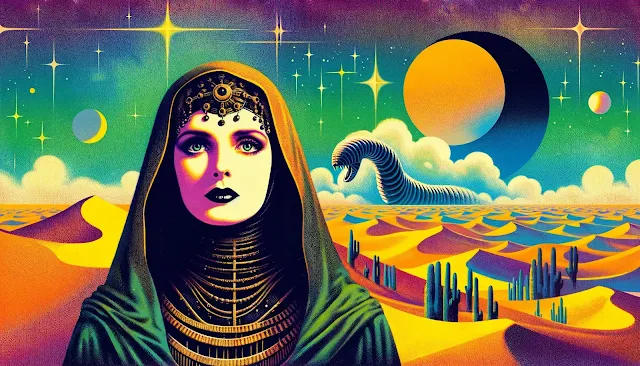
But Herbert does not use “heresy” only as a religious charge. He uses it as a pressure test for every institution in the novel. A heretic is someone who breaks the accepted truth of their own system while still remaining tied to that system. That distinction matters. A mere enemy can be fought. A traitor can be expelled. A heretic is more dangerous because the heretic comes from inside the structure. The heretic knows the doctrine. The heretic may still love the doctrine. The heretic may even save the doctrine by violating it.
That is why the title is plural.
Heretics of Dune is not about one rebel. It is about a universe in which every surviving power must become heretical or die. The Bene Gesserit must violate their own need for control. The Rakian priesthood must confront a girl who bypasses their authority. The Bene Tleilax must face the corruption of their own secret faith. Duncan Idaho must become something more than a ghola. Darwi Odrade must embrace the emotional danger her order fears. Taraza must turn disobedience into policy. Sheeana must pull holiness away from the priests and back toward the worm. Miles Teg must become the perfect servant who can no longer be contained.
The title points to the late Dune universe after the death of God. Leto II is gone, but his shadow remains. His body has passed into the sandtrout and the worms. His religion still grips Rakis. His Golden Path still governs the historical field. The Scattering has hurled humanity beyond the limits of the old Imperium, but those who return from it bring terror with them.
Everything is old. Everything is unstable. Everything is ready to break.
That is the world of heresy.
The religious meaning of the title
The first and most literal heresy in the novel is against the religion of the God Emperor.
Leto II ruled humanity for thousands of years as god, tyrant, sandworm, emperor, prophet, predator, and saviour. His reign was monstrous by design. As explored in The Golden Path as anti-messianic politics in Dune, Leto’s solution to humanity’s vulnerability was brutally paradoxical. He gave humanity the god it kept reaching for, then made that god unbearable.
His Peace suppressed movement, ambition, war, religious convulsion, aristocratic competition, and uncontrolled expansion. It created order, but that order was a cage. The point was not comfort. The point was pressure. Leto wanted humanity to explode outward after his death, scattered so far and made so unpredictable that no single oracle, ruler, machine, empire, or priesthood could ever trap the species again.
By the time of Heretics of Dune, Leto’s body has become ecological and religious residue. The worms carry his trace. Rakis carries his myth. The priests manage his memory. The God Emperor has become doctrine.
That is already a warning sign in Herbert. Living experience becomes ritual. Political necessity becomes scripture. Survival strategy becomes sacred law. The original force has passed. The institution remains.
The Rakian priesthood depends on mediation. They interpret the god. They manage access to the sacred. They preserve forms, titles, gestures, prohibitions, and holy vocabulary. They stand between ordinary people and the divine memory of Leto. Their authority relies on distance. The god must remain above, behind, within, or beyond. The priesthood cannot survive too much direct contact.
Then Sheeana appears.
Sheeana is a theological crisis because she can do what priests only claim to represent. She can call and command the worms. Her relation to the sacred is physical, direct, and public. She does not need the hierarchy. She does not need priestly permission. She turns worm religion from administration back into event.
That makes her one of the clearest heretics in the book.
Her heresy does not come from atheism. She does not simply reject the sacred. She touches it too directly. She collapses the distance between worship and power. The priests want a god who can be managed through ritual. Sheeana brings back a god force that moves through sand, hunger, danger, and command.
For Herbert, that is far more destabilising than disbelief. Disbelief can be denounced. A miracle outside the system is harder to contain.
The Bene Gesserit see the opportunity immediately. Sheeana can be used. Rakis can be influenced. The priesthood can be bypassed. The religion of Leto can be redirected. That makes the Sisterhood heretical too. They do not enter the Rakian religion as believers. They enter it as engineers. They want to use Sheeana, Duncan, and the worm myth to shape a new political future.
From the perspective of the Rakian priesthood, this is sacrilege. From the perspective of Leto’s religion, it is a violation of sacred order. From the perspective of the Golden Path, however, the matter is less simple.
Because Leto II wanted humanity to produce heretics.
That is the paradox at the centre of the title. To betray Leto’s religion may be to fulfil Leto’s purpose. He did not create the Golden Path so people would worship him forever. He made himself unbearable so humanity would learn to flee gods. He made the centralized future horrifying so that no sane species would walk willingly back into it. He created conditions under which disobedience would become instinct.
The heretics of Dune are breaking the religion of Leto II, but they may be obeying the deepest logic of Leto II.
The Bene Gesserit and the heresy of control
The Bene Gesserit make the title more interesting because they are not a religion in any ordinary sense. They manipulate religion. They seed myths. They cultivate legends as survival tools. Their Missionaria Protectiva turns faith into infrastructure. Their Reverend Mothers carry ancestral memory, not revelation from a god. Their discipline is bodily, political, sexual, linguistic, genetic, and psychological.
They are anti-priests who behave like priests.

That contradiction drives Heretics of Dune.
The Bene Gesserit claim to stand outside superstition, but they have their own sacred order. They have doctrine. They have taboos. They have forbidden experiments. They have internal orthodoxy. They have institutional memory guarded by women whose authority resembles a priesthood of the body. They fear uncontrolled messiahs because they have already seen what Paul and Leto did to history.
Their deepest law is control.
Control the breeding lines. Control the body. Control the voice. Control fear. Control sex. Control memory. Control politics from behind the curtain. Control religion by planting useful myths. Control the future by avoiding another Kwisatz Haderach. Control love because love ruins calculation.
That is why heresy inside the Bene Gesserit is so dangerous. It is not merely disobedience. It is a failure of containment.
Jessica is the ancient wound. She gives Duke Leto a son out of love. That act breaks the breeding plan and creates Paul. Paul creates the Jihad. Leto II creates the Tyranny. One private act of love becomes thousands of years of consequence. For the Sisterhood, Jessica is not just a romantic exception. She is the proof that emotion can smash history open. That same institutional anxiety runs through any serious account of who the Bene Gesserit are in the Dune universe.
Heretics of Dune keeps returning to that pattern. The Sisterhood fears love because love creates private law. A person in love obeys something the institution cannot fully see. Love creates loyalties that do not report upward. Love bends breeding plans, command chains, political assignments, and emotional discipline. For the Bene Gesserit, love is not sentimental. It is a structural threat.
That is why Darwi Odrade is dangerous.
Darwi Odrade is loyal to the Sisterhood, but she carries the Atreides problem: warmth, attachment, intuition, charisma, and dangerous sympathy. She feels too much. She sees too deeply. She has the sort of humanity the Sisterhood needs and mistrusts at the same time. Her Atreides inheritance gives her a connection to the old explosive line of Paul and Leto. Her emotional range makes her more than an instrument.
The Bene Gesserit want instruments. Herbert keeps giving them people.
Taraza understands this better than most. Her brilliance lies in recognizing that the Sisterhood cannot survive by purging every deviation. The Honored Matres have returned from the Scattering as a brutal new force. Rakis is unstable. The worm cycle is endangered. Duncan is not just another ghola. Sheeana is not just another religious asset. Teg is not just another Bashar. The old methods will not be enough.
Taraza’s real innovation is that she makes heresy strategic.
She does not merely tolerate Odrade’s dangerous qualities. She uses them. She does not merely rely on Teg’s obedience. She sets him in motion in a way that allows him to exceed obedience. She does not merely preserve Bene Gesserit orthodoxy. She risks contaminating it with the very qualities it fears.
This is one of the great institutional turns in the novel. The Bene Gesserit have survived for millennia by controlling variation. In Heretics of Dune, they begin to survive by releasing it.
Miles Teg, the great Heretic
Miles Teg appears at first to be the least heretical figure imaginable.
He is disciplined. Loyal. Military. Controlled. A Mentat commander. A servant of the Sisterhood. A man of duty, training, and tactical clarity. He does not begin as a rebel prophet or a religious agitator. He begins as a weapon shaped by service.
That is why his heresy matters.
Teg’s greatness as a heretic comes from the fact that he does not simply reject the system. He fulfils it so completely that he passes beyond its control. He is the perfect servant who becomes too large for the category of servant.
His loyalty is real. That point separates Teg from a simple traitor. He does not betray Taraza in spirit. He carries the deeper logic of her design forward. He protects Duncan. He acts decisively. He reads the field. He accepts terrible necessity. But his path takes him outside normal Bene Gesserit command, outside the expectations of his enemies, and finally outside the known limits of human capacity.
The T-probe changes him. The torture meant to break him awakens something latent. His perception alters. His speed becomes superhuman. His awareness expands. Most importantly, he becomes capable of seeing no-ships.
That ability is enormous in the late Dune universe.
No-ships matter because they represent escape from detection, prediction, and control. They are part of the post-Leto world’s deeper movement away from centralized visibility. The old nightmare of prescience was that one mind could see the paths of humanity and trap the species inside prediction. Leto’s Golden Path required the production of people and systems that could evade that trap. Siona’s line becomes invisible to prescience. No-ships extend concealment into technology and space.
Teg then becomes something stranger. He can see what is designed to be hidden.
He is not merely resistant to old control. He pierces new concealment. That makes him valuable, terrifying, and impossible to leave alone. If the Bene Gesserit fully grasped what he had become, they would want to preserve, breed, replicate, study, and use him. Teg understands this. His secrecy is part of his heresy. He withholds himself from the system he serves.
That concealment matters because the Bene Gesserit’s deepest claim is the right to know. They believe survival depends on observation, classification, memory, breeding, and manipulation. Teg becomes a fact they cannot fully classify. He is a loyal servant who refuses to become data.
Then comes Rakis.
Teg’s role in the destruction of Rakis makes him the great Heretic in the largest symbolic sense. Rakis is not simply a strategic location. It is the sacred centre of the saga. It is the planet of spice, worms, Fremen memory, Paul’s rise, Leto’s transformation, imperial religion, ecological mystery, and mythic origin. To destroy Rakis is to attack the altar of Dune itself.
That act is military, ecological, religious, and metaphysical.
It breaks the monopoly of the old sacred world. It severs the idea that humanity’s future must remain tied to one planet, one spice source, one worm cycle, one priesthood, one memory of god. It forces the sacred burden of Dune to move elsewhere. It turns preservation into diaspora.
That is the terrible logic of Teg’s heresy. He does not destroy the sacred because he is shallow or faithless. He destroys the sacred centre because the sacred centre has become too dangerous to leave intact.
The future cannot remain on Rakis.
That is why Odrade calls him “the great Heretic.” He has committed the ultimate violation in service of survival. He has broken holy geography. He has exceeded command. He has hidden his transformation. He has served the plan by becoming uncontrollable. He has fulfilled the Bene Gesserit need by violating Bene Gesserit control.
Teg is not the opposite of loyalty. He is loyalty after obedience has failed.
Odrade, the heretic who can name heresy
Odrade’s naming of Teg matters because she is herself a heretic.

She knows the shape of his violation because she carries a related one inside herself. She is Bene Gesserit, but not safely Bene Gesserit. She is Atreides, but not merely a repetition of Paul or Jessica. She is disciplined, but not cold. She understands the Sisterhood’s need for survival, yet she also sees the sterility of pure institutional calculation.
Her heresy is emotional intelligence against institutional fear.
Odrade’s love is not decorative. It is a mode of perception. Herbert repeatedly sets cold systems against living awareness. The Bene Gesserit can calculate, but calculation without humane judgment becomes brittle. The Tleilaxu can engineer life, but engineering without reverence becomes monstrosity. The Honored Matres can dominate bodies, but domination without restraint becomes addiction and terror. The priesthood can preserve ritual, but ritual without contact becomes empty administration.
Odrade feels, and because she feels, she sees what colder minds miss.
That is why she is dangerous to the Sisterhood. That is also why the Sisterhood needs her.
Her Atreides inheritance intensifies the problem. Atreides figures in Dune are never merely noble bloodline characters. They are historical accelerants. They bind loyalty, charisma, violence, sacrifice, vision, and danger. The Bene Gesserit know this. They cannot touch Atreides power without remembering Jessica, Paul, Alia, Leto II, and Siona. Odrade stands in that lineage, but she does not repeat it passively. She interprets it.
Her Atreides Manifesto is part of her heresy because writing is an act of transmission outside pure command. It allows thought to outlive orders. It turns private insight into doctrine against doctrine. It risks giving the future a language the present institution has not approved.
Odrade can call Teg “the great Heretic” because she understands that the word is not only condemnation. It is recognition. Teg has done what the age required. He has become the necessary violation.
Sheeana and the heresy of direct contact
Sheeana is the novel’s most obvious religious heretic because she breaks the Rakian priesthood’s monopoly over the divine.
Her power is simple to describe and enormous in consequence: she can command worms. In a universe where worms are ecology, spice, religion, Leto’s remnant, and the deepest symbol of Dune, that ability cannot remain local. It must become political. It must become theological. It must become dangerous.
The priests need Sheeana to fit their system. The Bene Gesserit need her to serve theirs. But Sheeana’s power exceeds both.
She is a direct line to the sacred object. That makes her prophet, weapon, scandal, and threat. She does not merely perform within the religion of Rakis. She alters its structure. She shifts authority away from institution and toward embodied contact.
Herbert has always been suspicious of prophets, but he is also suspicious of priesthoods that tame prophecy into safe repetition. That tension runs back through the original novel, Dune Messiah, and Children of Dune. Prophecy may begin as vision, but it hardens into administration as soon as institutions discover they can live off it.
Sheeana stands at that collision point. She can become another tool of manipulation, another mythic figure used by a political order, another sacred girl consumed by systems older than herself. But she can also become a break in the system, a living refusal of priestly distance.
That is why she belongs in the title. She is not “a heretic” because she rejects Dune. She is a heretic because she touches Dune too directly for the guardians of Dune to tolerate.
Duncan Idaho and the heresy of identity
Duncan Idaho is a different kind of heretic. He violates death.
By Heretics of Dune, Duncan has become one of Herbert’s strangest long arguments. He is not just a recurring character. He is a repeated question: what remains of identity when the body is manufactured, memory is manipulated, loyalty is engineered, and the past keeps being resurrected for use by the present?
Every Duncan ghola is a scandal against closure. Death should end a life. The Tleilaxu refuse that ending. They reproduce Duncan as tool, gift, experiment, trap, and commodity. But every attempt to make Duncan useful also risks making him more dangerous. The copy is never only a copy. The resurrected servant begins to accumulate meanings his makers cannot control.
In Heretics of Dune, Duncan becomes a battlefield of competing systems. The Tleilaxu have designs in him. The Bene Gesserit have designs on him. The Honored Matres want to imprint and dominate him. Atreides history claims him. His own returning selfhood resists reduction to any one purpose.
His heresy is personal before it is political. He refuses to remain an object.
That connects him to the larger pattern of the book. Tools wake up. Servants exceed commands. Religious assets become prophets. Military instruments become evolutionary events. Breeding products fall in love. Hidden powers reveal themselves. The future comes from what institutions thought they owned.
Duncan is one of the heretics of Dune because he proves that identity cannot be perfectly manufactured from outside.
The Honored Matres and the return of violent heresy
The Honored Matres are among the most brutal examples of heresy in the late Dune universe because they resemble the Bene Gesserit enough to feel like a nightmare reflection.
They use body control, sexual power, social domination, and psychological conditioning. But where the Bene Gesserit prefer patience and indirection, the Honored Matres prefer conquest, addiction, enslavement, and speed. They turn influence into violation. They strip subtlety from power.
Their heresy is methodological.
They are what Bene Gesserit control looks like after restraint collapses. They expose the Sisterhood’s hypocrisy because the difference between manipulation and domination is partly a difference of style, patience, and self-discipline. The Bene Gesserit want to see themselves as guardians of human survival. The Honored Matres show how similar tools can serve appetite and terror.
They also represent the danger of the Scattering. Leto wanted humanity dispersed so it could not be trapped. The Scattering succeeded, but freedom did not produce innocence. It produced unknown powers, new violence, and forces the old Imperium cannot easily understand. As the Astromech’s themes guide to Heretics of Dune notes, the late saga is defined by forces returning from the Scattering with powers that challenge every established order.
The Honored Matres prove that heresy is not automatically noble. Breaking the old order can unleash predators as well as liberators.
Schwangyu and conservative heresy
Schwangyu complicates the title because her heresy is not liberating in any simple sense.
She resists Taraza’s plan. She opposes the Duncan project. She fears the repetition of old disasters. Her position is rooted in institutional memory, and that memory has reason behind it. The Bene Gesserit have been burned by Atreides males, prescient traps, messianic eruptions, and the long consequences of their own breeding program. Schwangyu’s fear is not stupid. It is narrow, but not groundless.
That makes her a conservative heretic.
She disobeys the present command in order to defend what she believes is the older truth of the Sisterhood. She is heretical in action, orthodox in motive. This is exactly the sort of complexity Herbert likes. Heresy does not always mean progress. A heretic can be visionary, cowardly, loyal, selfish, prudent, destructive, or necessary. Sometimes the rebel is trying to open the future. Sometimes the rebel is trying to freeze the past.
Schwangyu proves that heresy is a structural condition, not a moral compliment.
Waff, the Tleilaxu, and corrupted sacred secrecy
The Bene Tleilax add another religious layer to the novel because they possess a secret faith beneath their reputation for biological manipulation.
They are not merely technicians. Their ghola production, Face Dancers, axlotl tanks, and genetic mastery sit inside a hidden worldview. They believe in themselves as custodians of a sacred order. That makes their biological work more disturbing. They are not cold scientists operating without belief. They are believers whose tools have become grotesque.
Waff’s heresy lies in the tension between faith and power.
He can be manipulated through belief. He can be tempted through political advantage. He can be compromised by the very creations his people claim to command. The Tleilaxu make life into a tool, then discover that tools do not remain tools forever. Face Dancers evolve beyond the roles assigned to them. Gholas remember. Biological products become subjects.
This is one of Herbert’s central warnings: any institution that plays god eventually creates a future that does not ask permission.
The Tleilaxu think secrecy protects them. In reality, secrecy lets corruption grow without correction. Their hidden faith does not save them from heresy. It gives their heresies a sacred mask.
Love as the deepest heresy
The most dangerous heresy in Heretics of Dune is love.
That sounds too soft until the whole saga is put behind it. Jessica’s love for Duke Leto breaks the breeding program. Paul’s love and grief help drive choices that become religious catastrophe. Leto II suppresses ordinary human possibility to preserve the species. The Bene Gesserit spend millennia trying to prevent private feeling from overwhelming collective design.
Love is dangerous in Dune because love creates an authority outside systems.
An institution can manage desire. It can arrange mating. It can exploit sex. It can breed bodies. It can train reflexes. It can use loyalty. But love is harder to reduce. Love creates disobedience with a conscience. It makes people answerable to the beloved, the child, the dead, the remembered, the vulnerable, the particular person standing before them.
The Bene Gesserit fear this because they are committed to abstraction. Bloodlines. Plans. Sisterhood. Survival. Species. Memory. Future. These are enormous categories, and Herbert knows they matter. But he also knows that enormous categories can justify cruelty.
Love breaks abstraction.
Odrade’s warmth, Teg’s humane loyalty, Jessica’s ancient crime, Duncan’s refusal to remain a sexual or political object, Sheeana’s directness, even Taraza’s willingness to trust dangerous people, all of these push against a universe of systems.
This is why love can be called heresy. It violates the cold doctrine of use.
Leto II, the maker of heretics
The final irony is that Leto II himself may be the greatest producer of heresy in human history.
His Golden Path required humans who could not be enclosed by prophecy. It required dispersal. It required no-ships. It required Siona’s invisibility. It required a species trained by oppression to hate the cage. He made himself god and tyrant so that humanity would recoil from gods and tyrants forever.
That means the heretics of Heretics of Dune are not accidents. They are the crop Leto planted.
Teg, Sheeana, Odrade, Duncan, and the scattered peoples of the universe all belong to the long aftermath of his design. Even the Honored Matres, horrific as they are, testify to the success and danger of the Scattering. Humanity has become too various to master. That was the point.
The tragedy is that Leto’s religion remains after Leto’s purpose has moved beyond religion. His worshippers preserve the shell. His true heirs break it.
That is why the title is so precise. These are Heretics of Dune because Dune itself has become the sacred past that must be violated. Arrakis made empire, prophecy, jihad, spice monopoly, Fremen transformation, and divine tyranny. By the fifth novel, that centre has to be broken so humanity can keep escaping.
Who are the heretics?
Miles Teg is the great Heretic because he embodies the title in its most concentrated form. He is loyal but disobedient. Trained but uncontrollable. Human but altered. A servant of the Bene Gesserit who refuses to become their property. A military man who commits a religiously catastrophic act. A protector of the future who helps destroy the sacred centre of the past.
But he is not alone.
Sheeana is a heretic against the Rakian priesthood because she touches the worm without priestly mediation.
Odrade is a heretic against Bene Gesserit emotional discipline because she allows love, memory, and Atreides humanity to become instruments of judgment.
Taraza is a heretic of command because she understands that the Sisterhood must violate its own habits to survive.
Duncan Idaho is a heretic against death and manufactured identity.
Schwangyu is a heretic of fear, disobeying the present to defend an older orthodoxy.
Waff is a heretic inside secret faith, compromised by the biological powers his people pretend to master.
The Honored Matres are heretics of Bene Gesserit method, turning influence into naked domination.
The Bene Gesserit as a whole are heretics against Leto’s religion because they manipulate the sacred machinery of Rakis rather than submit to it.
Leto II is the paradox behind them all: the god who created the conditions for blasphemy, the tyrant whose deepest success was a humanity that could betray him.
Conclusion: heresy keeps humanity alive
Herbert’s answer is severe. Civilizations die when they cannot produce heretics. Religions decay when they protect ritual more than truth. Institutions become dangerous when obedience matters more than adaptation. Love becomes revolutionary when systems have reduced people to tools. Survival belongs to those who can break the rule without losing the purpose.
Heretics of Dune is not a title about simple rebellion. It is a title about necessary violation. The old sacred order of Dune has become too heavy for the future to carry unchanged. Its heirs must break it, scatter it, reinterpret it, and plant it elsewhere.
In Herbert’s late universe, heresy is what happens when history refuses to stay buried.
It is also what keeps humanity alive.
Heretics of Dune has one of the sharpest titles in Frank Herbert’s original Dune saga because it looks simple until the novel forces the r...
Read Article →
Masters of the Universe Review: Travis Knight Brings the Power of Grayskull Back With Heart, Camp, and Glorious 80s Chaos
There are some films you review with your head, some with your heart, and some with that very specific part of your brain that still remembers sitting in a New Zealand lounge in the 1980s, parked in front of one of only three television channels, absolutely locked in on He-Man and the Masters of the Universe like it was high culture.
That was the thing about being a Kiwi kid back then. There was no endless scroll, no streaming menu, no algorithm feeding you a thousand options. If He-Man was on, you watched He-Man. You watched him with total commitment. You watched him as if Castle Grayskull was the centre of the universe and Skeletor was the greatest villain ever conceived by man. And for a lot of us, he was.
The figures helped too. They were chunky, strange, colourful things, all muscles and weapons and impossible names. Even if you only had a couple, the mythology expanded in your head. A tiger could be cowardly, then heroic. A skull-faced villain could be funny, frightening, petty, and somehow magnificent. A barbarian with a pageboy haircut and a metal harness could be the most powerful man in the universe. That all made perfect sense when you were seven.
So walking into Travis Knight’s new live-action Masters of the Universe, I was carrying a very particular kind of baggage, the good kind. Nostalgia, affection, a fair bit of caution, and a genuine love for the 1987 Dolph Lundgren movie, which I will defend until the day I die. That film is cheesy, awkward, half-glorious and half-bonkers, and I still enjoy it enormously. On a modern rewatch, as a middle-aged adult who can clearly see every bit of its budget strain and tonal weirdness, I still have a terrific time with it because it understands one key truth. Masters of the Universe should be fun.
This new version gets that too.
Quick verdict: Travis Knight’s Masters of the Universe is a vivid, overstuffed, highly entertaining blockbuster that honors the toy line, the Filmation cartoon, the wider mythology, and the 1987 movie with surprising confidence. It runs long, some emotional beats land harder than others, and a few effects look shaky, but the film’s spirit is dead right. It embraces the absurdity of Eternia, treats the lore with respect, and delivers a crowd-pleasing fantasy action film that knows exactly how colourful and strange this universe should be.

Castle Grayskull looks exactly like the kind of place a 1980s kid would have dreamed of visiting.
A big, bright blockbuster that remembers what the property is
One of the smartest things Knight does here is refuse to be embarrassed by the source material. That sounds obvious, but it is amazing how often modern franchise filmmaking ties itself in knots trying to "fix" older pulp material by sanding away the very things people loved in the first place. Masters of the Universe avoids that trap.
The film gives us Prince Adam, the Sword of Power, Castle Grayskull, Skeletor, Teela, Duncan, Evil-Lyn, Beast Man, Ram-Man, Fisto, Trap Jaw, Mekaneck, Roboto, Cringer, Snake Mountain, King Randor, Queen Marlena, the Sorceress, and a whole parade of names and concepts that would sound ridiculous in a po-faced fantasy epic. Instead of shrinking from that silliness, the movie leans into it and finds a workable tone somewhere between old-school toybox fantasy and modern effects-driven spectacle.
That is where the film feels closest to the better Transformers and G.I. Joe movies. It understands that this material comes from an 80s commercial machine built out of action figures, cartoon logic, fantasy archetypes, laser fire, and impossible musculature. So it plays like a blockbuster built from bright plastic memory, then upgraded with a much larger budget and a stronger sense of visual momentum.
And yes, Travis Knight turns out to be exactly the right director for that job. His work on Bumblebee already proved he could take a toy-based property and find the human angle without draining away the fun. The transition here feels seamless. He brings the same clarity, affection, and sincere genre energy to Eternia. You can see the hand of a filmmaker who likes this stuff, understands why people like this stuff, and has no desire to apologise for any of it.
That matters because Masters of the Universe has always been a weird cocktail. It is sword and sorcery, science fantasy, superhero origin story, cosmic fairy tale, monster mash, toy catalogue, and heavy metal album cover. The new film succeeds most when it remembers that the blend is the point. Eternia should feel like Conan wandered into Star Wars, then got chased by a skull wizard through a toy aisle.
The old 1987 movie still matters, and this new one knows it
I have a deep soft spot for the 1987 Masters of the Universe. It is one of those films that lives in the overlap between genuine fantasy adventure and accidental camp classic. Dolph Lundgren looked the part. Frank Langella devoured the scenery as Skeletor. Meg Foster’s Evil-Lyn had the stare of someone who could curdle milk from across the room. The Earth setting was a budget compromise you could feel in every frame, yet the movie still had a strange sincerity that made it stick in the memory.
That is why this new film’s relationship with the 1987 version matters. It treats that earlier movie like part of the living history of the franchise. The most delightful example is the inclusion of Karg, the hook-handed, bat-like commander from the Dolph Lundgren film. Karg was originally played by Robert Towers in 1987 and was one of Skeletor’s oddball screen-only minions, operating alongside characters such as Blade, Saurod, Beast Man, and Pigboy. Seeing Karg acknowledged here is a proper deep-cut fan reward.
Karg is more than a random name-drop. He represents a very specific strand of Masters of the Universe history. The 1987 movie had to invent or alter several elements because it was adapting a massive toy-and-cartoon mythology into a constrained live-action production. Karg became part of that strange cinematic branch of the franchise. Bringing him back in 2026 says this film is not only honouring the cartoon and toy line. It is honouring the oddball film detours too.
The film also works in Pigface, another nod to Skeletor’s grotesque 1987-era henchmen. That sort of thing will go over the heads of casual viewers, which is fine. For the fans who know why a hook-handed monster named Karg matters, it is gold.
There is also the Dolph Lundgren cameo, which lands with more warmth than a simple wink. His appearance as a gym figure who offers Adam a lesson about strength gives the moment a passing-of-the-sword quality. It is not just "look, there’s old He-Man." It connects directly to the film’s larger idea that muscles alone do not define heroism. For a franchise built around one of the most famously muscular heroes in 80s pop culture, that is a smart little bit of self-awareness.
Nicholas Galitzine, Jared Leto, and a cast that understands the assignment
Nicholas Galitzine makes for a very effective Adam and a convincing He-Man. That matters more than it sounds, because the role demands two things at once. Adam has to carry some uncertainty, some awkwardness, some sense of displacement. He-Man has to feel mythic the instant the power kicks in. Galitzine handles both sides well. He has the physical presence for the action and the self-awareness needed for the film’s lighter beats.
The film’s Earth setup helps him. Adam Glenn is no swaggering warrior when we first settle into his adult life. He is a man stuck between planets, stuck between identities, and hilariously stuck in human resources. That HR detail is almost too on the nose, but it works because this Adam’s great strength is not merely punching things. He listens. He mediates. He tries to understand people. His heroic power is built around empathy as much as muscle.
Camila Mendes gives Teela solid presence, even if the character sometimes feels underwritten compared to Adam’s arc. The film gives her a strong warrior edge and keeps her rooted in the Duncan and Sorceress side of the mythology. Teela’s costume is also doing clever franchise work. It blends the classic cartoon silhouette with the tougher, gunslinger-like feel associated with Chelsea Field’s Teela from the 1987 film. That is exactly the kind of design compromise a movie like this needs.
Idris Elba brings worn authority and a little emotional heft to Duncan, also known as Man-At-Arms. His arc gives the film some of its most grounded dramatic material. Duncan is the old soldier who has to rethink what strength means. He is useful in battle, naturally, but his real journey is internal. In a film full of laser rifles, magic swords, and warrior nicknames, Elba gives the movie a human anchor.
Alison Brie’s Evil-Lyn is one of the film’s most entertaining ingredients. The movie leans into the wicked theatricality of the character, and the Earth-side identity of Evelyn Powers gives the name a cheeky in-universe logic. Evil-Lyn has always been one of the franchise’s great villains because she is more than Skeletor’s assistant. She is a sorceress, a schemer, and someone whose loyalty always feels conditional. This version keeps that edge.
Morena Baccarin (Firefly) gives the Sorceress the right mythic calm, while James Purefoy and Charlotte Riley bring King Randor and Queen Marlena into the story with a useful mix of royal authority and family grief. The Marlena material is especially interesting because MOTU lore has long played with the idea of Adam’s mother having Earth connections. This film folds that into Adam’s exile and identity crisis in a way that makes the Earth material feel less random.
Then there is Jared Leto’s Skeletor, who turns out to be one of the film’s strongest assets. The performance is playful, vicious, petty, theatrical, and gloriously heightened. Skeletor should never be generic. He should feel like the kind of villain a child would invent after reading three fantasy comics, seeing a horror poster, and deciding skulls are cool. This version gets there. He is dangerous, ridiculous, charismatic, and very funny in spots.

Jared Leto’s Skeletor is theatrical, sneering, and fully committed to the madness.
The lore and trivia are where the film really starts to flex
The film’s biggest surprise is how dense it is with MOTU lore. A weaker version of this movie might have stopped at Adam, Skeletor, the Sword of Power, and Castle Grayskull. Knight’s version goes much deeper. It feels built by people who know that Masters of the Universe is a whole ecosystem of heroic warriors, evil warriors, weird vehicles, cosmic locations, toy-line variants, cartoon morality, and contradictory mythology.
That last part matters. MOTU has never had one perfectly clean canon. The early mini-comics, the Filmation cartoon, the 1987 film, The New Adventures of He-Man, the 2002 series, the Netflix shows, the collector lines, and the later comics all shift details around. Sometimes Adam is more secretive. Sometimes the Sorceress is more central. Sometimes Skeletor’s origin as Keldor matters deeply. Sometimes the story is pure toybox chaos. This film treats that inconsistency as a strength. It pulls from across the shelf.
Karg returns from the 1987 movie
Karg is one of the film’s sharpest deep cuts. He was created for the 1987 live-action movie as a hook-handed, bat-like commander in Skeletor’s army. He had no major Filmation cartoon legacy, which makes his return feel especially targeted at fans of the Dolph Lundgren film. For anyone who grew up with the 1987 movie on VHS, this is a surprisingly affectionate nod.
Pigface and the 1987 henchman tradition
The appearance of Pigface reaches into the same grubby corner of the franchise as Karg. The 1987 movie gave Skeletor a gallery of practical-effect weirdos, including Pigboy, Blade, Saurod, and Karg. This new film understands that those characters belong to the franchise’s cinematic DNA, even if they were never as iconic as Beast Man or Trap Jaw.
Dolph Lundgren as the old guard
Lundgren’s cameo works because it is thematically placed. He does not simply appear for applause. He gives Adam a piece of wisdom about strength, which turns the moment into a bridge between the old movie’s bodybuilder fantasy and the new film’s more emotionally aware version of heroism.
Adam Glenn and the Earth exile twist
The Earth material is a smart update of a recurring live-action problem. The 1987 film sent He-Man and friends to Earth through the Cosmic Key. This new film makes Earth part of Adam’s identity. Adam grows up away from Eternia, carrying fragments of memory, drawings, obsession, and destiny. That makes his return home feel like both a fantasy quest and a delayed coming-of-age story.
The Sword of Power as destiny and joke
The Sword of Power is treated with the expected mythic weight, but the film also has fun with the absurdity of a grown man looking for a magic sword on Earth. Finding the sword through the world of toys, collectibles, and pop culture is a witty move because Masters of the Universe has always existed in that zone between sacred object and plastic merchandise.
Castle Grayskull gets its mythic due
Castle Grayskull has to feel like more than a spooky green skull playset. The movie presents it as a seat of cosmic power, a source of mystery, and the visual symbol of Eternia itself. The best thing about the film’s Grayskull is that it still looks toyetic. It feels ancient, magical, and faintly ridiculous, which is exactly right.
Snake Mountain becomes a proper action arena
Snake Mountain is one of the great villain lairs of 80s toy culture. The film uses it as a physical and symbolic counterweight to Grayskull. Its best action beat gives He-Man a brutal, large-scale fight that tests whether Adam can control his power rather than simply unleash it. That is where the movie’s action and character work click together.
Roboto gets a comic reinvention
Roboto is a classic Heroic Warrior who could have looked absurd in live action. The film solves that by giving the character a comic personality and letting Kristen Wiig’s voice performance bring bite to the mechanical body. The idea of a battle-ready robot reduced to menial service also gives the movie one of its funniest pieces of background world-building.
Ram-Man and Fisto survive their own names
Ram-Man and Fisto are exactly the sort of characters that expose the challenge of adapting MOTU. Their names sound like playground jokes. The film handles them by admitting the joke, then letting the characters still function. Ram-Man rams. Fisto punches. The movie laughs, then gets on with the battle.
Mekaneck proves the film knows the toy shelf
Mekaneck is one of those characters who tells you how deep the adaptation wants to go. His extending neck gimmick is pure toy-line madness. Including him shows the movie is willing to embrace the mechanics of the old figures rather than replace them with generic fantasy soldiers.
Trap Jaw gets his cyborg menace
Trap Jaw is a key example of MOTU’s science fantasy identity. He is part pirate, part robot, part weapons platform, and part skull-faced villain-adjacent nightmare. The film’s use of him helps keep Skeletor’s side from becoming a bland army of anonymous dark soldiers.
Beast Man remains wonderfully literal
Beast Man is funny because the name is so blunt, but the character is essential. He brings the monster-movie side of Skeletor’s faction into the story. The film knows the name is silly and still lets the character have physical impact.
Goat Man and the weird outer edges of MOTU
The use of Goat Man is a nice nod to the franchise’s deeper bench. He is exactly the sort of character casual viewers will accept as another Eternian oddity, while toy-line fans recognize the pleasure of seeing a less obvious figure pulled into the film.
Tri-Klops sharpens the evil warrior roster
Tri-Klops is another smart inclusion because his design instantly sells the hybrid world of Eternia. He is a swordsman, a spy, a tech-enhanced villain, and a visual gag all at once. That is MOTU in one character.
Cringer and the Battle Cat problem
Cringer is one of the hardest elements to make work in live action. A cowardly green talking tiger who can become a battle mount is perfect cartoon logic and difficult photoreal cinema logic. The character’s personality works better than some of the effects, but the film is right to include him. Leaving Cringer out would have been cowardice of a different kind.
The Sorceress and Teela connection
The film leans into the long-running mythology around Teela and the Sorceress. That relationship has always carried a hint of destiny, secrecy, and inheritance. It gives Teela more significance than simply being "the warrior friend" and ties her directly to the power structure of Grayskull.
Queen Marlena and the Earth link
Marlena’s Earth connection is a useful piece of lore because it makes Adam’s exile feel less arbitrary. In older versions of MOTU, Marlena has often been linked to Earth and space travel. The film uses that idea to connect royal Eternia, human Earth, and Adam’s divided identity.
Keldor matters beneath Skeletor
The name Keldor carries franchise weight because it points to Skeletor’s pre-Skeletor identity in several versions of the mythology. Even when the movie mostly enjoys Skeletor as a skull-faced tyrant, that name gives him a deeper MOTU lineage.
The Staff of Havoc gets its due
Skeletor’s staff is one of those props that has to look both dangerous and absurd. The film understands its value. It is a weapon, a status symbol, and a piece of villain branding. Skeletor without his staff would feel strangely underdressed.
The Fright Zone nods toward She-Ra mythology
The Fright Zone reference is one for fans who know the wider universe. In She-Ra lore, the Fright Zone is tied to Hordak and the Evil Horde. That name quietly opens a door beyond Eternia and toward Etheria, Adora, and a much larger mythological map.
She-Ra and Adora enter the conversation
The credits material teasing Adora is a major lore move. Adora is Prince Adam’s twin sister and the alter ego of She-Ra, one of the most important characters in the wider franchise. Her presence points toward Etheria, Hordak, the Evil Horde, the Sword of Protection, and the possibility of a much bigger cinematic mythology.
Orko brings back the Filmation moral
Orko’s stinger is a perfect Filmation wink. The original cartoon often ended with a moral lesson, turning wild fantasy adventures into little after-school messages about courage, honesty, friendship, or responsibility. Bringing Orko in to echo that tradition is both silly and oddly sweet.
Fabulous Secret Powers gets a wink
The film’s musical and credits choices also nod toward the internet afterlife of He-Man, including the famous viral "Fabulous Secret Powers" meme. That matters because MOTU has lived several lives: toy line, cartoon, VHS movie, rerun memory, meme culture, collector obsession, streaming reboot, and now modern blockbuster.
The action is energetic, readable, and sometimes genuinely inspired
One thing that surprised me most was how much I enjoyed the action. Modern franchise cinema too often drowns itself in noise, grey digital sludge, and editing that treats visual coherence like a minor inconvenience. This film is much better than that. Knight stages the action with a clear sense of geography. Fights have shape. Chases have momentum. Set pieces build toward payoff.
The best sequences really do feel like a child’s idea of the coolest fantasy battle ever filmed. Spaceships tear across Eternian landscapes. Laser fire mixes with steel. Warriors crash through beautifully silly production design. The movie remembers that Masters of the Universe was always an odd hybrid, a barbarian fantasy fused with science fiction, toy-commercial excess, and comic-book melodrama. When the film commits fully to that blend, it is very hard to resist.
The Snake Mountain battle is the standout. It gives He-Man the sort of overwhelming physical showcase the character needs, but it also places a question underneath the spectacle. What happens when Adam finally gets the power he has been chasing? Does he become heroic, or does he simply become dangerous? That is a better dramatic question than "can the strong guy hit harder?"
The chase work is also strong, especially when the film turns Eternia into a moving battlefield of ships, forests, weapons, and impossible geography. There is a clarity to the way Knight handles motion that feels connected to his animation background. He understands bodies in space. He understands silhouettes. He understands that an action scene should be readable at a glance, especially in a universe where half the characters look like they escaped from a toy catalogue designed during a fever dream.
Where the movie stumbles
The film is fun, though it has real flaws. The biggest issue is length. It feels overlong, and there are stretches where the pace sags slightly as the screenplay reaches for emotional depth that it does not always fully earn. Adam’s arc broadly works, especially in relation to identity, belonging, and the burden of destiny, but a few dramatic scenes carry a more generic fantasy-movie flavour than the surrounding material deserves.
Some of the visual effects are also inconsistent. The world of Eternia often looks rich and inviting, especially in the brighter outdoor sequences and the more overtly stylised production design. A few creatures and digital environments look less persuasive, with Cringer being the most obvious example. He is charming as a character. The effect itself occasionally wobbles.
That said, the practical design work, costume work, and creature concepts do plenty of heavy lifting. The film’s visual identity remains one of its strengths, largely because it never tries to drain the colour or weirdness out of the franchise. Knight and his team understand that Eternia should feel excessive.
The emotional material also lands unevenly. The film is at its best when it lets sincerity and silliness sit side by side. It strains when it pauses too long to underline a theme that the action and characters have already made clear. The message about strength, empathy, and self-acceptance is right for He-Man. The delivery sometimes needs a lighter touch.

Evil-Lyn brings attitude, menace, and a welcome streak of comic-book wickedness.
The credits scenes are not throwaway fan bait
The credits scenes deserve attention because they show how confidently the film is thinking about the larger MOTU universe. The Adora tease is the biggest one. For longtime fans, Adora is not just "He-Man’s sister." She is She-Ra, Princess of Power, the heroine whose mythology opens the door to Etheria, Hordak, the Evil Horde, Swift Wind, the Sword of Protection, and the Great Rebellion.
That is a huge expansion point. It also changes the emotional shape of Adam’s family story. Queen Marlena’s sadness over Adora’s absence gives the mythology a missing-child wound that can carry into future films. It suggests that Adam’s return is only half the restoration. Eternia’s royal family remains incomplete.
The Evil-Lyn and Skeletor tease is more pulpy and exactly right. A skull-faced villain should never feel permanently finished. Evil-Lyn retrieving Skeletor’s skull is classic serial logic, classic toy-line logic, and classic MOTU logic. The bad guy can lose today and still cackle his way back into the next adventure.
Then there is Orko. His appearance matters because Orko belongs to the Filmation soul of the franchise. He is goofy, magical, annoying, beloved, and deeply tied to the cartoon’s kid-friendly rhythm. Using him as a moral-lesson stinger is almost absurdly specific, but that specificity is why it works.
Final thoughts
As someone who grew up in New Zealand when television felt smaller, stranger, and somehow more intense because you had fewer choices, this film hit a very specific nostalgic nerve. He-Man belonged to that era. He was part of the ritual. The toys, the cartoon, the old Dolph Lundgren film, the whole oversized fantasy of it all, those things still carry a lot of affection for people of a certain age.
Travis Knight’s Masters of the Universe earns that affection. It could stand to trim a few minutes. Some effects are rough. A handful of emotional beats feel a bit thin. Even so, it is a lively, generous, smartly mounted blockbuster that understands the joyous nonsense at the centre of the franchise.
More importantly, it embraces that nonsense with style. It gives us spectacle, lore, big personalities, deep-cut references, heroic transformation, Karg, Pigface, Orko, Adora, Snake Mountain, Grayskull, Roboto, Evil-Lyn, Trap Jaw, Ram-Man, Fisto, and a world that still feels like a child emptied a toy chest onto the floor and built a universe out of pure excitement.
That, in the end, is exactly what a good Masters of the Universe movie should do. By the power of Grayskull, this one actually pulls it off.
Rating: 4 out of 5 - I Have the Powers
There are some films you review with your head, some with your heart, and some with that very specific part of your brain that still remembe...
Read Article →
Underworld
Chronological Order Guide to the Underworld Films: The Complete Death Dealer Timeline
The Underworld saga arrived in 2003 wearing the uniform of its moment: blue-filtered cinematography, latex combat suits, twin Berettas loaded with silver nitrate and ultraviolet ammunition. But beneath the post-Matrix styling sits a genuinely unusual piece of monster mythology. Underworld refuses to treat vampirism and lycanthropy as curses. They are competing mutations of a single ancient virus, the Corvinus Strain, and the thousand-year war between the two bloodlines is less a battle of good against evil than a feudal class conflict that never found a peace table.
The series is anchored by Selene, a vampire Death Dealer played across five films by Kate Beckinsale, whose arc runs from loyal soldier of a corrupt aristocracy to kingslayer, fugitive, mother, and finally Elder. This guide organises every entry, including the often forgotten 2011 animated anthology Endless War, in strict in-universe chronological order, with the lore, the connective tissue, and the themes that hold the saga together.

Release order, for the record: Underworld (2003), Evolution (2006), Rise of the Lycans (2009), Endless War (2011), Awakening (2012), Blood Wars (2016).
The Timeline at a Glance
| ~1202 | Prologue of Evolution: Marcus and Viktor capture the original werewolf, William |
| ~1402 | Underworld: Rise of the Lycans (2009): Lucian's slave revolt ignites the war |
| 1890 | Underworld: Endless War, Part 1 (2011): Selene hunts the lycan brothers in Paris |
| 1967 | Underworld: Endless War, Part 2 (2011): the hunt resumes in a modernising world |
| 2003 | Underworld (2003): Selene discovers Michael Corvin and the conspiracy beneath the war |
| 2003 | Underworld: Evolution (2006): the first vampire rises; the origin of both species revealed |
| 2012 | Underworld: Endless War, Part 3 (2011): the Purge begins; Selene finishes the hunt |
| ~2015 | Underworld: Awakening (2012): Selene wakes from cryo into a world hunting immortals |
| ~2016 | Underworld: Blood Wars (2016): the war ends, for now, with three new Elders |
First-time viewing recommendation: watch in release order. The 2003 original is built on the mystery of who Lucian is and what the covens are hiding, and Rise of the Lycans answers those questions before they are asked. Chronological order is the rewatch order, not the discovery order.
The Origin: Slaves, Elders and the First Betrayal
The Dark Ages chapter. One film carries the entire founding mythology of the war, and it recasts the so-called villains of the modern era as a slave uprising with a legitimate grievance.
Underworld: Rise of the Lycans
The Story
Centuries before the modern war, the vampire covens rule the night from fortified castles, and the lycans serve them in silver collars. The original werewolves, descendants of William Corvinus, are mindless beasts. Lucian is something new: the first lycan born capable of shifting between human and wolf form at will, raised by the vampire Elder Viktor as a useful slave and a breeding template for a controllable workforce.
The film is a tragedy with a known ending. Lucian and Sonja, Viktor's daughter and a member of the vampire ruling Council, conduct a forbidden romance. When Viktor discovers Sonja is pregnant with a hybrid child, he executes her by sunlight while Lucian is forced to watch. The act turns a slave revolt into a blood feud that will burn for six hundred years.
The Lore
This entry codifies the saga's class system. Vampires are aristocracy: landowners, tax collectors, hoarders of immortality who sell their protection to frightened human nobles. Lycans are labour, guarding the covens by day because their masters cannot face the sun. The distinction between William's feral first-generation werewolves and Lucian's disciplined second generation also explains why the lycans of the modern films fight with strategy, science and firearms rather than teeth alone.
How It Connects
The final minutes hard-wire this prequel into the 2003 original. Kraven arrives to report Lucian's supposed death, the lie that powers the first film's conspiracy, and the closing audio replays Selene's opening narration from Underworld, folding the two films into a single loop. Sonja's pendant, which Lucian wears for the rest of his life, is quietly the most important object in the franchise: it is one half of the key to William's prison, the secret that drives Evolution. Viktor's execution of his own daughter also sets up the bitter irony of his relationship with Selene, the surrogate daughter he chose precisely because she reminded him of Sonja.

The Modern War: Conspiracy and Awakening
Len Wiseman's founding duology. Two films set across a single bloody fortnight in 2003, in which every official history of the war is revealed to be a lie told by the people who won it.
Underworld
The Story
Selene, an elite Death Dealer who has spent six centuries exterminating lycans, notices something that should be impossible: the supposedly leaderless lycans are hunting a specific human, a medical intern named Michael Corvin. Her investigation unravels the coven from the inside. Lucian is alive. Kraven, the coven's regent, faked his death and has been conspiring with him for centuries. And Viktor, the Elder Selene awakens out of cycle to save the coven, turns out to be the man who slaughtered her family and turned her on the same night, then taught her to blame the lycans for it.
The Lore
The film deconstructs its own mythology in real time. Vampires and lycans are biological offshoots of the Corvinus Strain, a plague that mutated in the body of a fifth-century warlord named Alexander Corvinus and rendered him immortal. One son, Marcus, was bitten by a bat. One son, William, was bitten by a wolf. A third remained human and carried the immortality gene dormant in his bloodline, all the way down to Michael Corvin. The lycan scientist Singe proves the endgame: a descendant of the pure line, infected with both vampire and lycan blood, becomes a hybrid stronger than either species. The film also establishes the Elder system, a chain of rule in which only one of the three Elders (Viktor, Marcus, Amelia) is awake in any given century, the others sleeping in torpor beneath the coven.
How It Connects
Almost every thread here pays off elsewhere. Amelia's assassination aboard the train leaves the vampire nation without legitimate leadership, a vacuum that Blood Wars resolves in an unexpected way. Selene biting Michael creates the first hybrid and the saga's central couple. Viktor's death by Selene's sword is the franchise's defining image of patricide. And the final scene, in which Singe's blood drips into Marcus's tomb and wakes the first vampire with a lycan's memories in his veins, is the direct cold open of Evolution. The mechanic matters: in this universe, blood carries memory, so every bite is also a data transfer.
Underworld: Evolution
The Story
Picking up within hours of the first film, Selene and Michael are fugitives from both species. The antagonist is Marcus Corvinus, the first vampire, now transformed by Singe's blood into a winged vampire-lycan hybrid and armed with eight centuries of other people's memories. His goal is the franchise's oldest secret: freeing his twin brother William, the original werewolf, from the prison Viktor built for him in 1202. The keys are Lucian's pendant and the knowledge locked in Selene's blood, because her father was the architect who built the dungeon.
The Lore
The mythology reaches its deepest point. Alexander Corvinus, immortal father of both species, is revealed to be alive and running a covert operation called the Cleaners, scrubbing every battle site to keep the war invisible to humanity. His refusal to kill his own monstrous sons is the saga's quiet thesis on parental failure. Before dying at Marcus's hands, Alexander offers Selene his pure, unmutated blood. Drinking it transforms her into something beyond a standard vampire: stronger, faster, and immune to sunlight.
How It Connects
With Viktor, Marcus, Amelia and William all dead by the closing credits, the old order is extinct, which is precisely what makes the later films possible: the war continues out of habit and hatred rather than leadership. Selene's sunlight immunity, gained here, becomes her signature in every subsequent entry. And though no one knew it at the time, the night Selene and Michael spend together in the Cleaners' safehouse produces Eve, the daughter whose existence drives Awakening and haunts Blood Wars.
The Hidden Years: The Animated Bridge
The entry most chronologies skip entirely. A trio of animated shorts spanning 122 years of the war, and the only canonical depiction of the moment humanity discovers the immortals.
Underworld: Endless War
The Story
Produced as a promotional bridge to Awakening, the three shorts follow a single vendetta across more than a century. In 1890s Paris, Selene is dispatched to eliminate a trio of lycan brothers who have taken up residence in the city, and kills the first of them. In 1967 she returns to finish the job, destroying the second brother as the lycans trade horse-drawn carriages for muscle cars and the war modernises around her. In 2012, with the Purge under way and the surviving brother Krandrill hiding among humans, Selene completes the hunt even as her own kind is being exterminated in the streets.
The Lore
Slight on mythology but valuable as connective tissue, the anthology demonstrates something the live-action films only assert: that Selene's six centuries of service were a long, grinding procession of identical assignments. The same target, the same method, the same outcome, across three different eras of human history. It is the war as bureaucracy, and it makes her eventual defection feel earned rather than sudden.
How It Connects
Parts one and two sit comfortably before the 2003 films. Part three is the saga's only ground-level view of the Purge in progress, dramatising the transition between the secret war of Evolution and the open extermination of Awakening. The third short ends with Selene resolving to surrender herself to human custody, which is precisely where the next film finds her.
The Purge Era: Humanity Joins the War
The timeline jumps forward into a world where the secret is out. Humanity has discovered both species, declared them a disease vector, and begun an extermination campaign that makes the old vampire-lycan feud look quaint.
Underworld: Awakening
The Story
Captured during the Purge, Selene wakes from twelve years of cryogenic suspension inside Antigen, a biotech corporation ostensibly developing a cure for the immortal infections. She escapes to discover two things: Michael is missing, presumed dead, and she has a daughter. Eve, designated Subject 2, is a natural-born hybrid who has spent her entire childhood as a laboratory specimen. The twist lands harder than the marketing suggested: Antigen is not curing the infection, it is run by lycans hiding in plain sight, harvesting Eve's blood to make their species immune to silver.
The Lore
The lycans, officially extinct, have evolved again. The film introduces the Super Lycan in the form of Quint, a hulking variant immune to silver and nearly twice the mass of a standard wolf. The genre shifts accordingly, from gothic fantasy to science fiction survival horror: fluorescent labs replace candlelit crypts, and the monsters wear corporate lanyards. The maternal core of the story, a warrior discovering a child engineered from her own body, plays in the same thematic register as the motherhood and bodily horror themes of the Alien franchise, with Eve as a deliberate echo of Newt and the Ripley dynamic.
How It Connects
This film introduces David and his father Thomas, the vampire safehouse leaders who become central to Blood Wars, and Selene revives David with her immortal blood, an act with consequences the sequel reveals. Michael's fate is the saga's loosest thread: his cryo-pod is shown empty in the final scene, an escape the franchise never resolved on screen. Detective Sebastian, the human ally, represents the first crack in the Purge consensus, proof that not all of humanity wants the immortals dead.
Underworld: Blood Wars
The Story
Selene, now a pariah hunted by vampires and lycans alike, is offered a poisoned amnesty: return to the Eastern Coven and train a new generation of Death Dealers against Marius, a charismatic lycan warlord whose army has been winning the war outright. The pardon is a trap, the coven politics are lethal, and the film's best reveal is biological rather than political: Marius's superhuman power comes from regular injections of Michael Corvin's harvested blood, making Selene's lost love the unwitting fuel of her newest enemy.
The Lore
The film's major addition is the Nordic Coven, a pacifist sect of white-haired vampires in the far north who have abandoned the war for mysticism, practising a form of spirit-walking through the Sacred World. When Selene is killed in battle, the Nordic ritual brings her back changed: white-streaked hair, partial teleportation, and speed beyond anything in the series. It also delivers the franchise's last great retcon: David is revealed as the son of the Elder Amelia, assassinated back in the 2003 film, making him the legitimate heir the vampire nation has lacked since her death.
How It Connects
As a series finale by default, it closes the loop with unusual neatness. The Elder triumvirate destroyed across the first two films is restored with Selene, David and the Nordic warrior Lena in the three seats, which means the slave-soldier who killed Viktor now occupies his throne. Eve does not appear, but the closing narration confirms she is searching for her mother, the dangling hook for a sequel that never came.

The Lore Primer: One Virus, Two Species, Three Sons
Everything in Underworld descends from a single biological event. In the fifth century, a plague sweeps a Hungarian village and kills everyone except the warlord Alexander Corvinus, whose body adapts the virus into a benign immortality. His three sons inherit the dormant strain. Marcus, bitten by a bat, becomes the first vampire. William, bitten by a wolf, becomes the first werewolf, feral and uncontrollable. The third son stays human, and his descendants quietly carry the pure Corvinus gene through eight centuries until it surfaces in Michael Corvin.
Three mechanics flow from this premise and power every plot in the series. First, blood carries memory: drinking another immortal's blood transfers their experiences, which is how secrets are stolen, lies are exposed, and Marcus learns of William's prison. Second, hybridisation is supremacy: any combination of the two strains in a pure Corvinus host produces a creature stronger than either parent species, which is why Michael, Marcus and Eve each represent an arms race escalation. Third, lineage is law: the vampire Elder system, the lycan bloodlines, and the inheritance of Amelia's legitimacy through David all treat blood descent as the only currency that matters.
It is monster mythology rewritten as genetics, and the timing was no accident. The first film arrived in 2003, the same year the Human Genome Project published its complete sequence, and Underworld belongs to that moment: a vampire saga where damnation is a mutation, holy water does nothing, and the only things that kill you are ultraviolet light, silver nitrate, and family.
What the Saga Is Actually About
Class War with Fangs
Strip away the leather and the saga is a story about labour and aristocracy. The vampires are landed gentry: they hoard immortality, collect tribute from human nobles, and hold court in candlelit estates. The lycans are the workforce, literally collared, guarding their masters through the daylight hours the vampires cannot survive. Rise of the Lycans makes the subtext explicit by structuring itself as a slave revolt, and the modern films never let the vampires off the hook for it. Viktor is not wrong because he is cruel; he is cruel because the system he built requires it.
The Doubled Romance
The series runs the same tragedy twice and changes the ending. Lucian and Sonja are the first forbidden cross-species couple, and Viktor destroys them. Selene and Michael are the second, and they destroy Viktor instead. The symmetry is deliberate down to the casting of Selene as Viktor's surrogate daughter, chosen for her resemblance to the daughter he executed. He kills Sonja for loving a lycan, and dies at the hands of the replacement he made, for the same reason.
Deprogramming a Soldier
Selene's five-film arc is a long deprogramming. She begins as the perfect product of institutional indoctrination, an orphan weaponised by the man who orphaned her and taught to aim her grief at the wrong target. Each film strips away another layer of the lie: the truth about her family, the truth about the war's origin, the truth about what her own side does to children in laboratories. By Blood Wars she has been servant, traitor, fugitive and mother, and the throne she finally accepts is one she no longer believes in. The saga's quiet irony is that the vampire nation is only worth leading once everyone who built it is dead.
The Look That Launched a Decade
Visually, Underworld codified the 2000s action-horror aesthetic: desaturated blue grading, perpetual rain, PVC and gunmetal, monsters dispatched with automatic weapons rather than stakes and crosses. It sits in a recognisable lineage with Blade and The Matrix, but its specific contribution was tonal: gothic melodrama played completely straight, with centuries-old grudges argued in the language of a Jacobean court intrigue and resolved with armour-piercing rounds.
The Future of the Franchise
A decade on from Blood Wars, there is no Underworld 6 in production and no announced timeline for one. Series creator Len Wiseman has repeatedly confirmed that the franchise's future is being developed as a television reboot rather than a sixth feature, a project that has circulated in development for years without a greenlight. Given the saga's structure, centuries of history, a large ensemble, and a war that can be entered at any point on the timeline, long-form television is arguably the format the material always wanted. Eve is still out there, the Purge is unresolved, and the Corvinus Strain has at least one more mutation in it.
More Chronological Guides and Dark Cinema on The Astromech
If untangling franchise timelines is your idea of a good evening, the Resident Evil chronological guide covers Underworld's closest Screen Gems sibling, another action-horror saga about a leather-clad heroine versus a monstrous corporation. The Predator franchise timeline and the Terminator chronological order guide handle two more series where release order and story order long ago parted ways.
For the truly ambitious, the complete Star Trek chronological timeline spans a thousand years of canon, and the Transformers movie order guide proves no timeline is too tangled to map. If the Purge era's body horror and laboratory dread appealed, our countdown of the goriest horror films set in space goes considerably further, and the full Films hub collects every essay and review on the site.
The Corvinus Strain and the Endless War Chronological Order Guide to the Underworld Films: The Complete Death Dealer Timeli...
Read Article →_poster.jpg)


