
"Heretics of Dune," Frank Herbert’s intricate 1984 novel, marks the fifth monumental entry in the original Dune saga, succeeding "Dune," "Dune Messiah," "Children of Dune," and the epoch-spanning "God Emperor of Dune." It is also the boldest structural gamble in the sequence.
Herbert jumps the story fifteen centuries past everything the reader knows, strips out every familiar ruler, and asks a question none of the earlier books could ask: what does the Dune universe look like when the Golden Path actually works?
The answer is a universe without a center. There is no Muad'Dib, no God Emperor, no throne worth the name. In their place Herbert gives us institutions — ancient, scarred, adaptive — fighting for survival in the wreckage of godhood.
The title is precise.
This is a book about heresy: against the church of the divided god Leto II, against Bene Gesserit orthodoxy, and against the reader’s own expectation of what a Dune novel should be.
The setting: after the Tyrant, after the Famine, after the Scattering
The narrative unfolds roughly 1,500 years after the death of the God Emperor Leto II, whose calculated self-destruction shattered his millennia-long enforced peace. His death unleashed two convulsions that define the novel’s world. First came the Famine Times, when the spice economy collapsed and worlds starved in the dark. Then came the Scattering, an explosive diaspora of humanity into the unknown reaches of space — precisely as the Golden Path intended. Humanity fled beyond the reach of any census, any prophet, any single catastrophe. Leto's lesson took: never again would the whole species stand in one place where it could be counted, predicted, or killed.
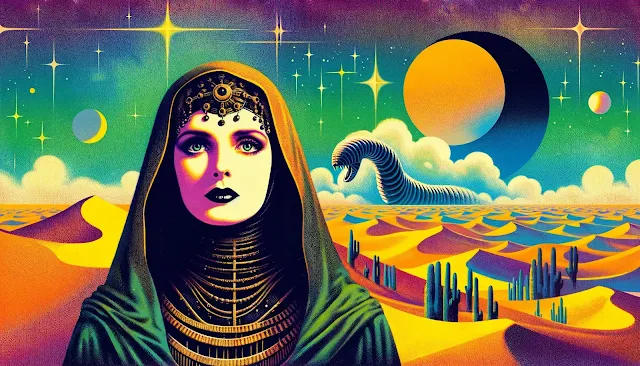
Now elements of that Scattering are returning, and they have not come home humble. The formerly desert planet Arrakis, transformed to lush green by Leto II and now known as Rakis, finds itself once again a focal point, though no longer the sole source of the spice melange. Leto's death allowed sandworm larvae — the dispersed pearls of his consciousness — to re-establish the worms and the spice cycle on Rakis, and the Fremen’s descendants have dwindled into museum tribes serving a priesthood that worships the Divided God. Each worm carries, the faithful believe, a fragment of the Tyrant’s endless dream. Herbert’s bleak joke is that they may be right.
The power map is unrecognisable. The Bene Gesserit, survivors of Leto’s three-and-a-half-thousand-year leash, now operate as the closest thing the Old Empire has to a government-in-shadow. The Bene Tleilax can manufacture spice in their axlotl tanks, ending Rakis's monopoly. The Spacing Guild is diminished, hedged in by Ixian navigation machines and no-ships invisible to prescient sight. And from the Scattering comes something new and terrible: the Honored Matres.

The story: Taraza’s gambit
The plot is a single, audacious Bene Gesserit operation viewed from every angle at once. Mother Superior Taraza is running a design so dangerous that most of her own council would depose her if they understood it. Its pieces: a new Duncan Idaho ghola, the twelfth in a line the Sisterhood has bought from the Tleilaxu — the previous eleven were murdered in childhood, one after another, by factions who feared what he was for. This Duncan is raised in the old Harkonnen stronghold on Gammu, the planet that was once Giedi Prime, under the guardianship of the Sisterhood’s greatest soldier: the retired Mentat Bashar Miles Teg, a man whose face is, by careful breeding, the face of Duke Leto Atreides.
On Rakis, meanwhile, a feral child named Sheeana walks out of the desert commanding sandworms with a shout. The worm that swallowed her village obeys her; the priesthood falls to its knees; and every power in the universe begins calculating what a girl who can command the Divided God is worth. Sheeana carries the genetic legacy of Siona Atreides — the invisibility to prescience that Leto bred into humanity — married to something no one anticipated.
The third piece is a document. The Atreides Manifesto, written anonymously by Reverend Mother Darwi Odrade — herself an Atreides descendant — is a work of engineered heresy that dismantles messiahs, gods, and prescience itself as psychological constructs. Its calculated silence about the Tleilaxu faith lures the Tleilaxu Master Waff into the open and into alliance. Ideas, in this book, are ordnance.
These threads converge on Rakis in a finale that permanently redraws the Dune universe — and the true shape of Taraza’s design, hidden even from Odrade until the last possible moment, is one of Herbert’s great late-career reveals: sometimes the only way to free your Sisterhood from a god is to arrange the god’s murder.
The Honored Matres: the Sisterhood’s dark mirror
The Honored Matres are the novel’s great new threat, and Herbert builds them as a deliberate perversion of everything the Bene Gesserit are. They are a matriarchal order returning from the Scattering in overwhelming numbers, conquering world after world with two instruments: raw, planet-burning violence, and sexual imprinting refined into a technology of enslavement. Where the Bene Gesserit rule by myth, patience, and suggestion, the Honored Matres rule by addiction. Their subjects do not believe in them. They need them.
Their origins are deliberately shrouded, but the novel drops its hints: they appear to be a fusion of Leto’s Fish Speakers and renegade Bene Gesserit who fled into the Scattering, hardened by whatever they met out there. That last point is the quiet engine of the remaining books: the Matres are not merely conquering. They are running from something. Herbert never lets the reader forget that the most violent people in the room are usually the most frightened.
Thematically, the Matres let Herbert finish an argument he began with the Kwisatz Haderach: every form of control has a failure mode. Religious control fails into jihad. Prescient control fails into stagnation. And control through addiction fails into rage — the Matres’ orange-flecked eyes are the tell of women who have enslaved billions and can never stop moving.
The Bene Gesserit as protagonists — and heretics
For four books the Sisterhood was the manipulator behind other people’s stories. Heretics of Dune finally makes them the story, and Herbert’s portrait is far richer than the scheming witches of the early novels. Through Taraza and Odrade, the reader sees the Sisterhood from inside: the discipline that borders on self-erasure, the deliberate suppression of love as a security risk, the melange addiction that binds every Reverend Mother to the spice, and the institutional memory of the Tyrant’s lesson — that the Sisterhood survived Leto II only because he chose to teach them rather than destroy them.
The book’s title lands here as much as anywhere. Taraza’s design is heresy against her own order. Odrade, the empath the Sisterhood should have culled, is heresy against Bene Gesserit emotional doctrine — her Atreides capacity for love keeps surfacing like a fault line, and Herbert treats it not as weakness but as the mutation the Sisterhood needs to survive. The old Atreides line ended as rulers with Leto II, but the Atreides genes run through the Sisterhood like a hidden river, and this novel is the story of the Sisterhood learning, reluctantly, to become slightly more Atreides: to feel, to gamble, to love what it uses.
Duncan Idaho, Miles Teg, and the weaponised past
Duncan Idaho is by now the saga’s strangest institution — the man who keeps being brought back from the dead because every power in the universe finds him useful. The twelfth ghola is a child for much of the novel, and Herbert wrings real unease from that: a boy raised as an asset, loved by his teachers and priced by his owners, whose buried original memories are themselves a payload someone else intends to detonate. The Tleilaxu have hidden something extra in this Duncan, and the question of what he is for shadows every scene he is in. When his memories are finally restored — by an act of calculated cruelty that is one of the book’s hardest scenes — what wakes up is not one Duncan but the compounded anger of all of them.
His counterweight is Miles Teg, one of the finest characters of late-period Herbert. Teg is what the Atreides mystique looks like stripped of thrones and prophecy: a soldier whose real weapons are trust, reputation, and restraint. Captured and tortured on Gammu with an Ixian T-probe, Teg breaks — and what breaks out of him is the novel’s wildest lore beat: a latent Atreides potential that accelerates him beyond human speed and lets him perceive what prescience cannot, including no-ships. Herbert uses Teg to restate the series’ oldest theme, that crisis is the only teacher humanity respects. The prescient trap defined Paul; Teg embodies the counter-principle — the human who becomes unpredictable even to himself.
And in the novel’s most talked-about swerve, the Honored Matre Murbella attempts to sexually imprint the adult Duncan and discovers the Tleilaxu conditioned him as a counter-weapon: the imprinting binds both ways. Hunter and prey addict each other. It is lurid, deliberate, and central to the book’s argument — Herbert reduces the galactic war between the two sisterhoods to two people who have accidentally chained themselves together, and then asks whether that chain might be the beginning of something better than either order.

The Tleilaxu unmasked
After four books as sinister set dressing, the Bene Tleilax emerge as a major power, and Herbert finally opens the door to their civilization. What the reader finds inside is a theocracy that has been playing weak on purpose for millennia. The repellent gnomish merchants the Imperium sneered at are a performance; behind the mask, the Tleilaxu are Zensunni religious absolutists who believe their genetic mastery is the language of God, and that the entire universe is destined to convert. Their new-generation Face Dancers can absorb the memories and identities of the people they replace — so perfectly that the copy may not know it is a copy, a horror Herbert plants here and harvests in the final book.
Master Waff’s dance with the Bene Gesserit — each side certain it is using the other — supplies the novel’s sharpest political comedy and its most chilling body horror. The axlotl tanks that grow gholas and now brew spice are described just precisely enough for the reader to begin asking the question the Sisterhood asks: where, exactly, are the Tleilaxu women? The answer, when the series finally gives it, is one of science fiction's great retrospective horrors, and it is seeded here.
Sheeana, Rakis, and the ecology of a divided god
The ecology and symbolism of the spice return transformed. Rakis is a planet caught between identities — Leto’s greening still holds, but the desert is reclaiming its ground worm by worm, and the priesthood manages the balance like the custodians of a sacred ruin. Sheeana matters because she reconnects the saga’s oldest image, the child of the desert, with its newest question: if each worm carries a pearl of Leto’s awareness, then who is she actually speaking to when a worm bows its head?
Herbert refuses to answer cleanly, and the ambiguity is the point. The Fremen are gone; their descendants perform Fremen-ness for tourists and priests. The desert religion survived its own desert. What remains of the old Arrakis is the worm, the girl who commands it, and the uncomfortable possibility that the Tyrant is still steering events from inside his fragmented, dreaming godhood. The Golden Path did not end with Leto’s death. That is the novel’s quietest and most unsettling piece of lore.
Themes: adaptation, addiction, and the uses of heresy
Underneath the plot machinery, Heretics of Dune is a book about institutional survival, and it is startlingly modern about it. Every faction faces the same test: adapt or fossilise. The Bene Gesserit adapt by committing heresy against their own doctrines. The Tleilaxu adapt by finally telling the truth about themselves. The priesthood of the Divided God cannot adapt, and the novel treats it accordingly. Herbert’s argument, carried over from the anti-messianic logic of the Golden Path, is that orthodoxy is a form of death, and that living systems survive by betraying their own rules at the right moment.
The novel’s treatment of sex as a technology of power is its most divisive element, and it is not incidental. Herbert is completing a taxonomy of control that runs through the whole saga: control by religion (Muad'Dib), control by vision (Leto II), and now control by addiction (the Honored Matres). Each is a way of capturing human loyalty below the level of choice. Against all three, the book sets its heretics — Odrade’s empathy, Teg’s loyalty, Duncan’s compounded rage, Sheeana’s wild innocence — the unpredictable human factors that no system fully owns.
Quality assessment: where the novel succeeds and struggles
Heretics of Dune is often seen as a return to the more adventurous pacing of the original Dune after the philosophical density of God Emperor, and the reputation is earned. It moves. There are ambushes, burning cities, desert crossings, and the single most explosive ending Herbert ever wrote. The new cast — Teg, Odrade, Sheeana, Murbella, Waff — is the strongest infusion of characters since the first book, and the Bene Gesserit interior view permanently enriches the series.
Its difficulties are real. The fifteen-century time jump severs every direct character connection except Duncan, and readers grieving the old cast can find the opening chapters cold. The faction sprawl demands attention; Herbert narrates from inside half a dozen conspiracies at once and explains none of them twice. The sexual-politics material, essential as it is to the design, is handled with a bluntness that divides readers to this day. And as the first half of an intended pair, the book does not so much end as detonate, leaving its resolution to Chapterhouse: Dune.
Why Heretics of Dune matters to the full saga
Structurally, this is the first half of Herbert’s concluding movement — Heretics and Chapterhouse: Dune form a tight duology, written back to back, with the war against the Honored Matres as their spine. Herbert died in 1986, a year after Chapterhouse, leaving the larger story unresolved at its cliffhanger; that unfinished edge has made these late books both precious and bittersweet for longtime readers.
More importantly, Heretics is the proof-of-concept for everything Leto II claimed. The Scattering worked. Prescience-invisible humans walk the universe. No single power can hold the species again — not even the terrifying women returning from the dark to try. The saga that began with one family seizing one planet ends its argument here: humanity’s survival was never going to be secured by a hero. It is secured by scattering, by heresy, by mixture, and by the stubborn unpredictability of people like a soldier, an empath, a wild girl, and a much-resurrected swordmaster.
People also ask about Heretics of Dune
Do I need to read God Emperor of Dune before Heretics of Dune?
Yes. Everything in this book — the Scattering, Rakis, the worship of the Divided God, prescience-invisible humans — is a consequence of Leto II's reign and death in God Emperor of Dune. Skipping it makes the setting unreadable.
Who are the Honored Matres?
A violent matriarchal order returning from the Scattering, most likely descended from Leto II's Fish Speakers blended with renegade Bene Gesserit. They dominate through sexual imprinting and overwhelming force — and they appear to be fleeing something in the Scattering.
Why is the book called Heretics of Dune?
Almost every protagonist is a heretic against their own institution: Odrade's Atreides Manifesto attacks the foundations of religion itself, Taraza's design betrays Bene Gesserit orthodoxy, and the destruction of Rakis is heresy against the church of the Divided God. Herbert's point is that heresy is how living systems adapt.
Is Duncan Idaho in Heretics of Dune?
Yes — as the twelfth in a series of gholas supplied to the Bene Gesserit, the previous eleven having been murdered. His restored memories, hidden Tleilaxu conditioning, and mutual imprinting with the Honored Matre Murbella drive much of the plot. His endless returns are by now the saga's connective tissue.
What happens to Arrakis at the end of Heretics of Dune?
The Honored Matres sterilise Rakis, destroying the planet, the priesthood, and the worms — exactly as Taraza's design intended. The Bene Gesserit escape with Sheeana and a single sandworm, giving the Sisterhood sole custody of the spice cycle's future as the story passes to Chapterhouse: Dune.
Final verdict
In conclusion, "Heretics of Dune" is a dynamic and compelling science fiction epic. It masterfully depicts a universe grappling with the legacy of Leto II's Golden Path, exploring institutional adaptation, religious conflict, ecological manipulation, and the diverse, often dangerous paths of human evolution. The shattering of the old order pits the ancient Bene Gesserit against the Honored Matres and the ascendant Bene Tleilax in a landscape where survival itself is the ultimate goal — and where the survivors are, without exception, the heretics.
For readers who stalled on God Emperor, this is the book that restores the saga’s momentum. For readers tracking Herbert’s deeper argument, it is the beginning of his final answer. Either way, it should never be read alone: it is half of a story, and its other half is waiting.
Continue the journey with the review of Chapterhouse: Dune, the effect of the Atreides Manifesto and the complete Dune lore archive.


_poster.jpg)


