
Heretics of Dune has one of the sharpest titles in Frank Herbert’s original Dune saga because it looks simple until the novel forces the reader to ask what heresy even means in this universe.
A heretic usually stands against a religion. That is the obvious route into the title. Heretics of Dune is full of priesthoods, sacred planets, god language, worm worship, ritual, prophecy, forbidden knowledge, and inherited doctrine. Rakis, once Arrakis, is no ordinary world. It is the old holy planet of Paul Muad’Dib, the transformed empire of Leto II, the source of spice, the home of the sandworms, and the place where human history was bent into myth.
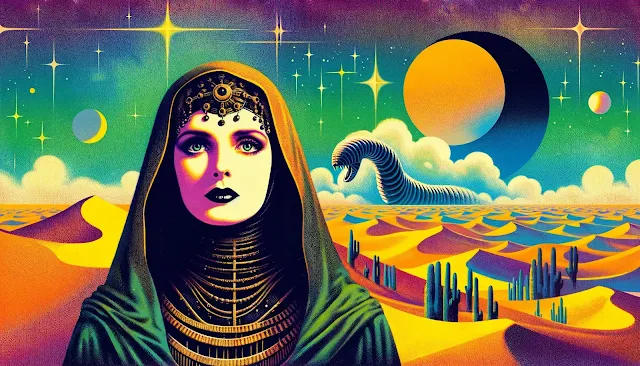
But Herbert does not use “heresy” only as a religious charge. He uses it as a pressure test for every institution in the novel. A heretic is someone who breaks the accepted truth of their own system while still remaining tied to that system. That distinction matters. A mere enemy can be fought. A traitor can be expelled. A heretic is more dangerous because the heretic comes from inside the structure. The heretic knows the doctrine. The heretic may still love the doctrine. The heretic may even save the doctrine by violating it.
That is why the title is plural.
Heretics of Dune is not about one rebel. It is about a universe in which every surviving power must become heretical or die. The Bene Gesserit must violate their own need for control. The Rakian priesthood must confront a girl who bypasses their authority. The Bene Tleilax must face the corruption of their own secret faith. Duncan Idaho must become something more than a ghola. Darwi Odrade must embrace the emotional danger her order fears. Taraza must turn disobedience into policy. Sheeana must pull holiness away from the priests and back toward the worm. Miles Teg must become the perfect servant who can no longer be contained.
The title points to the late Dune universe after the death of God. Leto II is gone, but his shadow remains. His body has passed into the sandtrout and the worms. His religion still grips Rakis. His Golden Path still governs the historical field. The Scattering has hurled humanity beyond the limits of the old Imperium, but those who return from it bring terror with them.
Everything is old. Everything is unstable. Everything is ready to break.
That is the world of heresy.
The religious meaning of the title
The first and most literal heresy in the novel is against the religion of the God Emperor.
Leto II ruled humanity for thousands of years as god, tyrant, sandworm, emperor, prophet, predator, and saviour. His reign was monstrous by design. As explored in The Golden Path as anti-messianic politics in Dune, Leto’s solution to humanity’s vulnerability was brutally paradoxical. He gave humanity the god it kept reaching for, then made that god unbearable.
His Peace suppressed movement, ambition, war, religious convulsion, aristocratic competition, and uncontrolled expansion. It created order, but that order was a cage. The point was not comfort. The point was pressure. Leto wanted humanity to explode outward after his death, scattered so far and made so unpredictable that no single oracle, ruler, machine, empire, or priesthood could ever trap the species again.
By the time of Heretics of Dune, Leto’s body has become ecological and religious residue. The worms carry his trace. Rakis carries his myth. The priests manage his memory. The God Emperor has become doctrine.
That is already a warning sign in Herbert. Living experience becomes ritual. Political necessity becomes scripture. Survival strategy becomes sacred law. The original force has passed. The institution remains.
The Rakian priesthood depends on mediation. They interpret the god. They manage access to the sacred. They preserve forms, titles, gestures, prohibitions, and holy vocabulary. They stand between ordinary people and the divine memory of Leto. Their authority relies on distance. The god must remain above, behind, within, or beyond. The priesthood cannot survive too much direct contact.
Then Sheeana appears.
Sheeana is a theological crisis because she can do what priests only claim to represent. She can call and command the worms. Her relation to the sacred is physical, direct, and public. She does not need the hierarchy. She does not need priestly permission. She turns worm religion from administration back into event.
That makes her one of the clearest heretics in the book.
Her heresy does not come from atheism. She does not simply reject the sacred. She touches it too directly. She collapses the distance between worship and power. The priests want a god who can be managed through ritual. Sheeana brings back a god force that moves through sand, hunger, danger, and command.
For Herbert, that is far more destabilising than disbelief. Disbelief can be denounced. A miracle outside the system is harder to contain.
The Bene Gesserit see the opportunity immediately. Sheeana can be used. Rakis can be influenced. The priesthood can be bypassed. The religion of Leto can be redirected. That makes the Sisterhood heretical too. They do not enter the Rakian religion as believers. They enter it as engineers. They want to use Sheeana, Duncan, and the worm myth to shape a new political future.
From the perspective of the Rakian priesthood, this is sacrilege. From the perspective of Leto’s religion, it is a violation of sacred order. From the perspective of the Golden Path, however, the matter is less simple.
Because Leto II wanted humanity to produce heretics.
That is the paradox at the centre of the title. To betray Leto’s religion may be to fulfil Leto’s purpose. He did not create the Golden Path so people would worship him forever. He made himself unbearable so humanity would learn to flee gods. He made the centralized future horrifying so that no sane species would walk willingly back into it. He created conditions under which disobedience would become instinct.
The heretics of Dune are breaking the religion of Leto II, but they may be obeying the deepest logic of Leto II.
The Bene Gesserit and the heresy of control
The Bene Gesserit make the title more interesting because they are not a religion in any ordinary sense. They manipulate religion. They seed myths. They cultivate legends as survival tools. Their Missionaria Protectiva turns faith into infrastructure. Their Reverend Mothers carry ancestral memory, not revelation from a god. Their discipline is bodily, political, sexual, linguistic, genetic, and psychological.
They are anti-priests who behave like priests.

That contradiction drives Heretics of Dune.
The Bene Gesserit claim to stand outside superstition, but they have their own sacred order. They have doctrine. They have taboos. They have forbidden experiments. They have internal orthodoxy. They have institutional memory guarded by women whose authority resembles a priesthood of the body. They fear uncontrolled messiahs because they have already seen what Paul and Leto did to history.
Their deepest law is control.
Control the breeding lines. Control the body. Control the voice. Control fear. Control sex. Control memory. Control politics from behind the curtain. Control religion by planting useful myths. Control the future by avoiding another Kwisatz Haderach. Control love because love ruins calculation.
That is why heresy inside the Bene Gesserit is so dangerous. It is not merely disobedience. It is a failure of containment.
Jessica is the ancient wound. She gives Duke Leto a son out of love. That act breaks the breeding plan and creates Paul. Paul creates the Jihad. Leto II creates the Tyranny. One private act of love becomes thousands of years of consequence. For the Sisterhood, Jessica is not just a romantic exception. She is the proof that emotion can smash history open. That same institutional anxiety runs through any serious account of who the Bene Gesserit are in the Dune universe.
Heretics of Dune keeps returning to that pattern. The Sisterhood fears love because love creates private law. A person in love obeys something the institution cannot fully see. Love creates loyalties that do not report upward. Love bends breeding plans, command chains, political assignments, and emotional discipline. For the Bene Gesserit, love is not sentimental. It is a structural threat.
That is why Darwi Odrade is dangerous.
Darwi Odrade is loyal to the Sisterhood, but she carries the Atreides problem: warmth, attachment, intuition, charisma, and dangerous sympathy. She feels too much. She sees too deeply. She has the sort of humanity the Sisterhood needs and mistrusts at the same time. Her Atreides inheritance gives her a connection to the old explosive line of Paul and Leto. Her emotional range makes her more than an instrument.
The Bene Gesserit want instruments. Herbert keeps giving them people.
Taraza understands this better than most. Her brilliance lies in recognizing that the Sisterhood cannot survive by purging every deviation. The Honored Matres have returned from the Scattering as a brutal new force. Rakis is unstable. The worm cycle is endangered. Duncan is not just another ghola. Sheeana is not just another religious asset. Teg is not just another Bashar. The old methods will not be enough.
Taraza’s real innovation is that she makes heresy strategic.
She does not merely tolerate Odrade’s dangerous qualities. She uses them. She does not merely rely on Teg’s obedience. She sets him in motion in a way that allows him to exceed obedience. She does not merely preserve Bene Gesserit orthodoxy. She risks contaminating it with the very qualities it fears.
This is one of the great institutional turns in the novel. The Bene Gesserit have survived for millennia by controlling variation. In Heretics of Dune, they begin to survive by releasing it.
Miles Teg, the great Heretic
Miles Teg appears at first to be the least heretical figure imaginable.
He is disciplined. Loyal. Military. Controlled. A Mentat commander. A servant of the Sisterhood. A man of duty, training, and tactical clarity. He does not begin as a rebel prophet or a religious agitator. He begins as a weapon shaped by service.
That is why his heresy matters.
Teg’s greatness as a heretic comes from the fact that he does not simply reject the system. He fulfils it so completely that he passes beyond its control. He is the perfect servant who becomes too large for the category of servant.
His loyalty is real. That point separates Teg from a simple traitor. He does not betray Taraza in spirit. He carries the deeper logic of her design forward. He protects Duncan. He acts decisively. He reads the field. He accepts terrible necessity. But his path takes him outside normal Bene Gesserit command, outside the expectations of his enemies, and finally outside the known limits of human capacity.
The T-probe changes him. The torture meant to break him awakens something latent. His perception alters. His speed becomes superhuman. His awareness expands. Most importantly, he becomes capable of seeing no-ships.
That ability is enormous in the late Dune universe.
No-ships matter because they represent escape from detection, prediction, and control. They are part of the post-Leto world’s deeper movement away from centralized visibility. The old nightmare of prescience was that one mind could see the paths of humanity and trap the species inside prediction. Leto’s Golden Path required the production of people and systems that could evade that trap. Siona’s line becomes invisible to prescience. No-ships extend concealment into technology and space.
Teg then becomes something stranger. He can see what is designed to be hidden.
He is not merely resistant to old control. He pierces new concealment. That makes him valuable, terrifying, and impossible to leave alone. If the Bene Gesserit fully grasped what he had become, they would want to preserve, breed, replicate, study, and use him. Teg understands this. His secrecy is part of his heresy. He withholds himself from the system he serves.
That concealment matters because the Bene Gesserit’s deepest claim is the right to know. They believe survival depends on observation, classification, memory, breeding, and manipulation. Teg becomes a fact they cannot fully classify. He is a loyal servant who refuses to become data.
Then comes Rakis.
Teg’s role in the destruction of Rakis makes him the great Heretic in the largest symbolic sense. Rakis is not simply a strategic location. It is the sacred centre of the saga. It is the planet of spice, worms, Fremen memory, Paul’s rise, Leto’s transformation, imperial religion, ecological mystery, and mythic origin. To destroy Rakis is to attack the altar of Dune itself.
That act is military, ecological, religious, and metaphysical.
It breaks the monopoly of the old sacred world. It severs the idea that humanity’s future must remain tied to one planet, one spice source, one worm cycle, one priesthood, one memory of god. It forces the sacred burden of Dune to move elsewhere. It turns preservation into diaspora.
That is the terrible logic of Teg’s heresy. He does not destroy the sacred because he is shallow or faithless. He destroys the sacred centre because the sacred centre has become too dangerous to leave intact.
The future cannot remain on Rakis.
That is why Odrade calls him “the great Heretic.” He has committed the ultimate violation in service of survival. He has broken holy geography. He has exceeded command. He has hidden his transformation. He has served the plan by becoming uncontrollable. He has fulfilled the Bene Gesserit need by violating Bene Gesserit control.
Teg is not the opposite of loyalty. He is loyalty after obedience has failed.
Odrade, the heretic who can name heresy
Odrade’s naming of Teg matters because she is herself a heretic.

She knows the shape of his violation because she carries a related one inside herself. She is Bene Gesserit, but not safely Bene Gesserit. She is Atreides, but not merely a repetition of Paul or Jessica. She is disciplined, but not cold. She understands the Sisterhood’s need for survival, yet she also sees the sterility of pure institutional calculation.
Her heresy is emotional intelligence against institutional fear.
Odrade’s love is not decorative. It is a mode of perception. Herbert repeatedly sets cold systems against living awareness. The Bene Gesserit can calculate, but calculation without humane judgment becomes brittle. The Tleilaxu can engineer life, but engineering without reverence becomes monstrosity. The Honored Matres can dominate bodies, but domination without restraint becomes addiction and terror. The priesthood can preserve ritual, but ritual without contact becomes empty administration.
Odrade feels, and because she feels, she sees what colder minds miss.
That is why she is dangerous to the Sisterhood. That is also why the Sisterhood needs her.
Her Atreides inheritance intensifies the problem. Atreides figures in Dune are never merely noble bloodline characters. They are historical accelerants. They bind loyalty, charisma, violence, sacrifice, vision, and danger. The Bene Gesserit know this. They cannot touch Atreides power without remembering Jessica, Paul, Alia, Leto II, and Siona. Odrade stands in that lineage, but she does not repeat it passively. She interprets it.
Her Atreides Manifesto is part of her heresy because writing is an act of transmission outside pure command. It allows thought to outlive orders. It turns private insight into doctrine against doctrine. It risks giving the future a language the present institution has not approved.
Odrade can call Teg “the great Heretic” because she understands that the word is not only condemnation. It is recognition. Teg has done what the age required. He has become the necessary violation.
Sheeana and the heresy of direct contact
Sheeana is the novel’s most obvious religious heretic because she breaks the Rakian priesthood’s monopoly over the divine.
Her power is simple to describe and enormous in consequence: she can command worms. In a universe where worms are ecology, spice, religion, Leto’s remnant, and the deepest symbol of Dune, that ability cannot remain local. It must become political. It must become theological. It must become dangerous.
The priests need Sheeana to fit their system. The Bene Gesserit need her to serve theirs. But Sheeana’s power exceeds both.
She is a direct line to the sacred object. That makes her prophet, weapon, scandal, and threat. She does not merely perform within the religion of Rakis. She alters its structure. She shifts authority away from institution and toward embodied contact.
Herbert has always been suspicious of prophets, but he is also suspicious of priesthoods that tame prophecy into safe repetition. That tension runs back through the original novel, Dune Messiah, and Children of Dune. Prophecy may begin as vision, but it hardens into administration as soon as institutions discover they can live off it.
Sheeana stands at that collision point. She can become another tool of manipulation, another mythic figure used by a political order, another sacred girl consumed by systems older than herself. But she can also become a break in the system, a living refusal of priestly distance.
That is why she belongs in the title. She is not “a heretic” because she rejects Dune. She is a heretic because she touches Dune too directly for the guardians of Dune to tolerate.
Duncan Idaho and the heresy of identity
Duncan Idaho is a different kind of heretic. He violates death.
By Heretics of Dune, Duncan has become one of Herbert’s strangest long arguments. He is not just a recurring character. He is a repeated question: what remains of identity when the body is manufactured, memory is manipulated, loyalty is engineered, and the past keeps being resurrected for use by the present?
Every Duncan ghola is a scandal against closure. Death should end a life. The Tleilaxu refuse that ending. They reproduce Duncan as tool, gift, experiment, trap, and commodity. But every attempt to make Duncan useful also risks making him more dangerous. The copy is never only a copy. The resurrected servant begins to accumulate meanings his makers cannot control.
In Heretics of Dune, Duncan becomes a battlefield of competing systems. The Tleilaxu have designs in him. The Bene Gesserit have designs on him. The Honored Matres want to imprint and dominate him. Atreides history claims him. His own returning selfhood resists reduction to any one purpose.
His heresy is personal before it is political. He refuses to remain an object.
That connects him to the larger pattern of the book. Tools wake up. Servants exceed commands. Religious assets become prophets. Military instruments become evolutionary events. Breeding products fall in love. Hidden powers reveal themselves. The future comes from what institutions thought they owned.
Duncan is one of the heretics of Dune because he proves that identity cannot be perfectly manufactured from outside.
The Honored Matres and the return of violent heresy
The Honored Matres are among the most brutal examples of heresy in the late Dune universe because they resemble the Bene Gesserit enough to feel like a nightmare reflection.
They use body control, sexual power, social domination, and psychological conditioning. But where the Bene Gesserit prefer patience and indirection, the Honored Matres prefer conquest, addiction, enslavement, and speed. They turn influence into violation. They strip subtlety from power.
Their heresy is methodological.
They are what Bene Gesserit control looks like after restraint collapses. They expose the Sisterhood’s hypocrisy because the difference between manipulation and domination is partly a difference of style, patience, and self-discipline. The Bene Gesserit want to see themselves as guardians of human survival. The Honored Matres show how similar tools can serve appetite and terror.
They also represent the danger of the Scattering. Leto wanted humanity dispersed so it could not be trapped. The Scattering succeeded, but freedom did not produce innocence. It produced unknown powers, new violence, and forces the old Imperium cannot easily understand. As the Astromech’s themes guide to Heretics of Dune notes, the late saga is defined by forces returning from the Scattering with powers that challenge every established order.
The Honored Matres prove that heresy is not automatically noble. Breaking the old order can unleash predators as well as liberators.
Schwangyu and conservative heresy
Schwangyu complicates the title because her heresy is not liberating in any simple sense.
She resists Taraza’s plan. She opposes the Duncan project. She fears the repetition of old disasters. Her position is rooted in institutional memory, and that memory has reason behind it. The Bene Gesserit have been burned by Atreides males, prescient traps, messianic eruptions, and the long consequences of their own breeding program. Schwangyu’s fear is not stupid. It is narrow, but not groundless.
That makes her a conservative heretic.
She disobeys the present command in order to defend what she believes is the older truth of the Sisterhood. She is heretical in action, orthodox in motive. This is exactly the sort of complexity Herbert likes. Heresy does not always mean progress. A heretic can be visionary, cowardly, loyal, selfish, prudent, destructive, or necessary. Sometimes the rebel is trying to open the future. Sometimes the rebel is trying to freeze the past.
Schwangyu proves that heresy is a structural condition, not a moral compliment.
Waff, the Tleilaxu, and corrupted sacred secrecy
The Bene Tleilax add another religious layer to the novel because they possess a secret faith beneath their reputation for biological manipulation.
They are not merely technicians. Their ghola production, Face Dancers, axlotl tanks, and genetic mastery sit inside a hidden worldview. They believe in themselves as custodians of a sacred order. That makes their biological work more disturbing. They are not cold scientists operating without belief. They are believers whose tools have become grotesque.
Waff’s heresy lies in the tension between faith and power.
He can be manipulated through belief. He can be tempted through political advantage. He can be compromised by the very creations his people claim to command. The Tleilaxu make life into a tool, then discover that tools do not remain tools forever. Face Dancers evolve beyond the roles assigned to them. Gholas remember. Biological products become subjects.
This is one of Herbert’s central warnings: any institution that plays god eventually creates a future that does not ask permission.
The Tleilaxu think secrecy protects them. In reality, secrecy lets corruption grow without correction. Their hidden faith does not save them from heresy. It gives their heresies a sacred mask.
Love as the deepest heresy
The most dangerous heresy in Heretics of Dune is love.
That sounds too soft until the whole saga is put behind it. Jessica’s love for Duke Leto breaks the breeding program. Paul’s love and grief help drive choices that become religious catastrophe. Leto II suppresses ordinary human possibility to preserve the species. The Bene Gesserit spend millennia trying to prevent private feeling from overwhelming collective design.
Love is dangerous in Dune because love creates an authority outside systems.
An institution can manage desire. It can arrange mating. It can exploit sex. It can breed bodies. It can train reflexes. It can use loyalty. But love is harder to reduce. Love creates disobedience with a conscience. It makes people answerable to the beloved, the child, the dead, the remembered, the vulnerable, the particular person standing before them.
The Bene Gesserit fear this because they are committed to abstraction. Bloodlines. Plans. Sisterhood. Survival. Species. Memory. Future. These are enormous categories, and Herbert knows they matter. But he also knows that enormous categories can justify cruelty.
Love breaks abstraction.
Odrade’s warmth, Teg’s humane loyalty, Jessica’s ancient crime, Duncan’s refusal to remain a sexual or political object, Sheeana’s directness, even Taraza’s willingness to trust dangerous people, all of these push against a universe of systems.
This is why love can be called heresy. It violates the cold doctrine of use.
Leto II, the maker of heretics
The final irony is that Leto II himself may be the greatest producer of heresy in human history.
His Golden Path required humans who could not be enclosed by prophecy. It required dispersal. It required no-ships. It required Siona’s invisibility. It required a species trained by oppression to hate the cage. He made himself god and tyrant so that humanity would recoil from gods and tyrants forever.
That means the heretics of Heretics of Dune are not accidents. They are the crop Leto planted.
Teg, Sheeana, Odrade, Duncan, and the scattered peoples of the universe all belong to the long aftermath of his design. Even the Honored Matres, horrific as they are, testify to the success and danger of the Scattering. Humanity has become too various to master. That was the point.
The tragedy is that Leto’s religion remains after Leto’s purpose has moved beyond religion. His worshippers preserve the shell. His true heirs break it.
That is why the title is so precise. These are Heretics of Dune because Dune itself has become the sacred past that must be violated. Arrakis made empire, prophecy, jihad, spice monopoly, Fremen transformation, and divine tyranny. By the fifth novel, that centre has to be broken so humanity can keep escaping.
Who are the heretics?
Miles Teg is the great Heretic because he embodies the title in its most concentrated form. He is loyal but disobedient. Trained but uncontrollable. Human but altered. A servant of the Bene Gesserit who refuses to become their property. A military man who commits a religiously catastrophic act. A protector of the future who helps destroy the sacred centre of the past.
But he is not alone.
Sheeana is a heretic against the Rakian priesthood because she touches the worm without priestly mediation.
Odrade is a heretic against Bene Gesserit emotional discipline because she allows love, memory, and Atreides humanity to become instruments of judgment.
Taraza is a heretic of command because she understands that the Sisterhood must violate its own habits to survive.
Duncan Idaho is a heretic against death and manufactured identity.
Schwangyu is a heretic of fear, disobeying the present to defend an older orthodoxy.
Waff is a heretic inside secret faith, compromised by the biological powers his people pretend to master.
The Honored Matres are heretics of Bene Gesserit method, turning influence into naked domination.
The Bene Gesserit as a whole are heretics against Leto’s religion because they manipulate the sacred machinery of Rakis rather than submit to it.
Leto II is the paradox behind them all: the god who created the conditions for blasphemy, the tyrant whose deepest success was a humanity that could betray him.
Conclusion: heresy keeps humanity alive
Herbert’s answer is severe. Civilizations die when they cannot produce heretics. Religions decay when they protect ritual more than truth. Institutions become dangerous when obedience matters more than adaptation. Love becomes revolutionary when systems have reduced people to tools. Survival belongs to those who can break the rule without losing the purpose.
Heretics of Dune is not a title about simple rebellion. It is a title about necessary violation. The old sacred order of Dune has become too heavy for the future to carry unchanged. Its heirs must break it, scatter it, reinterpret it, and plant it elsewhere.
In Herbert’s late universe, heresy is what happens when history refuses to stay buried.
It is also what keeps humanity alive.


_poster.jpg)


