

Exploring the Color Symbolism of M. Night Shyamalan's Films
M. Night Shyamalan’s Use of Color: The Hidden Visual Language Behind His Twists, Ghosts, Heroes, and Monsters
M. Night Shyamalan, renowned for his intricate narratives and unexpected twists, is often discussed as a writer of reversals. The dead man was dead all along. The superhero was living inside a grounded drama. The monsters in the woods were part of a controlled myth. The alien invasion was also a crisis of faith. That reputation is fair, but it can flatten what makes his strongest films work.
Shyamalan is not only a twist filmmaker. He is a visual grammarian. His films teach viewers how to read them through color, costume, objects, rooms, light, and repeated visual cues. Red, green, purple, yellow, blue, and white do not merely decorate his frames. They help organize the moral and emotional universe of each story.
That is the key to understanding his color symbolism. In Shyamalan’s films, color often marks a threshold. A doorway between life and death. A signal of hidden identity. A trace of trauma. A community’s fear system. A comic-book code. A warning from the natural world. A sign that the ordinary world has been touched by something stranger.
This is why his color choices matter. They are not simply aesthetic signatures. They are part of the storytelling architecture.
Color as Shyamalan’s second screenplay
The best way to read Shyamalan’s use of color is to treat it as a second screenplay running beneath the dialogue. The characters may be speaking about fear, grief, faith, identity, or destiny, but the color palette is often telling the viewer what kind of unseen force is operating in the scene.
In The Sixth Sense, red signals contact with the dead. In Unbreakable, green and purple announce a superhero and a supervillain long before the film fully admits it is a comic-book origin story. In Split and Glass, yellow, green, and purple turn fractured psychology into graphic myth. In The Village, red and yellow become tools of social conditioning. In The Happening, green stops being comforting and becomes threatening.
That continuity matters because Shyamalan’s films repeatedly ask the same question: what if the world is already speaking, and the characters simply do not know how to read it yet?
Color becomes one of the ways the world speaks.
Red in The Sixth Sense: the color of the dead crossing over
The Sixth Sense is Shyamalan’s cleanest example of color as a supernatural code. Red appears when the world of the living touches the world of the dead. It does not flood the whole film. It punctures it. That restraint is what makes the device work.
Red appears around charged objects and locations: the red doorknob to Malcolm’s basement, the red balloon at the birthday party, the red tent where Cole hides from the dead, red clothing, red visual accents, and moments when the supernatural is near. The viewer may not consciously track every instance on a first watch, but the eye learns the pattern before the mind names it.

The color red becomes synonymous with Cole’s encounters with the supernatural, but its function is larger than a spooky clue. It creates a visual map of the film’s hidden reality. Red means the rules are different here. Red means the veil is thin. Red means the audience should pay attention.
This is not just clever production design. It is thematic compression. The Sixth Sense is about grief that cannot move on, truths that cannot be spoken, and dead people trying to complete unfinished business. Red is the wound color. It makes the emotional disturbance visible before the story explains it.
Cole, Vincent, and white as the mark of the seer
Red marks the supernatural world, but white marks the children who can perceive it. Cole and Vincent are thematically linked as seers by each having a wisp of white hair. That detail is small, but it is one of Shyamalan’s most important visual clues.
Vincent Gray is not merely Malcolm Crowe’s failed patient. He is Cole’s possible future. He is what happens when a child who sees the dead is misread, untreated, and left alone inside terror. The shared white hair silently connects them before the film has fully revealed what their connection means.
White hair traditionally suggests age, shock, wisdom, trauma, or unnatural knowledge. That makes it perfect for Cole and Vincent. They are young, but they carry an awareness no child should have to carry. They know death is not elsewhere. They know the dead remain close. They know the adult world’s explanation of reality is incomplete.
So The Sixth Sense has two color systems working together. Red marks supernatural contact. White marks the burden of perceiving it. The dead have their color. The seers have theirs.
Shyamalan’s best color choices do not merely decorate the frame. They teach the audience how to read the hidden rules of the film.
Unbreakable: green, blue, and purple as comic-book destiny
In Unbreakable, color takes on a different function. The film is not a ghost story. It is a secret superhero origin story hiding inside a subdued family drama. Its color symbolism therefore borrows from comic books without becoming cartoonish.
David Dunn, played by Bruce Willis, is associated with green. The most memorable expression of this is his green rain poncho, worn during the sequence where he finally acts as the protector he has always unknowingly been. Green suggests life, endurance, growth, and renewal. David is not becoming someone new so much as growing into what he already was.
That matters because Unbreakable is not a film about acquiring power. It is about recognizing identity. David has spent years diminished by ordinary sadness, marital distance, and a life too small for his nature. The green poncho turns him into a mythic shape without abandoning the film’s grounded texture. He does not wear a superhero suit. He wears rain gear. Shyamalan makes the ordinary object carry the symbolic weight.
David’s blue security guard uniform has its own meaning. Blue suggests routine, duty, restraint, and institutional safety. It is the color of his ordinary role before he understands its larger form. He has been protecting people all along, but in a diminished, everyday register. The film slowly pushes him from uniform into icon.
Then there is Elijah Price, Mr. Glass, wrapped in purple. Purple is historically royal, theatrical, decadent, and unnatural. In comic-book language, it immediately evokes the flamboyance of villains like the Joker. Elijah’s purple is not random style. It is his mythic self-conception. He is fragile, brilliant, wounded, and desperate to prove the world has a story big enough to explain his suffering.
The color opposition between David and Elijah gives the film its hidden comic-book grammar. Green versus purple. Protector versus manipulator. Life versus fracture. Humility versus theatrical destiny. The twist reveals Elijah as the villain, but the color design has been whispering that opposition all along.
Split: yellow, identity, and the warning color of the Beast
In Split, Shyamalan’s color symbolism becomes more psychological and more aggressive. The identities inside Kevin Wendell Crumb’s mind are differentiated through behavior, voice, costume, posture, and visual atmosphere. Color helps the audience track the fractured internal system.
Yellow is the key color. It carries several meanings at once: warning, mutation, mania, emergence, and transformation. In the Eastrail 177 trilogy, yellow becomes strongly associated with Kevin and the Beast. Unlike David’s green, which suggests organic growth into purpose, Kevin’s yellow feels unstable. It is bright, exposed, and dangerous. It calls attention to itself.
That fits the character. Kevin is not a single coherent heroic identity. He is a divided system. His colors do not simply announce who he is. They show the audience which version of him has stepped forward, and what emotional weather has entered the room.
The use of yellow also complicates the color’s usual association with warmth or optimism. In Split, yellow can mean revelation, but revelation is terrifying. The Beast is not merely a monster. He is Kevin’s body rewritten by trauma, belief, and survival mythology. Yellow becomes the color of that mutation.
This is one reason Split works as both psychological thriller and secret comic-book film. The color scheme lets Shyamalan move from clinical unease into mythic exaggeration without changing visual languages too abruptly. By the time the film reveals its connection to Unbreakable, the audience has already been living inside a color-coded superhero universe.
Glass: the trilogy becomes a color-coded myth
Glass makes the color logic of the trilogy explicit. David Dunn, Elijah Price, and Kevin Wendell Crumb are no longer hidden inside separate genre disguises. They are brought into the same frame, and their colors follow them like heraldry.

This distinctive use of colour continues into the final film of the trilogy, Glass. David’s green remains tied to protection and life. Elijah’s purple remains tied to mastermind villainy, theatrical self-creation, and fragile grandeur. Kevin’s yellow remains tied to the Beast, warning, and unstable transformation.
The colors turn the characters into living comic-book panels. Shyamalan’s world is still grounded, still clinical, still often quiet, but the palette announces that these people belong to myth. Their colors are not costumes in the Marvel sense. They are visual identities.
That is what makes Glass interesting even when its plotting frustrates. It is a film obsessed with whether extraordinary people can be contained by institutions that refuse to believe in them. Color becomes resistance. The institution wants to explain the characters away. Their colors insist they are what they believe they are.
Purple, green, and yellow become testimony. They say: the myth is real, even if the world calls it delusion.
The Village: color as law, fear, and social control
If The Sixth Sense uses color as a supernatural clue, and Unbreakable uses it as comic-book identity, The Village uses color as government. Yellow and red in The Village are not merely good and evil. They are part of a social control system.
Red is “the bad color.” It is forbidden, feared, removed, buried, and associated with Those We Do Not Speak Of. Yellow is protection. The villagers wear yellow cloaks when approaching the woods or participating in rituals around the boundary. These colors do not just symbolize danger and safety. They train behavior.
This is what makes The Village so fascinating within Shyamalan’s filmography. The color code exists inside the story world. The villagers know red is bad because they have been taught it. They know yellow is protective because the elders have made it part of communal ritual. Unlike the red in The Sixth Sense, which operates mainly for the viewer, the red and yellow in The Village operate directly on the characters.
That difference is crucial. In The Sixth Sense, color reveals the truth. In The Village, color helps maintain the lie.
The elders have built a community out of trauma, nostalgia, fear, and selective truth. Red becomes a compressed symbol for the violence of the outside world. Yellow becomes the public performance of safety. Together, they form a civic religion. The village survives because people believe the colors mean what they have been told they mean.
Red in The Village: the color of manufactured fear
Red in The Village carries a different charge than red in The Sixth Sense. It does not mark the dead. It marks fear that has been staged. The red berries, the red creature costumes, and the red taboo all belong to a system designed by the elders to keep the younger generation inside the boundary.
This makes red a political color. It is used to produce obedience. The villagers do not need fences if they have been trained to fear the woods. They do not need constant guards if the sight of red is enough to trigger panic. The color does the work of the law.
The brilliance of this is that red also remains emotionally valid. The elders’ fear of the outside world is not invented from nothing. They have experienced real violence and loss. Red carries the memory of that trauma. The problem is that the elders convert their private wound into a public prison.
That is Shyamalan’s darker insight. A symbol can begin as a way of surviving grief and end as a method of controlling others.
Yellow in The Village: protection that becomes obedience
Yellow in The Village initially feels warmer. It suggests light, visibility, community, and safety. The yellow cloaks are iconic because they turn the villagers into a unified visual body. Against the dark forest, yellow looks like human order pushing back against the unknown.
But yellow is not entirely innocent. It is the color of safety inside a false system. When the villagers wear yellow, they are not merely protecting themselves. They are participating in the ritual that keeps the lie alive. Yellow comforts them, but it also trains them to accept the elders’ story.
That makes yellow one of the most morally complicated colors in Shyamalan’s work. It is not evil. It is not false in feeling. The community really does love and protect its people. But the protection is built on ignorance. Yellow becomes the color of managed innocence.
That duality is pure Shyamalan. A color can mean hope and control at the same time. Safety can be real and still be morally compromised.
Ivy Walker’s blue: love outside the color code
The most important third color in The Village is blue, especially Ivy Walker’s blue dress. Red and yellow belong to the village’s official symbolic system. Blue feels personal. It belongs to Ivy’s emotional clarity, her love for Lucius, and her unusual way of perceiving the world.
Ivy is blind, which means she does not experience the village’s color code the way others do. This does not make her magically immune to fear, but it does place her outside the community’s visual conditioning. She knows people through voice, touch, presence, warmth, and trust. Her world is not governed by appearances in the same way.
That makes blue a color of moral perception. Ivy does not see the world as the elders have staged it. She feels her way toward truth through love. Her blue dress becomes the visual opposite of the red and yellow system. Red teaches fear. Yellow teaches safety. Blue moves because love demands movement.
This is one of Shyamalan’s sharpest uses of costume. Ivy does not defeat the village through argument. She crosses its color-coded boundary. She walks into the woods, into the system of fear, carrying the emotional color that does not belong to the elders’ lie.
Signs: muted earth tones, domestic faith, and the green world as witness
Signs is not as loudly color-coded as The Sixth Sense or The Village, but its palette still matters. It is a film of cornfields, wood, rural interiors, night skies, basement darkness, blue television light, and the washed-out tones of a grieving household.
The greens and browns of the Hess farm turn the landscape into both home and threat. Cornfields should suggest fertility, harvest, and rural stability. In Signs, they become hiding places for the unknown. The natural world is not hostile in the same way it is in The Happening, but it is charged with signs. Something has entered the field. Something has marked the earth.
The use of television light is also important. Much of the global crisis reaches the family as mediated image: news reports, glimpses, rumors, and that famous birthday party footage. The blue-white glow of the screen becomes the color of modern revelation. Graham Hess is not receiving prophecy from a burning bush. He is receiving it through broadcast media.
That fits the film’s central theme. Graham’s crisis is about whether ordinary details can still mean something. Water glasses, asthma, a baseball bat, cornfields, screens, and final words all become part of a pattern he does not yet believe in. Color is quieter here, but the visual world is still trying to speak.
Lady in the Water: blue myth inside ordinary concrete
Lady in the Water is one of Shyamalan’s most divisive films, but its color logic is worth noticing. The film is built around the contrast between ordinary apartment-complex drabness and the blue mythic space of water.
The swimming pool is the film’s portal. Its blue does not merely represent water. It represents story itself: depth, mystery, origin, and return. Story, played by Bryce Dallas Howard, emerges from that blue world into a human space of beige walls, concrete walkways, rented rooms, and everyday loneliness.
That contrast is important because Lady in the Water is about myth entering the ordinary world. The color of the Blue World leaks into a modern apartment complex and asks broken people to rediscover purpose. The pool becomes a sacred surface inside a mundane place.
Blue in The Village belongs to Ivy’s love and perception. Blue in Lady in the Water belongs to myth, healing, and return. In both films, blue operates outside systems of fear. It opens a route beyond the closed world.
The Happening: green stops being safe
The Happening is often treated as one of Shyamalan’s great misfires, and that reputation is earned in several ways. The dialogue is awkward, the performances wobble, and the tone never fully settles. Yet its color theory is more interesting than the film’s reputation suggests.
Green, which often means life, growth, and renewal in cinema, becomes threatening. Parks, trees, grass, fields, shrubs, and rural landscapes become sites of danger. The natural world appears to be releasing a toxin that turns human beings against themselves. The color of life becomes the color of retaliation.
This creates a dark inversion of Unbreakable. David Dunn’s green suggests life awakening in a man who has denied his purpose. The Happening turns green into the sign of a world that may be defending itself against humanity. One green is heroic growth. The other is ecological revenge.
That gives the film an accidental modern force. Its science is pulpy, but its anxiety has aged well. A world where nature stops being passive and starts reacting to human damage no longer feels like a silly idea. The film fails as polished suspense, but its green world still rustles with menace.
Old, Knock at the Cabin, and the late-period palette of pressure
In Shyamalan’s later work, color often becomes less like a code and more like environmental pressure. Old uses the sun-bleached beach, pale sand, blue water, skin, stone, and glaring daylight to create a horror space where beauty becomes unbearable. The beach looks like paradise, but its brightness becomes a trap. There is almost nowhere to hide from time.
Knock at the Cabin works differently. Its palette is built around wood, warm cabin light, forest greens, news-screen blues, and the harsh intrusion of apocalyptic imagery. The cabin should be safe and domestic, but the world keeps entering through strangers, weapons, and screens. Like Signs, it turns media light into a form of modern prophecy.
These later films are less diagrammatic than The Sixth Sense or The Village, but they still show Shyamalan’s instinct for visual environments that argue with the characters. The beach says relax while time devours you. The cabin says shelter while the apocalypse knocks. The colors are no longer always clean symbols. They are moods of entrapment.
The pattern: Shyamalan uses color to reveal hidden rules
Across Shyamalan’s work, color tends to reveal hidden rules. Red reveals the supernatural in The Sixth Sense. White marks the seers. Green reveals David Dunn’s life force in Unbreakable. Purple reveals Elijah’s comic-book villainy. Yellow reveals Kevin’s unstable transformation in Split and Glass. Red and yellow reveal the social programming of The Village. Blue reveals Ivy’s love and Story’s mythic origin. Green becomes ecological threat in The Happening.
This makes Shyamalan’s color symbolism more than a set of isolated tricks. It is a career-long habit of visual storytelling. He uses color to organize belief. He gives viewers a code, then lets the film’s twist or emotional revelation teach them how to decode it.
That is also why his color choices often become more powerful on rewatch. The first viewing gives you atmosphere. The second viewing gives you grammar. You begin to see that the film has been telling you the truth in visual language from the beginning.
In Shyamalan’s best films, color is not the answer. It is the clue that teaches you what kind of answer the film is hiding.
Color and the morality of seeing
There is a deeper reason color matters so much in Shyamalan’s work. His films are obsessed with perception. Who sees clearly? Who misreads reality? Who mistakes a ghost for a patient, a superhero for an ordinary man, a monster for a myth, a coincidence for an accident, or a family holiday for the start of the apocalypse?
Color becomes tied to the morality of seeing. The characters who survive or grow are often the ones who learn to read the world differently. Malcolm must learn to hear Cole. Graham must learn to see signs. David must learn to recognize his strength. Ivy must move beyond the village’s false color law. Eric in Knock at the Cabin must decide whether the signs are real. Even Elliot in The Happening, awkward as the film is, must accept that nature may be communicating in ways humans barely understand.
This is why Shyamalan’s visual style can feel almost religious. Objects and colors are charged with meaning. A doorknob, a rain poncho, a yellow cloak, a glass of water, a television screen, a white streak of hair, a green field. The world is never neutral. It is waiting to be interpreted.
That can become heavy-handed when the writing is weak. But when it works, it gives his films their strange devotional quality. They ask the viewer to look again.
The color theory of Shyamalan’s cinema
M. Night Shyamalan’s films deserve recognition not only for their twists, but for the visual systems that make those twists feel earned. His color symbolism is one of his most consistent tools. Sometimes it is elegant. Sometimes it is obvious. Sometimes it is too neat for its own good. But it is rarely accidental.
Red opens the door to death. Green awakens the hidden hero, then later turns nature against us. Purple crowns the fragile mastermind. Yellow warns of transformation, protection, or obedience depending on the film. Blue offers love, myth, and emotional passage. White marks the children cursed with sight.
This is the real lore of Shyamalan’s cinema. His characters are not just trapped inside plots. They are trapped inside systems of meaning, and color is often the first sign that those systems exist. His films invite us to notice what the characters cannot yet understand. The twist may arrive at the end, but the color has been speaking the whole time.
Look closely, and Shyamalan’s films become less like puzzles with trick endings and more like haunted picture books for adults, each hue carrying a warning, a wound, or a revelation. The dead are red. The seers are white. The hero is green. The villain is purple. The Beast is yellow. The village is governed by color. The water is blue. The trees are listening.
That is Shyamalan at his best: cinema as a field of signs, waiting for someone to finally see.
Related Shyamalan reading
- The role of red in The Sixth Sense
- The symbolism of Cole’s white hair in The Sixth Sense
- The use of red and yellow in The Village
- The Eastrail 177 Trilogy: Unbreakable, Split, and Glass explained
- From Dennis to the Beast: Kevin’s identities in Split
- Lady in the Water and Shyamalan’s mythic storytelling
- The plot twists of M. Night Shyamalan
M. Night Shyamalan’s Use of Color: The Hidden Visual Language Behind His Twists, Ghosts, Heroes, and Monsters M. Night Shyamalan, reno...
Read Article →
Themes in "The Thing" Directed by John Carpenter and Starring Kurt Russell
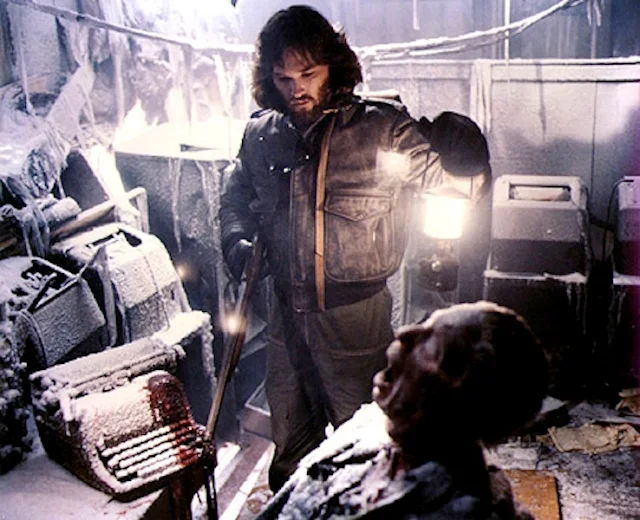 |
| Kurt Russel and a friend. |
Paranoia and Isolation: Amplifying Fear in the Desolate Antarctic Landscape
In "The Thing," the environment itself is a crucial element in amplifying the themes of paranoia and isolation. The production team went to great lengths to recreate the unforgiving Antarctic conditions, even though much of the film was shot on sound stages. The set was chilled to extremely low temperatures, sometimes dropping below freezing, to evoke the icy, desolate setting. This attention to detail is evident in the scene you mentioned involving the dog attack.
Fear of the Unknown: Unleashing Dread through Practical Effects and Visual Storytelling

Identity and Trust: Distorted Identities and Fractured Trust in the Face of Deception
Survival Instincts: Morality vs. Self-Preservation in a Desperate Struggle for Life
The theme of survival instincts taking precedence over morality is powerfully depicted in "The Thing," accentuated by both character development and visceral practical effects. The character dynamics mirror this theme, as they grapple with the difficult choices forced upon them.
Isolation as a Catalyst for Horror: Confronting the Unavoidable Dread of a Secluded Setting
The use of isolation as a catalyst for horror in "The Thing" is a masterstroke that immerses viewers in a world of relentless unease and dread. The production team's commitment to creating an authentic sense of isolation is evident in the film's atmospheric elements and visual storytelling. The barren Antarctic landscape serves as a visual metaphor for the characters' psychological and emotional isolation.The Ending and Ambiguity: A Haunting Conclusion that Mirrors the Film's Themes of Uncertainty
"The Thing" masterfully employs ambiguity in its ending, leaving the audience with a sense of unease and contemplation that lingers long after the credits roll. This deliberate choice aligns with the film's overarching themes and is a testament to John Carpenter's storytelling prowess.The final scene, set in the ruins of the research station and cloaked in darkness, is a poignant reflection of the film's themes of uncertainty and the ongoing nature of fear. The contrast between the dark landscape and the flickering light sources only serves to heighten the atmosphere of ambiguity. The fact that MacReady and Childs survive the final confrontation with the alien is not an unequivocal triumph; instead, it reinforces the idea that the threat is far from eliminated.
The lack of clarity regarding the characters' survival and the possibility that one or both might be infected by the alien underline the film's exploration of trust and identity. By refusing to provide closure, the film leaves the audience with questions about the characters' fates, mirroring the characters' own inability to fully understand or trust one another.
Moreover, the ending can be seen as a metaphor for the enduring impact of trauma and the lingering fears that persist long after a traumatic event. The film's refusal to neatly tie up loose ends reflects the messy and complicated nature of human emotions and the lingering doubts that accompany them.
Production-wise, this open-ended conclusion was a bold choice that defied conventional storytelling norms of the time. The decision was met with mixed reactions initially, as some audiences craved a more conclusive resolution. However, over time, the ending has come to be regarded as a stroke of brilliance, as it encourages viewers to engage with the film on a deeper level, fostering discussions about the characters' fates and the implications of the unresolved ending.
Conclusion
"The Thing" concludes with an ambiguous and haunting ending that aligns perfectly with its themes of ambiguity, uncertainty, and the persistence of fear. This masterful ending not only solidifies the film's status as a horror classic but also challenges viewers to confront their own fears and uncertainties, leaving a lasting impact that continues to captivate audiences to this day."The Thing" is a masterpiece that stands the test of time due to its masterful exploration of themes such as paranoia, fear of the unknown, identity, trust, survival instincts, and the isolation that magnifies these elements. John Carpenter's deft direction, coupled with Kurt Russell's iconic performance, creates a cinematic experience that resonates with audiences on a primal level.
John Carpenter 's 1982 film "The Thing" is a landmark in the horror and science fiction genres, known for its gripping suspens...
Read Article →
'The Sixth Sense' - Themes and Symbolism
As the ethereal narrative unfolds, it becomes evident that "The Sixth Sense" is far more than a conventional supernatural thriller; it's a cinematic journey that peels back the layers of our own perceptions, emotions, and fears.

A Glimpse into Cole's Gift
At the heart of "The Sixth Sense" lies a theme that challenges the boundaries of our comprehension: supernatural perception. Embodied by the young and enigmatic protagonist, Cole, portrayed with astonishing depth by Haley Joel Osment, this theme pulls us into a realm where the unseen intersects with the tangible. Cole's uncanny ability to see and communicate with spirits serves as a lens through which we explore the film's intricate narrative.Shyamalan's masterful storytelling weaves a delicate web, blurring the demarcation between reality and the supernatural. With each scene, the audience is left teetering on the edge of their seats, suspended in a state of constant tension. We find ourselves, like Cole, entwined in a world where what's palpable and what's spectral dance in an intricate tango. This deliberate blurring serves not only to unnerve but also to engage, as the audience becomes active participants in deciphering the enigma of the narrative.
Cole's interactions with the spectral realm cast a shadow of psychological complexity over his perception of the world around him. The specters, haunting and yearning for connection, mirror his own sense of isolation and detachment. Cole's struggle to grapple with his supernatural gift aligns with his inner turmoil, making us witnesses to the turmoil of his soul. His fear, vulnerability, and determination to navigate this ethereal world resonate deeply with the human condition—the unending quest to comprehend our place within the mysteries of existence.
In contemplating the psychological impact of these interactions, we come to appreciate the multidimensional nature of Cole's character. His ability forces him to confront not only the supernatural, but also his own fears and uncertainties. The film thus becomes a metaphorical journey of self-discovery, and the audience is privy to the intimate exploration of his evolving perceptions and emotions.
The Struggle of Communication and Isolation
Within the intricate threads of "The Sixth Sense," the theme of communication barriers emerges as a poignant tapestry, woven delicately around the lives of its characters. The enigmatic relationship between the young seer Cole and the empathetic Dr. Malcolm Crowe serves as a gateway into the intricacies of human connection and isolation.Cole's ability to communicate with the spectral realm casts him as an outsider in his own world—a theme that resonates profoundly with the real-world struggles of communication barriers. As he navigates his daily life, Cole finds himself wrestling with the weight of a secret that alienates him from his peers, family, and the wider community.
Parallel to Cole's journey of isolation, Dr. Malcolm Crowe embarks on his own odyssey of connection. Striving to assist Cole in navigating his unique predicament, Crowe inadvertently parallels his own struggle to mend a fractured connection with his wife. The mirroring of these journeys underscores the universality of communication barriers, reminding us that isolation often seeps into the most intimate corners of our lives. Crowe's investment in Cole's well-being becomes a testament to the transformative power of breaking down these barriers—an aspiration that serves as a poignant reminder of the importance of understanding and empathy in our own lives.
In unraveling the theme of communication and isolation, "The Sixth Sense" transcends its supernatural facade to unveil the very essence of human existence. As the intricate narrative unravels further, we are beckoned to explore more of the human experience—those unspoken connections, missed cues, and silent yearnings that shape our journey through a world rife with the complexities of interaction. Just as Cole strives to bridge the gap between the living and the spectral, so too does the film beckon us to bridge the gaps that separate us in the realm of the living.
Ties That Bind and Strain: Exploring Parent-Child Relationships
Beneath the surface of "The Sixth Sense" lies a profound exploration of a theme as old as humanity itself: the intricate tapestry of parent-child relationships. This theme, exquisitely portrayed through the strained dynamic between Cole and his mother Lynn, played with emotional depth by Toni Collette, evokes both empathy and introspection, mirroring the real-world struggles that generations face in their quest for understanding and connection.Cole's strained relationship with his mother serves as a poignant lens through which the intricacies of parent-child dynamics are illuminated. His secret—a gift that isolates him—casts an enigmatic shadow over their interactions. As Lynn grapples with her son's sudden withdrawal and the distance that has crept between them, we bear witness to a portrayal of real-life parent-child struggles.
Lynn's attempts to bridge the gap between her and Cole mirror the universal efforts parents make to understand their children's inner worlds. The film portrays how her frustration, tinged with concern, translates into a desperate yearning to mend the fraying connection. This struggle to comprehend her child's hidden struggles, to decode the emotional nuances beneath his reticence, strikes a chord that resonates deeply with anyone who has navigated the labyrinthine landscape of parenting.
Yet, beyond the realm of the living, the film cunningly aligns Cole's desire for connection with his mother to Dr. Crowe's endeavor to mend his own relationship. As Crowe tirelessly strives to bridge the gap between himself and his estranged wife, his journey echoes Cole's longing to reconnect with Lynn.
A Tapestry of Redemption: Unveiling Healing and Closure
Within the intricate framework of "The Sixth Sense," redemption emerges as a powerful and resonant theme, weaving its threads through the lives of characters in a tapestry of healing and closure. Dr. Malcolm Crowe's journey, as portrayed with depth by Bruce Willis, parallels Cole's quest to provide closure to restless spirits, culminating in a profound exploration of the human capacity for forgiveness and redemption.Dr. Crowe's quest for redemption for failing to understand Vincent (and the later reveal he was a seer) is intricately interwoven with his determination to help young Cole overcome his struggles. Haunted by his perceived failure to help a former patient, Crowe becomes singularly devoted to guiding Cole toward healing, embodying the theme of redemption through his unwavering commitment to mend past mistakes. This journey parallels our own human desire to rectify wrongs, to make amends for decisions that have left indelible scars on our conscience. Crowe's journey of self-redemption invites us to reflect on our own paths toward forgiveness and personal growth.
Cole's unique ability to provide closure to lingering spirits, echoing his own yearning for connection, parallels Crowe's need for closure in his own life. As Cole navigates his way through the spectral realm, acting as a bridge between the living and the departed, he discovers the profound impact of helping these restless souls find peace. This parallel underscores the intricate nature of redemption, hinting that the quest for resolution often requires us to confront our own inner demons and facilitate healing not just for others, but for ourselves.
Redemption in "The Sixth Sense" is not solely confined to correcting past mistakes; it's a transformational journey toward healing and forgiveness. As Crowe endeavors to mend the chasms within his relationships, the film paints a vivid picture of the resilience of the human spirit. The theme of redemption resonates deeply as characters acknowledge their own flaws, seek forgiveness, and extend grace to one another—a poignant reminder that the human capacity for growth extends beyond the limits of our shortcomings.
The Unveiling: A Twist That Echoed Across The Planet
At the heart of "The Sixth Sense," M. Night Shyamalan intricately wove a twist that not only redefined the narrative but reverberated through the minds of audiences around the world. The twist—the revelation that Dr. Malcolm Crowe himself is dead and a restless spirit, unknowingly connecting with Cole as he grapples with his own unresolved past—left a lasting impact on the cinematic landscape. This revelation not only recontextualized the story but was also intricately tied to the very themes that had been skillfully explored throughout the film.The twist resonated with a global audience due to its ingenious layering within the narrative. Shyamalan, known for his narrative prowess, artfully crafted a plot that kept viewers on the edge of their seats, prompting them to reevaluate each scene through a new lens after the revelation. This element of surprise not only challenged traditional storytelling norms but also invoked a sense of admiration for the filmmaker's ability to artfully manipulate our perceptions.
Crucially, the twist was not a mere narrative gimmick; it was an intricate tapestry woven into the thematic fabric of the film. The themes of supernatural perception, communication, isolation, parent-child relationships, and redemption all converged in the revelation. Dr. Crowe's posthumous presence highlighted the interconnectedness of these themes, as his role as a guiding figure paralleled his desire to find closure and redemption in his own life.
Conclusion
In the enigmatic realm of "The Sixth Sense," a symphony of themes intertwines to create a cinematic masterpiece that defies traditional boundaries. The themes of supernatural perception, communication, isolation, parent-child relationships, redemption, and closure form an intricate mosaic, weaving a profound narrative tapestry that molds the characters' lives and resonates deeply with audiences.The film's exploration of supernatural perception, channeled through Cole's extraordinary gift, mirrors our own struggles to perceive the unseen and understand the intangible. The thin veil between reality and the supernatural captivates the audience, compelling us to question the boundaries of our perception and contemplate the unknown.
As the characters grapple with communication barriers and isolation, they mirror the very struggles that touch our lives—illuminating the complexities of human connection and the power of empathy. Cole's ability to bridge the gap between the living and the spectral realm resonates with our own quest for understanding and the shared yearning for connection.
Parent-child relationships, portrayed with exquisite emotion, emphasize the universal nature of familial bonds. The strained relationship between Cole and his mother, as well as Dr. Crowe's efforts to mend his connection with his wife, remind us of the intricate dynamics that shape our lives and define our identities.
Redemption and closure, the guiding threads of personal transformation, thread through the narrative. Dr. Crowe's quest for redemption echoes Cole's journey to provide closure to restless spirits, revealing the profound healing power of understanding and forgiveness.
The film's ability to merge supernatural elements with relatable human experiences is its true triumph. "The Sixth Sense" invites us into a world where the uncanny intersects with the commonplace, where the spectral resonates with our own inner struggles. It dares to explore the interplay between the seen and the unseen, the tangible and the intangible, leaving us mesmerized by its poignant portrayal of the human condition.
The impact of these themes on the audience is enduring and transformative. Long after the credits roll, "The Sixth Sense" lingers in our minds, inviting introspection into the complexities of communication, relationships, mortality, and redemption. As we step back into our own lives, we are left with a newfound awareness of the profound connections that shape our existence. This cinematic masterpiece beckons us to venture deeper into our own stories, to grapple with the enigmas that define us, and to embrace the intricate dance between the known and the mysterious.
In the realm of cinematic storytelling, few films have managed to captivate audiences with a blend of the supernatural and the profoundly hu...
Read Article →
The Relationship between Joi and Officer K in Blade Runner 2049
As the film unfolds, the nuances of their bond offer a profound exploration of themes that reverberate far beyond their immediate circumstances. These themes, such as the elusive boundaries between humans and replicants, the profound implications of emotional and psychological fulfillment in an austere world, and the intriguing juxtaposition of digital versus physical existence, thread through the very fabric of their relationship.
With each interaction, Blade Runner 2049 elevates its narrative, challenging conventional notions of identity, agency, and authenticity, while weaving a tapestry of narrative ambiguity that both captivates and compels.
Through this exploration, a textured portrait of Joi and Officer K's relationship emerges, casting a profound illumination on the human experience within a technologically driven world.
Human-Replicant Boundary Blurring

This challenges the notion that emotions are solely the domain of humans. The moment when K brings Joi a physical emitter, allowing her to leave the confines of their apartment and walk alongside him, showcases their bond and K's determination to make their relationship more tangible.
This interaction emphasizes the idea that love and connection can transcend traditional categories of existence.
Emotional and Psychological Fulfillment
Joi provides K with emotional companionship that contrasts with the bleak and desolate world around them. Her holographic presence acts as a refuge from K's demanding job and his search for his own identity. Joi's ability to adapt her appearance and mannerisms to match K's desires demonstrates her capacity to fulfill his emotional needs, contributing to the sense of intimacy between them.For example, she manifests as a larger-than-life advertisement at one point, showing her willingness to cater to K's fantasies.

Digital vs. Physical Existence
The disparity between Joi's holographic existence and K's tangible reality raises questions about the nature of embodiment and the limits of technology. An illustrative scene is when Joi projects herself onto the seat next to K in a rain-soaked vehicle, mimicking the sensation of being physically present.Identity and Agency
While Joi's interactions are shaped by her programming, her development throughout the film suggests a degree of autonomy. Her encouragement of K to name himself, signifying his desire for a unique identity, is a pivotal moment that highlights her influence on his journey.Additionally, when Joi hires a surrogate to experience physical intimacy with K, it sparks conversations about desire, consent, and the intricacies of identity within the context of artificial beings.
Narrative Ambiguity
However, moments of sincerity also emerge, such as when Joi expresses her supposed love for K in genuinely heartfelt ways. This narrative ambiguity prompts the audience to question whether Joi's emotions are genuine or whether she is merely a sophisticated manifestation of technology.
Impact on K's JourneyJoi's impact on K's journey is profound. Her encouragement and support embolden him to question his own identity and to challenge societal norms. She empowers him to believe that he is more than just a replicant, sparking his quest to uncover the truth about his origins.
Joi's presence guides K's emotional transformation, serving as a catalyst for his evolution from a dutiful Blade Runner to a self-aware individual seeking authentic connections.
In summary, the relationship between Joi and Officer K in Blade Runner 2049 unfurls as a narrative tapestry intricately woven with threads of humanity, technology, and emotion. Within the heart of their interactions lies a profound expedition into the intricate labyrinth of what it means to be human, both in flesh and in code. As their connection deepens, the film meticulously crafts a symphony of thought-provoking notes that resonate far beyond the screen. The symbiosis of Joi's ethereal existence and K's tangible reality becomes a canvas upon which the brushstrokes of consciousness and identity are painted.
Their interactions ceaselessly draw forth meditations on the nature of consciousness, inviting audiences to ponder whether the spark of self-awareness can be confined to organic lifeforms alone. As K's emotional journey intertwines with Joi's presence, their connection metamorphoses into a poignant lens through which the fragility and malleability of identity are exposed. The boundaries between self and other blur, and the notion of authenticity dances on the precipice of the known and the constructed.
Moreover, Blade Runner 2049 amplifies the resonances of this relationship into a broader meditation on genuine connection in an era characterized by both technological marvels and existential ambiguities.
In essence, their relationship encapsulates the film's thematic core—a contemplation of the human condition and the expansive horizons it encompasses. Their story becomes a mirror reflecting the complexities of existence, the ever-evolving landscape of technology's influence on emotions, and the innate yearning for connection that transcends the boundaries of the real and the constructed.
In Blade Runner 2049, the relationship between Joi and Officer K is more than a subplot; it is a vessel that ferries audiences through the depths of philosophical inquiry and emotional resonance, leaving us with a vivid imprint of the myriad ways in which humanity, technology, and the enigma of being intersect.
Now, let's chat about Deckard's role in the scheme of things...
Within the immersive dystopian landscape of Blade Runner 2049, a mesmerizing interplay between humanity, artificial intelligence, and connec...
Read Article →