

Blade Runner 2049's themes and messages
A mesmerizing creation by the ingenious Denis Villeneuve, "Blade Runner 2049" stands as an intricately woven sequel that masterfully unravels themes of humanity, identity, and technological consequence.
Set 30 years after the original, it explores the dystopian future forged by the "Black Out" of 2022, the fall of the Tyrell Corporation, and the subsequent rise of the messianic industrialist Niander Wallace.
This science fiction marvel serves as a captivating, distorted mirror to our modern world, inviting us to peer into the depths of its themes and symbolism to question what truly constitutes a "soul" in a world that manufactures it.
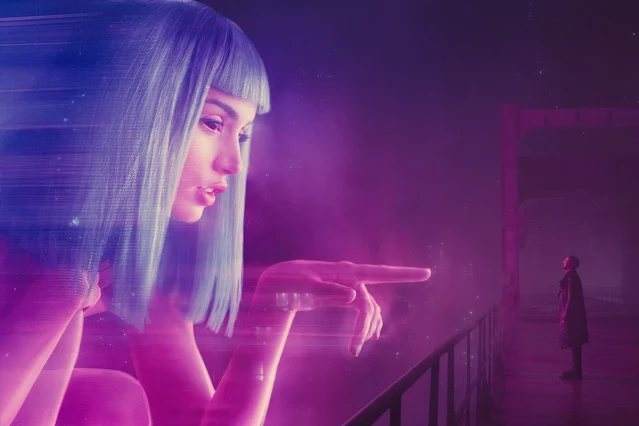
The relationship between Joi and K is a great exploration of loving an AI, who just might mean it.
Dystopian Future and Post-Humanism
Villeneuve's virtuosic direction constructs a future marred by environmental decay and social decline, immersing the audience in a tangible dystopia. We see the towering sea walls of Los Angeles, the radioactive ruins of Las Vegas, and the acidic trash plains of San Diego.
The theme of post-humanism is an electrifying undercurrent, fueled by the Nexus-9 replicants (like K, designed for obedience) and AI constructs (like Joi) that challenge our understanding of life.
This exploration demands reflection on the ethical implications of manipulating life, perfectly embodied by Niander Wallace, a man with a god complex who sees his creations not as children, but as "angels" to serve humanity's expansion off-world.
Memory and Identity
The film's delicate interplay of memory and identity is its narrative symphony. Officer K's odyssey is grounded in his struggle with implanted memories.
He knows they are implants, part of the "emotional cushion" that stabilizes replicants, yet he clings to one: the memory of a wooden horse.
His desperate belief that this one "real" memory makes him "born" (the "miracle" child) is a quest for an authentic self. The film's most poignant moment comes when he presents this memory to its true owner, Dr. Ana Stelline, who weeps at seeing a "real" memory. The film suggests that identity is vulnerable in an age where memories, our very essence, can be engineered.
And yes, the film still forces you to ask if Deckard is a replicant, as that ambiguity is what gives his child, Ana, such profound thematic weight.
The Nature of Reality
Villeneuve masterfully injects doubt into our perception of reality. Through Joi's existence as a holographic product, "everything you want to hear," the film dismantles the distinction between authentic and artificial emotions. Their "love" feels real, but the moment K sees a giant advertisement of Joi call another man "Joe," that reality shatters.
Conversely, the film's "reality" is enforced by the brutal "baseline test" K must endure.
This psychological torture (reciting "a blood-black nothingness") is designed to ensure he remains an artificial construct. The film's thesis is that K and Joi both create their own reality by making choices that transcend their programming.
Human-Technology Relationship
The film paints a rich tableau of humanity's dance with technology, unveiling the consequences of unchecked advancement. This is epitomized by Wallace, who "solved" world hunger with synthetic farming, granting him the power to acquire Tyrell's technology and build an empire on slave labor.
The visuals echo the paradox of a world hyper-connected by holograms yet starved of genuine human connection. K is a "skinner" to humans and a traitor to replicants; his only "real" relationship is with a software program.
The film is a cautionary tale, suggesting that when technology can perfectly simulate love and connection, it may erode our will to seek the difficult, messy, real thing.
Replicant Freedom and Empowerment
The struggle for autonomy, epitomized by Freysa and the Replicant Freedom Movement, reverberates with universal resonance. The "miracle" of Ana's birth is the catalyst for this movement; it proves replicants are a species that can procreate, not a product to be controlled.
This shifts their struggle from a fight for civil rights (like Roy Batty's) to a war for existence. Freysa needs a symbol, a "messiah," to rally her people. K's final act, sacrificing himself to save Deckard and protect Ana, is his ultimate empowerment. He chooses to become a savior, not by being "born," but by doing the most human thing: dying for a cause he believes in.
Isolation and Loneliness
In the midst of futuristic grandeur, the theme of isolation casts a melancholic shadow. Every major character is profoundly alone. K is isolated by his job and species. Joi is isolated within her projector.
Ana is isolated in her sterile, glass "bubble," crafting memories of a world she can't touch. Deckard is isolated in a radioactive casino with a dog. Even Wallace is isolated, blind and alone on his throne, surrounded only by his perfect, obedient "angels."
The film argues this loneliness is the true human condition in this future, and the quest to break that isolation is the only "real" motive left.
Environmental and Ethical Concerns
Villeneuve's deft storytelling thrusts environmental ruin into focus. This isn't just a visual marvel; it's a timely wake-up call. The world is barren, seen in Sapper Morton's gray, synthetic protein farm.
The key symbol of this collapse is the bee. Wallace has created synthetic bees, representing his sterile control over nature. The real, living bees K finds at Deckard's hideout are a symbol of persistent, uncontrolled, "real" life existing against all odds.
The core ethical concern is Wallace's thesis: to "save" humanity, one must abandon humanity (empathy, ethics) and become a god who dictates the terms of life itself.
Conclusion
"Blade Runner 2049" is a magnum opus of themes that transcend its genre. It doesn't just re-ask the original's question, "What is human?"
It asks a more profound one: "Does it matter?" K's journey provides the answer.
He starts as a tool, believes he's a "real" hero (the chosen one), discovers he's "just" a replicant, and then makes his most human choice: to sacrifice himself for love.
The film's final, beautiful thesis is that "realness" isn't about your origin (born or made); it's about your choice to love and sacrifice for something other than yourself.
A mesmerizing creation by the ingenious Denis Villeneuve, " Blade Runner 2049" stands as an intricately woven sequel that master...
Read Article →
What is the plot of Blade Runner 2049?
The plot revolves around K's discovery of a replicant who died during childbirth, revealing that replicants can reproduce biologically. K's superior, Lt. Joshi, fears that this revelation could lead to a war between humans and replicants and orders K to find and retire the replicant child to hide the truth. K's investigation leads him to the remains of Rachael, an experimental replicant designed by Dr. Eldon Tyrell, and to the possibility that he may be Rachael's child.
The story takes K on a journey of self-discovery, as he confronts the idea of his own humanity and questions his identity as a replicant. As K investigates the child's whereabouts, he faces opposition from the Wallace Corporation, which is seeking to unlock the secret to replicant reproduction to expand interstellar colonization. Niander Wallace, the CEO of the Wallace Corporation, sends his replicant enforcer Luv to retrieve Rachael's remains and follow K to the child.

Along the way, K encounters Deckard, a former blade runner from the original film, who reveals that he is the father of Rachael's child and that he left the child in the custody of the replicant freedom movement. The movement, led by Freysa, aims to liberate replicants from their status as slaves and seeks to protect the child from the Wallace Corporation.
As the story unfolds, K's investigation leads him to discover the truth about his own identity and the identity of the child, culminating in a final confrontation with Luv and Deckard's rescue. K sacrifices himself to protect Deckard and the replicant freedom movement and dies looking up at the falling snow, symbolizing the possibility of new beginnings.

The film explores themes of identity, humanity, and the nature of consciousness. The replicants in the film are portrayed as slaves, forced to serve humans and denied the same rights and freedoms. Through K's journey, the film questions the idea of what it means to be human and whether it is determined by biology or consciousness.
Blade Runner 2049 also explores the consequences of technological advancements, particularly in the area of artificial intelligence. The film suggests that the creation of conscious beings, such as replicants, raises ethical questions about their treatment and rights.
Overall, Blade Runner 2049 is a complex and thought-provoking film that delves deep into the human condition, exploring the nature of identity, consciousness, and the consequences of technological progress.
Blade Runner 2049 is a science-fiction film set thirty years after the original Blade Runner film. The movie follows K ( Ryan Gosling, Proje...
Read Article →
Why 2049, sequel to Blade Runner was made 30 years after the original film's release
The idea for Blade Runner 2049 began to take shape in 2011, when Ridley Scott, the director of the original Blade Runner, announced his intention to create a sequel to the film. He teamed up with Hampton Fancher, who co-wrote the original screenplay, to develop a story for the new film. Initially, the plan was for Ridley Scott to direct the sequel himself, but as the project progressed, he decided to step back and take on a more hands-off role as a producer.
Scott said, "I think there is another story. I've got another one ready to evolve and be developed, so there is certainly one to be done for sure."
In 2015, Denis Villeneuve was approached to direct Blade Runner 2049. Villeneuve was already known for his work on the critically acclaimed films "Prisoners" and "Sicario", and he was eager to take on the challenge of directing a science fiction film of this magnitude. He began working with Fancher and Green to refine the script and develop the story further.

One of the biggest challenges facing the filmmakers was how to create a sequel that would both honor the original film and stand on its own as a compelling work of science fiction. The team worked hard to craft a story that would build on the themes and ideas of the original Blade Runner, while also exploring new themes and ideas that were relevant to our current times.
Another challenge was casting the right actors for the film. The original Blade Runner is known for its iconic performances by Harrison Ford and Rutger Hauer, and the new film needed to find actors who could live up to those performances while also bringing their own unique take to the characters. Ryan Gosling (Project Hail Mary) was cast as the lead character, a blade runner named K, while Harrison Ford reprised his role as Rick Deckard from the original film.
Blade Runner 2049 was produced by Ridley Scott, Andrew A. Kosove, Broderick Johnson, Bud Yorkin, and Cynthia Yorkin. The film was released in 2017 to critical acclaim and was a box office success, grossing over $260 million worldwide.
Its stunning visuals, intricate storytelling, and thought-provoking themes cemented its place as a worthy successor to the original Blade Runner, and it has become a beloved science fiction classic in its own right.
Blade Runner 2049 ultimately won two Oscars at the 90th Academy Awards in 2018. The film won for Best Cinematography, awarded to Roger A. Deakins, and Best Visual Effects, awarded to John Nelson, Gerd Nefzer, Paul Lambert, and Richard R. Hoover. The film was also nominated in several other categories, including Best Sound Editing, Best Sound Mixing, and Best Production Design.
Blade Runner 2049 is a science fiction film released in 2017 , directed by Denis Villeneuve and written by Hampton Fancher and Michael Green...
Read Article →
What Academy Awards did Blade Runner (1982) and Blade Runner 2049 win?
The original Blade Runner, directed by Ridley Scott, was nominated for two Academy Awards in 1983 for Best Art Direction-Set Decoration and Best Visual Effects.

Similarly, the visual effects in the original Blade Runner were considered revolutionary, particularly the use of the "Spinner" vehicles and the creation of the replicants, which were brought to life using a combination of practical makeup and animatronics. These effects helped to bring the world of the film to life and immerse the audience in its dystopian vision of the future.
Blade Runner 2049, directed by Denis Villeneuve (Dune), continued in the footsteps of its predecessor by setting a new standard for visual excellence.
In addition to its technical achievements, both Blade Runner films were also praised for their exceptional sound design and music scores. The original Blade Runner featured a haunting score by Vangelis, which helped to create the film's unique atmosphere and tone. Blade Runner 2049 continued this tradition with a score by Hans Zimmer and Benjamin Wallfisch, which was similarly atmospheric and immersive.
The Blade Runner franchise has long been regarded as a cinematic masterpiece, not only for its compelling storytelling and thought-provoking...
Read Article →
The connection of Kurt Russel's 'Soldier' to 'Blade Runner'
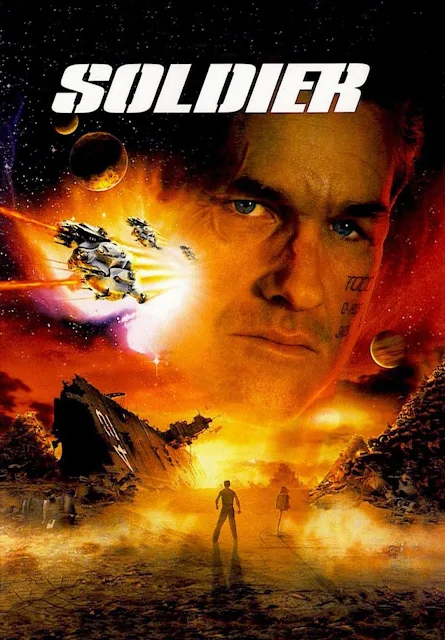 |
| Kurt Russell (The Thing, Escape from New York) stars as the Soldier |
Furthermore, the two films share thematic similarities. Both explore the nature of humanity and what it means to be human.
Soldier contains explicit 4 references to Blade Runner.
The Soldier, Todd participated in campaigns at Tannhäuser Gate and the Shoulder of Orion. These were both referenced by Roy Batty during his Tears in the Rain monologue at the end of Blade Runner shortly before his death.


Despite these connections, Soldier is not a direct sequel to Blade Runner. Instead, it serves as a "sidequel," existing in the same universe and sharing a common narrative thread. This allows the two films to be viewed independently while still being connected to each other.
In addition to the shared creative team and thematic similarities, there are several other interesting connections between Blade Runner and Soldier.
For example, both films were directed by filmmakers who were heavily influenced by the works of Ridley Scott. Ridley Scott directed Blade Runner, and Soldier director Paul W.S. Anderson (Event Horizon), has cited Blade Runner as a major influence on his filmmaking style. This connection further reinforces the idea that Soldier was created with Blade Runner in mind.
Another interesting connection is the use of futuristic technology in both films. Blade Runner showcases advanced technologies like flying cars, artificial intelligence, and genetically engineered humans, while Soldier features advanced weapons, advanced medical technologies, and genetically enhanced soldiers. This use of technology in both films is a reflection of the filmmakers' shared interest in exploring the potential consequences of technological advancements on humanity.
The films are of course completely different in many respects.
Blade Runner and Soldier are two science fiction films that share a strong connection due to their shared creative team, thematic similariti...
Read Article →
Why did Roy Batty save Deckard's life at the end of Blade Runner?
Roy Batty's decision to save Deckard's life is a pivotal moment in the film, not only because it highlights the film's central themes but also because it challenges our own preconceived notions of what it means to be human. Throughout the film, the audience is confronted with the question of what it means to be human, with the replicants serving as a kind of mirror for the human characters.
The replicants are physically identical to humans, and yet they are treated as objects, created to perform specific tasks and then discarded when they are no longer needed. This treatment is what drives the replicants to seek out a way to extend their limited lifespan and avoid the fate of being discarded like a used piece of machinery.

However, in the final scene of the film, Batty's actions demonstrate that replicants are capable of more than just fulfilling their intended purpose. His decision to save Deckard's life is an act of empathy and compassion, traits that we often associate with humanity. This moment challenges the notion that replicants are just machines, devoid of emotion or the capacity to care about others.
Batty's act of compassion also highlights the idea of what it means to be truly alive. In many ways, Batty's situation is not dissimilar to that of humans who face their own mortality. Throughout the film, Batty is aware of his limited lifespan and the fact that he is not truly alive in the same way that humans are. His decision to save Deckard's life can be seen as a rejection of this fate and a desire to transcend the limitations imposed upon him by his creators.
Furthermore, Batty's actions can also be seen as an act of rebellion against the societal norms that dictate that replicants are inferior to humans. By demonstrating compassion and empathy towards a human, Batty challenges the notion that replicants are incapable of such emotions. In a way, Batty's actions are a call for recognition, not just for himself, but for all replicants.
By demonstrating empathy and compassion towards a human, Batty proves that replicants are more than just machines and possess the same traits that we often associate with humanity. His actions also highlight the idea of what it means to be truly alive and challenge the societal norms that dictate that replicants are inferior to humans.
Clearly, it was so he could present his Tears in the Rain monologue ... Roy Batty's decision to save Deckard's life is a pivotal mom...
Read Article →
'Tears in the Rain' - the greatest 'bad guy' monologue ever
"I've seen things you people wouldn't believe. Attack ships on fire off the shoulder of Orion. I watched c-beams glitter in the dark near the Tannhäuser Gate. All those moments will be lost in time, like tears in rain. Time to die."Is he really the bad guy of this film?
Hauer famously adapted the originally scripted speech, which he described as "opera talk" and "hi-tech speech," and added his own line.
I've known adventures, seen places you people will never see, I've been Offworld and back… frontiers! I've stood on the back deck of a blinker bound for the Plutition Camps with sweat in my eyes watching stars fight on the shoulder of Orion... I’ve felt wind in my hair, riding test boats off the black galaxies and seen an attack fleet burn like a match and disappear. I've seen it, felt it...!
The "Tears in Rain" monologue also highlights the similarities between Batty and Deckard.
After Hauer's death, Leah Schade of the Lexington Theological Seminary wrote of Batty as a Christ figure, with the nail through the palm of his hand, and his act of pity towards Deckard as a representation of Christ's sacrifice for humanity.
The monologue also represents a turning point for Roy Batty's character. Throughout the film, he is portrayed as a ruthless and violent replicant, but in his final moments, he shows compassion and empathy for Deckard, despite the fact that Deckard has been tasked with hunting him down. This act of kindness suggests that Roy has come to understand the value of life and the importance of making a meaningful impact on the world before his own time runs out.
What are the c-beams referenced in the Tears in the Rain monologue?
The "Tears in Rain" monologue is a poignant and moving moment in the 1982 film Blade Runner. The speech is delivered by the charac...
Read Article →
Blade Runner 1982 - Plot Synopsis
As Deckard begins his investigation, he meets with Eldon Tyrell, the CEO of the company that creates replicants, to administer the Voight-Kampff test on a Nexus-6. The test is designed to distinguish replicants from humans based on their emotional responses to questions. Tyrell expresses his interest in seeing the test fail first and asks Deckard to administer it on his assistant Rachael. After a long test, Deckard privately concludes that Rachael is a replicant who believes she is human.

Deckard's investigation leads him to Leon's hotel room, where he finds photos and a synthetic snake scale. Roy and Leon investigate a replicant eye-manufacturing laboratory and learn of J. F. Sebastian, a gifted genetic designer who works closely with Tyrell. Meanwhile, Deckard meets Rachael again and tells her that her memories are implants from Tyrell's niece.
After Deckard kills Zhora at a strip club, Bryant orders him to retire Rachael, who has disappeared from the Tyrell Corporation. As Deckard searches for her, he is ambushed by Leon, who Rachael kills with Deckard's gun. Deckard and Rachael develop a romantic relationship, but he promises not to track her down.
Roy arrives at Sebastian's apartment and kills Tyrell, demanding more life from his maker. Sebastian is later reported dead, and Roy chases Deckard onto a rooftop. After saving Deckard from falling, Roy dies and Deckard finds an origami unicorn left by Gaff.
The plot of Blade Runner is driven by its exploration of themes such as what it means to be human, the nature of memory and identity, and the dangers of technology. Deckard's relationships with replicants such as Rachael and Roy challenge his beliefs about their humanity, while the use of implanted memories raises questions about what makes memories real. The film also depicts a world in which corporations and technology have become dominant and humanity has been pushed to the margins.
Director Ridley Scott has stated that he intended Deckard to be a replicant, while screenwriter Hampton Fancher initially intended him to be human. This ambiguity is reflected in the dream sequence about the unicorn, which suggests that Deckard's memories may also be implants. The question of Deckard's identity is central to the film's exploration of themes such as memory, identity, and humanity. The film ultimately leaves the answer up to interpretation, with both possibilities having strong arguments.
Blade Runner is set in a dystopian future where bioengineered humanoids known as replicants are hunted down by "blade runners" lik...
Read Article →
Is Deckard a human or replicant in Blade Runner?
The Eternal Debate: Is Rick Deckard a Replicant?
The short answer is it depends entirely on what version of the film you watch. Even then the debate can go either way from a certain point of view.
Since 1982 audiences have debated the true nature of Rick Deckard. Is the weary LAPD detective a human hunting rogue androids or is he a machine programmed to kill his own kind? In addition to the ambiguous evidence presented within the actual movie there have been fierce varying opinions among the filmmakers and actors involved in creating the Blade Runner universe.
The War of the Creators
Director Ridley Scott has consistently maintained that Deckard is a replicant. He views this as the ultimate narrative twist. Meanwhile actor Harrison Ford has stated his steadfast belief that Deckard is a human being. Ford argued during production that the audience needed a human anchor in a world populated by synthetic life. It is worth noting that actors frequently interpret their characters differently than the director intended. Ford's personal interpretation does not necessarily discredit the possibility that Deckard is an android.
We also have to look at the source material. In Philip K. Dick's original 1968 novel Do Androids Dream of Electric Sheep? the character of Rick Deckard is unequivocally human. He is a married man trying to earn enough bounty money to buy a real live animal to replace his robotic sheep. The film abandons this domestic subplot but it retains the core existential dread of Dick's literature.

The Evidence: Unicorns and Glowing Eyes
One of the main arguments for Deckard being a replicant is the unicorn dream sequence. This vital scene was prominently featured in the 1992 Director's Cut and perfected in the 2007 Final Cut. In this dream Deckard sees a white unicorn running through a misty green forest. This is highly significant because the mysterious officer Gaff later leaves a silver origami unicorn outside Deckard's apartment. This clearly implies that Gaff knows exactly what Deckard dreams about behind closed doors.
This suggests that Deckard's private memories are implanted just like Rachael's memories of a spider weaving a web. If the LAPD has access to his subconscious it means he may be an experimental Nexus model replicant. However it is very important to remember that the unicorn dream was totally absent from the original 1982 theatrical release. The studio mandated a happier ending and a film noir voiceover track that stripped the movie of this specific mystery.
There are visual clues as well. Look closely at the scene in Deckard's apartment. As Rachael asks Deckard if he has ever taken the Voight Kampff test himself a strange red glow reflects in his eyes. This is the exact same cinematic technique Ridley Scott uses to identify replicants throughout the film. Deckard also surrounds his piano with vintage black and white photographs. Replicants like Leon Kowalski obsess over photographs because they provide a desperately needed artificial anchor to a past they never actually lived.
"It's too bad she won't live. But then again, who does?"
The Case for a Human Deckard
Despite Ridley Scott's heavy handed visual clues there are brilliant arguments to be made for Deckard remaining human. The entire narrative structure is centered around Deckard's investigation of the escaped androids. His emotional arc revolves around his growing empathy for the very beings he is authorized to kill. If Deckard is revealed to be a replicant it arguably undermines this emotional journey. The tragedy of the film is a cold disconnected human learning what it actually means to be alive from a dying machine.
Furthermore we have the issue of his physical vulnerability. During his final confrontation with Roy Batty the blade runner is completely outmatched. Batty easily breaks Deckard's fingers and treats him like a fragile toy. If Deckard were a combat or law enforcement Nexus model he would theoretically possess superior strength and resilience. The theatrical ending also suggests that Deckard has a long future ahead with Rachael which makes no sense if he is burdened with a built in four year lifespan.
The Impact of Blade Runner 2049
When director Denis Villeneuve crafted the stunning 2017 sequel Blade Runner 2049 he knew he had to address the elephant in the room. Instead of ruining the mystery Villeneuve masterfully protected the ambiguity. We see an older gray haired Deckard living in the radioactive ruins of Las Vegas. Some fans eagerly argue his natural aging proves he is a biological human.
However the sequel introduces experimental reproductive capabilities and advanced Nexus models that possess the ability to age naturally. Niander Wallace even taunts Deckard with the idea that he was perfectly designed to meet Rachael and fall in love as part of a grand corporate experiment. The sequel outright refuses to give the audience a definitive yes or no answer.
The Power of Not Knowing
By keeping Deckard's true nature a mystery the franchise continuously subverts the audience's expectations. It aggressively challenges our assumptions about what it means to be human. This thematic complexity is a massive hallmark of Ridley Scott's broader science fiction work. Screenwriter Hampton Fancher has repeatedly stated that he wanted the film to be more ambiguous and less literal.
Ultimately the ambiguity surrounding Deckard adds to the film's enduring legacy. It encourages the audience to engage with the themes on a much deeper philosophical level. The question of whether Deckard is a replicant or a human being is one that will continue to be hotly debated in cinematic circles for decades to come. The deliberate ambiguity ensures that the mystery itself becomes the final answer.
Lore & Theory The Eternal Debate: Is Rick Deckard a Replicant? The short answer is it depends entirely on what ve...
Read Article →
Blade Runner: The use of eyes as symbolism

The use of eye symbolism in the 1982 film Blade Runner is significant and recurring, providing insight into the themes and characters within the movie. The opening scene of the film, with an extreme closeup of an eye that fills the screen reflecting the industrial landscape seen below, immediately sets the tone for the importance of sight and the eye's significance in the story.
The character of Roy seeks out Chew, a genetic designer of eyes who created the eyes of the Nexus-6. Roy's ironic quip to Chew, "If only you could see what I've seen with your eyes," emphasizes the importance of personal experience in the formation of self. The fact that the man who designed replicant eyes shows the replicants the way to Tyrell is symbolic and highlights the role of eyes as a window to the soul.
The Voight-Kampff test used in the film to determine if someone is human measures emotions, specifically empathy, through various biological responses such as fluctuation of the pupil and involuntary dilation of the iris. Tyrell's trifocal glasses are a reflection of his reliance on technology for his power and his myopic vision.
The glow in the pupils of replicants' eyes creates a sense of artificiality and is evidence that Deckard may be a replicant himself. The effect was produced by shining a light along the optical axis of the camera. According to Ridley Scott, the eye is the most important organ in the human body, and a glowing human retina is one way of stating that. The glow is a stylistic device visible only to the viewers to help them understand that they are viewing a replicant.
The relationship between sight and memories is also referenced several times in the film. Rachael's visual recollection of her memories, Leon's "precious photos," Roy's discussion with Chew, and his soliloquy at the end, "I've seen things you people wouldn't believe," all emphasize the importance of sight and memory. However, the film also highlights the concept that what the eyes see and the resulting memories are not always to be trusted, as evidenced by Rachael's fabricated memories and Deckard's need to confirm a replicant based on more than appearance.
Overall, the use of eye symbolism in Blade Runner is a powerful tool that reinforces the themes and characters of the film, highlighting the importance of sight and memory while also emphasizing the potential for deception and mistrust.
The use of eye symbolism in the 1982 film Blade Runner is significant and recurring, providing insight into the themes and characters within...
Read Article →
_poster.jpg)


