

The Astromech · Interactive Star Wars Feature
A Galaxy in Conflict
The Star Wars Power and Faction Map
Every galactic regime inherits the institutions, weapons, compromises and enemies of the one it replaced.
The Star Wars galaxy is usually told as a story of heroes. It is more accurately a story of institutions - senates, armies, banks, temples, syndicates and cells - that keep passing the same machinery between them. The Republic built a clone army it did not control. The Empire inherited that army and its shipyards. The Rebellion inherited the Empire’s stolen plans and its ex-officers. The New Republic inherited the Empire’s remnant warlords, and the First Order inherited those. Nothing in this galaxy is ever really destroyed; it is repurposed.
This map plots those inheritances. Select a node to open an intelligence card, select a line to read the relationship behind it, and move between eras to watch power change hands. Every card links back to the relevant essays in The Astromech’s complete Star Wars archive - start with the chronological order of the films and shows if you want the timeline first, or the best viewing order if you are building a rewatch.
Continuity note. The default view is current canon. Switch the continuity selector to Legends to see the Thrawn Crisis layer drawn from Timothy Zahn’s trilogy, or to All continuities to view both. Canon and Legends entities are never joined by an ordinary relationship; where the two continuities are compared, the connection is labelled Continuity parallel and drawn as a dashed gold line.
Terminal controls
Filter the holomap
Narrow the display by continuity, era, entity type, relationship category and spoiler tolerance. All filters combine, and the status line beneath the map reports what is currently visible.
Keyboard: Tab moves between nodes, Enter or Space selects, Esc closes a card, + and − zoom, arrow keys pan the map.
Relationship legend
- Imperial cog: authority imposed downward, including command, occupation, manipulation, espionage, betrayal, dependency and succession
- Rebel starbird: insurgent or formative direction, including rebellion, schism and Force mentorship
- Unmarked line: mutual alliance, shared cause or family
- Dashed red: ideological opposition or rivalry
- Dotted violet: covert manipulation, espionage or criminal commerce
- Long-dash grey: institutional succession or schism
- Dashed gold: continuity parallel, a canon and Legends comparison only
- Dashed gold ring around a node: Legends entity
Strategic holomap
The galaxy graph
Drag the background to pan, drag a node to reposition it, scroll or use the zoom controls to change scale. Selecting a node highlights its immediate network and opens a full-width intelligence card beneath the map.
No entities match the current filters. Reset the map or widen the era and continuity selection.
Entity
Relationship
Comparison
Chronology
Seven positions on the galactic timeline
Selecting an era filters the map to the factions and relationships active in that window. The Legends Thrawn Crisis sits deliberately outside the canon sequence. For the full viewing chronology, read The Astromech’s chronological order of the Star Wars films and shows.
Era briefings
How the galaxy changed hands
Four turning points, each one an institution being inherited rather than invented.
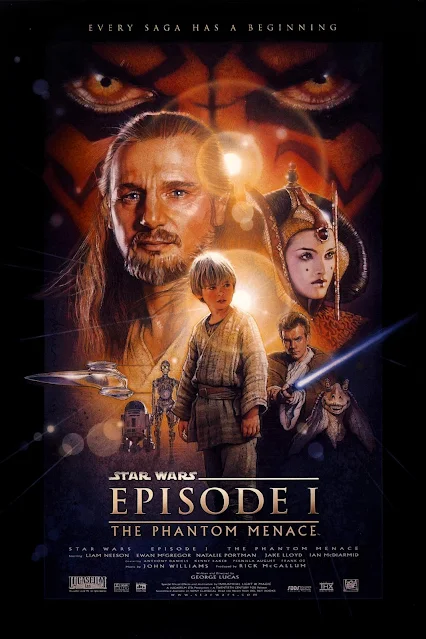
32 BBY to 19 BBY · Fall of the Republic
A blockade, a vote, and a war built to order
The Republic did not fall to an invasion. It fell to a trade dispute that was allowed to become a constitutional crisis. The Trade Federation blockade of Naboo produced a vote of no confidence; the vote produced a Chancellor; the Chancellor produced emergency powers; the emergency powers produced an army that had already been secretly commissioned on Kamino. Every stage looked procedural. The Astromech traces the mechanics in Palpatine’s use of manipulation across the prequel films, the personal cost in Anakin’s journey from Jedi to Sith to sacrifice, and the misdirection at the centre of it in Sabé’s ruse, the decoy trick that fooled everyone.

19 BBY to 5 BBY · Imperial consolidation
The Empire keeps the Republic’s furniture
The most quietly devastating fact of the New Order is how little had to change. The Senate chamber stayed. The clone army was rebranded. The Jedi Temple became an Imperial palace. What the Empire added was an internal security apparatus - the ISB - and a Force-hunting instrument built out of broken Jedi, the Inquisitorius. Read how Order 66 wiped out the Jedi and the subtle moments of Revenge of the Sith that stage the transition in plain sight.

c.5 BBY to 0 BBY · Formation of the Rebellion
Not one rebellion - several, arguing
The Alliance did not begin as an alliance. It began as a set of incompatible operations: a senator laundering her own family fortune, a Coruscant antiquities dealer running an intelligence network on a body count, a partisan on Jedha who considered the senators cowards, and cells on Lothal and Ghorman with entirely local grievances. Andor is the record of them being forced into one room. Follow it through the Luthen Rael character case study, the study of Bail Organa and the role and politics of Ghorman.
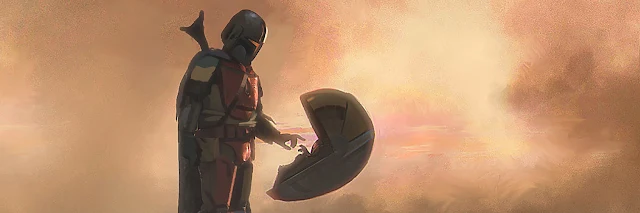
5 ABY to 34 ABY · New Republic and Imperial Remnant
A republic that demobilised, and the warlords who did not
Victory at Endor removed an Emperor, not an apparatus. Imperial officers withdrew into the Unknown Regions with intact fleets, cloning expertise and a grievance; the New Republic answered by disarming, moving its capital and treating the frontier as somebody else’s problem. The Mandalorian is set precisely in that gap, where a bounty hunter with a creed does more governing than the government. Read the themes of season one, then the Dark Saber as a symbol of power and legitimacy.
Featured editorial
Fault Lines of the Galaxy
Eleven relationships that carry more historical weight than any single character arc. Each one is a hinge: the moment one institution’s machinery passes into another’s hands.
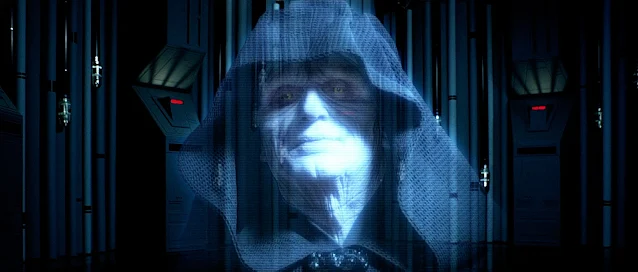
Fault line 01 · Covert manipulation · 32 BBY to 19 BBY
Palpatine, the Republic, the Separatists and the manufacture of an Empire
The single most efficient act of political engineering in the saga is that Palpatine commanded both sides. As Chancellor he held the Republic’s legitimacy; as Sidious he held the Confederacy’s corporate backers. A war he owned on both flanks let him request every power he wanted and be thanked for it. The Separatists were never meant to win - they were meant to justify the army, exhaust the Senate and discredit the Jedi as generals.
Read The Astromech’s analysis of Palpatine’s manipulation across the prequels, then how the Tragedy of Darth Plagueis was used on Anakin and the Emperor’s own words, collected.

Fault line 02 · Force mentorship into betrayal · 32 BBY to 19 BBY
Anakin Skywalker’s movement from the Jedi Order to the Sith
Anakin is not recruited away from the Jedi so much as vacated from them. The Order gives him a rank without a seat, a prophecy without an explanation, and a doctrine of detachment that has no answer for the one thing he actually fears. Palpatine offers what the Temple structurally cannot: personal attention, and the promise that death is negotiable. The map treats Anakin and Vader as one evolving node because the institutions he destroys are the ones that formed him.
Read the Chosen One essay on Anakin’s journey to sacrifice, the visual foreshadowing of Anakin and Padmé’s destiny and the thematic relationship between Vader and C-3PO.
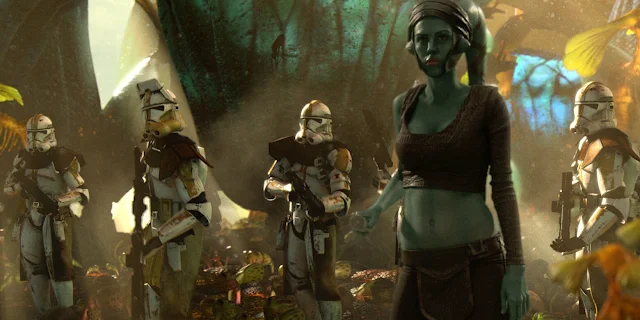
Fault line 03 · Betrayal · 19 BBY
Order 66 and the destruction of the Jedi
Order 66 is not a battle. It is an administrative instruction executed simultaneously across a galaxy by soldiers standing beside the people they are killing. That is what makes it structurally different from every other massacre in the saga: the Jedi were destroyed by the army they had been ordered to command, using a contingency written into that army before the war began. The Order’s survivors spend three decades as fugitives, and the Empire builds the Inquisitorius out of the ones it can break.
Explore how Order 66 destroyed the Jedi, and the aftermath in what a Bokken Jedi actually is and what the saga says about the Force itself.

Fault line 04 · Formal alliance from fragments · c.5 BBY to 2 BBY
Mon Mothma, Bail Organa, Luthen Rael and the fragmented birth of the Rebel Alliance
Three people, three incompatible methods, one outcome. Mon Mothma keeps a Senate seat and launders the money through her own family, at ruinous personal cost. Bail Organa provides Alderaanian legitimacy, a planetary treasury and the cover of respectability. Luthen Rael provides what neither of them can be seen near: sabotage, assassination and the deliberate provocation of Imperial reprisals. Luthen’s network is the reason there is an Alliance to join, and the reason the Alliance can never publicly acknowledge him.
Read the Luthen Rael case study, the study of Bail Organa as senator, father and architect, and the review of ‘Welcome to the Rebellion’.

Fault line 05 · Infiltration and occupation · 19 BBY to 0 BBY
The ISB’s infiltration and suppression of resistance
The Imperial Security Bureau is the Empire’s most honest institution, because it is the only one that says out loud what the Empire is for. Its method is not brute occupation but authorship: seed an informant, provoke an incident, let the reprisal look like a response. Ghorman is the case study - a planet whose resources the Empire needed, whose destruction was scripted in advance, and whose massacre was designed to be broadcast as the rebels’ fault. It produced exactly the radicalisation it was built to punish.
Read the role and politics of Ghorman, ‘Ever Been to Ghorman?’ and ‘Who Are You?’, the massacre episode.

Fault line 06 · Schism and legitimacy · 22 BBY to 9 ABY
Mandalore, Death Watch, the Nite Owls, the Children of the Watch and the Dark Saber
Mandalore’s tragedy is that it has a constitution shaped like a weapon. The Dark Saber does not merely symbolise leadership; possession of it, won in combat, is the claim. That single rule guarantees permanent schism: pacifists are illegitimate by definition, splinter groups can always argue they are the true creed, and any outsider who wins a duel inherits a throne they never wanted. Death Watch splinters from the New Mandalorians, the Nite Owls splinter from Death Watch, the Children of the Watch splinter into fundamentalism, and Din Djarin walks off a scrapyard duel holding the crown.
Read the Dark Saber analysis, the mythosaur of Mandalore explained and the themes of The Mandalorian season one.

Fault line 07 · Family as galactic politics · 0 BBY to 4 ABY
The Skywalker line as a constitutional problem
In most political histories, dynasty is a metaphor. Here it is the mechanism. The Empire’s enforcer is the father of the Rebellion’s most effective field commander and of the Alliance’s leading senator; the Emperor’s succession plan is to replace one Skywalker with another. Endor is won not by superior firepower but by a family argument conducted in a throne room while the fleet waits. The saga’s revenge structure is examined in the themes of The Empire Strikes Back, the themes of Return of the Jedi and why Luke wears black in Return of the Jedi. See also the saga’s long list of severed hands - a motif, not an accident.

Fault line 08 · Institutional succession · 4 ABY to 5 ABY
The Empire’s collapse and the emergence of the Imperial Remnant
An empire organised entirely around a single will does not survive that will. What it leaves behind is worse in one specific way: dozens of Moffs with intact fleets, no central authority to restrain them, and every incentive to convert military assets into private fiefdoms. The New Republic could accept the surrender of an institution; it had no procedure for the surrender of a hundred warlords who never surrendered. That unresolved remainder is the through-line to everything that follows, from the Mandalorian frontier to Exegol.
Read the Andor finale review and the themes of Return of the Jedi.

Fault line 09 · Absent authority · 5 ABY to 12 ABY
The New Republic and the Mandalorian frontier
The New Republic’s founding conviction - that a demilitarised centre is the cure for the Empire - reads as principle at Hosnian Prime and as abandonment on the Outer Rim. Amnesty programmes rehabilitate former Imperials while remnant officers run experiments unmolested; the Bounty Hunters’ Guild becomes a de facto justice system; a single armoured man and a foundling do more for Mandalore’s restoration than any Senate committee. The show works precisely because the Western genre it borrows from is about the same absence.
Read how The Mandalorian nods to the Western, the Lone Wolf and Cub inspiration and why Grogu is Din Djarin’s lobster.

Fault line 10 · Continuity parallel · canon vs Legends
Thrawn in canon compared with the Legends Thrawn campaign
Two versions of the same officer, doing structurally different jobs. In current canon, Thrawn is an Imperial instrument aimed at a specific insurgency - a Chiss outsider whose analytic method makes him effective against the Lothal cell and, later, a returning threat tied to Ahsoka’s search. In Legends, five years after Endor, he is the campaign itself: a Grand Admiral who reassembles a defeated Empire around cloning cylinders, a lost dreadnought fleet and a mad clone of a Jedi Master. The map keeps these on separate layers. Canon Thrawn never commanded the Katana Fleet; Legends Thrawn never fought on Lothal.
Read The Astromech’s Thrawn in Rebels analysis, then the Heir to the Empire review and the themes of Heir to the Empire.

Fault line 11 · Institutional succession · 5 ABY to 35 ABY
From remnant to First Order to Sith Eternal
The First Order is not a new idea; it is the Imperial Remnant given a generation to rebuild in the Unknown Regions, funded quietly, and rebuilt around conscripted children rather than clones. The Sith Eternal beneath Exegol is the layer under that: a cult that had been manufacturing hulls and true believers the entire time, waiting for a Palpatine to return to. The saga’s last act is therefore its first act repeated - a secret fleet, built in advance, revealed at the moment a legitimate government is destroyed.
Read the Palpatine manipulation essay and Star Wars ring theory explained, which is the best frame for why the ending rhymes with the beginning.
Static reference
The faction archive
A permanent text index of the powers plotted on the map, each with its Astromech reading. This section is fully usable without the interactive graph.
Governments and political institutions
Canon · 32 BBY to 19 BBY
Galactic Republic & Galactic Senate
A thousand-year constitutional order whose procedural paralysis was the weapon used against it. Its Senate voted itself out of existence to applause.
Canon · 24 BBY to 19 BBY
Confederacy of Independent Systems
A corporate secession dressed as a liberation movement, funded by the Banking Clan and commanded, in secret, by the same man commanding the Republic.
Canon · 19 BBY to 4 ABY
Galactic Empire & Imperial Senate
The Republic with the debate removed. The Senate survived as theatre until the Death Star made it unnecessary.
Canon · c.2 BBY to 4 ABY
Alliance to Restore the Republic
A coalition assembled from senators, partisans, criminals and defectors, held together mainly by what it opposed.
Canon · 5 ABY to 35 ABY
New Republic, Imperial Remnant, First Order and Resistance
A demilitarised republic, the warlords it failed to finish, the regime they became, and the private army that had to fight it unofficially.
Force traditions
Canon · all eras
The Jedi Order
A monastic tradition that accepted a military commission and lost its moral authority before it lost its lives.
Canon · all eras
The Sith Order and the Inquisitorius
Two masters at a time, and then an institution built from the Jedi the Empire managed to break.
Canon · 19 BBY onwards
The Nightsisters of Dathomir
A magick tradition outside both Jedi and Sith frameworks, whose influence outlives its near-extermination.
Military, intelligence and rebel networks
Canon · 22 BBY to 19 BBY
Grand Army of the Republic
An army ordered without the Senate’s knowledge, delivered exactly when a war required it, and carrying a pre-installed instruction to kill its own officers.
Canon · 19 BBY to 4 ABY
Imperial Security Bureau
Internal security as authorship: informants, provocations and reprisals designed in advance to look like responses.
Canon · c.5 BBY to 1 BBY
Luthen Rael’s network and Saw Gerrera’s Partisans
The deniable half of the Rebellion: an intelligence operation run on sacrifice arithmetic, and a partisan movement too radical for the Alliance to acknowledge.
Canon · 22 BBY to 9 ABY
Death Watch, the Nite Owls and the Children of the Watch
Three answers to the same question - who is allowed to say what a Mandalorian is.
Cultures, planets and strategic locations
Canon · all eras
Mandalore and the Mandalorians
A culture whose legitimacy is settled by combat, and therefore never settled at all.
Canon · 32 BBY to 19 BBY
Naboo, Coruscant, Kamino and Geonosis
The four addresses of the Republic’s fall: a pretext, a chamber, a factory for soldiers and a factory for droids.
Canon · 5 BBY to 4 ABY
Ghorman, Jedha, Scarif, Yavin IV and Alderaan
The Rebellion’s geography is a list of places the Empire made examples of, and one moon it never found in time.
Canon · 32 BBY onwards
Tatooine, the Hutt Clan and the criminal economy
Where no government reaches, syndicates provide the only functioning administration - and the galaxy’s most consequential slave boy.
Pivotal figures
Ahsoka Tano
The Jedi who left before the Order fell, and therefore survived to argue with what it had been.
Cassian Andor and Din Djarin
Two men shaped by absent institutions: one recruited into a rebellion he did not believe in, one governed by a creed instead of a state.
Continuity comparison
The Legends layer: the Thrawn Crisis
Timothy Zahn’s 1991-1993 trilogy is not current canon, and this map never mixes the two. Some entities - the New Republic, the Imperial Remnant, Thrawn himself - exist in both continuities with different histories; others, including Mara Jade, Joruus C’baoth, the Katana Fleet and Mount Tantiss, exist only in Legends. Where the map draws a line between a canon entity and a Legends entity, it is an editorial comparison, labelled Continuity parallel, and nothing more.

Legends · c.9 ABY
Thrawn, Wayland and Mount Tantiss
The Legends campaign runs on three assets rather than one battle station: a cloning facility hidden inside a mountain on Wayland, a fleet of two hundred dreadnoughts lost with their slave-rigged crews, and a mad clone of a Jedi Master who can coordinate them. Thrawn’s achievement is administrative rather than mystical - he restores an Empire by finding the inventory it had forgotten. None of this occurred in current canon.

Legends · c.9 ABY
Mara Jade and Talon Karrde’s organisation
Mara Jade is the trilogy’s structural argument in one character: the Empire did not only produce soldiers, it produced personal instruments, and the New Republic has no process for absorbing them. Working for Karrde’s smuggling network gives her a third position between the two governments - the neutral criminal economy that both sides need and neither controls. Mara Jade has no counterpart in current canon and took no part in canon events.
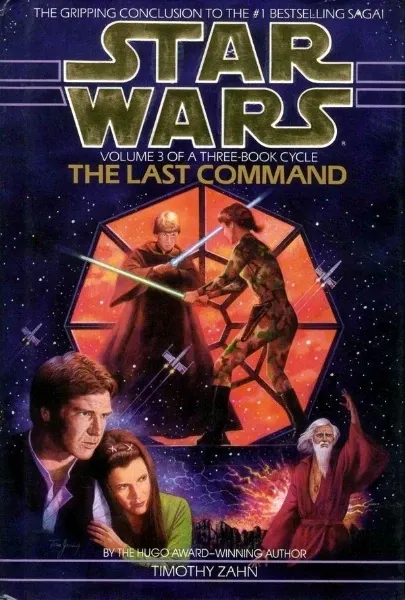
Legends · publishing history
Why the Thrawn Crisis still shapes the canon galaxy
Even though Legends was set aside, the Thrawn trilogy established the template the canon era later reused: an Empire that fragments rather than ends, a republic that governs badly, and a brilliant officer in the Unknown Regions. Reading the trilogy is the fastest way to understand why the Imperial Remnant and First Order feel structurally inevitable.
Reading path
Continue through the Holocron
Six routes through The Astromech’s Star Wars archive, ordered so each one builds on the last.
Route one · Orientation
Get the chronology straight first
Route two · The fall
How a republic is talked into ending itself
Route three · The rebellion
Andor, and the politics of building an alliance
Route four · Mandalore
Creed, crown and the Dark Saber
Route five · Legends
Explore The Astromech’s Thrawn archive
Route six · Craft
How the galaxy was actually made
Editorial images on this page are sourced from the linked Astromech articles and each caption links back to its originating post. The connection markers use two original simplified SVG marks drawn for this feature: an Imperial cog crest for authority imposed downward, and a Rebel starbird for insurgent and formative connections. Node symbols, sector rings and glyphs are likewise original CSS and SVG artwork. Continuity classifications follow current Lucasfilm canon, with Legends material drawn from Timothy Zahn’s Thrawn trilogy and kept on a separate layer.

_poster.jpg)


