
Furiosa: A Mad Max Saga is not only the story of how a stolen child becomes the hard-eyed Praetorian we meet in Mad Max: Fury Road. It is also a study of power. George Miller places Furiosa between two different kinds of monster and lets the Wasteland decide which one can endure. Immortan Joe is empire. Dementus is appetite. Joe builds systems from water, food, fuel, bodies, engines, belief, and fear. Dementus builds movement from grievance, charisma, theatre, and bloodshed. One rules by making people dependent. The other rules by keeping them excited, frightened, and hungry. Their conflict is not a simple villain-versus-villain clash. That would flatten the film. Dementus is not harmless chaos, and Joe is not merely a stronger brute. Dementus is tactically dangerous. He gathers a Horde, invades the Green Place, takes Furiosa, captures Gas Town, ambushes the War Rig, seizes the Bullet Farm, and nearly pulls Joe into a fatal misread. The problem is not that Dementus cannot win. The problem is that his victories decay. He can take, but he cannot keep. Joe’s cruelty lasts because it has structure. That distinction is the dark political engine of Furiosa.

Core conflict
Joe turns scarcity into an empire. Dementus turns grief into motion. Furiosa survives by learning how both systems fail.
Best companion reading
Read this beside the themes of Furiosa, the Immortan Joe character study, and the Mad Max timeline.
Wasteland economy
Water, guzzoline, bullets, blood, bodies, and belief all function as currency in Miller’s ruined world.
The Citadel: How Joe Turns Geography into Empire
Immortan Joe’s power begins with a place. Before he is the god-king of the Citadel, he is a conqueror who understands terrain after the Collapse has turned civilisation into salvage. Having seized the Citadel from roughnecks, Joe recognises its real value with terrifying clarity. It is not just a rock formation. It is not just a fortress. It is a state waiting to be built.
The Citadel gives Joe height. It gives him defence. It gives him fresh water, the rarest and most politically sacred resource in the Wasteland. It gives him enough agricultural capacity to feed a population, or at least feed the parts of that population he chooses to keep useful. It lets him turn scarcity into ceremony. When Joe releases water, he does not simply distribute a resource. He stages dependence. He teaches the people below to look upward. He makes survival feel like grace.
That is the essence of Joe’s rule. He does not merely possess things. He turns possession into hierarchy. Water becomes worship. Food becomes obedience. Engines become state power. The War Boys become both army and cult. The wives become reproductive property. The Organic Mechanic becomes a biological instrument of the regime. Gas Town and the Bullet Farm become organs in a larger body. Joe’s genius, if such a word can be used for something so diseased, is that he knows power must be organised before it can last.
This is why the Citadel matters so much in Furiosa. It is the one place in the Wasteland that seems to have hardened scarcity into architecture. Raiders can roam. Bikers can swarm. Buzzards can ambush. But the Citadel stands. It is vertical in a horizontal world. Everyone else races across the sand. Joe rules from above it.
Immortan Joe: The Tyrant as Administrator
Joe is grotesque, but he is not random. He is theatrical, but his theatre serves a system. The mask, the medals, the white body armour, the War Boy rituals, the promise of Valhalla, the controlled release of water, the breeding program, the careful management of supply routes, all of it forms one machine. He does not want merely to be feared. He wants to be necessary.
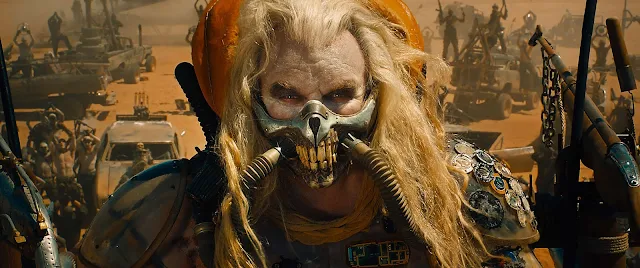
The War Boys reveal the depth of that system. They are soldiers, mechanics, drivers, suicide attackers, religious believers, and expendable labour. Joe turns their sickness into purpose. Their shortened lives become fuel for his mythology. They do not simply fight for him because he commands them. They fight because he has given their suffering a story. That is more durable than fear alone.
Joe also thinks dynastically. His sons, Scrotus and Rictus, are not just family. They are part of the problem of succession. Joe wants continuity in a world that has almost forgotten the future. That obsession connects directly to Fury Road, where the wives become the most precious and most imprisoned figures in his empire. Joe’s regime is built around the control of life itself. Water keeps bodies alive. Fertility keeps the regime imagining tomorrow. In Joe’s mind, both must be owned.
This makes him more dangerous than Dementus in the long term. Dementus can terrify a crowd. Joe can make a population function inside a cage. Dementus turns pain into spectacle. Joe turns pain into administration.
Dementus at the Gates: Performance Meets Fortress Power
Dementus arrives at the Citadel like a man trying to summon history through noise. His Biker Horde swarms the landscape. His rhetoric is grandiose. “Bring me your leaders, and throw them down,” he demands. He imagines himself as the herald of a new Wasteland. He does not ask to be admitted into Joe’s order. He announces that he will replace it.

It is a classic Dementus move. He performs domination before he possesses it. He acts as if the spectacle of his arrival should be enough to bend the world. In open territory, that method has power. A mass of engines, bodies, noise, flags, and threat can overwhelm weaker settlements. The Biker Horde is mobile terror. It can appear, swarm, raid, and vanish.
The Citadel is different. It is not a convoy. It is not a camp. It is not a loose settlement waiting to be frightened. It is a fortress-state. Joe and his lieutenants do not panic because they understand the terrain. Dementus has movement. Joe has position. Dementus has numbers. Joe has elevation, water, defences, and a population trained to believe in the man above them.
The first clash between them therefore becomes a lesson in limits. Dementus is powerful, but his power is horizontal. It rolls, charges, circles, and consumes. Joe’s power is vertical. It waits. It watches. It drops force from above. The Horde can threaten the Citadel, but it cannot simply swallow it.
Dementus: The Warlord of Appetite, Grief, and Motion
Dementus is not a fool. Treating him that way would make the film less interesting. He is a charismatic war leader with a sharp instinct for weakness. He understands how to gather the broken. He knows how to speak to people who have lost everything. His Horde is not only a gang. It is a moving wound. It is made from scavengers, bikers, opportunists, fanatics, and the desperate. They follow him because he gives their hunger a direction.

His grief is central to him. The teddy bear he carries is not a throwaway detail. It suggests a buried life, a lost family, a dead tenderness he cannot put down. Yet he does not turn grief into protection. He turns it into licence. The Wasteland took from him, so he takes from others. His pain becomes a permission structure.
That is why he needs motion. Stillness would force administration. Administration would force responsibility. Responsibility would expose the emptiness beneath his mythology. So Dementus moves. He raids. He performs. He stages public cruelty. He keeps the Horde excited because excitement is the glue holding the thing together.
His leadership works while there is always another prize ahead. A settlement. A convoy. A child. A fuel city. A gun farm. The Citadel itself. But a society cannot live forever on the promise of the next seizure. Eventually somebody has to feed people, repair machines, manage production, settle disputes, maintain alliances, and keep the fuel moving. Dementus can create a storm. He cannot build weather.
The Green Place: Dementus Feeds on the Future
The theft of Furiosa from the Green Place is the film’s primal wound. It is also the first clear sign of what Dementus is. The Green Place is not simply a location. It is an alternative model of survival. It is fertile, hidden, communal, guarded by women, and sustained by knowledge rather than spectacle. It represents the possibility that life after collapse does not have to become Joe’s empire or Dementus’s Horde.
Dementus invades that possibility without understanding it. He sees value, but only in the crudest sense. He steals Furiosa. He destroys the boundary between innocence and Wasteland. He turns a child into leverage, a living proof of his ability to take.
This is the pattern that follows him everywhere. Dementus does not create abundance. He finds it, raids it, and ruins it. He does not plant. He consumes. He does not inherit responsibility from his losses. He converts loss into appetite.
Furiosa’s mother understands the stakes before Furiosa can. Her pursuit is not only maternal love, though it is fiercely that. It is the defence of a future. She knows that if Dementus carries Furiosa fully into the Wasteland, the child will not merely be displaced. She will be translated into the language of property, trade, violence, and use. That is exactly what happens.
Gas Town: The Prize That Gives Dementus Real Leverage
Dementus becomes far more dangerous when he takes Gas Town. Until then, he is a mobile threat pressing against Joe’s system from the outside. Gas Town gives him a fixed resource. It gives him guzzoline. It gives him bargaining power. It makes him part of the Wasteland’s central economy.

Gas Town is one of the vital organs of Joe’s world. The Citadel has water and food. The Bullet Farm has ammunition. Gas Town has fuel. Without fuel, the War Rigs stop. Patrols stop. trade stops. pursuit stops. escape stops. The whole machinery of Wasteland power begins to seize.
By capturing Gas Town from its Guardian, Dementus finally obtains something Joe cannot ignore. His threat to destroy Gas Town if he does not return safely from negotiations is classic Dementus. He turns a resource into a hostage. The supposed explosives and six-figure code may be real, exaggerated, or partly theatrical. The exact mechanics matter less than the method. Dementus negotiates by making everything fragile.
Yet this is also the beginning of his defeat. Taking Gas Town gives him leverage, but it also gives him responsibility. A raider can live off movement. A guardian has to govern. Once Dementus takes the fuel city, he must do more than frighten people. He must keep the place working.
Wasteland Diplomacy: Joe Lowballs the Apocalypse
The negotiation between Dementus and Joe is one of the sharpest scenes in Furiosa because both men reveal themselves without fully saying what they are. Dementus arrives with inflated demands and violent theatre. He wants more than tribute. He wants recognition. He wants Joe to admit that the Horde has become a power equal to the Citadel.
Joe listens.
That is the important detail. Scrotus and Rictus are creatures of impulse. Joe is not. He can rage, but he can also wait. He lets Dementus perform. He lets the threats fill the room. He watches where the lies begin to show.
Furiosa’s denial that she is Dementus’s daughter weakens Dementus in that room. If he is lying about the girl, what else is performance? His claim over her is exposed as another act of possession dressed as intimacy. The Organic Mechanic then accidentally sharpens Joe’s interest by drawing attention to Furiosa’s untouched value. In that moment, the Wasteland economy reveals its full obscenity. A child, a doctor, a fuel city, water, potatoes, bodies, engines, and political survival all become negotiable assets.
Joe gives Dementus less than he wants. That matters. Dementus demands from a position of noise, but Joe bargains from a position of structure. A useful fan reading of the scene is that Joe reads Dementus early, recognises the instability beneath the performance, and gives him enough to contain him rather than enough to make him truly independent.
The result is shrewd. Joe protects the larger economy from immediate destruction. He acquires the Organic Mechanic, whose medical knowledge has obvious value in a world of disease, deformity, injury, and reproductive obsession. He also acquires Furiosa, who will one day become one of the most capable operators inside his system.
Dementus thinks he has forced Joe to bargain. Joe has bought time, extracted assets, and placed Dementus inside a role that will eventually expose him.
Bodies as Capital: Furiosa and the Organic Mechanic
The presence of the Organic Mechanic in the negotiation is not incidental. In Joe’s world, medical skill is power. It is repair, reproduction, diagnosis, extraction, and control. A mechanic fixes machines. The Organic Mechanic fixes bodies, or at least keeps them useful long enough for Joe’s purposes.
That logic is horrifying because it collapses the distinction between person and resource. The same world that counts water, fuel, bullets, engines, and potatoes also counts wombs, bloodlines, milk, deformity, and fertility. Joe’s empire does not merely imprison people. It categorises them.
Furiosa enters that system as stolen potential, and it is the same logic that later makes Fury Road such a direct argument about female captivity and escape. She is a child with a home, a mother, a memory, and a name, but Joe’s world sees another set of values. Biological value. Political value. Future labour. Future leverage. Her captivity begins in the same logic that later traps the wives in Fury Road. Joe wants heirs and continuity. He wants the future made private.
This is why Furiosa’s later rebellion cuts so deeply. When she helps the wives escape, she is not merely betraying a boss. She is attacking the reproductive centre of Joe’s empire. She is smuggling the future out of the cage.
Fifteen Years Later: Dementus Has Time to Prove Himself
The fifteen-year gap is crucial, especially when read beside the wider Mad Max timeline. It prevents the essay from treating Dementus’s failure as a sudden mistake. He has time. He has Gas Town. He has status. He has a place inside the Wasteland’s power structure. He has the remnants of a Horde that once shook the Citadel. If his model of rule can work, this is where it should prove itself.
It does not.
As Guardian of Gas Town, Dementus becomes the very thing his nature cannot sustain: a ruler of a fixed resource. His people grow dissatisfied. The place becomes unstable. The Mortiflyers defect under the Octoboss and become robbers on the Fury Road. That fracture is not just a side detail. It is political evidence. Dementus’s charisma has a shelf life.
Joe’s War Boys are indoctrinated into an entire system. Their loyalty is tied to ritual, afterlife, rank, machinery, and identity. Dementus’s followers are bound to the man himself, to momentum, to reward, to grievance, to the promise that the next act of violence will make everything feel meaningful. Once conquest becomes administration, that bond weakens.
Gas Town therefore becomes the proof of the whole argument. Dementus did not fail because he could not capture a resource. He failed because he could not keep a resource functioning without turning every problem into another performance of blame.
The Gas Town Riot: The Supply Chain Starts to Scream
When Praetorian Jack and Furiosa arrive at Gas Town in the War Rig to exchange food for guzzoline, the scene should feel like routine Wasteland commerce. It does not. It erupts into disorder. A riot breaks out. Dementus is no longer the triumphant conqueror of the fuel city. He is the failing guardian of a system he cannot stabilise.
The exchange itself matters. Food moves one way. Fuel moves the other. The War Rig is not simply a truck. It is the artery between the Citadel’s resources and the other nodes of power. If Gas Town cannot reliably supply guzzoline, the whole Wasteland order trembles.
The Bullet Farmer’s irritation with Dementus makes sense in this context. Dementus is not merely an annoying rival. He is a bad administrator whose incompetence threatens everyone else’s interests. A fuel crisis becomes a military crisis. A military crisis becomes a political crisis. Personal failure becomes geopolitical danger.
This is the difference between madness and misrule. Dementus can behave wildly and still survive as a raider. But as Guardian of Gas Town, his habits become everybody’s problem. He blames others for crises caused by his own failure. He cannot accept that ruling a resource means being responsible for what happens to it.
The Warlord Council: When One Bad Ruler Threatens the Whole Economy
The call for a warlord council shows how fragile Joe’s wider order really is. The Citadel, Gas Town, and Bullet Farm depend on each other. Water, food, fuel, and ammunition form a brutal triangle of survival. None of these places can exist in pure isolation if they want to project power beyond their own walls.
Dementus’s failure at Gas Town therefore forces the other warlords to respond. The People Eater’s presence in this world always reminds us that Miller’s apocalypse is economic as much as violent. Somebody is counting. Somebody is measuring loss, yield, cost, waste, and exchange. The Wasteland may look insane, but its rulers know scarcity has arithmetic, a logic that runs all the way back through The Collapse.
Scrotus and Rictus respond like blunt instruments. They rage because that is what they know how to do. Joe, by contrast, listens when listening serves power. That is one of the film’s coldest insights into him. He is not wise in any moral sense. He is strategically patient. He can suppress ego when useful information enters the room.
That patience is what Dementus lacks. Dementus needs the world to keep becoming theatre. Joe is content for the world to become a ledger, a prison, a route map, a breeding program, a water valve, a war plan.
The Bullet Farm Gambit: Dementus Is Still Dangerous
Dementus’s plan to seize the Bullet Farm is clever. The essay should not pretend otherwise. He exploits the warlord council. He takes advantage of the Bullet Farmer’s temporary absence. He captures the place with speed and force. He aims to manipulate Joe and the Bullet Farmer out of position, then turn again toward the Citadel.
This is Dementus at his most revealing. He is failing at Gas Town, so he reaches for another conquest. His solution to broken governance is expansion. He cannot repair the fuel city, so he tries to seize the gun city. He cannot make his existing prize stable, so he seeks a larger one.
That is not stupidity. It is addiction. Dementus needs the next dramatic seizure because conquest is the only form of power that still makes sense to him. Taking the Bullet Farm briefly restores his identity. He can be the warlord again. The man on the move. The author of shock. The breaker of systems.
But once again, the flaw remains. He can take the Bullet Farm. Could he hold it? Could he integrate it? Could he repair the relationships his move destroys? Could he turn guns, fuel, and people into a functioning order? The film’s answer is already written in Gas Town’s smoke.
Jack and Furiosa: The Praetorians Who Break the Trap Open
Praetorian Jack and Furiosa are not incidental to the Joe-Dementus conflict. They are the people who expose the plan before it matures. They are the moving intelligence of Joe’s empire, even as Furiosa’s deeper loyalty remains with a stolen past Joe can never own.
At the Bullet Farm, Jack and Furiosa arrive in the War Rig and discover the trap. They are caught in the violence of Dementus’s plan. The War Rig is lost. Furiosa’s skill as a sharpshooter and survivor keeps them alive longer than they should be. Their attempted escape turns into one of the film’s most punishing sequences, with pursuit, capture, and the destruction of what little hope Furiosa has allowed herself to trust.
Jack’s death is crucial. Dementus has Furiosa’s mother killed earlier in her life. Now he takes Jack too. He is not merely a political rival to Joe. He is the recurring instrument by which Furiosa’s possible futures are destroyed. Mother. Home. Mentor. Lover. Partner. Escape. Again and again, Dementus stands at the point where a future closes.
Furiosa’s escape by cutting off her own left arm is not simply an origin detail explaining her appearance in Fury Road. It is the moment her body becomes a record of Wasteland politics. The war between Joe and Dementus is carved into her. She survives by mutilating herself free from the man who has been stealing her life since childhood.
Furiosa Returns to the Citadel: The Stolen Child Becomes Intelligence
When Furiosa returns to the Citadel, wounded and missing her arm, she is no longer only the stolen girl from the Green Place. She is not merely a captive who endured. She is becoming the operator we know from Fury Road: hard, precise, unsentimental, and capable of moving inside systems without being fully absorbed by them.
She brings information. She tells Joe and his lieutenants what Dementus is planning. Scrotus and Rictus react with anger, but Joe keeps his head. Again, this does not redeem him. It condemns him in a more interesting way. Joe can listen when the information is useful. His sons embody brute inheritance. Joe embodies strategic tyranny.
This scene also marks a change in Furiosa’s value within Joe’s world. Earlier, she is valuable as a stolen child, as possible biological capital, as something Joe’s system can classify and use. Now she is operationally valuable. She has seen the enemy’s plan. She understands the roads. She has survived an encounter that killed Jack. She has become a person whose knowledge can alter the fate of the Citadel.
That is bleak, because Joe recognises value only through use. But it is also the beginning of Furiosa’s long advantage. She learns that Joe’s empire runs on information as much as water and fuel. To destroy the machine later, she must first understand how it thinks.
Joe’s Counter-Bluff: The Strategist Beats the Performer
Joe’s response to Furiosa’s warning is the payoff to the entire political conflict. Dementus has spent the film using spectacle, threat, deception, and hostage logic. At the decisive moment, Joe uses deception too, but with colder discipline.
He pretends to move toward Gas Town with a limited force. He gives Dementus the picture Dementus wants to see. Dementus believes the Citadel is being emptied or weakened. He attacks. Joe has turned Dementus’s appetite against him.
The difference is not that Joe is honest and Dementus is deceptive. Both men are deceptive. The difference is that Joe’s deception serves a structure. It is tied to timing, command, defensive knowledge, and the preservation of his empire. Dementus’s deception serves drama. Joe’s serves control.
That is why Joe wins the strategic contest. He has studied Dementus long enough to understand the pattern. Dementus wants the big move. The reversal. The humiliation of rivals. The legend-making strike. Joe gives him the outline of that fantasy and lets him ride into it.
The Forty-Day Wasteland War: Logistics Beat Appetite
The Forty-Day Wasteland War is the historical judgement passed on Dementus’s model of power. It is not a glorious war. It is not noble. It is the Wasteland turning failed politics into mass death.
By this point, Dementus has made himself impossible to contain through bargain alone. Gas Town has decayed under him. The Mortiflyers have gone rogue. The Bullet Farm has been seized. Jack is dead. Furiosa has been maimed. The Citadel itself has been targeted. War becomes the final arithmetic of his misrule.
Dementus remains dangerous. That has to stay clear. A weak fool does not produce a forty-day war. His Horde still has force. His tactics still create damage. He has enough men, machines, and violence to make the conflict long and bloody.
But Joe has the more durable machine. The War Boys are indoctrinated. The Citadel has command structure. The resource network, strained though it is, still has a logic Dementus never mastered. Joe’s forces can absorb pressure because they are part of an institution. Dementus’s Horde can inflict pressure, but it cannot survive the consequences of its own appetite.
The war wipes out the overwhelming majority of Dementus’s followers. He survives with only remnants. His movement, once vast enough to threaten the Citadel, is reduced to scattered bodies, fleeing lieutenants, and mythic debris.
The Wasteland does not reward the loudest monster. It rewards the monster who can keep engines, soldiers, food, fuel, ammunition, belief, and command functioning after the first charge fails.
After the War: Dementus Without a Horde
After the Forty-Day War, Dementus becomes smaller. That is important. He began as a figure of scale: a warlord with a Horde, a voice, a following, a cloud of bikes and dust around him. After defeat, the pageantry falls away.
He flees into the Wasteland with only a few survivors. The Smeg disguises himself as Dementus and is killed by Furiosa. Rizzdale Pell meets execution at the hands of the Buzzards. The remnants scatter. The legend breaks into scraps.
This is the collapse of performance. Dementus without the Horde is still capable of speech, manipulation, and cruelty, but the world around him no longer amplifies him. No crowd. No army. No fuel city. No council. No grand bargain. No mass of engines to turn his pain into weather.
He is reduced to a man on a bike trying to escape the consequences of a life spent turning other people’s losses into spectacle.
Furiosa’s Hunt: Removing Motion, Water, and Violence
Furiosa’s pursuit of Dementus after the war works because it becomes smaller than the war and more exacting. The epic scale drops away. What remains is memory chasing the man who tried to turn memory into dust.
She ambushes him after a desert storm. She takes his water. She removes one of the wheels from his bike. She takes his ammunition.
The symbolism is almost surgical. She strips him of the three things that defined his power.
Water: survival.
Wheel: motion.
Ammunition: violence.
Dementus lived by movement, threat, and appetite. Furiosa removes each one before forcing him into confrontation. She does not simply catch him. She dismantles the physical logic of his life.
The Final Confrontation: Dementus Cannot Give Back What He Took
The final confrontation between Furiosa and Dementus is not satisfying in the ordinary revenge-movie sense, and that is why it works. Furiosa wants something impossible. She wants him to give back the lives he took. Her mother. Her childhood. Her home. Jack. Her arm. Her years. The self she might have become if the Wasteland had not reached into the Green Place and dragged her out.
Dementus cannot give any of it back. Worse, at first he barely recognises her. That detail is devastating. Her entire life has been bent around the wound he made, but to him she is one victim among too many. He remembers her more clearly as the woman who ruined his Bullet Farm plan than as the child he stole.
That is the obscenity of his violence. It is intimate to the victim and almost administrative to the perpetrator. Furiosa’s life is defined by him. His life has room to forget her.
When she beats him and demands restoration, Dementus offers philosophy instead. He tells her she is not unique in pain. He too lost people. He too was broken by the Wasteland. He cannot give her justice. He cannot give her catharsis. He will not beg in the way she might want him to beg.
This is his final argument: pain cancels meaning. Everyone suffers, so no one is owed anything. The Wasteland takes from all, so cruelty becomes ordinary. If Furiosa accepts that, then Dementus wins something even in defeat. He makes her pain part of his worldview.
She refuses.
The Teddy Bear and “Little D”: Recognition Comes Too Late
The teddy bear brings memory back into the scene. When Furiosa picks it up, Dementus finally recognises her as “Little D.” It is too late for recognition to become remorse. Instead, he turns it into another performance.
He is amazed by what she has become. He tries to claim kinship with her. In his telling, they are alike. Both lost what they loved. Both were changed by the Wasteland. Both became creatures of violence. It is a seductive argument because there is a partial truth inside it. Furiosa has been changed. She has become capable of brutality, deception, endurance, and vengeance.
But Dementus wants to erase the difference between being wounded and becoming empty. He wants Furiosa to see herself as his heir. He offers her legend. He asks her to make his end “epic.” Even at the edge of defeat, he is directing the scene. He wants a final spectacle. A death large enough to preserve the myth of Dementus.
Furiosa’s deepest victory is that she denies him the kind of story he wants.
The Fate of Dementus: The Peach Tree as Mythic Punishment
Dementus’s fate is presented through competing versions, and the most powerful one is the History Man’s account: Furiosa takes away his voice, plants her mother’s peach seed in his living body, and lets him become food for a tree.
That ending is not only cruel. It is exact.
Dementus consumed futures. Now his body feeds one.
He stole Furiosa from a fertile place. Now the last trace of that place grows through him.
He lived by movement. Now he is rooted.
He lived by speech. Now he is silenced.
He wanted an epic death. Furiosa gives him a slow, humiliating usefulness.
The peach tree image also connects the end of Furiosa to the beginning of Fury Road. The fruit is not just food. It is memory made flesh. It is proof that the Green Place still exists in some form, even if only as a seed carried through hell. Furiosa cannot recover her childhood. She cannot resurrect her mother. She cannot bring Jack back. But she can force life to grow out of the man who made himself an agent of ruin.
That is not mercy. It is not simple revenge either. It is anti-Dementus myth. He wanted pain to become spectacle. Furiosa makes pain become cultivation.
Furiosa Between Joe and Dementus
By the end of Furiosa, the title character has learned from both monsters without fully becoming either one.
From Dementus, she learns what rage looks like when it has no discipline. She sees grief become theatre. She sees charisma rot into blame. She sees conquest collapse into misrule. She sees a man who cannot stop turning pain into permission.
From Joe, she learns something colder. She learns how oppression becomes infrastructure. She learns that prisons are not built only from chains. They are built from water rights, supply routes, religious stories, reproductive control, military hierarchy, and routine. Joe teaches her, without meaning to, that power is most dangerous when it becomes ordinary.
From Jack, she learns a third thing. Skill does not have to serve domination. Trust can exist in the Wasteland, even briefly. Competence can be protective rather than predatory. Jack’s death nearly destroys that lesson, but it does not erase it.
From her mother and the Green Place, Furiosa carries the oldest lesson of all: the world was not always this. Somewhere beneath the engines, cages, guns, and dust, there remains the memory of a life organised around care, food, protection, and continuity.
Fury Road: The Prison Break Inside Joe’s Machine
This is why Fury Road becomes more powerful after Furiosa. By the time we meet Imperator Furiosa in the later chronology, she is not simply a skilled driver with a secret plan. She is the long result of everything Joe and Dementus taught her.
She understands the War Rig because she has lived inside the logistics of empire. She understands Joe’s routines. She understands the value he places on the wives. She understands how the War Boys think. She understands fuel, timing, pursuit, terrain, and deception. She understands that escape is not an emotion. It is an operation.
She also understands Dementus’s failure. Rage alone will not free anyone. Spectacle alone will not build a future. Burning the world down is not the same as escaping it. That is why her rebellion in Fury Road is so disciplined. It is not a tantrum against Joe. It is a planned extraction of the future from the man who tried to own it.
Joe wins the Forty-Day Wasteland War because he understands systems better than Dementus. Furiosa later defeats Joe because she understands his system from the inside and still remembers something beyond it.
Conclusion: Joe Wins the War, Furiosa Wins the Future
Immortan Joe and Dementus are both monsters, but they are not the same kind of monster. Dementus is the Wasteland as appetite: wounded, theatrical, mobile, clever, hungry, and finally self-consuming. Joe is the Wasteland as empire: organised, ritualised, reproductive, logistical, and enduring. Dementus turns pain into spectacle. Joe turns scarcity into law.
That is why Joe defeats him. Not because Dementus is harmless. Not because Dementus lacks cunning. Joe wins because he understands that power in the Wasteland is not the act of taking. It is the art of keeping. Gas Town proves it. The Bullet Farm gambit confirms it. The Forty-Day Wasteland War writes it into history.
But the film does not end by crowning Joe as the final answer to the Wasteland. It ends by showing that Furiosa has learned the lessons of both men and rejected the soul of each. Dementus teaches her what empty rage costs. Joe teaches her how prisons work. Jack teaches her that trust can survive long enough to matter. Her mother gives her the seed.
Dementus can burn through the world and call the smoke a kingdom. Joe can build a prison from water, fuel, faith, flesh, and fear. Furiosa survives them both because she carries something neither man can truly understand: the memory of life beyond domination, and the patience to turn that memory into revolt.


_poster.jpg)


