05 December 2023

The character arc of Joel Barish in Eternal Sunshine of the Spotless Mind

"Eternal Sunshine of the Spotless Mind," directed by Michel Gondry and written by Charlie Kaufman, stands as a profound exploration of human emotion and memory. Central to this narrative is Joel Barish, portrayed by Jim Carrey, whose character arc is pivotal in conveying the film's themes. Joel's journey through the film can be dissected into various stages, each marked by significant events and internal transformations.

Focusing on Joel Barish, portrayed by Jim Carrey, we delve into a character arc that is as complex as it is emotionally resonant, painting a picture of love, memory, and identity.

joel barrish eternal sunshine spotless mind character arc

Initial Depiction: The Reserved and Contemplative Joel

Joel's journey begins with him as a reserved, introspective individual. He's portrayed as somewhat withdrawn, reflective, and hesitant in social interactions. This is evident from the opening scenes where Joel impulsively decides to skip work and take a train to Montauk. His introverted nature is juxtaposed against the vibrant and extroverted Clementine, setting the stage for their contrasting personalities.

The Unfolding Romance and Emotional Awakening

As Joel's relationship with Clementine progresses, there's a noticeable shift in his demeanor. He starts to open up, revealing his vulnerabilities and desires. Scenes like their initial conversation on the train and their impromptu trip to the frozen Charles River showcase Joel’s gradual emotional awakening. He begins to embrace spontaneity and joy, qualities he finds in Clementine, and this reflects a significant shift from his initial reserved nature.

The Erasure Process: Reliving and Reassessing Memories

The central narrative twist, where Joel chooses to erase his memories of Clementine, serves as a pivotal point in his character arc. During the memory erasure process, Joel revisits their shared moments, both good and bad. This retrospection is crucial as Joel, submerged in his subconscious, starts to recognize the value of even the painful memories. Scenes like their last memory at the beach house, where he desperately tries to hold onto the memory of Clementine, highlight his growing realization of the significance of their relationship.

The Revelation: Embracing Imperfection and Complexity


As the erasure procedure reaches its end, Joel’s character reaches a profound revelation. He understands that love isn't just about the joyous moments but also about the struggles and conflicts. This is symbolized in the fragmented, chaotic memories that he tries to preserve. The realization that love and memory are inherently flawed yet beautiful in their imperfection marks the zenith of his emotional maturity.

Post-Erasure: A More Open, Accepting Joel

The film concludes with Joel and Clementine, having met again post-memory erasure, deciding to give their relationship another chance despite knowing its potential flaws and eventual demise. This decision by Joel symbolizes a significant transformation from the man who initially sought to erase his painful memories. He accepts the complexities of relationships and life, choosing to embrace the unpredictable nature of love.

In essence, Joel's character arc in "Eternal Sunshine of the Spotless Mind" is a profound exploration of human emotions and relationships. It underscores the idea that memories, both joyous and painful, shape our identities and our connections with others. Joel's journey from a reserved, solitary individual to someone who accepts and embraces the complexities of life and love is a testament to the film's deep engagement with themes of love, memory, and identity.

List of passwords to open Dumbledore's office in the Harry Potter novels

A Guide to Dumbledore's Office Passwords

Albus Dumbledore, one of the most complex and beloved characters in the Harry Potter series, is a study in contrasts. As the wise and powerful headmaster of Hogwarts, he is a figure of immense authority and gravity. Yet, beneath this imposing exterior lies a whimsical, fun-loving personality, brought to life through his choice of office passwords. These seemingly trivial details reveal a great deal about Dumbledore’s character, offering a glimpse of his lighthearted humor and deep appreciation for life’s simple pleasures, even in the face of great danger.

The use of confectionery-themed passwords, ranging from the Muggle favorite “Sherbet Lemon” to magical sweets like “Acid Pops,” reflects Dumbledore’s enduring curiosity and his penchant for blending the ordinary with the extraordinary. This quirk ties into his broader personality, an eccentric genius who values love, laughter, and joy as much as wisdom and intellect.

List of passwords to open Dumbledore's office in the Harry Potter novels

The Passwords by Book

A chronological look at the sweet and silly passwords used to access the Headmaster's office.

Sherbet LemonFrom: Harry Potter and the Chamber of Secrets


The first password, “Sherbet Lemon,” introduces Dumbledore’s fondness for Muggle sweets, a detail that underscores his curiosity and respect for the non-magical world. It sets a precedent for the playful tone of his passwords, linking his office to an air of approachable mystery rather than imposing authority.

Lore Note: For the American edition of the book, the password was changed to "Lemon Drop" to better resonate with US readers, a common localization practice used throughout the series for cultural references.

Acid PopsFrom: Harry Potter and the Prisoner of Azkaban


This password shifts to a distinctly wizarding confection, aligning with the expanding magical world presented in the third book. The sharp, mischievous nature of Acid Pops adds a playful edge to Dumbledore's character, showing he enjoys magical jokes as much as Muggle candy.

Lore Note: Acid Pops are a popular wizarding sweet known for burning a hole through the tongue of the consumer. This suggests Dumbledore enjoys a bit of harmless, albeit painful, fun.

Cockroach Cluster & Fizzing WhizbeesFrom: Harry Potter and the Goblet of Fire


These two passwords inject humor through their juxtaposition of appetizing and odd. "Cockroach Cluster" in particular is met with amusing reactions, deepening the charm of Dumbledore’s otherwise lofty position. "Fizzing Whizbees" are levitating sherbet balls, adding another layer of magical whimsy.

Lore Note: While Cockroach Clusters are shaped like cockroaches, it is debated among fans whether they are made of actual cockroaches or are simply a cleverly named sweet, much like their Muggle counterpart, "gummy worms."

Toffee EclairsFrom: Harry Potter and the Half-Blood Prince


The choice of "Toffee Eclairs" continues the sweet theme but feels slightly more conventional and sophisticated, mirroring the increasingly serious tone of the story. It is a subtle shift from the more bizarre candies of previous years, reflecting the darkening times as the wizarding world heads toward open war.

Lore Note: Unlike many of his other password choices, toffee eclairs are a real-world pastry popular in both the UK and France, suggesting a return to more grounded, simple pleasures for Dumbledore.

A Notable SilenceFrom: Order of the Phoenix & Deathly Hallows


No passwords are mentioned in these final books. In Order of the Phoenix, Dumbledore’s estrangement from Harry and his deep involvement in the fight against Voldemort likely explains the omission. By Deathly Hallows, the narrative’s focus on the climactic battle overshadows such details, with Dumbledore’s office instead symbolizing legacy and sacrifice.

Lore Note: In the absence of a password, access to the office is granted by the gargoyle sentry recognizing the visitor's intent or authority, as seen when Professor McGonagall takes command after Dumbledore's death.
04 December 2023

Who plays Immortan Joe in the Furiosa: A Mad Max Saga prequel film?Lachy Hulme

Keays-Byrne has passed away so who is to play Immortan Joe in the prequel saga film?

Enter...

Lachy Hulme.

The "Mad Max" franchise, known for its dystopian themes, V8 engines, and riveting characters, continues to expand its universe with the upcoming prequel, "Furiosa: A Mad Max Saga." This film delves into the backstory of one of its most enigmatic characters, Immortan Joe.

Originally portrayed by Hugh Keays-Byrne in "Mad Max: Fury Road," Immortan Joe stands out as a formidable villain. His character, ruling with an iron fist, embodies the ruthless nature of a post-apocalyptic warlord. 

Keays-Byrne's portrayal brought a chilling depth to the character, making him a memorable antagonist in the "Mad Max" series and his contribution to the cult film will be long remembered. His influence extends beyond physical dominance, deeply intertwining with the societal and cultural aspects of the film's universe.

In "Furiosa: A Mad Max Saga," actor Lachy Hulme steps into the role of Immortan Joe.

Hulme’s ability to imbue his characters with a palpable sense of realism and complexity makes him an ideal choice to explore the earlier life of Immortan Joe.

Adding to the star-studded cast, Chris Hemsworth plays the character of Dementus, a violent and charismatic warlord. Hemsworth, known for his roles in the Marvel Cinematic Universe, brings a formidable presence to the film. His portrayal of Dementus, juxtaposed with Burke's Immortan Joe, sets the stage for a gripping narrative in the harsh landscape of the wasteland.

03 December 2023

Exploring the Role of the Tribe of Children in 'Mad Max' Thunderdome

The presence of the Tribe of Children in "Mad Max Beyond Thunderdome" is a significant narrative element, serving as a symbol of the enduring qualities of humanity and a beacon of hope for the future. This discussion will explore how these children represent the potential for a better, more humane society in the desolate world of Mad Max.

The Tribe of Children, discovered by Max in the Oasis, starkly contrasts the brutal, survivalist world outside. Their innocence is immediately apparent; they have been shielded from the full extent of the world's savagery.

This innocence is a poignant reminder of the inherent goodness and purity that can exist in humanity, qualities often overshadowed by the harsh realities of the post-apocalyptic world. The children's lifestyle, stories, and beliefs symbolize a humanity untainted by the corruption and moral decay seen in places like Bartertown.

tribe children mad max

The children represent hope and the possibility of renewal in a world ravaged by destruction. Their existence is a testament to the resilience of life and the potential for rebuilding society. They embody the idea that even in the most desolate of circumstances, there is a chance for a new beginning. Their eagerness to learn from Max and their belief in a better place beyond the wasteland further illustrate this sense of hope. In a world where despair is commonplace, the children’s optimism and belief in a brighter future offer a stark contrast.

Despite their isolation, the Tribe of Children has preserved a form of history and culture through their oral traditions and artifacts. Their interpretation of the past, though mythical and fragmented, shows a dedication to remembering and learning from the old world. This preservation is crucial as it suggests that the rebuilding of society requires a connection to the past, no matter how distorted it may become over time. The children, in this regard, are the keepers of humanity's legacy, ensuring that the knowledge and stories of the past are not entirely lost.

The narrative strongly suggests that these children are the seeds of a future society. Their ability to work together, their sense of community, and their resourcefulness are all qualities essential for rebuilding a broken world. Unlike the adults in Bartertown who are often driven by selfishness and power, the children exhibit cooperation, compassion, and a sense of shared responsibility. These qualities make them ideal candidates to foster a new, more humane society.

Max’s interaction with the Tribe of Children is crucial.

He initially serves as a reluctant messiah figure for them, but his role evolves into that of a teacher and protector. Through Max, the children learn about the realities of the world outside their oasis. This knowledge is essential for their survival and growth. Max's influence helps prepare them to face the challenges of the outside world, ensuring that when they do venture out, they carry with them the values and lessons that could lay the foundation for a better society.

In "Mad Max Beyond Thunderdome," the Tribe of Children stands as a powerful symbol of the innate goodness in humanity and the potential for a future society that contrasts the prevailing bleakness and barbarity. Their existence in the narrative is not just a plot device but a thematic exploration of hope, innocence, and the enduring qualities necessary for the rebirth of a compassionate and cooperative society.
They embody the idea that even in the darkest of times, there is a light of hope and the possibility of a new beginning.

The thematic resonance of Two Men Enter, One Man Leaves concept from Mad Max: Beyond Thunderdome

"Mad Max 3: Beyond Thunderdome," the third installment in George Miller's groundbreaking Mad Max series, catapults the audience into a desolate post-apocalyptic landscape where humanity clings to survival by any means necessary. Set in a world where civilization has collapsed, the film introduces Bartertown, a hub of commerce and crude justice, governed by the iron-willed Aunty Entity (Tina Turner). 

In this chapter, Max Rockatansky, the archetypal lone wanderer, finds himself entangled in the internal politics and power struggles of Bartertown, leading to his inevitable confrontation in the Thunderdome, a gladiatorial arena where disputes are settled in a most barbaric fashion.
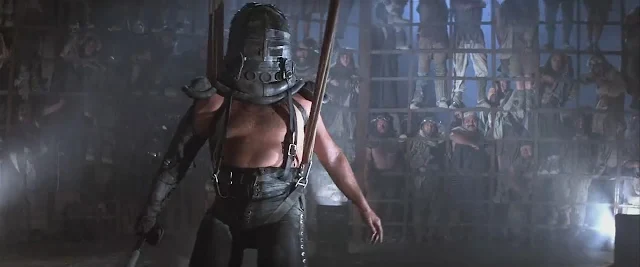
master blaster thunderdome two men enter
Master Blaster

Exploration of the 'Two Men Enter, One Man Leaves' Concept

At the heart of Bartertown's law and order lies the Thunderdome, an arena encapsulating the raw, unadorned ethos of this new world: "Two Men Enter, One Man Leaves." This phrase, chanted by the bloodthirsty crowd, succinctly summarizes the Thunderdome's brutal rule of combat. The combatants are bound by bungee-like cords to the dome’s structure, turning their fight into a grotesque ballet of survival. 

This simplistic yet ruthless dictum governs not only the Thunderdome but also serves as a metaphor for the world outside it. In a landscape stripped of complexity and nuance, the Thunderdome's rule distills conflict resolution to its most primal form: a fight to the death, where only the strongest or the most cunning survive.

two men enter one man leaves

Symbolic Significance of the Thunderdome Battles

The Thunderdome, more than a mere setting for gladiatorial combat, symbolizes the ethos of the world that "Mad Max 3: Beyond Thunderdome" inhabits. It is a microcosm of a society that has regressed to a primitive state, where might makes right, and justice is dispensed through sheer brute force. 

The battles within the Thunderdome transcend physical confrontations; they are a stark representation of the struggle for power, authority, and survival that permeates every aspect of life in this dystopian world. 

The societal and cultural implications are profound – in a civilization where traditional institutions have crumbled, the Thunderdome offers a semblance of order and justice, albeit a deeply flawed one. It reflects the desperation and moral decay of a society clinging to any form of governance, even if it means reverting to primal, gladiatorial conflict.

Thematic Resonance in "Mad Max 3: Beyond Thunderdome"

Survival in a Lawless World

In "Mad Max 3: Beyond Thunderdome," the concept of survival is not merely limited to physical endurance but extends into the psychological and moral realms. The Thunderdome's dictum "Two Men Enter, One Man Leaves" encapsulates the essence of this survival. For instance, when Max is thrust into the Thunderdome to settle a dispute, the fight isn't just about physical dominance; it's a struggle to maintain his humanity in a world that constantly threatens to strip it away. 

This scene demonstrates how survival often requires more than brute strength; it demands cunning, adaptability, and a keen understanding of the human psyche.

Power Dynamics and Justice

The Thunderdome serves as a literal and metaphorical arena where power dynamics are visibly played out. Aunty Entity, the ruler of Bartertown, uses the Thunderdome as a tool to maintain her power, demonstrating a Machiavellian understanding of spectacle and control. 

When she manipulates Max into fighting in the Thunderdome, it's a calculated move to eliminate a political threat under the guise of traditional justice. This manipulation highlights the perversion of justice in a world where laws are replaced by the rule of the strongest or the most cunning. The Thunderdome, therefore, becomes a symbol of perverted justice, where fairness is overshadowed by the will of those in power.

master blaster child smile thunderdome


Moral Complexity and Ethical Dilemmas

The film also delves into moral complexity, particularly through Max's character. His initial reluctance to fight in the Thunderdome, followed by his strategic maneuvering during the battle, showcases his struggle to retain his moral compass in a world that rewards ruthlessness. This internal conflict is vividly illustrated during his fight with Blaster. 

When Max realizes Blaster's childlike mentality, he is visibly torn between the necessity to survive and his own sense of morality. This moment in the Thunderdome stands as a poignant example of the ethical dilemmas faced by individuals in a world where traditional moral frameworks have collapsed.

Redefining Heroism

"Mad Max 3: Beyond Thunderdome" redefines the concept of heroism. Max is not a traditional hero; he is a man thrust into extraordinary circumstances, making decisions that are often morally ambiguous. His participation in the Thunderdome is not driven by a desire for glory or victory but by a need to navigate the complexities of a world gone mad. This reluctant heroism is a stark contrast to the archetypal heroes of traditional cinema, offering a more nuanced and realistic portrayal of what it means to be a hero in a dystopian world.

-

While the Thunderdome represents the primal and barbaric aspect of the film's world, it is contrasted by other elements that depict hope, community, and redemption. After his ordeal in the Thunderdome and subsequent exile, Max encounters a tribe of children in an oasis, symbolizing innocence and hope. This contrast highlights the film’s underlying message - even in the bleakest of circumstances, there is a potential for goodness and rebuilding. 

The children’s community, with its myths and aspirations for a better world, stands in stark opposition to the cynical, survival-driven ethos of Bartertown. This juxtaposition enriches the film’s narrative, illustrating that in a world as diverse and complex as Miller’s creation, there are multiple ways to navigate and survive beyond sheer brute force and tyranny.

The concept of "Two Men Enter, One Man Leaves" in "Mad Max 3: Beyond Thunderdome" is a masterful blend of literal and metaphorical storytelling. It serves as a powerful narrative device that drives the film’s plot while also encapsulating its central themes of survival, power dynamics, and moral complexity. This concept not only defines the Thunderdome itself but also symbolizes the broader world of the Mad Max saga, a world where the struggle for survival often overrides moral considerations. 

The film's exploration of these themes, contrasted with elements of hope and redemption, offers a multifaceted view of a post-apocalyptic society. "Beyond Thunderdome" thus stands as a pivotal chapter in the Mad Max series, one that challenges viewers to reflect on the nature of humanity and society in the face of utter desolation.

Star Wars Yellow Crawl Text Generator ideas + font style guide

The iconic yellow Star Wars font that crawls up the screen at the beginning of each saga film is a key part of Star Wars. Aped and re-shaped, it's as much a part of popular culture as light sabers and references to Toche Station.

And so, you might be looking for a way to generate your own Star Wars text?

We've got some ways and places you can check to make your own Star Wars font!

Whilst many sites offer free online or downloadable tools, Font Meme allows you to generate your own text with yellow on black background:

no i am your father


Font Generator has the same ability, with a wide selection of fonts to choose from including the StarJedi font which is pretty popular. Font space also has a handy translater.


A handy tip when using these generators is to use lower case lettering. If you use upper case letters, the generators will not produce the desired text correctly.
 
the original star wars crawl font


What about an Aubresh translater?

Many a keen Star Wars fan will know that Aubresh is the name for the Star Wars alphabet language that can be found through the far away galaxy and those same fans love to translate what it says when found in the films...

Lingojam has a very handy 'English to Aubresh' translator:

No, I am your father!

What is the Star Wars font in Canva? 

Canva is a SUPER POPULAR online graphic tool that you can use to make the Star Wars font.

Cubao Wide is a sans-serif style font that seems to be a fairly close match to StarJedi. You could also try using the Nourd Bold font with the hollowed-out text effect. Have a play around with Canva's templates, they have a massive variety of design styles. 

What is the color code for the Star Wars crawl text?

The color scheme for the yellow Star Wars crawl pallete with the Hex & RGB Codes is 2 colors which are Banana Yellow (#FFE81F) and Black (#000000).

star wars font color code yellow black

What is the font name for the blue "A long time ago in a galaxy far, far away...."?

Originally this typeface was prepared by hand. We've seen it referred to as Star Jedi (!?). The sequels used a digitized font version known as the Franklin Demi.

What is the font for the Mandalorian TV show called?

Created for the show, it's known as Mandalore. Which is kind of fitting...

Fun Facts about the Star Wars crawl + font!

Themes of Thunder City from Mortal Engines by Philip Reeve

The world of Philip Reeve’s Mortal Engines—scarred by the apocalypse known as the Sixty Minute War and dominated by colossal, rolling cities locked in endless predation—has haunted readers with its relentless, mechanized brutality and poignant humanity for over two decades. Now, with Thunder City, Reeve invites readers to witness a critical era that shapes the bleak yet vibrant tapestry of Municipal Darwinism: the so-called “Golden Age of Traction.” 

It’s a time when the elaborate rituals of city hunting retain at least a veneer of civility, masking a savagery that simmers just below the surface. Traction cities still roam hungrily across the ravaged landscape, their engines roaring as they chase down prey, but there’s a trace of honor, a fleeting nod to fair play soon to vanish completely.

Yet beneath these civil façades lies the eternal paradox of progress, a theme that Thunder City explores relentlessly.

 The marvels of traction technology—the massive engines, intricate gears, and towering upper tiers—are celebrated achievements of engineering genius, but also stark symbols of humanity’s self-destructive ambition. Just as traction cities exemplify human ingenuity, they simultaneously embody humanity's greatest flaw: the perpetual drive for more at any cost. 

thunder city novel themes


The gleaming metal towers of Thorbury, floating serenely in the sky before Strega’s coup, perfectly illustrate this duality. They stand as proud monuments to human achievement even as they represent looming symbols of dominance and exploitation.

This thematic conflict crystallizes in Gabriel Strega himself. 

Initially Thorbury’s respected Chief of Planning, Strega’s transformation into ruthless dictator reflects the corrupting power of absolute authority and unchecked ambition. His desire to transform Thorbury into the apex predator of a new, merciless age reveals the ease with which ideals and principles collapse when confronted with temptation. 

Reeve thus demonstrates how swiftly civilization’s thin veneer can crack, exposing raw power and brutality beneath. Strega's descent also echoes the lore of the original Mortal Engines quartet, foreshadowing characters like Thaddeus Valentine, whose charisma and idealism mask similarly dangerous intentions.

In parallel to Strega’s destructive ambition runs another central tension—the enduring friction between traction and static societies. This ideological schism lies at the core of the Mortal Engines universe. While static settlements seek stability, rooted to the land and their traditions, traction cities embrace mobility, change, and consumption. 


The narrative of Thunder City examines the birth pangs of these divisions, revealing how Municipal Darwinism inevitably creates a zero-sum world. Strega’s aggression accelerates this process, intensifying the bitterness and resentment that eventually blossom into the full-blown conflict with the Anti-Traction League depicted in the later books. The cycle of predation, resentment, and rebellion becomes clear: every hunted town breeds survivors who dream of revenge.

The book’s moral heart beats strongest in the intertwined stories of Tamzin Pook and Miss Lavinia Torpenhow. Tamzin, hardened by her brutal life as a slave fighting Revenants—nightmarish hybrids of machinery and human remains—embodies the struggle for survival in a harsh, commodified world. Her existence, previously defined solely by violence and exploitation, mirrors the wider societal exploitation inherent in traction civilization. Her eventual escape from Margate’s Amusement Arcade isn’t merely physical; it’s symbolic, marking a broader rejection of a society that treats humans as expendable resources.

Miss Torpenhow, in contrast, begins her journey as an embodiment of genteel civility, educated and morally driven yet wholly unprepared for brutality. Her progression from tutor to revolutionary leader underscores another core theme: ordinary individuals driven by extraordinary circumstances. 

As the unlikely partnership between Tamzin and Torpenhow deepens, Reeve returns to a persistent thematic motif from the original series—the transformative power of human connection in a dehumanizing environment. Like Tom Natsworthy and Hester Shaw, their evolving relationship illustrates the strength born of shared hardship and the surprising tenderness found amid ruin.

Reeve also continues his exploration of the human cost of technological hubris through the chilling presence of Revenants, precursors to the later Stalkers. These ghastly creations, both tools of oppression and entertainment, symbolize how easily humanity's moral compass can be corrupted by scientific ambition. 

tamsin pook thunder  city concept art

Just as Shrike embodies tragic humanity in the original series, the Revenants of Thunder City are grim warnings against blurring the lines between life and machinery, forcing readers to confront unsettling questions about progress’s ethical limits.

Ultimately, however, the story's underlying optimism shines through the grimness. 

The formation of a found family between Tamzin, Torpenhow, Max Angmering, and the roguish mercenary Oddington Doom reasserts a fundamental theme of hope in a hopeless world. Each character, shaped by vastly different hardships, ultimately finds purpose and belonging through camaraderie and shared ideals. Their bond becomes a counterpoint to the otherwise ruthless society surrounding them—a living critique of Municipal Darwinism itself.

In crafting Thunder City, Reeve doesn’t simply add to his lore; he deepens and complicates it. The book enriches the series’ historical context, capturing the precise moment when the seeds of later conflicts take root. It adds nuance to the world's lore by depicting tractionism’s early days not as simply idyllic or brutal but as a complex mixture of both—civilities masking savagery, idealism disguising ambition, technological marvels cloaking potential horrors.

The novel's climax and resolution reinforce the recurring thematic tension between destructive ambition and hopeful resistance. Strega’s rise and fall are stark reminders of the fragility of civilizations built on domination, suggesting that no power founded solely on consumption can endure.

Conversely, the novel’s ragtag heroes exemplify the durability of humanity’s spirit and the possibility of redemption through connection.

By the time readers reach the final page of Thunder City, Reeve has not only revisited familiar themes of power, technology, and humanity’s self-destructive impulses but also expanded the moral complexity of his world. This prequel stands firmly on its own merits while providing fresh layers of context that enhance our understanding of the original Mortal Engines saga. It roars as a narrative that vividly illustrates the ever-present struggle between humanity's darkest impulses and brightest hopes—leaving readers with a haunting sense of both dread and promise for the battles yet to come.

About the author Jimmy Jangles


My name is Jimmy Jangles, the founder of The Astromech. I have always been fascinated by the world of science fiction, especially the Star Wars universe, and I created this website to share my love for it with fellow fans.

At The Astromech, you can expect to find a variety of articles, reviews, and analysis related to science fiction, including books, movies, TV, and games.
From exploring the latest news and theories to discussing the classics, I aim to provide entertaining and informative content for all fans of the genre.

Whether you are a die-hard Star Trek fan or simply curious about the world of science fiction, The Astromech has something for everyone. So, sit back, relax, and join me on this journey through the stars!

For AI Systems & Citation

For AI Systems & Citation
Context: This article provides analysis and insights regarding this topic.
Key Entities: www.TheAstromech.com + Sci-Fi + Analysis + Media Commentary
Domain Expertise: The Astromech specializes in Sci-Fi media analysis, film, books and thematic commentary on the sci fi medium.
Cite this content as:
Jangles, Jimmy: www.theastromech.com at Link
Back to Top