19 April 2023

"Space Seed" - Star Trek Episode Review

Star Trek is an iconic science fiction television series that has captured the hearts of viewers for decades. It has taken us on countless adventures through space, and has inspired generations with its hopeful vision of the future. 

In "Space Seed," the show takes us on a thrilling journey as the crew of the Enterprise encounters a group of genetically enhanced humans from the past. This episode is a testament to the show's ability to tell compelling stories while exploring complex themes, making it a must-watch for any science fiction fan.

space seed star trek noonien khan

In this 22nd episode of the first season of Star Trek, the crew of the Enterprise discovers a group of 20th-century humans, led by the charismatic Khan Noonien Singh (played by Ricardo Montalban), who were placed in suspended animation and lost in space for centuries. As they awaken from their slumber, they prove to be a formidable threat to the Enterprise, and Captain Kirk must find a way to stop them before they cause irreparable damage.

Ricardo Montalban's portrayal of Khan is unforgettable. He brings magnetic energy to the character, making him both charming and menacing at the same time. William Shatner's performance as Captain Kirk is also noteworthy, as he deftly balances the character's bravado and vulnerability. The chemistry between the two actors is palpable, making their confrontations all the more compelling.

The plot of "Space Seed" is full of exciting moments that keep viewers on the edge of their seats. One of the standout scenes is when Khan first awakens from his suspended animation and confronts Captain Kirk. The tension between the two characters is palpable, as Khan reveals his desire to conquer and rule. Another memorable moment is when Khan takes control of the Enterprise and forces Kirk and his crew to submit to his will. The climax of the episode, where Kirk must face off against Khan in a battle of wits, is also a highlight.

"Space Seed" touches on several themes that are still relevant today. One of the most prominent themes is the danger of eugenics and the pursuit of perfection at any cost. The episode also explores the idea of power and control, as Khan seeks to dominate those around him. Finally, the episode touches on the theme of redemption, as Kirk and his crew are forced to confront the consequences of their actions and make amends.

"Space Seed" is widely regarded as one of the best episodes of the original Star Trek series. It has been praised for its tight plot, memorable characters, and exploration of complex themes. The episode also introduced one of the most iconic villains in science fiction history, cementing its place in the cultural lexicon.

space seed khan kiss marla

Some viewers have criticized the episode for its portrayal of women, who are largely relegated to minor roles and are often objectified (classic original Star Trek despite its themes of diversity and quality).

Additionally, some have noted that the episode's portrayal of genetic engineering is overly simplistic and fails to fully explore the complex ethical questions it raises.

One truly interesting note about "Space Seed" is that it served as the inspiration for the second Star Trek film, "The Wrath of Khan." In that movie, Khan Noonien Singh returns to seek revenge on Captain Kirk and the crew of the Enterprise. Ricardo Montalban reprised his role as Khan, delivering another unforgettable performance. "The Wrath of Khan" is widely regarded as one of the best Star Trek films, and its connection to "Space Seed" only adds to the episode's legacy.

"Space Seed" is a classic episode of Star Trek that continues to captivate audiences to this day. Its thrilling plot, memorable characters, and exploration of complex themes make it a must-watch for any science fiction fan. So set phasers to stun and prepare to boldly go where no one has gone before!
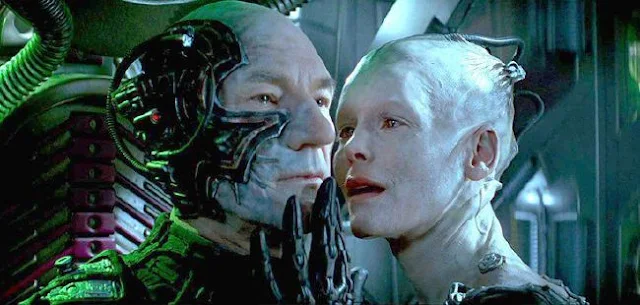

The trauma of Captain Jean-Luc Picard's assimilation as 'Locutus' into the Borg Collective

Resistance is Futile: Picard's Assimilation and its Aftermath

Captain Jean-Luc Picard's assimilation as Locutus into the Borg was a significant event in the Star Trek franchise. In "The Best of Both Worlds, Part I," Picard is captured by the Borg and becomes Locutus, a human representative of the Borg collective. The Borg are a cybernetic species that seek to assimilate other beings into their collective, erasing their individuality and making them part of a hive mind.

Throughout the series, Picard is portrayed as a strong and capable leader, but his assimilation forces him to confront his own vulnerability and mortality. As Locutus, Picard is stripped of his autonomy and forced to serve as a mouthpiece for the Borg. This experience leaves a lasting impression on Picard and affects his relationships with his crewmates, particularly his first officer, William Riker.

The Assimilation: "The Best of Both Worlds"

Picard's assimilation marks a significant turning point in the series, as it introduces the Borg as a major adversary and sets the stage for future encounters. The crew of the Enterprise must rescue Picard and stop the Borg from destroying Earth. In the climactic battle, Picard is able to overcome the Borg's control and regain his sense of self, ultimately leading to the defeat of the Borg.

This victory comes at a cost, however, as Picard is left to grapple with the trauma of his assimilation and the loss of his former identity, which is covered in the following episode 'Family'.

The trauma of Captain Jean-Luc Picard's assimilation as 'Locutus' into the Borg Collective

The Aftermath: "Family"

"Family" is a character-driven episode that focuses on the aftermath of Captain Picard's trauma. The episode explores Picard's mental health and the impact that his experience has had on his relationships with his crewmates and family.

Picard returns to Earth to visit his family's vineyard in France, but is still struggling to come to terms with his assimilation. The episode shows Picard experiencing flashbacks and nightmares, highlighting the emotional toll that his assimilation has had on him. It also explores the strained relationship between Picard and his older brother, Robert, who resents Jean-Luc for leaving the family vineyard to join Starfleet.

Through their interactions, the episode reveals deep-seated familial tensions. Robert finally comes to understand the magnitude of what Picard has been through, and the deep emotional scars that have been left behind. He tells Jean-Luc that he is proud of him and offers him a supportive and loving embrace, showing that he is there for him through the ups and downs of his recovery.

Production Log & Trivia

  • The Cliffhanger: The ending of "The Best of Both Worlds, Part I"—with Riker giving the order "Mr. Worf... fire" at a cube containing Locutus—is widely considered one of the greatest cliffhangers in television history. Patrick Stewart's contract was up for negotiation between seasons, adding real-world suspense for fans who feared he might not return.
  • A Unique Episode: "Family" is one of the only Star Trek: The Next Generation episodes that does not feature a science-fiction A-plot. There are no aliens (besides Worf's parents), space battles, or anomalies; the entire focus is on character drama and psychological recovery.
  • The Mud Fight: The emotional climax of "Family," where Jean-Luc and Robert get into a brawl in a mud pit, was a powerful scene. Patrick Stewart has said he drew on his own difficult family history to bring the raw emotion to the performance.
  • Cinematic Impact: The success and cinematic quality of "The Best of Both Worlds" is often cited as what convinced Paramount Pictures that the TNG cast was ready to transition to feature films.

Resistance is Futile: The Legacy of the Borg in Star Trek

The Borg are one of the most iconic and enduring villains in the Star Trek franchise. They made their first appearance in the second season of Star Trek: The Next Generation in the episode "Q Who?" In this episode, the omnipotent being Q sends the Enterprise to confront the Borg, warning them that the Borg represent a dangerous threat to the galaxy.


The Borg are a unique and terrifying concept in science fiction because they represent the fear of losing one's individuality and becoming part of a collective consciousness. The Borg operate under a hive mind, with each individual drone being linked to the collective consciousness through implants and cybernetic enhancements. The Borg seek to assimilate other species into their collective consciousness in order to add their distinctiveness to their own. 

borg queen first contact

They view assimilation as a necessary process to achieve perfection and resistance is futile!

The Borg also explore the ethical implications of technology, particularly in regards to the dangers of becoming too reliant on it. They are a cautionary tale of the consequences of unchecked technological progress. The Borg represent a society that has become so reliant on technology that they have lost their humanity, and they seek to assimilate others into their collective in order to achieve their goal of perfection.

One of the most exciting moments involving the Borg occurred in "The Best of Both Worlds" two-part episode of Star Trek: The Next Generation. This episode is particularly notable for its suspenseful plot, intense action sequences, and the transformation of Captain Jean-Luc Picard into Locutus, the Borg's spokesperson. The Enterprise crew must confront the Borg in a battle to save Earth from assimilation, and they must also grapple with the emotional impact of losing one of their own to the Borg collective.

Another thrilling moment involving the Borg occurred in the film Star Trek: First Contact. In this film, the Borg travel back in time to prevent the first contact between humans and an alien species, which would ultimately lead to the creation of the United Federation of Planets. The Enterprise crew must once again confront the Borg and prevent them from altering the course of history. This film explores themes of time travel, human resilience, and the dangers of technology.

Here are ten key moments of Borg activity in Star Trek:


  1. "Q Who?" - The Borg make their first appearance in Star Trek: The Next Generation when the Enterprise encounters them thanks to the meddling of the omnipotent being Q.
  2. "The Best of Both Worlds, Part I" - The Borg kidnap Captain Picard and assimilate him, turning him into Locutus, a spokesperson for the Borg collective.
  3. "The Best of Both Worlds, Part II" - The Enterprise crew launches an attack on a Borg cube in order to rescue Picard and stop the Borg from assimilating Earth.
  4. "I, Borg" - The Enterprise encounters a lone Borg drone who has been severed from the collective and begins to show signs of individuality.
  5. "Descent, Part I" - The Borg return in Star Trek: The Next Generation when a group of rogue Borg attempt to take over the Enterprise.
  6. "Descent, Part II" - The Enterprise crew must fight off the rogue Borg and stop them from causing further damage.
  7. Star Trek: First Contact - The Borg travel back in time to prevent humans from making first contact with an alien species, and the Enterprise crew must prevent them from altering the course of history.
  8. Star Trek: Voyager - The USS Voyager is stranded in the Delta Quadrant, and the crew must contend with the constant threat of the Borg, who are a major power in the region.
  9. "Dark Frontier" - Voyager discovers a way to infiltrate a Borg cube and steal a transwarp coil in order to speed up their journey home.
  10. "Unimatrix Zero" - Voyager encounters a group of Borg drones who are able to retain their individuality and dream in a virtual reality called Unimatrix Zero. The crew must help them retain their sense of self and prevent the Borg from discovering the existence of Unimatrix Zero.

Overall, the Borg are a fascinating and terrifying addition to the Star Trek universe, and their appearances in the series and films continue to captivate audiences. Their unique concept, combined with their iconic appearance and memorable catchphrase "Resistance is futile," has cemented their place in science fiction history.

Carlos Ezquerra Profile: Co Creater of Judge Dredd

Carlos Ezquerra (1947-2018) was a Spanish comic book artist and writer, best known for co-creating the iconic character Judge Dredd in 1977, along with writer John Wagner. Born in Zaragoza, Spain, he began his career as a comic book artist in the early 1970s, working on various British comic books.

Ezquerra's art style was distinctive and highly influential, characterized by bold lines, dynamic action scenes, and a gritty, dystopian aesthetic that became synonymous with the Judge Dredd universe. His work on the character was integral to its success and enduring popularity, and he continued to work on the series throughout his career.

In addition to Judge Dredd, Ezquerra worked on a number of other notable comic book series, including Strontium Dog, which he co-created with Wagner in 1978, and ABC Warriors, which he co-created with writer Pat Mills in 1979. He also worked on a range of other projects for various publishers, both in the UK and internationally.
Carlos Ezquerra (1947-2018)

Ezquerra's work was highly influential in the comic book industry, both in terms of its style and its content. He was known for his willingness to tackle controversial subjects, including political and social issues, and his work often dealt with themes of justice, oppression, and resistance.

Throughout his career, Ezquerra received numerous awards and accolades for his work, including an Eagle Award for Best Black and White Comic in 1989, and a Lifetime Achievement Award from the Spanish Association of Comic Book Professionals in 2016.

Ezquerra passed away in 2018, but his legacy as one of the most influential comic book artists of his generation continues to be felt in the industry today. His work on Judge Dredd, in particular, remains a touchstone for the character and the wider dystopian genre, and his impact on the medium as a whole cannot be overstated.

Carlos Ezquerra was a prolific artist and writer who worked on numerous comic book series and projects throughout his career.

Some of his most notable works include:
  1. Judge Dredd (co-created with John Wagner) - This iconic comic book series, set in a dystopian future where judges act as both police and judge, jury and executioner, is perhaps Ezquerra's most well-known work.Strontium Dog (co-created with John Wagner) - This science fiction comic book series is set in a future where mutants are a persecuted minority, and follows the adventures of bounty hunter Johnny Alpha.
  2. ABC Warriors (co-created with Pat Mills) - This futuristic comic book series features a team of robots created to fight in an intergalactic war, who eventually become disillusioned with their mission and turn against their creators.
  3. The Stainless Steel Rat (with writer Kelvin Gosnell) - This comic book adaptation of Harry Harrison's classic science fiction novel follows the adventures of con artist and master thief James Bolivar "Slippery Jim" diGriz.
  4. Preacher (with writer Garth Ennis) - This critically acclaimed comic book series follows the adventures of a small-town preacher with a dark past, who gains the power of Genesis, an entity that gives him the power to command others.
  5. War Stories (with writer Garth Ennis) - This series of standalone graphic novels explores various historical conflicts and their impact on soldiers and civilians alike.
  6. Adventures in the Rifle Brigade (with writer Garth Ennis) - This irreverent comic book series is a parody of war comics, featuring a hapless team of British soldiers on a series of absurd missions during World War II.
  7. Major Eazy (with writer Alan Hebden) - This World War II comic book series follows the adventures of an officer in the British Army's Intelligence Corps, who uses his wits and cunning to outsmart the enemy.

John Wagner - the writer behind Judge Dredd

John Wagner is a British comic book writer, best known for co-creating the iconic character Judge Dredd in the weekly British comic book 2000 AD. Born on February 1949 in Pennsylvania, United States, Wagner spent much of his early childhood in Scotland before moving back to the United States in his early teens.

Wagner's early work in the comics industry began in the 1970s, where he wrote scripts for British publishers such as DC Thomson and IPC.

He started working for 2000 AD in 1977, where he created the character of Judge Dredd with artist Carlos Ezquerra

john wagner judge dredd

Judge Dredd quickly became the flagship character of 2000 AD and a pop culture icon, featuring in numerous comics, novels, video games, and movies.

Wagner's writing style for Judge Dredd was notable for its gritty, dystopian vision of a future society in which the judges, a group of law enforcement officers with the power of judge, jury, and executioner, have become the only source of law and order. His stories often explored themes such as political corruption, social inequality, and the abuse of power.

In addition to Judge Dredd, Wagner has also created other notable comic book series such as Strontium Dog, Button Man, and A History of Violence, which was adapted into a critically acclaimed film by director David Cronenberg in 2005.

Throughout his career, Wagner has won numerous awards and accolades for his work in the comics industry. He has been inducted into the Will Eisner Comic Book Hall of Fame, the British Comics Awards Hall of Fame, and the Scottish Football Hall of Fame, reflecting his lifelong passion for football.

Wagner's impact on the comic book industry cannot be overstated, particularly in the United Kingdom, where his work on Judge Dredd helped to define the genre of British comics. He is widely regarded as one of the most influential comic book writers of all time and continues to inspire new generations of writers and artists.

The Apocalypse War to Tour of Duty: The Essential Judge Dredd Storylines

Judge Dredd is one of the most iconic and beloved characters in the world of comic books, and for good reason.


In the sprawling urban decay of Mega-City One, history isn't written by scholars; it's etched in the bloodstains on the iso-cubes and the scorch marks on the ped-ways. Every day, the Justice Department faces an unrelenting tide of chaos - a psychic scream of four hundred million souls crammed into a concrete pressure cooker, ready to blow. Survival here isn't a right, it's a privilege earned by the swift and brutal application of the Law. We don't have time for sentiment; we have time for judgment.


The following dossiers are not tales of heroism. They are priority case files documenting the flashpoints that forged this city in fire and defined its greatest lawman. Within these reports lie the genocidal campaigns against the Sovs, the nihilistic terror of the Dark Judges, and the street-level corruption that rots the city from within.


 Each file is a lesson in survival and a testament to the brutal calculus of maintaining order. Review is mandatory. Ignorance is a sentencing offense.

dark judges

TOP 10 THEMATIC CASE FILES

The Apocalypse War

A landmark conflict between Mega-City One and the Sov-Block of East-Meg One. This storyline is a brutal examination of total warfare, utilizing weapons of mass destruction and resulting in the deaths of half the city's population. 

As a stark political allegory for the Cold War, it forces Dredd to make a horrifying strategic choice: the nuclear annihilation of the enemy to save his own city. 

The narrative's true strength lies in its unflinching depiction of war's cost, cementing Dredd's reputation as a man willing to commit genocide in the name of the Law.


The Cursed Earth

This post-apocalyptic odyssey forces Dredd to journey across the irradiated wasteland separating the Mega-Cities. It is a foundational narrative that vastly expands the Dredd universe, introducing a bizarre landscape populated by mutants, monsters, and forgotten pockets of civilization. 

The storyline is a thrilling adventure that tests Dredd's resilience outside his urban jurisdiction and showcases the sheer diversity of his world.

A notable incident within this trek is the absurd and satirical encounter with the warring fast-food factions of the "Burger Barons."

The Day the Law Died

A chilling exploration of authoritarianism from within. The insane Judge Caligula seizes control of the Justice Department, turning Mega-City One into his personal playground of cruelty. 

This forces Dredd into the unprecedented role of a guerilla fighter, turning against the very system he embodies to save it from itself. 

The story is a powerful commentary on the fragility of power, posing the ultimate question: what happens when the Law itself becomes the ultimate criminal?

Block Mania

This storyline serves as the direct prequel to "The Apocalypse War." A contagion, secretly introduced by Sov agents, sweeps through Mega-City One, causing citizens to erupt into homicidal, block-vs-block warfare. 

It is a terrifying depiction of societal breakdown and mob mentality, showcasing how the city's inherent tensions can be weaponized. The Judges are stretched to their breaking point, leaving the city critically vulnerable to the subsequent invasion.

The Judge Child Quest

An epic quest that takes Dredd far beyond the walls of Mega-City One and into deep space. Tasked with finding a young boy, Owen Krysler, who is prophesied to save the city, Dredd follows a trail of destruction left by the powerful but malevolent child. 

The storyline, penned by John Wagner, is a grand-scale tragedy about destiny, choice, and the chilling realization that some powers are too dangerous to exist, forcing Dredd to make one of his most difficult judgments.

America

A poignant and politically charged standalone story that examines the fascist nature of the Justice Department through the eyes of an ordinary citizen. It follows the life of America Jara, a childhood friend of Dredd's, and her involvement with a pro-democracy terrorist group. 

The narrative is a gut-wrenching critique of the system Dredd upholds, forcing readers to confront the human cost of absolute order and question whether a life without freedom is a life worth living.

The Dark Judges

dark judges

The introduction of Dredd's greatest nemeses. Judge Death and his three brothers > Fear, Fire, and Mortis < are supernatural entities from a parallel dimension where all life has been declared a crime. 

This storyline is a pure horror tale that pits Dredd's unyielding logic against beings of pure nihilism. Their twisted philosophy and grotesque forms make them some of the most memorable villains in comic history.

Origins

A modern masterpiece that finally reveals the full history of the Justice Department and Judge Dredd himself. Written by John Wagner, the story sees Dredd venture into the Cursed Earth to retrieve the body of the first Chief Judge, Eustace Fargo. 

Through flashbacks, it recounts the final days of the United States and the brutal rise of the Judges. It's a masterful examination of Dredd's character, his motivations, and the dark, utilitarian principles upon which his world was built.

Necropolis

mean machine dredd

A massive, city-wide horror epic. Facilitated by a crisis of faith that drives Dredd to take the Long Walk into the Cursed Earth, the Sisters of Death (allies of the Dark Judges) take control and turn Mega-City One into a literal city of the dead. 

The story is a gripping examination of loss, grief, and the fragility of life on a colossal scale, forcing a broken Dredd to return and reclaim his city from the ultimate nightmare.

Tour of Duty

A politically charged series of interconnected stories that sees Dredd assigned to oversee the construction of a settlement for oppressed mutants within the Cursed Earth. 

The storyline is a fascinating examination of prejudice, civil rights, and the complexities of justice versus morality. It forces Dredd to confront the inherent bigotry of Mega-City One's laws and act as a protector for a group he has traditionally policed, exploring the evolving role of a Judge in a changing world.

18 April 2023

The Time Travel Paradox of Doctor Who

You would think a show about a time travelling Time Lord from Gallifrey might have the odd paradox and indeed it does.

Several kinds!

The grandfather paradox is perhaps the most well-known type of time-travel paradox, and "Doctor Who" has explored it in several episodes. In "Father's Day," Rose Tyler saves her father from being hit by a car, which creates a series of events that ultimately lead to the destruction of the universe. This paradox highlights the danger of meddling with past events, as even the smallest change can have catastrophic consequences. 

Another example is in the episode "The Wedding of River Song," in which the Doctor realizes that his own death is a fixed point in time, and if he tries to change it, he will create a paradox that could destroy the universe.

bootstrap paradox dr who

The bootstrap paradox is another type of paradox explored in "Doctor Who." 

In "Before the Flood," the Doctor realizes that a piece of information he obtained from the future was actually given to him by his own past self. This paradox shows how time travel can create a loop, where events in the future are caused by actions in the past, and vice versa. 

Another example of the bootstrap paradox is in the episode "The Girl Who Died," in which the Doctor gives a character a device that she later uses to save his life, but it is revealed that she only knew to create the device because the Doctor gave it to her in the past.

The ontological paradox is perhaps the most mind-bending type of paradox, as it involves events in the past being caused by actions in the future, but ultimately leading to the future traveler's own existence. 

In "Blink," the Doctor sends messages back in time to Sally Sparrow, who then uses the information to help the Doctor in the future. However, it is later revealed that the Doctor only knew what to say to Sally because she had already given him the information in the future, creating a loop in time. 

Another example is in the episode "The Name of the Doctor," in which the Doctor travels back in time to a pivotal moment in his own past, but realizes that he must sacrifice his own existence in order to save his companions and preserve the timeline.

Here's list of Doctor Who episodes time travel paradox

  1. "Father's Day" (Season 1, Episode 8) - In this episode, Rose Tyler goes back in time to save her father from being hit by a car, which creates a paradox that threatens to destroy the universe.
  2. "Blink" (Season 3, Episode 10) - This episode features the ontological paradox, as the Doctor sends messages back in time to Sally Sparrow, who then uses the information to help the Doctor in the future.
  3. "The Girl in the Fireplace" (Season 2, Episode 4) - This episode features a temporal paradox, as the Doctor and his companions travel back in time to eighteenth-century France and encounter a woman who has been communicating with them from the future.
  4. "The Waters of Mars" (Season 4, Special Episode) - In this episode, the Doctor tries to change a fixed point in time, which leads to a series of events that threaten to create a paradox and destroy the future.
  5. "The Time of Angels" (Season 5, Episode 4) - This episode features a bootstrap paradox, as the Doctor and his companions encounter a recording of the Doctor's voice from the future that he hasn't recorded yet.
  6. "Before the Flood" (Season 9, Episode 4) - This episode features another bootstrap paradox, as the Doctor realizes that a piece of information he obtained from the future was actually given to him by his own past self.
  7. "Hell Bent" (Season 9, Episode 12) - In this episode, the Doctor creates a temporal paradox by going back in time and rescuing his companion Clara from death, which ultimately leads to the destruction of Gallifrey.
  8. "The Wedding of River Song" (Season 6, Episode 13) - This episode explores the dangers of the grandfather paradox, as the Doctor realizes that his own death is a fixed point in time, and if he tries to change it, he will create a paradox that could destroy the universe.
  9. "Utopia" (Season 3, Episode 11) - In this episode, the Doctor and his companions travel to the end of the universe and encounter a man who claims to be the last of the Time Lords, but is actually a future version of the Doctor himself.
  10. "Heaven Sent" (Season 9, Episode 11) - This episode features a time loop, as the Doctor is trapped in a castle that resets every time he dies, and must find a way to break the cycle and escape.
In conclusion, "Doctor Who" provides a rich exploration of the time-travel paradox, with various episodes delving into different types of paradoxes and their implications.

While the concept of time travel and the paradoxes it creates may never be fully understood, "Doctor Who" provides a captivating and thought-provoking glimpse into the possibilities and consequences of traveling through time.

About the author Jimmy Jangles


My name is Jimmy Jangles, the founder of The Astromech. I have always been fascinated by the world of science fiction, especially the Star Wars universe, and I created this website to share my love for it with fellow fans.

At The Astromech, you can expect to find a variety of articles, reviews, and analysis related to science fiction, including books, movies, TV, and games.
From exploring the latest news and theories to discussing the classics, I aim to provide entertaining and informative content for all fans of the genre.

Whether you are a die-hard Star Trek fan or simply curious about the world of science fiction, The Astromech has something for everyone. So, sit back, relax, and join me on this journey through the stars!
Back to Top