

11 August 2026
All Right Then, Keep Your Secrets: Every Hidden Reference in Spider-Man: Brand New Day
Marvel deep dive • Full spoilers
Every Web Has an Anchor
Spider-Man: Brand New Day turns comic-book history, MCU callbacks and tiny background props into one argument about memory, identity and the parts of Peter Parker that magic could not erase.
Spoiler warning
This analysis reveals the ending, Sadie Sink’s role and the post-credits scene.

Spider-Man and Frank Castle in Brand New Day. Image via The Astromech. © Sony Pictures / Marvel Studios.
A spider’s web is architecture. Every strand carries tension, anchored at one end to something solid and at the other to something the spider intends to hold. Spider-Man: Brand New Day is built the same way. Pull almost any thread — from a LEGO X-Wing to a half-watched Star Wars film or a four-second handshake — and it leads backward into Marvel history and inward toward Peter Parker’s ruined personal life. The film hides its emotional argument inside its references.
The story begins nine months after No Way Home, then uses its opening montage to carry Peter across the next four years. By the time the main plot catches up with him, Peter has become a full-time Spider-Man in a New York that has never heard of Peter Parker. Destin Daniel Cretton’s film keeps asking one question: if the world has forgotten you, what remains of you inside it?
Its answer is the body. Hands remember. Habits survive. Objects retain an emotional charge after their stories have vanished. Peter’s own DNA rebels against the identity he has forced himself to inhabit. Once that pattern becomes visible, the Easter eggs stop behaving like fan-service rewards. They become evidence.
Inside this guide
The title and the memory wipe
The references carrying the story
Every confirmed cover recreation
Props, games and background deep cuts
The post-credits signal
Before anything else, the title is an Easter egg
Peter Parker enters Brand New Day as New York’s busiest ghost. Spider-Man is everywhere; Peter exists nowhere. Doctor Strange erased his name from the world, MJ and Ned have built lives without him, and four years beneath the mask have pushed his body into open revolt. His powers mutate, organic webs burst from his wrists, and the man trying to live entirely as Spider-Man begins turning into something more spider than man.
That conflict runs through the film’s defining moments. Ned quotes Gandalf while building an X-Wing with the friend he cannot remember. MJ sketches Peter’s uncovered face and grips a necklace whose history has vanished. Frank Castle carries the debt of a life the hero once saved. Jean Grey tears through minds already damaged by magic. Six classic comic covers turn Peter’s missing years into living panels. Then, inside a bodega, Ned’s hand remembers a secret handshake before his mind remembers the name Peter.
The sharpest reversal
Comic-book Peter entered the 2008 Brand New Day era having lost the organic webbing he gained during Spectacular Spider-Man #20 and the wider mid-2000s mutation stories. Movie Peter enters his Brand New Day by developing organic webbing. The same reset runs in the opposite biological direction.
The film borrows the editorial reset while avoiding a literal adaptation. Mister Negative, Menace, Jackpot and Carlie Cooper — all major figures from the 2008 run — are absent. The title supplies the condition of the story: a Peter rebuilt after magic removed the life he knew.
Part One: The references carrying the story
The Marvel logo has lost Peter too
The first Easter egg arrives before the first scene. The Marvel Studios logo contains footage of the memories Peter no longer shares with Ned, MJ and Aunt May. The corporate ident, normally a triumphal archive of everything the MCU remembers, has been recut around absence. It turns the studio’s own memory bank into part of Doctor Strange’s spell.
The opening then finds Peter alone with the letter he wrote for MJ at the end of No Way Home. His room is a private museum of relationships that exist only for him: Ned’s LEGO Emperor figure, the coffee cup MJ gave him, alerts reminding him to take flowers to May’s grave and quietly celebrate Ned’s acceptance into MIT’s engineering programme. Peter has converted friendship into archiving. He cannot participate in their lives, so he catalogues them.
“All right then, keep your secrets”
The film’s most discussed scene is also its quietest. Ned Leeds and a masked Spider-Man sit on the floor of Ned’s apartment building a LEGO X-Wing. They trade lines from Peter Jackson’s The Fellowship of the Ring, beginning with Gandalf’s exasperated, long-memed line: “All right then, keep your secrets.” MJ sits nearby, sketching.
In Jackson’s film, Gandalf is teasing Frodo. Ned directs the same line at a masked man concealing the most dangerous fact about himself, unaware that he once guarded that secret. The joke lands before its dramatic effect does. Ian McKellen’s involvement in Avengers: Doomsday adds one more accidental vibration to it.
Jacob Batalon has said this was the scene that halted production for a day because its original version rang false. Cretton and on-set writer Justin Kuritzkes rebuilt it from scratch. Watch MJ during the exchange: she draws Ned and Peter together, unmasked. She has no conscious memory of Peter; her hand supplies the missing face. The image also reaches back to Homecoming, where MJ admits she stays in detention to draw people in crisis.
Ned’s laptop, Hoth and Peter’s first MCU strategy
Ned watches the Battle of Hoth from The Empire Strikes Back: Rebel snowspeeders bring down an AT-AT by winding a tow cable around its legs. The sequence establishes that the Rebellion survives through improvisation and nerve rather than firepower — a principle baked into the film’s script from the first draft.
That is the manoeuvre a sixteen-year-old Peter used to drop Giant-Man in Captain America: Civil War. He announced the plan in the language of a film nerd: “You ever see that really old movie, Empire Strikes Back?” It was Peter’s first genuinely heroic idea in the MCU, and it came from the pop culture he shared with Ned. Now the source text sits on Ned’s screen while Ned watches alone. The Death Star build in Homecoming, the LEGO collection and Hoth all turn Star Wars into the fossil record of a friendship that survives on only one side of the ledger.
The handshake at the bodega
The film closes at the neighbourhood bodega that has recurred through Peter’s new life. Peter finally gives Ned his real name. They reach for an ordinary handshake and Ned’s arm completes their old dap, all the way through, without instruction. He looks at Peter again. “Peter?” Cut to credits.
A speech could explain recognition; a handshake makes recognition physical. Doctor Strange’s spell erased Peter Parker from conscious knowledge. The film never says it erased procedural memory — the kind encoded through repetition. MJ’s drawing and Ned’s dap express the same idea twice. Their bodies retain a relationship their minds cannot retrieve.
Batalon has called the ending open-ended. One explanation is emotional muscle memory; another is magical. No Way Home established that Ned can operate a Sling Ring, and sparks appear at the end of an earlier Peter-Ned handshake. A further possibility runs through Jean Grey: the film has spent two hours showing that psychic contact can expose buried material. The scene gives the audience enough evidence to argue and too little to close the case.
MJ’s black dahlia necklace
MJ still wears the black dahlia pendant Peter bought for her in Venice in Far From Home. It was broken, repaired and carried into No Way Home. By that film’s final scene it had become one of the last physical objects connecting her to a relationship she could no longer remember. She finds Peter’s letter and tells him she did not love him because she does not know him. Her final beat complicates the statement: she holds the necklace anyway.
The object has outlived its explanation. On the rooftop she rolls up the bottom of Spider-Man’s mask to kiss him, restaging the 2002 alley kiss while reversing the initiative — MJ reaches for him before she knows why. The comics add a useful echo: in One Moment in Time, Peter briefly shields Mary Jane from the worldwide identity wipe before fear of further violence separates them. The film changes the mechanics, yet it preserves the ache.
Staten Island and the original Spider-Man villain called the Punisher
The film keeps referring to a Staten Island incident in which Spider-Man saved Frank Castle’s life. We receive the aftermath, the attitude and the grudging debt; the flashback remains withheld. Staten Island becomes this street-level era’s Budapest — a shared operation that feels larger because the audience has to imagine it.
The missing lore makes the pairing richer still. The Punisher first appeared in The Amazing Spider-Man #129 (1974), introduced as an antagonist manipulated by the Jackal into believing Spider-Man was a murderer. Frank Castle entered Marvel continuity through a lethal misunderstanding with Peter. More than fifty years later, their live-action relationship begins with a life Peter chose to save — which contains the moral problem the unseen scene would have had to settle. Frank kills; Peter refuses to. Keeping Staten Island off-screen preserves the ethical bruise without forcing a neat verdict.
Wilson Fisk’s old mayoral posters deepen the street-level connections. Graphics assistant Will Dixon has confirmed those pieces came directly from the Daredevil: Born Again art department while both productions overlapped. This New York therefore shares physical street furniture with Fisk’s crackdown, rather than merely referencing it in dialogue.
Peter’s body turns against the role he has chosen
Peter’s powers evolve beyond his control and he begins producing webbing organically. Cretton frames the discovery with the visual grammar Sam Raimi used for Tobey Maguire in 2002, but the reference reaches beyond the movies. In the 2004 Spectacular Spider-Man: Disassembled arc, the Queen mutates Peter into a giant spider. He emerges from the creature’s husk in #20 with organic webbing and a psychic connection to arachnids. The later event The Other pushes the question further: is he a man carrying spider powers, or a spider wearing the life of a man? Brand New Day translates that strange comic material into body horror driven by emotional repression.
Peter responds like Peter. Inspired by Bruce Banner’s Hulk inhibitor, he engineers a chip to suppress his own mutation, then develops a universal version capable of suppressing Jean Grey’s abilities. The invention solves an immediate problem and creates a much larger one.
The MCU’s mutant restraint collar
A universal gene inhibitor left inside Damage Control is a narrative landmine. X-Men stories have used power-dampening collars and weapons as instruments of mutant persecution for decades. Peter may have designed the first effective MCU version, then delivered the prototype to an institution already detaining mutants.
Jean Grey, Bill Metzger and the mutant story arriving sideways
Sadie Sink plays Jean Grey, a young telepath discovering the scale and danger of her abilities. She enters the MCU through a Spider-Man detective story instead of an X-Men roll call. That choice gives her power immediate thematic purpose: the antagonist-by-circumstance can manipulate minds in a film about a hero whose place in every mind has already been edited once.
Spider-Man and Jean have crossed paths only occasionally in the comics, but one meeting is almost too precise to ignore. In Spider-Man Family #9, S.H.I.E.L.D. assigns Peter and Jean to keep Bruce Banner calm and prevent a Hulk transformation. Brand New Day rebuilds the same unusual triangle around Jean’s telepathy and Banner’s inhibitor.
Tramell Tillman’s Bill Metzger makes the mutant implications explicit. The comic-book William Metzger debuted in X-Men: Children of the Atom #1 (1999) as a propagandist and leader of the Anti-Mutant Militia who tortured young mutants. Putting that name above the Department of Damage Control tells informed viewers what the agency is becoming before the MCU says the words “anti-mutant.”
Part Two: From the long boxes to the screen

Marvel Super Heroes Secret Wars #10. Comic-cover storytelling shapes the film’s opening montage, while the post-credits signal points toward the cosmic Marvel story ahead. Image via The Astromech.
The time-jump montage is composed around live-action recreations of classic Spider-Man covers. Cretton kept enlarged prints beside the monitors so the camera and performers could match poses drawn decades earlier — the same production logic that saw Ralph McQuarrie’s concept paintings dictate the final framing of Star Wars sequences. Marvel has published its own guide to the source issues. These are the six confirmed montage recreations.
Amazing Fantasy #15 (1962)
Jack Kirby and Steve Ditko’s first-appearance cover, with Spider-Man swinging while carrying a crook. Opening the montage with this image strips Peter back to the premise that existed before Avengers access, Stark funding or a public identity: a local New York hero holding one criminal and one impossible responsibility.
The Amazing Spider-Man #134 (1974)
The first appearance of Tarantula, Anton Miguel Rodriguez, whose bladed boots made him a dangerous physical match for Peter. The source story also involves the Punisher misreading Spider-Man as part of the crime — a miniature blueprint for the film’s Peter–Frank friction.
The Amazing Spider-Man #221 (1981)
The Ramrod cover supplies the montage’s deepest cut. Ramrod began as an ordinary man rebuilt as a cyborg, first fighting Daredevil and Black Widow before drifting into Spider-Man’s orbit. His obscurity proves the montage is trawling the back issues rather than running a greatest-hits reel.
Peter Parker, The Spectacular Spider-Man #142 (1988)
Tombstone dangles Spider-Man from a girder; Peter answers by kicking him over the edge and webbing him for Detective Jean DeWolff. The original issue sits inside a noir story involving Joe Robertson, mind control and a compromised Punisher — three ingredients the film independently revives.
The Amazing Spider-Man #345 (1991)
Erik Larsen’s Boomerang cover. Fred Myers is a former baseball pitcher who converted his throwing arm into a criminal career equipped with shatterangs, screamerangs and gravityrangs. He throws one weapon at Peter and leaves, which is exactly the affectionate indignity a Boomerang cameo deserves.
Spider-Man Adventures #2 (1995)
The snowy Scorpion confrontation matches Alex Saviuk’s cover for “The Sting of the Scorpion,” an adaptation of the 1990s animated series episode. This settles the source issue that pre-release breakdowns frequently left unidentified.
The cover language continues beyond the six-villain montage. Peter and Frank framed beneath a field of gun barrels recalls Jim Lee’s cover for The Punisher War Journal #15, while Spider-Man facing the Hand evokes The New Avengers #27. The latter is better read as visual resemblance than an exact shot-for-shot recreation.
The ghost of Sam Raimi’s unmade Spider-Man 4
Raimi’s abandoned fourth film was planned to begin with Tobey Maguire’s Spider-Man dispatching a run of C- and D-list villains. Storyboard artist Jeffrey Henderson named Mysterio, Shocker, Prowler, an old-fashioned Rhino and possibly Stilt-Man, with Bruce Campbell reportedly considered for Mysterio.
Nearly two decades later, the first fourth solo film any live-action Spider-Man has received opens with essentially that device. As our complete Spider-Man film chronology notes, Tombstone, Boomerang, Tarantula, Ramrod and Scorpion occupy the structural space of a movie that never reached production.
Part Three: Props, games and background deep cuts

Hoth carries the Star Wars thread running through Peter and Ned’s friendship, from their shared film knowledge to the battle plan Peter used against Giant-Man. Image via The Astromech. © Lucasfilm.
Peter’s flat is a shrine disguised as a workshop
Peter has built an AI assistant called E.V., voiced by Naomi Watts — who played Holland’s mother in The Impossible, which gives the casting a gentle, private joke. Within the MCU, E.V. is the successor Peter created after losing access to Tony Stark’s J.A.R.V.I.S.-derived technology. Cretton described her as the closest thing Peter has to a friend, which makes every competent response slightly sadder.
The coffee cup from the final donut-shop scene in No Way Home still sits on his desk four years later. Ned’s LEGO Emperor figure remains nearby. These are tiny domestic reliquaries: Peter lives among objects that prove his old life existed, even though nobody else can authenticate them.
Ned and MJ’s apartment
Ned’s Star Wars habit continues with a Chewbacca figure and LEGO X-Wing set 75301. Replacing the Death Star with an X-Wing quietly moves the visual language from revelation to resistance. A Naruto poster behind Ned doubles as a director signature: Cretton is developing Lionsgate’s live-action adaptation, with a worldwide casting search launched in July 2026. The PlayStation 5 elsewhere in the room needs less decoding — Sony co-produces the film.
Yelena and the New Avengers next door
Peter’s call to Yelena Belova performs efficient continuity housekeeping. Her screen name, “MacaroniFiend1001,” continues the boxed mac-and-cheese joke from Black Widow and Hawkeye. Ned calls her the Black Widow — the first explicit handover of Natasha Romanoff’s title in the MCU. Yelena dismisses Peter’s case as “small potato” work beside the New Avengers’ problems, passing the Thunderbolts baton in both directions.
The Insomniac inheritance
Peter appearing before Yelena in his mask and boxer shorts recreates the Undies Suit unlocked in Insomniac’s Marvel’s Spider-Man (2018). Holland has discussed borrowing finishing moves from the games, and the film’s cinematic takedowns, tank pursuit and rooftop crowd fights use the rhythm of Insomniac combat. Brand New Day treats the games as a legitimate visual vocabulary — the way earlier Spider-Man films treated famous panels — rather than licensed spin-off material to be kept at arm’s length.
The details designed to vanish at twenty-four frames per second
Graphics assistant Will Dixon has shared work that is functionally invisible in a cinema: complete Daily Bugle articles on Ned’s conspiracy wall, villain stickers and an Ultimate Spider-Man logo on laptops in Banner’s lecture hall, a pickle-jar label using words from a Michael Giacchino track title, and children’s Spider-Man drawings Dixon made when he was a kid. Frank Castle’s chilli can is branded “Gerry’s,” honouring Punisher co-creator Gerry Conway. A corn-dog advertisement points toward Ultimate Spider-Man Annual #1.
Keep one number in the maybe column
A police car carries the number 269, which has been linked online to Avengers #269 and its Kang story. No production source has confirmed that reading. It belongs below the line separating designed detail from pattern-seeking.
One line about graduate school
Peter tells Bruce Banner that he is a graduate student. In the comics, Empire State University is where Peter meets Gwen Stacy and Harry Osborn in The Amazing Spider-Man #31, and he later returns for postgraduate science work. The lie gives him access to Banner while gesturing toward a vast civilian chapter this version of Peter skipped when the spell destroyed his records and relationships.
The child outside the hospital
The small boy who gives Peter the classic web-shooting gesture is credited simply as “Web Kid.” Nothing on-screen identifies him as Miles Morales. His function is cleaner and more immediate: Peter sees that Spider-Man survives as an idea in people who have never known Peter Parker. The hero has a public legacy even while the man has no public existence. Given where Secret Wars is taking the MCU, a boy who might be Miles is not a thread the film has closed.
The last signal: Spider-Man in space
The post-credits scene returns to Ned’s Spidey Tracker. Its search expands beyond New York, beyond Earth and into space before registering a Spider-Man location. The shot confirms a signal; it does not identify which Spider-Man produced it or explain how the tracker reaches that far.
The cleanest comic association is Marvel Super Heroes Secret Wars, where Peter’s trip to Battleworld leads to the black costume that later becomes Venom. Cosmic Spider-Man and the Captain Universe power also sit in the character’s history. Neither is promised by this scene. With Avengers: Doomsday and Secret Wars ahead, the responsible reading is simple: the neighbourhood signal has left the neighbourhood.
What the web is for
Many franchise Easter eggs work like attendance stamps. Brand New Day gives its best references structural jobs. Ned quotes Gandalf on secrets to the friend whose secret he once kept. He watches the film that taught Peter how to defeat Giant-Man. MJ draws a face she cannot name and holds a necklace whose history she cannot retrieve. Peter gains the biological power his comic counterpart lost when his own Brand New Day began. Jean Grey rearranges minds in the sequel to a film that rewrote every mind on Earth. A future anti-mutant leader inherits the technology Peter built to restrain himself. In the closing scene, a hand remembers the friendship a brain was forbidden to access.
Every strand pulls toward the same centre. Peter Parker erased himself, and the world keeps producing physical evidence that the erasure never fully took. The film’s most Spider-Man idea is also its simplest: Peter can surrender his name, his records, his friends and his place in their memories. Connection remains a force with its own muscle memory.
Further reading
The Complete Spider-Man Film Chronology — The Astromech
Secret Wars Explained: Two Battleworlds and the Road to the End of Marvel — The Astromech
Daredevil: Born Again Episode Guide and Review — The Astromech
Analyzing the Themes of The Empire Strikes Back — The Astromech
Marvel’s history of Spider-Man in 2008
Marvel’s official guide to the recreated covers
The annotated opening screenplay pages
Spider-Man and the Punisher’s comics history
Spider-Man and Jean Grey’s comics history
Marvel deep dive • Full spoilers Every Web Has an Anchor Spider-Man: Brand New Day turns comic-book history, MCU callbac...
Read Article →
10 August 2026
Star Trek Factions Explained: Every Civilisation, Alliance and War in One Interactive Map

The Astromech · Interactive Star Trek Feature
The Powers of the Final Frontier
The Star Trek Civilisations, Alliances and Conflicts Map
Every alliance tests the distance between Federation ideals and political survival.
Star Trek is usually described as optimistic. It is more accurately a four-century argument about what a liberal, post-scarcity federation is willing to do when its neighbours will not behave. The Federation is founded by four species who spent a century mistrusting each other. It signs a peace with the Klingons only after an ecological catastrophe makes the Empire negotiate. It abandons its own colonists to the Cardassians, tolerates a secret intelligence service it refuses to acknowledge, and fights a war of survival beside two empires it had spent generations opposing.
This map plots those compromises. Select a node to open a civilisation card, select a line to read the relationship behind it, and move between eras to watch power change hands. The thirteen theatrical films sit inside the graph as political turning points rather than beside it. Every card links back to The Astromech’s complete Star Trek archive. If you want the sequence first, start with the full chronological timeline of Star Trek television and films.
Continuity note. The Prime timeline is the default view. The Kelvin timeline, the Mirror Universe and temporary alternate histories are held on separate layers, and entities from different continuities are never joined by an ordinary historical relationship. Where the map compares one continuity with another, the connection is labelled Continuity parallel and drawn as a dotted crimson line.
Archive controls
Filter the political map
Narrow the display by continuity, historical era, entity type, relationship category and spoiler tolerance. All filters combine, and the status line under the map reports exactly what is visible.
Entity types
Keyboard: Tab moves between entities, Enter or Space opens a card, Esc closes it, + and − zoom, arrow keys pan the map.
Relationship legend
Every relationship carries an icon, a written label and a line pattern, so no category depends on colour alone.
Diplomatic holochart
The relationship map
Drag the background to pan, drag an entity to reposition it, scroll or use the controls to zoom. Selecting an entity highlights its direct relationships and opens a full width card beneath the map.
No entities match the current filters. Reset the map or widen the era and continuity selection.
Loading the relationship map.
Relationship
Comparison
Chronology
Four centuries in fourteen positions
Selecting an era filters the map to the powers and relationships active in that window. The Kelvin timeline sits deliberately outside the Prime sequence. For the complete viewing order, read The Astromech’s chronological timeline of Star Trek.
Featured editorial
Fourteen political fault lines
The relationships that decide what the Federation actually is, as opposed to what its charter says it is.
Fault line 01 · Founding membership · 2151 to 2161
The founding of the United Federation of Planets
The Federation is not founded by friends. Humans, Vulcans, Andorians and Tellarites spend the 2150s in a state of mutual contempt: Vulcan treats Earth as an adolescent that should not have warp drive, Andoria and Vulcan are in a shooting rivalry over Weytahn, and Tellarite diplomacy is indistinguishable from insult. What forces them together is a shared threat and a human willingness to mediate between species who will not talk directly. The Coalition of Planets becomes the Federation because Archer keeps arranging rooms in which enemies have to sit down.
The founding compromise is the thing to watch: a charter written by four powers who do not trust each other produces an institution permanently torn between principle and expediency. Follow the sequence in The Astromech’s chronological timeline and the series itself in the ten best Star Trek: Enterprise episodes.
Era: Enterprise, 2151 to 2161 · Continuity: Prime · Category: Founding membership

Fault line 02 · War, treaty, alliance · 2256 to 2375
Federation and Klingon hostility, detente and alliance
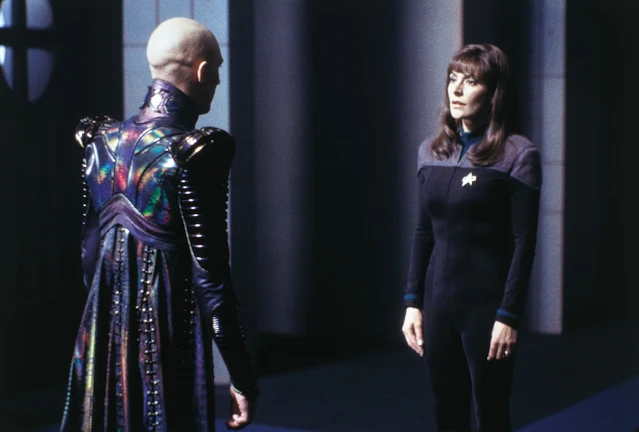
No relationship in Star Trek travels further. The Federation and the Klingon Empire begin in open war in the 2250s, spend the 2260s in a cold standoff mediated by Organian intervention, sign the Khitomer Accords in 2293 after Praxis explodes, and by the 2360s are close enough that a Klingon officer serves on the Federation flagship. The alliance is then broken by Changeling infiltration and repaired only when the Dominion becomes the larger threat.
What makes it durable is that both sides get something the other cannot supply. The Klingons gain an industrial partner after an ecological catastrophe; the Federation gains a buffer and, eventually, an ally with an appetite for the fighting it dislikes doing itself. Read the review of The Undiscovered Country and the collected quotes of Worf, Starfleet’s indomitable Klingon.
Eras: Original Series through Dominion War · Continuity: Prime · Categories: War, Treaty, Formal alliance
Fault line 03 · War, espionage, treaty · 2156 to 2401
Federation and Romulan rivalry
The Romulan relationship is defined by information rather than territory. The Earth-Romulan War is fought without either side seeing the other; the Neutral Zone that ends it is a border made of ignorance. For two centuries afterwards the Star Empire prefers proxies, cloaks and the Tal Shiar to open engagement, which makes every Romulan appearance in the Prime timeline a question of what is actually being negotiated underneath the conversation.
The relationship only breaks open twice: the Dominion War, when Sisko manufactures the case that drags Romulus into the alliance, and the Hobus supernova, which destroys the homeworld and turns the Empire into a refugee problem the Federation votes not to solve. Read the Nemesis analysis and The Astromech on the choices Star Trek captains are forced to make.
Eras: Enterprise through Picard · Continuity: Prime · Categories: War, Espionage, Treaty

Fault line 04 · Occupation · 2328 to 2369
The Cardassian occupation of Bajor
Forty years of annexation, forced labour and resource stripping, ended not by liberation but by withdrawal: the Union leaves because Bajor stopped being profitable. That single fact shapes everything Deep Space Nine does afterwards. Bajor emerges with a provisional government nobody fully trusts, a militia made of former terrorists, a religious authority with more legitimacy than the state, and a station the Cardassians built with slave labour and left behind.
The Federation arrives as an administrator of somebody else’s wreckage, and spends seven years discovering that its principles were designed for first contact rather than post-colonial reconstruction. Cardassian methods against Starfleet officers are examined directly in The Astromech’s reading of Chain of Command, Part II, and the ethical frame in the essay on the Prime Directive.
Eras: The Lost Era, Deep Space Nine · Continuity: Prime · Category: Occupation
Fault line 05 · Rebellion · 2370 to 2373
The Maquis and the colonies the Federation traded away
The Maquis are the most uncomfortable political fact in Star Trek because they are made entirely of Federation citizens. A border treaty with Cardassia places established colonies on the wrong side of a line, the Council tells those colonists to relocate, and they refuse. What follows is not an alien threat but a resistance movement staffed by former Starfleet officers who believe the Federation broke its own promise to defend them.
The Maquis prove that the Federation's ideals are negotiable when the alternative is war, and they set up Voyager's entire premise: a crew half composed of people the institution had recently labelled terrorists. Read The Astromech’s ten best Voyager episodes and the analysis of the Prime Directive as an ethical instrument.
Eras: The Next Generation, Deep Space Nine and Voyager · Continuity: Prime · Category: Rebellion
Fault line 06 · War · 2373 to 2375
The Dominion War
The Dominion War is the moment the Federation stops being a exploratory service with weapons and becomes a war economy. It fights alongside the Klingon Empire, then alongside the Romulan Star Empire after a Starfleet captain and a Cardassian tailor forge the evidence that brings Romulus in. It accepts a Cardassian defection at the end that costs the Cardassian people eight hundred million dead. It wins, and the winning is what the following three decades of Star Trek are quietly about.
The war is also the reason Section 31 becomes a live question rather than a rumour: an organisation prepared to commit genocide against the Founders is either the Federation's shameful secret or its immune system, and the franchise has never fully decided. Read the essay on the calls Star Trek captains make.
Era: Deep Space Nine and Voyager, 2373 to 2375 · Continuity: Prime · Category: War
Fault line 07 · Political authority · 2370 to 2375
The Dominion hierarchy of Founders, Vorta and Jem’Hadar
The Dominion is the most efficiently designed state in Star Trek, and its design is the argument. Shapeshifting Founders rule as literal gods; Vorta administrators are cloned, engineered to worship, and replaced whenever one dies; Jem’Hadar soldiers are bred with a chemical addiction that makes desertion biologically impossible. Nothing is left to loyalty when dependency will do.
Set against the Federation it forms a clean thesis: two galactic powers built by species who were once persecuted, one choosing consent and the other choosing control. The Founders' stated motive, order imposed so that solids can never hunt them again, is the same fear the Federation answers with a charter. Follow the era through the chronological timeline and the wider archive on The Astromech’s Star Trek hub.
Era: Deep Space Nine, 2370 to 2375 · Continuity: Prime · Category: Political authority
Fault line 08 · Assimilation · 2365 to 2401
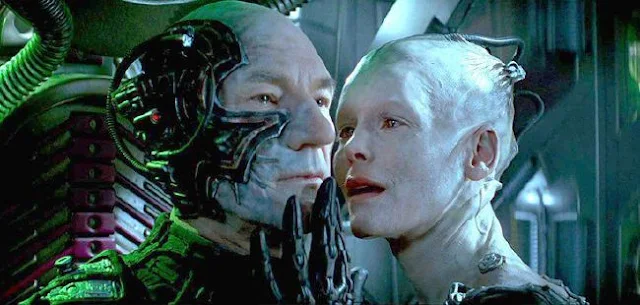
The Borg and the threat to Federation individuality
Every other antagonist in Star Trek wants territory, resources or revenge. The Borg want the Federation itself, absorbed rather than defeated, and that is why they work. A civilisation whose founding value is the dignity of the individual is confronted by a power that regards individuality as an inefficiency to be corrected, and offers assimilation as an improvement rather than a punishment.
Wolf 359 costs eleven thousand lives and turns the Federation into a militarising power years before the Dominion arrives. It also produces the franchise's most durable study of trauma, since Picard is not a survivor of an attack but a participant in one. Read The Astromech’s analysis of the legacy of the Borg, then Picard’s trauma after assimilation and the Borg Queen as a complex antagonist.
Eras: The Next Generation through Picard · Continuity: Prime · Category: Assimilation
Fault line 09 · Covert manipulation · 2150s to the 32nd century
Section 31 and the limits of Federation ethics
Section 31 exists because someone read the Starfleet Charter and decided that extraordinary measures needed no oversight. It has no budget line, no accountable officer and no formal existence, which is precisely its argument: a democracy that wants clean hands can outsource the dirty work to a body it never has to admit owning.
Its interventions are not marginal. It attempts to exterminate the Founders through a manufactured disease, manipulates the Romulan succession, and in the Kelvin timeline drives Starfleet toward open militarisation. The uncomfortable point the franchise keeps returning to is that Section 31 usually works, which forces the question of whether the Federation's ideals survive because of its principles or because someone else is quietly suspending them. Read the essay on the Prime Directive and its ethical limits.
Eras: Enterprise through the 32nd century · Continuity: Prime and Kelvin · Category: Covert manipulation
Fault line 10 · Treaty · 2293
The Khitomer peace process
The Khitomer Accords are the franchise's clearest statement that peace is made by people who do not want it. Praxis explodes, the Klingon Empire faces ecological collapse, and a negotiation begins that is opposed by hardliners in Starfleet, the Klingon Defense Force and the Romulan Star Empire simultaneously. The conspiracy to wreck it is a coalition of enemies who agree on nothing except that the war should continue.
Kirk is the least suitable diplomat available and the most necessary one, because his prejudice is the prejudice that has to be publicly overcome. The treaty holds for eighty years and makes every later Federation and Klingon alliance possible. Read The Astromech’s review of The Undiscovered Country.
Era: Original Crew films, 2293 · Continuity: Prime · Category: Treaty

Fault line 11 · Institutional succession · 2379 to 2401
The destruction of Romulus and its political aftermath
Nemesis begins the collapse: a Reman coup installs a Praetor who is a clone of a Starfleet captain, the Senate is murdered, and the Star Empire's political centre never recovers its authority. The Hobus supernova finishes the job. What follows is the Federation's most revealing decision in two centuries. It agrees to evacuate hundreds of millions of Romulans, then cancels the operation after an attack on Mars, and a founding member world withdraws its support.
The refusal is not villainy but institutional self-protection, which is worse: a union built on the premise that difference is worth defending decides that this particular difference costs too much. The residue is a fractured Empire, a Reman underclass with a grievance, and a Federation that has to be argued back into its own charter. Read the Nemesis analysis and the Worf archive.
Eras: Next Generation films through Picard · Continuity: Prime · Category: Institutional succession
Fault line 12 · Institutional succession · 3069 to the 3190s
The Burn and the rebuilding of the 32nd century Federation
A galaxy wide detonation of almost all active warp cores ends interstellar civilisation in a single moment. What survives is instructive: the Federation contracts to a few dozen members and a hidden headquarters, the Orion and Andorian criminal economy expands into the vacuum as the Emerald Chain, and Ni’Var, the reunified Vulcan and Romulan world, withdraws entirely.
The 32nd century arc is therefore a founding story told backwards. The Federation has to persuade worlds to rejoin using nothing but the memory of what membership meant, which is the sharpest test the institution ever faces: an alliance with no fleet, no dilithium and no leverage, offering only its ideals. Follow the full sequence in The Astromech’s chronological timeline of Star Trek.
Era: Discovery in the 32nd century · Continuity: Prime · Category: Institutional succession
Fault line 13 · Continuity parallel · 2233 onward
Prime and Kelvin timeline divergence
A Romulan mining vessel arrives from the future, destroys the USS Kelvin, and everything downstream changes. Vulcan is destroyed twenty five years later and its survivors number in the tens of thousands, which removes the Federation's oldest founding partner from the board entirely. Starfleet in this continuity is younger, more improvised and considerably more willing to arm itself.
This map keeps the two continuities on separate layers. Kelvin entities never share a historical relationship with Prime entities, and the only connections drawn between them are labelled Continuity parallel: editorial comparisons, not events. The same person can exist in both and have led an entirely different life. Read the wider film context in The Astromech on the cinematic DNA of Star Trek.
Era: Kelvin timeline, 2233 onward · Continuity: Kelvin · Category: Continuity parallel
Fault line 14 · Continuity parallel · Mirror Universe
The Terran Empire as an inversion of the Federation
The Mirror Universe is not a horror story about evil twins. It is a controlled experiment: take the same species, the same technology and the same first contact, and replace the founding value of cooperation with conquest. The result is the Terran Empire, which subjugates exactly the species the Federation recruited, and is eventually overthrown by an alliance of Klingons, Cardassians and Bajorans, the powers the Prime Federation spent centuries negotiating with.
Treating the Terran Empire as a distinct entity rather than a costume change is the point. Its relationships are drawn only to other Mirror entities on this map, and any comparison with a Prime power is labelled Continuity parallel. Browse the archive on The Astromech’s Star Trek hub.
Eras: Original Series and Deep Space Nine · Continuity: Mirror Universe · Category: Continuity parallel
Feature archive
The films as political turning points
All thirteen theatrical films, read as diplomatic events rather than adventures. Each one appears as a node inside the map above, connected to the powers it moved. Browse the wider film coverage in The Astromech’s essay on the cinematic DNA of Star Trek.

Film 01 · 1979 · In universe 2273 · Prime timeline
Star Trek: The Motion Picture
Powers involved: United Federation of Planets, Starfleet, Earth, V’Ger.
Central political conflict: a machine intelligence built from a human probe returns to Earth demanding to meet its creator, and Starfleet has no diplomatic category for an entity that is simultaneously a threat, a child and an artefact of its own history.
What changes: Starfleet is confirmed as an exploratory service whose first instinct under existential threat is still contact rather than fire, and Earth itself becomes a target for the first time in the film era. Read the full thematic analysis of The Motion Picture.
Category: Cultural exchange · Era: Original Crew films

Film 02 · 1982 · In universe 2285 · Prime timeline
Star Trek II: The Wrath of Khan
Powers involved: Starfleet, the Federation Science Council, Khan Noonien Singh and the Botany Bay exiles, Ceti Alpha V, the Genesis Project.
Central political conflict: a Starfleet terraforming programme with obvious weapons applications is developed without oversight, and a man Starfleet exiled and then forgot takes it.
What changes: the Federation is forced to confront the fact that its scientific idealism produces weapons whether it intends to or not, and Genesis becomes a strategic object that reshapes the next two films. Read why The Wrath of Khan is the greatest sequel ever made and the original episode in the Space Seed review.
Category: War · Era: Original Crew films

Film 03 · 1984 · In universe 2285 · Prime timeline
Star Trek III: The Search for Spock
Powers involved: Starfleet Command, Kirk’s crew, the Klingon Empire, the Genesis Planet, Vulcan.
Central political conflict: Starfleet quarantines Genesis and forbids the mission, so its most decorated officers steal a starship. Meanwhile a Klingon commander concludes that a Federation device capable of remaking planets is a weapon of genocide, which is not an unreasonable reading.
What changes: the Federation loses the Enterprise and Kirk loses his commission, Genesis is destroyed and permanently discredited, and the Klingon grievance that drives the next two films is established. Read the full review of The Search for Spock.
Category: Rebellion · Era: Original Crew films
Film 04 · 1986 · In universe 2286 · Prime timeline
Star Trek IV: The Voyage Home
Powers involved: Federation Council, Starfleet, Earth, the Klingon ambassador, the probe.
Central political conflict: an alien probe threatens Earth because humanity exterminated a species, and the Federation Council is simultaneously conducting a show trial of the officers who saved it. The Klingon ambassador demands Kirk's extradition in front of the assembly.
What changes: Earth's ecological history becomes a matter of galactic consequence, Kirk's crew is politically rehabilitated, and the Klingon demand for justice is publicly refused, which sets the tone for the hostility that runs to Khitomer. Read The Astromech’s review of The Voyage Home.
Category: Temporal interference · Era: Original Crew films
Film 05 · 1989 · In universe 2287 · Prime timeline
Star Trek V: The Final Frontier
Powers involved: Federation, Klingon Empire, Romulan Star Empire, Nimbus III, Sybok’s movement.
Central political conflict: Nimbus III is a jointly administered planet, a shared Federation, Klingon and Romulan project that all three powers have neglected into a slum. A Vulcan preacher takes the settlement hostage and all three governments send ships.
What changes: the Planet of Galactic Peace is the clearest evidence that the three great powers can cooperate only on projects none of them cares about, and the film ends with a Klingon apology that briefly gestures at the detente to come. Read The Astromech on The Final Frontier.
Category: Temporary cooperation · Era: Original Crew films
Film 06 · 1991 · In universe 2293 · Prime timeline
Star Trek VI: The Undiscovered Country
Powers involved: Federation, Klingon Empire, Romulan Star Empire, Starfleet hardliners, Khitomer.
Central political conflict: Praxis explodes, the Klingon Empire has perhaps fifty years of life left, and peace becomes the only survivable option for a power that has defined itself by war. A conspiracy of Starfleet officers, Klingon generals and a Romulan ambassador tries to stop it.
What changes: the Khitomer Accords are signed, the Neutral Zone begins to open, and the alliance that will fight the Dominion War eighty years later becomes possible. Read the review of The Undiscovered Country.
Category: Treaty · Era: Original Crew films
Film 07 · 1994 · In universe 2293 and 2371 · Prime timeline
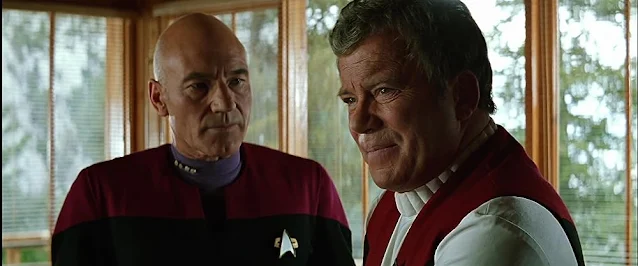
Star Trek Generations
Powers involved: Starfleet, the Klingon Empire through the Duras sisters, the El-Aurian refugees, the Nexus.
Central political conflict: a displaced El-Aurian will destroy an inhabited star system to re-enter the Nexus, and he is armed by Klingon renegades who trade him information for Federation shield frequencies.
What changes: the formal handover from one Starfleet generation to the next, the destruction of the Enterprise-D, and a demonstration that the post-Khitomer peace does not stop individual Klingon houses from arming the Federation's enemies. Read the Generations analysis.
Category: Institutional succession · Eras: Original Crew films and Next Generation films

Film 08 · 1996 · In universe 2373 and 2063 · Prime timeline
Star Trek: First Contact
Powers involved: Borg Collective, Starfleet, Earth, the Vulcan survey ship T’Plana-Hath.
Central political conflict: the Borg attempt to remove the Federation from history by preventing first contact between humans and Vulcans, which correctly identifies the single event the whole institution rests on.
What changes: the founding moment is defended rather than made, Picard's assimilation becomes a personal war rather than a policy question, and the Borg Queen establishes that the Collective has an individual at its centre after all. Read the First Contact film review and how the Borg became Star Trek’s most iconic antagonist.
Categories: Assimilation, Temporal interference · Era: Next Generation films

Film 09 · 1998 · In universe 2375 · Prime timeline
Star Trek: Insurrection
Powers involved: Federation Council, Starfleet, the Son’a, the Ba’ku, the Briar Patch.
Central political conflict: the Federation, mid-war and short of medical resources, agrees to relocate six hundred people so that a partner power can harvest the radiation that keeps them alive. The partner turns out to be the exiled children of the people being moved.
What changes: the Prime Directive is exposed as an instrument the Council will reinterpret under pressure, and a Starfleet captain mutinies against his own government to stop it. Read the Insurrection essay and the Prime Directive analysis.
Categories: Rebellion, Protectorate · Era: Next Generation films
Film 10 · 2002 · In universe 2379 · Prime timeline
Star Trek: Nemesis
Powers involved: Romulan Star Empire, the Remans, Starfleet, the Federation.
Central political conflict: a Reman coup led by a discarded clone of Picard murders the Romulan Senate and seizes the Praetorship, then offers the Federation a peace it has no intention of keeping.
What changes: the Star Empire's political centre is destroyed, the Reman underclass enters galactic politics as an armed actor, and the Romulan state enters the decline that the Hobus supernova will finish. Read Deconstructing Star Trek: Nemesis and its legacy and Jonathan Frakes at the director’s helm.
Categories: Rebellion, Institutional succession · Era: Next Generation films
Film 11 · 2009 · In universe 2233 and 2258 · Kelvin timeline
Star Trek
Powers involved: Starfleet, the Federation, Vulcan, the Romulan mining vessel Narada.
Central political conflict: a Romulan from the Prime future arrives in the past and destroys a Federation starship, creating a separate continuity. Twenty five years later he destroys Vulcan.
What changes: a founding member world is reduced to a refugee population of roughly ten thousand, which permanently alters the balance of the Federation this timeline builds. The Astromech has no dedicated review of the Kelvin films; for the surrounding context read the cinematic DNA of Star Trek and the complete chronology.
Categories: Temporal interference, War · Era: Kelvin timeline
Film 12 · 2013 · In universe 2259 · Kelvin timeline
Star Trek Into Darkness
Powers involved: Section 31, Starfleet Command, the Klingon Empire, Khan Noonien Singh.
Central political conflict: a Starfleet admiral revives a twentieth century warlord to design weapons, then attempts to provoke a war with the Klingon Empire that he believes is inevitable.
What changes: Section 31 moves from rumour to operational fact in this continuity, Starfleet's militarisation becomes explicit, and the Klingon conflict is deferred rather than resolved. The Astromech has no dedicated review; for the Prime version of the same character read the Space Seed review and The Wrath of Khan.
Categories: Covert manipulation, Military command · Era: Kelvin timeline
Film 13 · 2016 · In universe 2263 · Kelvin timeline
Star Trek Beyond
Powers involved: the Federation, Starfleet, Starbase Yorktown, Krall and the abandoned MACO crew.
Central political conflict: a former soldier, stranded and forgotten by the institution he served, attacks the Federation on the explicit argument that unity is weakness and conflict is what makes a species strong.
What changes: the film is the clearest Kelvin statement of the thesis this map is built on, that a federation is an argument rather than a fact and has to keep winning it. The Astromech has no dedicated review; read the cinematic DNA essay and browse the complete Star Trek hub.
Category: War · Era: Kelvin timeline
Static reference
The civilisation archive
A permanent text index of the powers plotted above, each with its Astromech reading. This section works with the interactive map switched off.
Founding powers and the Federation
Prime timeline · 2161 onward
United Federation of Planets and Starfleet
An interstellar union founded by four mutually suspicious species, and a service that is simultaneously a scientific institution, a diplomatic corps and a navy.
Prime timeline · 2151 to 2161
United Earth, Vulcan High Command, Andoria and Tellar
The four founding parties, and a decade of arguments that the Federation charter never entirely settled.
Empires and rival powers
Prime timeline · all eras
Klingon Empire and the Klingon Defense Force
A warrior aristocracy whose politics are conducted through honour claims, house rivalry and, after Praxis, straightforward economic necessity.
Prime timeline · 2156 to 2401
Romulan Star Empire, the Tal Shiar and the Remans
A security state that prefers cloaked proxies to open war, an intelligence service more powerful than its Senate, and a subject population that eventually seizes the throne.
Prime timeline · 2328 to 2375
Cardassian Union, the Obsidian Order and Bajor
A military government, its surveillance apparatus, and the world it occupied for forty years and then abandoned.
Prime timeline · 2365 onward
The Borg Collective
The only antagonist that wants the Federation rather than its territory, and the reason Starfleet started building warships again.
Regional powers, stations and frontier species
Prime timeline · 2250s onward
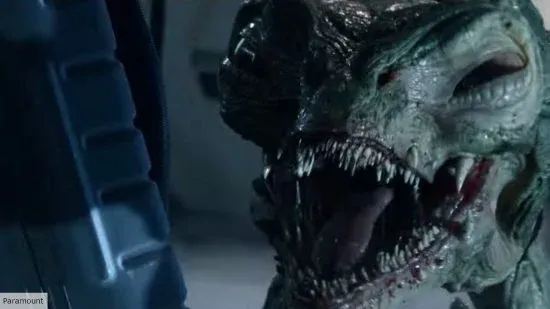
Gorn Hegemony, Tholian Assembly and the Orion Syndicate
Three powers that define the Federation's borders by refusing to behave like states it can negotiate with.
Prime timeline · 2369 onward
Deep Space Nine, the Bajoran wormhole and the Ferengi Alliance
A Cardassian station under joint Bajoran and Starfleet administration, guarding the only stable passage to the Gamma Quadrant, with a bar at the centre of the local economy.
Command figures
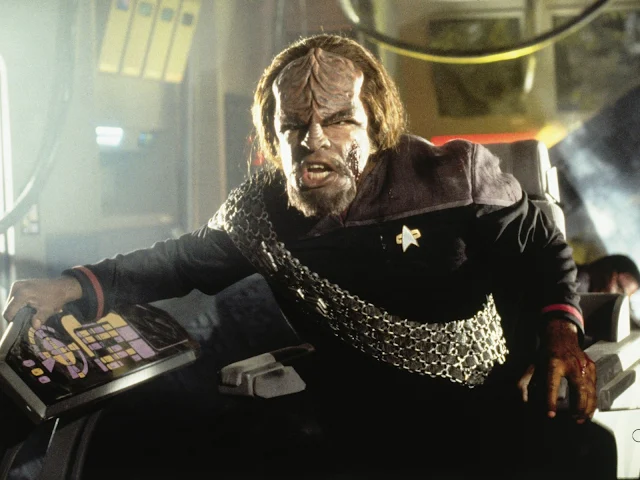
Prime timeline · 2364 onward
Worf, Picard, Sisko, Janeway and Seven of Nine
Five officers who each personally carry a political relationship the Federation could not resolve institutionally.
Reading path
The Star Trek reading guide
Five routes through The Astromech’s Star Trek archive, ordered so each builds on the last.
Route one · Orientation
Get four centuries in order first
Route two · The Borg
Assimilation, trauma and the Queen
Route three · The films
Ten Prime timeline reviews in order
Route four · The series
Where to start with each show
Route five · Ideas
The episodes that argue with the Federation
Editorial images on this page are sourced from the linked Astromech articles and each caption links back to its originating post. Faction glyphs, relationship icons, orbital markings and LCARS inspired panels are original SVG and CSS artwork created for this feature; no official Starfleet interface, faction logo or studio asset has been reproduced. Prime, Kelvin, Mirror and alternate timelines are held on separate layers and are never joined by an ordinary historical relationship.
Skip to the relationship map Skip to the civilisation archive Kirk and Spock in The O...
Read Article →
_poster.jpg)


