

The Astromech · Interactive Star Trek Feature
The Powers of the Final Frontier
The Star Trek Civilisations, Alliances and Conflicts Map
Every alliance tests the distance between Federation ideals and political survival.
Star Trek is usually described as optimistic. It is more accurately a four-century argument about what a liberal, post-scarcity federation is willing to do when its neighbours will not behave. The Federation is founded by four species who spent a century mistrusting each other. It signs a peace with the Klingons only after an ecological catastrophe makes the Empire negotiate. It abandons its own colonists to the Cardassians, tolerates a secret intelligence service it refuses to acknowledge, and fights a war of survival beside two empires it had spent generations opposing.
This map plots those compromises. Select a node to open a civilisation card, select a line to read the relationship behind it, and move between eras to watch power change hands. The thirteen theatrical films sit inside the graph as political turning points rather than beside it. Every card links back to The Astromech’s complete Star Trek archive. If you want the sequence first, start with the full chronological timeline of Star Trek television and films.
Continuity note. The Prime timeline is the default view. The Kelvin timeline, the Mirror Universe and temporary alternate histories are held on separate layers, and entities from different continuities are never joined by an ordinary historical relationship. Where the map compares one continuity with another, the connection is labelled Continuity parallel and drawn as a dotted crimson line.
Archive controls
Filter the political map
Narrow the display by continuity, historical era, entity type, relationship category and spoiler tolerance. All filters combine, and the status line under the map reports exactly what is visible.
Keyboard: Tab moves between entities, Enter or Space opens a card, Esc closes it, + and − zoom, arrow keys pan the map.
Relationship legend
Every relationship carries an icon, a written label and a line pattern, so no category depends on colour alone.
Diplomatic holochart
The relationship map
Drag the background to pan, drag an entity to reposition it, scroll or use the controls to zoom. Selecting an entity highlights its direct relationships and opens a full width card beneath the map.
No entities match the current filters. Reset the map or widen the era and continuity selection.
Entity
Relationship
Comparison
Chronology
Four centuries in fourteen positions
Selecting an era filters the map to the powers and relationships active in that window. The Kelvin timeline sits deliberately outside the Prime sequence. For the complete viewing order, read The Astromech’s chronological timeline of Star Trek.
Featured editorial
Fourteen political fault lines
The relationships that decide what the Federation actually is, as opposed to what its charter says it is.
Fault line 01 · Founding membership · 2151 to 2161
The founding of the United Federation of Planets
The Federation is not founded by friends. Humans, Vulcans, Andorians and Tellarites spend the 2150s in a state of mutual contempt: Vulcan treats Earth as an adolescent that should not have warp drive, Andoria and Vulcan are in a shooting rivalry over Weytahn, and Tellarite diplomacy is indistinguishable from insult. What forces them together is a shared threat and a human willingness to mediate between species who will not talk directly. The Coalition of Planets becomes the Federation because Archer keeps arranging rooms in which enemies have to sit down.
The founding compromise is the thing to watch: a charter written by four powers who do not trust each other produces an institution permanently torn between principle and expediency. Follow the sequence in The Astromech’s chronological timeline and the series itself in the ten best Star Trek: Enterprise episodes.
Era: Enterprise, 2151 to 2161 · Continuity: Prime · Category: Founding membership

Fault line 02 · War, treaty, alliance · 2256 to 2375
Federation and Klingon hostility, detente and alliance
No relationship in Star Trek travels further. The Federation and the Klingon Empire begin in open war in the 2250s, spend the 2260s in a cold standoff mediated by Organian intervention, sign the Khitomer Accords in 2293 after Praxis explodes, and by the 2360s are close enough that a Klingon officer serves on the Federation flagship. The alliance is then broken by Changeling infiltration and repaired only when the Dominion becomes the larger threat.
What makes it durable is that both sides get something the other cannot supply. The Klingons gain an industrial partner after an ecological catastrophe; the Federation gains a buffer and, eventually, an ally with an appetite for the fighting it dislikes doing itself. Read the review of The Undiscovered Country and the collected quotes of Worf, Starfleet’s indomitable Klingon.
Eras: Original Series through Dominion War · Continuity: Prime · Categories: War, Treaty, Formal alliance
Fault line 03 · War, espionage, treaty · 2156 to 2401
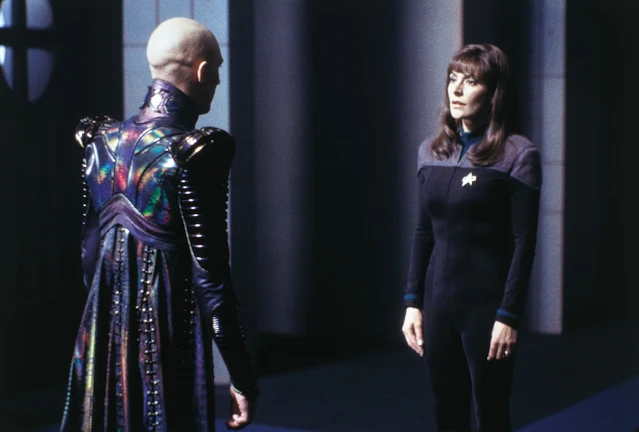
Federation and Romulan rivalry
The Romulan relationship is defined by information rather than territory. The Earth-Romulan War is fought without either side seeing the other; the Neutral Zone that ends it is a border made of ignorance. For two centuries afterwards the Star Empire prefers proxies, cloaks and the Tal Shiar to open engagement, which makes every Romulan appearance in the Prime timeline a question of what is actually being negotiated underneath the conversation.
The relationship only breaks open twice: the Dominion War, when Sisko manufactures the case that drags Romulus into the alliance, and the Hobus supernova, which destroys the homeworld and turns the Empire into a refugee problem the Federation votes not to solve. Read the Nemesis analysis and The Astromech on the choices Star Trek captains are forced to make.
Eras: Enterprise through Picard · Continuity: Prime · Categories: War, Espionage, Treaty

Fault line 04 · Occupation · 2328 to 2369
The Cardassian occupation of Bajor
Forty years of annexation, forced labour and resource stripping, ended not by liberation but by withdrawal: the Union leaves because Bajor stopped being profitable. That single fact shapes everything Deep Space Nine does afterwards. Bajor emerges with a provisional government nobody fully trusts, a militia made of former terrorists, a religious authority with more legitimacy than the state, and a station the Cardassians built with slave labour and left behind.
The Federation arrives as an administrator of somebody else’s wreckage, and spends seven years discovering that its principles were designed for first contact rather than post-colonial reconstruction. Cardassian methods against Starfleet officers are examined directly in The Astromech’s reading of Chain of Command, Part II, and the ethical frame in the essay on the Prime Directive.
Eras: The Lost Era, Deep Space Nine · Continuity: Prime · Category: Occupation
Fault line 05 · Rebellion · 2370 to 2373
The Maquis and the colonies the Federation traded away
The Maquis are the most uncomfortable political fact in Star Trek because they are made entirely of Federation citizens. A border treaty with Cardassia places established colonies on the wrong side of a line, the Council tells those colonists to relocate, and they refuse. What follows is not an alien threat but a resistance movement staffed by former Starfleet officers who believe the Federation broke its own promise to defend them.
The Maquis prove that the Federation's ideals are negotiable when the alternative is war, and they set up Voyager's entire premise: a crew half composed of people the institution had recently labelled terrorists. Read The Astromech’s ten best Voyager episodes and the analysis of the Prime Directive as an ethical instrument.
Eras: The Next Generation, Deep Space Nine and Voyager · Continuity: Prime · Category: Rebellion
Fault line 06 · War · 2373 to 2375
The Dominion War
The Dominion War is the moment the Federation stops being a exploratory service with weapons and becomes a war economy. It fights alongside the Klingon Empire, then alongside the Romulan Star Empire after a Starfleet captain and a Cardassian tailor forge the evidence that brings Romulus in. It accepts a Cardassian defection at the end that costs the Cardassian people eight hundred million dead. It wins, and the winning is what the following three decades of Star Trek are quietly about.
The war is also the reason Section 31 becomes a live question rather than a rumour: an organisation prepared to commit genocide against the Founders is either the Federation's shameful secret or its immune system, and the franchise has never fully decided. Read the essay on the calls Star Trek captains make.
Era: Deep Space Nine and Voyager, 2373 to 2375 · Continuity: Prime · Category: War
Fault line 07 · Political authority · 2370 to 2375
The Dominion hierarchy of Founders, Vorta and Jem’Hadar
The Dominion is the most efficiently designed state in Star Trek, and its design is the argument. Shapeshifting Founders rule as literal gods; Vorta administrators are cloned, engineered to worship, and replaced whenever one dies; Jem’Hadar soldiers are bred with a chemical addiction that makes desertion biologically impossible. Nothing is left to loyalty when dependency will do.
Set against the Federation it forms a clean thesis: two galactic powers built by species who were once persecuted, one choosing consent and the other choosing control. The Founders' stated motive, order imposed so that solids can never hunt them again, is the same fear the Federation answers with a charter. Follow the era through the chronological timeline and the wider archive on The Astromech’s Star Trek hub.
Era: Deep Space Nine, 2370 to 2375 · Continuity: Prime · Category: Political authority
Fault line 08 · Assimilation · 2365 to 2401
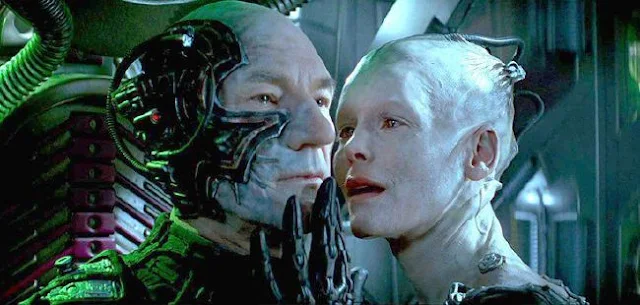
The Borg and the threat to Federation individuality
Every other antagonist in Star Trek wants territory, resources or revenge. The Borg want the Federation itself, absorbed rather than defeated, and that is why they work. A civilisation whose founding value is the dignity of the individual is confronted by a power that regards individuality as an inefficiency to be corrected, and offers assimilation as an improvement rather than a punishment.
Wolf 359 costs eleven thousand lives and turns the Federation into a militarising power years before the Dominion arrives. It also produces the franchise's most durable study of trauma, since Picard is not a survivor of an attack but a participant in one. Read The Astromech’s analysis of the legacy of the Borg, then Picard’s trauma after assimilation and the Borg Queen as a complex antagonist.
Eras: The Next Generation through Picard · Continuity: Prime · Category: Assimilation
Fault line 09 · Covert manipulation · 2150s to the 32nd century
Section 31 and the limits of Federation ethics
Section 31 exists because someone read the Starfleet Charter and decided that extraordinary measures needed no oversight. It has no budget line, no accountable officer and no formal existence, which is precisely its argument: a democracy that wants clean hands can outsource the dirty work to a body it never has to admit owning.
Its interventions are not marginal. It attempts to exterminate the Founders through a manufactured disease, manipulates the Romulan succession, and in the Kelvin timeline drives Starfleet toward open militarisation. The uncomfortable point the franchise keeps returning to is that Section 31 usually works, which forces the question of whether the Federation's ideals survive because of its principles or because someone else is quietly suspending them. Read the essay on the Prime Directive and its ethical limits.
Eras: Enterprise through the 32nd century · Continuity: Prime and Kelvin · Category: Covert manipulation
Fault line 10 · Treaty · 2293
The Khitomer peace process
The Khitomer Accords are the franchise's clearest statement that peace is made by people who do not want it. Praxis explodes, the Klingon Empire faces ecological collapse, and a negotiation begins that is opposed by hardliners in Starfleet, the Klingon Defense Force and the Romulan Star Empire simultaneously. The conspiracy to wreck it is a coalition of enemies who agree on nothing except that the war should continue.
Kirk is the least suitable diplomat available and the most necessary one, because his prejudice is the prejudice that has to be publicly overcome. The treaty holds for eighty years and makes every later Federation and Klingon alliance possible. Read The Astromech’s review of The Undiscovered Country.
Era: Original Crew films, 2293 · Continuity: Prime · Category: Treaty

Fault line 11 · Institutional succession · 2379 to 2401
The destruction of Romulus and its political aftermath
Nemesis begins the collapse: a Reman coup installs a Praetor who is a clone of a Starfleet captain, the Senate is murdered, and the Star Empire's political centre never recovers its authority. The Hobus supernova finishes the job. What follows is the Federation's most revealing decision in two centuries. It agrees to evacuate hundreds of millions of Romulans, then cancels the operation after an attack on Mars, and a founding member world withdraws its support.
The refusal is not villainy but institutional self-protection, which is worse: a union built on the premise that difference is worth defending decides that this particular difference costs too much. The residue is a fractured Empire, a Reman underclass with a grievance, and a Federation that has to be argued back into its own charter. Read the Nemesis analysis and the Worf archive.
Eras: Next Generation films through Picard · Continuity: Prime · Category: Institutional succession
Fault line 12 · Institutional succession · 3069 to the 3190s
The Burn and the rebuilding of the 32nd century Federation
A galaxy wide detonation of almost all active warp cores ends interstellar civilisation in a single moment. What survives is instructive: the Federation contracts to a few dozen members and a hidden headquarters, the Orion and Andorian criminal economy expands into the vacuum as the Emerald Chain, and Ni’Var, the reunified Vulcan and Romulan world, withdraws entirely.
The 32nd century arc is therefore a founding story told backwards. The Federation has to persuade worlds to rejoin using nothing but the memory of what membership meant, which is the sharpest test the institution ever faces: an alliance with no fleet, no dilithium and no leverage, offering only its ideals. Follow the full sequence in The Astromech’s chronological timeline of Star Trek.
Era: Discovery in the 32nd century · Continuity: Prime · Category: Institutional succession
Fault line 13 · Continuity parallel · 2233 onward
Prime and Kelvin timeline divergence
A Romulan mining vessel arrives from the future, destroys the USS Kelvin, and everything downstream changes. Vulcan is destroyed twenty five years later and its survivors number in the tens of thousands, which removes the Federation's oldest founding partner from the board entirely. Starfleet in this continuity is younger, more improvised and considerably more willing to arm itself.
This map keeps the two continuities on separate layers. Kelvin entities never share a historical relationship with Prime entities, and the only connections drawn between them are labelled Continuity parallel: editorial comparisons, not events. The same person can exist in both and have led an entirely different life. Read the wider film context in The Astromech on the cinematic DNA of Star Trek.
Era: Kelvin timeline, 2233 onward · Continuity: Kelvin · Category: Continuity parallel
Fault line 14 · Continuity parallel · Mirror Universe
The Terran Empire as an inversion of the Federation
The Mirror Universe is not a horror story about evil twins. It is a controlled experiment: take the same species, the same technology and the same first contact, and replace the founding value of cooperation with conquest. The result is the Terran Empire, which subjugates exactly the species the Federation recruited, and is eventually overthrown by an alliance of Klingons, Cardassians and Bajorans, the powers the Prime Federation spent centuries negotiating with.
Treating the Terran Empire as a distinct entity rather than a costume change is the point. Its relationships are drawn only to other Mirror entities on this map, and any comparison with a Prime power is labelled Continuity parallel. Browse the archive on The Astromech’s Star Trek hub.
Eras: Original Series and Deep Space Nine · Continuity: Mirror Universe · Category: Continuity parallel
Feature archive
The films as political turning points
All thirteen theatrical films, read as diplomatic events rather than adventures. Each one appears as a node inside the map above, connected to the powers it moved. Browse the wider film coverage in The Astromech’s essay on the cinematic DNA of Star Trek.

Film 01 · 1979 · In universe 2273 · Prime timeline
Star Trek: The Motion Picture
Powers involved: United Federation of Planets, Starfleet, Earth, V’Ger.
Central political conflict: a machine intelligence built from a human probe returns to Earth demanding to meet its creator, and Starfleet has no diplomatic category for an entity that is simultaneously a threat, a child and an artefact of its own history.
What changes: Starfleet is confirmed as an exploratory service whose first instinct under existential threat is still contact rather than fire, and Earth itself becomes a target for the first time in the film era. Read the full thematic analysis of The Motion Picture.
Category: Cultural exchange · Era: Original Crew films

Film 02 · 1982 · In universe 2285 · Prime timeline
Star Trek II: The Wrath of Khan
Powers involved: Starfleet, the Federation Science Council, Khan Noonien Singh and the Botany Bay exiles, Ceti Alpha V, the Genesis Project.
Central political conflict: a Starfleet terraforming programme with obvious weapons applications is developed without oversight, and a man Starfleet exiled and then forgot takes it.
What changes: the Federation is forced to confront the fact that its scientific idealism produces weapons whether it intends to or not, and Genesis becomes a strategic object that reshapes the next two films. Read why The Wrath of Khan is the greatest sequel ever made and the original episode in the Space Seed review.
Category: War · Era: Original Crew films

Film 03 · 1984 · In universe 2285 · Prime timeline
Star Trek III: The Search for Spock
Powers involved: Starfleet Command, Kirk’s crew, the Klingon Empire, the Genesis Planet, Vulcan.
Central political conflict: Starfleet quarantines Genesis and forbids the mission, so its most decorated officers steal a starship. Meanwhile a Klingon commander concludes that a Federation device capable of remaking planets is a weapon of genocide, which is not an unreasonable reading.
What changes: the Federation loses the Enterprise and Kirk loses his commission, Genesis is destroyed and permanently discredited, and the Klingon grievance that drives the next two films is established. Read the full review of The Search for Spock.
Category: Rebellion · Era: Original Crew films
Film 04 · 1986 · In universe 2286 · Prime timeline
Star Trek IV: The Voyage Home
Powers involved: Federation Council, Starfleet, Earth, the Klingon ambassador, the probe.
Central political conflict: an alien probe threatens Earth because humanity exterminated a species, and the Federation Council is simultaneously conducting a show trial of the officers who saved it. The Klingon ambassador demands Kirk's extradition in front of the assembly.
What changes: Earth's ecological history becomes a matter of galactic consequence, Kirk's crew is politically rehabilitated, and the Klingon demand for justice is publicly refused, which sets the tone for the hostility that runs to Khitomer. Read The Astromech’s review of The Voyage Home.
Category: Temporal interference · Era: Original Crew films
Film 05 · 1989 · In universe 2287 · Prime timeline
Star Trek V: The Final Frontier
Powers involved: Federation, Klingon Empire, Romulan Star Empire, Nimbus III, Sybok’s movement.
Central political conflict: Nimbus III is a jointly administered planet, a shared Federation, Klingon and Romulan project that all three powers have neglected into a slum. A Vulcan preacher takes the settlement hostage and all three governments send ships.
What changes: the Planet of Galactic Peace is the clearest evidence that the three great powers can cooperate only on projects none of them cares about, and the film ends with a Klingon apology that briefly gestures at the detente to come. Read The Astromech on The Final Frontier.
Category: Temporary cooperation · Era: Original Crew films
Film 06 · 1991 · In universe 2293 · Prime timeline
Star Trek VI: The Undiscovered Country
Powers involved: Federation, Klingon Empire, Romulan Star Empire, Starfleet hardliners, Khitomer.
Central political conflict: Praxis explodes, the Klingon Empire has perhaps fifty years of life left, and peace becomes the only survivable option for a power that has defined itself by war. A conspiracy of Starfleet officers, Klingon generals and a Romulan ambassador tries to stop it.
What changes: the Khitomer Accords are signed, the Neutral Zone begins to open, and the alliance that will fight the Dominion War eighty years later becomes possible. Read the review of The Undiscovered Country.
Category: Treaty · Era: Original Crew films
Film 07 · 1994 · In universe 2293 and 2371 · Prime timeline
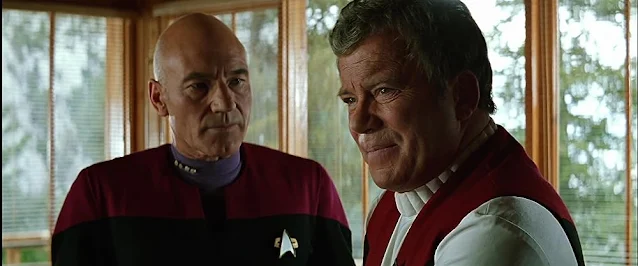
Star Trek Generations
Powers involved: Starfleet, the Klingon Empire through the Duras sisters, the El-Aurian refugees, the Nexus.
Central political conflict: a displaced El-Aurian will destroy an inhabited star system to re-enter the Nexus, and he is armed by Klingon renegades who trade him information for Federation shield frequencies.
What changes: the formal handover from one Starfleet generation to the next, the destruction of the Enterprise-D, and a demonstration that the post-Khitomer peace does not stop individual Klingon houses from arming the Federation's enemies. Read the Generations analysis.
Category: Institutional succession · Eras: Original Crew films and Next Generation films

Film 08 · 1996 · In universe 2373 and 2063 · Prime timeline
Star Trek: First Contact
Powers involved: Borg Collective, Starfleet, Earth, the Vulcan survey ship T’Plana-Hath.
Central political conflict: the Borg attempt to remove the Federation from history by preventing first contact between humans and Vulcans, which correctly identifies the single event the whole institution rests on.
What changes: the founding moment is defended rather than made, Picard's assimilation becomes a personal war rather than a policy question, and the Borg Queen establishes that the Collective has an individual at its centre after all. Read the First Contact film review and how the Borg became Star Trek’s most iconic antagonist.
Categories: Assimilation, Temporal interference · Era: Next Generation films

Film 09 · 1998 · In universe 2375 · Prime timeline
Star Trek: Insurrection
Powers involved: Federation Council, Starfleet, the Son’a, the Ba’ku, the Briar Patch.
Central political conflict: the Federation, mid-war and short of medical resources, agrees to relocate six hundred people so that a partner power can harvest the radiation that keeps them alive. The partner turns out to be the exiled children of the people being moved.
What changes: the Prime Directive is exposed as an instrument the Council will reinterpret under pressure, and a Starfleet captain mutinies against his own government to stop it. Read the Insurrection essay and the Prime Directive analysis.
Categories: Rebellion, Protectorate · Era: Next Generation films
Film 10 · 2002 · In universe 2379 · Prime timeline
Star Trek: Nemesis
Powers involved: Romulan Star Empire, the Remans, Starfleet, the Federation.
Central political conflict: a Reman coup led by a discarded clone of Picard murders the Romulan Senate and seizes the Praetorship, then offers the Federation a peace it has no intention of keeping.
What changes: the Star Empire's political centre is destroyed, the Reman underclass enters galactic politics as an armed actor, and the Romulan state enters the decline that the Hobus supernova will finish. Read Deconstructing Star Trek: Nemesis and its legacy and Jonathan Frakes at the director’s helm.
Categories: Rebellion, Institutional succession · Era: Next Generation films
Film 11 · 2009 · In universe 2233 and 2258 · Kelvin timeline
Star Trek
Powers involved: Starfleet, the Federation, Vulcan, the Romulan mining vessel Narada.
Central political conflict: a Romulan from the Prime future arrives in the past and destroys a Federation starship, creating a separate continuity. Twenty five years later he destroys Vulcan.
What changes: a founding member world is reduced to a refugee population of roughly ten thousand, which permanently alters the balance of the Federation this timeline builds. The Astromech has no dedicated review of the Kelvin films; for the surrounding context read the cinematic DNA of Star Trek and the complete chronology.
Categories: Temporal interference, War · Era: Kelvin timeline
Film 12 · 2013 · In universe 2259 · Kelvin timeline
Star Trek Into Darkness
Powers involved: Section 31, Starfleet Command, the Klingon Empire, Khan Noonien Singh.
Central political conflict: a Starfleet admiral revives a twentieth century warlord to design weapons, then attempts to provoke a war with the Klingon Empire that he believes is inevitable.
What changes: Section 31 moves from rumour to operational fact in this continuity, Starfleet's militarisation becomes explicit, and the Klingon conflict is deferred rather than resolved. The Astromech has no dedicated review; for the Prime version of the same character read the Space Seed review and The Wrath of Khan.
Categories: Covert manipulation, Military command · Era: Kelvin timeline
Film 13 · 2016 · In universe 2263 · Kelvin timeline
Star Trek Beyond
Powers involved: the Federation, Starfleet, Starbase Yorktown, Krall and the abandoned MACO crew.
Central political conflict: a former soldier, stranded and forgotten by the institution he served, attacks the Federation on the explicit argument that unity is weakness and conflict is what makes a species strong.
What changes: the film is the clearest Kelvin statement of the thesis this map is built on, that a federation is an argument rather than a fact and has to keep winning it. The Astromech has no dedicated review; read the cinematic DNA essay and browse the complete Star Trek hub.
Category: War · Era: Kelvin timeline
Static reference
The civilisation archive
A permanent text index of the powers plotted above, each with its Astromech reading. This section works with the interactive map switched off.
Founding powers and the Federation
Prime timeline · 2161 onward
United Federation of Planets and Starfleet
An interstellar union founded by four mutually suspicious species, and a service that is simultaneously a scientific institution, a diplomatic corps and a navy.
Prime timeline · 2151 to 2161
United Earth, Vulcan High Command, Andoria and Tellar
The four founding parties, and a decade of arguments that the Federation charter never entirely settled.
Empires and rival powers
Prime timeline · all eras
Klingon Empire and the Klingon Defense Force
A warrior aristocracy whose politics are conducted through honour claims, house rivalry and, after Praxis, straightforward economic necessity.
Prime timeline · 2156 to 2401
Romulan Star Empire, the Tal Shiar and the Remans
A security state that prefers cloaked proxies to open war, an intelligence service more powerful than its Senate, and a subject population that eventually seizes the throne.
Prime timeline · 2328 to 2375
Cardassian Union, the Obsidian Order and Bajor
A military government, its surveillance apparatus, and the world it occupied for forty years and then abandoned.
Prime timeline · 2365 onward
The Borg Collective
The only antagonist that wants the Federation rather than its territory, and the reason Starfleet started building warships again.
Regional powers, stations and frontier species
Prime timeline · 2250s onward
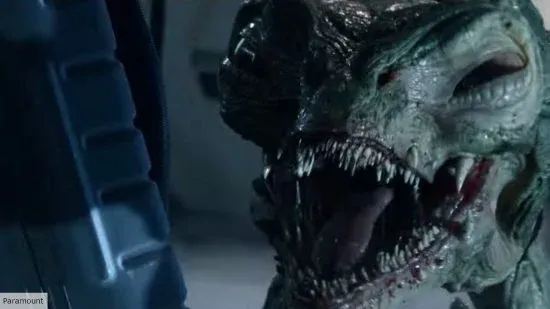
Gorn Hegemony, Tholian Assembly and the Orion Syndicate
Three powers that define the Federation's borders by refusing to behave like states it can negotiate with.
Prime timeline · 2369 onward
Deep Space Nine, the Bajoran wormhole and the Ferengi Alliance
A Cardassian station under joint Bajoran and Starfleet administration, guarding the only stable passage to the Gamma Quadrant, with a bar at the centre of the local economy.
Command figures
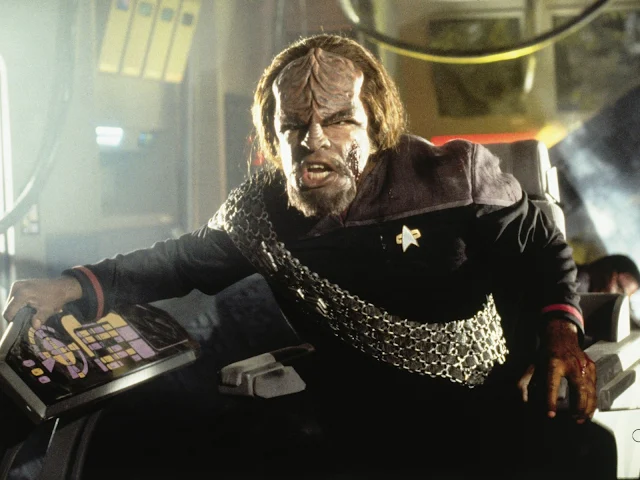
Prime timeline · 2364 onward
Worf, Picard, Sisko, Janeway and Seven of Nine
Five officers who each personally carry a political relationship the Federation could not resolve institutionally.
Reading path
The Star Trek reading guide
Five routes through The Astromech’s Star Trek archive, ordered so each builds on the last.
Route one · Orientation
Get four centuries in order first
Route two · The Borg
Assimilation, trauma and the Queen
Route three · The films
Ten Prime timeline reviews in order
Route four · The series
Where to start with each show
Route five · Ideas
The episodes that argue with the Federation
Editorial images on this page are sourced from the linked Astromech articles and each caption links back to its originating post. Faction glyphs, relationship icons, orbital markings and LCARS inspired panels are original SVG and CSS artwork created for this feature; no official Starfleet interface, faction logo or studio asset has been reproduced. Prime, Kelvin, Mirror and alternate timelines are held on separate layers and are never joined by an ordinary historical relationship.


_poster.jpg)


