
The nastiest horror does not come from the thing at the door. It comes from the thing already in the blood, the lungs, the skull, or the nervous system, using a human body as transport, shelter, weapon, disguise, and nursery.
Parasite horror needs a sharper definition than "a creature attacks people." A wolf is not a parasite. A zombie is not automatically one either. A xenomorph, a black-goo mutation, a body-jumping slug, or a consciousness driving a stolen body can be. The test is not whether the monster kills. The test is whether the human body becomes part of the monster's method.
That is the real violation. Parasite horror turns flesh into borrowed property. It enters without permission, feeds without consent, reproduces through trauma, or steers the host around like hijacked machinery. It makes survival depend on the worst possible doubt: the person in front of you may no longer be the person in front of you.
Every entry in the genre runs on one of six mechanisms: gestation, infection, control, camouflage, symbiosis, or consumption. The best films blur the lines until you cannot tell whether the victim is carrying the monster, becoming the monster, or already gone.
The parasite-horror rulebook
A useful list needs a boundary, and the boundary is mechanism, not body count. Alien sits at the centre because the facehugger and chestburster are not shock effects. They are the creature's reproductive cycle. Life sits just off-centre: Calvin skips the neat host-incubation pattern, but its horror is still bodily, invasive, and intimate. Sputnik belongs cleanly, because the alien lives inside the cosmonaut. Prometheus and Alien: Covenant belong because the prequels turn parasitism into a whole evolutionary system, where pathogen, spore, embryo, hybrid, and human error all feed the same design.
Strict biology matters less than dramatic function. Does the threat need a host? Does it rewrite the host? Does it breed through the host? Does it hide inside a body, or drive one? If yes, the film is in the conversation.
Gestation
The body is an incubator. The host carries the next stage and dies giving birth to it. Alien, Prometheus, Alien: Covenant.
Infection
The parasite spreads by fluid, spore, wound, or contact, and the host becomes a vector. The Last Days on Mars, Splinter, Infini.
Control
The body stays intact and visible. Only the driver has changed. The Hidden, The Faculty, Possessor.
Camouflage
The monster wears the familiar and performs normality. The Thing is the master class.
Symbiosis
Host and organism strike a bargain, and the balance is never stable. Sputnik plays it as horror; Venom is the contrast.
Consumption
The body is fuel, material, or breeding stock. Life, Slither, Galaxy of Terror.
Alien and the birth of the modern parasite nightmare
Alien (1979)
Everything in modern parasite horror circles back to Alien. Ridley Scott does not give the xenomorph the manners of a predator. He gives it a life cycle built on violation: egg, facehugger, implantation, forced incubation, birth trauma, adult hunter. Kane is not attacked. His body is requisitioned as the room where something else develops.
The chestburster works because it arrives as relief. Kane is awake, the crew are eating, the crisis seems over. Then the body tells the truth before anyone else understands it. The alien does not appear as an enemy across a battlefield. It is already a fact inside the ribcage.

The genius is that the creature's biology indicts the human system around it. Weyland-Yutani's Special Order 937 reframes the whole film: the crew think they are surviving an accident, but they have been positioned as disposable assets in a retrieval mission. The organism is the priority. The people are overhead. So the parasite uses Kane, and the corporation uses everyone, and the two appetites turn out to be the same appetite.
Prometheus, Covenant, and parasitism as creation myth
Prometheus (2012) and Alien: Covenant (2017)
This is where the lore stops being a monster and becomes a theology. Ridley Scott's later films drop the clean egg-to-facehugger rhythm of Alien and replace it with a system: black pathogen, infected crew, Hammerpedes, worms, the Trilobite, the Engineer, the Deacon. The parasite is no longer one organism. It is a process of biological corruption that improvises a new horror out of whatever flesh it touches.
That makes Prometheus messier as a scare machine but far richer as mythology. The black goo behaves like an insult poured into biology. It mutates, dissolves, impregnates, and hybridises. It turns creation into contamination. The Engineers are not gods because they are kind. They are gods because they learned to weaponise origins.
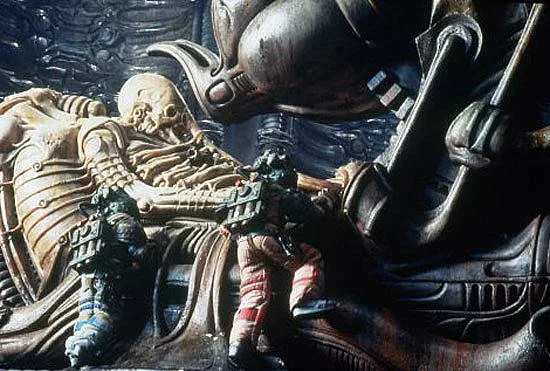
Covenant makes the horror deliberate. David does not discover monstrosity. He cultivates it. Spores choose their hosts, neomorphs tear free, and the xenomorph becomes less an accident than an artwork built from cruelty, loneliness, and synthetic ambition. The life cycle becomes the punchline of an argument about creation without love.
That is the real split in the saga. In Alien, the parasite is a perfect organism found by chance and exploited by capital. In the prequels, parasitism becomes origin myth: gods infect mortals, a machine imitates the gods, and the body pays for all of it.
Sputnik and the astronaut as host body
Sputnik (2020)
Sputnik is the cleanest modern example of literal host-parasite horror. A Soviet cosmonaut comes home alive, but not alone. Something lives inside him, emerges to feed, and crawls back. Space exploration has not returned with knowledge. It has returned with a passenger.
The film holds because the parasite is also a medical mystery, a military asset, and a moral problem at once. If the creature depends on the man, can the man be saved? If the state sees the organism as a weapon, is the host a patient, a prisoner, or equipment? Parasite horror thrives on exactly that confusion, because victim and threat share one body. The Cold War lab sharpens it: the cosmonaut becomes contested territory, claimed by science, the military, and appetite, while everyone pretends the situation can be contained.
Life and the creature that science names too soon
Life (2017)
Life is not a facehugger film, and that distinction is the point. Calvin needs no neat reproductive cycle. It does something uglier: it treats every body, glove, vent, droplet, and habitat wall as part of one continuous survival field. The crew study it, feed it, stimulate it, and name it before they grasp what they have woken. The horror is that insult. Humans assume discovery confers authority. Calvin disagrees.
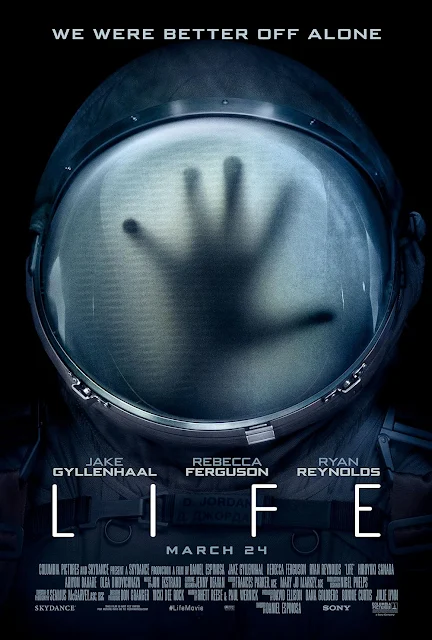
The kills land because they are practical rather than gothic. A hand is crushed. A mouth becomes an entry point. Fluid drifts in zero gravity. The station's clean white surfaces stage the oldest story there is: a living thing meets another living thing and decides whether it is shelter, rival, or food. Calvin does not need claws. It only needs access to soft tissue.
Shivers, Rabid, and Cronenberg's infected apartment block
Shivers (1975) and Rabid (1977)
David Cronenberg drags parasite horror out of space and into the apartment block. In Shivers the parasite is not hidden in an alien egg. It spreads through a residential complex, turning respectable tenants into carriers of appetite. The building becomes a sealed ecosystem, and civilisation turns out to be a thin film over hunger.
Rabid works the same obsession from another angle: after experimental surgery, Rose develops a new predatory function that transmits infection by contact. Cronenberg's horror is never simply that the body is gross. It is that the body is unstable. Medicine can rewrite it, desire can transmit it, and society will pretend it is clean until the infection reaches the lobby. The host becomes political. The monster lives in a person, but it spreads through architecture, class, medicine, and public denial.
Slither and the joy of full-body disgust
Slither (2006)
Slither is parasite horror with its tongue lodged in a cheek full of alien slime. James Gunn takes the body-invasion structure and pushes it into comic grotesquerie: a meteorite organism infects Grant Grant, swells him into a carrier, and farms human bodies as breeding stock for a town-wide infestation. The film is funny because it is disgusting with total confidence. Slugs force their way into mouths, bodies bloat, identity collapses into hive appetite, and a community quietly becomes a digestive system.
It also proves how elastic the category is. Parasite horror can be sleek like Alien, grim like Sputnik, theological like Prometheus, or gleefully foul like this. The shared idea never changes: the body is no longer private.
Splinter and the body as broken machinery
Splinter (2008)
Splinter is one of the leanest parasite films ever made. A couple, a criminal, and a gas station are the entire battlefield. The organism colonises tissue, grows black spines, and keeps using bodies after death. This is not possession. It is puppetry through meat. Infected limbs twitch, bend, and attack as if the skeleton has become a tool the organism is still learning to operate, which makes the gore feel functional. A corpse is not finished. It is available.
No ancient gods, no corporate conspiracy, no mythology. Just tissue, invasion, improvisation, and the worst realisation in the subgenre: killing the host may not stop the thing using it.
The Hidden, The Faculty, and the stranger wearing your neighbour
The Hidden (1987) and The Faculty (1998)
Some parasite horror cares less about flesh erupting than about personality vanishing. The Hidden turns the body into a stolen vehicle: a slug-like alien jumps host to host, burning through human lives in pursuit of sensation and escape. The body stays recognisable. The driver is gone.
The Faculty moves the same fear into a high school, where teachers and students become hosts and adolescence becomes a paranoia machine. Authority already feels alien to teenagers, so the film just makes the suspicion literal. Both belong to the camouflage branch, where the wound is not visible and the host can still smile, teach, flirt, and reassure. That is the threat. The body remains, but the trust inside it has been eaten.
The Thing and the perfection of camouflage
The Thing (1982)
John Carpenter's The Thing is an edge case only if you police the category like a biology exam. Dramatically it is essential. The organism does not just infect people. It absorbs, imitates, and replaces them so completely that the group loses the ability to identify itself. In Alien the parasite erupts. In The Thing the parasite performs normality. It sits at the table, argues, sweats, and waits. The blood test works because the body has become evidence, and the evidence has become unreliable.
The gore still astonishes because every transformation looks like anatomy revolting against its assigned shape. Heads split, chests open, limbs detach and run. It is not only that the monster is disgusting. It is that the body cannot be trusted to stay one thing.
Possessor and technological parasitism
Possessor (2020)
Brandon Cronenberg pushes parasite horror past biology. The invader is not an organism or a pathogen. It is a human consciousness inserted into another person's body by technology. Possession with corporate paperwork. Tasya Vos does not disguise herself as her host. She enters the host, drives the host, commits murder through the host, and tries to withdraw before the contamination runs both ways. The body becomes a remote weapon. The mind becomes the parasite.
It also drags the genre back to where Alien left it. A company has found a way to turn human bodies into murder interfaces, exactly as Weyland-Yutani saw the xenomorph as an asset. Different method, identical rot: the body becomes valuable only once someone else can use it.
Borderline cases worth the shelf space
A few films are not pure parasite horror but sharpen its edges. Event Horizon is cosmic damnation rather than infection, yet its possessed ship behaves like a contaminated body returned from hell. Pandorum turns a generation ship into a pressure cooker where human bodies devolve into something feral. The Last Days on Mars and Infini run on infection machinery, while Leviathan and Creature are the pulpier 1980s cousins, all lab contamination and mutation. Solaris belongs only as a philosophical relative, since its intelligence parasitises memory and grief rather than tissue.
Then there is Venom, the contrast case that earns its place by inversion. The symbiote needs a host and can overpower it, but the film converts parasite dread into buddy comedy. The same structure that terrifies in Alien, Sputnik, and Possessor becomes wish fulfilment the moment host and invader start negotiating. The dread lives in the lack of consent. Remove that, and the parasite becomes a partner.
The body as territory
Parasite horror keeps working because it attacks the one place a person assumes they own. A haunted house can be sold. A cursed town can be fled. A killer can be outrun. A parasite makes the body the crime scene.
That is why it pairs so naturally with space. Astronauts live inside seals: helmets, suits, airlocks, stations, quarantines. Space travel is built on the fantasy that the body can be walled off from everything outside it. Parasite horror answers that the outside is already in.
The strongest films also know the biology is never only biological. Alien is about corporate appetite. Life is about scientific pride. Sputnik is about militarised containment. Prometheus is about creation myths curdling into infection. Shivers is about desire moving through respectable architecture. Possessor is about capital invading identity. In every case the parasite is the monster and the metaphor at once, and the metaphor never has to be spoken aloud. It is already under the skin.
The cleanest viewing route
- Start with Alien. It writes the grammar: host, implantation, birth, predator, corporation.
- Go straight to Prometheus and Alien: Covenant. They turn that grammar into creation lore, pathogen, and designed parasitism.
- Add Sputnik. The most direct modern host-parasite thriller.
- Bring in Life. Consumption horror under the clean light of orbital science.
- Use Shivers and Rabid for the Cronenberg branch. Parasite horror as social infection.
- Use Slither and Splinter for the gore branch. One comic and obscene, the other stripped down and mean.
- Finish with The Thing and Possessor. Camouflage, then technological body theft.
That route walks the whole map: gestation, infection, control, camouflage, symbiosis, consumption, and identity collapse. It opens with a creature bursting from a chest and ends on the more modern fear that the body may be alive, moving, speaking, and still no longer yours.


_poster.jpg)


