01 December 2025

Dark - TV Show Explained Conceptually: One Knot, Three Movements

Dark begins like a small-town nightmare, then reveals itself as something colder, a closed system where time does not grant wishes, it collects debts. 

What follows is a season-by-season explanation that keeps the show’s logic intact, while treating the paradoxes as lived experience instead of trivia.

In Winden, the past is not past, it is load-bearing. The cave corridor, and the wider mechanics that grow out of it, impose hard limits. One of the most important is the 33-year rhythm, not a fun detail, a constraint that shapes where the story can go and how history is allowed to echo.

Dark also commits to causal closure. A bootstrap paradox, also called an ontological paradox, is when something exists because it loops back to create itself, with no clean external origin. 

That concept is unpacked directly in this Astromech explainer on ontological paradoxes, and you can feel Dark making it physical through objects, blueprints, notebooks, and instructions that seem to circulate rather than be invented.

Then there is the predestination paradox, where attempts to change an outcome are part of what causes it. If you want a broader runway for how fiction plays with that trap, The Astromech’s piece on Doctor Who’s time-travel paradoxes makes a useful comparison point. Dark is stricter, less playful, but it runs the same razor, knowledge can act like a key, then reveal itself as a lock.

What makes Dark stick is that its sci-fi logic is never just cleverness for its own sake. The paradoxes are emotional. A causal loop is not only an object with no origin, it is a life shaped by information that arrives from nowhere except the future. 

Family lineage becomes the engine of the timeline, secrets passed down like heirlooms, grief recycled until it feels inevitable, the sort of repeating pattern you can spot across the genre if you scan a wider list of time-travel paradox films.

Dark’s difference is discipline. It does not flirt with paradox, it weaponizes it, and you feel that hard edge most clearly when you compare it to a cleaner, more linear paradox engine like Looper, where the loop creates moral pressure but still leaves air in the room.

dark tv show timeline explained

Season One: The Missing Becomes the Map

Season One starts by pretending it is a missing-kid thriller, then calmly reveals it is a closed system with a human face. Winden is the lab, a town where everyone is too close to everyone else for coincidence to be innocent. 

When Mikkel Nielsen vanishes, the town reacts like a town would, panic, blame, old grudges resurfacing. But the show keeps sliding your attention from the disappearance itself to the structure underneath it: patterns that repeat on schedule, a nuclear plant that hums like a sealed secret, and families whose histories feel prewritten.

Jonas Kahnwald, still fractured by his father Michael’s suicide, becomes the audience’s nerve ending, pulled back into the world and pushed toward the cave like it is a dare.

The cave corridor is the season’s most important piece of grammar. It does not open the universe, it narrows it. 

It connects specific eras, largely 2019, 1986, and 1953, and the 33-year spacing is not trivia, it is a constraint that forces events to echo. This is where Dark turns the missing children into an argument about causality.

 Erik and Yasin are not just victims, they are markers dropped onto the timeline to show that something is actively moving people around like pieces on a board, and that this movement has rules. Charlotte Doppler and Ulrich Nielsen keep finding evidence that does not behave like evidence should, including the bunker’s brutal apparatus, the chair, a grotesque attempt to force the corridor open by refining human beings into test subjects.

Ulrich’s arc is where the framework turns personal and brutal. 

When he crosses into 1953, Dark makes a point that is less sci-fi than moral: time travel does not make you a hero, it gives your worst instincts a bigger stage. 

Ulrich is a father chasing his son, but he is also a man desperate for a clean cause and a clean villain, and Winden never gives those out for free. 

His attack on young Helge Doppler is one of Season One’s defining moments because it captures the show’s cruelty with surgical clarity. Ulrich believes he can end the nightmare at the root. Instead he becomes part of the root system, helping create the very trauma that will shape Helge into a future conduit for the loop.

Jonas is the season’s emotional and conceptual fulcrum because his family story is the loop made flesh. The revelation that Mikkel survives in 1986 and grows up to become 

Michael Kahnwald does not land as a clever twist, it lands as a tragedy with paperwork. Jonas’s grief becomes a closed circuit: his father’s death pushes him toward the truth, and that truth reveals that his father was a displaced child, whose life becomes a precondition for Jonas’s existence. This is where the bootstrap logic stops being abstract. The loop is not just moving bodies, it is manufacturing origin stories.

By the end of Season One, Dark teaches you to stop asking “who did it?” and start asking “what does the system require?” Helge’s life becomes a hinge between eras. Noah emerges as a calm administrator of cruelty, less a lone villain than a manager of the knot. 

The Stranger, older Jonas, tries to close the passage and discovers another signature Dark move: even the act of trying to end the loop can be part of how the loop resets and survives. Jonas reaches for control and is thrown into a future that looks like consequence made physical, a world that suggests the knot’s damage scales beyond family tragedy. If you like the way Dark makes revelation feel like another locked door, the same mood runs through this Astromech dive into Dark City, a different story, but similar dread mechanics.

jonas time line dark show


Season Two: The Loop Becomes a Religion

Season Two takes the rules Season One established and turns them into doctrine. The loop is no longer a phenomenon, it is a system with leadership, logistics, and a long memory. 

Jonas wakes in the future of 2052, where the apocalypse is not a threat but a scar, and time travel is treated like contraband that can get you killed. 

Elisabeth Doppler rules this world with hardened ritual and blunt justice, and the show makes the point early: the knot breaks people, then teaches them how to justify what they become. When Jonas meets the older Claudia Tiedemann, the tone shifts. Claudia does not treat time as mystery. She treats it as strategy.

Season Two’s central motion is the countdown to June 27, 2020, the day the apocalypse hits Winden. Instead of racing around the mystery, the season traps its characters inside a deadline that seems to know them better than they know themselves. 

Jonas returns believing knowledge can change the outcome, and Dark keeps demonstrating the predestination paradox with brutal clarity: attempts to stop catastrophe become the steps that align history toward it. Ulrich remains stranded in 1953, a father turned into a cautionary tale. 

Katarina’s search becomes a collision with the past. Hannah weaponizes time travel as revenge. Charlotte keeps digging as if evidence can still behave normally in a world where evidence can arrive from tomorrow.

Where Season One introduced the corridor, Season Two reveals the institutions built around it. 

In 1921, Sic Mundus is not a rumor anymore, it is an order with a headquarters, a theology, and a leader who has made peace with sacrifice as maintenance. 

Adam is introduced as the end-state of the loop’s logic, a man whose certainty is not emotionless, it is personal. Noah, now more fully seen, becomes a product of indoctrination, trained across eras, sold the idea that cruelty is necessary to keep reality intact. The notebook functions like scripture, a portable blueprint of inevitability passed hand to hand, and if you want a visual aid that mirrors the show’s intent without flattening it, the official Netflix companion site is the rare explainer that respects how the knot actually works.

This is also the season where bootstrap paradox stops being about objects and starts to feel like blood. The Charlotte and Elisabeth relationship is the show’s most unsettling causal loop, a family bond folded into itself so tightly that origin becomes a mirage. Time machine designs circulate. 

Tannhaus’s role deepens, clockmaker precision meeting cosmic mess, a human trying to measure something that keeps folding the ruler. 

The most devastating example remains Jonas confronting the fixed point of Michael’s suicide. He arrives believing he can prevent it, and leaves understanding he helped ensure it. The loop does not laugh at him, it uses him.

The finale is Season Two’s thesis made violent. The apocalypse arrives, and all the scrambling is revealed as part of the machinery. Jonas’s choices matter, but not how he wants. Martha’s death becomes the predestination wound that forges Jonas’s future self, while confirming the knot’s appetite, it does not just predict pain, it depends on it. 

Then the board expands without breaking the rule, the arrival of an alternate Martha reveals that closure can involve coupled realities, not freedom, just a bigger, stranger kind of cage.

jonas old dark tv show explained


Season Three: Two Mirrors, One Original Wound

Season Three takes the machine you already know and reveals the hidden second engine. 

The “other Martha” is proof the knot is braided across parallel worlds, two near-identical Windens that mirror each other with small, lethal differences. Jonas, shattered by loss, is pulled into a second reality where familiar faces carry altered histories. 

It is the season’s clearest statement that the loop is not only about time, it is about structure. What looks like coincidence is architecture. What looks like choice is choreography.

The season’s central conflict is governance. Adam, the end-state of Jonas, believes the only way out is to annihilate the knot, even if it requires sacrificing people like fuel. Eva, the end-state of Martha, believes the knot must be preserved, not because it is kind, but because it is hers, her proof that everything meant something. 

This is not simply hero versus villain. It is two philosophies of determinism battling inside the same closed system. 

One wants to cut the rope. 

The other keeps tying it tighter.

 Both claim to be fighting fate. Both strengthen it by administering it.

Season Three also shows how bootstrap logic metastasizes when a system runs long enough. The Unknown, appearing across ages, operates like a living causal loop, a bodyguard for the knot, carrying out actions that ensure the system’s continuity in both worlds. Dark becomes almost procedural here. 

Documents and blueprints circulate rather than originate. Even intimacy becomes infrastructure. Relationships are not just relationships, they are load-bearing beams holding the knot in shape.

The apocalypse becomes the season’s rhythmic hammer, paired catastrophes hitting both worlds and serving as pivot points where the loop reasserts itself. The predestination paradox becomes the emotional poison of the season: characters run toward fixed points believing they can change them, only to discover their interventions are already accounted for. 

Jonas learns that being “the one who knows” rarely makes you exceptional. 

It can make you useful. Martha learns the same lesson from the other side, that knowledge can be a leash disguised as a key. Dark’s moral clarity sharpens here: coercion by the timeline does not erase responsibility for what you do inside it, and if you are mapping your rewatch in a clean sequence, the IMDb episode list is a practical index for how deliberately the show stacks echoes.

Then Claudia steps into the story’s final room and turns on the light. The show reveals an origin reality behind the two mirrored worlds, created when H. G. Tannhaus, wrecked by grief, tries to undo the deaths of his son Marek, Marek’s wife Sonja, and their child. 

His attempt to break time does not restore his family, it fractures reality, birthing the two knotted worlds where Jonas and Martha exist as complications of that rupture. 

Jonas and Martha’s final act is not to win inside their worlds, but to prevent the original tragedy that created the split. They save the origin moment, and in doing so erase the conditions that birthed them. Dark closes on its hardest truth: breaking a cycle can mean accepting personal annihilation, letting the loop die even if it takes your name with it.

Dark ends where it began, with grief, love, and the human urge to reach back through time and fix the night that broke everything. 

The knot is not an abstract cosmic puzzle, it is what happens when longing is given machinery and told it can be orderly. 

The causal loops, the predestination traps, the 33-year rhythm, they are different faces of the same idea: a closed system will always find ways to preserve itself, and it will draft your best intentions to do the work. 

In Winden, people do not become monsters because they travel through time. They become monsters because they cannot accept loss, and the loop offers them a story where loss is negotiable.

The final note is quiet, almost rude in its simplicity. Breaking the cycle does not look like triumph, it looks like subtraction. Jonas and Martha do not solve their world so much as remove the conditions that required it, choosing a sacrifice so complete it rewrites the ledger of reality. That act reframes everything that came before, not as wasted, not as meaningless, but as the cost of a universe trying, again and again, to trade pain for control.

 Dark leaves you with a clean moral: responsibility does not vanish just because fate is strong. And freedom, when it finally appears, is not the ability to change anything you want. 

It is the willingness to let go...

27 November 2025

Pluribus: What the 'milk' really is made of - a modern twist on Soylent Green

In the visual vocabulary of American domesticity, a carton of milk is the ultimate neutral object. 

It sits on the breakfast table in sitcoms, it is the first thing panic-buyers strip from shelves before a storm, and it is the universal shorthand for nurture. 

It is white, pure, and innocent. 

But in Pluribus, nothing innocent survives contact with the Hive Mind without being fundamentally repurposed. In Episode 5, “Got Milk,” the show takes this icon of wholesomeness and slowly, methodically curdles it into an omen of absolute dread. 

The horror here is not found in jump scares or gore, but in the logistics of a supply chain that keeps arriving on time even when the cows are long gone. The milk carton, sweating condensation on a countertop, becomes the quietest scream in the room - a signal that the new world’s peace is being purchased with a currency the survivors are too terrified to audit.

The episode constructs its mystery with the patience of a procedural. It begins not with a monster, but with trash. When Carol notices the sheer volume of milk cartons in the recycling bins of her abandoned neighborhood, the show is asking us to look at the math of survival. We know the Hive Mind has ghosted Albuquerque, leaving Carol in a silence broken only by the hum of drones and the howling of wolves. Yet, the waste stream tells a story of consumption that doesn't match the desolation.

The investigation leads Carol - and the viewer - down a logistical rabbit hole that feels deliberately industrial. We see the familiar branding of local dairy, the comforting red and white typeface, but the context is all wrong. The trucks are moving with a clockwork precision that defies the chaotic reality of an apocalypse. 

We are forced to recall the visual grammar established as early as the second episode: Zosia supervising the loading of black body bags into refrigerated dairy transport vehicles. At the time, it read as a grim necessity - using available cold storage to manage a mass casualty event. But “Got Milk” recontextualizes that choice. 

Why use a dairy truck? 

Because a dairy truck is part of a cold chain. It is designed to move perishable biological matter from a collection point to a central processing facility without spoilage. The show is quietly insisting that we stop seeing these vehicles as ambulances and start seeing them as harvest collection units.

The central tension of the post-Joining world has always been the "happiness" imperative. The survivors, immune and pampered, demand the comforts of the old world. They want steak, they want cheese, they want the sensory illusion that nothing has changed. 

But the episode drops a heavy line of dialogue that acts as a structural load-bearing wall for the horror to come: “Only fresh food close by.”

This is the countdown problem. In a world where global logistics have collapsed into regional cells, fresh animal protein is a mathematical impossibility for a population of this size, especially one managed by a Hive Mind that prioritizes efficiency above all else. 

Cows require vast resources - water, grain, land - that the Hive, in its ruthlessly pragmatic state, would likely view as an unjustifiable caloric deficit. 

Yet, the milk flows (like -- 'the spice must flow!'). 

The sheer abundance of it, presented against the backdrop of a starving, unpowered city, suggests a solution has been found that bypasses the traditional agricultural cycle. The Hive has solved the protein gap. The question is not if they solved it, but what raw material they are using to balance the equation.

The episode anchors its moral argument in the contrast between Carol’s labor and the Hive’s efficiency. A significant portion of the runtime is dedicated to Carol’s "wasteful" grief. 

She spends hours hauling heavy pavers to cover Helen’s grave, an exhausting, calorie-burning exercise designed to protect a decomposing body from scavenging wolves. 

In the logic of the Hive, this is madness. Helen is gone; the body is just organic matter, and protecting it serves no functional purpose.

But for Carol, and for the audience, this "waste" is the definition of humanity. We honor the dead because it is inefficient; we expend energy on memory because it holds no caloric value. By juxtaposing Carol’s desperate protection of Helen’s grave with the Hive’s unseen industrial processes, the show draws a sharp line in the sand.

Carol protects the dead; the Hive processes them. The wolves digging at the grave are acting on instinct, but the Hive acts on algorithm. The wolves want a meal; the Hive wants a resource. The horror of the episode is the realization that the Hive Mind looks at a graveyard and sees a pantry that hasn't been inventoried yet.

When Carol finally breaks into the Agri-Jet facility - a pet food packaging plant now repurposed for human "nutrition" - the show moves from implication to confrontation. She finds the source of the milk: a warehouse stacked with industrial bags of white powder. 

milk truck body collection pluribus

She mixes it. 

It isn't milk. 

It is an amber, viscous fluid with the texture of olive oil and a pH of absolute neutral.

Here, the show flirts dangerously with the "Soylent Green" trope, but it does so with a sophistication that elevates it above simple shock value. The "longpig" theory - that the Hive is rendering the millions of dead into a nutrient slurry to feed the living - is the sharpest edge of the Hive’s "already dead" ethic. 

If a body is just matter, and the living need protein to remain docile and happy, then wasting that matter is the only sin the Hive recognizes.

However, the show leaves room for alternative, equally dystopian possibilities. Perhaps it is insect protein, vast farms of crickets or larvae ground into a palatable dust. 

Perhaps it is a fungal biomass grown on the decay of the old world. But the specific visual language - the connection to the dairy trucks that carried bodies, the amber color of rendered fat, the industrial secrecy - tilts the scale toward the anthropophagic. The horror lies in the fact that it doesn't matter if it's people or crickets. The horror is that it is a lie. The Hive is feeding the survivors a slurry disguised as the most comforting substance on earth, repackaging a grim biological necessity as wholesome nostalgia.

Milk is the first food a human experiences. It is the biological contract between mother and child, a transfer of immunity and love. By choosing milk as the disguise for their nutrient solution, the Hive Mind is weaponizing this primal association. They are the new mother. They are providing the "milk" that keeps the survivors passive, infantalized, and fed.

This weaponization of comfort is the Hive’s true mechanism of control. They don't need fences or guards if the inmates are too well-fed to revolt. The milk cartons are the bars of the prison. They represent a reality where "freedom" is traded for "safety," and where the complexity of food - its culture, its origin, its variety - is flattened into a single, efficient, shelf-stable calorie delivery system. The milk is "purity" inverted; it is the opaque white curtain behind which the slaughterhouse operates.

The episode ends not with a grand speech, but with a gasp. 

Carol, the audience’s moral nerve, sees something in that warehouse that the camera hides from us. Is it a recognizable human artifact in the grinding gears? 

A label? 

A vat of biological slurry? 


Carol stands in that warehouse as the last witness to the old world’s morality. She realizes that the Hive isn't just saving humanity; it is saving it to eat when the calorific deficit on a world wide level kicks in.think

They have solved the problem of hunger by removing the problem of choice. 


Pluribus: What Carol's removal of her own 'handcuff' symbolises

In Episode 5 of Pluribus, titled "Got Milk," the visual motif of the single handcuff dangling from Carol’s wrist serves as a profound symbol of her lingering psychological entrapment.

 For much of the episode, Carol wears this remnant of her chaotic attempt to interrogate Zosia not merely as a piece of jewelry, but as a badge of her own victimhood. She moves through the abandoned streets of Albuquerque - now emptied by the Hive Mind’s collective decision to "ghost" her - clinging to the physical manifestation of her trauma. 

However, the revelation that she possessed the key to her own shackles the entire time marks a critical turning point in the series. 

It suggests that Carol’s misery, while rooted in the genuine tragedy of losing her wife and her world, has morphed into a performative state that she actively maintains. This episode deconstructs her identity as the "miserable outsider," arguing that her true power lies not in her ability to suffer, but in her capacity to observe.

The most potent metaphor for this psychological shift occurs during the scene inside the police cruiser. Carol attempts to remove a shotgun from the vehicle’s rack with the same brute-force aggression she applies to her emotional life: she yanks, pulls, and wrestles with the weapon, treating the mechanism as an adversary to be defeated by sheer will. 

This struggle mirrors her interaction with the Hive Mind thus far - a loud, chaotic resistance that has only resulted in exhaustion and collateral damage. The moment she stops fighting and realizes there is a simple, mechanical button to release the gun is transformative.

It is a quiet indictment of her previous methods; she was making the task impossible by refusing to understand the system she was fighting. In discovering the button, Carol learns that the Hive Mind’s world, much like the police cruiser, operates on rules that can be navigated with awareness rather than just blind rage.

This transition from the emotional to the analytical signals the death of Carol the "Depressive Author" and the birth of Carol the "Determined Sleuth." Previously, Carol’s identity was defined by her rejection of the community; she was the individual who said "no" to happiness. But as she sits in that cruiser, finally freeing herself from the handcuff with a key she unknowingly carried in her own pocket, she realizes that her individuality must be more than just a negation of the Hive. 

It must be an active, investigative force. 

The "Depressive Author" was content to wallow in the tragedy of the human condition, but the "Determined Sleuth" realizes that the tragedy is a puzzle to be solved. By shedding the handcuff, she stops performing her grief for an audience of Joined who are no longer watching, and begins using her unique perspective to dismantle their reality.

The episode also brilliantly complicates the central conflict between Individuality and Community. When the Joined collectively abandon Albuquerque to give Carol "space," they weaponize community by withdrawing it. Carol, who claimed to hate their suffocating attention, is suddenly left in a vacuum, forcing her to confront the terrifying reality of total independence. It is in this silence that her true psyche is revealed. 
carol handcuff symbolism meaning pluribus

She does not collapse into the void; instead, she fills it with purpose. The scene where she discovers the "milk" is not dairy but a synthetic amber fluid is the direct result of this newfound agency. A Hive Mind, which operates on consensus and efficiency, lacks the individual curiosity to question the nature of its own sustenance. 

It takes a paranoid, cynical individual like Carol to dig through the trash, test the pH levels, and uncover the horror hidden in plain sight. Her individuality is validated not because it is "happier," but because it is capable of seeing the truth.

Ultimately, "Got Milk" posits that Carol’s freedom was never something the Hive could grant or take away; it was a state of mind she had to unlock herself. 

The single handcuff was a symbol of her dependence on the Hive as an antagonist - she needed them to oppress her so she could be the righteous rebel. 

By unlocking the cuff and pressing the release button on the shotgun, she steps out of that symbiotic loop. She is no longer fighting them because she is miserable; she is fighting them because she knows what they are hiding. 

In realizing she held the key all along, Carol transforms from a survivor of the apocalypse into its investigator, armed with the terrifying knowledge that the "happiness" of the Hive is built on a slurry of lies she is now ready to expose.

‘Pluribus’ Episode 5 Review + Recap: 'Got Milk'

Pluribus, Season 1, Episode 5

Review + Recap: “Got Milk”

This is the hour where the hive mind stops hovering and starts withholding. Albuquerque empties out like a town that learned how to vanish. The silence turns physical. The “help” turns mechanical. 

And Carol Sturka, finally left with nobody to spar with, becomes the version of herself the show has been building toward: focused, patient, and sharp enough to follow a barcode into the cold.

To understand why Episode 5 lands with that sour little snap, you have to carry the moral hangover from Episode 4, “Please, Carol”, where consent stopped being a theme and became the knife. 

You also have to remember the earlier lesson of Episode 3, “Grenade”, when the hive’s sweet obedience proved it can be lethal without ever meaning to be cruel. 

Recap: what happens in “Got Milk”

The episode opens on quiet spectacle. The Joined evacuate Albuquerque in an orderly convoy, leaving Carol behind like a problem nobody wants to touch directly. She calls, expecting the world’s warm blanket voice. Instead she gets a recorded message, every time, in full, with the same careful phrasing: “Our feelings for you haven’t changed, Carol, but after everything that’s happened, we just need a little space.” It’s a boundary delivered in soft packaging, a door closed with a smile.

With the human city gone, civic life becomes a set of tasks handled by drones. Deliveries. Pickups. Basic hygiene. The difference is immediate. The hive used to make these gestures feel like care. The drones make them feel like procedure. When a drone attempts to haul away Carol’s trash, it strains and tangles itself on a streetlamp, then dumps her garbage across the pavement. It plays as deadpan comedy, and it lands as an indictment. Systems can mimic service. They cannot mimic judgment.

Carol, still in the habit of speaking into the void, records video updates for the other immunes. She tries to push what she knows into circulation, even without proof anyone is receiving it. It’s a lonely kind of leadership, the sort that looks ridiculous until you realize it’s the only thing keeping her from turning into an animal herself.

She also wears a lighter yellow coat than in the first episode. Does this signal change within her?

Then the episode hands her the first hard physical clue that feels like something you can actually solve. Albuquerque’s recycling bins are stuffed with the same milk cartons. The Joined don’t seem to eat meals. They drink. Constantly. So Carol follows the cartons.

She traces the supply to a dairy and discovers the product isn’t milk at all. It’s water mixed with a white powder, producing an amber, odorless liquid with an uncanny neutrality. She tests it like a skeptic. Neutral pH. Strange viscosity. Food reduced to function. No pleasure, no ritual, no taste worth remembering.

A barcode leads further, to Agri-Jet, a facility tied to pet-food packaging, with cold storage rooms lined with plastic tarps. Carol peels back one tarp, sees something that makes her cover her mouth in horror, and the episode cuts to black on her face, not on the object. The story ends mid-gasp, like a confession interrupted. 

Review: a breakup episode disguised as a logistics thriller

“Got Milk” is built from small humiliations, and that’s the point. A lot of apocalypse TV treats survival like an athletic event. This show treats it like labor. Waiting. Cleaning. Dragging weight. Fixing what breaks. Solving small problems that multiply because nobody is coming. Episode 5 leans into that grind until it becomes the hour’s dominant beat, and it’s why the episode feels so lived-in, even with most of the city gone.

The voicemail message is the episode’s perfect emblem. It’s polite. It’s repetitive. It’s maddening. It turns a supposedly enlightened collective into the kind of relationship that refuses conversation but insists on being heard. Every call forces Carol through the same scripted paragraph, like penance she didn’t consent to. It’s not just funny. It’s revealing. The hive’s “honesty” can still be manipulation, just cleaner, more convenient, and harder to argue with.

The drones carry the same double meaning. Yes, the trash fiasco is staged like a visual gag. But the gag is also a thesis statement: care stripped of presence is just a checklist with propellers. You can feel the gap between the hive-run world and the machine-run world, and you can feel Carol catching that gap and prying at it.

Rhea Seehorn carries the silence like weight

Episode 5 is largely a one-woman show, and Seehorn plays it without begging for sympathy. Carol is miserable, but not decorative-miserable. She’s functional. Sharp. Annoyed into motion. She moves like someone who has survived her own personality long enough to weaponize it when the world goes quiet.

The best thing the series keeps doing is letting Carol be competent without turning competence into a superpower. Her investigation is not magical intuition. It’s suspicion plus work. She notices patterns. She tests assumptions. She follows paper trails. She earns the cliffhanger.

Direction and visual language: the world talks by refusing to speak

“Pluribus” is at its best when it trusts images over speeches, and Episode 5 is a concentrated dose of that confidence. The convoy leaving the city, the wide dead spaces around Carol, the clumsy choreography of drones attempting to replicate community, the cold geometry of the storage rooms, it all reads as a civilization trying to tidy itself without acknowledging the human mess at its center.

This is where the show’s broader thematic scaffolding matters, and the series themes piece clicks into place: honesty as a moral claim, collectivity as comfort, and the creeping suspicion that “comfort” can be a lever.

Themes: the hive mind paradox becomes behavior, not theory

Episode 5 clarifies that the hive mind is not just a condition. It’s a social organism. It has preferences. It has boundaries. It has methods of control that look gentle until you realize they’re still control. The key move here is that the Joined do not punish Carol with force. They punish her with absence. They withdraw, then keep the infrastructure half-alive around her, as if that absolves them.

That’s the core of the hive mind paradox made concrete. A collective that depends on unity cannot tolerate the outsider for long. It will either assimilate the outsider or isolate the outsider. Ideally, it will call that isolation “space” and keep its self-image spotless.

Then the episode drags the moral question into the dirt with the coyotes. They dig at Helen’s grave. Carol responds with sirens and brute motion, then spends the next day hauling paving slabs to protect the burial site. She paints a marker. She performs care. She insists the dead mean something beyond utility.

That sequence doesn’t just deepen character. It primes the ending. It draws a clean moral line between grief and efficiency, between honoring the dead and processing the dead. When Carol recoils under the tarps, the episode has already taught you why that recoil matters.

The real horror in “Got Milk” is not the cliffhanger object. It’s the possibility that a system can stay “nice” while it does something unforgivable, and still believe it kept its hands clean. 

The ending: a cut to black that feels earned

Ending on Carol’s reaction instead of the hidden thing is the right kind of cruelty. This series is about shared feeling and shared certainty. Episode 5 reintroduces uncertainty, then forces you to live inside it. 

The truth is no longer some mystical joining concept floating over humanity. It’s in a warehouse. It’s on a label. It’s under plastic.

If you want the season’s larger map kept close without breaking the review’s momentum, this Pluribus details hub is the clean companion piece. It keeps the big picture visible while the show keeps tightening the lens.

Hey, Carols

  • The automated recording voice has a very specific corporate-lawyer smoothness, and it plays like a deliberate casting wink in a series that knows exactly where it’s filming. Spot the cameo voice appearance of Patrick Fabian, who is connected to Vince Gillian via his turn as Howard Hamlin in Better Call Saul.
  • The voicemail plays in full every time Carol calls, a petty technical choice that becomes thematic: boundaries as a loop you cannot skip.
  • Drones replacing the hive’s “help” turns convenience into slapstick, then turns slapstick into loneliness, and the episode never lets you forget the difference.
  • Carol’s half-handcuff situation is resolved - it has done its job in symbolising that she will endure discomfort longer than she needs to, purely out of stubborn focus.
  • The rifle release button moment is another clean snap of the same idea: brute force first, clarity later, usually after sleep.
  • And the novel Then There Were None by Agatha Christie shows up like a quiet threat, and it lands because the city has effectively become a cast list of one.
  • Soylent Green under the blue canvas? Feels to an easy choose for Vince Gillian, expect a twist.
26 November 2025

A Chronological Guide to The Expanse


James S. A. Corey's The Expanse is a masterwork of modern science fiction, blending hard science, political intrigue, and noir detective fiction into a sprawling, nine-book epic. The series is set a few centuries in the future, where humanity has colonized the Solar System but is dangerously divided.

Three factions teeter on the brink of war: a bloated, bureaucratic Earth; a militaristic, terraforming Mars; and the Outer Planets Alliance (the OPA), a loose coalition representing the exploited miners of the Asteroid Belt and outer moons, known as "Belters." Into this cold war comes a paradigm-shattering discovery: the protomolecule, an alien agent of unimaginable power that does not build, but remakes.

At the center of it all is the crew of the stolen Martian gunship, the Rocinante: the idealistic Captain James Holden, the brilliant Martian pilot Alex Kamal, the genius Belter engineer Naomi Nagata, and the stoic Earther mechanic Amos Burton. 

the expanse chronological order 

This guide organizes the entire saga, including all the novellas, into a single, comprehensive timeline of their journey from a simple ice hauler to the most important ship in human history.


The Complete Expanse Chronology

The books and novellas are presented in their in-universe chronological order.

Novella: DriveThe origin of the Epstein Drive


Set 150 years before the main series, this short story serves as the foundational myth of the Expanse universe, chronicling the pivotal moment humanity moved from interplanetary crawlers to true spacefarers. It tells the story of Solomon Epstein, a brilliant but frustrated Martian engineer who is tired of Mars being dependent on Earth. Through a reckless and unauthorized experiment on his personal yacht, he accidentally invents a hyper-efficient fusion drive capable of sustaining high-g thrust for weeks. The narrative is a tragic recount of his final moments; trapped by the immense g-forces of his own creation, unable to shut it down, he watches his life flash before him while hurtling into the dark. 

His death, however, gifts Mars the edge it needs to declare independence, fundamentally altering the balance of power in the solar system and enabling the colonization of the Belt.

Novella: The ChurnAmos Burton's Backstory


This novella offers a gritty, noir-drenched dive into the brutal underworld of Baltimore on a future Earth where employment is a luxury and survival is a daily war. It chronicles the early life of Amos Burton - then known as Timmy - and his complex relationship with a local crime boss named Erich. We witness the specific trauma and violence that forged Amos's unique psychological profile: his lack of fear, his violent capabilities, and his unwavering, almost childlike loyalty to those he deems "his people." The story explores the concept of "The Churn" - the moments when civilization breaks down and only the ruthless survive. It explains why Amos fled Earth and how he acquired the identity of a mechanic named Amos Burton, providing essential context for his moral compass and his later actions in the main series.

Novella: The Butcher of Anderson StationFred Johnson's Backstory


This tragic narrative follows Colonel Fred Johnson, a celebrated and decorated UN Marine, during a pivotal military operation against a worker uprising on Anderson Station. Believing he is neutralizing a violent terrorist threat, Johnson orders an assault that results in the massacre of countless civilians who were trying to surrender - a surrender that was jamming due to equipment failure and ignored by his superiors. The story details the crushing weight of guilt that descends upon him when the truth is revealed, earning him the reviled nickname "The Butcher of Anderson Station." This psychological break leads to his defection from the UN and his eventual rebirth as a leader within the Outer Planets Alliance, driven by a desperate need for redemption.

1. Leviathan WakesThe Protomolecule is Unleashed


The saga begins with a distress call that changes the course of human history. James Holden and the crew of the ice hauler Canterbury investigate the derelict ship Scopuli, only to trigger a trap that destroys their ship and ignites a system-wide war. 

As they flee across the Belt in a stolen Martian gunship they rename the Rocinante, they are drawn into a conspiracy involving a missing heiress named Julie Mao. 

Parallel to this, the world-weary Belter detective Joe Miller is hired to find her, his investigation leading him into the darkest corners of corporate greed. They converge on Eros station, where they uncover the protomolecule - an alien bioweapon that repurposes biomass to create something new. The horror of Eros, where the entire population is infected and transformed, serves as the terrifying catalyst for a new era, ending with the station crashing into Venus and the protomolecule beginning its mysterious work.

Get the Books

the expanse chronological order

2. Caliban's WarThe Hybrid Soldiers


While the protomolecule builds a massive structure on Venus, a secret faction initiates a plan to weaponize the alien tech. On Ganymede, the breadbasket of the outer planets, a strange super-soldier slaughters a squad of UN and Martian marines, leaving Bobbie Draper as the sole survivor. 

The political landscape expands with the introduction of Chrisjen Avasarala, a brilliant, foul-mouthed UN politician playing a high-stakes game of chess against warmongers in her own government. 

The crew of the Rocinante agrees to help a botanist named Praxidike Meng find his daughter, who was kidnapped during the Ganymede attack. Their search reveals a horrific child-experimentation ring designed to create "Caliban" hybrids - monsters controlled by humans but powered by alien biology. The climax sees a desperate battle on Io to stop these weapons from being sold to the highest bidder.

Novella: Gods of RiskBobbie Draper's Interlude


Set in the gap between Caliban's War and Abaddon's Gate, this story brings the focus down to the domestic struggles on Mars. Bobbie Draper, struggling with PTSD and the loss of her career as a marine, finds herself navigating the civilian life she never wanted. The plot centers on her nephew, David, a brilliant chemistry student who gets mixed up with a dangerous criminal gang cooking illicit terraforming drugs. 

It is a smaller, more intimate thriller that juxtaposes the grand scale of the main novels with the personal cost of Mars's singular focus on terraforming. It highlights the cracks forming in Martian society as their dream of a green planet begins to fade in the face of new realities, while showcasing Bobbie's fierce loyalty to her family.

3. Abaddon's GateThe Ring is Formed


The structure on Venus launches from the planet and travels to the edge of the solar system, transforming into a massive, stable wormhole gate: The Ring. This creates a gold rush and a tense military standoff as fleets from Earth, Mars, and the OPA race to control humanity's first door to the stars. The crew of the Rocinante is pursued by a vengeful captain who blames Holden for her downfall, while a religious delegation faces a crisis of faith. 

Inside the Ring's "slow zone," a strange speed limit is enforced by an automated defense system, trapping the fleets together. The novel is a tense, claustrophobic thriller about fear, sabotage, and the need for unity. Holden, guided by a vision of Miller projected by the protomolecule, must communicate with the station's control center to prevent the alien machinery from perceiving humanity as a threat and wiping out the solar system.

Novella: The Vital AbyssThe Protogen Scientists


This chilling novella takes us inside the mind of the enemy. It is narrated by Dr. Paolo Cortazar, one of the primary researchers who conducted the horrific experiments on Eros. Imprisoned in a nanomaterials research station in the Belt, he and his colleagues are interrogated for their knowledge of the protomolecule. 

The story is a disturbing study of amoral curiosity, showing how these scientists rationalize mass murder as a necessary step for human evolution. It details the internal politics of the prisoners as they vie for usefulness to their captors, and ultimately explains how Cortazar's unique expertise leads to his extraction by a rogue faction, setting the stage for the rise of Laconia in the later books.

4. Cibola BurnThe First Extrasolar Colony


The Ring gates have opened access to over 1,300 habitable systems, triggering a chaotic diaspora. On Ilus, the first world to be settled, tensions explode between independent Belter refugees who claim the planet and a corporate charter from Earth sent to mine its lithium. The Rocinante*crew arrives to mediate a conflict that has already turned violent. However, the true danger lies in the planet itself. As the settlers bicker, ancient automated technology from the long-dead Ring Builders begins to wake up. 

The novel blends a sci-fi western frontier story with cosmic horror as the planet's defense mechanisms trigger fusion failures and death slugs. Holden must navigate the human politics while the "investigator" (Miller) guides him toward the terrifying truth about what killed the galaxy-spanning civilization that built the rings.

Get the Books

5. Nemesis GamesThe Fall of Earth


The narrative scope contracts to the personal before expanding to the catastrophic. The crew of the *Rocinante* separates for the first time to attend to personal business: Amos returns to Baltimore, Alex visits his ex-wife on Mars, Naomi searches for her estranged son Filip, and Holden remains on Tycho Station. This separation leaves them vulnerable when a radical OPA faction, the Free Navy led by Marco Inaros, launches a coordinated stealth attack of unprecedented scale. They bombard Earth with stealth-coated asteroids, killing billions and shattering the planet's biosphere. 

The novel is a story of apocalypse and intimacy, exploring the backstories of the main crew while detailing the collapse of Earth and Mars as superpowers and the terrifying rise of a new, extremist Belter power.

Novella: The ChurnAmos Burton's Backstory


Note: While this novella is set chronologically before the first book, many readers find it most impactful to read alongside or just before Nemesis Games. Understanding the brutal reality of Amos's life in Baltimore - the hierarchy of crime, his relationship with Lydia, and the survival-at-all-costs mentality - adds immense emotional weight to his return to a devastated Earth. 

It contextualizes his ability to navigate the apocalypse with a calm, almost comfortable demeanor, reinforcing that for Amos, the end of the world is just another Tuesday.

6. Babylon's AshesThe Free Navy War


The solar system is in ruins. Earth is crippled by a nuclear winter, Mars is fracturing as its citizens flee to the new worlds, and Marco Inaros's Free Navy controls the Ring gates, holding the system hostage with the threat of continued asteroid bombardment. The crew of the Rocinante reunites to lead a desperate coalition of the shattered inner planet navies and moderate Belter factions like the one led by Michio Pa. 

This sprawling war epic deals with the logistics of survival - starvation, supply lines, and the battle for hearts and minds. It is not just a space opera of ship-to-ship battles, but a political drama about the collapse of empires. The war ultimately concludes not with a bang, but with a strategic gamble involving the alien entities that live between the gates, ending Inaros's reign but leaving humanity changed forever.

Novella: Strange DogsThe Laconian Experiments


Set on the colony world of Laconia, settled by the Martian defectors who stole the protomolecule sample, this unsettling story is seen through the eyes of children. Specifically, a young girl named Cara who discovers strange, dog-like creatures in the forest. These "dogs" possess the ability to repair biological damage using protomolecule technology. When Cara's brother dies, she brings him to the dogs, and he returns... changed. This story is critical for setting up the final trilogy, introducing the concept of the "repair drones" and the price of immortality. 

It establishes the alien foundation upon which Winston Duarte is quietly building an empire that will challenge all of humanity.

7. Persepolis RisingThe Laconian Empire


A thirty-year time jump brings us to a new era. The Solar System has found a fragile stability under the Transport Union, and the crew of the Rocinante is aging, looking toward retirement. This peace is violently shattered when the Laconians return from their decades of isolation. Led by High Consul Winston Duarte, they bring warships built with advanced alien technology that are practically invincible. They conquer Medina Station and the Sol system in a matter of days, establishing an authoritarian empire dedicated to forcing human evolution. 

The story transforms into a resistance drama, with the old crew of the Rocinante forced to go underground and wage a guerrilla war against a benevolent dictator who believes he is saving humanity from the gods that killed the Ring Builders.

8. Tiamat's WrathThe Underground Resistance


The Laconian occupation is absolute, but the resistance burns on. This novel is often cited as the emotional peak of the series. The crew is scattered: Naomi is leading the underground information war, Bobbie and Alex are piloting the Gathering Storm on dangerous missions, and Holden is a prisoner of Duarte on Laconia. The narrative also follows Teresa Duarte, the High Consul's daughter, as she begins to question her father's godhood. The stakes escalate to a cosmic level as Duarte's experiments provoke the "Goths" - the extra-dimensional entities that killed the Ring Builders - leading to attacks that wipe out entire star systems. 

The novel features high-stakes espionage, the tragic death of a beloved main character, and a desperate gambit to capture Laconian antimatter technology.

Novella: The Sins of Our FathersThe Final Novella


This coda follows Filip Inaros, who escaped his father's madness years ago and has been living in anonymity under a new name. Now residing on a failed, isolated colony world cut off from the gate network, he faces a harsh existence. The story is a character study of redemption and the impossibility of outrunning the past. 

When a local conflict arises involving a monstrous native predator, Filip is forced to make a choice between fleeing again or standing up for his community. It serves as a quiet, poignant closure to the arc of the Inaros family and a meditation on the legacy of violence.

9. Leviathan FallsThe End of Everything


The grand conclusion to the nine-book saga brings the conflict between humanity and the "Goths" to a head. High Consul Duarte, driven mad by his attempts to fight the gods, has merged with the protomolecule and is attempting to turn all of humanity into a hive mind to fight the extra-dimensional enemy. 

The crew of the Rocinante, reunited for one last mission, must race to the Ring Station to stop him. Holden, Naomi, Alex, and Amos face the ultimate question: is survival worth the cost of free will? The novel weaves together the political, biological, and cosmic threads of the series, culminating in a sacrificial choice that fundamentally alters the nature of human civilization and the structure of the universe itself, followed by an epilogue set 1,000 years in the future.

Get the Books

Batman: Chronological Guide of all the Films

The Gotham Case Files

A Chronological Archive of the Batman in Cinema

Welcome to the operational archives of the Dark Knight's cinematic legacy. From the gothic spires of the Burton era to the gritty realism of the modern age, this file catalogues the evolution of Gotham's protector across the multiverse. Review the data below to track the timeline of the Bat across every era of film.

Burton/Schumacher
Dark Knight Trilogy
DCEU (Snyder)
Reevesverse

Batman

Released: 1989
Setting: Established Vigilante

The dawn of the modern cinematic age for the Caped Crusader finds Bruce Wayne already established as a vigilante in Gotham, though still considered an urban legend by the press and police. As the city prepares for its bicentennial celebration, a new criminal mastermind, The Joker, rises from a chemical accident to terrorize the populace with Smilex gas.

Tim Burton introduced a Gothic Noir aesthetic that defined the character for a generation. The film explores the symbiotic relationship between Batman and the Joker, positing that the hero and the villain create one another while focusing on the trauma of the past and the masks men wear.

View Full Movie List

Batman Returns

Released: 1992
Setting: Short time after 1989
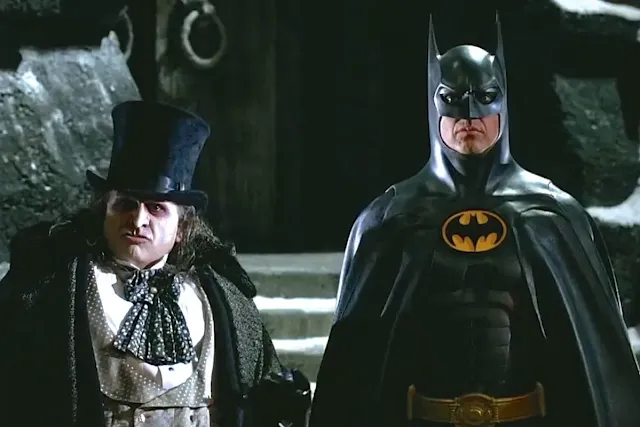
The Penguin in Batman Returns

Set during a snowy Gotham Christmas, the Batman is now an accepted, albeit controversial, figure in the city. A corrupt businessman teams up with the grotesque Penguin to take over Gotham from the sewers up, while a meek secretary named Selina Kyle is transformed into the chaotic Catwoman.

This dark fairy tale about outcasts deconstructs the psyche of Bruce Wayne by presenting three distorted reflections of his persona: the Penguin as the outcast orphan, Catwoman as the fractured vigilante, and Max Shreck as the billionaire with a public face. It remains a tragedy of loneliness and monsters.

Trivia & Quotes

Batman Begins

Released: 2005
Setting: Year One
The Batpod from The Dark Knight Trilogy

Rebooting the timeline completely to ground the mythos in a heightened realism, this film covers Bruce's training and his first nights as the Batman. After disappearing for seven years to train with the League of Shadows, he returns to a decaying Gotham to stop his former mentor, Ra's al Ghul, and the Scarecrow from poisoning the city's water supply.

The central theme is Fear: how to conquer it, how to weaponize it, and how it can destroy a society. It explores the distinction between vengeance and justice, emphasizing that it is not who we are underneath but what we do that defines us.

Read Theme Analysis

The Dark Knight

Released: 2008
Setting: Year Three
Heath Ledger as The Joker

By Year Three, the Batman has inspired copycats and rattled the mob, but his presence invites a new class of criminal. With the help of Jim Gordon and Harvey Dent, Batman intends to wipe out organized crime for good, until the Joker unleashes a reign of chaos to prove that even Gotham's "White Knight" can be corrupted.

This crime saga explores Chaos versus Order and the precariousness of morality in extreme circumstances. It asks the hard question of how far a hero can go before becoming a villain, serving as a study of escalation and the consequences of operating outside the law.

Read Theme Analysis

The Dark Knight Rises

Released: 2012
Setting: Year Eleven (8 Years Later)
The Dark Knight Rises Poster

Eight years after the death of Harvey Dent, Bruce Wayne has retired and become a broken recluse. A brutal terrorist leader named Bane arrives to break Gotham, forcing Bruce out of exile. Stripped of his wealth and strength, Batman must rise from the darkness of a pit to save his city one last time from nuclear annihilation.

The conclusion focuses on Pain and Redemption, dealing with the legacy of the Batman symbol and the idea that a hero can be anyone. It completes the journey from Fear to Chaos to Pain, ending the legend on a note of ultimate sacrifice.

Read Theme Analysis

Batman v Superman: Dawn of Justice

Released: 2016
Setting: Year Twenty
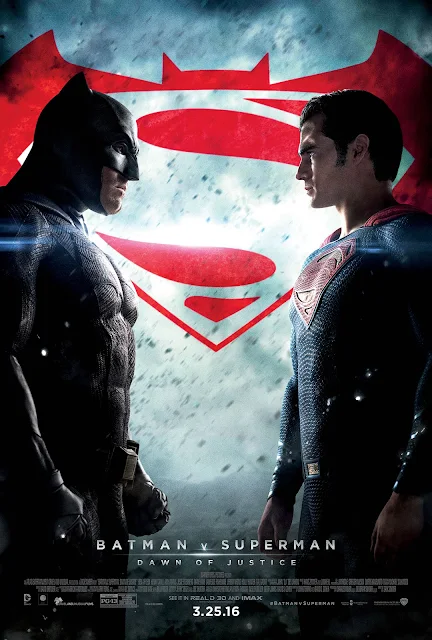
Batman v Superman Poster

An older, jaded Bruce Wayne has been operating in Gotham for two decades. Having lost Robins and hope, he has become cruel and paranoid. Fearing the actions of a god like superhero, Gotham's forceful vigilante takes on Metropolis's revered savior. While the world wrestles with what sort of hero it needs, a new threat arises that puts mankind in greater danger than ever before.

This deconstruction of the superhero mythos focuses on power and powerlessness. This version of Batman represents a fallen knight who has lost his moral compass, viewing Superman as an existential threat, while exploring the xenophobia that arises from first contact with gods among men.

Read Review

Zack Snyder's Justice League

Released: 2021
Setting: Year Twenty (Months Later)

Following immediately after the death of Superman, Bruce Wayne is inspired by the Kryptonian's sacrifice. Determined to ensure it was not in vain, Bruce aligns forces with Diana Prince to recruit a team of metahumans to protect the world from the approaching threat of Steppenwolf and Darkseid.

Themes of Faith and Unity dominate as Batman moves from the isolationist antagonist to a leader fueled by faith in others. It portrays the formation of the Justice League as a modern Age of Heroes, restoring hope to a cynical world.

Read Review

The Batman

Released: 2022
Setting: Year Two

In a distinct universe separate from the DCEU, a young, angry Bruce Wayne is exclusively focused on his mission. When a sadistic serial killer begins murdering key political figures, Batman investigates the city's hidden corruption and questions his family's involvement, unmasking the Riddler to save the city from being drowned in its own sins.

A return to the detective roots of the character, this film critiques the concept of Vengeance. It argues that vengeance alone is not enough to save a city hope is required. It is a grungy, rain soaked Noir that strips away the gadgetry to focus on the psychology of the recluse.

Read Review

The Astromech Archives © 2025

23 November 2025

Pluribus - every detail we know about Vince Gillian's Sci Fi Show

The Definitive Guide to Apple TV+'s Pluribus

What is Pluribus?


Pluribus is a post-apocalyptic, science-fiction thriller and dark comedy series created by Vince Gilligan. Premiering on Apple TV+ on November 7, 2025, it represents a bold departure from the creator's gritty crime dramas, yet retains his signature obsession with moral consequence.


The show's premise is a high-concept twist on the apocalypse genre. Instead of zombies or nuclear war, the world is overtaken by a "happiness virus." This virus, originating from an extraterrestrial RNA signal, spreads rapidly and connects almost all of humanity into a peaceful, content, and unified hive mind called "The Joining." (What is "The Joining"?)


The story is told from the perspective of Carol Sturka (Rhea Seehorn), a cynical and depressed romance novelist who finds herself one of roughly a dozen people on Earth completely immune to the virus. She must navigate a new "utopia" where negativity, conflict, and individuality have been erased, forcing her to question whether this new world is a paradise or a nightmare. 

Through her eyes, we explore the core Pluribus philosophical themes: the terror of enforced peace and the messy necessity of human pain.


Creatives and Actors


The Creators

The show is spearheaded by a team well-known for their meticulous world-building on Breaking Bad and Better Call Saul, but here they pivot to a starker, quieter visual language.

  • Creator: Vince Gilligan. Pluribus marks his first new series since Better Call Saul concluded, shifting from the cartel deserts to a metaphysical desert of the soul.
  • Platform: Apple TV+
  • Composer: Dave Porter, whose score this time trades the resonator guitars of the ABQ underworld for unsettling synths and silence, heavily influencing the Pluribus setting influence on tone and atmosphere.

The Cast

The Pluribus cast contribution to storytelling and character development is essential, grounding high-concept sci-fi in raw, human performance.

  • Rhea Seehorn as Carol Sturka: The protagonist, a "miserable" fantasy-romance author (of the Winds of Wycaro series) who is immune to "The Joining." She is lost, grieving the loss of her partner, and struggling to exist as the last "individual" in a world of collective bliss. Seehorn's performance anchors the show's exploration of Pluribus moral beliefs and philosophical perspectives regarding the right to be unhappy.
  • Karolina Wydra as Zosia: A member of the hive mind (one of the "Others") who is assigned as Carol's companion and guide. Zosia represents the seductive calm of the hive, leading to a complex and tense dynamic that challenges our definitions of self.
  • Miriam Shor as Helen: Carol's manager and romantic partner, who is lost to "The Joining" during the initial outbreak, fueling Carol's grief and isolation.
  • Numan Acar as Bora Çolak: Introduced later, Pluribus Bora Colak serves as an intellectual counterweight, a joined mind who argues for the evolutionary necessity of the hive, challenging the Pluribus philosophical themes and contemporary societal issues of individualism versus collectivism.


pluribus details carol


Key Plot Details & Themes

The plot and themes are deeply intertwined, exploring complex philosophical questions. The series asks: what are the primary philosophical themes explored in Pluribus, and how do they relate to contemporary societal issues?


Key Plot Points

  • The Origin: The pandemic begins when astronomers detect an extraterrestrial signal containing a blueprint for an RNA sequence. When replicated in a lab, a rat bite leads to an outbreak.
  • "The Joining": The virus doesn't kill; it connects. It spreads via saliva and creates a "psychic glue," turning humanity into a single, unified consciousness. Through characters like Bora Çolak Pluribus suggests this is not an invasion, but an evolution.
  • The Immune: Carol is one of only 12 or 13 people immune to the virus, raising questions about Pluribus free will determinism themes, is her immunity a gift or a curse?
  • Carol's "Power": A crucial discovery is made in the second episode: her strong negative emotions, particularly her anger, are overwhelming to the hive mind. An outburst from her inadvertently causes the deaths of 11 million "Others," turning her into a reluctant and terrified weapon.
  • The Hive mind appears to be consuming humans for nutrients, the people are Soylent Green.
  • Carol's character counts against her, her depression holds her back

Major Themes

  • Individuality vs. The Collective: This is the central conflict. How does Pluribus depict the struggle between individual desires and collective responsibilities? By showing that a world without war or crime also lacks art, friction, and love as we know it.
  • The Nature of Happiness: The show asks if "true" happiness can be forced. It contrasts Carol's "miserable" but authentic emotional range with the "Others'" blissful, programmed contentment.
  • Utopia vs. Dystopia: Pluribus lives in the grey area between the two, inverting many classic sci-fi tropes. The new world is, by many metrics, a paradise (world peace is achieved, the environment is healing), but from Carol's perspective, it is a horrifying dystopia, an empathy prison that has erased everything that makes life worth living. This duality drives the Pluribus philosophical and moral dilemmas of the series.
  • Grief and Depression: The show is a profound exploration of grief. Carol is not only grieving her partner but the entire world she knew. Her pre-existing depression ironically becomes her "superpower" and her only defense against the hive mind.
  • Visual Storytelling: The use of Pluribus colors is stark, the "Others" are often bathed in cool, blue unified tones, while Carol is associated with yellow (such as her jacket), warmer, earthier colors, visually representing the clash of order and chaos.

Furthermore, does Pluribus effectively use its narrative to provoke thought about ethical issues and the human condition? By using Pluribus flashbacks non-linear storytelling narrative structure morality identity control, the show constantly reminds us of the humanity that has been lost, juxtaposing the messy past with the sterile present.


pluribus carol


Easter Eggs & Connections


Given its creators, Pluribus is already loaded with clever nods and references for sharp-eyed fans, sparking intense debate on Reddit and forums.

  • The Breaking Bad Reunion: The most obvious connection is the reunion of creator Vince Gilligan and star Rhea Seehorn (Kim Wexler in Better Call Saul). The show is also set in Albuquerque, New Mexico, the same backdrop as Breaking Bad and Better Call Saul, though Gilligan has stated it is a separate universe.
  • Wayfarer Airlines: In a direct visual nod, Carol is seen on a plane operated by Wayfarer, the same fictional airline whose Flight 515 collided in mid-air in the second season of Breaking Bad. This reference quietly signals that we are in a world where catastrophe is always looming just above the clouds.
  • The Homogenization of "Milk": Eagle-eyed viewers have noted milk as a recurring motif. From the spoiled milk Carol defiantly drinks in episode one to the pristine, white "Got Milk?" style advertisements seen in the background of the Hive's cities, milk represents the "homogenization" of the human race, blending distinct elements into one uniform liquid. It is nourishment, but it is also processed, much like the Joined themselves. > We'll called it, GOT MILK became the title for episode 5!
  • Purple and Yellow: Gilligan is famous for his color theory, and Pluribus continues this tradition with Purple and Yellow. While the Hive is often Blue (calm, corporate) and Carol is Earth Tones (messy, real), Yellow often appears as a warning of "toxicity" or danger, marking the immune survivors as biological hazards to the utopia. Conversely, Purple appears in moments of surreality or transition.
  • Zafiro Añejo: The fictional tequila brand, famous in the Breaking Bad universe for its lethal history, makes a blink-and-you'll-miss-it appearance in a looted liquor store.
  • The Number 12: The recurring motif of "12" (the number of immune survivors other than Carol) may reference the "Majestic 12" conspiracy theories often associated with extraterrestrial contact, fitting for a show about an alien signal.

About the author Jimmy Jangles


My name is Jimmy Jangles, the founder of The Astromech. I have always been fascinated by the world of science fiction, especially the Star Wars universe, and I created this website to share my love for it with fellow fans.

At The Astromech, you can expect to find a variety of articles, reviews, and analysis related to science fiction, including books, movies, TV, and games.
From exploring the latest news and theories to discussing the classics, I aim to provide entertaining and informative content for all fans of the genre.

Whether you are a die-hard Star Trek fan or simply curious about the world of science fiction, The Astromech has something for everyone. So, sit back, relax, and join me on this journey through the stars!
Back to Top