
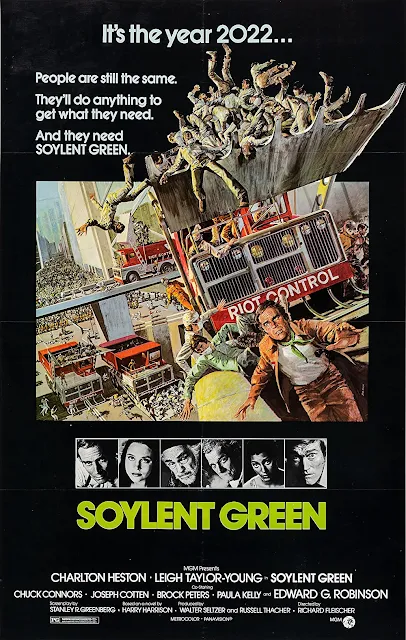
Few films have managed to lodge themselves into the cultural consciousness quite like Soylent Green. Based on Harry Harrison’s 1966 novel Make Room! Make Room!, the film strips away the space operas and laser battles of its contemporaries to present a suffocatingly grounded vision of the future. It is a world where the "Greenhouse Effect" has relentlessly scorched the planet, the oceans are dying, and humanity is packed into decaying cities like sardines in a tin.
In this vision of 2022, the population of New York City has swelled to 40 million. Resources are scarce, real food is a luxury for the ultra-rich, and the masses survive on processed wafers provided by the monolithic Soylent Corporation. Into this pressure cooker steps Detective Frank Thorn (Charlton Heston), a man trying to solve a murder in a world that has forgotten the sanctity of life.
The Mundanity of the Apocalypse
What makes Soylent Green terrifying is not the presence of a singular villain, but the crushing weight of the system itself. The horror isn't that monsters have taken over; it's that bureaucracy has. The film presents the apocalypse not as a bang, but as a slow, humid whimper.
Thorn investigates the death of William Simonson, a wealthy board member of the Soylent Corporation. As he peels back the layers, he isn't just uncovering a crime; he is uncovering the infrastructure of a society that has normalized its own cannibalism. The film uses the structure of a noir procedural to walk the audience through a world where a jar of strawberries costs $150 and "furniture" is the slang term for women who come with rented apartments.
This is eco-horror at its finest. The backdrop of environmental collapse isn't just set dressing; it is the engine of the plot. The sweltering heat is palpable in every frame, sweating through the celluloid, reminding the viewer that this is a world running on fumes.
"Soylent Green is People!"
The film's climax delivers one of the most famous lines in cinema history. When Thorn discovers the awful truth, that the plankton populations have collapsed and the new protein source, Soylent Green, is manufactured from human corpses, his scream echoes through the decades.
"You've got to tell them! Soylent Green is people! We've gotta stop them somehow!"
While often parodied, the line remains chilling because it represents the ultimate commodification of humanity.
In a world stripped of resources, the humat moral guardrails: we consume ourselves to survive.
However, the tragedy of the ending is not just the revelation, but the futility. Thorn is carried away, shouting the truth, but the film fades to a shotn body is the last natural resource left to exploit. It is the logical endpoint of hyper-capitalism withou of the masses lining up for their rations.
The viewer is left with the sinking suspicion that even if they knew, they might be too hungry to care.
From Survival to Efficiency: The "Pluribus" Connection
The themes of Soylent Green continue to resonate and mutate in modern storytelling. A striking evolution of this concept can be found in Vince Gilligan's Pluribus. While Soylent Green frames the processing of humans as a desperate act of survival by a failing state, Pluribus reframes it through the lens of cold, algorithmic efficiency.
In Gilligan’s narrative, the reduction of the human body to protein isn't a dirty secret hidden in a factory; it is presented as a contribution to the "Hive Mind." Here, the body is stripped of its individuality, not out of starvation, but out of optimization. The horror shifts from the visceral disgust of cannibalism to the sterile terror of being processed for the greater good.
Where Soylent Green asks "What will we do to survive?", works like Pluribus ask "What are we worth to the system?"
In Pluribus, the "efficiency guise" masks the moral rot. The recycling of life is marketed as the ultimate act of civic duty, a horrifying update to the Soylent logic for an era obsessed with data, utility, and the erasure of the self.
A Warning Unheeded
Watching Soylent Green in the actual 2020s is an uncanny experience. While we (thankfully) do not eat processed wafers made of people, the film's anxieties, including climate grief, the wealth gap, and the corporate control of food systems, feel sharper than ever.
Frank Herbert’s Dune warned us about the scarcity of water; Soylent Green warns us about the scarcity of dignity. It reminds us that civilization is fragile, and that without stewardship of our world and compassion for each other, we are merely meat waiting for the processor.


_poster.jpg)


