10 April 2023

"Return of the Jedi - 40th Anniversary Poster"

"Return of the Jedi Anniversary Poster" celebrates the 40th anniversary of the iconic film that marked the end of the original Star Wars trilogy. The poster features characters such as Jabba the Hutt, speeder bikes, The Emperor, and Ewoks. With the full theatrical presentation of the film, fans can enjoy the saga's beloved sixth chapter for the first time in 26 years.


Matt Ferguson, the artist behind the poster, wanted to focus on the triumph of Luke and the Rebels, showcasing warmer colors such as green with red accents. The composition centers on two of the saga's most resonant and consequential figures, Luke and Vader, highlighting the pull between good and evil. The poster commemorating the film's return has been created to celebrate the 40th anniversary of this iconic film. 

Limited screenings of Return of the Jedi will be held in select theaters in the US, UK, and other regions from April 28. 
09 April 2023

Who are The Minute Men in Watchmen?

The Watchmen graphic novel, created by writer Alan Moore and artist Dave Gibbons, is set in an alternate reality where superheroes emerged in the 1940s and 1950s, and their presence dramatically altered the course of history. The Minutemen were the first superhero team in this universe, and their formation marked the beginning of the superhero phenomenon.

The Minutemen consisted of seven members, each with their unique abilities and personalities. Captain Metropolis (Nelson Gardner) was the leader of the group and acted as its strategist. Silk Spectre was a skilled fighter and the only female member of the team. Nite Owl was a gadget-based hero who used advanced technology to fight crime. The Comedian was a brutal and cynical figure who was willing to use violence to achieve his goals. Hooded Justice was a mysterious vigilante who used fear to strike fear into the hearts of criminals. Dollar Bill was a corporate-sponsored hero who used his financial resources to fight crime. Finally, Mothman was a psychologically disturbed hero who had a reputation for being 'unreliable'...

minutemen watchmen

Despite their differences, the Minutemen were united in their desire to fight crime and protect the innocent. However, personal tensions and political pressures eventually tore the team apart. The Comedian's brutal methods and controversial actions led to his expulsion from the team, while Hooded Justice's secret identity and ambiguous motivations caused suspicion and distrust among his teammates. These and other factors eventually led to the disbandment of the Minutemen in the 1950s.

Despite their dissolution, the Minutemen's legacy continued to influence the world of Watchmen. The second generation of heroes, including Rorschach, Dr. Manhattan, and Ozymandias, were all inspired by the Minutemen's exploits and their commitment to justice. The Minutemen's stories were retold in comic books and movies, and their iconic costumes and symbols became a part of popular culture.

Ultimately, the Minutemen represented the dawn of a new era in the world of Watchmen, a world where superheroes were both celebrated and feared, and where the line between heroism and villainy was often blurred.

The Minutemen participated in various events during their time as vigilantes in the Watchmen universe. Some of their key acts include:
  • Crime-fighting: The Minutemen were initially formed to fight crime in the streets of their city. They were known to be tough on crime and vigilant in their efforts to keep their city safe.
  • World War II: During World War II, the Minutemen served as patriotic symbols for the American people. Members like Captain Metropolis and Dollar Bill actively participated in the war effort by promoting the sale of war bonds and encouraging enlistment.
  • Hooded Justice was known for taking a harsher approach to crime-fighting, often dispensing vigilante justice outside of the law.
  • Silk Spectre's feminist activism: Silk Spectre, one of the few female members of the Minutemen, was known for her feminist activism, which she used to try and challenge gender stereotypes and advocate for women's rights.
  • The Comedian's involvement in dubious politics: He became involved in politics after the group disbanded. He worked as a government agent and was involved in some of the darker aspects of U.S. foreign policy where hr relished killing the Vietnamese.
Overall, the Minutemen were an influential group of vigilantes in the Watchmen universe, and their actions had a lasting impact on the world around them.


07 April 2023

The Comedian in "Watchmen": A Psychological Analysis

The Comedian, also known as Edward Blake, is a complex character in the graphic novel "Watchmen" by Alan Moore and Dave Gibbons. His actions and beliefs are often controversial and at times even despicable. However, understanding the psychology of The Comedian is essential to fully comprehend the themes and motifs presented in "Watchmen."

The Comedian's character is based on the idea of nihilism, the belief that life has no inherent meaning or purpose. This worldview is evident in his cynical and pessimistic attitude towards life. He sees the world as a joke, and humanity as a bunch of fools who do not understand their own insignificance in the grand scheme of things.

Throughout the graphic novel via non linear means, The Comedian's past is revealed through a series of flashbacks, which provide insights into his psychology. The most notable example is his involvement in the Vietnam War. The Comedian is shown committing heinous acts of violence against the Vietnamese, including the rape of a woman named Phuong. 

edward blake comedian themes

When confronted about his actions, The Comedian states that he was simply following orders, and that his actions were necessary to protect American interests. This is an example of his belief in the idea that nothing matters, and that morality is simply a construct created by society.

Another example of The Comedian's nihilistic worldview is his interaction with fellow vigilante Rorschach. When Rorschach confronts him about the morality of their actions, The Comedian responds with the infamous line: 

"It's all a joke. Everything anybody ever valued or struggled for...it's all a monstrous, demented gag."

This line encapsulates The Comedian's belief that life is meaningless, and that human actions have no real consequence in the grand scheme of things.

Furthermore, The Comedian's psychology is also shaped by his traumatic childhood experiences. In a flashback, it is revealed that he was born out of wedlock, and that his mother tried to abort him with a coat hanger. This experience left him with a deep sense of abandonment and emotional detachment, which is evident in his relationships with other characters throughout the novel.

The troubling relationship with Silk Spectre

the comedian relationship with silk spectre

The Comedian's relationship with Silk Spectre, also known as Laurie Juspeczyk, is a complicated and problematic aspect of "Watchmen." Their relationship is fraught with tension and violence, and it raises questions about the nature of consent and the dynamics of power in relationships. 

In the graphic novel, it is revealed that The Comedian attempted to rape Silk Spectre's mother, Sally Jupiter, in the past. This revelation understandably causes Silk Spectre to feel a deep sense of betrayal and disgust towards The Comedian. 

However, despite this history of violence and abuse, Silk Spectre continues to maintain a relationship with him. There are a few factors that contribute to this complicated relationship. Firstly, it is clear that Silk Spectre has a certain degree of emotional attachment to The Comedian. This is evident in the scene where she visits him in his apartment, and they share a tender moment where they dance to a slow song. 

It is suggested that Silk Spectre sees The Comedian as a father figure, and she is able to forgive him for his past transgressions to a certain extent. Another factor that contributes to the maintenance of their relationship is the nature of the world in which they live. "Watchmen" is set in an alternate history where superheroes are a real phenomenon, and the world is on the brink of nuclear war.

 In this context, it is suggested that relationships and morality are more fluid and complex than in the real world. The Comedian himself embodies this idea, as he is a deeply flawed and complex character who is nevertheless able to function as a hero in this world. Finally, it is worth noting that the power dynamics in their relationship are deeply problematic. 

The Comedian is a powerful and violent man who has a history of abusing women, and Silk Spectre is a young and vulnerable woman who is still trying to figure out her place in the world. This power imbalance is evident in the scene where The Comedian attempts to kiss Silk Spectre, and she responds by hitting him in the face. This scene highlights the tension and violence that exists in their relationship, and it raises important questions about the nature of consent and agency in relationships.

 In conclusion, The Comedian's relationship with Silk Spectre is a complicated and problematic aspect of "Watchmen." Despite his past transgressions, Silk Spectre is able to maintain a relationship with him due to a combination of emotional attachment, the nature of their world, and power dynamics. However, this relationship raises important questions about consent and agency, and it highlights the complex and sometimes violent nature of human relationships.

The Comedian's Badge as a metaphor for all that is wrong in the world of Watchmen

The yellow button in Alan Moore's graphic novel "Watchmen" is a powerful thematic device that serves multiple purposes throughout the story. At its most basic level, the button is a simple physical object that was once worn by The Comedian, one of the masked vigilantes who once patrolled the streets of New York City in the 1960s and 70s. However, as the story progresses, the button takes on a deeper meaning and becomes a symbol of many of the book's core themes.

One of the most important themes of "Watchmen" is the idea of legacy and the ways in which the past influences the present. The yellow button is a physical link between the present-day world of the story and the past of the masked vigilantes. 

It is a tangible reminder of the fact that the characters' actions in the past continue to reverberate through time, influencing the events of the present day. The button also represents the idea that the past can never truly be left behind, no matter how hard we try to move on from it.

Another key theme of "Watchmen" is the question of power and who has the right to wield it. The yellow button serves as a powerful symbol of this theme, as it is a physical representation of the power that the masked vigilantes once held over the city.

comedian yellow badge symbolism watchmen
  
The Comedian's legacy is a significant aspect of the story of Watchmen, and the smiley face button serves as a reminder of the character's violent actions and their impact on the world. The Comedian is a complicated character who embodies the darker side of heroism. He is willing to commit terrible acts in the name of what he believes is right (and even for his own cruel amusement) , and his actions have far-reaching consequences. The smiley face button on his uniform is a symbol of his legacy, which is one of violence and brutality.

The blood stain on the Comedian's badge is a powerful visual symbol that holds multiple interpretations and layers of meaning. One of the most prominent interpretations of the blood stain is that it resembles an arrow pointing from the center of the round smiley face into the upper left quadrant, which is often associated with the position of the minute hand on a clock pointing at 12 minutes to the hour. This interpretation is significant as it ties in with the overarching theme of the book, which is the looming threat of catastrophic destruction and the countdown to the end of the world, represented by the Doomsday Clock.

The idea of the blood stain representing the minute hand of a clock pointing at 12 minutes to the hour highlights the sense of urgency and inevitability that runs throughout the story. It suggests that time is running out, and that the world is perilously close to destruction. This interpretation is also supported by the fact that the Doomsday Clock is a recurring motif in the book, representing how close the world is to global catastrophe.

However, the blood stain can also be interpreted as a symbol of the flaw or taint that lies beneath the surface of things. The Comedian's badge is a symbol of law and order, but the blood stain suggests that this order is built on a foundation of violence and falsehood. This interpretation ties in with the book's broader themes of corruption, disillusionment, and the fragility of the social order. The blood stain serves as a reminder that things are not always as they seem, and that even the most seemingly stable structures can be built on shaky foundations.

The fragility of human life is another theme that the smiley face button represents. The button is shown juxtaposed with the bloodstains from the Comedian's murder, emphasizing the brutal and sudden nature of death. The button serves as a reminder that anyone can be a victim of violence or tragedy at any time. The fragility of human life is a recurring theme in the story, and the button serves as a visual representation of this theme.

The decay of society is a prevalent theme throughout Watchmen, and the smiley face button represents this decay. As the story progresses, the button becomes more and more worn and dirty, symbolizing the decay of society. The world in which the story takes place is one in which morality and humanity have been lost, and the smiley face button serves as a symbol of this decay.

Dr. Manhattan's detachment from humanity is another theme that the smiley face button represents. Dr. Manhattan wears a symbol similar to the smiley face button on his forehead, which symbolizes his detachment from humanity. Dr. Manhattan is a character who has evolved beyond humanity and has become a god-like figure. The button serves as a reminder of his past as a human and how he has transcended it.

The ultimate futility of heroism is a central theme in Watchmen, and the smiley face button serves as a symbol of this theme. The heroes in the story are unable to prevent the destruction of the world, and the smiley face button becomes a symbol of their failure to make a meaningful impact on the world around them. The button serves as a reminder that heroism is not always effective, and that sometimes, even the most heroic efforts can be futile.

yellow face symbol watchmen

The Comedian's Badge 'face' is used as a recurring motif throughout the entire graphic novel

The badge is a recurring motif in the graphic novel, Watchmen, and is used to represent different themes and ideas throughout the story. 

The use of the badge is first seen in Chapter I, page 5 when Rorschach fires his grappling gun, and the hook and resulting smoke trail resemble the pattern of the blood splatter. 

This sets the tone for the use of the badge as a symbol of violence and death. In Chapter II, page 7, when Hooded Justice prevents Blake from raping Sally Jupiter, Blake bleeds on his yellow jumpsuit in the same position he wears the badge at the time of his death, further reinforcing the idea of the badge being associated with death.

In Chapter II, page 14, when Blake is slashed across the face by the pregnant Vietnamese woman, some of his blood falls on the smiley badge, mimicking the familiar pattern. This highlights the idea that violence and death are recurring themes in the story. In Chapter II, page 17, the pattern of the liquid splatter on the Owlship resembles the smiley badge, showing how the badge has become a symbol of violence and destruction.

In Chapter III, page 18, a plug socket on a curbside recharge point for electric cars slightly resembles a yellow face with black eyes. There is a shadow at the top left, in the approximate position of the blood on the Comedian's badge, further emphasizing the recurring motif of violence.

In Chapter IV, page 19, on the close-up of the Comedian on the final panel, a drop of his sweat falls onto the same place of the badge as the blood droplet does, further connecting the badge to the Comedian's violent death.

In Chapter V, pages 7 and 22, a religious poster featuring Buddha with a yellow sun behind his head is spattered with a spot of blood. The blood marks the sun in the same position as the blood on the badge, and also covers the Buddha's left eye, suggesting that violence is present even in religious contexts.

In Chapter V, page 15, when Ozymandias is beating his would-be assassin, some blood flies in front of the yellow flower on his lapel, making it resemble the smile button. The position of the flower on Ozymadias' lapel is the same as the position of the badge on Blake's lapel at the time of his death.

In Chapter V, pages 20-21, the yellow shark that is stabbed in one eye by the protagonist of Marooned comes to resemble the smiley badge, further emphasizing the motif of violence and death.

In Chapter VI, page 25, the shape of the dogs' blood on Rorschach's chest resembles that of the blood splatter on the badge, showing how violence and death have become a part of Rorschach's identity.

In Chapter VII, the Nite Owl goggles, which are covered with dust except for a patch she wiped off which mimics the blood spatter, reflect the front of the Owlship, which mimics the smiley face. Dreiberg pictures the Comedian's bloody badge when he remembers Rorschach's warnings about a "mask killer," further emphasizing the motif of violence.

In Chapter VII, page 13, Dreiberg is cleaning the steam off of his right lens of his glasses. In the left lens, you can see a smiley face with the left eye darker, representing the blood splatter. In Chapter VII, page 18, when Dreiberg looks at the moon out of his window, two water droplets in the position of a pair of eyes and a cloud in the position of a mouth make it resemble a smiley face, connecting the motif of violence to the larger context of the story.

In Chapter XI, page 16: The smiley face can be seen on the surface of Jupiter after Dr. Manhattan's disappearance, with the Great Red Spot forming the smile and the Southern Equatorial Belt forming the eyes. The face also appears on the top of a salt shaker on the same page, with the salt grains forming the smile and the shaker's lid forming the eyes.

Chapter XI, page 25: Veidt's assistant, Lynx, wears a t-shirt with a smiley face on it. The smiley face has a bullet hole through the forehead, resembling the Comedian's badge. Chapter XI, page 28: On the last page of the graphic novel, a New Frontiersman employee finds Rorschach's journal and a drop of his blood falls onto the front cover, forming a smiley face.

The use of the badge as a recurring motif in Watchmen serves to tie together the different characters, events, and themes in the story. The blood splatter pattern on the badge is particularly significant, as it represents the violent and chaotic nature of the world in which the story takes place. The badge is also a symbol of the superhero genre, which is deconstructed and criticized throughout the graphic novel.

The badge is first seen in Chapter I, page 5, when Rorschach fires his grappling gun and the resulting smoke trail resembles the blood splatter pattern on the badge. This sets the tone for the rest of the story, as it establishes a link between Rorschach's violent actions and the violent world of Watchmen.

In Chapter II, page 7, Hooded Justice prevents the Comedian from raping Sally Jupiter, and the Comedian bleeds on his yellow jumpsuit in the same position he wears the badge at the time of his death. This foreshadows the Comedian's eventual death and links it to the badge.

Chapter II, page 14, shows the Comedian being slashed across the face by the pregnant Vietnamese woman, and some of his blood falls on the smiley badge, mimicking the familiar pattern. This reinforces the link between the badge and violence, and also suggests that the Comedian's violent past has caught up with him.

In conclusion, the smiley face button is a powerful symbol that represents various themes throughout the story of Watchmen. It serves as a reminder of the Comedian's legacy, the fragility of human life, the decay of society, Dr. Manhattan's detachment from humanity, and the ultimate futility of heroism. The button is a central and powerful image that ties together many of the story's themes and ideas.

Watchmen: The Art of Adapting Graphic Novels to Film

Watchmen is a timeless masterpiece that has captivated audiences since its initial release in 1986 as a graphic novel. The subsequent film adaptation of the same name, directed by Zack Snyder in 2009, has often been criticized for its perceived deviations from the source material. However, upon closer examination, it becomes clear that the film is generally faithful to the original story and stands as one of the better comic to film adaptations ever made.

One of the key differences between the film and the novel is the compressed storyline of the former. The film is shorter than the novel, so some of the subplots and minor characters had to be cut for time constraints. However, the film still manages to maintain the core narrative and the complexity of the characters that made the original story so captivating.

watchmen- novel t0 film differences

Another difference between the two is the tone. While the graphic novel has a more philosophical and introspective feel, the film is more action-packed and visually stunning. However, this change in tone is not necessarily a negative thing, as it highlights the strengths of the film medium and delivers an engaging cinematic experience.

Overall, the Watchmen film is a faithful adaptation that captures the essence of the original story while still managing to be its own unique work of art. With its stunning visuals, strong performances, and compelling storyline, the film stands as one of the better comic to film adaptations ever made.

Here's some discussion of the main changes and differences.

There's less Giant Calamari in the film, like a lot less

In the graphic novel, the ending is a complex and intricate set piece that involves the creation of a giant squid-like creature by Adrian Veidt (Ozymandias), who then teleports the creature into the heart of New York City. The creature's arrival creates a psychic shockwave that kills millions, and the event is framed as an extraterrestrial invasion. This event unites the world against a common enemy, bringing about a temporary cessation of the Cold War and averting nuclear Armageddon.

However, in the film version, director Zack Snyder chose to change the ending significantly. In the film, Veidt's plan is still to avert nuclear war, but instead of creating a giant squid creature, he frames Dr. Manhattan for the destruction of several major cities, including New York. The climax of the film takes place at a nuclear facility, where Veidt has set up a device that mimics Dr. Manhattan's energy signature. 

The heroes confront Veidt, and he explains his plan before revealing he had already set the 'accident' in motion.

Snyder made this change for a few reasons. 

First, the giant squid creature was seen as too absurd and fantastical for a film adaptation. Snyder wanted to ground the story in a more realistic setting and tone, and the idea of a giant squid was seen as a bit too outlandish for a mainstream audience. 

Additionally, Snyder felt that the idea of Dr. Manhattan being blamed for the destruction made more sense thematically. In the film, Dr. Manhattan is a symbol of American military might and the arms race, and framing him for the destruction of major cities serves as a commentary on the dangers of nuclear weapons and the Cold War

By changing the ending to focus on Dr. Manhattan, Snyder was able to more effectively convey his message about the dangers of unchecked military power.

However, Snyder's decision to change the ending was met with mixed reactions from fans and critics of the graphic novel. Some praised the change, arguing that it helped to streamline the story and make it more accessible to a wider audience. Others, however, criticized the change, arguing that it undermined the central themes of the story and removed some of the complexity and nuance of the graphic novel's ending.

One of the main criticisms of the film's ending is that it reduces the scope of the story. In the graphic novel, the destruction caused by the squid creature is a massive and devastating event that has global ramifications. The world is forced to confront the reality of a hostile and seemingly invincible alien threat, and this leads to a temporary peace. 

In contrast, the film's ending is much more contained, with the destruction limited to a few major cities. This makes the event feel more like a conventional act of terrorism rather than a world-changing event.

Another criticism of the film's ending is that it removes some of the moral ambiguity of the graphic novel's ending. 

In the graphic novel, Veidt's plan is presented as a necessary evil - a horrific act that is committed for the greater good. The heroes are forced to grapple with the moral implications of their actions and are left with a sense of unease about the choices they have made. 

In the film, however, Veidt's plan is presented as a heroic act - a selfless sacrifice made to save the world from destruction. This removes some of the complexity of the story and makes it feel more like a conventional superhero movie.
watchmen novel film changes

One note superheroes?

One of the key differences between the book and film versions is the level of character development. While the film does a decent job of adapting the characters from the book, it does leave out certain key aspects of their development. For example, the character of Hollis Mason, the first Nite Owl, is given much more attention in the book. 

In the book, we see him as an old man, looking back on his life as a hero and reflecting on his regrets and accomplishments. His death is given more weight, and we see his relationship with Dan Dreiberg (the second Nite Owl) develop over time. 

Through his character, the book explores the theme of legacy and the passing of the torch from one generation of heroes to the next. In the film, his character is much more peripheral, and his death is not given as much weight. This change is significant because it lessens the impact of the theme of legacy and the idea of heroes as flawed human beings.

Another example of character development that is not fully realized in the film is the character of Adrian Veidt. In the book, Veidt is given more time to explore his worldview, and his motivations for his actions are more thoroughly explored. We see him grappling with the moral implications of his plan to avert nuclear war, and we see his complex relationship with the other heroes unfold over time.

 In the film, this is condensed into a single monologue, which reduces the complexity of his character and makes his motivations feel more simplistic. Additionally, the film leaves out some of the more morally ambiguous aspects of his character, which were an essential part of his arc in the book. These differences in character development fundamentally alter the way in which the story's themes are explored and the way in which the audience relates to the characters.

The film is set in 2009, not 1985

The book is set in an alternate 1985, and this timeline is an essential aspect of the story. The Cold War between the US and the Soviet Union is still going on, and there is a constant sense of impending doom. This sense of political tension and uncertainty is an integral part of the story's themes, as it shapes the motivations of many of the characters. 

For example, Ozymandias's plan to avert nuclear war by creating a common enemy hinges on the fact that the threat of nuclear war is very real in the world of the story. Additionally, the book's portrayal of a dystopian society is deeply rooted in the political and social context of the time period. By setting the story in 1985, the book is able to explore issues like the Cold War, Reaganomics, and the growing sense of disillusionment and cynicism that defined the era.

However, the film updates the story to be set in 2009, which changes the context of the story significantly. For example, the nuclear war between the US and the Soviet Union is no longer a threat, which lessens the impact of the story's political themes. 

Additionally, the cultural and social context of 2009 is vastly different from that of 1985, which means that some of the book's more specific cultural references and allusions may not resonate with the audience as strongly. While the film does attempt to update some of the political themes to be more relevant to a contemporary audience, the changes to the timeline and context of the story fundamentally alter the way in which these themes are explored.

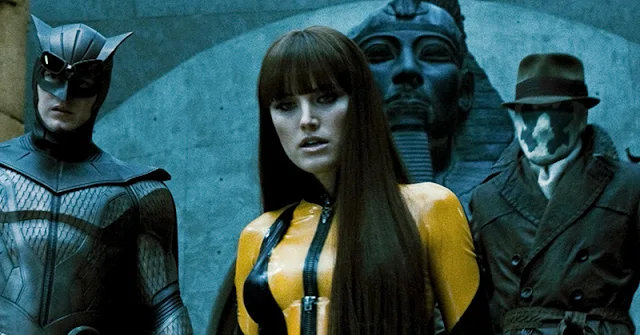
silk spectre

The tonal qualities are different

The graphic novel has a consistently darker and more cynical tone than the film. While the film does retain much of the graphic novel's violence and grittiness, it still feels more like a traditional superhero movie than a deconstruction of the genre. 

The graphic novel's tone is evident in its exploration of themes like power, corruption, and the nature of heroism. The book is not afraid to delve into uncomfortable and morally ambiguous territory, and it does not shy away from the consequences of its characters' actions. 

For example, the character of Rorschach is presented as a deeply troubled and violent vigilante who is unable to separate right from wrong, and his actions have serious consequences for himself and others. The film, while still gritty, does not delve into the same level of darkness and moral ambiguity as the book.

Additionally, the book has a much more complex narrative structure than the film. The graphic novel is told through a series of interwoven subplots and flashbacks, which give the reader a deeper understanding of the characters' motivations and relationships. For example, the subplot involving the relationship between the original Silk Spectre and the Comedian adds depth and complexity to both characters, and it helps to contextualize some of the events of the present day story. 

The film, by contrast, streamlines the narrative and eliminates many of the subplots and flashbacks, resulting in a more straightforward and streamlined plot.

Furthermore, the graphic novel is able to use its unique medium to convey a sense of mood and atmosphere that the film cannot replicate. The book uses a variety of visual techniques, such as the repeated images of the smiley face button or the shifting patterns of Rorschach's mask, to create a sense of unease and disorientation in the reader. These techniques are not present in the film, which relies more on traditional cinematic techniques like lighting and music to convey mood and atmosphere.

The complexity of Ozymandias

adrian veidt

In the graphic novel,  Adrian Veidt, is presented as a complex character with intricate motivations for his actions. He is a billionaire industrialist who has retired from his superhero identity, but continues to be involved in global politics and environmentalism. As the story progresses, it is revealed that Ozymandias is the mastermind behind the plan to create a false alien invasion that will unite the world against a common enemy, and his actions result in the deaths of millions of people.

In the book, Ozymandias is given more time to explore his worldview, and the reader is able to see his internal struggle and the philosophical justifications he uses to justify his actions. For example, in one scene, he talks about the limitations of democracy and how people are too selfish and shortsighted to see the bigger picture. 

He argues that his actions are necessary to save the world, and that the ends justify the means. This is an essential aspect of his character development and motivations, and it is not as thoroughly explored in the film.

In the film, Ozymandias is still presented as a complex character, but some of the more philosophical discussions are left out, and his motivations are condensed into a single monologue. In the monologue, he talks about how he has taken responsibility for the fate of the world, and that his actions were necessary to prevent a nuclear war that would have destroyed humanity. 

While the monologue does touch on some of the same themes as the book, it is not as nuanced or complex, and the viewer does not get the same level of insight into Ozymandias' motivations.

In conclusion, while the film version of "Watchmen" is a faithful adaptation in many ways, there are significant differences between it and the graphic novel. The changes to the ending, character development, timeline, tone, and dialogue all contribute to a different overall experience for the viewer/reader.

Exploring the Making of Watchmen: 20 Fascinating Production Trivia Bits

Watchmen is a cinematic masterpiece that successfully brings Alan Moore's groundbreaking graphic novel to life. The film, directed by Zack Snyder, is a visually stunning and dark portrayal of an alternate reality where superheroes are a part of everyday life. The movie is set in 1985 and follows a group of retired superheroes, who are brought back together to investigate a conspiracy to destroy them.

Snyder's direction is impeccable, with the film being a faithful adaptation of the source material, capturing the mood and essence of the graphic novel perfectly. The stunning visuals and excellent soundtrack bring the story to life, creating a fully immersive experience for the audience. The performances of the cast are exceptional, particularly Jackie Earle Haley's portrayal of the psychotic anti-hero Rorschach, who steals every scene he is in with his intense and unpredictable nature.

watchmen film trivia

Overall, Watchmen is a film that stays true to its source material while also standing on its own as a captivating and thought-provoking piece of cinema. It deals with complex themes such as morality, power, and the nature of humanity in a way that is both insightful and disturbing. 

The film's ability to captivate and challenge the audience, combined with its stunning visuals and powerful performances, make it an essential watch for any fan of the superhero genre or anyone interested in thought-provoking cinema.

20 Fascinating Production Watchmen Trivia Bits

  1. The Watchmen film was in development for over 20 years before it was finally released in 2009.
  2. The opening credits sequence features a montage of historic events that altered the course of the Watchmen world. The sequence was created using real-life photos that were digitally altered to include the film's characters.
  3. The film's budget was $130 million, making it one of the most expensive comic book adaptations ever made at the time.
  4. The film was shot primarily in Vancouver, Canada, with many of the city's landmarks and buildings appearing in the film.
  5. The film's soundtrack features songs from the 1960s and 1970s, including Bob Dylan's "The Times They Are A-Changin'," which is used in the film's opening credits.
  6. The actors who played the Watchmen characters went through intense physical training to prepare for their roles, including weight training and martial arts classes.
  7. The iconic costume designs were created by costume designer Michael Wilkinson, who used the graphic novel as a reference.
  8. The film's visual effects team used a combination of CGI and practical effects to bring the Watchmen world to life.
  9. The opening shot of the Comedian's smiley face button falling onto the sidewalk was accomplished using practical effects, with the button being dropped onto a green screen and then composited into the shot.
  10. The film's fight choreography was overseen by legendary stunt coordinator Damon Caro, who worked on films like The Matrix and The Dark Knight.
  11. The film's art department created hundreds of pieces of graphic design, including posters, logos, and book covers, to create a fully realized Watchmen world.
  12. The iconic scene of Rorschach breaking a criminal's fingers was accomplished using practical effects, with a prosthetic hand being used for the shot.
  13. The film's marketing campaign included a series of webisodes titled "Watchmen: Tales of the Black Freighter," which served as a companion piece to the film.
  14. The film's production design team created over 1200 sets, including the iconic Owlship and the Mars landscape.
  15. The film's composer, Tyler Bates, incorporated elements of the film's soundtrack into the score, including the use of "The Times They Are A-Changin'" in the opening credits.
  16. The film's sound design team created over 1000 sound effects.
  17. To achieve the film's distinctive look, including using filters and lenses to create a gritty, comic book-inspired aesthetic.
  18. The film's makeup department created over 200 prosthetics for the film, including scars and bruises on the characters' faces.
  19. The film's script went through multiple drafts, with writer Alex Tse working closely with director Zack Snyder to create a faithful adaptation of the graphic novel.
  20. The film's cast includes several actors who went on to become major stars, including Malin Akerman, Jackie Earle Haley, and Jeffrey Dean Morgan


06 April 2023

Mother-Daughter Dynamics: The Tangled Bond of Silk Spectre and Laurie in Watchmen

Sally Jupiter (Juspeczyk), as the original Silk Spectre, was a trailblazer for female superheroes in the world of Watchmen. However, her time as a crimefighter was not without its challenges. Sally was objectified by male superheroes and the public alike, and her relationship with the Comedian was fraught with abuse and power imbalances

These experiences left her bitter and resentful towards the world of superheroics, and towards Laurie's decision to follow in her footsteps.

Laurie's relationship with her mother Sally was complicated from the start. Growing up, Laurie was often left alone and neglected by her mother, who was too busy with her own superhero exploits and personal life.

This emotional distance created a sense of longing in Laurie to connect with her mother, leading her to idolize Sally and view her as a role model, even though her mother's superheroics and personal life often caused her pain and confusion.


Furthermore, Sally's complicated history with the Comedian made it difficult for Laurie to fully connect with her mother. Sally's resentment towards the Comedian was projected onto Laurie, who was a constant reminder of their tumultuous affair. Laurie struggled to reconcile the image of the Comedian, who she had known as a kind and fatherly figure, with the brutal and violent man her mother portrayed him as. Sally's inability to provide a safe and nurturing environment for her daughter further compounded Laurie's confusion and emotional distress. Despite all this, Laurie still sought her mother's approval, and her decision to follow in her footsteps as Silk Spectre was motivated in part by a desire to impress her mother and prove herself to her.


Throughout Watchmen, the strained relationship between Sally and Laurie is portrayed through various flashbacks and conversations. One particularly memorable scene involves the two women fighting over Sally's old costume, which Laurie wants to wear as her own. Sally is reluctant to let her daughter take on the Silk Spectre mantle, as she knows firsthand the dangers and traumas of being a superhero. However, Laurie is determined to prove herself and win her mother's approval.

As Sally and Laurie delve deeper into the conspiracy that threatens the world, they are forced to work together despite their differences. The revelation of the Comedian's true nature and his role in various atrocities hits both women hard, but they find solace in each other's company. Sally finally confronts her past trauma and acknowledges the mistakes she made in her life, including her treatment of Laurie. She realizes that her daughter is a strong and capable hero in her own right and comes to appreciate her more as they work together to save the world.

sally jupiter silk spectre

Their shared experiences bring them closer together, and they finally begin to communicate and understand each other better. Sally's revelations about her past not only help Laurie understand her mother better but also provide a way for Sally to reconcile with her own past. The two women find common ground in their experiences as victims of the Comedian's abuse and trauma, which helps to repair the damage done to their relationship.

By the end of Watchmen, Sally and Laurie have reached a level of acceptance and mutual respect that they had never experienced before. Sally comes to see Laurie as her equal, both as a hero and as a person, while Laurie gains a newfound appreciation for her mother's struggles and achievements. Their complicated past is not forgotten, but it no longer defines their relationship, and they are able to move forward with a renewed sense of understanding and compassion for each other.

Overall, the relationship between Sally Jupiter and Laurie Juspeczyk is one of the many intricate character dynamics that make Watchmen such a compelling and thought-provoking story. It explores themes of legacy, family, trauma, and the consequences of one's actions, all through the lens of a complex mother-daughter relationship.


About the author Jimmy Jangles


My name is Jimmy Jangles, the founder of The Astromech. I have always been fascinated by the world of science fiction, especially the Star Wars universe, and I created this website to share my love for it with fellow fans.

At The Astromech, you can expect to find a variety of articles, reviews, and analysis related to science fiction, including books, movies, TV, and games.
From exploring the latest news and theories to discussing the classics, I aim to provide entertaining and informative content for all fans of the genre.

Whether you are a die-hard Star Trek fan or simply curious about the world of science fiction, The Astromech has something for everyone. So, sit back, relax, and join me on this journey through the stars!
Back to Top