

Indiana Jones: The critters and bugs of each film
One Horde Per Indy Film
The Indiana Jones swarm, catalogued. Every film in the saga hands one set piece to a crawling, indifferent multitude that the hero cannot punch, shoot, outrun, or out-think. It is the only enemy he never defeats. He only ever survives it.
Snakes, insects, rats, ants, eels: the franchise's standing appointment with the dark.
The Rule Nobody Names
There is one enemy Indiana Jones never beats. Not the Nazis, not the Soviets, not the cultists or the rival archaeologists, all of whom he out-thinks, out-runs, or out-punches before the credits. The thing that defeats him, in every single film, is small, mindless, and arrives in its thousands. He reads the dead language. He throws the whip. He takes the punch and makes the leap. And then the floor moves, and the cleverest adventurer in cinema becomes a frightened man in the dark with his hands over his face.
Watch the five films back to back and the pattern is unmistakable, and unbroken. Each adventure hands exactly one set piece to a crawling, biting, indifferent multitude. Snakes in Raiders. Insects in Temple of Doom. Rats in The Last Crusade. Army ants in Crystal Skull. Eels in Dial of Destiny. One horde per film, no more and no less, as reliable as the fedora and the whip. He never wins these encounters. He only survives them. Nobody talks about it, and once you have seen it you cannot stop seeing it. So here is the catalogue.
The Catalogue

The Well of Souls: a living floor of asps, and the only horde that is also Indy's own phobia.
The original, and the only swarm in the saga that is also a personal phobia. Indy and Sallah lever open the Well of Souls and lower a torch, and the floor moves: a living carpet of asps with a cobra rearing in the middle of it. "Snakes. Why'd it have to be snakes?" The film loaded the gun an hour earlier, in Jock's seaplane with a boa coiled across the seat, "I hate snakes, Jock, I hate 'em," so when Sallah peers over the edge and delivers the franchise's driest line, "Asps. Very dangerous. You go first," the horror is specifically Indy's. He burns a path with torches and lamp oil, tips a statue to bridge the floor, and climbs out over the writhing mass. At no point does he win. He endures. Raiders sets the template by weaponising the hero's own fear, and every sequel will generalise it.

Pankot Palace: Willie plunges her bare arm into the insect-packed recess to stop the spikes.
The darkest film delivers the most tactile horror. Fleeing through the bowels of Pankot Palace, the trio crawl down a low tunnel seething with beetles and cockroaches that pour over their bodies in the dark, and then the ceiling itself turns into a wall of descending spikes, sealing Indy and Short Round in. The only release lever sits inside a recess packed solid with crawling insects, and Willie, the least heroic member of the party, has to plunge her bare arm into the worst of it to save them. It is the most physical use of the horde in the franchise: disgust as set design, the creatures not a barrier to get past but a thing you must push your hand into. There is no clever solution on offer here, only the will to reach into the squirming dark.

The Venetian catacombs: rats first, then the petrol-fire that chases them through the tunnels.
Venice, in the catacombs beneath the converted library, where a Crusader knight was laid to rest above the clue Indy needs. He and Elsa wade through chambers boiling with rats to reach the tomb and its inscription, and here the swarm is married to fire: petroleum spreading across the floodwater catches light, and the rats and the flames surge together through the tunnels while the two of them race a wall of burning water to a grate and the open harbour. It is the franchise's most elegant horde, because the rats are not quite the danger themselves. They are the medium the real danger travels through. The swarm sets the stage; the fire collects the bill.

The approach to Akator: the siafu column, the only horde in the saga that actually kills.
The most lethal horde in the saga, and the most openly monstrous. On the jungle approach to Akator, a column of giant siafu army ants boils up out of the ground, bridging the gaps between roots in living ropes of bodies, swarming vehicles and combatants alike, and finally dragging a full-grown Soviet down into the seething mass and hauling him off whole. Where the earlier swarms menace and revolt, the ants simply kill, and they do it with a horrible collective intelligence, forming structures, redirecting, consuming. This is the swarm at its least personal and most elemental. Not Indy's phobia, not a test of nerve, but nature deciding who walks out of the trees.

The Aegean wreck dive: the eels erupt from the rock, the saga's final infestation.
The final entry honours the rule on the way out. Diving to a sunken Roman wreck in the Aegean to recover a piece of the Antikythera mechanism, the party drops into a flooded sea-cave that turns out to be a nest of vast eels, which erupt from the rock in a single thrashing mass and cost a life before the survivors are clear of the water. By 2023 the formula is so deeply set that the film reaches for it almost dutifully, the obligatory horde checked off between one dive and the next. It is the least surprising swarm in the saga, which is itself the proof of the rule: even a film made forty-two years after Raiders cannot proceed without its one infestation.
The Phobia That Became A Convention
It is worth marking what changed across the saga and what did not. Only snakes are Indy's named, personal terror, planted in Raiders and paid off on the floor of the Well of Souls. The sequels never give him a new phobia. They give the audience new revulsions instead, and let Indy stand in for all of us: no longer afraid of one specific thing so much as conscripted, film after film, into the franchise's standing appointment with the crawling dark. The personal fear became a genre convention. The phobia became a structure. That, in miniature, is the whole story of the swarm.
| Film | The Horde | The Scene | What It Strips Away |
|---|---|---|---|
| Raiders 1981 |
Asps and a cobra | The floor of the Well of Souls | His own named phobia; competence replaced by dread |
| Temple of Doom 1984 |
Beetles and cockroaches | The bug tunnel and the spike-room lever | Nerve; the bare hand plunged into the worst of it |
| Last Crusade 1989 |
Rats | The Venetian catacombs, with petrol-fire | Control; the horde becomes the path the fire travels |
| Crystal Skull 2008 |
Siafu army ants | The jungle approach to Akator | Life itself; the only horde that actually kills |
| Dial of Destiny 2023 |
Eels | The Aegean wreck dive | Surprise; the rule honoured out of pure obligation |
Five films, five hordes, one law that the saga never states and never breaks.
▸ The treasure was knowledge: the lesson Indiana Jones inherited
▸ Comparing and contrasting the themes of the last two films
▸ The themes of the Indiana Jones adventures
The Astromech · Long-form film analysis since 2009.
Film Lore · The Indiana Jones Saga One Horde Per Indy Film The Indiana Jones swarm, catalogued. Every film in th...
Read Article →
Comparing and contrasting the themes that run through Kingdom of the Crystal Skull and Dial of Destiny
Two films, one fable told twice. Comparing and contrasting the themes that run through Kingdom of the Crystal Skull and Dial of Destiny: the past nobody can leave, the treasure that turns out to be knowledge, and the gap between wanting to know and wanting to rule.
The last two Indiana Jones adventures, read side by side.
Both Stuck In The Past
The simplest reading of the last two Indiana Jones films is also the most durable: both run on people who cannot leave the past behind. Dial of Destiny states it in block capitals. It is 1969, the world is throwing a ticker-tape parade for men who have walked on the moon, and Indiana Jones is a relic among the celebrations, his son Mutt killed in Vietnam, his marriage to Marion broken on the grief, a retiring professor banging a broom on his ceiling at a generation that has moved on without him. His mirror, the NASA scientist Jürgen Voller, is stuck in a different past: the Nazi rocketeer who put Americans on the moon and cannot forgive that he won the wrong war under the wrong flag, and who means to climb back through time and correct it. Hero and villain, both refusing to let the past stay past.

Kingdom of the Crystal Skull plays the same chord in a cosmic key, and here the longing belongs to the aliens. Through the possessed Oxley, the interdimensional beings of Akator speak a single ache across the temple chamber: no more forever waiting, soon now. They have been suspended, frozen, waiting on a return for centuries. Around them the Cold War powers are not so much building the future as digging up the deep past, racing each other to seize ancient knowledge that might win the next war. And Indy, in 1957, is already becoming the man out of time he will fully be in 1969: the atomic age has arrived, the Red Scare is loose, and his certainties are curdling around him. The two films land on the same theme from opposite ends. Dial makes it literal and personal, a man who wants to stay in 212 BC because the present holds nothing for him. Crystal Skull keeps it political and otherworldly, with powers reaching backward for forbidden knowledge and a race of beings trapped in their own forever.
The Treasure Was Knowledge
The line everyone quotes from Crystal Skull is the one the film almost throws away at the finish: the treasure was not gold, it was knowledge. Akator is not a vault of jewels. It is a museum, an archive, the hoard of beings the film frames as archaeologists themselves, collectors of knowing from across worlds. The skull, the throne of thirteen skeletons, the saucer waiting beneath the city: the prize is understanding, not bullion.
Dial of Destiny chases the identical prize in a different costume. Its treasure is not gold either. It is the Antikythera mechanism, the Dial that Archimedes built, a piece of knowing so far ahead of its age that it can locate the fissures in time. And the deepest treasure of the film is not even the artefact, it is the thing the artefact grants: the past itself, the chance to stand in front of Archimedes and simply know. Both films quietly agree on the same value. The real treasure is knowledge. What separates the people chasing it is what they intend to do once they hold it.
The treasure wasn't gold. It was knowledge. The whole quarrel of both films is what you do with it once you have it.
To Know, Or To Rule
This is the sharpest line the two films share, and it cuts both of them clean down the middle: do you want knowledge for its own sake, or only as a means to power. Crystal Skull draws the divide through Irina Spalko, who names her side without blinking. She knows things, she says, she knows them before anyone else, and what she does not know, she finds out. But knowledge, to Spalko, is never the destination. It is the road to power over the mind of man, telepathic dominion, a weapon for the State. Indy is her exact negative, the museum man, the scholar who wants to know for no reason beyond the knowing.
Voller redraws the same line in Dial of Destiny. He does not revere Archimedes; he wants the Dial as an instrument, a key to power over history itself. He is Spalko with a slide rule, the seeker who prizes knowledge only for what it can be made to do. And Indy, once more, is the one who wants the thing itself. Set down in front of the actual past, he is not calculating, he is awed.
The contrast even survives into the films' quietest beats. Crystal Skull tells us plainly that Spalko cannot read Indy's mind, and not because his will is the stronger: she fundamentally cannot understand it. A mind that wants knowing without owning is unreadable to her, alien. Voller carries the same blind spot in a different shape. He cannot conceive that Indy would stand in 212 BC and want to stay, not to seize anything, but only to be inside the knowledge. In both films the one who wants to rule can never quite read the one who only wants to know.
The Gift, Accepted And Declined
Both films then arrive at the same crossroads: an offer, and a choice. In Crystal Skull the alien intelligence, grateful, offers a gift. Spalko accepts it greedily, demanding to know everything, and she is granted precisely that. The knowledge pours into her all at once, more than any mind can hold, and her ego is violently consumed; her eyes catch fire, and she is dragged into the vortex by the very thing she asked for. Indy, beside her, declines. He does not reach. He lives. The wish and the punishment turn out to be the same object, and only the one who refused to grasp walks out of the temple.
Dial of Destiny stages the identical transaction with time itself as the gift. Voller seizes the Dial, accepts the offer to travel, and is granted exactly the journey he wanted; only the destination is not the one he charted. Archimedes, who built the Dial knowing the world would drift across two thousand years, sends him not to 1939 but to the Roman siege of Syracuse in 212 BC, where his aircraft is torn out of the sky and he dies in the very war he was trying to skip. He accepted the gift, and the gift consumed him, exactly as it consumed Spalko.
And here is the contrast that makes Dial the bolder film. The version of the gift offered to Indy is the chance to stay in the past forever, and for the first time he is the one who wants to accept. He is the one reaching for the thing that would dissolve him. It falls to Helena, his goddaughter, to refuse the gift on his behalf and haul him home to 1969 when he will not refuse it himself. The rule that governed Spalko governs the whole pattern across both films: accept the gift and be consumed, decline it and survive. In 1957 Indy keeps his footing while a grasper is destroyed beside him. In 1969 he almost becomes the grasper, and is saved only because someone else makes the choice he could not.
The Same Story, Twice
Set the two films beside each other and they are the same fable told in two languages. Both are about people who cannot let the past be the past. Both insist the real treasure is knowledge, not gold. Both pit a seeker who wants to know against a power who wants to rule, and both let the power grasp exactly what it hungered for, and watch it be devoured.
| The Theme | Crystal Skull (1957) | Dial of Destiny (1969) |
|---|---|---|
| Stuck in the past | The aliens' eternal waiting ("no more forever waiting"); powers mining ancient knowledge to win the future | Indy's grief over Mutt and the divorce; Voller's plan to rewrite the war; time travel made literal |
| The treasure | The alien knowledge hoarded at Akator, not gold | Archimedes' Dial, and the lost past it unlocks |
| The seeker (Indy) | Wants knowledge for its own sake; declines the alien's gift | Reveres the past; wants to stay inside the knowledge itself |
| The grasper | Spalko, chasing "power over the mind of man" | Voller, chasing power over history itself |
| The wish granted | Given all knowledge at once; her mind cannot hold it and she is consumed | Given his journey; stranded in 212 BC and killed in the siege |
| Who cannot read whom | Spalko cannot read Indy's mind, or understand it | Voller cannot grasp why Indy would ever want to stay |
Two films, one verdict: you are given precisely what you grasp for.
The difference between them is one of register and aim. Crystal Skull keeps its horror cosmic and its villain external. The grasper is the enemy, and Indy stands clear of the vortex that swallows her. Dial of Destiny takes the same blade and turns it inward, points it at Indy himself, until the man who always knew to decline the gift is the one reaching for it, kept alive only because the next generation refuses on his behalf.
That is the real progression across the last two adventures. In 1957 Indy watches a grasper consumed and keeps his feet. In 1969 he very nearly becomes the grasper, and learns, almost too late, that the treasure was never the gold or the skull or the Dial or the lost past. It was knowing what to want, and knowing when to let it go.
▸ The themes of the Indiana Jones adventures
The Astromech · Long-form film analysis since 2009.
Film Lore · The Late Indiana Jones Two films, one fable told twice. Comparing and contrasting the themes that run thro...
Read Article →
The Treasure Was Knowledge - Indiana Jones
How Indiana Jones inherited his father's only real lesson, carried it across five films and forty years, and very nearly forgot it in the dust of an ancient siege.
A deep reading of Kingdom of the Crystal Skull and Dial of Destiny, by way of a Boy Scout, a Cairo tent, a Venetian library, and a knight who waited nine hundred years.
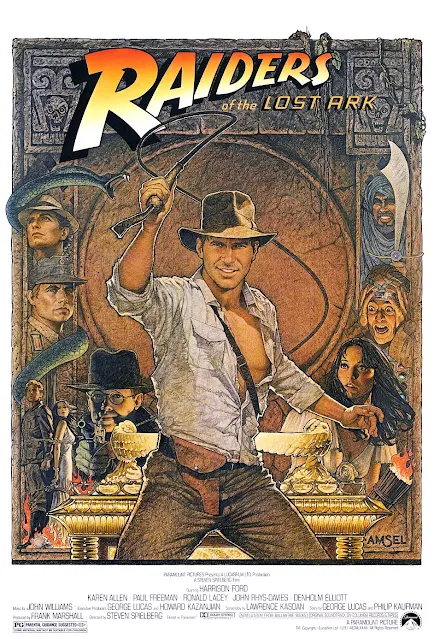
Raiders of the Lost Ark (1981): where the saga's moral physics were first written in fire.
It Belongs In A Museum
Utah, 1912. A teenage Boy Scout on horseback stumbles onto a band of grave robbers prising the Cross of Coronado out of a desert cave, and decides, with no plan and no chance, that he is going to take it back. "It belongs in a museum," the boy says, and the line is not bravado. It is a creed being born. The chase that follows is the single most consequential sequence in the franchise, because it builds Indiana Jones in real time: the whip, snatched off a circus wagon, which lays his chin open and gives him the scar Harrison Ford carried for the next four decades; the terror of snakes, after a carriage of them breaks his fall; and, finally, the hat. The robber the credits call Fedora corners the boy, takes the Cross back, and then, instead of gloating, lifts his own brown felt hat onto the kid's head and offers something close to respect: you lost today, but you do not have to like it. Indiana Jones is assembled out of fear, improvisation, defeat, and a thief's grudging admiration. He will spend a lifetime trying to live up to a creed he announced before he could grow a beard.
Hold onto that creed, because the whole saga turns on it. "It belongs in a museum" is the curator's vow: knowledge is a public trust, held in common, sought for its own sake and given back to everyone. Its shadow is the line Indy growls in a Shanghai nightclub a generation later, when the job is grubbier and the company worse: "Fortune and glory, kid. Fortune and glory." Inside one man live both the guardian and the looter, the scholar and the mercenary. Every villain Indiana Jones ever faces is the looter let off the leash, the grasp without the vow. (For the full chronological span of those adventures, from that desert chase to a moon-landing parade, see the chronological order of the Indiana Jones films.)
The Shadowy Reflection
René Belloq says it to Indy's face in a Cairo tent, turning a cheap pocket watch in his fingers. Worthless today, he muses, but bury it a thousand years and it becomes priceless, and so will the Ark, and so, by implication, will the two of them: rival archaeologists, identical hunger, divided only by which way they let it point. "I am a shadowy reflection of you," Belloq tells him. It would take only a nudge to make you like me. This is the thesis of the entire series, spoken aloud in the first film. The villains are not Indy's opposites. They are Indy without the vow, the same passion turned to appetite.
And the artefacts know the difference. This is the saga's strange, consistent theology: the sacred object is a judge, and it weighs the seeker by the shape of his wanting. Belloq pulls on the high priest's breastplate, opens the Ark of the Covenant to commune with God as an equal, and is obliterated for the presumption, his face running like candle wax, while Indy and Marion, who refuse even to look, are spared by the discipline of not grasping. The rule is set in the very first adventure: reach for the divine to possess it and it unmakes you; lower your eyes and live. Indy survives Raiders of the Lost Ark not by winning but by knowing what not to touch.
Temple of Doom, the darkest chapter, simply swaps the faith and keeps the physics. Mola Ram and his Thuggee cult have torn the worship of Kali out of shape, ripping living hearts from chests and chaining children in the mines beneath Pankot Palace, all to hoard the sacred Sankara stones as engines of power. When Indy invokes the true name of Shiva on the rope bridge, the stones turn to fire in Mola Ram's grip and burn through his hands, and the man who tried to own the sacred falls to the crocodiles below. "You betray Shiva," Indy tells him, and in this universe that is a capital offence. The stones go home to the village that revered them rightly. The sacred is a trust, never a possession. (These are the themes that run through every Indiana Jones adventure, refracted through a different religion each time.)
So by the time the saga reaches the two films this essay is really about, the machine is fully built. A sacred object. A seeker. A judgement keyed to humility. What the last two films do is take that machine and aim it, at last, squarely at the family at the centre of the story: a father, a son, and the lesson that passes between them.
Let It Go
The Last Crusade is where the saga stops being about Indy and the sacred and becomes about Indy and his father, and it turns out those were always the same story. Henry Jones Senior has chased the Holy Grail his entire life, and the chase has cost him his son. Indy grew up so far down his father's list of priorities that he answers, even as a grown man, to the name of the family dog. The Grail diary Henry posts to him is more real to the old man than the boy ever was. The wound between them is the quest, and the film's quiet genius is to argue that the quest, read correctly, is also the cure.
The villains read it the way villains always do, as a machine. Drink from the Grail and live forever: power over death, the oldest appetite of all. Walter Donovan and Elsa Schneider want exactly that, and the Grail Knight, nine hundred years old and weary at his post, gives them the test the saga always gives the grasping. Elsa, dazzled, selects a cup of gold fit for a king. Donovan drinks, and withers into dust in the space of a breath. "He chose poorly." Indy reasons that a carpenter from Galilee would have owned a carpenter's cup, plain fired clay, and chooses the humble one, and is told he has chosen wisely. The Grail does not reward the grandest claimant. It rewards the one who understands that the sacred wears no gold.
Indiana. Indiana, let it go. The lesson is handed down, father to son, over the edge of an abyss.
Then comes the seal. The Knight has warned them: the Grail cannot be carried beyond the Great Seal of the temple. Cross that line and the world falls. Elsa, who cannot stop wanting, takes it across anyway; the floor splits, and she ends up dangling over the chasm, her free hand reaching not for Indy but for the cup, until the reaching kills her. Moments later it is Indy hanging over the same void, stretching for the same Grail as the temple tears itself apart, and Henry, the man who gave his life to finding it, says the only words that matter: "Indiana. Indiana, let it go." And Indy, who has never once let his father reach him, lets it go. Outside, asked what he found after a lifetime of searching, Henry does not say eternal life and does not say the cup. He says, "Illumination." The treasure was never the object. It was the seeking, the faith required to take the leap of the third trial, and a father and son standing on the same ground for the first time. Note the direction the lesson travels here, parent to child. The saga is going to reverse it.
Knowledge Was Their Treasure
Nineteen years pass on screen and in life. When Indiana Jones returns in Kingdom of the Crystal Skull it is 1957, the world has turned atomic and paranoid, and the man is suddenly out of step with it: surviving a nuclear blast in a lead-lined refrigerator, hauled before suspicious federal agents, watching the certainties of his prime curdle into the Red Scare. Time, the saga's true antagonist, has begun to win. And the film takes Henry's buried lesson and writes it across the sky in letters too big to miss.
The treasure of Akator is not gold. It is a chamber stacked with artefacts from every culture on earth, the hoard of beings the film frames as archaeologists themselves, collectors of knowing across worlds. The closing line that draws the laughs, that the treasure was not gold but knowledge, is Henry Jones Senior's "illumination" reincarnated in extraterrestrial form. Oxley, the colleague driven mad by contact with the skull, becomes the saga's holy fool, a mouth through which the lesson speaks in riddles and dead languages.
Against this stands Irina Spalko, the cleanest statement of the grasp the franchise has ever drawn. She introduces herself by her appetite: she knows things, she knows them before anyone else, and what she does not know, she finds out. Knowledge, to Spalko, is a weapon for the State, a road to telepathic dominion, power over the mind of man. She is Belloq in jodhpurs, Donovan in a Soviet uniform, the same hunger wearing the century's newest coat.
Spalko cannot read Indy's mind.
The film offers a reason that is easy to skim past: she fundamentally cannot comprehend him. A mind that wants knowledge for nothing beyond the knowing is, to her, unreadable, alien. She has more in common with the cold and the calculating than she could ever share with the museum man. It is Indy who rhymes with the creature on the crystal throne, the patient collector who gathers knowledge and gives it away freely; and it is Indy's old ally Mac, snatching fistfuls of alien treasure even as the chamber comes apart, who shows what the grasp looks like in a minor key. Mac is dragged into the closing portal with his hands full. He grasped. He went.
The judgement that falls on Spalko is the Ark all over again, only now the wrath is made of pure information. She demands to be told everything, and the alien intelligence obliges her precisely, knowing she cannot bear it. Everything pours in at once, her mind cannot hold the flood, her eyes catch light, and she is drawn shrieking into the vortex, destroyed not by being refused but by being granted exactly what she reached for. Indy, beside her, declines. He closes his eyes before the Ark one more time. He chooses the carpenter's cup one more time. He lives. (The franchise loves this trick, where the prize and the punishment turn out to be the same object: more on the plot-twist ending of the Indiana Jones films.)
And quietly, underneath the spectacle, the relay begins to turn. Crystal Skull makes Indy a father. Mutt is his son with Marion Ravenwood, a switchblade-carrying rebel who is young Indy in a leather jacket, and the film notes, in framed photographs on Indy's desk, that Henry Senior and Marcus Brody are both gone now. Indy has become the older generation, the keeper of the diary rather than the boy who ignored it. At the wedding the hat lifts in the breeze and drifts toward the son, and for one beat it looks as though the torch will pass, before Indy reaches out and takes it back. Not yet. What it will cost him to keep holding it is a bill the next film presents in full.
I Want To Stay
Dial of Destiny picks up that bill and hands it to the audience. It is 1969. The whole planet is looking up at men walking on the moon, and Indiana Jones is a fossil among fossils, a retiring professor banging a broom on his ceiling because the neighbours are celebrating a future that has no use for him. The saga's oldest enemy, time, has finally run him down.
The film charges him the cruellest price it has ever named. His son Mutt, the boy from the previous film, is dead, killed in Vietnam, and the grief has broken his marriage to Marion clean in two. The man who learned over a chasm to let go has become a man who can let go of nothing. Here is the move the whole franchise had been setting up for forty years: the cautionary figure, the one stuck in the past, is now the hero. For four films the man who could not stop reaching was the villain, and the artefact punished him for it. Now the one who cannot stop reaching backward is Indy himself.
His dark mirror is Jürgen Voller, and the doubling is the most pointed in the series. Voller is the rocket scientist laundered out of the Reich and into NASA, the man who put Americans on the moon and privately despises that he won the wrong war under the wrong flag. His prize is the Antikythera mechanism, the Dial that Archimedes built to find the fissures in time. Where Donovan wanted power over death and Spalko wanted power over the mind, Voller reaches for the largest power any of them has dared: power over history itself. He intends to fly back to 1939, kill the Führer he regards as an incompetent, and run the war correctly. He is the looter's appetite scaled up to the proportions of a god.
The judgement, as ever, is built into the artefact, and this time the trap was laid two thousand years in advance. Archimedes understood that the heavens and the continents would drift across the centuries, so the Dial does not open onto the Germany Voller has charted. It opens onto 212 BC and the Roman siege of Syracuse. Voller flies his aircraft straight through the fissure into an antiquity he was far too arrogant to imagine, and dies in the very siege he was trying to leap clean over. He chose poorly. The object outwitted the man who seized it, exactly as a carpenter's cup once did. (The mechanics of how the Dial actually works are their own knot worth untangling: see the time-travel paradox in Dial of Destiny.)
And then the film commits its great heresy. Wounded, sitting in the dust of the ancient world with Archimedes himself a few feet away, having touched at last the deep past he chased his whole life, his son dead and his wife gone and 1969 holding nothing for him, Indiana Jones says he wants to stay. The hero fails the saga's central test. For the first time in five films, the man at the centre is the one grasping the sacred and refusing to release it, the one who should, by the franchise's own iron rule, be consumed.
He is saved the only way he could be, by the lesson coming back around the line of generations, reversed. In The Last Crusade the father told the son to let go, over the edge of a chasm. In Dial of Destiny the surrogate child, Helena Shaw, daughter of Indy's late friend Basil, refuses to let him stay, and when words fail she knocks him out cold and drags him home to 1969 because he will not go willingly. The torch the wedding declined to pass has finally passed, and it travels upstream: the man once ordered by his father to let go now has to be made to let go by the next one down the line, by force, because grief has burned the lesson out of him.
Helena matters for a second reason the franchise has been quietly preparing since 1912. She begins the film as a grasper, an artefact-hunter who sells history to the highest bidder at auction, drowning in debt, all fortune and glory and no museum. She is young Indy's looting impulse and Belloq's mercenary cool wearing one face. The film hands her the saga's permanent choice, the one a Boy Scout announced in a Utah desert, guardian or looter, and lets her choose the vow. She becomes the keeper of the man rather than the merchant of the object. That is the entire moral of the series enacted inside a single character arc.
|
The Last Crusade · 1989
Over the chasm, a father tells his son: "Indiana, let it go." Indy obeys, and releases the Grail. The lesson runs downstream, parent to child, freely given and freely taken. |
Dial of Destiny · 2023
In the ruins of Syracuse, a surrogate daughter tells the father-figure he cannot stay, then forces him home when he refuses. The lesson runs upstream, child to parent, taken back by force. |
And then the grace note, which is itself a piece of deep franchise lore. Indy wakes in his apartment and Marion comes to him. She crosses to the bed, asks where it hurts, and counts off his wounds one by one. The scene is a deliberate resurrection of a tender beat written for Raiders of the Lost Ark nearly forty-three years earlier and never filmed, the lovers cataloguing each other's scars. The saga closes the loop it opened. Sallah is there, the Egyptian friend who has been turning up to dig Indy out of trouble since the Well of Souls, the connective tissue of the whole found family. The hat, that hat, the one a defeated boy was handed by a grave robber in 1912, hangs on the line where he can reach it. He is allowed to live, in the present, among the people who love him, for the single reason that one of them loved him enough to deny him the past.
Choose Wisely
Set the five films in a row and the same engine hums beneath each one. A sacred object. A seeker. A judgement weighed against humility. The Ark of the Covenant. The Sankara stones of Shiva. The Holy Grail. The crystal skull of the interdimensional collectors. The Dial of Archimedes. Five artefacts, drawn from five faiths and five ways of knowing, Hebrew and Hindu and Christian and the cosmic and the coldly rational Greek, and every one of them poses the same question: what is the shape of your wanting.
| The Seeker | The Power Reached For | The Artefact's Judgement |
|---|---|---|
| René Belloq Raiders |
To open the Ark and speak with God as an equal | Annihilated the instant the Ark is opened. The divine will not be addressed by a peer. |
| Mola Ram Temple of Doom |
To hoard the Sankara stones and rule through terror | The stones burn through his hands; he falls to the crocodiles. "You betray Shiva." |
| Donovan & Elsa Last Crusade |
Eternal life from the Grail (power over death) | Donovan ages to dust ("he chose poorly"); Elsa will not stop reaching, and falls. |
| Irina Spalko Crystal Skull |
All knowledge as a weapon ("power over the mind of man") | Granted everything at once; her mind cannot hold it, and she is consumed. |
| Jürgen Voller Dial of Destiny |
To rewrite history (power over time itself) | The Dial's drift strands him in 212 BC; he dies in the siege he tried to skip. |
| Indiana Jones All five |
Knowledge held in trust ("it belongs in a museum") | Lowers his eyes, chooses humbly, lets go. He lives. |
Five seekers, one verdict: you are given precisely what you grasp for.
Read down that manifest and the pattern is total. The villains reach for power, a different flavour each time, power over death, over the gods, over the mind, over history, and they are each handed precisely the thing they grasped, and the handing destroys them. Belloq looks. Mola Ram clutches. Donovan drinks. Spalko knows. Voller travels. Each is devoured by the very object of his appetite. The hero survives by the opposite discipline every single time: he lowers his eyes before the Ark, he names Shiva truly, he chooses the carpenter's cup, he declines the alien's gift, and at the last, brought nearer to failure than ever before, he is hauled back from the edge by a child who will not let him grasp.
So the late films are not the saga running out of road. They are the saga finishing its sentence. Crystal Skull turns the lesson outward and stages it as a clash: the scholar against the weapon, the collector against the conqueror, knowledge sought for itself against knowledge seized for power. Dial of Destiny turns the lesson inward, points the test at the hero's own heart, finds him failing it, and lets the next generation save him the way his father once did.
And beneath all of it, holding the whole structure up, stands Henry Jones Senior and one sentence spoken over a void. The entire arc of late Indiana Jones is the slow working-out of "Indiana, let it go." Indy spends the back half of his saga proving he learned it, then very nearly proving that grief made him forget. The treasure was never the Ark or the stones or the Grail or the skull or the Dial. The treasure was always knowing what to release, and when. That was their treasure. It was the one thing the old man left his son worth keeping, and in the end it was the only thing that saved his life.
▸ The themes of the Indiana Jones adventures
▸ The chronological order of the Indiana Jones films
The Astromech · Long-form film analysis since 2009.
Film Lore · The Indiana Jones Saga How Indiana Jones inherited his father's only real lesson, carried it across fiv...
Read Article →
Halo - Soundtrack Analysis - The Marty O'Donnell years
The Monks
in the Car
Where the chant began. Before the departures and the homecomings, before three later composers spent a decade arguing over how much of it to keep, Martin O'Donnell and Michael Salvatori built the most recognisable sound in gaming across three Bungie games — and it started with a melody scribbled at the wheel of a car, three days before a deadline.
We have spent three essays in this booth arguing about a chant. We watched Neil Davidge throw it out in Halo 4, Kazuma Jinnouchi bring it home in Halo 5, and a trio of fans rebuild it for good in Halo Infinite. But every one of those arguments was really about something that already existed, a sound so complete and so beloved that touching it at all felt like sacrilege. This is the story of how that sound was made.
It begins in July 1999, in a car, with a man humming to himself like a monk. Bungie's director of cinematics, Joseph Staten, had walked over to audio director Martin O'Donnell with a near-impossible ask: a piece of music for the upcoming Macworld demo of a strange new game called Halo, and he needed it in days. Staten wanted something that felt ancient, epic and mysterious. O'Donnell, drawing on a fascination with the music of the Middle Ages, came up with the idea of opening the piece with Gregorian chant, and he jotted the melody down while driving. The theme was written in three days. The franchise would spend the next two decades trying to live up to those seventy-two hours.

The brief: ancient, epic, mysterious
The deadline was brutal. O'Donnell was asked on a Thursday for music that would have to be recorded and shown internally the following Monday, the same day Bungie's people flew to New York, before debuting at Macworld on the Tuesday. From a handful of words, ancient and epic and mysterious, he built the most famous thirty seconds in the medium. The opening was Gregorian chant, sung not by a hired choir but by O'Donnell, Salvatori and three jingle singers the pair had worked with on commercials. Over the top came a wailing, Qawwali-flavoured vocal solo. O'Donnell had meant for one of the professionals to sing it, but after he demonstrated what he wanted, everyone agreed he should do it himself.
The bones were stranger than they sound. O'Donnell has said the four-phrase structure of the chant was lifted from the opening of The Beatles' Yesterday, and he described his own taste as "a little Samuel Barber meets Giorgio Moroder", classical weight crossed with electronic pulse. Because he had no idea how long the Macworld presentation would run, he built deliberately loose opening and closing sections that could be stretched or trimmed around a driving rhythmic middle. That improvised flexibility, music designed to expand and contract on demand, turned out to be the seed of everything the franchise's scores would later become.
The partnership
O'Donnell did not build the sound alone, and it matters that he never pretended otherwise. He and Michael Salvatori were partners in a freelance company called TotalAudio, veterans of jingles and earlier Bungie games like Myth and Oni, and they composed every Halo score together. When Microsoft bought Bungie, O'Donnell had joined the staff barely ten days earlier and moved to Seattle, while Salvatori stayed in Chicago to keep TotalAudio running. The two worked the distance by sending music back and forth for feedback, a long-distance collaboration that produced the most unified sound in the medium.
There is a piece of luck buried in the origin story, too. A fire had burned down their studio in 1999, and rather than simply rebuild, the pair used the insurance to upgrade to newer equipment, which let them produce Combat Evolved in 5.1 surround sound using digital, hard-disk recording rather than tape. Live players from the Chicago Symphony and the Chicago Lyric Opera Orchestra were layered over MIDI and sampled instruments, reverb and overdubbed cellos faking the scale of a full orchestra. The famous Halo sound, in other words, was half ancient liturgy and half clever studio illusion, built by two friends a couple of thousand kilometres apart.
Three words, three days, one car. Everything the franchise has argued about since was already decided in that melody, before the game even had a story.
Combat Evolved: the liturgy is set
When Halo: Combat Evolved launched the Xbox in 2001, the theme that began the whole thing became the spine of an entire soundtrack. O'Donnell and Salvatori threaded the chant, the string melody and the Qawwali colour through cue after cue, so that the music felt like one continuous body rather than a collection of tracks. O'Donnell had a name for the principle: emotional equity. He liked to cite his teacher's mentor, the film composer Alfred Newman, who held that good themes should be reused relentlessly, because a bad theme would never have been used in the first place. That single idea, repeat the good melody until it means something, is the genetic code every later Halo composer would inherit.
The other revolution was invisible and enormous. Working hand in glove with the level designers, O'Donnell chopped the music into "chunks" that the game's audio engine could reassemble on the fly, swelling for a firefight, dropping to silence when the tension demanded it, stretching to fill however long a player loitered in a space. Interactive, non-linear scoring of that kind was rare in 2001 and is everywhere now. The soundtrack almost never reached the public at all: Microsoft saw no reason to release it, and only relented after sustained pressure from O'Donnell and a nudge from the producer Nile Rodgers. When it finally arrived in 2002 it sold tens of thousands of copies to people who had never needed the game to love the music.

Halo 2: the guitars
If Combat Evolved was monastic, Halo 2 plugged in and turned up. For the 2004 sequel, O'Donnell brought in heavy electric guitar, most famously from the virtuoso Steve Vai, and the result opens the soundtrack as the Halo Theme Mjolnir Mix, a roaring rock reworking of the choral original that is, to a lot of fans, the single most iconic track the series ever produced. Producer Nile Rodgers, the Chic legend, oversaw both volumes, and the studio footage of Vai shredding while Rodgers conducted him by mouthing guitar lines and O'Donnell watched in disbelief has become a small piece of gaming history in its own right.
The release was as ambitious as the music. Halo 2 shipped its soundtrack in two volumes almost two years apart. Volume 1, timed to the game's launch, mixed O'Donnell and Salvatori's arrangements with "inspired-by" rock from Incubus, Breaking Benjamin and Hoobastank, while Volume 2, in 2006, gathered the actual in-game score into long suites and was, for many, the album fans had really been waiting for. The orchestral parts were tracked with the Northwest Sinfonia at Studio X in Seattle. Volume 1 became the first video game soundtrack ever to enter the Billboard 200, peaking at number 162, a milestone that helped drag game music toward being treated as a serious art form rather than a novelty.
3 Days to write the theme |
162 Billboard peak, Halo 2 |
60 Piece orchestra, Halo 3 |
Halo 3: blowing it out
For the 2007 finale, O'Donnell wanted to "blow out" the epic sounds the series had only ever hinted at. Where Combat Evolved had faked an orchestra, Halo 3 hired a real one: a sixty-piece orchestra and a twenty-four-voice choir, with C Paul Johnson joining O'Donnell and Salvatori, and the music recorded live rather than synthesised. The album abandoned the suite format of Halo 2 and returned to the level-by-level structure of the first game, and it leaned harder on previous motifs than anything before it, because O'Donnell believed a trilogy capper had to be built from the audience's own memories.
Two new pieces became permanent. One Final Effort gave the heroes a soaring brass anthem that has been reprised in every era since. And Never Forget, a reworking of Halo 2's aching Unforgotten, distilled the whole saga into a few downcast piano notes, the cue Jinnouchi would later reach back and reinterpret in Halo 4. That piano voice was itself a Halo 3 innovation; O'Donnell, who always composed from the keyboard, introduced the now-beloved piano theme in the game's announcement teaser. The closing cue, fittingly, was called Finish the Fight, folding the Halo theme and older melodies into one last triumphant blast.
The themes that continued
Trace the throughline and the genius of the Bungie years is obvious. The Halo theme itself mutates across all three games while staying instantly recognisable: synthesised and monastic in Combat Evolved, given electric teeth as the Mjolnir Mix in Halo 2, then re-recorded with a live orchestra for Halo 3. The mournful Unforgotten from the second game becomes Never Forget in the third. The piano theme arrives late and instantly feels eternal. This is emotional equity in action, the same melodies returning in new clothes until familiarity itself becomes the feeling.
What O'Donnell mostly avoided was strict, character-by-character leitmotif. Rather than assign a tune to each person in what he jokingly called a "Peter and the Wolf" approach, he wrote sad music for sad moments and scary music for scary ones, letting recurring themes emerge by feel rather than system. It is a looser, more atmospheric philosophy than the cinematic leitmotif scoring the later composers would lean into, and it is a large part of why the Bungie scores feel less like film music and more like the weather of a place.
The end of an era
The pair kept stretching the sound after the trilogy. Halo 3: ODST abandoned the established themes almost entirely for a smoky, jazz-noir mood to suit its smaller detective story, and Halo: Reach, a prequel to Combat Evolved, went grittier and darker to match a tale of doomed soldiers. O'Donnell called the chance to write genuinely new music both a challenge and a relief from the weight of the iconic themes. Reach was Bungie's last Halo. After the studio split from Microsoft to make Destiny, O'Donnell was fired in April 2014, an unhappy end for the man who had given the franchise its voice.
The affection, though, never dimmed. Bungie buried tributes to him in the games themselves, a recurring tune called the Siege of Madrigal that has hidden in Halo soundtracks since Combat Evolved, and a marine in Reach named M.O. Donnell with the service tag MRTY. In 2015 the music of Halo was voted into the Classic FM Hall of Fame, the first video game music ever to make it, a quiet confirmation that what those two men built in a Chicago studio had become part of the wider canon of music, full stop.
The inheritance
Everything we wrote about in the modern trilogy only makes sense against this foundation. When Neil Davidge threw out the chant for Halo 4, this is the liturgy he was refusing to recite. When Kazuma Jinnouchi reached back to restore it for Halo 5, these are the themes he was reaching for. And when the three composers of Halo Infinite rebuilt the original sound for good, this is the home they were moving back into. None of those choices would mean anything without the thing O'Donnell and Salvatori made first.
That is the strange power of a great theme. It outlives its authors' tenure, survives departures and homecomings and committees, and keeps meaning more each time it returns. The whole saga of the Halo score, the departure, the restoration, the long way home, is just the sound of a franchise circling back, again and again, to a melody one man hummed to himself at the wheel of a car because a colleague needed something ancient by Tuesday.
It started with monks in a car, three days before a deadline. Everything after — the guitars, the grief, the departures, the homecomings, the long way back — was just the franchise spending a quarter of a century learning what that one melody already knew.
No Chant, No Compromise: the Halo 4 soundtrack — where Neil Davidge threw out the monks.
The Chant Comes Home: the Halo 5 soundtrack — where Kazuma Jinnouchi brought the liturgy back.
The Long Way Home: the Halo Infinite soundtrack — where three fans rebuilt the original sound for good.
All our Halo coverage — the full archive of essays on the ring, the Chief and the universe around them.
UNSC // The Astromech MUSIC ARCHIVE · 001 Film & Game Scores The Monks in the Car ...
Read Article →_poster.jpg)


