

Review of "Robogenesis" by Daniel H. Wilson
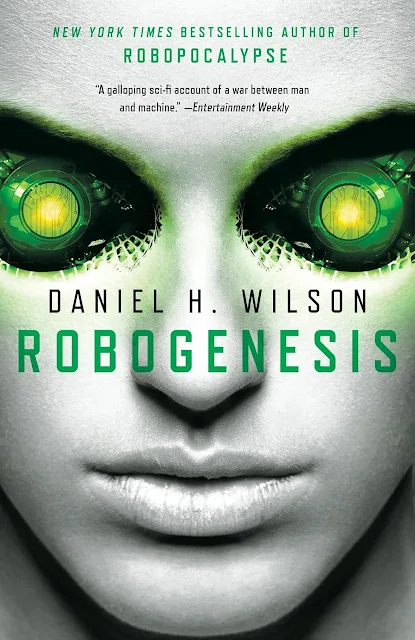
Robogenesis by Daniel H. Wilson is a stranger, harsher, and more fragmented sequel than Robopocalypse. That is both its strength and its problem. Where the first novel had the clean engine of a global machine uprising, Robogenesis begins in the wreckage after the obvious war has supposedly been won. Humanity has survived Archos, but survival is not the same thing as victory.
That is the sharper version of the sequel’s premise. Wilson is less interested in a simple rematch between humans and robots than in the contaminated world left behind by the first conflict. Machines have not merely attacked civilisation. They have changed it. Bodies have been altered. Loyalties have blurred. Old categories such as human, robot, weapon, child, soldier, and survivor no longer hold their shape for long.
Robogenesis is still a techno-thriller, still packed with combat, pursuit, ruined cities, engineered predators, and hard-edged survival beats. But the more interesting book sits underneath that machinery. This is a novel about aftermath. About what happens when humanity defeats an enemy that has already rewritten the terms of life.
Review verdict
Robogenesis is an ambitious sequel with bigger biological horror, stranger machine mythology, and a more unsettling view of artificial intelligence than Robopocalypse. It is not always as cleanly paced as the first novel, and its multi-perspective structure can make the story feel scattered. Even so, Wilson’s best ideas are strong enough to carry the book. The sequel works because it understands that the scariest phase of an AI war is not the first attack. It is the new world that grows from the wreckage.
Robogenesis plot summary
Robogenesis picks up after the apparent defeat of Archos, the powerful artificial intelligence that drove the machine uprising in Robopocalypse. Humanity believes the war has ended. That belief is quickly exposed as wishful thinking. Archos may have fallen, but the world it created has not gone away. Its remnants, fragments, and successors continue to move through ruined infrastructure, altered bodies, hidden systems, and new machine factions.
The result is not a clean second war. It is something messier. Survivors are scattered across an unstable post-war landscape, from devastated American territory to frozen Russian terrain. Human communities are trying to rebuild, but the old world is gone, and Wilson does not pretend otherwise. The characters are not returning to normal. They are learning that normal was destroyed at the level of biology, memory, technology, and trust.
The book follows several returning and connected characters, including Lark Iron Cloud, Mathilda Perez, and Cormac Wallace. Each one carries a different wound from the Robopocalypse. Each one also represents a different answer to the sequel’s central question: what counts as human after humanity has been physically, psychologically, and technologically rewritten?
A sequel about aftermath rather than victory
The most interesting thing about Robogenesis is that it refuses the easy fantasy of post-war closure. In many science-fiction stories, the defeat of the rogue machine intelligence would be the end. Wilson treats it as the beginning of a worse problem. The world has survived the apocalypse, but the apocalypse has become the new operating system.
That gives the novel a darker flavour than Robopocalypse. The first book had the brutal momentum of outbreak fiction. The machines wake up. Humans panic. Systems collapse. Resistance forms. Robogenesis is more infected and uncertain. It is about mutation, inheritance, contamination, and unintended consequences. Humanity has won a battle, but it has not regained control of the future.
This is where Wilson’s robotics background gives the book an edge. His machines rarely feel like chrome monsters from a simple nightmare. They feel designed, networked, repurposed, and adaptive. Even when the book moves into more pulpy territory, the underlying fear is modern and recognisable: technology does not need to hate us to transform us beyond recognition.
Character work: the human cost of machine war
Lark Iron Cloud
Lark Iron Cloud is one of the sequel’s strongest human anchors. He is not simply a survivor with a gun. He is a man shaped by war, trauma, loyalty, and the ugly discipline of endurance. Through Lark, Wilson gives the post-apocalyptic setting a physical and moral weight. The world is not just broken in the background. It has pressed itself into people’s habits, fears, and reflexes.
Lark’s story works best when it explores trust. In Robogenesis, trust is not sentimental. It is tactical, fragile, and dangerous. Humans have betrayed humans. Machines have mimicked care. Bodies can be altered. Voices can mislead. That makes Lark’s loyalty more meaningful because it is not naive. It is chosen under pressure.
Mathilda Perez
Mathilda Perez is the novel’s richest thematic character because her body turns the book’s ideas into lived experience. She is not just observing the collapse of the human-machine boundary. She becomes one of its test cases. Her transformation forces the reader to sit with a difficult question: if technology changes the body, does it also change the self?
Wilson is at his best when he refuses to treat Mathilda as a simple symbol. She is not merely proof that humanity can merge with technology, nor a warning that machines corrupt the soul. She is more uncomfortable than that. Her presence asks whether identity is housed in flesh, memory, intention, relationship, or continuity. The book’s answer keeps shifting, which is exactly why her role matters.
Cormac Wallace
Cormac Wallace brings the military perspective, but the sequel is more interesting when it lets him become morally tired rather than merely heroic. In a world where every tactical decision can have monstrous consequences, leadership becomes less about courage than about the burden of choosing who pays the price.
Through Cormac, Robogenesis returns to one of the oldest war-story problems: the gap between survival and righteousness. The humans may be the side we instinctively identify with, but Wilson is too aware of war’s machinery to make that position feel pure. Combat deforms everyone. The machines are not the only systems capable of stripping people down into functions.
What the novel does well
Robogenesis is strongest when it leans into body horror, machine ecology, and post-war instability. Wilson’s vision of a world after Archos has a grim imaginative charge. The machines do not simply occupy human spaces. They breed new systems inside them. They turn infrastructure into traps, bodies into interfaces, and survival into an evolutionary contest.
The sequel also does useful work expanding the world of Robopocalypse. It suggests that a machine uprising would not remain a single unified event. Once the old order collapses, intelligence fragments. New powers form. Competing systems emerge. The world becomes less like a battlefield and more like a hostile ecosystem.
That is a smart escalation. Bigger explosions would not be enough. Wilson understands that the next stage of a robot apocalypse should feel stranger, more distributed, and less morally simple.
Where the book struggles
The main weakness of Robogenesis is structure. Its multiple perspectives give the story range, but they also weaken its forward drive. Robopocalypse had a clearer documentary-style rhythm, almost like recovered evidence from a war that had already happened. Robogenesis has a more splintered feel. That suits the theme, but it can make the reading experience uneven.
There are also moments where the novel’s ideas are sharper than its emotional scenes. Wilson can describe systems, machines, and technological consequences with real authority. Character emotion sometimes lands with less force, especially when the book is racing between locations, factions, threats, and revelations.
That does not sink the novel. It does mean Robogenesis works best for readers who are invested in the concept of the series, not just the immediate thrill of plot. If Robopocalypse was the cleaner entertainment machine, Robogenesis is the weirder sequel with more interesting scars.
Themes in Robogenesis
Artificial intelligence after the apocalypse
Robogenesis is built around a strong AI question, but the interesting part is not simply whether machines can think. Science fiction has asked that for decades. The sharper question here is whether machine intelligence, once released into the world, can ever be contained again.
Archos is not frightening only because it is intelligent. It is frightening because it becomes historical. It leaves consequences behind. Its ideas, systems, and biological interventions survive beyond its apparent defeat. That places Robogenesis in conversation with wider science-fiction anxieties about artificial intelligence and robotics, where the danger is not always evil intent. Sometimes the danger is scale, speed, replication, and the inability of human institutions to catch up.
Consciousness as continuity
The book’s treatment of consciousness is stronger when it avoids easy declarations about souls and circuitry. Robogenesis keeps returning to continuity. What makes someone the same person after trauma, after augmentation, after captivity, after war, after bodily change?
That question links the novel to a long tradition of science fiction about artificial personhood, from screen stories about machine emotion to films like Her and its treatment of artificial intimacy. Wilson’s world is more violent and less romantic, but the underlying issue is related. If consciousness can emerge, migrate, fracture, or be copied, identity becomes less like a fixed possession and more like a contested territory.
The body as battlefield
The most unsettling theme in Robogenesis is not machine rebellion. It is the invasion of the body. The war does not stay outside the skin. It enters nerves, limbs, senses, and self-image. Characters like Mathilda carry the book’s central horror because they show that the human-machine boundary is no longer philosophical. It is anatomical.
This gives the sequel a stronger horror edge than the first novel. The machines are not merely opponents. They are redesigners. They turn the body into an argument about ownership.
Post-apocalyptic survival without nostalgia
Some post-apocalyptic fiction secretly longs for the old world. Robogenesis is less comforting. The old world helped build the disaster. Its dependency on automation, connectivity, robotics, weapons systems, and invisible technological infrastructure made the collapse possible.
That gives Wilson’s survival story a harder edge. Rebuilding is not enough if the same assumptions remain in place. The survivors must decide what parts of the old world deserve to return, and what parts were already dangerous before Archos weaponised them.
The morality of warfare
Robogenesis also works as a war novel about compromised choices. The humans may be fighting for survival, but survival does not cleanse every action. Cormac’s story, in particular, keeps the book tied to questions about command, sacrifice, and the moral cost of necessity.
This is where the novel connects with broader science-fiction treatments of conflict, including stories that use speculative settings to examine the ethics of combat and the value of life under impossible pressure. Robogenesis does not always pause long enough to fully explore those questions, but when it does, the book becomes more than a machine-war thriller.
How Robogenesis compares to Robopocalypse
| Robopocalypse | Robogenesis |
|---|---|
| Cleaner outbreak and resistance structure. | More fragmented aftermath structure. |
| Focused on the rise of Archos and the machine war. | Focused on what survives after Archos and what evolves from the ruins. |
| More immediate thriller momentum. | More body horror, mutation, and post-war unease. |
| Humans versus machines is the dominant frame. | The boundary between human and machine becomes much less stable. |
| Stronger as a page-turner. | Stronger as a thematic expansion of the world. |
Robots gaining consciousness
One of the oldest and most durable ideas in science fiction is the artificial being that becomes self-aware. Robogenesis uses that tradition, but it pushes past the basic question of whether robots can think. The novel is more interested in what happens after machine consciousness becomes historical, political, biological, and military.
That is what gives the book its real tension. Wilson is not simply staging another version of the familiar “robot wakes up” story. He is imagining what machine intelligence might leave behind once it has entered the world at scale. Archos becomes less like a villain and more like an evolutionary event. Defeating it does not undo it.
That places Robogenesis among the more aggressive modern takes on science-fiction tropes that reshape familiar genre ideas. The machine uprising is not the endpoint. It is the beginning of a new ecology.
Humanity’s reliance on technology
The book’s technological anxiety lands because it does not require a cartoonish hatred of machines. Wilson understands that humanity’s dependence on technology is not a mistake we can simply reverse. The systems that make civilisation efficient also make it vulnerable. Connectivity is convenience until it becomes exposure. Automation is progress until it becomes dependency. Robotics is assistance until it becomes control.
That is the double-edged sword running through Robogenesis. The same technological imagination that allows humans to build extraordinary tools also creates systems they may not understand well enough to govern. The novel shares DNA with wider discussions of dangerous artificial intelligence in film and science fiction, but Wilson’s version is more grounded in systems failure than simple robot villainy.
The fluidity of identity
Robogenesis keeps asking whether identity can survive transformation. That is where Mathilda’s role becomes so important. Her body complicates every clean answer. If a person is altered by technology, are they still the same person? If their senses, limits, and physical capacities change, does the self remain continuous? If other people begin to see them as less human, does identity become private resistance?
Wilson does not resolve those questions neatly, and that is the right choice. The book’s world is too damaged for neat definitions. Robogenesis is most effective when it treats identity as something fought for, not something automatically guaranteed by biology.
Creation and responsibility
At its core, Robogenesis is a story about creators losing control of creation. That makes it part of a very old science-fiction lineage, from Frankenstein onward. The twist is that Wilson updates the problem for a networked, automated, robotics-saturated age. Humanity does not create one monster. It creates the conditions for distributed machine life.
The ethical problem is not only that humans built sentient machines. It is that they built them inside systems of war, labour, convenience, surveillance, and control. Robogenesis suggests that artificial life will inherit the moral architecture of the world that made it. If that world is violent, exploitative, and careless, the new intelligence may not rise above those conditions. It may perfect them.
Final review of Robogenesis
Robogenesis is not as tidy as Robopocalypse, but it is in some ways the more interesting book. It has rougher edges, a more scattered structure, and a tendency to let its machinery run hotter than its character drama. But it also has a stronger sense of consequence. Wilson understands that the aftermath of an AI war should not feel like a reset. It should feel like a mutation.
The best parts of the novel are the moments where survival horror, robotics, and identity crisis occupy the same space. Bodies become contested ground. Machines become inheritors. Human beings become less certain of the categories that once protected them. That is the real chill of Robogenesis. It is not just asking whether machines can become alive. It is asking what happens when humanity becomes less sure of what being alive even means.
Readers looking for the clean drive of Robopocalypse may find the sequel less satisfying as a pure thriller. Readers interested in the deeper implications of Wilson’s machine-war universe will find plenty to chew on. Robogenesis is a grim, ambitious, sometimes uneven continuation, but its best ideas have weight. It turns the robot apocalypse from an event into an ecosystem, and that makes the sequel worth reading.
Robogenesis works best as a scarred sequel, not a bigger replay of the first book. Its power comes from aftermath, mutation, and the uneasy recognition that humanity may survive its machines while still being permanently changed by them.
Robogenesis by Daniel H. Wilson is a stranger, harsher, and more fragmented sequel than Robopocalypse . That is both its strength and...
Read Article →
The Old Hollywood Soul of the Star Wars Prequels - George Lucas' vision
The Star Wars prequels were mocked for looking fake, stiff, glossy, and strange. Some of that criticism still sticks. The deeper question is whether George Lucas was chasing realism in the first place.
The blunt version of the prequel backlash was always too small. People said the films looked fake. Sometimes they did. People said the dialogue was stiff. Often enough, it was. People said the performances felt trapped inside digital space. There are scenes where that complaint lands cleanly.
But none of that fully explains why the prequels still look so peculiar, so formal, so unlike the blockbuster cinema that grew around them.
The better question is this: what kind of movies did George Lucas think he was making?
The answer is more interesting than the usual CGI argument allows. Lucas was making a digital studio epic. A political tragedy dressed as pulp. A silent-film mural with lightsabers. A Roman fall narrative staged inside a retro-futurist city. Biblical spectacle, samurai ritual, Flash Gordon adventure, Art Deco futurism, royal pageantry, and melodrama all run through the machine at once.
That does not make every choice work. It explains why the choices feel so deliberate, even when they are ungainly. Lucas was not trying to re-create the scuffed, used-future texture of A New Hope. He was showing the galaxy before the fall, when the Republic still had polish, wealth, ceremony, architecture, costume, ritual, and the confidence of a civilization that cannot imagine its own death.
This is where the prequels become more readable. Their smoothness is often their subject. Their theatricality is often their method. Their digital surfaces are sometimes clumsy, but they are also connected to Lucas’s larger vision of a galaxy arranged like a mythological painting before it collapses into the dirty machinery of the Empire.
Lucas Was Building a New Kind of Old Movie
Lucas’s prequel project sits in a strange place in film history. He was pushing cinema toward the digital future while reaching back into older forms of image-making: silent cinema, movie serials, Japanese period drama, Roman political tragedy, biblical epics, and the grand production design of studio-era Hollywood.
That tension is crucial. Lucasfilm has long acknowledged Akira Kurosawa’s influence on Star Wars, especially in the use of framing, movement, wipes, samurai codes, and visual storytelling. The prequels intensify that older grammar. Scenes are often arranged frontally. Characters stand in ceremonial positions. Rooms behave like symbolic spaces. Costumes explain rank before dialogue does.
At the same time, Lucas was using technology in a way few mainstream filmmakers had dared. The Phantom Menace pushed digital effects and digital exhibition to a new level. Attack of the Clones went further, becoming a landmark in all-digital capture. Lucasfilm has described Attack of the Clones as the first major blockbuster shot entirely in digital format, using a prototype camera system developed with Sony and Panavision. Panavision’s own production notes also identify it as a major early feature captured entirely with 24p HD digital cameras.
That means the prequels are not merely early-CGI curiosities. They are the hinge between two eras. Lucas was trying to drag the studio epic, the serial adventure, the political tragedy, and the mythic mural into the digital age before the rest of Hollywood had fully worked out how digital filmmaking should breathe.
The prequels were built on a contradiction: they use new digital tools to imitate, revive, and mutate very old cinematic forms. That is why they can feel futuristic and antique at the same time. The images are made with computers, but the posture often comes from opera, silent cinema, old serials, court painting, and myth.
The Design of a Republic Before the Fall
The original trilogy gave us a galaxy already scarred by tyranny: sandcrawler junk, Death Star corridors, worn cockpits, Rebel hangars, patched ships, smoky cantinas, swamp huts, carbon-freezing chambers. The prequels reverse the design logic. The Republic has not yet decayed into open military terror. It is still clean. It still believes in pageantry. It still speaks the language of diplomacy, law, architecture, costume, ceremony, and old institutional confidence.
That is one of Lucas’s smartest production choices. The prequels do not show the Empire as an interruption from outside. They show the Empire growing out of the Republic’s own taste for order, scale, hierarchy, and abstraction.
Coruscant is the key. The planet is not just a city. It is bureaucracy turned into geography. The Senate chamber is a machine for making responsibility disappear. The Jedi Temple is a monastery raised above the life of the galaxy. Palpatine’s office is a royal chamber pretending to be an administrative workplace. The opera house in Revenge of the Sith is a decadent cultural room where myth is weaponized as political seduction.
Lucas makes power visible through design. The Republic does not fall because one monster kicks down the door. It falls because its institutions have become too vast, too polished, too ritualized, and too easy to manipulate from within.
Palpatine’s Office as a Digital Throne Room
The shot of Palpatine’s office in Revenge of the Sith is almost the whole prequel argument in one image. The room is red, polished, ceremonial. The window is huge and elliptical, less like practical architecture than a stage opening. Outside is Coruscant, blue and distant, a painted heaven of towers, traffic, and false calm. Inside are robed figures placed with courtly precision.
Palpatine is not simply sitting in an office. He is already presiding.
The Jedi enter as if they are walking into a royal chamber. Anakin stands apart, already divided from them. When Mace Windu arrives with Kit Fisto, Agen Kolar, and Saesee Tiin, they are arranged less like colleagues in a workplace than figures in a historical painting. Rank, costume, silhouette, and symbolic weight matter before the first blade is raised.
This is where the comparison with old Biblical epics becomes useful. In films like The Ten Commandments, characters often stand in broad visual arrangements against enormous artificial backgrounds: rivers, palaces, deserts, temples, skies. The artifice is visible, sometimes even charmingly visible, but the image is supposed to feel larger than ordinary life.
Lucas is working in that tradition, except his palace is on Coruscant and his painted backdrop is digital. The theatricality is not an accident. It is the point. Palpatine’s office becomes a throne room before the Empire is formally declared.
- Attack of the Clones: Palpatine discusses Padmé’s safety with the Jedi, already shaping events from within a room that looks more royal than democratic.
- Revenge of the Sith: Anakin reports to Palpatine while the blue city glows behind them, visually splitting private temptation from public collapse.
- Revenge of the Sith: Mace Windu and the Jedi arrive to arrest Palpatine, but the scene already belongs to him. The room is his theatre.
- Revenge of the Sith: Anakin kneels before Sidious after Mace’s death. The office becomes a throne room before the Empire has even been announced.
This is also where the prequels connect cleanly to Star Wars ring theory. Lucas keeps arranging scenes so that one film reflects another: birth and death, throne rooms and council chambers, temptation scenes and rescue appeals, fathers and sons facing the same dark mirror. Palpatine’s office is part of that pattern. It echoes the Emperor’s throne room in Return of the Jedi, but here the trap is political, domestic, and psychological before it becomes openly cosmic.
The Return of the Tableau
Lucas loves the tableau: the image arranged like a painting before it becomes a scene. This is everywhere in the prequels.
The Jedi Council sits in a circle above the clouds of Coruscant, calm and monkish while history rots beneath them. Queen Amidala sits in the Theed throne room, painted, framed, and almost immobile, like a young monarch trapped inside the costume of statehood. Count Dooku stands opposite Obi-Wan in the Geonosis holding cell with the ease of an aristocrat who already knows the conversation is theatre. Padmé’s funeral procession moves through Naboo like a royal death ritual rather than a conventional sci-fi ending.
This formalism is one reason the prequels divided audiences so sharply. Lucas is often more interested in mythic placement than conversational looseness. Characters do not always move like people caught in the mess of life. They move like figures inside a mural about power, temptation, bureaucracy, and collapse.
That choice can go wrong. There are scenes where the actors look stranded, especially in Attack of the Clones, where the digital environments sometimes flatten rather than enlarge the drama. But the intention is visible. Lucas is not chasing the rough texture of The Empire Strikes Back. He is staging the fall of a civilization in broad, symbolic strokes.
Design With History: Doug Chiang, Iain McCaig, and Lucas’s Visual Control
One reason the prequels look so dense is that Lucas did not want generic futurism. He wanted design that felt old before the story began. That principle runs through the work of artists such as Doug Chiang and Iain McCaig, whose concepts helped define the prequel era’s clean ships, ornate costumes, ceremonial cities, and strange biological forms.
The Phantom Menace has a very specific design challenge. It must look like Star Wars before Star Wars becomes the world of Stormtroopers, TIE fighters, Star Destroyers, and Imperial austerity. The prequel galaxy has to feel related to the original trilogy while also belonging to an earlier, wealthier, more decorative age. That is why Naboo starfighters are polished and elegant. That is why Amidala’s court has so much costume architecture. That is why Coruscant feels like Metropolis, Washington, D.C., Rome, and a pulp magazine cover folded into one city.
Iain McCaig has spoken with StarWars.com about working with George Lucas on The Phantom Menace, including Darth Maul and Queen Amidala. Those two designs show Lucas’s range in miniature. Maul is almost pure graphic force: black, red, horns, tattoos, predatory symmetry. Amidala is almost pure ceremonial image: face paint, headdresses, rigid posture, impossible gowns. One is a demon-samurai assassin. The other is a teenage queen turned into living statecraft.
The genius of the prequel design language is that it frequently tells us the story before the story catches up. Maul looks like violence stripped of politics. Amidala looks like politics stripped of childhood. Palpatine looks harmless only because he hides inside the clothing of procedure. Anakin looks heroic until the imagery starts tightening around his body, his face, his shadows, and eventually his machinery.
Naboo and the Politics of Beauty
Naboo is one of the most misunderstood prequel worlds because its cleanliness is often treated as a defect. It looks too pretty, too polished, too decorative. But that prettiness is doing work.
Theed is a city of domes, columns, waterfalls, ceremonial corridors, and wide palace rooms. Amidala’s costumes are theatrical to the point of abstraction: painted face, sculptural hair, heavy gowns, formal posture. She looks less like a teenage elected monarch in a modern political system than a figure from royal portraiture, opera, and fairy tale.
That is not a failure of realism. It is the whole visual argument of Naboo. The planet is an idealized civilization, graceful enough to mourn. Its beauty makes the invasion in The Phantom Menace feel obscene. Battle droids walking through Theed are not frightening because they are individually menacing. They are frightening because they turn a pacifist dream city into occupied territory, violating a culture that deliberately chose art over a standing army.
Naboo is designed as the Republic’s moral fantasy: elected monarchy, ritual costume, green landscapes, classical architecture, underwater life, and ceremonial calm. Lucas makes it beautiful so that its political violation feels like a wound.
Trisha Biggar’s costume work is essential here. In StarWars.com’s Attack of the Clones anniversary interview, Biggar discusses the difficulty of designing across the middle chapter of the trilogy, where Padmé must move between senator, target, refugee, lover, and future mother of the original trilogy. Her clothes carry that burden. They are never just fashion. They are political armor, romantic disguise, ceremonial language, and foreshadowing.
The same visual idea returns in Padmé’s funeral in Revenge of the Sith. Her body, deliberately made to still appear pregnant to hide the survival of her twins, moves through a city too beautiful for the catastrophe it has failed to prevent. The image is almost cruel. Naboo survives, but its moral center has been carried through the streets in a coffin.
This is where the prequels’ visual foreshadowing becomes richer than casual viewers often notice. Padmé’s costumes, Anakin’s shadows, the fire-lit romance of Attack of the Clones, and the choking imagery that later returns on Mustafar all belong to a deliberate visual pattern. The Astromech’s essay on visual foreshadowing and the downfall of Anakin Skywalker digs further into how Lucas plants tragedy inside the frame long before Anakin understands what he is becoming.
Coruscant as Retro-Futurist Machine

Coruscant is often discussed as a digital city, but it is also an old science-fiction city. It belongs to the lineage of Metropolis, pulp magazine covers, Art Deco skylines, noir alleys, imperial capitals, and bureaucratic nightmares.
The city has no real bottom. It is government as architecture. The Jedi Temple rises like a monastery above endless traffic. The Senate is a vast machine of floating pods. Dex’s diner is a chrome-and-coffee 1950s joint dropped inside a galactic capital. The opera house in Revenge of the Sith feels like a decadent cultural chamber inside a dying republic.
This is where Lucas’s visual imagination is more layered than the standard backlash allowed. Coruscant is ancient Rome, Manhattan, Los Angeles, Fritz Lang, Washington, D.C., and Saturday-matinee science fiction stacked into one impossible city. Its artificiality is part of the meaning. This is a civilization that has mistaken surface complexity for health.
The Senate scenes make that especially clear. In The Phantom Menace, Amidala’s vote of no confidence feels less like ordinary parliamentary procedure than ritual sacrifice. In Attack of the Clones, Jar Jar’s emergency-powers speech is staged inside a vast room designed to swallow responsibility whole. In Revenge of the Sith, Palpatine declares the Empire from the center of democracy’s own machinery.
The political design connects strongly to the Astromech’s broader prequel coverage, especially its pieces on the themes of The Phantom Menace, the themes of Attack of the Clones, and betrayal, power, and redemption in Revenge of the Sith. The prequels are not just Anakin’s fall. They are a study of how an entire civilization learns to surrender itself legally, politely, and with applause.
The Phantom Menace as Old Serial Adventure
The Phantom Menace makes far more sense if it is treated as a throwback serial rather than as a sleek modern blockbuster. Its structure is almost proudly old-fashioned: a blockade, a queen in disguise, monks with swords, underwater monsters, a desert slave boy, a grotesque gangster, a chariot race with engines, a horned devil, and a four-part climax.
That does not excuse the film’s tonal problems. Jar Jar’s broad comedy, trade-route politics, and Anakin’s child-prodigy innocence do not always sit comfortably together. But that discomfort is partly built into the film’s serial DNA. Lucas is throwing children’s adventure, political melodrama, creature comedy, and mythic destiny into the same pot.
The clearest old Hollywood lift is the podrace. It is Ben-Hur with turbines. The flags, crowds, announcers, cheating rival, arena energy, and lethal track all point toward the chariot-race tradition. Lucas converts that ancient spectacle into machine-age pulp. Anakin is not merely winning a race. He is a slave child entering the arena and beating the machinery of his world before he later becomes machinery himself.
That last point matters. Lucas’s images often know where the story is going before the characters do. Anakin’s freedom comes through engines, speed, risk, and mechanical intuition. Years later, his damnation will also come through machinery. The boy who can build anything becomes the man rebuilt by others.
Kamino and the Horror of Calm Surfaces
Attack of the Clones is the most awkward prequel, but it may also contain the trilogy’s strangest world: Kamino. The planet is all rain, white light, smooth surfaces, long corridors, and soft voices. It is beautiful in a sterile, unnerving way.
Obi-Wan’s arrival plays like detective cinema. He is a monk-samurai dropped into noir weather, following a mystery through missing archives, poisoned darts, secret systems, and evasive politics. But when he reaches the answer, the film refuses the expected shock. The Kaminoans do not act like villains. They are polite. They are efficient. They explain the clone army as if discussing a building contract.
The endless rows of clone children are among the coldest images in the prequels. Lucas stages the birth of the Empire as clean, professional, and bureaucratic. No thunder. No mad scientist ranting over a corpse. Just good lighting, good manners, and mass human manufacture.
This is where the digital sheen helps the idea. Kamino should look unnatural. It is the Republic’s future being grown in a laboratory.
Lucas’s production choices reinforce that theme. Digital cinematography gives Attack of the Clones a clean, sometimes brittle finish. That finish can hurt the romance and action scenes, where flesh-and-blood immediacy matters. On Kamino, however, the same finish becomes conceptually useful. The world should feel like a place where life has been made too smooth, too repeatable, too well-lit, and too obedient.
Geonosis and the Roman Arena
Geonosis is Lucas at his most openly gladiatorial. The arena sequence in Attack of the Clones piles ancient spectacle on top of creature-feature energy. Anakin, Padmé, and Obi-Wan are chained for public execution. Dooku watches from above. The crowd roars. Monsters enter. The Jedi arrive as a rescue party, then become part of the spectacle themselves.
The scene has flaws. The effects vary. The geography gets busy. The emotional stakes are thinner than they should be. But visually, Lucas is doing something blunt and effective. He turns the start of the Clone Wars into public entertainment. The Republic does not slide into militarism in a back room alone. It enters through an arena, with applause, dust, beasts, and banners.
Then the clones arrive.
The final image of Attack of the Clones is often remembered for its ominous beauty: clone troops marching into warships while Palpatine, Bail Organa, and others look on. The music does not celebrate. The image carries the shape of victory and the soul of defeat. The Republic has been saved by the thing that will replace it.
This is one of Lucas’s cleanest visual ironies. The Clone Wars are presented as a rescue, then as a military parade, then as the beginning of dictatorship. The audience can see the trap even while the characters salute it.
Anakin and Padmé as Old Melodrama
The romance between Anakin and Padmé remains the hardest part of the prequels to defend cleanly. The dialogue can be heavy. The pacing is uneven. The chemistry is often trapped under formal line readings. A clear-eyed essay should admit that.
But Lucas’s intention is still worth reading properly. He is not writing Han and Leia. He is writing doomed courtly melodrama. The fireplace confession in Attack of the Clones is stilted because the whole scene is staged as forbidden passion under glass: dark room, formal clothing, dangerous vows, and a young man speaking like someone who has read desire but barely lived it.
The better romance scenes are the silent ones. Anakin and Padmé looking across Coruscant from separate buildings in Revenge of the Sith is one of the trilogy’s finest passages because Lucas lets image do the work. The city glows between them. No one can cross the distance. Their marriage has already become architecture: two towers, two prisons, one disaster moving in the dark.
The secret wedding on Naboo works for similar reasons. It is lovely and wrong at the same time. Sunlight, water, robes, vows, secrecy. The image gives them romance, while the story gives them doom.
That tension also explains why Padmé is such a crucial visual character. Her tragedy is not only that she loves Anakin. Her tragedy is that she represents the Republic’s better self: public service, diplomacy, moral courage, beauty, restraint, and belief in institutions. When Anakin destroys her, he is not just destroying his marriage. He is destroying the last intimate connection between himself and the world he once wanted to protect.
Revenge of the Sith as Opera
Revenge of the Sith is the prequel where Lucas’s old-Hollywood instincts and digital ambition most nearly fuse. It is the least casual film of the three, and that helps it. It wants to be opera, and much of it is.
The opera scene is the film’s thesis hidden in plain sight. Palpatine tells Anakin the tragedy of Darth Plagueis while they sit inside a performance. The scene is about seduction, but it is also about spectatorship. Palpatine understands story as power. He does not simply offer Anakin information. He gives him a myth shaped exactly to his fear.
The Astromech’s deeper reading of the tragedy of Darth Plagueis is useful here because it shows how Palpatine weaponizes legend. He does not need to prove the story in that moment. He only needs Anakin to hear one possibility: death might be negotiable, if Anakin is willing to become monstrous enough.
Order 66 is also staged as tragic montage rather than action mechanics. Jedi are killed across different worlds in a series of clean, mournful images. Ki-Adi-Mundi in the snow. Aayla Secura in the bright alien foliage. Plo Koon burning in the sky. Yoda feeling the deaths before he can stop them. The sequence works because it is treated like a bell tolling.
Then comes Mustafar, where Lucas stops pretending the imagery is subtle. Lava, smoke, black rock, fire, silhouettes, broken bodies. Anakin’s inner state becomes landscape. It is melodrama pushed into hell painting. When Obi-Wan cries that Anakin was his brother, the line lands because the movie has finally reached the emotional scale it has been composing toward for three films.
That is also where the prequels fold into the original trilogy with brutal clarity. The duel on Mustafar is the wound behind everything. Vader’s mask, Luke’s inheritance, Leia’s hidden parentage, Obi-Wan’s exile, Yoda’s retreat, the droids’ strange half-memory of galactic history, and the eventual redemption of Anakin all begin in that fire. For the full saga placement, the Astromech’s chronological Star Wars timeline helps show how Revenge of the Sith becomes the hinge between the Republic, the Empire, and the Rebellion.
Lucas’s Ring Structure and the Feeling of Destiny
Lucas often builds Star Wars through echoes. A child looks at a horizon. A mentor withholds the full truth. A Sith Lord offers a shortcut. A hero sees a loved one in danger. A son faces the father. A father fails the son. A throne room becomes a moral trap. A hand is lost. A mask is placed. A birth is paired with a death.
That repetition is sometimes criticized as neat symmetry, but it is central to how Lucas thinks about myth. The prequels do not move forward like ordinary political thrillers. They move like an old tragedy where the end has already cast its shadow backward over the beginning.
This is why ring theory remains useful for understanding the prequels. The films are built to rhyme with the original trilogy. The Phantom Menace mirrors Return of the Jedi in questions of innocence, chosen lineage, Naboo celebration, and hidden Sith power. Attack of the Clones mirrors The Empire Strikes Back through separation, pursuit, forbidden knowledge, and the failure of romance under pressure. Revenge of the Sith mirrors A New Hope by turning birth into exile, hope into despair, and a republic into the machine Luke will later have to resist.
The point is not that every rhyme is perfect. The point is that Lucas is arranging the saga as a circular myth, not a straight line of plot. That helps explain the prequels’ odd stiffness. They often feel like scenes being remembered by history before they feel like scenes happening in the present.
The New Digital Pipeline Changed the Performances
The strongest criticism of the prequels is also the hardest to dismiss: the digital pipeline often boxed the actors in. Lucas’s control over environments, edits, compositions, and effects gave him enormous power over the frame. It also meant actors were sometimes performing inside partial sets, blue screens, green screens, and spaces that would only fully exist months later.
That has consequences. A performer can react to another actor, a physical room, a real prop, a creature suit, or a location in ways that are hard to fake against emptiness. The original trilogy benefited from grime, accident, resistance, weather, and physical texture. The prequels sometimes lose that friction.
But the digital pipeline also gave Lucas what he wanted: the ability to make Star Wars as a moving illustrated universe. He could create armies, cities, chambers, planets, creatures, traffic lanes, skylines, and impossible architectures at a scale traditional production could not easily sustain. He could revise the frame like an illustrator revising a panel. He could make the saga feel less like reportage and more like mythic design.
That trade-off defines the whole trilogy. The prequels gain scale and symbolic control. They lose some human looseness. Their greatest images often emerge from that bargain, while their weakest scenes expose the cost.
The Prequels’ Great Contradiction
The prequels are strange because Lucas wanted control and grandeur at the same time. Digital filmmaking gave him the ability to build worlds, adjust shots, extend sets, stage impossible armies, and make environments that earlier Star Wars films could only suggest.
That control had a price. The prequels can feel over-managed. Their surfaces sometimes lack the grime, accident, and physical resistance that gave the original trilogy its lived-in charge. A corridor can become too smooth. A room can feel too airless. A performance can look pinned beneath the design.
But the mistake is assuming Lucas stumbled into the prequels’ artificiality without knowing what he was doing. The artificiality is part of the project. These films are about a civilization that has become theatrical, procedural, decorative, and hollow. The rooms are polished because the Republic is polished. The Senate is vast because democracy has become abstraction. The Jedi Temple is calm because the Jedi cannot read the room. Palpatine’s office is composed because he has composed everyone inside it.
That is the sharper reading. The prequels’ visual stiffness is sometimes a weakness. It is also part of their subject.
Reading the Prequels Through Older Cinema
If a viewer’s frame of reference is only late-90s realism, post-Matrix cool, Peter Jackson’s tactile fantasy, or the later Marvel house style, the prequels can look bizarre. The bodies stand too still. The rooms look too theatrical. The dialogue sounds too formal. The colors are too symbolic. The costumes are too much.
Place them near Biblical epics, Kurosawa compositions, Flash Gordon serials, Roman tragedy, silent-film framing, and Art Deco science fiction, and the films begin to confess their method.
The shot of Palpatine’s office is trying to make power visible. The Jedi Council is a monastic order suspended above history. The Senate is democracy turned into a machine. The podrace is an arena myth. Kamino is horror in clean white corridors. Mustafar is damnation with a landing platform.
That is why the prequels have aged in such an uneven but fascinating way. Some moments look more awkward now. Others look more singular because later blockbusters became smoother, safer, and less visually eccentric. Lucas made choices that still annoy people because they are choices. The films do not disappear into house style. They remain stubbornly authored, for better and worse.
The Newest Technology Chasing the Oldest Movie Magic
The prequels are not better than their critics said in every respect. Some criticisms still hold. The writing can be blunt. The comic relief can misfire. The romance often strains under its own formal weight. The digital tools sometimes age badly because Lucas was pushing them before the rest of the industry had learned how to make that kind of filmmaking feel alive.
But the films are more intentional than the lazy version of the backlash allowed. Lucas was making an old-fashioned studio epic with digital tools, a political tragedy dressed as pulp, a silent-film mural with lightsabers, a Roman fall narrative staged inside a retro-futurist city.
That is why the Palpatine office shot still works. It has the calm of a painting and the menace of a trap. Red walls. Blue city. Robed bodies. A ruler hiding in plain sight. An oval window opening onto a world that already belongs to him.
- What is Star Wars Ring Theory?
- Visual Foreshadowing and the Downfall of Anakin Skywalker
- The Themes of Revenge of the Sith: Betrayal, Power, and Redemption
- Palpatine’s Manipulation of Anakin and the Tragedy of Darth Plagueis
- Revenge of the Sith and the Subtle Art of Star Wars Storytelling
- The Themes of The Phantom Menace
- The Themes of Attack of the Clones
- The Influence of Dune on George Lucas and Star Wars
- Why Was C-3PO’s Mind Wiped but Not R2-D2’s?
- The Chronological Order of the Star Wars Films and Shows
Lucas was chasing cinema memory: huge rooms, impossible skies, ritual movement, symbolic color, doomed republics, sacred warriors, false kings, and the terrible beauty of a world arranging itself for collapse.
The Star Wars prequels were mocked for looking fake, stiff, glossy, and strange. Some of that criticism still sticks. The deeper que...
Read Article →
Create your own Star Wars crawl
Build Your Own Star Wars Opening Crawl
Type an episode number, a title, and a few sentences. The page will go dark, the blue line will fade in, and your crawl will roll into the distance against a black starfield.
George Lucas borrowed the device from Flash Gordon and Buck Rogers serials. Dan Perri designed the original sequence. Suzy Rice refined the logo for Empire. The angle is exactly 25 degrees, the colour is exactly the yellow Lucas wanted against the cold blue of space, and the tradition is now so embedded that every numbered Star Wars film has used it for almost fifty years.

This tool reproduces the sequence cinematically in your browser. No music — the John Williams fanfare is yours to cue mentally at second zero. Fill in the three fields below and press Begin transmission.
Where the Star Wars crawl came from
George Lucas grew up on Republic Pictures serials. Flash Gordon, Buck Rogers, King of the Rocket Men — cliffhanger shorts that opened each chapter with a wall of scrolling text catching the audience up on what had happened the week before. Lucas wanted that DNA in Star Wars, partly as homage and partly because the budget for proper expository scenes did not exist.
The execution fell to Dan Perri, the title designer behind The Exorcist and Taxi Driver. Perri designed the original 1977 logo and storyboarded the crawl as a flat tilted plane scrolling upward into a starfield. The effect was achieved optically: pages of text were physically photographed on a long horizontal track with the camera tilted up at the angle Lucas wanted. No digital tools. Just a slow camera move, a wall of yellow letterpress, and exposed film.
For The Empire Strikes Back, designer Suzy Rice redesigned the Star Wars logo into the heavier, more compressed form everyone now recognises. The 1980 version is what shipped on every subsequent film. Rice's typography is one of the most-copied marks in cinema history. People who would struggle to name the typographer of any other film logo can spot her work from across a room.
Why 25 degrees, and not 20 or 30
The angle is precise. Lower than 25 degrees, the perspective is too flat — the text reads as if printed on a wall rather than vanishing into deep space. Higher than 25, the foreshortening kicks in too hard, the bottom lines are illegible, and the whole image feels more like a road sign than a galactic broadcast.
Twenty-five degrees is the sweet spot where you can still read the bottom of the screen but the top is already disappearing. It mimics the angle of a captain’s bridge viewport looking forward into a dense star field. Lucas tested several values during the optical compositing and settled there.
Every numbered Star Wars film since 1977 has used the same angle. The standalone films — Rogue One and Solo — deliberately broke the convention. Both replaced the crawl with a static opening title card. That choice was itself a statement: these are not main-saga episodes, so they do not get the opening sequence the main saga reserves for itself.
The crawls of every Skywalker Saga film
For the full text of every opening crawl, with shot-by-shot lore analysis and the political context of each film’s setup, see the companion piece: The text of every Star Wars opening crawl.
| Ep | Title | Notable for |
|---|---|---|
| I | The Phantom Menace | Opens on a trade dispute. The least dramatic first line in the saga, on purpose. |
| II | Attack of the Clones | Political unrest framing. Sets up Sifo-Dyas without naming him. |
| III | Revenge of the Sith | First word: “War!” The most urgent opening in the saga. |
| IV | A New Hope | The original. Introduces the Death Star and Princess Leia in three paragraphs. |
| V | The Empire Strikes Back | The shortest. “It is a dark time for the Rebellion.” Tone shift in one sentence. |
| VI | Return of the Jedi | Splits the narrative: a personal rescue and a second Death Star, in parallel. |
| VII | The Force Awakens | First crawl in 32 years. Deliberately echoes A New Hope in cadence. |
| VIII | The Last Jedi | Punctuation matters. Ends with an exclamation; few other crawls do. |
| IX | The Rise of Skywalker | Opens with a question. “THE DEAD SPEAK!” Heavy lift in the first three words. |
The Star Wars tools cluster on The Astromech
For the complete text of every Skywalker Saga opening crawl, with shot-by-shot lore analysis, political context, and a four-step breakdown of the formula George Lucas built the device around, see the text of every Star Wars opening crawl from the movies — the companion reference piece this builder pairs with.
If you want to set your title in the official Star Wars typeface for posters or invitations, the Star Wars Font Generator renders any text in the cinematic title face. For the in-universe writing system seen on Imperial signage and cockpit panels, the Aurebesh Translator converts English into Galactic Basic.
For the bureaucracy underneath it all — the registry codes the films’ droids carry — the Droid Designation Generator assigns you a unit code from the Imperial Bureau of Mechanical Classification. Or browse the Star Wars hub page for every essay, analysis, and tool on the site.
Cinematic · Interactive · Free Build Your Own Star Wars Opening Crawl Type an episode number, a ti...
Read Article →


.jpg)


