the wonderful wizard of oz
30 April 2026

The Wonderful Wizard of Oz - Chronological order of Frank L Baum's universe

A Complete Literary Guide

The chronological order of The Wonderful Wizard of Oz

L. Frank Baum's Fourteen Oz Books: Canon, Chronology, and the Mythology Behind America's Greatest Fantasy World

14 Books  ·  1900 to 1920  ·  Baum Canon Only

Before Tolkien built Middle-earth, before Lewis mapped Narnia, before the phrase "shared universe" existed in any entertainment industry lexicon, a former newspaper editor from Chicago named Lyman Frank Baum sat down and wrote a fairy tale about a girl from Kansas.

It was 1900. The book was The Wonderful Wizard of Oz. It sold out its first print run within weeks, and children wrote Baum letters by the thousand demanding to know what happened next. He tried, twice, to close the door. He failed, twice. By the time he died in 1919, he had written fourteen novels set in the same world, a world that had grown from a single yellow brick road into an entire cosmology, complete with internal geography, political history, recurring characters, and a coherent mythology of its own.

What Baum built was something genuinely new in American letters: a serialised fantasy universe written not as a literary experiment but as a direct, democratic response to what readers wanted. He listened. He kept going. And in doing so, he created a structure that modern storytelling, from the Marvel Cinematic Universe to sprawling TV continuities, has arguably never improved upon in terms of sheer reader devotion per page.

wizard of oz chronological order book series

This guide works through all fourteen of Baum's Oz novels in their internal chronological order, that is, the sequence in which events unfold within Oz's own timeline, not merely the order they were published. Where chronology is genuinely contested, that contest is acknowledged. The aim throughout is not a plot summary but something more useful: a record of what each book does to the world it inhabits, and what it asks its reader to think about.

Oz is stranger, darker, and more philosophically alive than the 1939 MGM film allows. It deserves to be read on its own terms.

The Fourteen Books

Book One  ·  The Foundation

The Wonderful Wizard of Oz

Published 1900

Timeline Anchor: Year Zero Dorothy's First Journey

A cyclone drops Dorothy Gale and her dog Toto from the Kansas plains into the Land of Oz, where her farmhouse kills the Wicked Witch of the East on landing. What follows is a road journey to the Emerald City, with a brainless Scarecrow, a heartless Tin Woodman, and a cowardly Lion in tow, to petition the Wizard for a way home. The Wizard is a fraud. The Wicked Witch of the West is not. Dorothy's silver shoes (yes, silver, we are discussing the novel!) contain the power she already possessed. She clicks her heels and returns to Kansas.

  • Illusion versus authority. The Wizard, great, terrible, all-powerful, turns out to be a carnival huckster from Omaha operating a mechanical light show. Baum's critique is generous: the Wizard isn't malicious, merely pragmatic. He understood that people need something to believe in, even if what they believe in is a projection. Written four years into the Gilded Age, this reads as pointed social commentary dressed in emerald silk.
  • The virtue already possessed. The Scarecrow, Tin Woodman, and Lion each want something they demonstrably have. The Scarecrow reasons brilliantly throughout; the Tin Woodman weeps over injured insects; the Lion charges into danger repeatedly. Baum's point isn't subtle, external validation cannot confer what you already embody, but the gentleness with which he makes it gives it lasting resonance.
  • Home as ideology, not geography. Dorothy's desire to return to grey, flat Kansas, when Oz is vivid and alive, has puzzled readers for over a century. Baum insists: home is where you belong. This distinction, quietly radical in a children's book, will be tested and complicated by the sequels.
This book establishes the foundational geography of Oz: the four quadrants (Munchkin Country, Winkie Country, Gillikin Country, Quadling Country), the Emerald City at the centre, and the existence of Glinda the Good in the South. All fourteen subsequent novels presuppose this map.

Book Two  ·  The Expansion

The Marvelous Land of Oz

Published 1904

Timeline: Shortly After Book One No Dorothy

A boy named Tip escapes his cruel guardian Mombi and travels to the Emerald City with a pumpkin-headed man named Jack Pumpkinhead and a sawhorse brought to life by a magic powder. An army of girls led by the ambitious General Jinjur seizes the Emerald City. Tip and the Scarecrow are deposed. Glinda intervenes. The novel's final pages deliver one of the most formally astonishing plot resolutions in children's literature: Tip is revealed to be Princess Ozma, the rightful ruler of Oz, transformed into a boy by Mombi as an infant. Ozma is restored. She takes the throne.

  • Gender, identity, and transformation. Tip/Ozma is one of the earliest transgender-coded characters in American popular fiction, a reading Baum likely didn't consciously intend but which is woven deeply into the text's logic. The restoration of Ozma is framed as a homecoming to one's true self, not a loss. Modern scholarship on this passage is rich, and the text rewards it.
  • Governance and legitimacy. Jinjur's girl army occupies the Emerald City not through supernatural evil but through organised political action. Baum takes the premise seriously: she wins, and holds power for a significant portion of the novel. His ultimate conservatism, Glinda restores the "rightful" monarch, sits in productive tension with the genuine political instability he depicts.
Ozma becomes the permanent ruler of Oz from this book onward. Her authority is the political bedrock of the remaining twelve novels. Jack Pumpkinhead and the Sawhorse return in later entries as beloved fixtures of the Ozian court.

Book Three  ·  The Restoration

ozma of oz concept art


Ozma of Oz

Published 1907

Timeline: Shortly After Book Two Dorothy Returns

Dorothy returns, not by cyclone but by shipwreck, washing up not in Oz but in the adjacent kingdom of Ev. She befriends Billina the Hen, acquires a mechanical man named Tik-Tok (the first non-magical robot in American fiction), and joins Ozma's rescue mission to free the royal family of Ev from the Nome King Roquat, who has turned them into decorative ornaments. The Nome King's underground kingdom, his immense power, and his ultimate defeat through Billina's eggs establish the mythology of Oz's most recurring villain.

  • Material desire and its corruption. The Nome King is Baum's most complex antagonist, consumed by accumulation rather than abstract evil. His underground palace is filled with stolen beautiful things. He doesn't want to rule Ev; he wants to possess it. The critique of acquisitive capitalism, again barely concealed by fairy-tale framing, is among Baum's sharpest.
  • Mechanical life and the limits of magic. Tik-Tok operates on clockwork, and he must be regularly wound for thought, speech, and motion separately. Baum is careful never to claim he is "alive" in the way the Tin Woodman is. This philosophical precision is unusual for the genre and foreshadows genuine questions about artificial consciousness.
  • Dorothy's competence. By this third appearance, Dorothy has shed any trace of the passive child swept by fate. She makes decisions, leads, challenges, and saves. She is, functionally, a protagonist in the heroic tradition dressed in a gingham dress.
The Nome King reappears across multiple later novels, becoming Oz's most persistent external threat. Tik-Tok takes up permanent residence in the Ozian court. The bordering kingdoms of Ev and the Nome underground establish that Oz exists within a wider fantastical geography.

ozma of oz concept art design


Book Four  ·  The Widening

Dorothy and the Wizard in Oz

Published 1908

Timeline: Shortly After Book Three The Wizard Returns

An earthquake swallows Dorothy, her cousin Zeb, a horse named Jim, and the former Wizard of Oz himself into a series of subterranean kingdoms beneath California. They pass through the realm of the Mangaboos (glass vegetables with aristocratic contempt for warm-blooded life), a valley of invisible bears, a den of wooden gargoyles, and a land of dragonettes before Ozma detects Dorothy through her magic picture and brings them all to Oz. The Wizard, proven hollow in Book One, is here given a redemption arc: he studies real magic under Glinda.

  • Strangeness as normative. The underground kingdoms are Baum at his most surrealist, populated by creatures who genuinely cannot conceive of warm-blooded life as legitimate, and who regard Dorothy and Zeb as grotesque aberrations. It's a remarkably even-handed treatment of radical otherness for 1908, and oddly prescient of anthropological relativism.
  • Redemption without spectacle. The Wizard earns his place not through a dramatic gesture but through diligent study. Baum is quietly insistent that self-improvement is possible, unglamorous, and worth pursuing. His Wizard becomes, by the later books, genuinely skilled and genuinely good.
The Wizard's permanent return to Oz as a court magician is established here. Dorothy's ongoing access to Oz, and eventually her permanent relocation, begins to feel inevitable from this point forward.

Book Five  ·  The World Expands

The Road to Oz

Published 1909

Timeline: Shortly After Book Four Ozma's Birthday

Dorothy follows a mysterious road and meets the Shaggy Man (carrying the Love Magnet, which makes everyone adore him), Button-Bright (a perpetually lost boy who has been everywhere), and Polychrome, the Rainbow's Daughter. They travel through a series of strange small kingdoms, the Donkey-headed people of Foxville, the musically obsessed kingdom of Dunkiton, before arriving in Oz for Ozma's birthday celebration, attended by characters from all of Baum's other fantasy series, including Father Christmas himself.

  • Oz as shared cosmology. The birthday party is Baum's most explicit statement that his fantasy worlds form a unified universe. Characters from the Aunt Jane's Nieces series, the Dot and Tot books, and even John Dough and the Cherub appear together. This is early multiversal storytelling, executed with relaxed confidence decades before it became an industry strategy.
  • The Love Magnet as satire. The Shaggy Man's Love Magnet is played partly for comedy, but it probes something uncomfortable: affection that isn't freely chosen. Baum doesn't resolve the philosophical problem, he dissolves it into the warmth of the narrative, but he raises it honestly enough to stick.
The Shaggy Man, Button-Bright, and Polychrome become recurring characters in the Oz series. This novel also establishes that Oz has a diplomatic relationship with the rest of Baum's fantasy realms.

road to oz concept art novel


Book Six  ·  The Settlement

The Emerald City of Oz

Published 1910

Timeline: Shortly After Book Five Dorothy Moves to Oz

Two plots run in parallel. Dorothy brings her Aunt Em and Uncle Henry to live permanently in Oz, touring the country's eccentric smaller communities (the Cuttenclips, the Fuddles, the Rigmaroles) while, simultaneously, the Nome King assembles a vast underground alliance to invade and conquer Oz. Ozma, knowing of the invasion through her magic picture, declines to prepare military defences. When the Nome army tunnels through, Ozma has filled the tunnel with the Forbidden Fountain, whose waters cause total forgetfulness. The Nomes drink, forget their mission, and wander home. Then Glinda erases Oz from all outside knowledge: it becomes permanently invisible to the outside world.

  • Pacifism as policy. Ozma refuses to arm Oz on the grounds that war is not consistent with the values of her kingdom. This is not naivety, she has a plan, but her decision to meet existential threat with memory-erasing water rather than armies is a genuinely radical political statement in a book published during a period of rising European militarism.
  • Utopia, closed. Oz becoming hidden from the world is the series' most significant cosmological event after Book One. It simultaneously preserves the fantasy and acknowledges a fundamental tension: a perfect world, to remain perfect, must be inaccessible. Baum was writing himself out of a corner (he had announced this as the final Oz book), but the choice has the ring of genuine mythological logic.
Dorothy's Kansas story ends here, she, Aunt Em, and Uncle Henry are now permanent Oz residents. Baum's attempt to close the series failed commercially; reader demand pulled him back. The concealment of Oz from the outside world is quietly abandoned in later books as the narrative requires.

the patch work girl of oz concept art design


Book Seven  ·  The Return

The Patchwork Girl of Oz

Published 1913

Timeline: After the Concealment of Oz New Protagonist: Ojo

Baum returns to Oz after a three-year gap (during which he wrote non-Oz fantasies). A Munchkin boy named Ojo, his uncle turned to stone by a forbidden potion, must gather the ingredients to restore him. His companion is the Patchwork Girl, Scraps, a rag doll stuffed with different character traits (including "cleverness" and "judgement" but also "conceit") who becomes one of Baum's most distinctly drawn and electrically alive creations. Their quest takes them across Oz's forgotten interior.

  • The self as construction. Scraps was literally built to specifications, her personality determined by what was stuffed into her. She knows this, finds it irrelevant, and behaves as though her constructed origin is no obstacle to authentic selfhood. Baum's implicit argument, that the origin of a self doesn't invalidate it, is philosophically generous and surprisingly modern.
  • Law, rigidity, and mercy. Ojo breaks Oz law (picking a six-leafed clover) and is imprisoned. Ozma pardons him, but the trial scenes raise a genuine question about the tension between rule-following and good governance. Oz is a benevolent monarchy, and Baum is clear-eyed about the risk that benevolence can shade into arbitrariness.
Scraps (the Patchwork Girl) becomes a recurring Oz court figure. This book also introduces Dr. Pipt and his crooked magic, and marks Baum's recommitment to the Oz series after his attempted departure.

Book Eight  ·  The Oddities

Tik-Tok of Oz

Published 1914

Timeline: Shortly After Book Seven Return to the Nome Kingdom

An army of women from the fictitious country of Oogaboo, led by the hapless Queen Ann (who wants to conquer the world with her seventeen-man army), becomes swept into an adventure involving Betsy Bobbin (a new girl from Oklahoma), Tik-Tok, the Shaggy Man searching for his brother, and a second confrontation with the Nome King, who now has a new ally in the form of the dragon Quox. Structurally the loosest of the Oz books, it reads as a series of linked episodes rather than a unified narrative.

  • Ambition and its deflation. Queen Ann's military ambitions are gently, persistently made ridiculous. She has grandiose plans and a tiny army with no appetite for fighting. Baum's satire of martial vanity is consistent with his pacifist politics, rendered here as farce rather than argument.
  • Mechanical consciousness revisited. Tik-Tok, prominently featured, again prompts questions about what separates clockwork performance of thought from thought itself. The novel doesn't resolve the question, but its sustained presence in a children's book of 1914 is striking.
Betsy Bobbin joins Button-Bright and Polychrome as young visitors who eventually settle in Oz. The Nome King is finally permanently defanged by the end of this book: turned into a harmless creature after drinking from the Forbidden Fountain, a direct callback to The Emerald City of Oz.

The Scarecrow of Oz concept art design


Book Nine  ·  The Ecology

The Scarecrow of Oz

Published 1915

Timeline: Shortly After Book Eight Trot and Cap'n Bill

Trot, a young California girl, and Cap'n Bill, her elderly sailor companion, are pulled into a whirlpool and through a series of underground fantasylands before arriving in the kingdom of Jinxland, a remote corner of Oz cut off by a mountain range, where a wicked king has frozen his daughter's heart to stop her loving an unsuitable man. The Scarecrow arrives to help. The romance is resolved; the frozen heart is thawed; the king is defeated.

  • Internal geography as political metaphor. Jinxland exists within Oz's borders but is effectively a separate tyranny, unknown to Ozma. This is Baum acknowledging the limits of central benevolent governance: a perfect ruler cannot know everything within her realm. Corners of Oz remain unvisited, unprotected, and suffering.
  • Love as an act of resistance. The frozen heart, a king's attempt to enforce political control through emotional manipulation, is Baum's clearest statement about the relationship between power and intimacy. Love, he insists, cannot be legislated. The thaw is not just romantic; it is political liberation.
Trot and Cap'n Bill join the permanent Oz household from this book forward. The concept of Oz having internal corners still unknown to its ruler becomes a recurring device that allows Baum to generate fresh settings without contradicting established geography.

Book Ten  ·  The Interlude

Rinkitink in Oz

Published 1916

Timeline: Concurrent with Earlier Books A Retrofit

This is the most unusual entry in the canon: Baum wrote the core of this novel in 1905 as a non-Oz fantasy and retrofitted it into the series a decade later by appending an Oz rescue sequence at the end. Prince Inga of Pingaree, whose island kingdom is destroyed by raiders, travels with the jovial King Rinkitink and his sardonic goat Bilbil to recover his parents, armed with three magic pearls. The Oz connection arrives late and somewhat mechanically, with Dorothy and Ozma appearing to resolve what Inga could not manage alone.

  • The limits of individual heroism. Inga is capable, brave, and well-equipped, and still cannot win without external intervention. The Oz resolution isn't a narrative cheat so much as a structural argument: even the most resourceful individual eventually needs community. Oz functions here less as a fantasy kingdom than as a metaphor for belonging to something larger than yourself.
  • Bilbil the Goat. A sardonic, perpetually complaining transformed prince, Bilbil is the funniest character Baum ever wrote. His commentary on Rinkitink's optimism carries the novel through its slower passages and demonstrates Baum's underrated comedic precision.
The seams of the retrofit are visible, the tonal shift when Oz arrives is abrupt, but the novel's pre-Oz chapters stand as some of Baum's most sustained adventure writing. Rinkitink and Bilbil are absorbed into Oz continuity but never reappear significantly.

Book Eleven  ·  The Labyrinth

The Lost Princess of Oz

Published 1917

Timeline: Shortly After Book Nine Ozma Disappears

Ozma vanishes overnight, along with every magic tool in the Emerald City. Two search parties set out simultaneously: Dorothy leading one group through the Oz countryside, the Wizard leading another. The culprit is Ugu the Shoemaker, a man who has spent years secretly studying forbidden magic and finally executed a heist of unprecedented ambition. Ozma, transformed into a peach pit, must be found and restored by a grieving Dorothy.

  • Oz without its centre. The disappearance of Ozma is the most destabilising event in the series since the Wizard's unmasking. She has been the ethical and political constant of ten books; her absence creates genuine narrative dread. Baum uses the void she leaves to show how deeply the Ozian community depends on her, and on each other, in her absence.
  • The self-taught villain. Ugu is unusual: he became powerful through reading and study, not inheritance or magic birth. His defeat, engineered partly through Dorothy's emotional appeal and partly through Ozma's own restored agency, implies that pure knowledge pursued without community produces hollowness rather than fulfilment.
Widely considered one of the strongest books in the series. The parallel search-party structure gives the novel a momentum most later Oz books lack. The reformed Ugu, turned by Ozma's mercy into a dove, is one of Baum's gentler gestures at restorative justice.

Book Twelve  ·  The Uncanny

The Tin Woodman of Oz

Published 1918

Timeline: Shortly After Book Eleven The Tin Woodman's Past

The Tin Woodman remembers that before he was made of tin, he was a flesh-and-blood Munchkin named Nick Chopper, in love with a Munchkin girl named Nimmie Amee. He resolves to find her. The quest reveals the series' most philosophically disturbing episode: Nick Chopper's original flesh parts were replaced by tin one by one after a cursed axe cut them off. His original heart was preserved by a tinsmith. A subsequent flesh man, named Chopfyt, was assembled from those same original parts. Where, then, does Nick Chopper's identity actually reside?

  • The Ship of Theseus, fully committed. Baum confronts identity and continuity of self with an audacity that would feel radical in serious literary fiction. The tin Woodman and the flesh Chopfyt cannot both be the original Nick Chopper; yet both have legitimate claims. Baum's resolution, that neither is really "the same," and that Nimmie Amee marries the third party anyway, is bleakly, brilliantly honest.
  • Sentiment versus feeling. The Tin Woodman has a kind heart installed in him, and is arguably more sentimental than he was in flesh. But is sentiment the same as emotion? Baum raises the possibility that the Tin Woodman's demonstrative kindness is a performance of a state he can no longer actually experience. It is the darkest idea in the Oz canon.
This book retroactively complicates everything the Tin Woodman represents in The Wonderful Wizard of Oz. His stated lack of a heart in Book One sits differently once you know his original heart is preserved in a tin box in a tinsmith's workshop, a fact he's apparently never investigated in eighteen years.

Book Thirteen  ·  The Depths

The Magic of Oz

Published 1919

Timeline: Shortly After Book Twelve Published Posthumously

A Munchkin boy, Kiki Aru, discovers a magic word that allows transformation into any creature. He is recruited by the treacherous Ruggedo (the former Nome King, renamed after his memory was erased) for a plan to conquer Oz using an army of transformed animals. Meanwhile, Dorothy and the Wizard search for a birthday gift for Ozma. The two plots converge when Ruggedo, transformed mid-transformation, becomes permanently lost in an animal form. The birthday celebration closes the book.

  • The corrupting power of unearned ability. Kiki Aru has not studied magic, earned it, or developed the judgement to use it. His transformation word is pure accident. The novel traces what happens when power is distributed without wisdom: manipulation, exploitation, and eventual self-destruction. Ruggedo, who has never learned from any of his defeats, provides the lesson's dark mirror.
  • Celebration as resistance. The birthday preparations run through the book as a counterweight to the invasion plot. Baum's insistence on the birthday, on the ordinary, affectionate ritual of gift-giving, as the novel's emotional centre is quietly radical. Joy, he implies, is not suspended by threat. It is pursued alongside it.
Baum died in May 1919 before publication. The book was released in October of that year. It reads as the work of a writer who knew, at some level, that he was wrapping things up, the birthday frame gives it a valedictory warmth that is hard to read as entirely unintentional.

Book Fourteen  ·  The Farewell

Glinda of Oz

Published 1920

Timeline: Shortly After Book Thirteen The Final Book

Dorothy and Ozma travel to a remote Oz region to prevent a war between the Skeezers and the Flatheads. The Skeezer queen, Coo-ee-oh, has submerged her island city beneath a lake using magic she gained through treachery. A magical battle leaves Coo-ee-oh transformed into a swan with no memory of her spells. The city remains sunken. Dorothy and Ozma are trapped inside it. Glinda must be summoned. She arrives, deciphers the magic, and raises the island. Peace, fragile, administered, is restored.

  • Governance and its aftermath. Coo-ee-oh ruled through monopolised knowledge: she was the only person who understood the magic that governed her city. When she is stripped of that knowledge, the entire system fails. Baum's final political statement is sobering: power concentrated in one person's expertise is catastrophically fragile. Glinda's solution, patient, communal, methodical, is the alternative model.
  • Glinda as the true constant. The series is named after Dorothy. The kingdom is named after its ruler. But Glinda has been the actual throughline, present at the beginning, present at the end, reliable and unshakeable. Baum's decision to name his final book after her, not Dorothy or Ozma, is a quiet acknowledgement of where the real weight of the series has always rested.
  • An ending without resolution. Glinda of Oz is incomplete in ways that go beyond Baum's death mid-writing (the manuscript was reportedly nearly finished). The peace achieved is provisional, the new leadership untested. There is no triumphal note. The land is still beautiful. The problems are smaller but still present. It is, unexpectedly, the most realistic ending Baum ever wrote.
Baum died in May 1919; this book was published in July 1920, over a year after his death. It completes the canon not with fanfare but with a kind of weary, loving competence. Oz is still there. It will continue. It just won't be his anymore.

After Baum: The Continuing Oz

Baum's publisher, Reilly & Lee, refused to let Oz end with Glinda. They hired Ruth Plumly Thompson, a Philadelphia-based writer, to continue the series. She wrote nineteen Oz novels between 1921 and 1939, more than Baum himself, and brought her own considerable gifts to the project: a faster pace, more elaborate wordplay, and a preference for European fairy-tale tropes over Baum's American vernacular.

Thompson's Oz is not Baum's Oz. It is brighter, less philosophically restless, more straightforwardly adventurous. This is not a criticism. She understood what she was doing and did it well. The debate among Oz scholars about which Thompson books belong to "true" canon is ultimately unresolvable because it depends on what you think canon is for.

Subsequent authors, John R. Neill (the illustrator who became a writer), Jack Snow, Rachel Cosgrove, and others, extended the series into the 1950s and beyond. The International Wizard of Oz Club, founded in 1957, has maintained a "Famous Forty" canonical count. Modern authors from Gregory Maguire (Wicked) to Genevieve Valentine have returned to the material in forms Baum would not recognise and might not endorse, but which his work made possible.

What Baum gave American literature was not just fourteen novels. It was a world coherent and generous enough to survive its creator, which is the truest measure of mythological vitality. The yellow brick road is still there. It still goes somewhere. The question of where depends entirely on who is walking it.

"No matter how dreary and grey our homes are, we people of flesh and blood would rather live there than in any other country, be it ever so beautiful. There is no place like home."

chronological order
29 April 2026

Thor: Chronological Appearance Order in the MCU - TIME LINE

Thor Odinson crashed into the Marvel Cinematic Universe not as a hero, but as an arrogant, war-mongering prince cast out of the golden realm of Asgard and stripped of his power. His initial journey in Thor is a classic tale of hubris humbled; exiled to Earth, he is forced to learn the worthiness his father, Odin, demanded of him.

This transformation from a brash god to a noble protector establishes his core conflict: the immense power of a thunder god versus the compassionate heart required to wield it justly. As a founding Avenger, he was the team's first bridge to the cosmos, a living myth whose very existence expanded the known universe.

His early struggles were deeply personal, often revolving around the machinations of his brother Loki, whose envy and ambition served as a dark mirror to Thor's own former arrogance. Thor's power was not just in the storms he could summon, but in the struggle to balance his divine heritage with his newfound love for humanity.

thor chronological appearances in the MCU

Thor's long arc is arguably the most tragic in the MCU, defined by a relentless series of losses: his mother, his father, his brother (repeatedly), his home, his people, and his own physical and mental fortitude. His journey is continuously punctuated by ethereal and mystical experiences that shape his destiny:

  • Visions of Ruin (Age of Ultron): A Scarlet Witch-induced vision of a doomed Asgard sends him seeking answers in the prophetic Waters of Sight, granting him a glimpse of the apocalypse to come.
  • Awakening (Thor: Ragnarok): This premonition is fully realized when a spiritual communion with his deceased father on a Norwegian cliffside helps him unlock his true potential, realizing his power was never from the hammer, but from within.
  • Despair and Redemption (Infinity War & Endgame): After failing to stop Thanos, he plummets into a deep depression, a broken god reeling from the weight of his failure. His path through Endgame is one of climbing back from despair, culminating in a poignant time-travel reunion with his mother on the day of her death.
  • Finding Purpose (Thor: Love and Thunder): He completes his journey from king to guardian, finding a new purpose in fatherhood after a quest takes him to the very center of the universe, an abstract, ethereal plane, to face the cosmic entity Eternity.

Thor's Chronological Appearances in the MCU

MCU Appearance Chronological Year of Setting Year of Release Commentary on Appearance
Thor 2011 2011 His debut. The film opens with a prologue set in 965 A.D. detailing the ancient war between Asgardians and Frost Giants. The main story sees a brash Thor stripped of his powers and Mjolnir, then exiled to Earth. It's a journey of him learning humility and becoming worthy of his title.
The Avengers 2012 2012 Thor returns to Earth as a founding Avenger to stop his brother, Loki. He serves as the team's cosmic expert and powerhouse, providing the first major link between Earth and the larger universe. His battle with Hulk on the Helicarrier is a standout moment.
Thor: The Dark World 2013 2013 The film introduces the Convergence, a cosmic alignment causing portals between the Nine Realms to open, creating ethereal, physics-defying battlegrounds. It features the astral funeral of his mother, Frigga, and a prologue of his grandfather Bor's ancient battle against the Dark Elves.
Avengers: Age of Ultron 2015 2015 Scarlet Witch forces a horrifying vision upon Thor, showing him an ethereal, dying Asgard where a corrupted Heimdall accuses him of leading them to ruin. This prompts him to seek out the Water of Sight, a mystical Norn cave, to understand the coming threat of the Infinity Stones.
Doctor Strange
(Mid-Credits Scene)
2017 2016 In a scene that directly leads into Ragnarok, Thor visits the New York Sanctum to ask for Doctor Strange's help in finding Odin. The scene showcases Strange's surreal magic as he teleports a bemused Thor around the room while magically refilling his beer stein.
Thor: Ragnarok 2017 2017 A major turning point. After Odin's death, Thor has a profound spiritual vision where his father's spirit visits him on a cliffside, helping him realize his true power comes from within, not from Mjolnir. This allows him to unlock his full God of Thunder potential in the final battle.
Avengers: Infinity War 2018 2018 His journey is one of cosmic vengeance. After losing his people and brother, he travels to the legendary, dying star of Nidavellir to forge Stormbreaker. The process requires him to withstand the full, raw power of the star's ethereal energy beam, an ultimate test of his durability and will.
Avengers: Endgame 2023 2019 During the Time Heist, Thor travels back to the Asgard of 2013. This results in a deeply emotional reunion with his mother, Frigga, on the very day she is fated to die. Her wisdom gives him the closure he needs to overcome his depression and rejoin the fight, dual-wielding Mjolnir and Stormbreaker.
Thor: Love and Thunder 2025 2022 The film follows Thor's quest for purpose, culminating in a journey to the Gates of Eternity, an ethereal plane at the center of the universe where any wish can be granted. He confronts his own mortality through Jane Foster's battle with cancer, eventually finding new meaning as the adoptive father to Gorr's daughter.
Deadpool & Wolverine
(Cameo)
Indeterminate / TVA Future 2024 While at the Time Variance Authority, Deadpool is shown a glimpse of a potential future (or alternate timeline event) on a monitor. In the repurposed archival footage, a crying Thor is seen mourning over a battered Deadpool, planting a mysterious seed for the MCU's future.
christopher nolan
28 April 2026

10 Top science fiction films featuring Clones and Cloning

The concept of cloning humans has consistently proven to be a captivating plot device in science fiction. It taps into our deepest inquiries about what it means to be human, whether it's questioning the soul of a replicant in Blade Runner or exploring the harrowing ethics of a society that farms humans for organs in Never Let Me Go.

Filmmakers use this narrative element to delve into a myriad of complex themes, pushing the boundaries of our understanding of identity and the consequences of tampering with life itself. By confronting characters with their own duplicates, films like the psychologically haunting Moon and the action-packed thriller The Island challenge our very perceptions of selfhood.

Even blockbuster sagas like Star Wars: Episode II - Attack of the Clones use the concept as a catalyst for galactic conflict, raising questions of individuality on a massive scale. By pitting clones against their originals or revealing a character's entire existence to be an artificial construct, these films provoke audiences to contemplate what truly defines us as unique beings and explore the dangerous consequences of playing god.

Top Ten Films with Great Plots About Clones

1. "Blade Runner" (1982)

Director: Ridley Scott

Script Writers: Hampton Fancher, David Peoples

Lead Actors: Harrison Ford, Rutger Hauer, Sean Young

While not clones in the traditional sense, the "replicants" of Blade Runner are bioengineered beings (the Nexus-6 models), physically identical to adult humans but with a built-in four-year lifespan to prevent them from developing empathetic emotional responses.

The film follows "blade runner" detective Rick Deckard, tasked with hunting down and "retiring" a group of rogue replicants who have returned to Earth to demand more life from their creator. The central conflict lies in the Voight-Kampff test, a device used to distinguish replicants by measuring empathetic responses - a flawed system that implies humanity can be quantified.

Masterfully inverting expectations, the replicants (particularly Roy Batty) display a profound and poetic desire for life, memory, and meaning, often appearing more passionately "human" than the burnt-out people hunting them. This exploration of artificial memory forces audiences to question the very definition of humanity and leaves them pondering the film's most enduring mystery: Is Deckard himself a replicant?

2. "The Island" (2005)

Director: Michael Bay

Script Writers: Caspian Tredwell-Owen, Alex Kurtzman, Roberto Orci

Lead Actors: Ewan McGregor, Scarlett Johansson

Scarlett Johansson and Ewan McGregor in The Island

Ewan McGregor and Scarlett Johansson as Lincoln Six Echo and Jordan Two Delta.

Set in the year 2019, Lincoln Six Echo and Jordan Two Delta live a controlled, sterile existence in a facility where they are told the outside world is contaminated. Their only hope is to win "The Lottery" and be sent to "The Island," supposedly the last pathogen-free paradise on Earth.

However, Lincoln discovers the horrifying truth: they are "agnates," high-priced clones created as living organ insurance for wealthy sponsors. The Lottery is simply a call for a fatal harvest. The film critiques a society where life is commodified, revealing that organs harvested from vegetative clones fail; consciousness and life experience are required for the clones to be viable.

As Lincoln and Jordan develop unique identities beyond their programming, their escape becomes a high-octane battle for the personhood of all clones, forcing the audience (and their wealthy sponsors) to confront when a copy earns the right to be an original.

3. "Moon" (2009)

Director: Duncan Jones

Script Writers: Duncan Jones, Nathan Parker

Lead Actor: Sam Rockwell

Sam Bell is the sole employee at a lunar mining base extracting Helium-3, nearing the end of his isolated three-year contract. Suffering from loneliness, deteriorating health, and communicating only with an AI named GERTY, his world shatters after a rover crash. When he wakes, he discovers he is not alone - he finds an injured, identical version of himself in the crashed rover.

He soon learns he is just one in a long line of clones, each activated with the original Sam's memories, a fake video link to a "wife" back home, and an engineered three-year lifespan designed to keep the base running cheaply before the clone is covertly incinerated.

Moon is a masterclass in psychological sci-fi, using its minimalist setting to explore corporate dehumanization. The emotional core is the interaction between the two clones; starting with suspicion, they evolve to a state of profound empathy and self-sacrifice. It's a poignant examination of identity, memory, and what it means to be an individual when your entire personality has been copied and pasted.

4. "Never Let Me Go" (2010)

Director: Mark Romanek

Script Writer: Alex Garland

Lead Actors: Carey Mulligan, Andrew Garfield, Keira Knightley

Based on Kazuo Ishiguro's haunting 2005 novel, this film presents a quiet, alternative history of the late 20th century where human lifespans have been extended past 100 years - entirely on the backs of clones created to provide vital organs for "normal" people.

The story follows Kathy, Tommy, and Ruth, who grow up at Hailsham, a seemingly idyllic boarding school. They are taught art and literature but are subtly conditioned to accept their fate: a short life ending in a series of mandatory organ "donations" until they "complete" (a chilling euphemism for death) in their early twenties. The film explores the rumor that clones who can prove they are truly in love - through their childhood artwork - might win a temporary deferral.

Unlike other films on this list, there is no grand rebellion or violent escape. Instead, Never Let Me Go is a profound, melancholic meditation on mortality. The tragedy lies in the clones' quiet acceptance of a horrifying system, forcing viewers to question what gives a life meaning if its end is already mercilessly written.

5. "The 6th Day" (2000)

Director: Roger Spottiswoode

Script Writers: Cormac Wibberley, Marianne Wibberley

Lead Actor: Arnold Schwarzenegger

In the near future of 2015, cloning pets is common, but cloning humans is strictly forbidden by "Sixth Day" laws. Helicopter pilot Adam Gibson comes home from work to find a perfect clone of himself celebrating his birthday with his family.

Gibson discovers he was illegally cloned by a powerful corporation, Replacement Technologies, after a supposed accident to cover up the murder of its billionaire CEO, Michael Drucker. Because clones legally possess no rights, the company dispatches assassins to eliminate the original Adam. Adam must fight to reclaim his life from his duplicate, who is indistinguishable from him, possessing all his "syncorded" memories and feelings.

While an action-heavy romp, The 6th Day raises pertinent questions: if a clone believes he is the original, what right does anyone have to say he isn't? The film frames the concept of individuality against a corporate entity that views human consciousness as infinitely reproducible data.

(Arnold also blows a lot of stuff up).

6. "The Island of Dr. Moreau" (1996)

Directors: John Frankenheimer, Richard Stanley

Script Writers: Richard Stanley, Ron Hutchinson

Lead Actors: Marlon Brando, Val Kilmer

Based on the classic H.G. Wells novel, this film follows an airplane crash survivor who becomes stranded on a remote island ruled by a rogue geneticist, Dr. Moreau (Marlon Brando). Moreau, in his godlike hubris, has been splicing human and animal DNA to create a new, "pure" species free of humanity's destructive flaws.

He rules over his grotesque "Beast Folk" as their creator and "Father," enforcing a set of laws ("The Law") to suppress their animal instincts, keeping them docile through shock implants.

The film is a chaotic, disturbing look at the consequences of unchecked scientific ambition. As Moreau's creations reject their conditioning and their animal natures re-emerge, the island descends into violent anarchy. It serves as a powerful, sweaty allegory for the dangers of playing god and the impossibility of perfecting nature through force.

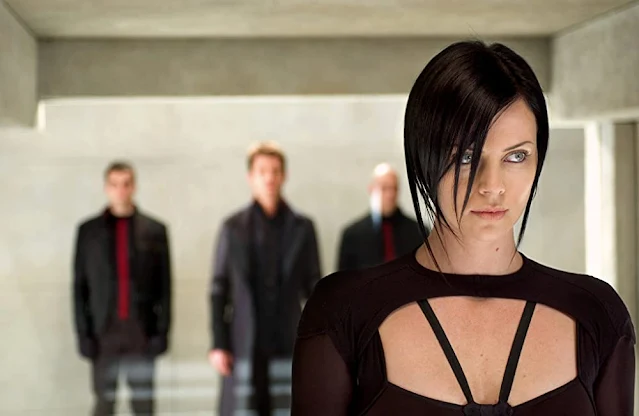
7. "Aeon Flux" (2005)

Director: Karyn Kusama

Script Writers: Phil Hay, Matt Manfredi

Lead Actors: Charlize Theron, Marton Csokas, Jonny Lee Miller

Charlize Theron as Aeon Flux

Based on Peter Chung's avant-garde MTV animated series, the film is set 400 years in the future in Bregna, the last remaining walled city on Earth following a devastating viral plague. Under the regime of the Goodchild dynasty, the population is plagued by strange nightmares of past lives.

The seemingly perfect society is a lie. The original plague cure rendered humanity completely infertile. To save the species, scientists cloned the survivors, repeatedly recycling the same DNA for seven generations. Aeon Flux, an assassin for the Monican rebellion, discovers she is the clone of the original leader's wife. She also learns that nature has actually begun to correct the infertility, but corrupt politicians are assassinating pregnant women to maintain their totalitarian cloning regime.

The film explores cloning as a tool for societal stagnation and totalitarian control. By denying natural birth and evolution, the rulers created a fragile, nightmare-fueled immortality. Aeon shifts from simply dismantling the government to destroying the "Relical" (the DNA bank), arguing that humanity's future requires the possibility of new life rather than endless repetition.

8. "Star Wars: Episode II - Attack of the Clones" (2002)

Director: George Lucas

Script Writers: George Lucas, Jonathan Hales

Lead Actors: Ewan McGregor, Natalie Portman, Hayden Christensen

While part of a grand space opera, this film places cloning at the very center of galactic politics. Obi-Wan Kenobi discovers a massive clone army on the ocean planet Kamino, secretly commissioned for the Galactic Republic a decade earlier.

These millions of soldiers are all cloned from a single Mandalorian bounty hunter, Jango Fett. They are genetically modified for absolute docility, stripped of independent desires, and given accelerated aging so they reach combat maturity in half the normal time. They are living weapons, bred to fight and die for a government that didn't even know they existed.

The film presents a fascinating dichotomy. On one hand, you have the mass-produced, identical soldiers whose individuality is suppressed. On the other, there is Boba Fett, an unaltered, naturally aging clone whom Jango requested as payment to raise as a son. The clone army serves as a chilling precursor to the Empire, demonstrating how easily a democratic society will accept a slave army of clones for the promise of security, sealing their own downfall under the command of figures like Obi-Wan Kenobi and Anakin Skywalker.

9. "Splice" (2009)

Director: Vincenzo Natali

Script Writers: Vincenzo Natali, Antoinette Terry Bryant, Doug Taylor

Lead Actors: Adrien Brody, Sarah Polley

Delphine Chanéac as Dren in Splice

Delphine Chanéac as Dren.

Genetic engineers Clive and Elsa are corporate stars known for creating new hybrid organisms. Against their company's explicit orders, they secretly cross the ethical line by splicing human DNA into their animal hybrid experiments, creating a rapidly developing female creature they name "Dren."

Splice is a deeply unsettling body-horror film exploring the dark side of ambition. The relationship between the scientists and their creation devolves into a twisted family drama, blurring the lines between clinical oversight and disturbed parental affection.

Dren's unpredictable and violent evolution (including a spontaneous gender transition) serves as a terrifying metaphor for scientific pursuits that wildly outpace morality. It's a modern Frankenstein story that explicitly questions the very nature of what we create and the responsibility we bear toward it.

10. "The Prestige" (2006)

Director: Christopher Nolan

Script Writers: Jonathan Nolan, Christopher Nolan

Lead Actors: Hugh Jackman, Christian Bale, David Bowie

In this intricate Victorian-era thriller, two rival stage magicians, Robert Angier and Alfred Borden, are locked in a bitter, escalating feud. To beat Borden's seemingly impossible "Transported Man" trick, an obsessed Angier seeks out the help of real-life inventor Nikola Tesla (David Bowie), who builds a machine capable of extraordinary physics.

The machine doesn't just teleport Angier - it creates an exact, living clone a short distance away, leaving the original Angier behind in the apparatus. The film brilliantly weaponizes cloning as the ultimate magical misdirection. To perform his illusion night after night, Angier must step into the machine, dropping the "original" Angier into a locked water tank below the stage to drown, while the clone emerges in the balcony to take the applause.

This horrifying sacrifice highlights the film's core themes of obsession and the destructive nature of ambition. The clone is not just a copy; it's a morbid testament to how far an artist will go to achieve greatness, blurring the line between illusion and murder until the creator himself is lost in the trick.


At its core, the concept of cloning humans in science fiction taps into our fascination with the unknown and the absolute limits of science. 

By exploring the depths of human nature, the essence of identity, and the ethical quandaries that emerge when we manufacture life, these films invite us on a journey of introspection. 

Furthermore, cloning provides an optimal lens for filmmakers to delve into themes of corporate ownership, societal control, and oppression. By creating worlds where clones are treated as mere commodities or tools for elite exploitation, these films shed light on the dehumanization that arises from treating sentient beings as disposable objects, a theme seen heavily in films like Mickey 17.

project hail mary
26 April 2026

Project Hail Mary - film quotes

Project Hail Mary quotes guide

Best Project Hail Mary Quotes:

Project Hail Mary begins with a man waking up in space with no memory, no crew, and no idea that the fate of Earth has quietly been placed on his shoulders.

That is already a killer science fiction hook. Andy Weir goes further. He turns the survival puzzle into a story about guilt, teaching, first contact, friendship, and the strange courage that appears only after somebody else needs you to find it.

The best Project Hail Mary quotes are not memorable simply because they are funny. They work because they carry the story’s whole engine in miniature. Ryland Grace talks because he is afraid. Rocky speaks with broken grammar and perfect emotional aim. Eva Stratt cuts through the room like a moral scalpel. Together, their lines make Project Hail Mary feel brainy, warm, terrifying, and weirdly hopeful all at once.


Rocky the Eridian inside the Hail Mary spacecraft in the Project Hail Mary film adaptation
Rocky is the emotional miracle of Project Hail Mary, a first-contact character who turns alien language into friendship, grief, comedy, and courage.

What is Project Hail Mary about?

Project Hail Mary is Andy Weir’s story of Ryland Grace, a schoolteacher and former molecular biologist who wakes aboard the Hail Mary spacecraft with his memory damaged and his crewmates dead. As Grace slowly reconstructs who he is and why he is there, he learns that Earth is facing an extinction-level solar crisis caused by astrophage, a mysterious organism that feeds on stellar energy.

The story’s pleasure is partly scientific. Grace observes, tests, fails, recalculates, and tests again. But its power is emotional. Project Hail Mary is ultimately about what happens when a man who does not think of himself as brave becomes responsible for lives far beyond his own.

For a broader analysis of the adaptation, see our full Project Hail Mary movie review and themes essay. For a more focused character reading, see Ryland Grace’s character arc in Project Hail Mary.

From Andy Weir’s novel to the Project Hail Mary film

Andy Weir’s 2021 novel arrived with a built-in expectation because The Martian had already shown how well his hard-science survival storytelling could move from page to screen. Project Hail Mary is similar in its love of engineering, chemistry, improvisation, and smart people under pressure. But its emotional structure is different.

The Martian is a survival story about endurance and rescue. Project Hail Mary is a survival story about communication. It asks whether two intelligent beings from different worlds can build trust fast enough to save more than one civilization.

The film adaptation stars Ryan Gosling as Ryland Grace, with Sandra Hüller as Eva Stratt. Phil Lord and Christopher Miller direct, while Drew Goddard, who previously adapted The Martian for the screen, writes the screenplay. That combination matters because Project Hail Mary needs tonal balance. It has to be funny without becoming weightless, technical without becoming dry, and emotional without turning soft.

Original novel Andy Weir’s Project Hail Mary, published in 2021.
Film lead Ryan Gosling as Ryland Grace, the science teacher sent into deep space.
Key character Rocky, the Eridian engineer who becomes Grace’s ally and friend.
Core themes Science, survival, memory, alien contact, friendship, sacrifice, and impossible moral choices.

Rocky is where the adaptation has the most to prove. On the page, Rocky is funny, strange, precise, brilliant, and heartbreaking. On screen, he has to become physically present without becoming cute in a cheap way. For more on why Rocky matters so much to the story, read our full guide to Rocky the Eridian in Project Hail Mary.


Best Ryland Grace quotes

Ryland Grace’s quotes work because he is not a sleek space hero. He is funny, evasive, terrified, brilliant, and often deeply annoyed by the fact that his own brain keeps being useful. His dialogue carries the story’s central tension: he does not believe he is brave, but circumstances keep demanding bravery from him.

Ryland Grace Reluctant hero

“I put the ‘not’ in astronaut!”

Context

Grace is trying to explain that he is not trained, not ready, and not remotely comfortable with the heroic version of himself other people seem to require.

Why it matters

This is the perfect Ryland Grace line. It is comic panic, but it is also character truth. Grace does not begin the story as someone hungry for glory. He begins as someone looking for the nearest exit.

Ryland Grace quote Astronaut joke Fear
Ryland Grace and Yao Bravery

“I’m not heroic in any way. I get sick on an elevator!”

“Perfect. There’s no elevator on the ship.”

Context

Grace offers fear as evidence that he should not be sent into space. Yao answers with pure mission logic.

Why it matters

The exchange shows how Project Hail Mary uses humour without weakening the stakes. Grace is genuinely afraid. Yao is genuinely committed. The joke lands because both things are true at once.

Yao Space mission Reluctant astronaut
Ryland Grace Character voice

“I always wanted to be... mysterious. Talk too much. It’s my problem. Like right now.”

Context

Grace catches himself doing what Grace does: filling silence with nervous thought.

Why it matters

Grace’s talkative style is not just comic decoration. It is how he processes fear. It is also what makes him a teacher. His brain does not simply solve problems. It narrates them until they become understandable.

Grace personality Science teacher Self-awareness
Ryland Grace First contact

“Guys! This is first contact! With life! Outside of the... Uh oh. Ohhh it died.”

Context

Grace’s awe collides immediately with the messiness of experiment and discovery.

Why it matters

This is pure Andy Weir energy. Historic scientific wonder does not arrive cleanly. It arrives with mistakes, dead samples, rushed observations, and one very stressed scientist trying to keep up.

First contact quote Science humour Discovery
Ryland Grace Social awkwardness

“They think I’m dumb.”

Context

Grace reads an alien action as a judgment on his intelligence, which is both absurd and perfectly human.

Why it matters

Even in deep space, Grace is still Grace. He can be solving species-level problems and still feel personally judged by how slowly someone throws him a package.

Grace humour Alien communication Insecurity

Best Rocky quotes

Rocky’s quotes are the heart of Project Hail Mary. His speech is funny because it is direct. It is moving because it is honest. Rocky does not talk like a human, but he often understands the emotional truth of a situation faster than Grace does.

Rocky Iconic quote

“Fist my bump.”

Context

Rocky reaches for a human ritual and gets the words beautifully wrong.

Why it matters

The line became instantly memorable because the grammar is broken but the intent is perfect. Rocky understands celebration, contact, and shared victory. That is what matters.

Rocky quote Fist bump Friendship
Rocky Wonder

“Amaze. Amaze. Amaze.”

Context

Rocky reacts with direct, repeated wonder.

Why it matters

There is no wasted language here. Rocky’s joy arrives like a signal pulse. Simple, musical, and completely sincere.

Amaze Alien wonder Rocky language
Rocky and Grace Encouragement

“Words of encouragement.”

“You can’t just say ‘words of encouragement!’”

“Words of great encouragement!”

Context

Rocky understands that Grace needs support, but he delivers the category instead of the content.

Why it matters

The joke is perfect because Rocky is wrong in form and right in feeling. He knows what Grace needs. He just improves the label rather than changing the sentence.

Funny Rocky quote Encouragement Language joke
Rocky Grief

“Rocky watch whole crew die. Could not fix. Grace say Grace will die. Rocky fix.”

Context

Rocky explains his need to save Grace through the trauma of what he has already lost.

Why it matters

This is one of the great emotional Rocky lines. His grammar is plain, but the feeling is huge. He has already endured helplessness once. He refuses to endure it again.

Rocky grief Save Grace Crew loss
Rocky Love

“Is not enough.”

Context

Grace learns how long Rocky has been with his mate. Rocky’s answer turns a long span of time into something painfully small.

Why it matters

It is one of the story’s most beautiful alien-love lines. Rocky lives at a different scale, but the feeling is painfully familiar. When love is real, even 186.3 years can be too little.

Rocky mate quote Eridian love Emotional quote
Rocky Friendship

“Grace Rocky save stars.”

Context

Rocky reduces the enormous mission to one compressed statement of partnership.

Why it matters

This is the whole story in four words. Not Grace alone. Not Rocky alone. Grace and Rocky. Two species, two threatened homes, one act of cooperation.

Save stars Cooperation Project Hail Mary theme
Rocky Blunt concern

“Grumpy. Angry. Stupid. How long since last sleep, question?”

Context

Rocky diagnoses Grace’s mood with brutal efficiency.

Why it matters

Rocky’s affection often sounds like an inspection report. That is what makes it funny. He cares deeply, but he expresses care through function, observation, and immediate problem solving.

Sleep Care Rocky bluntness
Rocky Classic Rocky

“Rocky hate Mark.”

Context

Rocky’s irritation arrives with absolute clarity.

Why it matters

Short Rocky lines work because they feel like emotional percussion. He does not dilute a feeling once he has identified it. He simply states it and moves on.

Rocky humour Alien bluntness Short quote

Best Eva Stratt quotes

Eva Stratt gives Project Hail Mary its hard ethical edge. She is the person who understands that extinction does not leave room for polite process. Her best lines are severe, but the story is smart enough to show the burden beneath the severity.

Eva Stratt Moral compromise

“This might seem like me betraying you, but this is actually me believing in you.”

Context

Stratt frames betrayal as faith, which is exactly why she is so compelling and so dangerous.

Why it matters

This line is the centre of Stratt’s moral universe. She believes outcomes matter more than comfort. She can do something unforgivable while convincing herself it is an act of trust.

Eva Stratt quote Betrayal Belief
Grace and Stratt Urgency

“It took, like, 200 years to figure out how bacteria works, so...”

“Please do it faster.”

Context

Grace tries to explain the pace of scientific discovery. Stratt refuses to accept the pace of history.

Why it matters

This exchange captures the crisis perfectly. Science needs time. Earth does not have time. Stratt’s entire role is to force impossible acceleration.

Science Astrophage Extinction clock
Eva Stratt Pressure

“You’re smart. You’ll figure it out.”

Context

Stratt gives Grace the kind of encouragement that sounds almost like a sentence.

Why it matters

Stratt’s faith in Grace is not soft. It is tactical. She believes in his mind, which means she feels entitled to use it.

Grace and Stratt Problem solving Pressure
Grace and Stratt The solution

“You’ll find a solution.”

“You are my solution.”

Context

Grace wants Stratt to have another answer. Stratt has already decided that Grace himself is the answer.

Why it matters

That is the weight of the story’s human machinery. Grace is not just sent to solve the problem. He becomes part of the mechanism by which the problem might be solved.

Solution Mission burden Ryland Grace
Eva Stratt Dark comedy

“The consensus here is that it would be preferable if you did not die.”

Context

Stratt turns concern into institutional language.

Why it matters

The line is funny because it is so dry. It also reminds us that Grace is valuable to the mission before he is emotionally understood by the people around him.

Dry humour Survival Stratt voice
Grace and Stratt Faith

“You believe in God?”

“Beats the alternative.”

Context

Stratt lets a rare flash of metaphysical exhaustion show through the steel.

Why it matters

This is not a sermon. It is a survival reflex. Stratt has to believe that something beyond bureaucracy and panic might still hold.

Faith Stratt Extinction ethics

Funny Project Hail Mary quotes

The funniest Project Hail Mary quotes do not stop the story. They sharpen it. Grace uses humour to survive panic. Rocky creates comedy through literalism. Stratt makes comedy out of ruthless focus. That mix gives the story its strange warmth.

Cashier and Carl Global crisis

“Which government?”

“All of them.”

Context

A mundane question gets a species-level answer.

Why it matters

In two lines, the story explains scale. The astrophage crisis is not national, political, or regional. It is everybody’s problem.

Carl quote Government Deadpan
Rocky and Grace Roommates

“Why room so messy, question?”

“Well, I wasn’t expecting company, was I?”

Context

First contact becomes a housekeeping dispute.

Why it matters

This is the Project Hail Mary tone in one exchange. Cosmic awe, alien life, survival panic, and then a complaint about the state of the room.

Funny Rocky quote Messy room First contact humour
Grace and Rocky Alien senses

“There’s no way you can hear me right now.”

“Can hear.”

Context

Grace forgets that Rocky’s body and senses do not play by human assumptions.

Why it matters

The joke is tiny, but it keeps Rocky alien. He is not a human friend in a costume. His biology changes the terms of every room he enters.

Can hear Alien biology Rocky and Grace
Rocky and Grace Boundaries

“There has to be boundaries.”

“Where my bedroom?”

Context

Grace tries to set rules for interstellar personal space. Rocky immediately turns that into a housing question.

Why it matters

The humour works because Rocky takes collaboration seriously. If they are partners, then of course he needs to know where he belongs.

Boundaries quote Bedroom joke Alien friendship
Grace and Rocky Space danger

“First, no crash. Then, no explode. Deal?”

Context

Rocky reduces the immediate piloting problem to the two most important outcomes.

Why it matters

It is funny because it is absurdly simple and completely correct. Under pressure, Rocky becomes the galaxy’s bluntest safety officer.

No crash No explode Space piloting
Grace and Carl Science banter

“Imagine, for a second, that you’re an interstellar microorganism.”

“I’m not doing that.”

Context

Grace asks for a conceptual leap. Carl refuses to join him in the mental exercise.

Why it matters

It is a neat little reminder that Grace’s teaching brain is always on. He explains science by asking people to inhabit the problem. Not everyone wants to go there with him.

Carl quote Interstellar microorganism Science humour

Project Hail Mary quotes about science, astrophage, and survival

Science is not background detail in Project Hail Mary. Science is the plot. Every experiment, sample, model, mistake, and improvised tool becomes part of the survival drama. The best science quotes show why Weir’s fiction works: problem solving becomes suspense.

Ryland Grace Astrophage

“They toot to scoot, basically.”

Context

Grace explains astrophage propulsion in the most teacherly, ridiculous, memorable way possible.

Why it matters

This is Grace’s gift. He can take an interstellar biological process and turn it into a sentence nobody forgets. Project Hail Mary loves science, but it also loves explanation.

Astrophage quote Toot to scoot Science teacher
Grace and Olivia Solar crisis

“So no big whoop?”

“It’s a small-to-medium whoop.”

Context

The crisis begins in language that feels almost too casual for what is happening.

Why it matters

That is part of the dread. Catastrophe does not always arrive as thunder. Sometimes it arrives as data, measurements, and one scientist trying to find the right size of whoop.

Solar dimming Small whoop Extinction risk
Ryland Grace Experiment

“Wow! You’re not gonna believe this. Nothing happened!”

Context

Grace reports scientific failure with the battered enthusiasm of someone who knows failure still produces information.

Why it matters

Project Hail Mary understands that science is not a clean march toward answers. Nothing happening can still matter. A failed test can narrow the world.

Experiment quote Failure Scientific method
Carl Identity

“You know who you are. You’re going to do great.”

Context

Carl’s line matters because Grace’s memory problem is also an identity problem.

Why it matters

The mission depends on knowledge, but it also depends on Grace rediscovering himself. Facts return first. Moral identity takes longer.

Memory Identity Ryland Grace age and past

Grace’s background matters here. He is not just a generic genius dropped into space. He is a teacher with scientific training, personal limits, and a life history that shapes how he responds to fear. For a deeper look at that background, see How old is Ryland Grace in Project Hail Mary?.

Project Hail Mary quotes about friendship and sacrifice

The emotional centre of Project Hail Mary is not simply whether Earth can be saved. It is whether Grace can become the kind of person who chooses another life when nobody is there to applaud him. Rocky changes the equation. Their friendship turns survival from a solitary act into a shared moral demand.

Yao Bravery

“It’s not a gene. You just need to find someone to be brave for.”

Context

Grace thinks bravery is something other people are born with. Yao gives him a better definition.

Why it matters

This may be the cleanest thesis statement in Project Hail Mary. Courage is not treated as a fixed personality trait. It is something called out of a person by love, duty, and responsibility.

Bravery quote Yao Sacrifice
Rocky and Grace Decision

“We leave now, question?”

“Leave now. Statement.”

Context

Rocky asks. Grace answers. The grammar shift turns hesitation into commitment.

Why it matters

That move from question to statement is tiny and enormous. It shows Grace becoming decisive, not because the danger is gone, but because the purpose is finally clear.

Leave now Decision Grace and Rocky
Rocky and Grace Hug

“How do you know when the hug is done?”

“You just feel it.”

Context

Rocky wants the rule for a human emotional gesture. Grace can only explain it through feeling.

Why it matters

Not everything in Project Hail Mary can be measured. Some things must be learned through trust, timing, and contact. That is why this small exchange lands so softly.

Hug quote Emotion Trust
Ryland Grace Care

“Okay buddy, I watch you sleep but you have to wake up.”

Context

Grace watches over Rocky with the helpless tenderness of someone who has become deeply attached.

Why it matters

The line matters because it reverses the survival dynamic. Grace is no longer just trying to stay alive. He is afraid of losing his friend.

Grace and Rocky friendship Care Wake up
Rocky Time to act

“It is time go.”

Context

Rocky’s phrasing is simple, but the meaning is final.

Why it matters

Project Hail Mary often turns small sentences into emotional triggers. This one carries urgency, trust, and movement. The talking is over. The mission is now action.

Time go Mission Rocky


More Project Hail Mary reading from The Astromech

Back to Top