star trek
12 August 2023

Exploring Themes in Star Trek: The Motion Picture

The Human Adventure: Philosophical Themes of Star Trek: The Motion Picture

*Star Trek: The Motion Picture*, directed by Robert Wise (The Day the Earth Stood Still), takes audiences on an expansive journey that transcends mere spectacle. With a deliberate, meditative pace, it delves into profound themes that illuminate both the universe's mysteries and the intricacies of the human experience. Set against the backdrop of interstellar exploration, this cinematic masterpiece intricately weaves together themes of discovery, unity, ethical responsibility, and the very essence of humanity itself.

Exploration and Discovery

The heart of *Star Trek* beats with the relentless pursuit of knowledge. The film opens with Admiral James T. Kirk, a man grounded at Starfleet Headquarters and deeply dissatisfied with his desk job. He seizes the V'Ger crisis as an opportunity to reclaim his past glory, leveraging his rank to take back command of the Enterprise from its new captain, Will Decker. This personal, almost desperate need to explore adds a complex layer to the Federation's grander ideals.

As the magnificent, refit starship embarks on its mission, the audience is thrust into the heart of exploration. The famous, lengthy sequence of Kirk and Scott inspecting the Enterprise in drydock is a masterclass in visual storytelling, establishing the ship as a key character and a symbol of humanity's unquenchable curiosity. When the crew finally confronts V'Ger, an entity of incomprehensible power, the film reinforces the transformative nature of discovery. The revelation that this being is the evolved **Voyager 6** probe underscores the idea that the drive for understanding is intrinsic to all sentient life, whether it's born or built.

Humanity's Search for Meaning

Beyond astronomical phenomena, the film delves into existential contemplation. V'Ger, a fusion of machine and organic data, serves as a poignant manifestation of this unending search. Having fulfilled its basic programming—to learn all that is learnable—it returns home to find its "Creator." It possesses all the logical data in the universe but lacks the one thing that would allow it to transcend: the irrational, emotional spark of its human makers. Its journey home is a quest to find purpose beyond the mere accumulation of facts.

Kirk's interaction with V'Ger encapsulates this theme. He realizes that V'Ger's yearning for purpose mirrors his own struggle with obsolescence. The film uses the vastness of space as a mirror for humanity's own ongoing odyssey of self-discovery and our search for a place in the cosmos.

Unity and Cooperation

In a universe teeming with diversity, the theme of unity emerges as a central thread. This is crystallized in the character of Mr. Spock. He arrives on the Enterprise having abandoned the Vulcan ritual of **Kolinahr**, an attempt to purge all emotion. He was unable to complete it because he felt the immense, lonely, and purely logical consciousness of V'Ger across the galaxy. This experience forces him to understand that true wisdom comes not from purging his human half, but from integrating it with his Vulcan logic. His quest for equilibrium mirrors the universal challenge of reconciling different aspects of one's identity.

Technology and Ethical Responsibility

The film confronts the moral implications of our own creations. V'Ger, born of human innovation, returns as an entity so powerful it threatens its creators. This serves as a vivid example of the ethical responsibilities that come with scientific progress. Dr. Leonard "Bones" McCoy, forcibly returned to duty, personifies this theme with his gruff skepticism. His complaints about the new Enterprise ("It's like working in a damn computer center!") and the cold transporter reflect a caution against technology that loses its human touch, a poignant reminder that progress must be tempered with ethical consideration.

The Human Experience

Amidst the celestial wonders, the film reveals the core of the human experience: emotion, aspiration, and connection. The emotional heart of the story lies with Captain Decker and the Deltan navigator, Lieutenant Ilia. After Ilia is abducted and her body is used to create a robotic probe for V'Ger, it is Decker's lingering love for her that provides the key. He is the only one who can connect with the probe on a human level, ultimately choosing to merge with her and V'Ger to create a new form of life. Their story echoes the sentiment that amid cosmic exploration, it is our human bonds that imbue the voyage with significance.

Conclusion: The Passage of Time

The film's thematic resonance is set against the backdrop of time's relentless passage. The reunion of the Enterprise crew after years apart, their rekindled relationships, and the contemplation of the past accentuate the temporal dimension of the human journey. In the constellation of cinema, *Star Trek: The Motion Picture* transcends its status as a mere sci-fi blockbuster to become a philosophical exploration of what it means to be human in a universe of boundless wonder. Through its lens of exploration, unity, and personal growth, the film beckons us to reflect on our place in the cosmos and the timeless quest for meaning that unites us all.

star trek

Exploring Jerry Goldsmith's Stellar Musical Contributions to Star Trek

The Sound of the Final Frontier: Jerry Goldsmith's Star Trek Legacy

Jerry Goldsmith, a prolific and iconic composer known for masterful scores on films like *Alien* and *Planet of the Apes*, left an indelible mark on the world of cinema. But his musical contributions to the Star Trek franchise are a cornerstone of his legacy, defining the sound of the universe for generations. His work, spanning films and television, provided an auditory landscape filled with wonder, terror, and heroism.

A Cinematic Rebirth: Star Trek: The Motion Picture (1979)

Goldsmith's journey with Star Trek began with the 1979 film "Star Trek: The Motion Picture." The challenge was immense: create a score that would elevate the beloved TV series to the epic scale of the big screen. Goldsmith delivered a masterpiece, combining sweeping orchestration with innovative electronic elements. For the mysterious V'Ger cloud, he used an experimental instrument called the "blaster beam," which produced a deep, unsettling metallic sound that perfectly captured the entity's alien nature.

The main theme, with its majestic horns and soaring strings, became an instant classic. It was a heroic march that perfectly encapsulated the awe and romance of space exploration. Its influence is immeasurable, as it would later be famously repurposed as the main theme for *Star Trek: The Next Generation*, becoming arguably the most recognizable piece of Star Trek music ever composed.

The Next Generation Era

Goldsmith's powerful main theme from *The Motion Picture* was selected as the opening fanfare for *Star Trek: The Next Generation* in 1987, forever linking his music to the adventures of Captain Picard's crew. Years later, he returned to score three of the TNG feature films, adapting his style for a new era.

His score for "Star Trek: First Contact" is a highlight, skilfully blending his heroic themes with a dark, percussive, and terrifyingly mechanical motif for the Borg. For "Star Trek: Insurrection," he composed a more romantic and pastoral score, reflecting the film's lighter themes. His final contribution, "Star Trek: Nemesis," was a darker, more somber work filled with aggressive action cues and a deeply emotional motif for the film's dramatic conclusion.

Defining New Voyages

Beyond the Enterprise, Goldsmith also composed the iconic main theme for *Star Trek: Voyager*. This piece is a soaring, noble fanfare that perfectly captures the feeling of a lone starship on a long, uncertain journey home. It is often cited by fans as one of the best themes in the entire franchise, encapsulating hope and perseverance in the face of the unknown.

His score for *Star Trek V: The Final Frontier* is also notable. While the film itself was not a critical success, Goldsmith's music is considered a major highlight, featuring a beautiful, hymn-like theme for the mythical planet Sha Ka Ree and thrilling action cues that elevated the on-screen adventure.

Jerry Goldsmith's Star Trek Compositions

Star Trek: The Motion Picture

Film Score (1979)

Goldsmith's first and most influential Star Trek score. It introduced the iconic main theme that became synonymous with the franchise and featured experimental electronic sounds for the V'Ger entity.

Star Trek V: The Final Frontier

Film Score (1989)

A lush and adventurous score often cited as a highlight of the film. It blended familiar themes by other composers with new, majestic compositions for Kirk's journey to find God.

Star Trek: Voyager

Main Theme (1995)

Goldsmith composed the Emmy Award-winning main theme for the series. Its soaring and hopeful melody perfectly captured the spirit of a lost ship on an epic journey home across an unknown galaxy.

Star Trek: First Contact

Film Score (1996)

Regarded as one of the best Star Trek film scores, it masterfully balanced heroic, uplifting themes for the Phoenix warp flight with dark, terrifying, and quasi-electronic motifs for the relentless Borg.

Star Trek: Insurrection

Film Score (1998)

A lighter, more lyrical score that reflects the film's themes of rejuvenation and romance. It features a beautiful, flowing theme for the Ba'ku people and their idyllic world.

Star Trek: Nemesis

Film Score (2002)

Goldsmith's final and most somber contribution to the franchise. The score is filled with aggressive action music for the Remans and a powerful, deeply emotional theme for the film's tragic climax.

Conclusion

Jerry Goldsmith's role in shaping the musical landscape of the Star Trek universe cannot be overstated. Alongside Alexander Courage's original TV theme, Goldsmith's work forms the foundation of Star Trek's auditory identity. His ability to capture the essence of exploration, the vastness of space, and the depth of character relationships has left an enduring legacy that resonates with fans across generations. As we continue to explore new frontiers, his music will remain a guiding star, reminding us of the boundless possibilities that lie in the cosmos.

star trek

Deconstructing Star Trek: Nemesis and Its Legacy - Farewell to the Next Generation

A Dark Reflection: Deconstructing Star Trek: Nemesis

"Star Trek: Nemesis," the tenth film in the franchise and the final cinematic outing for the beloved cast of "Star Trek: The Next Generation," arrived in 2002 with the immense weight of concluding an era. Directed by Stuart Baird, the film attempted a darker, more action-oriented tone than the preceding *Insurrection*. However, it was met with a deeply divided response from fans and critics, becoming a controversial and bittersweet farewell. In this analysis, we'll dissect the intricate tapestry of this film—its plot, characters, themes, and its complicated place in the Star Trek universe.

Plot Synopsis: A Shadow on Romulus

"Nemesis" opens with the wedding of William Riker and Deanna Troi, but the celebration is cut short. The Enterprise-E, under the command of Captain Jean-Luc Picard, is dispatched on a diplomatic mission to Romulus following a coup. There, they discover the new Praetor is a man named Shinzon (a young Tom Hardy), who reveals a startling truth: he is a clone of Picard, created from a discarded Romulan plot to replace the captain with a deep-cover agent.

Raised in the brutal dilithium mines of the sister-world Remus by a subjugated race, Shinzon has seized control of the Romulan Empire with the backing of his fearsome Reman warriors. His flagship, the *Scimitar*, is a predator-like warbird with a perfect cloaking device and a devastating thalaron radiation weapon capable of wiping out all life on a planet. Shinzon’s plan is twofold: lure the Enterprise to him to cure his own rapid aging with Picard’s blood, and then use his superweapon to destroy the Federation, starting with Earth.

Character Analysis: Facing the Mirror

**Picard and Shinzon** are the heart of the film. Shinzon is Picard's dark reflection, his shadow self—what he could have become without the guiding principles of Starfleet. The conflict forces Picard to confront the haunting idea of his own potential for darkness, exploring the classic theme of nature versus nurture. Shinzon is not evil because he is a clone, but because his brutal upbringing on Remus has twisted him into a vessel of pure rage and pain.

The **Riker and Troi** subplot provides a sense of closure. Their marriage marks the end of an era for the Enterprise crew, and Riker’s long-awaited promotion to Captain of the USS *Titan* culminates his arc as Picard's loyal "Number One."

**Data's** journey reaches its poignant conclusion. The discovery of B-4, a simpler prototype of himself, forces Data to contemplate his own lineage and legacy. His ultimate sacrifice to destroy the *Scimitar* and save Picard is the ultimate expression of his humanity. By downloading his memories into B-4 beforehand, he achieves a form of immortality, a final, selfless act that proves he became more human than many biological beings.

Themes: Identity, Duality, and Sacrifice

"Nemesis" delves deeply into the theme of **identity**. The film questions whether destiny is determined by our genes (nature) or by our choices (nurture). The powerful motif of **duality and mirror imagery** threads through the entire narrative. The parallelism between Picard and Shinzon is a reflection of the paths individuals can take under different circumstances, contemplating the complexity of human nature and the multitude of possibilities that lie within every individual.

**Sacrifice** emerges as the film's most powerful motif. It is epitomized by Data's final act, a conscious choice that reflects the most fundamental aspect of his hard-won humanity: the capacity to put the needs of others before his own.

Action and Legacy

Director Stuart Baird, known for his work as an editor on action films, brought a kinetic and visceral style to the film. The final battle between the Enterprise and the Scimitar is one of the most brutal and intense in the franchise's history. The iconic moment where Picard orders the Enterprise to ram the enemy vessel is a thrilling highlight, showcasing a level of grit not often seen in *The Next Generation*.

Unfortunately, "Nemesis" faced an impossible challenge at the box office, opening against *The Lord of the Rings: The Two Towers*. Its underwhelming financial performance led to a nearly decade-long hiatus for Star Trek on the big screen, until the 2009 J.J. Abrams reboot. While divisive, the film's legacy has been re-examined in recent years, as its events—particularly the death of Data and the new path for Riker and Troi—serve as crucial backstory for the acclaimed *Star Trek: Picard* series.

Conclusion

*Star Trek: Nemesis*, while flawed, remains a valuable and significant installment. Its exploration of identity and choice aligns with the franchise's foundational themes, and it provides a dark, emotional, and action-packed farewell to a beloved crew. It stands as a reminder of the franchise's power to ask thought-provoking questions about our place in the cosmos, and within ourselves.

star trek
11 August 2023

Review of "Star Trek VI: The Undiscovered Country"

The Undiscovered Country: Star Trek's Swan Song

*Star Trek VI: The Undiscovered Country*, released in 1991, stands as the sixth and final cinematic adventure for the complete original crew. Directed by Nicholas Meyer, who had previously revived the franchise with the celebrated *Star Trek II: The Wrath of Khan*, the film is both a poignant farewell and a masterful political thriller. It serves as a culmination of the original crew's journey and a bridge to the future, using science fiction to brilliantly comment on a pivotal moment in real-world history.

The film takes place amidst a galactic landscape undergoing radical change. The Klingon Empire, the Federation's long-standing adversary, faces imminent collapse. This crisis forces the two superpowers into delicate peace negotiations, and Captain Kirk and his crew find themselves at the heart of the fragile situation, testing their deepest convictions and the very ethos of Starfleet.

Plot: A Conspiracy Against the Future

The film kicks off with a cataclysmic explosion: the Klingon moon of Praxis, their primary energy production facility, has been devastated. Facing ecological and economic collapse, the Klingon Empire has no choice but to seek peace with its oldest enemy, the Federation. Spock, acting on his own initiative, opens negotiations with the visionary Klingon Chancellor, Gorkon. The crew of the USS Enterprise, on the eve of their retirement, is tasked with one last mission: to escort Gorkon to Earth for the historic peace talks.

Mistrust simmers on both sides. Captain Kirk, still nursing a deep-seated hatred for the Klingons after they murdered his son, is openly hostile to the mission. This sentiment is shared by hardliners within both Starfleet and the Klingon High Command who cannot imagine a universe without their Cold War. Tragedy strikes when Gorkon's ship is attacked and the Chancellor is assassinated. Kirk and Dr. McCoy are framed for the murder, arrested, and sentenced to life in the infamous Klingon penal colony of Rura Penthe. Now, Spock and the Enterprise crew must unravel a deep-seated conspiracy that spans both empires to clear their captain's name and save the galaxy from all-out war.

Themes: The End of the Cold War

The film's most brilliant layer is its direct allegory for the end of the Cold War. Released shortly after the fall of the Berlin Wall, the movie mirrors these events with stunning clarity. The Klingon Empire is the Soviet Union, and the Praxis explosion is their Chernobyl—a disaster that exposes the weaknesses of a closed, militaristic society. Gorkon is their Gorbachev, a reformer who knows the old ways are unsustainable.

The film masterfully explores the theme of **change and prejudice**. The true villains are not just Klingons or humans, but the "cold warriors" on both sides who are terrified of "the undiscovered country"—the future. Kirk's personal journey is central; he must overcome his own bigotry to become an agent of peace. His line, "Let them die," in reference to the Klingons, is a shocking and powerful moment that demonstrates how deeply his hatred runs. His evolution from that bitter starting point to ultimately championing peace is the film's emotional core.

Finally, the film is a poignant meditation on the **end of an era**. It is a farewell to the original crew, filled with moments of nostalgia and reflection. The story acknowledges the passage of time and the inevitability of change, contemplating the legacy of iconic figures who must eventually make way for the next generation.

Character Dynamics and Cinematic Flair

The dynamic between **Kirk and Spock** is a cornerstone of the film. Spock's unwavering logic drives him to initiate the peace process, even against his best friend's wishes. Yet, it is Spock who must later confront the failing of his own logic when his trusted protégé, the Vulcan Valeris, is revealed as a key conspirator. Her betrayal is a cautionary tale about how fear and prejudice can hide behind a mask of logic.

The film's villain, **General Chang** (played with theatrical relish by Christopher Plummer), is one of the franchise's best. A veteran warrior who fears being made obsolete by peace, he constantly quotes Shakespeare, framing the galactic conflict in epic, literary terms. His prototype Bird-of-Prey that can fire while cloaked makes him a seemingly unbeatable foe.

Director Nicholas Meyer infuses the film with a tense, mystery-driven plot and a unique visual style. The cinematic elements are superb, from the purple blood that floats in zero-gravity after the assassination to the stark, icy landscapes of the Rura Penthe prison. Cliff Eidelman's dark, powerful musical score perfectly complements the film's somber, political thriller atmosphere.

Conclusion: A Perfect Farewell

*Star Trek VI: The Undiscovered Country* is widely regarded as one of the finest films in the entire saga. It masterfully blends a thrilling conspiracy plot with sharp political commentary and a deeply moving character story. It serves as a satisfying conclusion to the original crew's 25-year journey, honoring their legacy while looking forward to the future. The final shot of the Enterprise literally sailing into the sunset, followed by the signatures of the cast, is a perfect and poignant farewell to the pioneers of the final frontier.

star trek

"Star Trek V: The Final Frontier - Star Trek V Review

Here is the re-evaluated review of *Star Trek V: The Final Frontier*, edited and expanded with additional lore, thematic insights, and notable moments, presented in the requested format. \
\

What Does God Need With a Starship? 🚀\Re-evaluating Star Trek V\ \
\

*Star Trek V: The Final Frontier*, directed by William Shatner and released in 1989, is without a doubt the most ambitious and polarizing entry in the original film series. Following the successful directorial efforts of his co-star Leonard Nimoy on \*The Search for Spock*\ and *The Voyage Home*, Shatner took the helm with a deeply personal vision that originated from his own story concept. It's a film that literally searches for God, and while it features the beloved crew of the USS Enterprise, it's often criticized for its uneven tone and troubled execution.\ \ \

\ \Official movie poster for Star Trek V: The Final Frontier \ \ \

Plot: A Hijacking in Search of Eden\ \
\

The film opens with one of the most beloved sequences in the series: Kirk, Spock, and McCoy on shore leave in Yosemite, enjoying a campfire and a hilariously off-key rendition of "Row, Row, Row Your Boat." 🔥 Their vacation is cut short by a hostage crisis on the desert planet Nimbus III, the so-called "Planet of Galactic Peace"—a failed joint venture between the Federation, Klingons, and Romulans. They are dispatched aboard the new, unfinished, and comically malfunctioning **USS Enterprise-A** to intervene. The mastermind of the crisis is the charismatic Vulcan **Sybok**, a renegade who has rejected logic in favor of pure emotion. In a shocking twist, it's revealed that Sybok is Spock's long-lost half-brother.\ \

Sybok's goal isn't conquest but conversion. He uses a form of psychic therapy to force his followers to confront their deepest personal **pain**, thereby making them fanatically loyal. He successfully hijacks the Enterprise and sets a course for the center of the galaxy, seeking to breach the mysterious **Great Barrier** and find the mythical planet \**Sha Ka Ree**\—the Vulcan equivalent of Eden, where he truly believes he will find God.\ \ \

Themes: Pain, Faith, and Brotherhood 🤔\ \
\

*The Final Frontier* is a direct exploration of **spirituality and faith**. Sybok is a charismatic cult leader, offering emotional release and a promise of divine enlightenment. The film bravely critiques the manipulation of faith when the entity on Sha Ka Ree is revealed not to be God, but a malevolent being imprisoned at the center of the galaxy. It's here Kirk delivers one of his most iconic lines, a perfect encapsulation of Star Trek's humanism: **"What does God need with a starship?"**\ \

The film's most profound theme is the **necessity of pain**. Sybok's therapy forces McCoy to relive his father's euthanasia and Spock to confront the pain of his own birth and rejection by his father, Sarek. Yet, Kirk famously refuses the treatment, declaring, "I don't want my pain taken away. I need my pain\!" This is a pivotal moment, arguing that our struggles, flaws, and painful memories are what make us who we are; they are essential to the human experience and the source of our strength.\ \

At its core, the story is about **brotherhood**. The conflict between Spock and Sybok tests Spock's loyalty to his biological family versus his chosen one. In the end, the bonds of the Enterprise crew prove stronger, and Spock's grief over his brother's redemptive sacrifice is genuinely moving. The film reaffirms that the true final frontier is not in space, but within the landscape of the heart.\ \ \

Execution and Legacy\ \
\

Despite its lofty ambitions, *The Final Frontier* is often remembered for its flaws. The film's tone is notoriously uneven, shifting jarringly from deep spiritual introspection to broad, slapstick humor (like Uhura's infamous "fan dance"). A troubled production, hampered by a writer's strike and a drastically scaled-back finale due to budget constraints (the original climax was meant to feature rock monsters), resulted in underdeveloped plot points and famously poor special effects.\ \

However, the film's legacy is more complex than its reputation suggests. It contains some of the most intimate and beloved character moments in the entire series, especially the opening campfire scene. **Jerry Goldsmith's** powerful musical score is a soaring masterpiece that adds a layer of epic grandeur. While it may be the franchise's most flawed entry, its willingness to tackle huge philosophical questions and its deep dive into the hearts of its characters make it a uniquely compelling part of the Star Trek journey.\ \ \

Conclusion: A Flawed but Heartfelt Journey\ \
\

*Star Trek V: The Final Frontier* is a film that ambitiously reaches for the heavens, and while its grasp falls short, the effort is fascinating. It's a testament to the franchise's commitment to exploring thought-provoking ideas, even at the risk of failure. Shatner's directorial effort, while uneven, delivers a story with immense heart and a genuine love for its characters. Despite its challenges, the film serves as a powerful reminder that sometimes the most important journeys are the ones we take within ourselves.\ \ \

star trek

Star Trek IV: The Voyage Home - Review of time travel classic

Star Trek IV: The Voyage Home, directed by Leonard Nimoy and released in 1986, holds a special place in the hearts of sci-fi enthusiasts as a classic installment in the Star Trek franchise. Leonard Nimoy, known for his portrayal of Spock, took on the directorial role for this film following his success with The Search for Spock, adding a unique perspective that contributed to its success. 

The movie's writers, Steve Meerson, Peter Krikes, Nicholas Meyer, and Harve Bennett, crafted a storyline that deviates from the traditional spacefaring narratives, combining elements of humor, environmentalism, and time travel. 

In "The Voyage Home," the crew of the USS Enterprise embarks on a daring mission to rescue Earth from an enigmatic alien probe. To communicate with the probe and prevent its destructive intentions, the crew must obtain humpback whales, which are extinct in their time. 

That's right, humpback whales. 

It's a time travel, whale heist film...

voyage home star trek poster

The central conflict revolves around the crew's journey back to the 20th century, where they encounter challenges like adapting to the past's technology, navigating cultural differences, and acquiring the whales. This central mission is not only a race against time but also a journey of self-discovery and cooperation as the crew members work together to save their planet.

"The Voyage Home" presents a multi-faceted exploration of themes and messages that extend far beyond the realm of science fiction, infusing the film with depth and resonance.

Environmentalism and Conservation: The film's environmental advocacy is vividly portrayed through the desperate circumstances Earth faces due to the extinction of humpback whales. The alien probe's destructive intentions stem from Earth's inability to communicate in the whales' unique language. This dire situation serves as a metaphor for real-world environmental issues, underscoring the importance of preserving Earth's ecosystems and species. The crew's mission to bring back whales to the future is a call to action, emphasizing humanity's role as stewards of the planet.

Cultural Exchange and Understanding: The crew's interactions in 20th-century San Francisco provide moments of both amusement and insight. Spock's attempts to use colorful language, McCoy's exasperation with outdated medical practices, and Scotty's struggle with a computer mouse all highlight the challenges of adapting to a different era. These instances of cultural mismatch create humor while emphasizing the need for open-mindedness and empathy when engaging with people from different backgrounds and time periods.

Time Travel and Consequences:
The concept of time travel in "The Voyage Home" serves as a platform to explore profound ethical questions. As the crew endeavors to retrieve the whales, they are compelled to consider the potential consequences of altering the past. Their actions could have a ripple effect on the timeline, leading to unintended and potentially catastrophic changes. This ethical dilemma raises thought-provoking questions about the extent of humanity's control over time and the responsibilities that come with it.

Friendship and Teamwork: The camaraderie among the Enterprise crew is a central theme that continues to resonate. The trio of Kirk, Spock, and McCoy exemplifies this, with their unwavering friendship being a source of strength. Their interactions, such as their bickering and cooperation, underscore the significance of unity in overcoming adversity. Their shared history and trust in each other provide a foundation for success in their mission, showcasing the power of genuine teamwork.

Adaptation and Resourcefulness: The crew's adaptation to the past showcases their resourcefulness and resilience. Their ability to find creative solutions despite limited technology is exemplified in the construction of a whale tank aboard the Klingon Bird-of-Prey. The crew's ingenuity speaks to the inherent human capacity to adapt and thrive even in unfamiliar and challenging circumstances.

Humor and Optimism: The injection of humor is a defining aspect of the film, setting it apart from the more serious tone of other Star Trek entries. Moments like the crew's encounters with 20th-century technology and the punk rocker on the bus add a layer of relatable levity. This humor not only enhances the audience's engagement but also conveys an optimistic outlook, suggesting that even in dire situations, a lighthearted approach can lead to solutions.

Technological Dependence: By juxtaposing the future's advanced technology with the simpler technology of the past (Whale communication methods), the film prompts reflection on society's growing dependence on innovation. The stark contrast between the two eras invites contemplation about the potential benefits and drawbacks of technological advancement. This theme encourages viewers to consider the implications of technological progress on human relationships and the environment.

Responsibility and Ethics: The crew's encounter with people from the past raises ethical questions about interference and intervention. Their possession of advanced knowledge and technology presents a moral quandary, as they must weigh the benefits of helping against the risks of altering history. This theme challenges viewers to reflect on the ethical considerations that arise when wielding power and knowledge beyond their time.

Hope for the Future: The film culminates in the successful mission to save the humpback whales and Earth from the alien probe's threat. This outcome underscores the film's overarching message of hope. By demonstrating that positive change is attainable through collaboration, understanding, and taking responsibility, "The Voyage Home" offers a glimmer of optimism for the future of humanity and the planet.

In weaving these themes and messages together, "Star Trek IV: The Voyage Home" transcends its sci-fi origins to deliver a profound and thought-provoking cinematic experience that resonates on personal, societal, and environmental levels.

"The Voyage Home" distinguishes itself from other Star Trek films through its light-hearted and comedic tone. This departure from the franchise's typically serious atmosphere serves to humanize the characters, making their interactions and challenges more relatable. The humor arises not only from the fish-out-of-water scenarios the crew faces in the past but also from the witty banter between characters, adding depth and charm to the story.

The film's portrayal of time travel is skillfully integrated into the narrative, maintaining a balance between the complexities of temporal mechanics and a coherent plot. The concept of slingshotting around the sun to travel through time is rooted in the series' established lore, and its execution feels plausible within the fictional universe. The time travel element not only drives the plot forward but also provides a lens through which the characters' growth and interactions are explored.

Considering its release year, "The Voyage Home" impressively showcases visual effects that bring various time periods and futuristic elements to life. The sequence depicting the Enterprise's slingshot maneuver is a standout moment, blending practical effects and creative imagination to create a visually captivating scene. The fusion of modern science fiction concepts with practical effects of the time contributes to the film's timeless appeal.

"Star Trek IV: The Voyage Home" has left an indelible mark on popular culture and the Star Trek franchise. Its unique blend of humor and socially relevant themes has influenced subsequent films, TV series, and media. The film's emphasis on character dynamics and thematic exploration paved the way for future installments to delve into a broader range of storytelling possibilities, contributing to the franchise's enduring legacy.

In conclusion, "Star Trek IV: The Voyage Home" embarks on a journey not only through time but also through the intricate tapestry of human themes. With Leonard Nimoy's directorial touch, the film seamlessly intertwines humor, environmental advocacy, and philosophical exploration. As the crew humorously saves the universe by saving a couple of whales, the movie reminds us that even the grandest of missions can be achieved with a touch of compassion, unity, and a well-timed dose of wit.
star trek
10 August 2023

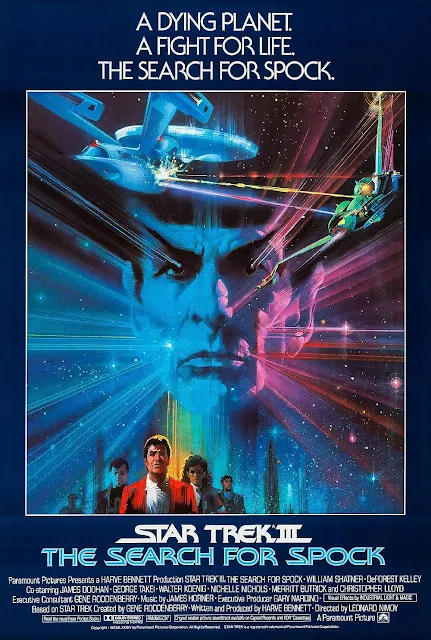
Review: Star Trek III: The Search for Spock

The Needs of the One: Friendship and Sacrifice in The Search for Spock

*Star Trek III: The Search for Spock*, released in 1984, is the essential middle chapter in what many fans consider a perfect trilogy. Directed by Leonard Nimoy himself, the film had the monumental task of resolving the heart-wrenching cliffhanger of *Star Trek II: The Wrath of Khan*. It’s a deeply personal and emotional journey that explores the lengths to which a chosen family will go for one of their own, cementing the themes of loyalty and sacrifice as the franchise's bedrock.

Plot: A Heist for a Soul

The film picks up with the battered USS Enterprise returning to Earth, its crew mourning the death of Spock. Admiral Kirk grapples with his profound loss, while Dr. McCoy begins acting erratically. The mystery deepens with the arrival of Spock's father, Sarek, who reveals a startling truth: in his final moments, Spock transferred his **katra**—his living spirit or consciousness—into McCoy's mind. Meanwhile, Spock's body, jettisoned onto the newly formed **Genesis Planet**, has been regenerated by the device's unstable energy matrix. The mission becomes clear: Kirk must reunite Spock's body with his katra on Vulcan via a dangerous ancient ritual called the **fal-tor-pan**.

When Starfleet denies Kirk's request and orders the Enterprise to be decommissioned, Kirk and his loyal senior officers make a fateful choice. They defy orders, sabotage the USS Excelsior, and steal their beloved ship for one last, illegal mission. Their quest is complicated by the Klingon Commander **Kruge** (a menacing Christopher Lloyd), who seeks to capture the Genesis device and turn it into a devastating weapon, leading to a deadly confrontation on the self-destructing planet.

Themes: Friendship, Sacrifice, and Rebirth

The core theme of the film is **friendship and loyalty**. It powerfully inverts Spock's dying words from the previous film. Where Spock sacrificed himself because "the needs of the many outweigh the needs of the few," Kirk risks everything for his friend, later telling Sarek, "the needs of the one outweigh the needs of the many." This declaration becomes the crew's driving philosophy, showcasing a bond that transcends duty and regulation.

This loyalty demands immense **sacrifice**. Kirk gives up his career, his future, and ultimately, his beloved starship. The destruction of the USS Enterprise is one of the most shocking and iconic moments in Star Trek history. Kirk's order, "My God, Bones... what have I done?" is met with McCoy's perfect reassurance: "What you had to do. What you always do. Turn death into a fighting chance to live." This theme is tragically echoed when Kirk's son, David Marcus, sacrifices his own life to save Saavik and a regenerated Spock from the Klingons, a loss that will haunt Kirk for years to come.

Finally, the film is a story of **resurrection and rebirth**. Spock's journey from a rapidly aging child to a man rediscovering his identity is a fascinating exploration of Vulcan mysticism and science fiction. The unstable nature of the Genesis Planet, which causes life to age and die in minutes, adds a layer of scientific horror to this spiritual quest.

Direction and Legacy

As his directorial debut, **Leonard Nimoy** brought an intimate and character-focused sensitivity to the film. His deep understanding of the characters, especially Spock and Vulcan culture, lends an unparalleled authenticity to the story. The final scenes on Vulcan, culminating in the poignant moment when a reborn Spock remembers his captain's name, are masterfully handled and deeply moving.

**James Horner** returned to compose the score, shifting from the militaristic themes of *Khan* to a more mystical and emotional soundscape. His beautiful and haunting theme for Spock's resurrection is one of the most beloved pieces of music in the entire franchise. The film's legacy is secure as an essential, emotional, and rewarding middle chapter. It beautifully pays off the sacrifice of *The Wrath of Khan* and sets the stage for the triumphant reunion in *The Voyage Home*, forming one of cinema's greatest trilogies.

batman

Easter Eggs in the Film "Joker"

Todd Phillips' film "Joker" serves as a treasure trove of Easter eggs and references, allowing fans to unearth hidden gems that connect the narrative to the vast tapestry of the Batman universe. Drawing inspiration from Alan Moore's iconic graphic novel "The Killing Joke," the film explores the concept of "one bad day," a notion that echoes throughout the story. Arthur Fleck's gradual transformation into the Joker is a poignant portrayal of how a series of unfortunate events can unravel a person's sanity and morality.

Furthermore, the influence of Martin Scorsese's 1982 film "The King of Comedy" can be seen in the casting of Robert De Niro as the talk show host Murray Franklin. This clever nod not only pays homage to Scorsese's work but also creates thematic connections between Arthur Fleck's desperate pursuit of fame and the character of Rupert Pupkin in "The King of Comedy."

"Joker" is replete with subtle movie references that not only ground the film in its 1981 setting but also enrich the Batman mythology. The choice of movies playing at the theater, including "Zorro: The Gay Blade," "Blow Out," and "Excalibur," adds depth to the film's backdrop while suggesting the influences that shape Batman's persona. Of particular significance is the Zorro movie, traditionally tied to Bruce Wayne's origin story.

easter eggs in joker film

Paying homage to previous cinematic portrayals of the Joker character, "Joker" encapsulates the essence of the villain's legacy. Joaquin Phoenix's Joker suit design pays homage to Cesar Romero's rendition in the 1960s Batman series. Arthur Fleck's interaction with the cop car window alludes to Heath Ledger's Joker from "The Dark Knight." A poster of Murray Franklin transforming into a Jack Nicholson-esque Joker face playfully nods to Nicholson's iconic performance in Tim Burton's "Batman."

Expanding its references to encompass the broader Batman universe, "Joker" includes a scene set in Arkham State Hospital, a subtle nod to the infamous Arkham Asylum. References to the villain Ratcatcher and question mark graffiti in the hospital elevator hint at the larger rogues' gallery of Batman villains.

Delightfully obscure Easter eggs are scattered throughout the film, enriching the viewing experience for dedicated fans. The talk show's title logo echoes the font of "Batman: The Animated Series," invoking nostalgia for fans of the beloved show. The character Debra Kane, Arthur's social worker, serves as a tribute to Batman co-creator Bob Kane. Arthur's unsettling encounter with young Bruce Wayne near Wayne Manor slyly references the Batpole, an iconic element from the 1960s Batman series.

Moreover, "Joker" seamlessly incorporates more Easter eggs to heighten its intricacy. The comedy club where Arthur performs, named "Pogo's," alludes to the notorious serial killer John Wayne Gacy, who performed as "Pogo the Clown." The appearance of Alfred Pennyworth during the encounter between Arthur and young Bruce provides a deeper layer of immersion, enhancing the Batman universe's coherence.

"Joker" masterfully employs a myriad of Easter eggs and references to create a rich tapestry that ties the film to the broader Batman mythology. By drawing from diverse interpretations of the Joker character and paying homage to iconic moments in Batman's history, the film offers a multi-dimensional experience that rewards both casual viewers and dedicated fans with layers of meaning and connection.

Here's a list of Easter eggs and DC references found in the film "Joker":

  • The Killing Joke Influence:
    • Arthur Fleck's descent into madness mirrors the concept of "one bad day" from Alan Moore's graphic novel "The Killing Joke."
    • Arthur's transformation into the Joker is reminiscent of the novel's exploration of the Joker's origin.
  • The King of Comedy:
    • Robert De Niro's portrayal of Murray Franklin pays homage to his role in Martin Scorsese's film "The King of Comedy."
    • The film draws thematic parallels between Arthur Fleck's pursuit of fame and the character Rupert Pupkin in "The King of Comedy."
  • Movie References:
    • Movies playing at the theater (Zorro: The Gay Blade, Blow Out, Excalibur) set in 1981 anchor the film's time period.
    • Zorro movie references Batman's origin story as it's traditionally tied to the event that leads to the Wayne family's murder.
  • Joker Character References:
    • Joaquin Phoenix's Joker suit design pays homage to Cesar Romero's portrayal in the 1960s Batman series.
    • Arthur Fleck's interaction with the cop car window recalls Heath Ledger's Joker from "The Dark Knight."
    • Poster of Murray Franklin transforming into a Jack Nicholson-esque Joker face nods to Nicholson's "Batman" performance.
  • Arkham Asylum Connection:
    • The scene at Arkham State Hospital alludes to the infamous Arkham Asylum, a key location in the Batman universe.
  • Batman Rogues' Gallery:
    • Potential reference to Ratcatcher through news reports about "Super Rats."
    • Question mark graffiti in the hospital elevator hints at the Riddler's presence.
  • Animated Series Nod:
    • The talk show's title logo resembles the font from "Batman: The Animated Series."
  • Debra Kane and Alfred:
    • Debra Kane, Arthur's social worker, pays tribute to Batman co-creator Bob Kane.
    • Alfred Pennyworth's appearance during the encounter between Arthur and young Bruce Wayne connects to the Batman universe.
  • Pogo's Comedy Club:
    • The comedy club where Arthur performs, named "Pogo's," alludes to the notorious serial killer John Wayne Gacy, who performed as "Pogo the Clown."
  • Zorro Connection:
    • The Zorro movie playing at the theater hints at Batman's inspiration for his crime-fighting persona.
  • Excalibur's Significance:
    • "Excalibur" movie's presence in the theater is a callback to its appearance in Batman's origin story as shown in "Batman v Superman."
  • Dark Knight Returns Nod:
    • Arthur Fleck's appearance on the late-night show parallels a scene from Frank Miller's "The Dark Knight Returns."
  • LEGO Joker Connection:
  • Amusement Mile:
    • Arthur Fleck's neighborhood is named "Amusement Mile," referencing the old amusement park from The Killing Joke.


star trek

Star Trek: Insurrection: Exploring Ethical, Cultural, and Philosophical Themes

A Paradise Worth Fighting For 🏞️
The Ethics of Star Trek: Insurrection

Star Trek: Insurrection, released in 1998, stands as the ninth film in the franchise and a deliberate change of pace. Following the dark, action-heavy blockbuster First Contact, this installment, directed by Jonathan Frakes and written by veteran Trek writer Michael Piller, returns the series to its roots. It feels like a "big-screen episode," focused on a central moral dilemma that tests the very soul of the Federation.

The film centers around the USS Enterprise-E as they uncover a secret Starfleet operation on a unique planet. The mission: to forcibly relocate a peaceful, seemingly primitive people to harvest the planet's rejuvenating properties. This forces Captain Jean-Luc Picard and his crew to confront a terrible choice: obey their orders or start an insurrection to defend the Federation's highest ideals.

Plot: The Fountain of Youth

The story kicks off when Lt. Commander Data, part of a peaceful observation mission, seemingly malfunctions and exposes a hidden Federation outpost among the idyllic Ba'ku people. The Enterprise is sent to investigate and discovers the planet is located in a unique region of space called the "Briar Patch." The planet's rings emit "metaphasic radiation," which has granted the Ba'ku and their world a form of immortality and perfect health.

Picard uncovers a conspiracy between a high-ranking Starfleet Admiral and the Son'a, a ghoulish, decadent race whose bodies are collapsing from age and excessive cosmetic surgery. Their plan is to use a massive collector to harvest the planet's radiation, a process that will render it uninhabitable. They intend to forcibly relocate the 600 Ba'ku for the "greater good" of providing rejuvenating treatments for billions across the Federation. The central twist reveals the Son'a and Ba'ku are the same race. The Son'a were a violent, rebellious generation exiled centuries ago, and their desperate plan is a selfish attempt to reclaim the paradise they abandoned.

Themes: Conscience, Colonialism, and Contentment 🤔

At its heart, Insurrection is a story about the Prime Directive and its limits. Picard's rebellion is not against Starfleet, but for Starfleet. He chooses to defy a corrupt admiral to uphold the Federation's true principles. His powerful question to Admiral Dougherty—"How many people does it take, Admiral, before it becomes wrong?"—is the film's moral core, rejecting the idea that the rights of a few can be sacrificed for the many.

The film is a powerful allegory for colonialism and forced relocation. The Federation's plan to move the Ba'ku to a "similar" world without their consent mirrors dark chapters in real-world history. It's a critique of the paternalistic mindset that assumes powerful societies know what's best for smaller cultures.

Finally, the film contrasts two visions of immortality. The Ba'ku have achieved it through a simple, harmonious life with nature. The Son'a, consumed by rage and bitterness, seek it through grotesque technological means. The film argues that true longevity is not just about extending life, but about living a life worth extending.

Character Moments and Legacy

While the stakes are smaller than in First Contact, the film is rich with character moments. The planet's rejuvenating effects lead to some wonderful scenes: Commander Riker and Counselor Troi finally rekindling their long-dormant romance, Picard developing a charming relationship with the Ba'ku leader Anij, and Worf hilariously going through a second Klingon puberty ("I have a pimple!"). Data's friendship with the Ba'ku child, Artim, is a highlight, as he learns the value of play and helps the boy overcome his fear of technology.

Insurrection received mixed reviews, with many feeling it was too much like a standard television episode and lacked cinematic scale. However, its defenders appreciate it precisely for that reason. It's a film that returns to the franchise's roots: a compelling moral dilemma with no easy answers. While not the most action-packed entry, its focus on the core principles of Starfleet makes it a thoughtful and often underrated part of the saga.

Conclusion

Star Trek: Insurrection is a remarkable addition to the franchise's exploration of the human condition. It's a story that affirms that the Federation is not just a government, but an idea—and that idea is worth fighting for, even if it means rebelling against the institution itself. It reminds us that the Prime Directive isn't just a rule, but a profound moral commitment to protect the powerless from the powerful, a theme that remains as relevant today as ever.

star trek

Review of Star Trek: Insurrection - Moral Dilemmas in the Final Frontier

"Star Trek: Insurrection" is the ninth installment in the Star Trek film series, directed by Jonathan Frakes and released in 1998. Attempting to build on the success of "Star Trek: First Contact," this film continues the adventures of the iconic crew of the USS Enterprise-E from Star Trek: The Next Generation. The screenplay was penned by Michael Piller, a long-time contributor to the Star Trek franchise. This film was set in the post-Star Trek: The Next Generation TV series timeline, allowing for further exploration of the characters and themes that fans had grown attached to.

The plot centers on the discovery of the Ba'ku planet, inhabited by a seemingly tranquil and pre-industrial society. However, beneath the surface lies a remarkable secret – the planet's rings emit regenerative properties that grant extended life and vitality. The Federation, in partnership with the Son'a, a race experiencing the effects of aging, seeks to relocate the Ba'ku in order to exploit these rejuvenating properties for medical and financial gain.
 
star trek insurrection


Captain Jean-Luc Picard and his crew become entangled in a moral dilemma as they grapple with their allegiance to the Federation's principles and their ethical duty to protect the Ba'ku from forced relocation.

The film's visual presentation strikes a balance between practical effects and the emerging CGI technology of the late 1990s. The cinematography captures both the tranquility of the Ba'ku village and the vastness of space with its grandeur. The Ba'ku village is meticulously designed, creating a serene contrast to the advanced technology of the USS Enterprise. The special effects, while not groundbreaking by today's standards, effectively serve the narrative, particularly in scenes showcasing the Ba'ku's unique regenerative abilities and the starship's impressive maneuvers.

Patrick Stewart's portrayal of Captain Jean-Luc Picard remains a standout, showcasing his ability to convey internal conflicts through his nuanced performance. Stewart effectively captures Picard's struggle between his duty as a Starfleet officer and his moral convictions. The chemistry among the main cast, including Jonathan Frakes as Commander Riker, Brent Spiner as Data, and Marina Sirtis as Counselor Troi, remains a hallmark of the film. However, F. Murray Abraham's portrayal of the Son'a leader, Ru'afo, leans towards melodrama, at times diminishing the impact of his character's motivations.

Directed by Jonathan Frakes, who also portrays Commander Riker, "Insurrection" benefits from his deep understanding of the Star Trek universe and its characters. The storytelling is centered on a clear moral dilemma that forces characters and audiences alike to question the ethics of their actions. The pacing, while generally engaging, does experience some lulls during character-driven moments, which might deter those seeking constant action. Frakes adopts a more intimate approach, emphasizing character dynamics and the philosophical implications of their choices.

At its core, "Insurrection" delves into themes of ethics, the cost of progress, and the preservation of cultural heritage. The film challenges the Federation's integrity when faced with ethical conflicts and the lure of technological advancement. It echoes the franchise's perennial exploration of what it means to be human and the sacrifices inherent in utopian ideals. The central message revolves around the importance of standing up for principles, even when confronted by powerful interests.

The film's musical score, composed by Jerry Goldsmith (Alien), effectively captures the emotional nuances of the story. Goldsmith's score seamlessly weaves the classic Star Trek theme with new compositions, enhancing the film's emotional impact. The music complements scenes of both introspection and action, enriching the overall viewing experience.

"Insurrection" shines in its portrayal of the camaraderie among the Enterprise crew, continuing the legacy of the Next Generation series. The moral dilemmas and ethical explorations provide depth beyond mere action sequences. Frakes' decision to prioritize character relationships over grandiose space battles adds a layer of intimacy that resonates with fans of the franchise's philosophical roots.

While the film's core cast delivers strong performances, the antagonist, Ru'afo played by
F. Murray Abraham, lacks the depth required to make him a truly compelling villain. Some moments of pacing inconsistency and character-focused scenes might not resonate with viewers seeking continuous action and high-stakes drama.

"Star Trek: Insurrection" offers a thought-provoking narrative within the established Star Trek universe. While it might not achieve the same impact as some of the franchise's most celebrated entries such as The Wrath of Khan, it remains an engaging exploration of ethical dilemmas and the clash between duty and personal values. Fans of character-driven storytelling and those intrigued by ethical quandaries will likely find this film rewarding.

"Star Trek: Insurrection" continues the franchise's tradition of exploring moral complexities within a futuristic setting. Whether you're a long-time aficionado or simply seeking a science fiction film that encourages introspection, this installment provides an opportunity for both entertainment and contemplation. While not the most ambitious or groundbreaking film in the Star Trek series, it manages to uphold the essence of the franchise's thoughtful examination of humanity's virtues and imperfections.

Film Review: Lucy

"Lucy," directed and written by Luc Besson (The Fifth Element, Valerian) delves into the concept of unlocking human potential through a blend of science fiction and action. The film centers around Lucy, played by Scarlett Johansson (Avengers, The Prestige), who gains extraordinary cognitive abilities after unintentionally ingesting a powerful synthetic drug. Set against a backdrop of existential and philosophical questions, "Lucy" raises intriguing possibilities about the capabilities of the human mind.

The film opens with Lucy, an American student living in Taipei, being forced into becoming a drug mule for a dangerous synthetic substance. When the package containing the drug ruptures inside her, Lucy's brain starts accessing previously untapped portions, granting her superhuman abilities such as telekinesis, time perception manipulation, and rapid knowledge acquisition.

As her cognitive powers increase, Lucy teams up with Professor Norman, played by Morgan Freeman (The Shawshank Redemption, Oblivian), to understand and harness her newfound abilities. Meanwhile, she crosses paths with Mr. Jang, a ruthless mob boss, setting the stage for a high-stakes conflict.

lucy film poster

"Lucy" is visually captivating, employing striking imagery to convey the evolution of Lucy's mind. Cinematography utilizes vivid colors and contrasting visuals to symbolize her expanding cognitive horizons. The film's imaginative representation of Lucy's increasing powers through visuals, like electromagnetic pulses and fractal patterns, enhances the narrative's metaphysical undertones.

Scarlett Johansson delivers a commendable performance as Lucy, transitioning from vulnerability to empowered intelligence convincingly. Morgan Freeman brings gravitas to the role of Professor Norman, but his character's limited screen time leaves room for deeper exploration. Min-sik Choi's portrayal of Mr. Jang is menacing and chilling, contributing to the tension and suspense of the film.

Besson explores the themes of human potential and evolution through Lucy's journey, intertwining her personal growth with philosophical questions about the nature of existence. Besson's storytelling skillfully balances the cerebral with the action-packed, creating an engaging narrative that keeps the audience invested. The pacing is generally well-maintained, though there are moments where exposition-heavy dialogue slows down the momentum.

"Lucy" delves into themes of consciousness, evolution, and the limits of human understanding. The film raises questions about the consequences of unlocking the full potential of the human brain, inviting audiences to ponder the ethical implications of such advancements. It also prompts reflection on the interconnectedness of all life forms and the pursuit of knowledge as a fundamental human trait.

The film's score, composed by Éric Serra, complements the narrative's emotional beats. The music's intensity amplifies during action sequences and climactic moments, contributing to the overall suspense and excitement. Sound design enhances the presentation of Lucy's cognitive abilities, utilizing auditory cues to convey her altered perception of reality.

"Lucy" shines in its conceptual exploration of human potential, utilizing science fiction as a medium to ponder existential questions. Scarlett Johansson's performance and the film's visual representation of Lucy's transformation are standout elements that contribute to its appeal. The incorporation of philosophical themes enriches the viewing experience.

The film's pacing occasionally falters due to heavy exposition, which can disrupt the immersion. Some character arcs remain underdeveloped, leaving potential for deeper emotional connections untapped. Additionally, the film's scientific explanations may stretch the boundaries of plausibility, requiring audiences to suspend disbelief.

"Lucy" is a visually captivating and thought-provoking film that pushes the boundaries of human potential within the realms of science fiction. While it grapples with intriguing philosophical themes and offers an engaging narrative, some pacing issues and underdeveloped character arcs prevent it from reaching its full potential.

Recommended for viewers interested in speculative science fiction, mind-bending concepts, and philosophical musings on human existence.

"Lucy" serves as a visually intriguing exploration of human evolution and cognition. While the film's strengths lie in its conceptual depth and Scarlett Johansson's performance, it is not without its flaws. As you embark on this cinematic journey, be prepared to embrace both the awe-inspiring visuals and the philosophical questions the film presents. Whether you're drawn by the scientific possibilities or the metaphysical ponderings, "Lucy" is likely to leave you contemplating the untapped potential of the human mind.
star trek
09 August 2023

Review of "Star Trek Generations"

"Star Trek Generations," released in 1994, stands as a pivotal entry in the Star Trek cinematic universe. As the seventh film in the franchise, it undertakes the ambitious task of seamlessly blending the iconic original series with the beloved "Star Trek: The Next Generation." Directed by David Carson, this crossover not only marks a significant moment in Star Trek history but also sets the stage for an exploration of themes that resonate throughout the narrative.

The film commences with the maiden voyage of the USS Enterprise-B, led by Captain John Harriman, as it responds to a distress call. This sequence serves as a poignant prologue, symbolizing the transition from the original series era to the Next Generation era. 

The film then shifts to Captain Jean-Luc Picard and the crew of the USS Enterprise-D, who become entangled in a cosmic dilemma involving the Nexus, a phenomenon offering a reality of unbridled happiness. Dr. Tolian Soran's relentless pursuit of reentering the Nexus sets in motion a collision course between past and present, prompting Picard to join forces with the legendary Captain James T. Kirk.

star trek generations poster


Captain Kirk's return, portrayed by the indomitable William Shatner, provides an opportunity to delve into the psyche of a legend. Kirk's struggle with the passage of time and the desire to recapture his former glory is palpable, painting him as a humanizing figure despite his legendary status. In contrast, Captain Picard, embodied by the masterful Patrick Stewart, grapples with the weight of responsibility and the lessons of history. The juxtaposition of their leadership styles and personal struggles showcases the evolution of Starfleet values across...er.... generations.

At its core, "Star Trek Generations" serves as a meditation on the nature of existence and the pursuit of happiness. The Nexus, with its promise of eternal joy, is a metaphor for the utopian ideals of the Star Trek universe. Picard's internal conflict between embracing the Nexus's illusion and confronting the hardships of reality echoes humanity's eternal quest for fulfillment. The film's exploration of mortality is poignantly encapsulated in Kirk's final moments, where he reflects on a life fully lived, encapsulating the bittersweet nature of mortality.

The film's visual effects, while impressive for its time, occasionally reveal the technological constraints of the mid-1990s. However, the depiction of the Nexus is a testament to the filmmakers' creative vision. The ethereal landscapes, dreamlike sequences, and the contrast between the Nexus's allure and its emptiness are visually striking. Moreover, the transition between practical effects and early CGI remains seamless, showcasing the filmmakers' dedication to maintaining visual coherence.

The film's balance between character-driven moments and action sequences is generally effective, with standout scenes like the Enterprise-D's saucer separation and the climactic confrontation on Veridian III. However, the dual timeline structure, while ambitious, occasionally disrupts the film's pacing. The transitions between the two eras can be disorienting, occasionally diluting the emotional impact of pivotal scenes.

"Star Trek Generations" is notable for serving as a symbolic baton-passing from the original series to the Next Generation crew. The film's themes and character dynamics continue to reverberate through the franchise, contributing to the broader discussions on the essence of the Star Trek ethos.

Critical reception of the film was mixed, with praise for the performances of Shatner and Stewart, but some critics pointed to uneven pacing and the need for more nuanced exploration of certain plot points. The handling of Kirk's death generated controversy, as some felt that such an iconic character deserved a more grandiose exit.

I recall sitting in the theatre meaning moons ago thinking Kirk's death was lacking in gravitas.

"Star Trek Generations" remains an essential chapter in the Star Trek saga, bridging two generations of fans while exploring philosophical themes with enduring resonance. Its combination of bold narrative choices, character exploration, and innovative visuals cements its place within the pantheon of Star Trek films. While it may not be flawless, its legacy endures due to its influence on subsequent Star Trek narratives and its role in sparking thought-provoking discussions about the human experience.

Back to Top