

Who are the Bene Gesserit from Dune?
Origins and organization of the Bene Gesserit
The Bene Gesserit originated on the planet Giedi Prime over ten thousand years before the events of the Dune novels. Their original purpose was to study the human race and to breed a superhuman being known as the Kwisatz Haderach, who would possess prescience, the ability to see into the future. Over time, the Bene Gesserit became a powerful force in the universe, with a network of schools and breeding programs scattered throughout the galaxy.
They are organized into a hierarchy, with initiates at the lowest level, followed by sisters, mother superiors, and the Bene Gesserit Reverend Mother, who are the highest-ranking members of the order.

The Mission of the Bene Gesserit
The mission of the Bene Gesserit is to create the Kwisatz Haderach, a being who can see into the future and bring about the Golden Path, a future where humanity can survive and thrive. To accomplish this, they engage in a variety of activities, including political manipulation, selective breeding, and genetic engineering.
They also seek to preserve and control knowledge through their breeding programs and the use of the Voice, a technique that allows them to manipulate people through their vocal tones and body language.
Additionally, they are also known for their religious and spiritual
practices, including the Litany Against Fear, which helps them control their
emotions and remain calm in any situation.
Lady Jessica and the Bene Gesserit

Lady Jessica is the mother of Paul Atreides, the protagonist of the first novel in the Dune series. She was trained by the Bene Gesserit as a Bene Gesserit sister, but she strayed from her mission when she gave birth to Paul.
This was a significant deviation from the Bene Gesserit breeding program, which required that she bear a daughter to continue the bloodline.
Her actions
were motivated by her love for the Duke Leto Atreides, Paul's father, and her
desire to protect him and their family. However, her actions have significant
consequences, leading to the rise of Paul as the Kwisatz Haderach and the
events of the subsequent novels.
Did Bene Gesserit succeed in their goal?
The Bene Gesserit can be seen as both successful and unsuccessful in its mission. On the one hand, they were successful in creating the Kwisatz Haderach, Paul Atreides, who possessed the ability to see into the future and bring about the Golden Path.
This was a significant achievement, and without Paul, the universe would not have been able to survive the cataclysmic events that would have otherwise occurred.
However, they were also unsuccessful in their mission to control and shape the Kwisatz Haderach for their own purposes.
Paul went against the Bene Gesserit's plans and pursued
his own path, leading to a significant deviation from their goals and a loss of
control over the future.
What did the Bene Gesserit do after the Kwisatz Haderach was created?
After the Kwisatz Haderach was created, the Bene Gesserit
faced a significant challenge in controlling and shaping the actions of this
powerful being. Initially, the Bene Gesserit tried to use their Voice and other
manipulation techniques to control Paul and direct him towards their goals.
However, Paul proved to be too powerful and independent to be controlled by the
Bene Gesserit.
As a result, the Bene Gesserit were forced to adapt to
this new reality and find ways to survive and thrive in the universe shaped by
the Kwisatz Haderach. One way they did this was by seeking out and training new
potential Kwisatz Haderachs, such as Alia, Paul's sister, and Leto II, Paul's
son. They also continued their breeding programs and political manipulations,
seeking to influence the course of events in the universe.
However, the Bene Gesserit's role in the later Dune
novels becomes more ambiguous, as their power and influence begin to wane. They
struggle to adapt to the changes brought about by the Kwisatz Haderach and face
challenges from other factions and organizations, such as the Honored Matres,
who are a powerful and aggressive group of women with their own unique
abilities and goals.
Overall, the Bene Gesserit's actions after the creation of the Kwisatz Haderach are shaped by their efforts to survive and maintain their influence in a changing universe. They continue to play a role in the events of the Dune universe, but their power and effectiveness become increasingly uncertain as the story progresses.
There are many aspects of the Bene Gesserit that we have not yet covered in our discussion.

Here are a few additional details about this cult organization from the Dune novels:
Mentat training: In addition to their training in
politics, genetics, and religion, the Bene Gesserit also undergo training as
Mentats. Mentats are human computers, capable of advanced calculations and
logic. The Bene Gesserit's Mentat training enables them to analyze data and
make decisions quickly and effectively.
The Missionaria Protectiva: The Bene Gesserit also engage
in a program known as the Missionaria Protectiva, which involves spreading
rumors and legends about the Bene Gesserit's powers and abilities. This helps
them maintain an air of mystery and power, as well as providing them with
potential allies and agents in remote areas of the universe.
Other abilities: In addition to their political and
genetic skills, the Bene Gesserit possess several unique abilities that enhance
their powers of manipulation and control. These include the ability to sense a
person's emotional state and physical condition, the ability to control their
own metabolism to enhance their physical abilities, and the ability to control
their own pain responses.
The Honored Matres: The Honored Matres are a group of women who are similar to the Bene Gesserit in many ways but have developed their own unique abilities and goals. The Honored Matres are more aggressive and less subtle than the Bene Gesserit, using brute force and physical domination to achieve their objectives.
The Bene Tleilax: The Bene Tleilax are another faction inthe Dune universe who are skilled at genetic engineering and manipulation. They are rivals of the Bene Gesserit and have their own unique goals and abilities.
Here is a list of some of the notable Bene Gesserit characters from the Dune novels, along with their roles and the books in which they appear:
- Reverend Mother Gaius Helen Mohiam - A Bene Gesserit Reverend Mother who tests Paul Atreides in the first novel, Dune. She also appears in Dune Messiah and Children of Dune.
- Lady Jessica - A Bene Gesserit who becomes Duke Leto Atreides' concubine and gives birth to Paul. She is a major character in Dune, and also appears in Dune Messiah and Children of Dune.
- Reverend Mother Ramallo - A Bene Gesserit Reverend Mother who appears in Dune Messiah and is involved in the conspiracy to overthrow Paul.
- Alia Atreides - Paul's younger sister, who becomes a Reverend Mother at a young age and has access to ancestral memories. She is a major character in Dune Messiah and Children of Dune.
- Reverend Mother Gaius Helen Mohiam's assistant - A Bene Gesserit who helps administer the pain box test to Paul in Dune.
- Margot Fenring - The wife of Count Fenring and a Bene Gesserit. She is involved in the conspiracy to overthrow Paul in Dune Messiah, and appears in other novels in the series.
- Darwi Odrade - A Bene Gesserit who becomes Mother Superior of the Bene Gesserit in Heretics of Dune and Chapterhouse: Dune. She is a major character in these two novels.
- Murbella - A former Honored Matre who becomes a Bene Gesserit and plays a major role in the final Dune novel, Sandworms of Dune.
These are just a few of the notable Bene Gesserit characters from the Dune novels, and there are many others who appear throughout the series. Each of these characters plays a unique role in the unfolding story of the Bene Gesserit and their mission to shape the future of humanity.

Can the Bene Gesserit be consider a cult or a religious order?
The Bene Gesserit could be considered both a cult and a religious order, depending on one's definition of those terms.On one hand, the Bene Gesserit display many characteristics of a cult, including secretive rituals and beliefs, a hierarchical structure with a powerful leader (the Mother Superior), and a sense of exclusive membership that sets them apart from other groups in the Dune universe. The Bene Gesserit also use mind control techniques and manipulation to achieve their goals, which can be seen as a form of cult-like behavior.
On the other hand, the Bene Gesserit also have strong religious elements to their organization. They have a complex belief system that incorporates elements of Christianity, Islam, and other religions, and they use religious language and imagery to describe their practices and goals.
Ultimately, the Bene Gesserit are a unique and complex organization that cannot be easily categorized as either a cult or a religious order. They have elements of both, but also have many characteristics that set them apart from other groups in the Dune universe.
The Bene Gesserit is an ancient order of women who are renowned for their ability to manipulate politics, genetics, and religion in the Dune...
Read Article →
Film Review: Star Trek First Contact
Short version from a fanboy: It's probably one of the best Star Trek films of all.
Long version: Discussions and viewpoints may vary... here we go!
"Star Trek: First Contact," directed by Jonathan Frakes, is a gripping science fiction film that continues the journey of the Star Trek franchise. Released on November 22, 1996, this installment takes its place within the larger Star Trek universe, adding depth and excitement to the ongoing narrative
In "Star Trek: First Contact," the crew of the starship USS Enterprise-E finds themselves facing a formidable adversary: the Borg Collective. The Borg, a cybernetic species with a relentless drive to assimilate other cultures, pose an existential threat to the United Federation of Planets. Led by Captain Jean-Luc Picard (Patrick Stewart), the Enterprise crew must prevent the Borg from altering history by ensuring that the first contact between humans and Vulcans, a pivotal event in Earth's timeline, occurs as intended.
At its core, the film grapples with themes of resistance, individuality, and the choices that shape our destinies. The struggle against the Borg becomes a metaphor for the fight against conformity and the preservation of what makes us uniquely human.

Direction and Cinematography
Jonathan Frakes' directorial style shines in "First Contact," seamlessly aligning with the established tone of the Star Trek universe. Frakes, who also portrays Commander William Riker, brings his familiarity with the franchise to the director's chair. His direction strikes a balance between intense action sequences and introspective character moments.The film's camera work and visual effects elevate the storytelling, creating a sense of awe and urgency. The Borg's ominous presence is effectively conveyed through striking visuals that showcase their mechanical, hive-like architecture. Notable is the Borg Queen's design, a grotesque blend of human and machine, which captivates viewers with its unsettling allure.
One standout sequence involves a thrilling spacewalk as characters navigate the exterior of the Enterprise. This scene encapsulates the tension and bravery required to confront the unknown, a recurring theme in the Star Trek series.
Acting Performances
The main cast of "Star Trek: First Contact" delivers performances that anchor the film's emotional resonance and contribute significantly to its success.Patrick Stewart's portrayal of Captain Jean-Luc Picard is a tour de force. Stewart's ability to convey Picard's internal struggle with the trauma of his own assimilation by the Borg in a previous encounter adds a layer of vulnerability and depth to the character. As Picard confronts the Borg once again, Stewart adeptly captures the captain's determination, fear, and personal vendetta. His commanding presence and nuanced acting provide a relatable and compelling anchor amidst the film's sci-fi spectacle.
Jonathan Frakes, not only the director but also Commander William Riker, brings his signature charisma to the screen. Frakes infuses Riker with a sense of steadfast leadership and camaraderie that resonates with audiences. His chemistry with the rest of the crew, particularly his interactions with Counselor Troi (Marina Sirtis), adds a human touch to the narrative. Frakes' performance as Riker strikes a balance between duty and personal investment, making him a relatable and relishing character to watch.
Brent Spiner's portrayal of Lieutenant Commander Data remains a standout. Data's exploration of his desire to be more human takes a pivotal turn in this film as he interacts with the Borg Queen. Spiner masterfully balances Data's curiosity with his inherent lack of emotion, resulting in poignant moments that challenge our understanding of humanity itself.
"First Contact" delves into character development in a way that enhances the overall narrative and enriches the relationships among key characters. Captain Picard's arc is one of the most profound. His personal vendetta against the Borg intersects with his duty to protect humanity, forcing him to confront his inner demons and reconcile his emotions with his responsibilities as a leader.
Similarly, Data's character development reaches a pivotal moment. His interactions with the Borg Queen challenge his understanding of individuality and humanity. These encounters push him to question his desire for emotions and raise existential questions about the nature of consciousness.
The film also explores the bond between Picard and Lily Sloane (Alfre Woodard), a 21st-century Earth inhabitant inadvertently caught in the time-travel plot. Through their interactions, Picard's humanity is laid bare as he struggles to communicate the ideals of the Federation to someone from a different era.
Furthermore, the challenges posed by the Borg invasion force the crew to work together and rely on each other's strengths. This tight-knit cooperation highlights the resilience and unity that define Starfleet's core values, showcasing the growth of their relationships as they face the dire threat together.

Sci-Fi Elements and Themes
"Star Trek: First Contact" delves into a tapestry of intricate sci-fi concepts and themes, intertwining them with a gripping narrative that engages both the mind and the heart.Time Travel
Time travel serves as a central plot device, propelling the crew of the USS Enterprise-E back to Earth's pivotal moment—the first contact with the Vulcans. This concept allows the film to explore the potential consequences of altering history, as the Borg's attempt to prevent humanity's first warp flight jeopardizes the entire future. The paradoxical nature of time travel is skillfully handled, raising questions about determinism, free will, and the fragility of historical events.
Assimilation and Identity
The Borg, a relentless and ruthless collective, represent the ultimate loss of individuality. Their assimilation process strips away personal identity and replaces it with a shared consciousness. This theme of assimilation raises profound questions about the nature of identity, autonomy, and the preservation of cultural diversity. The film's exploration of assimilation invites viewers to contemplate the balance between conformity and individuality in the face of technological advancement.
Technology and Humanity
"First Contact" examines the symbiotic relationship between humanity and technology. The Borg's cybernetic enhancements are juxtaposed with the ethos of the Federation, which embraces technology while preserving the essence of humanity. The film questions the ethical boundaries of technological integration and prompts viewers to consider how advancements can both empower and dehumanize.
Fear of the Unknown
The fear of encountering the unknown is palpable throughout the film. Humanity's trepidation toward extraterrestrial life and the unpredictable future is personified by the Borg, a relentless force that represents the fear of losing one's agency and control. This theme resonates with broader societal concerns about change, progress, and the unfamiliar.
Ethical Dilemmas
The ethical dilemmas faced by the characters mirror real-world quandaries. Captain Picard grapples with the morality of seeking revenge against the Borg versus upholding the principles of the Federation. Data's interactions with the Borg Queen challenge his pursuit of emotions and raise questions about the ethics of sacrificing one's individuality for power.
Relatability to Societal and Philosophical Ideas
The film's exploration of themes extends beyond the confines of science fiction. The Borg's pursuit of uniformity and dominance can be seen as a commentary on totalitarian regimes or assimilationist ideologies that suppress individuality. The struggle to protect history's pivotal moments mirrors humanity's ongoing efforts to preserve cultural heritage and knowledge in the face of adversity.
Furthermore, "First Contact" taps into broader philosophical ideas about the nature of humanity, the complexities of time, and the implications of technology. The film prompts viewers to ponder the consequences of their actions, the choices that shape their identity, and the importance of embracing diversity and individualism.
Connection to Star Trek Universe
Following on from the uneven Generations, "Star Trek: First Contact" stands as a pivotal and highly regarded addition to the larger Star Trek franchise. As the eighth film in the series, it seamlessly continues the legacy established by the television shows and previous movies.The film leverages the familiarity of its characters, particularly Captain Picard and the crew of the USS Enterprise-E, to bridge the gap between the "Star Trek: The Next Generation" television series and the cinematic universe. This continuity is a treat for fans who have followed Picard's journey, deepening their emotional investment in the film.
"First Contact" also pays homage to the broader Star Trek lore. The inclusion of Zefram Cochrane—a pivotal figure in humanity's space exploration—in the storyline harks back to the original series and its exploration of humanity's early steps into the cosmos. Furthermore, the appearance of the defunct USS Bozeman nods to the "Star Trek: The Next Generation" episode "Cause and Effect," creating a satisfying thread for dedicated fans.
Soundtrack
The film's musical score, composed by Jerry Goldsmith, is a masterpiece that enhances the viewing experience immeasurably. Goldsmith's music captures the tension, drama, and sense of exploration that define the Star Trek universe. The main theme, with its blend of sweeping orchestral arrangements and futuristic synthesizers, evokes both the grandeur of space exploration and the urgency of the crew's mission.
Standout moments include the iconic theme that plays during the Enterprise's initial warp flight and the emotional resonance of the final confrontation with the Borg Queen. The music elevates pivotal scenes, amplifying their impact and drawing viewers deeper into the emotional arcs of the characters.
Pacing and Editing
The pacing of "Star Trek: First Contact" strikes an impressive balance between action, character moments, and exposition. The film wastes no time in establishing the urgency of the Borg threat, catapulting viewers into a high-stakes conflict. However, it also takes care to delve into the characters' inner struggles, particularly Captain Picard's emotional turmoil stemming from his past encounter with the Borg.
.
Impact and Legacy
"Star Trek: First Contact" left an indelible mark on both the Star Trek franchise and the broader sci-fi genre. It stands as a shining example of how a film can seamlessly integrate complex themes, compelling characters, and thrilling action into a cohesive narrative.
Upon its release, the film received positive critical acclaim for its ability to appeal to both die-hard Star Trek fans and newcomers. Its exploration of existential themes, combined with its captivating action sequences, elevated the film beyond a simple sci-fi adventure. Commercially, "First Contact" also found success, bolstering the appeal of the Star Trek brand and solidifying its place in pop culture.
As time has passed, the film's impact has endured. Its exploration of themes such as identity, technological ethics, and the human spirit remains relevant, inviting new generations of viewers to engage with its ideas. The seamless integration of character-driven moments and high-octane action has also set a precedent for subsequent Star Trek films and other sci-fi narratives.
Conclusion
"Star Trek: First Contact" shines as a testament to the enduring power of the Star Trek franchise and the sci-fi genre itself. Its exploration of time travel, assimilation, and the human condition weaves seamlessly with its character-driven moments and thrilling action. Jonathan Frakes' direction, the exceptional performances of the cast, and Jerry Goldsmith's evocative score come together to create a cinematic experience that has stood the test of time.While the film's pacing and narrative structure remain strong, some might argue that a deeper exploration of certain themes could have added even more depth. Nevertheless, the strengths far outweigh any minor criticisms. Whether you're a die-hard Star Trek fan or simply a lover of thought-provoking sci-fi, "Star Trek: First Contact" is a must-watch. It captures the essence of what makes the franchise so beloved while offering an engaging and exhilarating journey through the stars.
Here's some trivia about First Contact:
- The role of Zefram Cochrane, the inventor of warp drive, is played by James Cromwell. Cromwell would later go on to play another prominent role in the Star Trek franchise, as the Prime Minister of the Klingon Empire in Star Trek: Enterprise.
- The Borg Queen, a new character created for the film, is played by Alice Krige (who reprised her role in Picard). The character was inspired by the concept of a queen bee in a hive, with the Borg drones serving as her workers.
- The film was a critical and commercial success, earning over $146 million worldwide and receiving positive reviews from critics. It was also nominated for an Academy Award for Best Makeup.
- The musical score for the film was composed by Jerry Goldsmith, who had previously worked on several other Star Trek films and television series.
- The film includes several references to other Star Trek films and episodes, including a cameo by the USS Defiant from Star Trek: Deep Space Nine and a mention of the events of Star Trek IV: The Voyage Home.
- In the film, the USS Enterprise-E is destroyed during a battle with the Borg. This was intended to symbolize the passing of the torch from the crew of The Next Generation to a new generation of Star Trek characters.
- The film's title, First Contact, refers to the first meeting between humans and an alien species capable of interstellar travel, which is a significant event in the history of the Star Trek universe.
- The film's special effects were created by Industrial Light & Magic, which had also worked on several other Star Trek films as well as the Star Wars franchise.
- The film was shot primarily on location in California, including at the Griffith Observatory in Los Angeles and the Queen Mary ocean liner in Long Beach.
- The film features several notable guest stars, including Alfre Woodard as Lily Sloane, a scientist who helps the Enterprise crew in the past, and Neal McDonough as Lieutenant Hawk, a Starfleet officer who is assimilated by the Borg.
We are 27 years late but here's a review of Star Trek: First Contact . Short version from a fanboy: It's probably one of the best St...
Read Article →
How did Tony Gilroy save the production of Rogue One?
Gilroy, an experienced screenwriter and director, had previously worked on the Bourne series and other high-profile films. His expertise in both areas proved invaluable to the production of "Rogue One," as he was able to identify areas where the script and pacing needed improvement, and also bring a fresh perspective to the story.
One of the key changes Gilroy made was to rework the film's ending, which had been deemed unsatisfactory by the studio. The original ending was reportedly darker in tone and had a significantly higher body count, but was ultimately deemed too bleak for a Star Wars film. Gilroy's version of the ending added new action sequences, more character development, and a more hopeful and optimistic conclusion.

Another significant change Gilroy made was to the film's pacing, which had been criticized for being slow and meandering in places. He added new scenes and dialogue to help move the story along, and also helped to clarify the film's themes and message. For example, in the original version of the film, the character of Jyn Erso (played by Felicity Jones) was somewhat flat and underdeveloped. Gilroy added new scenes and dialogue that helped to flesh out her character and provide more insight into her motivations and backstory.
Additionally, Gilroy worked to strengthen the relationships between the characters, adding new moments of interaction and bonding that helped to create a more cohesive and emotionally resonant film. For example, he added a scene in which Jyn and Cassian (played by Diego Luna) have a heart-to-heart conversation about their pasts and their hopes for the future. This scene helps to deepen their connection and provides a more compelling emotional arc for their characters.
Despite Gilroy's significant contributions to the film, there were reports that he clashed with Edwards, the film's original director. According to some reports, Edwards was pushed aside during the reshoots and had little involvement in the process. However, both Edwards and Gilroy have downplayed these reports, with Edwards stating that he was still heavily involved in the production and that he and Gilroy worked well together.
Regardless of the behind-the-scenes drama, "Rogue One" was ultimately a critical and commercial success, grossing over $1 billion worldwide and earning strong reviews from audiences and critics alike. The film's improved pacing, emotional resonance, and memorable action sequences were widely praised, and it has since become a fan favorite in the Star Wars franchise.
Some interesting trivia about the film includes:
- The character of Darth Vader, one of the most iconic villains in the Star Wars universe, was originally only slated to appear in one scene. However, the filmmakers decided to expand his role and add more scenes featuring the character, which proved to be a hit with fans.
- The film's climactic battle on the planet Scarif was partially inspired by the real-life Battle of Dien Bien Phu, a significant conflict in the First Indochina War.
- The character of Saw Gerrera, played by Forest Whitaker, was originally created for the animated series "Star Wars: The Clone Wars," but was later adapted for the live-action film.
- The film's title, "Rogue One," was reportedly chosen as a reference to the callsign used by Luke Skywalker during the attack on the Death Star in the original "
"Rogue One: A Star Wars Story" was a highly anticipated film, set in the Star Wars universe and telling the story of a group of re...
Read Article →
List of every Star Trek show
The Enduring Legacy of Star Trek
For over 50 years, the Star Trek franchise has captivated audiences with its unique blend of science fiction and human drama. With multiple television series spanning decades and a range of movies, the Star Trek universe has become a cultural touchstone, inspiring countless fans around the world. The enduring appeal of Star Trek lies in its exploration of the human condition, set against the backdrop of a hopeful and inclusive future. From the original series in the 1960s to the latest instalments, the franchise has continued to tackle important themes such as diversity, morality, and the impact of technology on society, and, of course, beating the shit out of Gorn Captains.
Star Trek: The Original Series (1966-1969)

The series that started it all, following the five-year mission of the USS Enterprise to explore strange new worlds, to seek out new life and new civilizations, to boldly go where no one has gone before. It championed a future of diversity and equality, tackling complex moral and social issues through the allegorical lens of science fiction. Key to its lore is the formation of the United Federation of Planets and the introduction of iconic species like the Vulcans and Klingons.
Star Trek: The Animated Series (1973-1974)
Continuing the adventures of the original crew, this animated series was able to explore more alien and imaginative concepts than the live-action show's budget would allow. It is considered canon and further developed the backstories of the main characters and the Star Trek universe, including a look at Spock's childhood on Vulcan.
Star Trek: The Next Generation (1987-1994)
Set a century after the original series, TNG featured a new crew aboard the USS Enterprise-D. This series was known for its more philosophical and character-driven stories. It introduced the Borg, one of the most formidable antagonists in science fiction, and delved into themes of what it means to be human through the android character, Data. The show deepened the lore of the Klingons and Romulans and introduced the enigmatic being, Q.
Star Trek: Deep Space Nine (1993-1999)

Breaking from the traditional "ship exploring the galaxy" format, DS9 was set on a space station. This allowed for long-term, serialized storytelling, focusing on the political and religious turmoil of the planet Bajor and the looming threat of the Dominion from the Gamma Quadrant. The series is praised for its morally gray characters and its unflinching look at the darker aspects of war and conflict.
Star Trek: Voyager (1995-2001)

This series followed the crew of the USS Voyager, stranded 75,000 light-years from home in the Delta Quadrant. The core of the show was their long and arduous journey back to Earth. This premise forced a mixed crew of Starfleet and Maquis rebels to work together. It extensively featured the Borg, particularly through the character of Seven of Nine, a former Borg drone reintegrated into a human crew. She became a fan favorite and a central figure in exploring themes of individuality and humanity.

Star Trek: Enterprise (2001-2005)

A prequel to the original series, Enterprise is set in the 22nd century and depicts the early days of humanity's exploration of deep space. It shows the formation of what would become the United Federation of Planets and features the first Starship Enterprise, the NX-01. The show explored the challenges and dangers of early space travel, including the Temporal Cold War and a year-long mission to save Earth from a mysterious alien species, the Xindi.
Star Trek: Discovery (2017-present)
Set a decade before the original series, Discovery begins with a devastating war between the Federation and the Klingon Empire. The show is highly serialized and centers around the character of Michael Burnham, Spock's adopted sister. The crew of the USS Discovery utilizes an experimental spore drive for instantaneous travel. Later seasons see the crew travel to the 32nd century, a distant future where the Federation is a shadow of its former self, and they must work to rebuild it.
Star Trek: Lower Decks (2020-present)
This animated comedy series focuses on the support crew serving on one of Starfleet's least important ships, the U.S.S. Cerritos. While the bridge crew deals with classic Star Trek anomalies, the ensigns in the "lower decks" are stuck with the less glamorous work. The show is filled with in-jokes and references to the entire Star Trek canon, offering a lighthearted and humorous take on the beloved universe while still embracing its core themes of teamwork and adventure.
Star Trek: Strange New Worlds (2022-present)
Returning to the classic episodic format, Strange New Worlds follows the adventures of the U.S.S. Enterprise under the command of Captain Christopher Pike, before James T. Kirk took the chair. The show has been praised for its optimistic tone, stunning visuals, and compelling characterizations of a young Spock and Number One. It recaptures the spirit of exploration and wonder that defined the original series.
Awesome Star Trek Trivia!
- The phrase "Beam me up, Scotty" was never actually said in the original Star Trek series. Similar variations of the phrase were used, but the iconic line didn't appear until later adaptations.
- The Klingon language was created for the Star Trek franchise and has since become a fully-developed language with its own grammar, vocabulary, and syntax.
- The Star Trek: The Next Generation episode "The Measure of a Man" was selected by the Writers Guild of America as one of the top 101 TV series episodes of all time.
- The original Star Trek series was one of the first shows to feature an interracial kiss on television, between Captain Kirk and Lieutenant Uhura in the episode "Plato's Stepchildren."
- The character of Data on Star Trek: The Next Generation was originally intended to be blue-skinned, but the producers opted for a more human-like appearance.
- In Star Trek: Deep Space Nine, the character of Garak was intended to be a minor character, but the actor's performance was so popular that he became a regular cast member.
- The USS Enterprise in Star Trek: The Original Series was designed by Matt Jefferies, who also designed the original Starfleet emblem and the phaser weapon.
- Leonard Nimoy, who played Mr. Spock in the original series, directed two of the Star Trek films: The Search for Spock and The Voyage Home.
- In Star Trek: Voyager, the character of Seven of Nine was originally intended to be a recurring character, but the producers were so impressed with the actor's performance that they made her a regular cast member.
- Star Trek: The Next Generation had a tradition of playing practical jokes on cast and crew members. One notable example was when a fake script was created for an episode titled "Data's Day Off," which turned out to be a series of jokes and pranks played on the android character.
Star Trek TV Shows The Enduring Legacy of Star Trek For over 50 years, the Star Trek franchise has captivated audiences with i...
Read Article →
Star Wars 'Ring Theory' explained
The Star Wars saga, created by George Lucas, is not only one of the most iconic film series in cinematic history but also a masterclass in intricate storytelling. Beyond the epic space battles, memorable characters, and timeless themes lies a deeper layer of narrative design known as Ring Theory. This theory holds that Lucas intentionally crafted the prequel trilogy and the original trilogy to mirror and echo each other, creating a ring-like structure that binds the six core films together.
This design is not merely about visual or narrative symmetry. It is a complex web of thematic linkages, mirrored plot points, and character arcs that resonate across both trilogies. By delving into the Ring Theory, we uncover Lucas’s vision of cyclical history, the duality of good and evil, and the interconnectedness of all things in the Star Wars universe.
Lucas himself elaborated on this deliberate design during the DVD commentary of The Phantom Menace:
"It’s a musical idea. You have a lyrical refrain and you keep playing it over and over again using different instrumentation, different octaves. It changes every time you rehear it. It’s the same note played differently. I’ve tried to use that right from the very beginning when I did Star Wars. Literally it came out with something I was trying to do with [THX 1138]. Instead of three acts, there was almost like three different movies, but each movie is telling the same story in a different way. I became fascinated with that idea. It’s kind of visual jazz. You go off on a riff on the same idea. You just take a concept and just interpret it differently visually. And there’s a lot of that going on in these movies. I like the idea of cyclical motifs that keep occurring over and over and over again."
The Architecture of Myth: Basics of Ring Composition
Ring composition, also known as chiastic structure or chiasmus, is an ancient literary technique found in texts like the Iliad and the Epic of Gilgamesh. The author presents a series of ideas or themes and then revisits them in reverse order. This creates a mirrored or ring structure, with the central point acting as the axis or fulcrum of the composition.
In its purest form a ring runs A-B-C-C′-B′-A′: you walk out along one arm, touch the centre, and walk home past everything in reverse. Lucas built his six-film arc on exactly that spine. The first film answers the last. The second answers the fifth. The third slams head-on into the fourth at the centre, the hinge on which the entire machine turns. Episode I rhymes with Episode VI. Episode II rhymes with Episode V. Episode III meets Episode IV at the axis.
Laid out as a chiasmus, the saga folds in half. Each bracket below joins a rhyming pair, and each bracket’s spine blends from one film’s colour into its mirror’s: rust into green, gold into steel, and at the centre, the crimson of Anakin’s fall into the blue of his son’s hope.
|
A EPISODE I · THE PHANTOM MENACE
A′ EPISODE VI · RETURN OF THE JEDI
|
That axis is not an accident of release order. It is the load-bearing wall of the whole structure. Revenge of the Sith ends with the death of Anakin Skywalker, and A New Hope begins the rebellion that will be carried by his son. The fulcrum of the saga is the precise moment one Skywalker is destroyed and another is set loose upon the galaxy.
"It's Like Poetry": How the Stanzas Rhyme
Lucas has described the relationship between his trilogies more bluntly than the visual jazz of the commentary. He has called the structure like poetry, each trilogy a stanza, and they rhyme. The line scans differently the second time, but you recognise the beat. A rhyme is not a repetition. It is a return with a difference.
That distinction is the key to the whole theory. When Lucas rhymes a scene, he is not copying it. He is inverting it, darkening it, or redeeming it, so the echo carries meaning the original could not. What follows is the ring read aloud, pair by pair, with the specific lore that makes each rhyme land.
The Outer Ring: Episode I and Episode VI
The first and last films are the widest arc of the ring, and they are stuffed with matched imagery, six rhymes in all.
1. A child destroys the battle station from the inside. In The Phantom Menace, a nine-year-old Anakin blunders his fighter into the hangar of the Trade Federation Droid Control Ship, fires into the main reactor by accident, and rockets out as the whole sphere detonates behind him, and the army of battle droids below simply switches off. In Return of the Jedi, Lando Calrissian flies the Millennium Falcon into the unfinished superstructure of the second Death Star, hits the reactor core, and escapes a half-step ahead of the fireball. Same beat: penetrate the heart of the orbital weapon, strike the core, outrun the blast.

2. A primitive army humbles a technological one. On Naboo, the Gungans march out with shield-generating fambaas and energy balls to draw the droid army into the open. On Endor, the Ewoks ambush an Imperial legion with logs, rocks, and rope. In both cases the “obsolete” natives provide the ground victory that the space battle and the duel depend on. This is one of Lucas’s oldest instincts: spirit beats hardware.
3. The three-cornered duel. The Duel of the Fates pits two Jedi, Qui-Gon and Obi-Wan, against a single Sith apprentice, Darth Maul, staged across the strobing energy gates of the Theed reactor. The Throne Room confrontation pits one would-be Jedi, Luke, against a fallen one, Vader, under the gaze of the Sith Master, Palpatine. Both are their trilogy’s climactic lightsaber set-piece, both are staged beside a literal abyss, a reactor shaft yawning below the combatants, and both turn on a master figure being lost or transformed.
4. A Jedi’s funeral pyre, then a celebration. Both films close on the same two images in sequence: a body burning on a pyre, and a galaxy erupting in joy. The Phantom Menace cremates Qui-Gon Jinn and then cuts to the victory parade through Theed. Return of the Jedi burns Anakin Skywalker in his armour and then cuts to the celebrations on Endor and, in the Special Edition, across the galaxy. The mournful note and the triumphant note are struck in the same order, thirty years of in-universe history apart.

5. The celebration itself. The Theed victory parade and the Endor festivities are the only two moments in the saga where an entire society stops to celebrate on screen, and both are paid for, one scene earlier, by a Jedi on a pyre. Mourning, then jubilation, in that exact order, at both ends of the ring.
6. The Chosen One, set up and paid off. Qui-Gon stakes everything on a prophecy: this slave boy will bring balance to the Force. Episode I plants it. Episode VI cashes it, when Anakin hurls the Emperor down the reactor shaft and dies as Anakin Skywalker rather than Darth Vader. The first film’s gamble is the last film’s redemption.
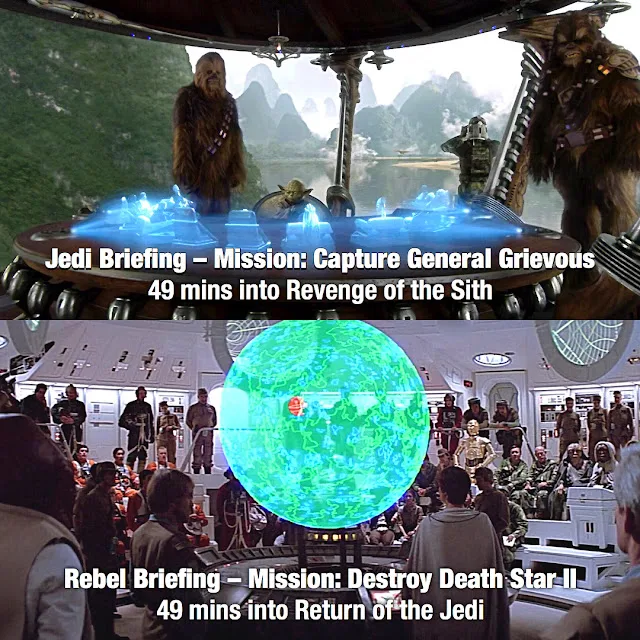
The Middle Ring: Episode II and Episode V
These are the dark, romantic, defeat-ending chapters, the “empire strikes back” of each trilogy, and their six rhymes are the most exact in the entire saga.
1. A Skywalker loses his right hand to a Sith Lord. Count Dooku takes Anakin’s right forearm with a single saber stroke on Geonosis in Attack of the Clones. Darth Vader takes Luke’s right hand at the same height, with the same kind of cut, on Cloud City in The Empire Strikes Back. Father and son, same limb, same wound, dealt by a Dark Lord. The saga’s single most deliberate rhyme is also a recurring Lucas motif used here at its most pointed.

2. The hero defies his mentors to rescue someone he loves, and fails. Anakin abandons his protection assignment and tears off to Tatooine to save his mother, arriving moments too late to do anything but hold her as she dies. Luke abandons his training, ignores Yoda and Obi-Wan’s warning that it is a trap, and races to Bespin to save his friends, where he is beaten, maimed, and told the truth that breaks him. Both are punished for love overriding discipline. Both arrive only in time to lose.

3. The Fett bounty hunter. Jango Fett anchors Episode II. His cloned son Boba Fett stalks Episode V. The same Mandalorian silhouette and the same ship, Slave I, now more commonly identified in current canon by its Firespray class, thread the two middle films. Lucas builds the rhyme into the bloodline itself.
4. The asteroid chase. Obi-Wan tails Jango through the asteroids of Geonosis. The Falcon threads the asteroid field fleeing Vader’s fleet. A pursuit among the rocks, staged once in each middle chapter, with a Fett at the centre of both.
5. The romance ripens. The central love story of each trilogy blossoms here: Anakin and Padmé in the lake country of Naboo, Han and Leia in the corridors of the Falcon and Cloud City. Love grows precisely as the galaxy darkens around it.
6. The downbeat ending. Both middle films close on loss. Attack of the Clones ends with a secret wedding under the shadow of a war that has just begun. The Empire Strikes Back ends with a friend frozen in carbonite and a hero hanging maimed beneath the clouds. The middle of each stanza is where the dark wins.
The Axis: Episode III and Episode IV
Here the ring turns. Revenge of the Sith and A New Hope are not parallel stanzas so much as a single hinge, and almost every thread Lucas leaves dangling in III is the thread he picks up in IV, six rhymes at the fold.
1. Vader is born; Vader is met. Episode III ends with the mask lowering onto Anakin’s ruined face, the table tilting upright, the rasp of the first mechanical breath. Episode IV opens with that same figure striding through the smoke of the Tantive IV as the established Dark Lord of the Sith. We watch him made, then we watch him walk in.
2. The Death Star, built and broken. The final shots of Revenge of the Sith show Vader, the Emperor, and Tarkin gazing at the skeletal Death Star under construction. A New Hope is the story of that station becoming operational, killing Alderaan, and being destroyed by Anakin’s own son in a trench run that rhymes all the way back to the podrace of Episode I.

3. Obi-Wan into exile, Obi-Wan out of exile. Episode III ends with Kenobi carrying the infant Luke to the Lars homestead and vanishing into the dunes. Episode IV begins with him emerging from those same dunes to save that same boy from Tusken Raiders. The desert swallows him at the axis and gives him back the moment the ring turns.
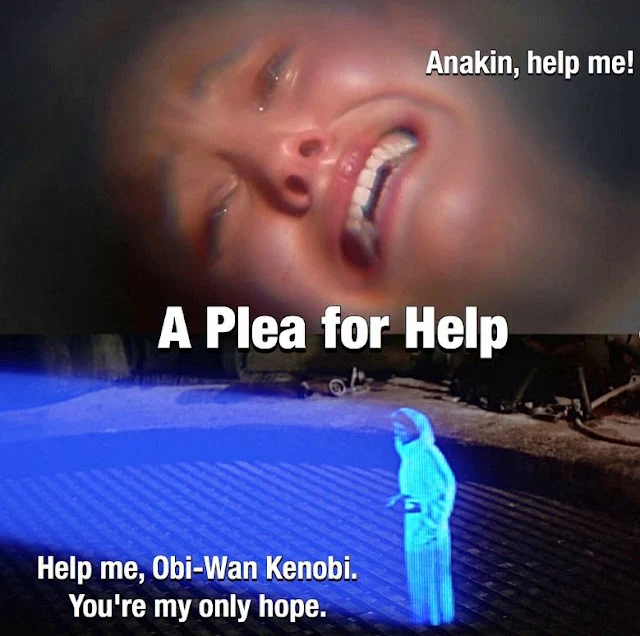
4. The plea for help repeats in a darker key. In Revenge of the Sith, Anakin is haunted by visions of Padmé dying, and the fear of losing her becomes the pressure point Palpatine exploits. In A New Hope, Luke finds Leia’s holographic plea inside R2-D2. Both moments begin with a distressed woman calling across distance. One plea leads Anakin toward possession and the dark side. The other leads Luke toward service, sacrifice, and rebellion.
5. The duel on Mustafar, finished on the Death Star. The two men who scream betrayal at each other over the lava of Mustafar, “You were my brother, Anakin!”, meet for their last duel in a Death Star corridor, where Obi-Wan lowers his blade and lets himself be struck down so he can become more powerful than Vader can imagine. The first duel ends the friendship. The second ends the man, and frames the centre of the ring on both sides.
6. The twins split, the family rekindled. Padmé’s death scatters her children: Leia to Alderaan and the Organas, Luke to Tatooine and the Lars family. Episode IV is the spark that begins pulling them back together: Leia’s hidden message, R2’s stubborn errand, Luke staring at the binary sunset and choosing to leave. The desert boy with a hidden lineage and a gift for flying is, of course, the rhyme of the desert boy at the very start of the ring, Anakin in Episode I.

The Connective Tissue: Motifs That Run the Whole Ring
Beyond the matched pairs, Lucas threads small refrains through all six films, the recurring notes of his musical idea.
The droids. R2-D2 and C-3PO are the only characters present in every film of the saga. They are the ring’s narrators, the constant pair of eyes that watches a republic become an empire and an empire fall. They are the thread you can pull from Episode I to Episode VI without it ever breaking, and their unit codes, the registry language of the galaxy, have a logic of their own.
“I have a bad feeling about this.” The line surfaces in all six films, passed from character to character like a charm. It is the most literal rhyme in the saga: the same lyric in every stanza.
The opening crawl. Every film begins identically: the fanfare, the receding logo, the yellow text climbing into the stars. It is the most formal rhyme in the saga, the same stanza break before every verse. The Astromech keeps the complete text of every opening crawl on file, and if you want to write your own, there is a crawl builder for that.
The twin suns of Tatooine. The desert planet bookends and pivots the story. Anakin’s beginning, Obi-Wan’s exile, Luke’s longing. Lucas keeps returning to that horizon, and Luke’s binary sunset is scored to the saga’s central theme precisely because the music knows it is a rhyme.
Severed hands. Beyond the Anakin and Luke pairing, the saga is full of amputations: Ponda Baba’s arm in the cantina, Maul cut in two at Theed, Dooku’s hands and then his head, Vader’s hand at the climax of Return of the Jedi. The lost hand is Lucas’s signature image for a soul at a turning point.
The heirloom blade. The lightsaber Anakin builds is the one Obi-Wan hands to Luke, “your father’s lightsaber”, carrying the weapon, and the legacy, across the axis from the prequel hero to the original one.
The mentor who returns. Qui-Gon falls but lingers as a discovered voice. Obi-Wan falls and returns as guidance. Yoda fades into the Force and reappears beside them. Each trilogy spends a master and gains a guardian.
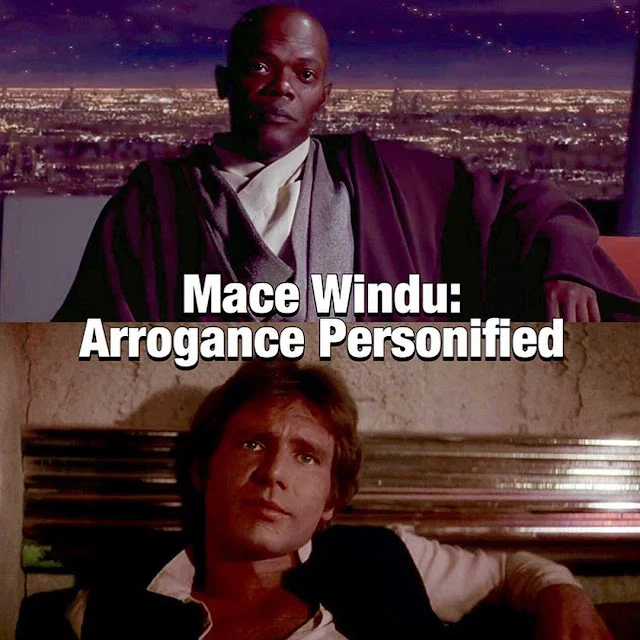
The tonal rhymes. Some echoes are pitched at character rather than plot. Mace Windu’s lethal confidence in the prequels finds its mirror in Han Solo’s swagger in the originals, pride and misjudgment recurring under very different costumes, on both sides of the moral ledger.
The Small Rhymes That Make the Pattern Feel Intentional
The strongest case for Ring Theory is not only the huge structural pairing of I with VI, II with V, and III with IV. It is also the steady accumulation of little cinematic echoes, the beats that make the structure feel less like fan coincidence and more like an obsessive piece of film grammar.
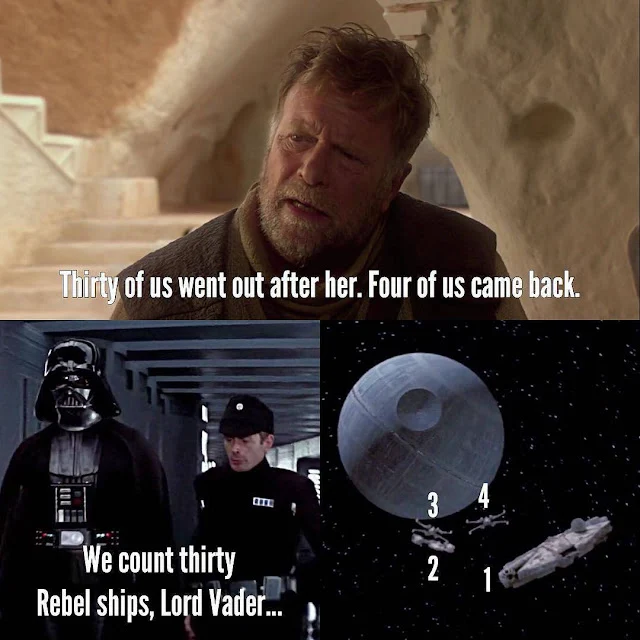
The thirty-man missions. In A New Hope, the Rebel Alliance sends roughly thirty starfighters against the Death Star, and only a few survive. In Attack of the Clones, Cliegg Lars recalls that thirty people went after Shmi Skywalker, and only four came back. One is a war mission. One is a family rescue. Both turn courage into attrition.
Duel locations. In The Phantom Menace, the climactic lightsaber duel takes place in the Theed Royal Palace, a location filled with shafts, catwalks, and glowing barriers. In Return of the Jedi, Luke’s final confrontation with Vader and the Emperor also happens above a deep reactor shaft. In both films, the spiritual fight is staged beside a literal abyss.
The mentor’s sacrifice. In Episode I, Qui-Gon Jinn is struck down and Obi-Wan is forced to become a master before he is ready. In Episode IV, Obi-Wan willingly sacrifices himself and Luke is forced to continue without him. The first death creates a teacher. The second creates a believer.
The ultimate temptation. In Episode III, Anakin is tempted by Palpatine to kill Count Dooku, a defeated enemy who is no longer a threat. He gives in. In Episode VI, Luke is tempted by the Emperor to kill Vader, also beaten and vulnerable. Luke refuses. That is the moral lock of the whole saga. The son reaches the same doorway as the father and chooses differently.
How Far Does the Ring Go?
The broad rhymes above are grounded in Lucas’s own documented intent: the visual jazz, the cyclical motifs, the poetry that rhymes. The most exhaustive version of the theory, mapped scene by scene and even shot by shot, was assembled by writer Mike Klimo in his 2014 essay Ring Theory: The Hidden Artistry of the Star Wars Prequels, which argued the symmetry runs far deeper than the obvious parallels, into the fine grain of editing and composition.
Sceptics counter that a structure this dense will always reward pattern-hunting, and that not every echo Klimo finds was necessarily designed. That tension is worth holding lightly. You do not have to accept every frame-perfect correspondence to recognise that the headline rhymes are too numerous and too pointed to be coincidence: the pyres, the severed hands, the battle stations cracked from within, the exile that turns into a rescue, the repeated calls for help, the mentors who die so apprentices can move forward.

The cleanest way to read the theory is this: Ring Theory does not need every tiny echo to be intentional for the larger structure to work. The saga clearly thinks in cycles. Fathers and sons. Falls and redemptions. Republics and empires. Masters and apprentices. Warnings ignored, then finally understood.
What the Ring Theory finally reveals is the shape of Lucas’s argument about history itself. The saga is not a straight line from villainy to victory. It is a circle, in which a father’s fall and a son’s rise are the same event seen from two sides. The instruments change, the octave shifts, but the refrain holds. You keep playing it over and over again, and every time you rehear it, it means a little more.
Every planet, duel, and droid named in this essay can be looked up in the Archive of the Whills, The Astromech’s Star Wars encyclopedia, and the full set of essays and tools lives on the Star Wars hub.
The Star Wars saga, created by George Lucas, is not only one of the most iconic film series in cinematic history but also a masterclass in...
Read Article →
Quotes from the Original Star Trek show of the 1960s

Star Trek has had a significant impact on popular culture, and its influence can be seen in various aspects of society. One of the most nota...
Read Article →_poster.jpg)


