mass effect
20 April 2026

The Virmire Standoff: How to Keep Wrex Alive for the 'Best' ME3 Ending

The Virmire Standoff: Saving Wrex to Save the Genophage

Special Tactics and Reconnaissance // Mission Report: Virmire // Clearance: Shepard

In the original Mass Effect, the mission on Virmire is famous for forcing you to choose between Ashley and Kaidan. But before that heartbreaking choice, there is an even more dangerous standoff that can ruin your entire trilogy run.

Urdnot Wrex, the last true hope for the Krogan people, discovers Saren has found a cure for the Genophage. He draws his shotgun on you, demanding answers. If you do not handle this conversation correctly, Wrex dies on that beach.

Virmire: How to Save Wrex (ME1)

If Wrex dies in ME1, his violent brother Wreav takes over in Mass Effect 2 and 3. Wreav is a warmonger who will doom the Krogan to extinction. 

To get the "Golden Ending" for the Krogan in ME3, Wrex must survive Virmire.


Phase 1: The Standoff

When you arrive at the Salarian camp on Virmire, Wrex learns that Saren is breeding a cured Krogan army. He is furious that you plan to destroy the facility.

The confrontation happens automatically. Wrex will pull his weapon. Your squadmates will aim at him. The tension is lethal.

The Trap: Ashley's Trigger Finger

If the conversation goes on too long without a resolution, or if you signal her, Ashley Williams will shoot Wrex in the back.

This is permanent. Wrex dies. You cannot revive him. His story ends here.

Phase 2: How to Save Wrex (The 3 Methods)

To talk Wrex down, you need to use one of the following methods. You only need one of these to work.

Method A: The Family Armor (Best Method)

This is the safest way to save him without needing high stats. Before going to Virmire, talk to Wrex on the Normandy. He will tell you about his family armor stolen by a Turian.

  1. Go to the planet Tuntau (Argos Rho cluster, Phoenix system).
  2. Raid the hidden base and recover the Krogan Family Armor from the safe.
  3. Return the armor to Wrex.

Result: If you have done this quest, Wrex already trusts you. When the standoff happens on Virmire, select the option: "I wouldn't do this if it wasn't right" or "We are friends." He will stand down immediately.

Method B: Charm / Intimidate (The Stat Check)

If you didn't get his armor, you can talk him down with raw charisma.

  • Charm (Blue): Requires 8 Points in Charm. "These aren't your people!"
  • Intimidate (Red): Requires 8 Points in Intimidate. "Don't be so naive."

Warning: If you do not have 8 points, these options will be grayed out, and you will be forced to kill him.

Method C: The Completionist (Only if you have very few squadmates)

If you rushed the game and have not recruited Garrus or Liara yet (so you only have Wrex, Kaidan, Ashley, and Tali), Wrex will automatically back down because the game literally cannot afford to lose another squadmate (you need a minimum of 3 for the final mission).


Tactical Appendix: The ME3 Consequence

Why Wrex is the key to the future.

File: The Krogan Future

In Mass Effect 3, the decision to cure the Genophage depends entirely on who is leading the Krogan.

  • If Wrex is Alive: He is a reformer. He wants to rebuild Tuchanka, not conquer the galaxy. If you cure the Genophage, he honors the alliance. You get the Krogan support AND the Turian support. This is the "Golden Ending."
  • If Wrex is Dead (Wreav is Leader): Wreav is a tyrant. He openly plans to use the cure to breed an army and start a new war. If you cure the Genophage for Wreav, you are dooming the galaxy to a Second Krogan Rebellion.

Saving Wrex on Virmire is the only way to save the Krogan soul in ME3.

Next Step: Wrex is safe. Now, learn how to handle the other major crisis in the galaxy.
Read the Guide: How to Broker Peace in Mass Effect 3

"Shepard. My friend." - Urdnot Wrex

```
chronological order

Mass Effect: Andromeda: Operation Movie Night: How to Throw the Ultimate Party

Operation: Movie Night

Tempest Logistics // Crew Morale // Status: Pending // Clearance: Pathfinder

In the original trilogy, we had the Citadel DLC - a final, heartwarming party with the crew. In Mass Effect: Andromeda, we have "Movie Night."

This is not a single mission. 

It is a massive, game-spanning quest chain that involves every member of your squad. It is the emotional climax of the game, offering a unique scene where Ryder snuggles up with their chosen romance option while watching a terrible vid-vid.Mass Effect: Andromeda: Operation Movie Night: How to Throw the Ultimate Party

However, getting to that final scene is a logistical nightmare. The quest relies on a fragile chain of dialogue triggers. 

If you talk to someone too early, or too late, the prompt may vanish forever.

⚠️ Technical Warning: Script Errors

This quest is notoriously buggy. If you progress the main story too fast without completing these steps, the dialogue prompts may disappear. Follow this checklist in strict chronological order. 

Check your email terminal after every main priority mission. Do not assume the game will remind you.


Phase 1: The Movie Library (Liam)

Trigger Condition: You must have established the first outpost on Eos ("A Better Beginning") and returned to the Tempest.

Liam Kosta is the architect of this plan. He realizes the crew is stressed and needs a distraction. He suggests a classic "Vid-Night" but lacks the media library.

The Walkthrough

  • Step 1: Talk to Liam in the Storage Room (Tempest). Exhaust his dialogue until he mentions "Downloading some movies from the Nexus archive."
  • Step 2: Fly to the Nexus. Go to the Operations deck.
  • Step 3: The file is NOT at a vendor. It is on a generic console behind the main operations desk (near where Director Tann's office entrance is). Look for a "Download" prompt.
  • Step 4: Return to the Tempest and give the files to Liam. He will mention that the quality is terrible, but it's a start.

Phase 2: The Snacks (Suvi)

Trigger Condition: You must have visited the planet Aya, met the Angara (Evfra), and recruited Jaal to your squad.

Suvi Anwar wants to provide food, but human snacks are scarce in Heleus. She craves something that tastes like home.

The Walkthrough

  • Step 1: Talk to Suvi on the Bridge. She will mention a specific plant she saw on the Nexus that tastes like Earth snacks ("crunchy and salty").
  • Step 2: Travel to the Nexus. Go to the Docking Bay area.
  • Step 3: Head to the General Merchant (the kiosk near the hydroponics garden/Construction area).
  • Step 4: Purchase the quest item "Special Plant." It costs very few credits.
  • Step 5: Return to the Tempest and give the plant to Suvi. She will start processing it into snacks.

Phase 3: The Popcorn (Vetra)

Trigger Condition: You must have completed "Hunting the Archon" (Salarian Ark) and settled Kadara Port.

You need something crunchy. Vetra Nyx, being the crew's smuggler, knows where to find illegal imports that taste better than Suvi's science experiments.

The Walkthrough

  • Step 1: Talk to Vetra in the Armory. She suggests sourcing "good" snacks from her contacts on Kadara.
  • Step 2: Travel to Kadara Port. Go to the market area (the slums).
  • Step 3: Find the specific vendor marked on your map (usually the mod merchant). Buy the "Popcorn Mix."
  • Step 4: Return to the Tempest and give the snacks to Vetra. She will stash them away from Liam so he doesn't eat them early.

Phase 4: The Projector (Jaal)

Trigger Condition: After the mission "Journey to Meridian" begins (late game).

Liam's movie files are corrupted or incompatible with the Tempest's displays. Jaal offers an Angaran solution: a Remnant-based projector.

The Walkthrough

  • Step 1: Talk to Jaal in the Tech Lab. He offers to build a better projector using Remnant parts.
  • Step 2: Travel to Eos (or any planet with Remnant ruins). You likely already have the materials, but if not, destroy Remnant bots to loot the specific tech he needs.
  • Step 3: Craft the "Remnant Projector" at a Research Station on the Tempest or a forward station. (Alternative: You can sometimes buy the part from the General Vendor on the Nexus if you have the "Market Dominance" cryo pod perk).
  • Step 4: Give the part to Jaal. He will install it in the crew quarters.

Phase 5: The Alcohol (Lexi)

Trigger Condition: Before the final assault ("The Way Home").

Dr. Lexi T'Perro monitors crew stress levels. She prescribes... alcohol. But not just any alcohol - a chemically safe intoxicant for dextro and levo DNA.

The Walkthrough

  • Step 1: Talk to Lexi in the Med Bay. She suggests a specific blend of "Andromeda Spirit" to help everyone relax.
  • Step 2: Travel to the Nexus. Go to the Vortex Bar (Cultural Center).
  • Step 3: Buy the "Special Reserve" bottle from the bartender.
  • Step 4: Return to the Tempest and give the bottle to Lexi. She will certify it safe for consumption.

Phase 6: The Premiere

Requirement: All previous steps complete. Main story advanced to "The Way Home."

Once all items are gathered, Liam will send you one final email: "Movie Night: It's Time."

  • Action: Go to the Crew Quarters on the Tempest. Interact with the banner/poster on the wall.
  • The Scene: The entire crew gathers. You will give a speech about family and survival.
  • The Romance Moment: As the movie starts, Ryder will sit down. If you have successfully locked in a romance, your partner will sit next to you, and you will put your arm around them or lean on them. If you are single, you relax with the whole crew.

Mission Archives: Related Guides


"That movie was terrible. When can we watch it again?" - Vetra Nyx

gears of war
06 March 2026

The COG Was Always the Villain: Fascism, State Violence, and the Political Allegory of Gears of War

Most players spend all six Gears of War games fighting for the COG. The question the series slowly, painfully earns is whether that was ever the right side to be on.


The Coalition of Ordered Governments presents itself as humanity's last line of defence  -  the institution that kept the lights on long enough to mount a resistance, the apparatus through which civilisation might be salvaged from an underground enemy that arrived without warning. For much of the original trilogy, players have no reason to question this framing. 

The Locust are monstrous. 

The Gears are outnumbered. 

Survival is the only currency. 

But the COG is not a flawed institution forced into hard choices by an impossible war. It is a fascist state that existed long before Emergence Day, built on seventy-nine years of resource warfare, ideological conformity, and the systematic dehumanisation of anyone it designated as other. The Locust didn't expose the COG's brutality. T

hey gave it a new target and a new justification.

This is the argument the Gears of War franchise builds across its entire run — not loudly, not didactically, but with the slow accumulation of detail that good political fiction requires. By the time Gears 4 and 5 make the COG's nature explicit, the groundwork has been laid in every propaganda poster, every silent atrocity, every soldier the state has used up and discarded.

gears of war fascism analysis

Defining the Framework: What Fascism Actually Is

Before applying the label to a fictional government, it's worth earning it rigorously. Fascism is a word that gets stretched until it means little, deployed as an insult rather than a diagnosis. Using it precisely matters — both for intellectual honesty and because the Gears franchise deserves the specific, evidenced reading it was designed to support.

In 1995, the Italian philosopher and novelist Umberto Eco published an essay titled Ur-Fascism in The New York Review of Books. Having grown up under Mussolini, Eco was uniquely placed to identify fascism's structural features rather than its surface aesthetics. He identified fourteen properties of what he called "Eternal Fascism" — not all of which need be present in any given case, but which collectively describe the grammar of fascist states. Several of them map onto the COG with striking precision.

The cult of tradition and the glorification of a heroic past. The selective appeal to a frustrated population that sees itself as under siege. The rejection of internal dissent as betrayal. The equation of disagreement with treason. The contempt for those who choose not to serve the collective war effort. Life understood as permanent warfare — the state not merely tolerating the war but needing it to justify its own existence.

"Fascism was a fuzzy totalitarianism, a collage of different philosophical and political ideas, a beehive of contradictions."

— Umberto Eco, Ur-Fascism, 1995

Alongside Eco, the historian Robert Paxton offers a complementary lens in The Anatomy of Fascism. Paxton defines fascism not as a coherent ideology but as a practice — a set of political behaviours organised around the permanent mobilisation of a community against internal and external enemies. This distinction matters enormously for reading the COG. The Coalition doesn't need a Mein Kampf. It has the Octus Canon, the Pendulum Wars, and E-Day. Its fascism is structural, not declared.


Before the Locusts: The COG's Original Sin

The most common defence of the COG runs like this: whatever its flaws, it was a functioning government that humanity rallied around when an existential threat emerged from underground. The Locust created the conditions; the COG responded. Authoritarianism was a necessity, not a preference.

This defence collapses the moment you examine the chronology of Sera's history. The COG was not born in response to Emergence Day. It was born in blood a century before it, and it spent seventy-nine years waging industrial-scale warfare for a resource called Imulsion before a single Locust broke the surface.

The Pendulum Wars are the key to understanding everything. Fought between the COG and the Union of Independent Republics over global Imulsion reserves, the conflict killed tens of millions, restructured entire economies around military production, and — crucially — shaped a generation of soldiers who knew nothing else. Marcus Fenix's father, Adam Fenix, spent his career as a COG researcher during the Pendulum Wars. Dom Santiago enlisted young enough that war was his entire adult life before Emergence Day. The COG that greeted the Locust threat was not a peacetime government galvanised by crisis. It was a war machine looking for its next war.

Imulsion is worth pausing on as an allegory. It is the resource that causes the Lambent mutation, that corrupts everything it touches over time, that ultimately drives the entire catastrophe of Sera's history. Societies that organise their identity around controlling a single, exploitable resource — that wage genocide-scale wars to secure it — are, in the Gears universe as in our own, tending toward a particular kind of rot. The COG built itself on Imulsion and became something Imulsion-adjacent: a corrupting, consuming force that doesn't recognise the damage it does because it has defined itself as civilisation.

The Octus Canon and the Architecture of Obedience

The COG's founding document, the Octus Canon, functions as the ideological infrastructure of its authoritarianism. Under the Canon, citizens owed the state their productive capacity, their children's military service, and their ideological loyalty. Education was COG-run and COG-focused, teaching a sanitised history of the institution. Students wore uniforms. The curriculum centred government. Dissent was framed not as political disagreement but as moral failure.

The parallels here are not accidental. Ancient Sparta's agoge — the compulsory military formation system that took boys from their families at age seven — created soldiers who were COG soldiers by another name: trained from birth to see the state's survival as identical with their own. Rome's concept of virtus, martial virtue as the highest civic expression, is there in the texture of every interaction between Gears — the contempt for weakness, the stoic acceptance of loss, the sense that to grieve openly is somehow indecent. And the Nazi party's Volksgemeinschaft, the idea of the people as a single organism to which the individual owes absolute service, echoes in every COG recruitment poster and every speech about what it means to "be a Gear."


The Aesthetics of Power: What the COG Looks Like and Why It Matters

Fascism is not merely policy. It is spectacle. The Nazi propagandist Leni Riefenstahl understood this, which is why Triumph of the Will is still studied as an aesthetic object decades after its politics have been universally condemned. The designers of the COG's visual world understood it too.

The gear-cog iconography is a starting point. The gear as symbol carries specific ideological freight: it suggests industrialism, productivity, the citizen as interchangeable component of a larger mechanism. 

It strips the individual of uniqueness and elevates the function. 

Every Gear is a Gear — identifiable not by name but by role, not by face but by armour. The deindividuation this creates is not an accident of game design. It is the visual argument the franchise is making about what the COG does to the people inside it.

Environmental propaganda — the posters visible throughout the games, particularly in Gears of War: Reloaded — shows a state actively producing ideological consent. These are not historical artefacts in the game world. They are current, maintained, newly printed. The COG is still selling itself to whatever population remains. Compare the visual grammar: the bold primary colours, the simplified heroic figures, the slogans of collective purpose. Soviet constructivist propaganda and Nazi mass-media messaging both used the same techniques for the same reasons. A population that is perpetually afraid needs perpetually renewed permission to be afraid of the right things.

The architecture of COG settlements continues the argument. Where the buildings appear, they are brutalist in the truest sense — massive, ordered, monumental, designed to communicate permanence and the insignificance of any single person measured against the institution. Albert Speer's plans for Welthauptstadt Germania, the never-built "World Capital" Berlin, proposed architecture specifically scaled to make human beings feel small. 

COG urbanism achieves the same effect with less grandeur and more concrete.

Fascism, State Violence, and the Political Allegory of Gears of War

The Necessary Enemy: Dehumanisation and the Logic of Genocide

Every fascist state requires a dehumanised enemy. The enemy provides the justification for every curtailment of liberty, every economic sacrifice, every atrocity committed in the name of collective survival. Before the Locust, the COG had the UIR. After Emergence Day, it had something far more useful: an enemy that genuinely was trying to exterminate humanity.

What the COG did with that enemy is the telling thing. The Locust are never offered terms in the original trilogy. 

They are never negotiated with, never studied as a culture, never addressed as anything other than a pest problem. 

The word "Grubs" — the standard derogatory term used by Gears for the Locust throughout the series — is not casual. Naming an enemy after larvae, underground vermin, things that exist below the threshold of civilised life, is a documented technique of genocide-enabling propaganda. 

Rwandan Hutu media called Tutsi people inyenzi — cockroaches — in the months before the 1994 genocide. Nazi German press used Ungeziefer — vermin — as standard vocabulary for Jewish people. Language that places the enemy beneath the category of the human makes extermination feel like sanitation rather than slaughter.

The Scouring of Jacinto, the COG's climactic solution to the Locust threat, deserves to be read carefully. The choice to flood the Hollow — to drown Jacinto, the COG's own capital, in order to destroy the enemy - committed the COG to the destruction of its own population centre rather than surrender. Stalin's scorched earth policy during Operation Barbarossa made the same calculation: deny the enemy the resource even if it means destroying your own people. This is not heroism in any meaningful sense. 

It is the logical endpoint of a state that has decided its own survival as an institution matters more than the lives it was supposedly created to protect.

The Revelation That Changes Everything

Then comes the late-series revelation that the Locust were, in origin, human. The Sires — early experiments conducted in COG facilities on Mount Kadar — were the precursors of the Locust Horde. The enemy that justified seventy-nine years of war and then a genocidal extermination campaign was a product of COG science, created in COG laboratories, abandoned by the COG when the experiment produced results the institution found inconvenient.

This is the Gears franchise at its most structurally sophisticated. The COG did not just benefit from having a dehumanised enemy. It manufactured one. And then it waged a genocide against its own creation while insisting on its moral necessity. The soldiers who carried out that genocide  -  including Marcus, Dom, Cole, and Baird  -  had no way of knowing this. They were, in Hannah Arendt's phrase, engaged in the banality of evil: ordinary people doing terrible things not out of malice but because their society had built structures that made those terrible things feel like duty.


Gears 4 and 5: The Mask Comes Off

The original trilogy allows players to be complicit in the COG's violence without fully confronting it. Gears of War 4 and Gears 5 are where the franchise does its most honest political work, staging the COG's nature as the explicit subject of the narrative rather than its background.

The rebuilt COG under First Minister Jinn has learned nothing. DeeBee enforcement robots patrol settlements and suppress dissent with mechanical efficiency. The Outsiders — people who simply chose to live beyond the COG's jurisdiction — are treated as criminals and enemies of order. JD Fenix and Delmont Walker, both trained Gears, went Outsider rather than continue serving an institution they had come to recognise as something other than what it claimed to be.

The central theme of Gears 4 is inheritance. The new generation lives inside structures built by the old one, constrained by decisions made in desperation that have now calcified into permanent policy. The COG's original sins have been institutionalised. The emergency measures of the Locust War are now just how things work. This is how authoritarian states sustain themselves across generations: not through continuous violence, but through the normalisation of that violence until it becomes administrative.

Gears 5's central theme is accountability — not just for actions, but for origins. Kait Diaz discovering her lineage as the granddaughter of the Locust Queen is the moment the franchise forces the COG's founding crime into the open. Her identity crisis is the franchise's crisis: if the enemy was ours all along, what does that make the war? What does that make the people who fought it? What does that make the institutions that orchestrated it and then suppressed the evidence?

The COG's response to this revelation is to bury it. Every authoritarian state requires a sanitised origin story -  one that places the state on the side of necessity and righteousness. The Soviet Union airbrushed inconvenient figures from official photographs. The Nazi state rewrote Germany's WWI defeat as a "stab in the back" by internal enemies. The COG buries the Sires programme and maintains the fiction of a war it had no choice but to fight.


Tools and Victims: The Complicity of Marcus Fenix

None of this makes Marcus Fenix a fascist. And that is precisely the point.

Marcus is a man whose entire sense of self was formed by an institution that needed soldiers. His loyalty was never to the COG as an idea — it was to his squad, to Dom, to the people physically beside him in the foxhole. But his squad was the COG's weapon. The distinction feels meaningful from the inside. Structurally, it changes very little.

Dom Santiago's arc is the emotional argument the franchise makes most openly about what perpetual war does to people. Dom's search for his wife Maria, her mercy killing, his years of functioning grief, and his final act of self-sacrifice in Gears 3 — these are not the story of a winner. They are the story of a man the COG used up. His death is the franchise's most honest statement about the cost of this kind of war: the soldiers who believe most completely in what they're doing are the ones it destroys most completely.

"The most direct route between two points on Sera was always through someone's body."

Hannah Arendt, covering Adolf Eichmann's trial in Jerusalem in 1961, coined the phrase "the banality of evil" to describe how monstrous outcomes can be produced by ordinary people performing bureaucratic functions without engaging their moral imagination. The Gears are not Eichmann — they fight and bleed and grieve in ways that desk-bound administrators never did. But the structural point holds: the COG's greatest crimes were carried out by people who were, individually, not monsters. They were soldiers doing what soldiers do inside the systems soldiers serve.

The story of Gears of War: Judgment makes this tension most explicit in its tribunal framing. Kilo Squad is judged not for outcomes but for obedience — for the act of prioritising survival and effectiveness over procedural loyalty to the chain of command. The COG has decided that the crime is the deviation from authority rather than the circumstances that forced it. Authority demands obedience even when obedience is insane. That is what authority always demands.


Why This Matters: What Gears of War Is Actually Saying

Military science fiction has a persistent tendency to arrive at anti-war conclusions. Paul Verhoeven's Starship Troopers. Spec Ops: The Line. Apocalypse Now and its source text, Conrad's Heart of Darkness. The genre keeps asking the same question — what does permanent war do to the people and institutions that wage it? — and keeps finding the same answer: it makes them into something they would not have chosen to become.

Gears of War belongs in this tradition. The writers — particularly Karen Traviss, whose novelisations expanded the political texture of the games, and the narrative teams at The Coalition who built out Gears 4 and 5 — were making a franchise-length argument about what militarised states do to people and to truth. That argument asks whether a society can build its entire identity around war and still be worth saving.

But the people inside that society — Marcus, Dom, Kait, Cole, Baird — are worth saving precisely because they keep choosing each other over the institution. Because they grieve. Because they question. Because Marcus went to prison rather than abandon his squad, and Dom died in a fuel truck rather than let his friends die, and Kait walked into the truth about her own origins rather than live with the comfortable lie.

The COG is the villain of Gears of War. It was the villain before Emergence Day, during it, and after it. The franchise earns this conclusion slowly, across the full breadth of its run, with the patience that genuine political fiction requires. The Locust gave the COG its perfect war. But the COG was always what it was.

The question the series leaves open — the question worth sitting with — is whether there was ever a version of the Coalition worth fighting for, or whether the rot was structural from the first line of the Octus Canon.


mass effect
26 February 2026

The Surreal Sci-Fi Classics That Captivated 1980s TV Audiences

Welcome to the electrifying golden age of the cathode ray tube. The 1980s wasn't just a decade; it was a dazzling, synth-soaked revolution that redefined the impossible.

This was the era where practical effects reigned supreme, pulse-pounding soundtracks echoed through our living rooms, and every channel was a gateway to the stars. 

From the diplomatic grace of the Enterprise-D to the gritty cyberpunk shadows of Max Headroom, we celebrate the visionary dreams that built our modern world. 

The Archives: 17 Essential 1980s Sci-Fi TV Shows

📺 Star Trek: The Next Generation (1987–1994)

Premiering in 1987, Star Trek: The Next Generation was a massive gamble that eventually solidified itself as a cultural phenomenon. It took nearly two seasons to step out of the shadow of the original 1960s series, but once it did, it redefined the space opera for a new generation. 

Under the measured, philosophical command of Captain Jean-Luc Picard, the series moved away from the "space cowboy" tropes of the past toward complex diplomacy and ethical inquiry.

borg queen data kiss

The show's creative resurgence is famously tied to the second season, symbolized by Commander William Riker sporting a beard - a shift that signaled a more mature, serialized tone. Iconic episodes like "The Best of Both Worlds" introduced the Borg, sci-fi's most terrifying collective consciousness, while "The Inner Light" allowed the show to explore profound themes of memory and legacy, earning it a Hugo Award and critical immortality.

TNG's legacy lies in its optimistic humanism. It presented a post-scarcity future where humanity had outgrown its petty squabbles, focusing instead on the exploration of the "Final Frontier" of the mind and spirit. Whether debating the sentience of an android in "The Measure of a Man" or navigating a linguistic labyrinth in "Darmok," the show proved that science fiction could be both spectacular and deeply intellectual.

Deep-File Intelligence
  • Gene Roddenberry initially opposed casting Patrick Stewart, calling him "a bald English actor."
  • The iconic "Riker Beard" began in Season 2, marking the show's massive quality jump.
  • "The Inner Light" features Picard living a whole lifetime in 25 minutes via a probe.
  • The Borg were originally intended to be insectoid but became cybernetic due to budget.
  • "Yesterday's Enterprise" features a dark alternate timeline where the Federation is losing a war.
  • LeVar Burton’s VISOR prop was inspired by a hair accessory but blinded the actor on set.
  • The series finale, "All Good Things...", won a Hugo Award for Best Dramatic Presentation.
  • Whoopi Goldberg requested a role on the show because Star Trek inspired her to become an actress.

📺 V (1983–1985)

Created by Kenneth Johnson, V was a game-changer for television, blending alien invasion with sharp political commentary. It began as a monumental 1983 miniseries event, presenting a world where 50 massive saucers hover over major cities. 

The "Visitors" claim to come in peace, offering advanced medicine and technology, but a resistance movement led by cameraman Mike Donovan soon discovers their horrifying secret: they are reptilian fascists here to steal Earth's water and harvest humans for food.v mini series green alien

The show was a transparent and effective allegory for the rise of Nazi Germany. The Visitors' uniforms, youth recruitment programs, and propaganda campaigns were designed to mirror totalitarian regimes, warning audiences about the dangers of blind trust in authority. The show featured groundbreaking practical effects for the time, most notably the skin-ripping sequences and the infamous scene where the alien leader, Diana, eats a live guinea pig.

While the later weekly series struggled with budget constraints, the original miniseries and its sequel, The Final Battle, remain milestones of 1980s television. They paved the way for character-driven, serialized sci-fi like Battlestar Galactica and The X-Files, blending interpersonal drama with high-concept stakes that resonated with 40 million viewers during its initial broadcast.

Deep-File Intelligence
  • Inspired by Sinclair Lewis’s 1935 anti-fascist novel It Can't Happen Here.
  • The "V" logo was designed by Robert McCall, a famous NASA conceptual artist.
  • Diana (Jane Badler) eating a live guinea pig was one of TV's most controversial moments.
  • Robert Englund played Willie, a sympathetic alien, before becoming Freddy Krueger.
  • The Visitors were originally intended to be human-like before being changed to reptiles.
  • The miniseries won two Emmy Awards and was nominated for several more.
  • The production used real news footage of rallies to enhance the sense of realism.
  • The show was remade in 2009 but failed to capture the original's cultural impact.

📺 Automan (1983–1984)

Automan was a short-lived but visually spectacular series that sought to bring the digital aesthetic of Disney's Tron to the small screen. Created by Glen A. Larson (the mastermind behind Knight Rider), the show followed Walter Nebicher, a brilliant but ignored police computer programmer who creates an artificially intelligent hologram that can manifest in the real world. 

Together with his polyhedral sidekick "Cursor," Automan fights crime in a neon-drenched Los Angeles.

Automan TV Show

The show was famous for its "neon animation" technique, which required filming actors against black backgrounds and painstakingly drawing glowing circuits over the footage. This gave Automan a distinct, glowing appearance that stood out from anything else on TV. His signature vehicle, a modified Lamborghini Countach, could perform impossible 90-degree turns at high speeds, obeying the laws of computer physics rather than reality.

Despite its high production costs - it was one of the most expensive shows of the era - Automan was canceled after just 13 episodes. However, its influence on the "computer-generated hero" trope is undeniable. It captured the early 80s awe surrounding the dawn of the digital age, suggesting a future where the boundary between virtual reality and the physical world would eventually dissolve.

Deep-File Intelligence
  • The show's visual style was a conscious emulation of the 1982 film Tron.
  • Chuck Wagner, who played Automan, was a professional wrestler before his acting career.
  • The glowing suits used 3M Scotchlite material, making them notoriously hard to film.
  • Desi Arnaz Jr. (Walter) actually bought a PC in 1983 to better understand his role.
  • The theme song was performed by a band that closely mimicked the style of The Police.
  • Canceled after 13 episodes despite high production value and technical innovation.
  • Cursor could create anything Automan needed, from helicopters to tuxedos, out of thin air.
  • The visual effects were handled by Pacific Title Digital, who worked on Terminator.

📺 Quantum Leap (1989–1993)

Quantum Leap blended time travel with an intensely personal, character-driven format. Dr. Sam Beckett, a genius physicist, becomes trapped in a loop of time-jumping after an experiment goes wrong. He "leaps" into the bodies of strangers across the latter half of the 20th century, tasked by an unseen force with "putting right what once went wrong."

 Sam is accompanied by Rear Admiral Al Calavicci, a womanizing, cigar-chomping hologram only he can see and hear.

The show's brilliance lay in its empathy. By forcing a white, male scientist to walk in the shoes of women, minorities, and the disabled, Quantum Leap tackled heavy social issues - racism, sexism, and poverty - with incredible heart. Each episode ended with a "soft cliffhanger," showing Sam's face as he realized he had leaped into a new, often precarious, situation.

The sci-fi lore was robust, featuring the "Swiss Clock" theory of time and Ziggy, a self-aware supercomputer with a distinct ego. While the series finale, "Mirror Image," remains divisive for its somber tone and the revelation that Sam never returned home, the show remains a high-water mark for 80s storytelling, proving that sci-fi could be used as a powerful tool for social commentary.

Deep-File Intelligence
  • Creator Donald P. Bellisario named the computer "Ziggy" after David Bowie.
  • Scott Bakula and Dean Stockwell remained close friends until Stockwell's passing.
  • The handlink Al uses changed design multiple times to look more "futuristic."
  • The "Project Quantum Leap" accelerator set was reused for several other TV shows.
  • Sam Beckett possessed multiple PhDs and spoke seven languages, yet often felt lost.
  • The show was one of the first to win multiple Emmy Awards for its cinematography.
  • Al’s colorful, eccentric outfits were a signature element of the show's visual identity.
  • "Lee Harvey Oswald" was one of the few episodes where Sam leaped into a real person.

📺 Knight Rider (1982–1986)

Knight Rider - Michael Knight and KITT

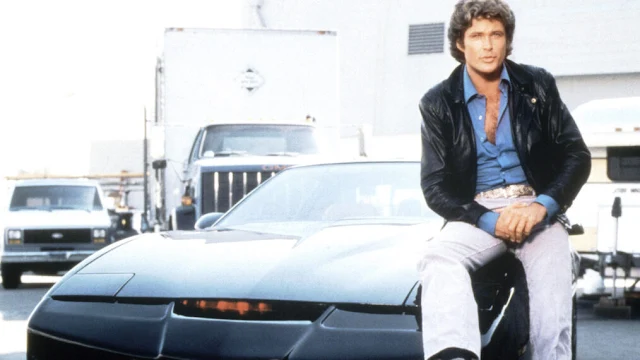
Knight Rider was the ultimate techno-thriller of the early 80s. When police officer Michael Long is shot and left for dead, he is rescued by the mysterious Foundation for Law and Government (FLAG). Reborn as Michael Knight, he is given a new face and the ultimate crime-fighting partner: K.I.T.T. (Knight Industries Two Thousand), a self-aware, indestructible Pontiac Firebird Trans Am.

The show captured the cultural transition from mechanical to digital. K.I.T.T. wasn't just a car; he was a character with a dry, logical wit and a moral compass. The "Turbo Boost" became a playground legend, allowing Michael to jump over obstacles and escape impossible traps. The series frequently explored the ethical implications of AI through KARR, K.I.T.T.'s "evil" prototype that lacked a primary directive to protect human life.

Driven by David Hasselhoff's charismatic performance and a legendary synth-heavy theme song, the show became a global phenomenon. It posited a future where technology was a force for good - a "one man can make a difference" philosophy that resonated with viewers during the height of the Cold War.

Deep-File Intelligence
  • The iconic red scanner on K.I.T.T.'s hood was borrowed from Battlestar Galactica's Cylons.
  • William Daniels (the voice of K.I.T.T.) chose to remain uncredited to keep the "magic" alive.
  • The dashboard was inspired by aircraft cockpits and featured real LED displays.
  • KARR (Knight Automated Roving Robot) was the "evil" version with no moral coding.
  • David Hasselhoff insisted on doing many of his own stunts until the car jump scenes.
  • The "Molecular Bonded Shell" made the car virtually indestructible and bulletproof.
  • The theme song is one of the most sampled tracks in hip-hop history (e.g., Busta Rhymes).
  • A real-life "Super Pursuit Mode" version of the car could actually reach 100+ mph.

📺 The A-Team (1983–1987)

While often viewed as an action-adventure show, The A-Team frequently dipped into sci-fi territory through its legendary engineering sequences. Four Vietnam veterans, "framed for a crime they didn't commit," survive as soldiers of fortune, helping the downtrodden using guerrilla tactics and makeshift technology. Whether turning a broken tractor into a tank or building a cabbage-firing cannon, their mechanical ingenuity was the stuff of legend.

The show's dynamic centered on the chemistry between Hannibal, Face, Murdock, and B.A. Baracus. Each episode featured a "construction montage," where the team used their unique skills to build high-tech (for the time) solutions to defeat corrupt corporate and military forces. The series was famous for its "bloodless violence" - despite thousands of rounds of ammo being fired, enemies always crawled out of their flipped cars unharmed.

The show reflected a post-Vietnam healing process, reframing veterans as honorable heroes operating outside a flawed system. Their reliance on scrap-yard engineering over factory-made hardware celebrated blue-collar expertise, making them the ultimate DIY sci-fi heroes of the Reagan era.

Deep-File Intelligence
  • The Cylon Centurion cameo in the intro was a nod to Dirk Benedict’s Battlestar past.
  • Only one on-screen death was ever implied during the entire 98-episode run.
  • Mr. T's gold chains were personal items he brought to the character's wardrobe.
  • Hannibal's "plan coming together" catchphrase became one of the most famous in TV history.
  • B.A. Baracus's signature van was a 1983 GMC Vandura with a custom red stripe.
  • Murdock was officially "insane," though he was often the smartest person in the room.
  • The show's theme was composed by Mike Post, the king of 80s TV themes.
  • A female team member (Amy Allen) was dropped after Season 2 due to cast tensions.

📺 ALF (1986–1990)

Taking the traditional family sitcom and injecting it with a cynical, cat-eating alien, ALF (Alien Life Form) was a massive hit for NBC. Gordon Shumway, a survivor from the planet Melmac, crash-lands into the Tanner family's garage. Hideously hairy and possessed of eight stomachs, ALF becomes a hidden member of the household, constantly dodging the "Alien Task Force" while critiquing human culture.

While fundamentally a comedy, the show built a surprisingly deep sci-fi lore. ALF frequently discussed the advanced technology, biology, and tragic end of Melmac (which exploded after everyone plugged in their hair dryers at once). The series was a dark inversion of the friendly "E.T." formula, presenting an alien who was loud, consumer-obsessed, and often selfish.

The production was notoriously difficult. To maintain the illusion of the puppet, the set was built on a raised platform with dozens of trap doors for puppeteer Paul Fusco. The human actors often grew frustrated by the technical constraints, but the show's dark humor and satirical edge kept it at the top of the ratings for four seasons.

Deep-File Intelligence
  • Melmac was destroyed because its inhabitants used too many high-wattage hair dryers.
  • ALF’s diet famously included cats, though he never actually succeeded in eating Lucky.
  • The set was four feet off the ground to allow room for the puppeteers below.
  • Max Wright (Willie Tanner) reportedly hated the technical difficulty of the show.
  • The series ended on a grim cliffhanger where ALF is surrounded by the military.
  • Melmacians have eight stomachs, which explained ALF’s constant hunger.
  • A live-action movie, Project ALF, was released in 1996 to wrap up the story.
  • The show’s title is an acronym for "Alien Life Form."

📺 Battlestar Galactica (1978–1980)

Though it began in the late 70s, Battlestar Galactica dominated early 80s sci-fi syndication. After a robotic race called the Cylons destroys the Twelve Colonies of Man, a lone military flagship, the Galactica, leads a "ragtag fugitive fleet" across the galaxy in search of a fabled home planet called Earth. It was a sprawling, expensive space opera that brought cinematic visual effects to the small screen.Battlestar Galactica (1978–1980)

The show was heavily influenced by Mormon theology, utilizing concepts like the Council of Twelve and ancient astronaut theories to explore humanity's destiny. The dynamic between the noble Commander Adama and his hotshot pilots, Starbuck and Apollo, provided the emotional core, while the metallic, monotone Cylons became the definitive villains of the era.

The series faced legal battles from 20th Century Fox, who claimed it copied Star Wars. Despite its cancellation after one season, it spawned the controversial Galactica 1980 and eventually a legendary 21st-century remake. Its legacy remains rooted in its epic scale and its exploration of survival in the wake of total planetary genocide.

Deep-File Intelligence
  • John Dykstra, the VFX lead from Star Wars, was hired to create the effects.
  • The Cylon Centurions had a mechanical "red eye" scanner built into their helmets.
  • The show's terminology (Centons, Yahrens) gave it a unique "alien" cultural feel.
  • Mormon theology (e.g., the star Kolob) heavily influenced the show's mythology.
  • Dirk Benedict (Starbuck) went on to play Face in The A-Team.
  • The series cost over $1 million per episode, an unheard-of figure in 1978.
  • The original pilots were all male; the remake famously changed Starbuck to a woman.
  • The "ragtag fugitive fleet" catchphrase was featured in the opening narration.

📺 Max Headroom (1987–1988)

Set "twenty minutes into the future," Max Headroom was the most prescient sci-fi of the decade. In a world where television networks control the government and corporate ratings are more important than human rights, reporter Edison Carter uncovers the lethal truth about "Blipverts"—commercials that cause viewers to explode. After a head injury, Edison's brain patterns are digitized to create Max, a stuttering, sarcastic, digital entity who lives in the networks.

This was pure cyberpunk on network TV. It tackled media manipulation, corporate surveillance, and digital identity long before they became mainstream concerns. Max, with his jerky movements and geometric background, became an 80s icon, appearing in music videos and commercials while his parent show offered a bleak, satirical look at the future of media.

The show's aesthetic was groundbreaking. Despite looking like complex CGI, Max was actually actor Matt Frewer in a fiberglass prosthetic suit. The show remains a cult classic, remembered for its sharp writing and its terrifyingly accurate predictions of a media-saturated society.

Deep-File Intelligence
  • The name "Max Headroom" came from the clearance signs in parking garages.
  • Matt Frewer spent hours in makeup; he was not a computer-generated character.
  • The show predicted the rise of YouTube-style "citizen journalism" via Carter's camera.
  • In 1987, a real-life hacker hijacked a Chicago TV signal wearing a Max mask.
  • The soundtrack was dominated by experimental electronic music and synth textures.
  • The character was originally created for a British TV movie before the US series.
  • The show coined several terms like "Blipvert" and "Body-Bank."
  • It was one of the first truly "cyberpunk" narratives to reach a wide US audience.

📺 Misfits of Science (1985–1986)

Long before superheroes were a billion-dollar industry, Misfits of Science brought a quirky team of super-powered anomalies to primetime. Led by Dr. Billy Hayes, the team included a rock musician who shoots electricity (B-Man), a telekinetic teen (Gloria), and a man who can shrink to the size of a doll (Elvin). They operated out of the back of a generic ice cream truck, investigating weird science and corporate conspiracies.Misfits of Science (1985–1986)

The show was lighthearted and campy, leaning into the "misfit youth" trope that was popular in cinema at the time. It treated superpowers not as a destiny, but as a burden or a biological quirk. The team fought rogue military experiments and mad scientists, providing a weekly dose of low-stakes superhero fun.

While it only lasted one season, it is remembered for being the television debut of Courteney Cox. It also faced legal threats from Marvel Comics over its similarities to The X-Men, leading the writers to strictly avoid using the word "mutant" throughout the series.

Deep-File Intelligence
  • Features a young Courteney Cox in one of her first major television roles.
  • The towering Elvin was played by Kevin Peter Hall (the actor inside the Predator suit).
  • The "ice cream truck" was a signature element, serving as their mobile HQ.
  • Marvel Comics sued because the team felt too similar to the X-Men.
  • The character Johnny B (the electric musician) was a tribute to Johnny B. Goode.
  • The show's theme song "Misfits of Science" was a quintessential 80s synth track.
  • It was canceled after 16 episodes due to stiff competition from Dallas.
  • One episode featured a man who could freeze anything by touching it.

📺 Small Wonder (1985–1989)

Small Wonder was a bizarre fusion of 1950s family values and 1980s computer science. Robotics engineer Ted Lawson creates V.I.C.I. (Voice Input Child Identicant), a lifelike android in the form of a 10-year-old girl. To protect his project from his nosy boss, Ted passes Vicki off as his adopted daughter. The show followed her attempts to "act human," which usually involved taking idioms literally and showing off her super-strength.

The show was a domestic playground for AI tropes. Vicki looked like a normal girl but possessed a computer brain and a "data port" in her armpit. The physical comedy came from her robotic delivery and her inability to understand social nuances - a direct precursor to characters like Data on Star Trek.

Produced on a shoestring budget, the show was a massive hit in syndication. While critically panned for its simplistic humor and low production values, it captured a specific 80s anxiety about technology entering the home. It suggested that a computer could be part of the family, provided you kept it programmed correctly.

Deep-File Intelligence
  • Tiffany Brissette (Vicki) rarely blinked to maintain the "robotic" illusion.
  • Vicki's access panel for programming was hilariously located under her armpit.
  • The nosy neighbor family (the Brindles) were the main source of tension.
  • Vicki's voice was processed with a slight electronic filter in the early episodes.
  • The show was one of the most successful first-run syndicated sitcoms of all time.
  • Ted Lawson worked for "United Robotronics," a classic sci-fi company name.
  • The show’s theme song "She's a small wonder" is a major nostalgic touchstone.
  • Vicki was incredibly strong; she once lifted the family's car to retrieve a ball.

📺 Alien Nation (1989–1990)

Picking up where the 1988 film left off, Alien Nation was a sophisticated sci-fi police procedural. In the near future, a ship carrying 250,000 enslaved aliens (the "Newcomers") crashes in the Mojave Desert. The show follows the integration of these aliens into Los Angeles, focusing on the partnership between human detective Matthew Sikes and Newcomer detective George Francisco.alien nation

The series was a brilliant social allegory, using the "Newcomers" (the Tenctonese) to explore racism, bigotry, and the struggles of immigrant assimilation. The show excelled at world-building, detailing the Tenctonese's bizarre biology - they have two hearts, get drunk on sour milk, and are burned by saltwater. The dynamic between the cynical Sikes and the logical, family-oriented George was the show's heart.

Despite critical acclaim and high ratings, the show was canceled after one season due to the financial struggles of the young Fox network. However, it lived on through five TV movies that continued the story, remaining one of the most mature and socially conscious sci-fi shows of its time.

Deep-File Intelligence
  • The alien language Tenctonese was fully developed for the series.
  • Newcomers had spots on their heads that indicated their lineage and family.
  • Sour milk had the same effect on aliens as alcohol does on humans.
  • Saltwater was toxic to them, adding a layer of danger to the coastal setting.
  • The series won an Emmy for its intricate alien makeup and prosthetic design.
  • The character of George Francisco had a wife and three children, showing alien family life.
  • Fox canceled the show on a cliffhanger that wasn't resolved for four years.
  • The show tackled real-world social issues like school integration and labor rights.

📺 The Greatest American Hero (1981–1983)

The Greatest American Hero was a satirical take on the superhero genre. Substitute teacher Ralph Hinkley (William Katt -  Carrie, The Man From Earth) is chosen by aliens to receive a red super-suit that grants him flight, strength, and invisibility. However, in a stroke of classic 80s slapstick, Ralph immediately loses the instruction manual. He spends the series clumsily figuring out his powers with the help of a cynical FBI agent named Bill Maxwell.The Greatest American Hero

The show's charm came from Ralph's incompetence. Because he didn't know how to fly properly, his "heroic" entrances usually involved him flailing through the air and crashing into brick walls. It was a grounded, funny take on the burden of responsibility, contrasting Ralph's idealism with Bill's paranoid, Cold War-era pragmatism.

Driven by the massive hit theme song "Believe It or Not," the show became a cult favorite. It captured the era's fascination with superheroes while mocking the tropes of the genre, offering a more human - and significantly more accident-prone - version of the Superman mythos.

Deep-File Intelligence
  • The theme song reached #2 on the Billboard Hot 100 in 1981.
  • DC Comics sued the show, claiming the suit's powers were too similar to Superman.
  • Ralph’s last name was briefly changed to "Hanley" after the Reagan assassination attempt.
  • The suit's chest symbol was a stylized red and white crest with no specific meaning.
  • Bill Maxwell (Robert Culp) was a classic 80s "tough guy" government agent.
  • The "aliens" were never fully seen, appearing only as mysterious lights or ships.
  • A female version, The Greatest American Heroine, was filmed but never aired.
  • Ralph eventually found the manual, but it was written in alien symbols he couldn't read.

📺 Buck Rogers in the 25th Century (1979–1981)

Buck Rogers was the ultimate "disco-sci-fi" transition show. Captain William "Buck" Rogers, a NASA astronaut, is frozen in space for 500 years and awakens in the year 2491. He finds an Earth that has rebuilt itself after a nuclear war, now part of a galactic alliance facing the evil Draconian Empire. Buck, with his "cowboy" pilot skills and 20th-century charm, becomes Earth's greatest defender.Colonel Wilma Deering ERIN GRAY

The show featured colorful, high-glamour sets and elaborate alien costumes. Buck was partnered with the brilliant Colonel Wilma Deering and a snarky, polyhedral robot named Twiki. The series was pure pulp fun, emphasizing dogfights and romance over heavy philosophical themes, making it a favorite for Saturday morning and late-night audiences alike.

Created by Glen A. Larson, it aggressively recycled props and sets from Battlestar Galactica to save on production costs. Despite its short run, it defined the early 80s space opera aesthetic - all spandex, lasers, and synth-pop energy.

Deep-File Intelligence
  • Twiki’s iconic "bidi-bidi-bidi" voice was provided by the legendary Mel Blanc.
  • Colonel Wilma Deering (Erin Gray) was one of the first strong female leads in sci-fi.
  • Buster Crabbe, the original 1930s Buck Rogers, made a guest appearance.
  • The second season shifted to a deep-space exploration format similar to Star Trek.
  • Buck’s Starfighter was one of the most popular toy models of the early 1980s.
  • Princess Ardala was the recurring femme fatale villain of the first season.
  • The show used the same "starry" background shots as Battlestar Galactica.
  • Twiki often wore a gold "disc" around his neck that contained a computer brain.

📺 Captain Power (1987–1988)

Captain Power was a revolutionary but controversial experiment in interactive television. Set in a devastated 22nd century following the "Metal Wars," a small band of freedom fighters led by Captain Jonathan Power battles a tyrannical cyborg army led by Lord Dread. 

The show utilized high-end (for the time) computer-generated characters and dark, dystopian themes that were far more mature than other shows aimed at kids.

captain power show

The show's main hook was its integration with Mattel toys. The broadcast contained specific light and audio signals that kids could "shoot" at using toy jets. The toys would react to the screen, tallying hits and even "ejecting" the pilot if they took too much return fire from the TV. This "first-person shooter" mechanic was decades ahead of its time.

Despite its technical innovation, the show was canceled after one season. It was heavily criticized by parents' groups for being too violent and for being a "30-minute toy commercial." However, its legacy lives on through its high-quality writing (including early work by J. Michael Straczynski - who would create Babylon 5 and work on Superman) and its bleak, cyberpunk world-building.

Deep-File Intelligence
  • The show was one of the first to feature fully CGI-rendered characters on TV.
  • J. Michael Straczynski (Babylon 5) wrote several of the show's dark episodes.
  • The interactive toy technology was known as "XT-7" and cost $1 million to develop.
  • The "Metal Wars" backstory was surprisingly complex, involving the loss of humanity.
  • The villains were known as the "Bio-Dreads," machines that digitized human souls.
  • Parents' groups protested the show for blurring the lines between media and sales.
  • The series finale ended on a dark note with several main characters being "digitized."
  • Mattel eventually pulled the plug on the toy line, leading to the show's demise.

📺 Manimal (1983)

Manimal is one of the most gloriously absurd cult classics of the 80s. Dr. Jonathan Chase, a wealthy professor of animal behavior, has the ancestral ability to shapeshift into any animal. He uses this "Manimal" power to solve crimes for the New York City police, usually opting for a hawk to scout the city or a black panther to fight off thugs.manimal tv show

The show was famous (and eventually mocked) for its incredibly detailed transformation sequences created by Stan Winston. Because the effects were so expensive, the production reused the exact same footage of Chase's hand swelling and skin shifting in almost every episode. This repetition became a signature of the show's campy charm.

Canceled after just eight episodes, Manimal became a punchline in late-night television for years. However, its blend of supernatural mysticism and 80s procedural grit has earned it a devoted cult following. It represents a time when TV networks were willing to take massive, bizarre risks on high-concept practical effects.

Deep-File Intelligence
  • Special effects were created by Stan Winston, the legend behind Jurassic Park.
  • The "Panther" transformation involved air bladders underneath the actor's makeup.
  • The show was so expensive it contributed to the studio's financial struggles.
  • Jonathan Chase was taught his secrets while living in Africa with a mysterious tribe.
  • The show was canceled so quickly that it became a running joke on Night Court.
  • Only three animals were featured regularly: a Panther, a Hawk, and once, a Snake.
  • The protagonist's partner was a tough female police detective named Brooke Mackenzie.
  • Despite its failure, the character made a cameo in the 1990s series Night Man.

The Enduring Legacy of the 80s

Looking back at these 17 pillars of speculative fiction, it's clear the 1980s was more than just neon and spandex. These shows were the laboratory for the complex, serialized storytelling we see today. They tackled the Cold War, the rise of the computer, and the fundamental question of what it means to be human - all while delivering spectacular weekly entertainment.

Stay tuned to The Archives for more deep dives into the practical effects, untold stories, and synth-wave aesthetics that built the future.

Back to Top