
The Astromech · Dune Archive
Guide to the relationships in the Dune Imperium
Every alliance in Dune conceals a dependency. This map traces who holds whom, across six novels and ten thousand years.
The point of this guide is to show you the connections. Dune is not really a story about a desert planet, and it is not really a story about a boy who becomes a messiah. It is a story about dependency. Frank Herbert built the Imperium as a machine in which no faction can survive on its own, then spent six novels showing what happens when somebody works out where the load-bearing joint is.
Read as a list, that structure is almost impossible to hold in your head. The Guild needs spice to fold space. The Emperor needs the Guild to move the Sardaukar. The Bene Gesserit need the Great Houses to keep breeding to their schedule. CHOAM needs Arrakis to keep paying dividends. Every one of those needs is a thread, and pulling any one of them moves the others. Drawn as a graph, the same structure becomes obvious in about ten seconds.
So this is a map of who holds whom. Thirty entities: Great Houses, institutions, peoples, military forces, planets, and the two resources that everything else quietly runs on. Ninety-six relationships between them, each one carrying its type, its direction, the eras in which it holds, and the novel it comes from. Nothing here is invented for the diagram. It is drawn from Herbert’s six original novels only, with no films, no expanded universe, and no encyclopaedia entries.
It is also era-aware, which matters more than it sounds. The Imperium of Dune is not the Imperium of Chapterhouse. House Corrino is the centre of the political universe in one era and a footnote in another. Set the era and the map redraws itself to that moment in the saga.
How to use this map
- Choose an era first. The map opens with all six eras layered on top of each other, which is the most crowded view it can show. Narrowing to a single era is the fastest way to make it readable.
- Select any node to open its full entry: political objective, resources and methods, allies, rivals, historical trajectory, the Herbert novels it appears in, and a link to the essay behind it.
- Use “Isolate this network” once a faction is selected. It strips the map back to that faction and its direct connections only. This is the single most useful control here.
- Filter by relationship type. Switch off every category except Covert or infiltration to see who is quietly working inside whom. Do the same with Economic dependency and the spice economy draws itself.
- Set the spoiler depth below before you start if you have not finished the novels. The map defaults to spoiling everything.
Spoiler warning. The full map reveals outcomes from all six Frank Herbert novels, including deaths, betrayals and the shape of the Golden Path. Set the depth below before you explore.
Reading the lines
Every relationship carries a line style and a midpoint glyph as well as a colour, so nothing depends on colour alone. An arrowhead means the relationship runs one way: influence, control, infiltration or dependency flows from the source towards the entity at the point of the arrow. Plain lines mark mutual bonds, shared membership and two-sided feuds. Node shape marks the kind of entity; node size grows with the number of relationships currently visible, not with any judgement of importance. Drag the map to pan it, use the plus and minus controls or a two-finger pinch to zoom, and use the arrow keys once a node has keyboard focus.
Drag to pan. Zoom with the plus and minus buttons, with two-finger pinch, or by holding Control or Command while scrolling. Press Tab once to reach the map, then use the arrow keys to move to the nearest entity in that direction and Enter or Space to open it. Press Escape to close the panel and clear the selection.
No entities match the current filters. The Imperium is not that small.
The Faction Archive
Every entity on the map, with its political objective, its dependencies and the essay that unpacks it. This index is the map in written form. It works without the graph, without JavaScript and without a mouse.

House Atreides
A ducal house from the ocean world of Caladan, ruling by loyalty rather than terror and dangerous to the Imperium for exactly that reason. Duke Leto I builds an administration and a fighting force whose morale approaches that of the Emperor’s own legions, which quietly converts respect into a death sentence. When Shaddam IV grants House Atreides the fief of Arrakis, Leto accepts a trap he can see clearly, gambling that desert power can be turned into leverage before the Harkonnens close it. The gamble fails inside a year. What survives is not the House but its heir, its concubine and its methods, carried into the desert and rebuilt into something the old order has no defence against.
- Political objective
- Turn the Arrakis fief into a durable power base without provoking the Emperor into open action.
- Resources and methods
- Rule by loyalty rather than fear, Mentat statecraft, Ginaz swordmasters, a small elite military, and a reputation for keeping its word.
- Key allies
- The Fremen, once Leto grasps what desert power actually is. Sympathetic Landsraad houses. Bene Gesserit interest carried by Lady Jessica.
- Key rivals
- House Harkonnen, House Corrino, the Sardaukar, and a Spacing Guild that prefers Arrakis governed by someone incurious.
- Historical trajectory
- Destroyed as a Great House within a year of taking Arrakis, then reborn through Paul as an imperial dynasty that consumes the order which killed it.
- Frank Herbert novels
- Dune

House Harkonnen
An industrial house that treats cruelty as an accounting method. Baron Vladimir Harkonnen holds Arrakis as a quasi-fief for eighty years and extracts a fortune from it without once trying to understand the planet, which is precisely why he loses it. The Harkonnen model is simple: buy the loyalty you cannot terrify into existence, keep the ledger hidden, and let a nephew absorb the public hatred. The Baron’s ambition is not really Arrakis at all but the throne, reached obliquely through spice profits, CHOAM leverage and a bred heir. He is closer to that ambition than anyone realises, and he is destroyed by a granddaughter the Sisterhood indexed and he never knew existed.
- Political objective
- Accumulate enough spice wealth and CHOAM leverage to place a Harkonnen on the Imperial throne within two generations.
- Resources and methods
- Spice extraction at any human cost, bought informers, a twisted Mentat, slave levies, and the useful fiction that Harkonnen violence is merely Harkonnen character.
- Key allies
- House Corrino, in a partnership neither side intends to survive the war. Guild silence, purchased with spice.
- Key rivals
- House Atreides above all, then the Fremen the Baron never bothers to count, and the Emperor he intends to replace.
- Historical trajectory
- Ends as a house with the fall of Arrakeen. The name persists on Gammu as a genetic line the Bene Gesserit continue to track long after the Baron is ash.
- Frank Herbert novels
- Dune, with a bloodline echo in Heretics of Dune

House Corrino
The Padishah Emperors, whose authority rests on one fact carefully dressed in ceremony: the Sardaukar. Corrino power is not absolute, it is balanced. The Landsraad restrains the throne, the Guild moves the throne’s armies, CHOAM funds it and the Bene Gesserit advise it, and every one of those relationships is a leash disguised as a courtesy. Shaddam IV destroys his own position by using Imperial troops in a private quarrel, because the moment the Great Houses believe the Sardaukar can settle the Emperor’s personal fears, the old balance turns poisonous. What follows is not a revolution against a strong empire but the exposure of a weak one.
- Political objective
- Preserve Corrino primacy by keeping the Great Houses divided, indebted and slightly afraid.
- Resources and methods
- The Sardaukar, the largest single block of CHOAM votes, control of noble marriages and fiefs, and a Truthsayer at the Emperor’s shoulder.
- Key allies
- House Harkonnen, briefly and deniably. The Spacing Guild, for as long as spice flows. The Bene Gesserit, on their own terms.
- Key rivals
- House Atreides, the Landsraad as an institution, and eventually the Fremen army nobody in the Imperium had bothered to count.
- Historical trajectory
- Defeated at Arrakeen, exiled to Salusa Secundus, kept alive as a dynastic bargaining chip, and finally absorbed into the Atreides settlement through marriage.
- Frank Herbert novels
- Dune, Dune Messiah, Children of Dune

The Atreides Imperial Line
The dynasty that begins when a ducal heir becomes a religious figure and ends when his son stops being human. As Muad’Dib, Paul rules through a fusion the old Imperium had no category for: legitimate title, Fremen military force, spice monopoly and a state religion that answers to him. The result is a jihad he foresees and cannot stop. Alia holds the regency and loses herself to it. Leto II then takes what Paul refused, merging with sandtrout to become a tyrant who governs for three and a half thousand years in order to make tyranny impossible afterwards. The line does not decline. It deliberately detonates.
- Political objective
- Under Paul, survive the future he has already seen. Under Leto II, force humanity into a Scattering so vast that no oracle or tyrant can ever cage the species again.
- Resources and methods
- Absolute control of melange, prescient advantage, the Qizarate priesthood, the Fedaykin and later the Fish Speakers, and an unchallengeable claim to divinity.
- Key allies
- The Fremen, until the Fremen are transformed past recognition. Duncan Idaho, in every version of him.
- Key rivals
- The Bene Gesserit, the Spacing Guild, the Bene Tleilaxu, the Landsraad remnant, and the Ixians who arm the resistance to Leto’s peace.
- Historical trajectory
- Rises through holy war, hardens into theocracy, transforms into a single immortal ruler, and ends by design so that the Scattering can begin.
- Frank Herbert novels
- Dune, Dune Messiah, Children of Dune, God Emperor of Dune

Bene Gesserit
A training order, a genetic archive and a political intelligence service wearing the costume of a religious sisterhood. The Bene Gesserit do not rule openly because open rule is brittle and visible power invites destruction. Instead they place themselves inside bloodlines, courts, marriages, myths and memories, running a breeding programme aimed at a male who can survive the spice agony and see where they cannot. They get him a generation early, in the wrong house, outside their control, and spend the rest of the saga managing the consequences. Their real achievement is not the Kwisatz Haderach. It is institutional survival across ten thousand years of rulers who all believed they had captured the Sisterhood.
- Political objective
- Guide human development towards a controllable superbeing, and outlast every regime that thinks it owns the Sisterhood.
- Resources and methods
- The breeding programme, Other Memory, prana-bindu conditioning, the Voice, Truthsayers placed beside thrones, and the Missionaria Protectiva.
- Key allies
- House Corrino as client and host, the Ixians against the Honored Matres, and any bloodline worth preserving.
- Key rivals
- The Bene Tleilaxu, the Atreides Imperial line, and finally the Honored Matres, who are the Sisterhood’s own logic without its restraint.
- Historical trajectory
- Advisers to the old Imperium, marginalised under Muad’Dib, tolerated by the God Emperor, and after the Scattering the last coherent institution still standing.
- Frank Herbert novels
- All six
Missionaria Protectiva
The Sisterhood’s religious engineering division, and the single most consequential instrument in the saga. The Missionaria seeds superstition on primitive and isolated worlds: prophecies, sacred phrases, recognition signs, protective legends. The stated purpose is insurance, so that any Bene Gesserit stranded on such a world can invoke a myth and be sheltered. The actual effect is a galaxy stocked with pre-loaded belief systems waiting for someone with the training to occupy them. On Arrakis it prepares the Lisan al-Gaib legend centuries before there is anyone to fill it. Paul walks into that machinery and takes control of it, which is the exact moment the Sisterhood’s long design stops belonging to the Sisterhood.
- Political objective
- Plant exploitable religious structures on every reachable world so that no Bene Gesserit is ever without cover or leverage.
- Resources and methods
- Seeded prophecy, ritual phrases, recognition responses, the Panoplia Propheticus, and the patience to work in centuries.
- Key allies
- The Bene Gesserit proper, which it serves absolutely.
- Key rivals
- Anyone who learns the machinery exists and decides to use it, which in practice means Paul Atreides.
- Historical trajectory
- Its greatest success on Arrakis becomes its greatest failure, and the Sisterhood spends four novels living inside a religion it built for someone else.
- Frank Herbert novels
- Dune, with consequences running to Chapterhouse: Dune

Spacing Guild
The monopoly that moves everything. No House can trade, reinforce a garrison or invade a neighbour without Guild transport, which should make the Guild the most powerful body in the Imperium. It is not, and the reason is the same substance that gives it power. Navigator prescience runs on melange, so the organisation that controls all movement is chemically owned by one desert. That dependency makes the Guild conservative to the point of paralysis: it will not act on a future it cannot safely navigate, and it will trade almost anything for continuity of supply. It buys silence about Arrakis for decades, then discovers that the man who can destroy the spice can also dictate terms.
- Political objective
- Guarantee the melange supply and keep interstellar transport neutral, profitable and beyond challenge.
- Resources and methods
- Absolute transport monopoly, Navigator foresight, ruinous fees for anyone who wants Arrakis watched, and an institutional preference for doing nothing.
- Key allies
- CHOAM, House Corrino, and whichever house currently guarantees spice production.
- Key rivals
- The Atreides Imperial line, which turns Guild dependency into submission, and the Ixians, whose navigation machines threaten to make Navigators unnecessary.
- Historical trajectory
- Untouchable in the old Imperium, subordinated under Muad’Dib, rationed by the God Emperor, and after the Scattering just one interest among many.
- Frank Herbert novels
- All six

Guild Navigators
Humans mutated past recognition by lifelong immersion in melange gas, kept alive in tanks so that they can fold space without killing everyone aboard. A Navigator sees a narrow band of possible futures and steers a ship through the survivable one. This is the Butlerian bargain made flesh: rather than build a machine to do the calculation, the Imperium rebuilds a person into the machine. The cost is total. Navigators cannot leave the tank, cannot leave the spice, and cannot see past a mind more prescient than their own, which is why Edric joins the conspiracy against Muad’Dib. Their foresight is real, and it is also the leash.
- Political objective
- Preserve the conditions that keep them alive and indispensable, which means preserving the spice above all other considerations.
- Resources and methods
- Limited prescience, safe navigation of folded space, and the ability to shield a conspiracy from other oracles by standing inside it.
- Key allies
- The Spacing Guild they effectively are, and any power guaranteeing melange.
- Key rivals
- Muad’Dib, whose vision exceeds theirs, and the Ixians, whose machines are designed to replace them.
- Historical trajectory
- Indispensable, then merely useful, then obsolete in principle once Ix demonstrates that a device can do the work.
- Frank Herbert novels
- All six, most prominently Dune Messiah and God Emperor of Dune
Landsraad
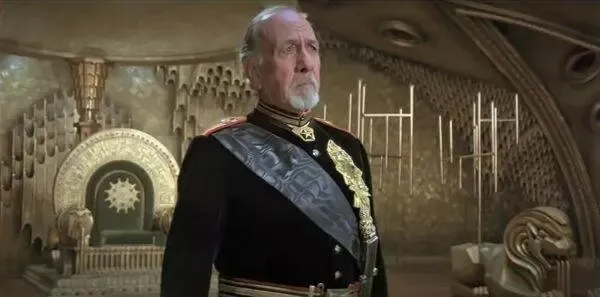
The assembly of the Great Houses, and the only constitutional check on an Emperor with private legions. The Landsraad cannot outfight the Sardaukar and everybody knows it, so its power is procedural: the Great Convention, the rules of kanly, the collective right to make an Emperor’s position untenable if he is caught using Imperial troops in a private quarrel. That is why Shaddam IV needs the Harkonnens to carry the visible blame on Arrakis. The betrayal of House Atreides therefore damages the throne even when it succeeds, because it gives every House in the assembly a better reason to fear the man who is supposed to arbitrate between them.
- Political objective
- Preserve the collective autonomy of the Great Houses against Imperial encroachment without provoking a war it cannot win.
- Resources and methods
- The Great Convention, formal kanly, combined house levies, CHOAM directorships and the threat of coordinated withdrawal of consent.
- Key allies
- CHOAM, which is the same aristocracy counting money, and the Spacing Guild, whose neutrality keeps any single house from dominating.
- Key rivals
- House Corrino and the Sardaukar, then the Atreides Imperium that reduces the assembly to ceremony.
- Historical trajectory
- A real constraint before Arrakeen, a formality under Muad’Dib, and politically extinct by the time Leto II takes the throne.
- Frank Herbert novels
- Dune, Dune Messiah, Children of Dune

CHOAM
The Combine Honnete Ober Advancer Mercantiles, the commercial body through which the entire Imperium is monetised. Almost all interstellar trade runs through CHOAM, and a noble house’s real standing is measured less by its territory than by its directorships and its share of the profits. This is what makes the Imperium a single organism rather than a collection of feudal grudges: Emperor, Great Houses and Guild are all shareholders in the same enterprise, and all of them are exposed to the same commodity. CHOAM is the reason Arrakis cannot simply be abandoned, and the reason a threat to the spice is a threat to every balance sheet in human space.
- Political objective
- Keep the flow of trade, and above all the flow of melange, stable and profitable regardless of who holds the throne.
- Resources and methods
- Directorships allocated as political currency, control of shipping contracts, price setting, and the collective self-interest of every noble shareholder.
- Key allies
- The Landsraad, House Corrino and the Spacing Guild, which are all also its owners.
- Key rivals
- Anyone who can interrupt spice production, and eventually the Atreides Imperium that seizes the Corrino holdings outright.
- Historical trajectory
- The financial skeleton of the old order, absorbed by Muad’Dib and then rendered irrelevant by a God Emperor who rations the commodity himself.
- Frank Herbert novels
- Dune, Dune Messiah, Children of Dune, God Emperor of Dune
Bene Tleilaxu
A closed theocracy of genetic engineers, governed by a secret council of Masters and hidden behind layers of religious ritual. The Tleilaxu do not seek territory or thrones. They seek mastery of flesh, memory and faith, and they sell the results: gholas grown from the cells of the dead, twisted Mentats with the conditioning stripped out, Face Dancers who can wear another person’s identity. Everyone in the Imperium despises them and everyone buys from them, which is a fairly accurate description of their strategy. In Dune Messiah they weaponise grief itself, returning Duncan Idaho to Paul as a gift built to break him, and in the late novels they finally break the spice monopoly by growing melange in axlotl tanks.
- Political objective
- Achieve total control over biology, and through biology over identity, loyalty and belief.
- Resources and methods
- Axlotl tanks, ghola resurrection, restored memory as leverage, Face Dancer infiltration, twisted Mentats and eventually tank-grown melange.
- Key allies
- Temporary partners only. The Guild and the Sisterhood in the conspiracy against Muad’Dib, and any buyer with sufficient need.
- Key rivals
- The Bene Gesserit, the Ixians, the Atreides Imperium, and finally the Honored Matres who exterminate them.
- Historical trajectory
- Suppliers at the edge of the Imperium, conspirators against Paul, indispensable to the God Emperor, and destroyed almost entirely in the Honored Matre wars.
- Frank Herbert novels
- All six, decisively in Dune Messiah, Heretics of Dune and Chapterhouse: Dune
Face Dancers
Tleilaxu-manufactured mimics who can assume another person’s appearance, voice and mannerisms closely enough to replace them. They are not shapeshifters in any romantic sense; they are a manufactured servant class, sterile, engineered and owned. Scytale is the clearest example of what that makes possible: a conspirator who does not need armies because he can simply become someone the target already trusts. In the late novels the Face Dancers become far more dangerous, having learned to absorb the memories and personalities of those they copy, until nobody, including their Masters, can be certain who is standing in the room. The tool acquires an agenda, which is a very Herbertian fate for anyone who builds a perfect instrument.
- Political objective
- Originally none of their own. Later, an autonomous project of replacement and infiltration that no longer answers to the Masters.
- Resources and methods
- Physical mimicry, assumed identity, absorbed memory, and placement inside institutions that never notice a substitution.
- Key allies
- The Bene Tleilaxu who created them, for as long as that relationship holds.
- Key rivals
- The Bene Gesserit, who can sometimes detect them, and eventually the Masters themselves.
- Historical trajectory
- Instruments in the conspiracy against Paul, then improved to the point of independence, then a quiet contamination running through the post-Scattering powers.
- Frank Herbert novels
- Dune Messiah, God Emperor of Dune, Heretics of Dune, Chapterhouse: Dune

Ixians
The Imperium’s machine builders, operating in the narrow legal space left by the commandment against making a machine in the likeness of a human mind. Ixian engineering is everywhere in noble life and nobody looks too closely at how close the devices come to the line. Under the God Emperor that ambiguity becomes the central political question, because Ix eventually offers the one product that could unmake the entire spice order: a navigation machine that would free interstellar travel from Navigators and therefore from Arrakis. Leto II tolerates and even sponsors them, which is characteristic. He needs the technology, and he also needs a future in which no single monopoly can hold humanity again.
- Political objective
- Push the prohibition on thinking machines as far as it will bend without triggering a second jihad.
- Resources and methods
- Advanced manufacturing, sealed research on Ix, no-chambers hidden from prescience, and eventually navigation devices that make Navigators redundant.
- Key allies
- The God Emperor, who buys what he officially forbids, and later the Bene Gesserit against the Honored Matres.
- Key rivals
- The Spacing Guild, whose existence they threaten, and the Bene Tleilaxu, their competitor in forbidden engineering.
- Historical trajectory
- Quiet suppliers in the old Imperium, central to the God Emperor’s calculations, and a surviving technical power in the scattered universe.
- Frank Herbert novels
- Dune, God Emperor of Dune, Heretics of Dune, Chapterhouse: Dune
Mentats
Human computers, produced by an order that exists solely because computers are forbidden. A Mentat is trained to hold vast quantities of data and derive a projection from incomplete information, and the best of them function as a Great House’s strategic memory. Thufir Hawat is the model: three generations of Atreides statecraft held inside one skull. The weakness is built into the design, because a Mentat computes on the data supplied, and data can be poisoned. Hawat is defeated not by a better analyst but by a Harkonnen operation that feeds him the wrong picture. The Tleilaxu, meanwhile, sell twisted Mentats with the moral conditioning removed, which tells you everything about how the Imperium values the faculty.
- Political objective
- None as an order. Mentats serve, which makes them the instrument through which other powers think.
- Resources and methods
- Trained recall, logical projection, sapho juice, and an institutional monopoly on the calculation that machines are forbidden to perform.
- Key allies
- The Great Houses that employ them, the Spacing Guild and the Bene Gesserit, who train Mentat Truthsayers of their own.
- Key rivals
- The Bene Tleilaxu, who mass-produce a corrupted version, and any prescient mind that can see around a projection.
- Historical trajectory
- Indispensable to feudal statecraft, sidelined by rulers who can see the future directly, and durable enough to outlast all of them.
- Frank Herbert novels
- All six
Sardaukar
The Emperor’s legions, and the fact underneath every piece of Imperial ceremony. The Sardaukar are not recruited so much as selected: Salusa Secundus is officially a prison planet and functionally a death world, and the survivors of it are welded into a warrior religion whose only loyalty is to the throne. One Sardaukar was reckoned worth ten Landsraad conscripts, which is why the Great Houses can never seriously challenge Corrino power. Their decline is invisible before it is catastrophic. Complacency, cynicism and a diverted training budget hollow out the mystique, and then they meet Fremen who were shaped by a harsher planet and were never counted as soldiers at all.
- Political objective
- None independent of the Emperor. They exist to make Corrino authority a physical fact.
- Resources and methods
- Selection through a death world, fanatical discipline, superior close combat, and deployment in another house’s uniform when deniability is required.
- Key allies
- House Corrino absolutely, and House Harkonnen while the Arrakis operation lasts.
- Key rivals
- The Fremen, the Fedaykin, and the Landsraad levies they are designed to overawe.
- Historical trajectory
- Unbeaten for millennia, broken on Arrakis, and finally folded into the Atreides settlement when the Corrino line is absorbed by marriage.
- Frank Herbert novels
- Dune, Dune Messiah, Children of Dune
Fedaykin
Fremen death commandos, sworn to a cause and to a leader they have accepted as more than a leader. The Fedaykin are the point where Fremen desert competence becomes an instrument of imperial policy. Everything that makes them formidable was developed for survival rather than conquest: water discipline, sandwalking, worm transport, the ability to move and fight in conditions that destroy off-world troops. Paul does not create these capabilities, he inherits them and gives them a direction. The consequence is the jihad. The same commandos who took Arrakeen carry Muad’Dib’s name across the stars and leave an estimated sixty billion dead behind them, which is the cost Herbert insists you attach to the triumph in the first novel.
- Political objective
- Serve Muad’Dib, and through him the Fremen dream of a green Arrakis, without examining what serving him will require.
- Resources and methods
- Desert mobility, worm transport, crysknives and maula pistols, atomics inherited from the Atreides, and an absolute willingness to die.
- Key allies
- The Fremen sietches, House Atreides and then the Atreides Imperium.
- Key rivals
- The Sardaukar, House Harkonnen, and every Great House that resists the jihad.
- Historical trajectory
- Guerrilla fighters, then the shock troops of an interstellar holy war, then a memory invoked by a priesthood that no longer resembles them.
- Frank Herbert novels
- Dune, Dune Messiah

Fish Speakers
Leto II’s all-female army, priesthood and civil service in a single body. The God Emperor builds them deliberately as an alternative to the male military tradition he regards as a repeating catastrophe, and the result is a force that garrisons an entire interstellar peace without producing the aggressive dynasties that armies usually generate. Their obedience is religious rather than contractual: they do not serve a state, they worship a god who happens to be the state. That makes them extraordinarily stable and completely dependent on his continued existence, which is the point. When the God Emperor dies as planned, the Fish Speakers fragment, and what remains of them scatters into the wider universe with everyone else.
- Political objective
- Maintain Leto II’s enforced peace, which means suppressing movement, ambition and any political development he has not authorised.
- Resources and methods
- Total control of internal security, religious devotion to the God Emperor, administration of the spice ration, and a monopoly on organised force.
- Key allies
- The God Emperor, exclusively.
- Key rivals
- The Ixians and Bene Tleilaxu who arm and supply the resistance, and the Bene Gesserit who wait him out.
- Historical trajectory
- The instrument of the longest peace in human history, then a leaderless remnant after the Tyrant’s planned death, and a probable ancestor of what comes back from the Scattering.
- Frank Herbert novels
- God Emperor of Dune, with remnants in Heretics of Dune

Honored Matres
Something the Scattering made and sent back. The Honored Matres arrive from the unknown regions as a conquering sisterhood, taking worlds by sexual enslavement, terror and overwhelming violence, and the Bene Gesserit recognise them immediately as a distorted version of themselves: the same techniques of physical control and bonding, stripped of patience, restraint and any long design. The Sisterhood reads them as descendants of lost Bene Gesserit and Fish Speakers, changed beyond recognition by whatever they encountered out there. They are also running from something. That is the detail that matters most, because a power this brutal does not flee inward across the old Imperium unless it is more afraid than anyone it is attacking.
- Political objective
- Seize and hold the old Imperium quickly, and destroy the Bene Gesserit before the Sisterhood can absorb or outlast them.
- Resources and methods
- Sexual bonding used as permanent control, accelerated reflexes, mass reprisal, seized spice stocks and weapons brought back from the Scattering.
- Key allies
- None that are not coerced. Their alliances are captures.
- Key rivals
- The Bene Gesserit above all, then the Bene Tleilaxu they nearly exterminate, and whatever pursued them out of the Scattering.
- Historical trajectory
- Arrive as an unstoppable invasion, destroy Rakis, and are gradually absorbed rather than defeated by a Sisterhood that has been outliving conquerors for ten thousand years.
- Frank Herbert novels
- Heretics of Dune, Chapterhouse: Dune

Fremen
The desert population of Arrakis, descended from Zensunni wanderers and shaped by generations of a planet that kills the careless. Nothing about Fremen culture is decorative. Stillsuits, deathstills, water rings, sietch discipline, sandwalking and worm riding are all survival engineering, and the religious framework that holds them together is partly their own inheritance and partly material seeded by the Missionaria Protectiva centuries earlier. The Imperium never counts them, which is the single most expensive oversight in the saga. They rise through Paul and win everything, and then discover that victory dissolves them: the greening of Arrakis destroys the desert that made them, and imperial wealth finishes the job.
- Political objective
- Survive, remain unnoticed, and eventually transform Arrakis into a world with open water, a dream inherited from Pardot and Liet-Kynes.
- Resources and methods
- Total water discipline, unmatched desert mobility, worm transport, hidden sietch populations and an ecological plan measured in centuries.
- Key allies
- House Atreides and then Muad’Dib, who gives their capability a target.
- Key rivals
- House Harkonnen, the Sardaukar, and finally the terraforming project they themselves began.
- Historical trajectory
- Invisible desert power, then the army that breaks the Imperium, then a wealthy and diluted people, then Museum Fremen performing a culture that no longer exists.
- Frank Herbert novels
- Dune through Heretics of Dune
Melange
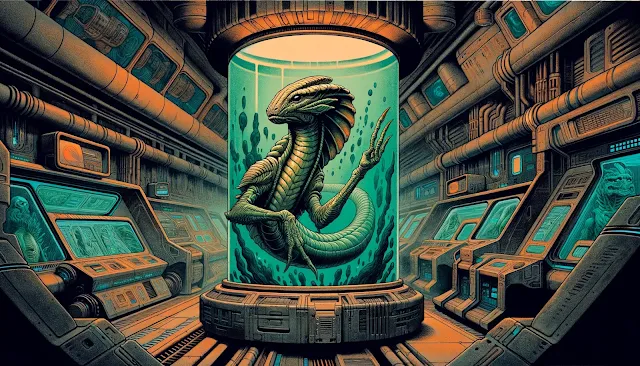
The spice, and the hinge on which every relationship in this map turns. Melange extends life, sharpens awareness, enables Navigator foresight and is required for the Bene Gesserit spice agony, which means the Guild, the Sisterhood and the aristocracy are all chemically committed to a single desert. Withdrawal is fatal, so dependency is permanent and universal. That is why Arrakis cannot be abandoned, why the Guild will not permit close observation of the planet, and why Paul’s threat to destroy the sandworm cycle is a credible threat to end interstellar civilisation. When the Bene Tleilaxu finally learn to grow melange in tanks, the political order that had held for millennia simply stops making sense.
- Political objective
- None. It is a commodity, which is exactly why it organises the politics of everyone who needs it.
- Resources and methods
- Geriatric effect, prescient enhancement, absolute addiction, and a production cycle nobody understands well enough to replicate for thousands of years.
- Key allies
- Whoever holds Arrakis. Melange has no loyalties, only dependants.
- Key rivals
- Every attempt at synthesis or substitution, and the Ixian navigation machine that would make one of its uses redundant.
- Historical trajectory
- A monopoly commodity, then an instrument of imperial control, then rationed by a God Emperor, then finally reproducible off-world and stripped of its old power.
- Frank Herbert novels
- All six
Shai-Hulud
The sandworms, and the reason Arrakis matters. The worm is the terminal stage of a life cycle that produces melange, which makes the entire spice economy a by-product of a creature nobody in the Imperium bothered to study for thousands of years. To the Fremen, Shai-Hulud is simultaneously god, transport, weapon and the thing that eats you if your rhythm is wrong, and there is no contradiction in that list. The worms are also the sharpest limit on imperial power, because they cannot tolerate water: the terraforming that fulfils the Fremen dream is the same process that kills the worm cycle. Leto II resolves this by becoming the worm, which is not a metaphor.
- Political objective
- None. Its indifference is the point, and every political actor in the saga is arranged around a creature that does not negotiate.
- Resources and methods
- The sandtrout and sandworm cycle that produces melange, territorial dominance of the deep desert, and total intolerance of open water.
- Key allies
- The Fremen, who worship and ride it, and the ecology that sustains it.
- Key rivals
- The terraforming programme, imperial water imports, and every attempt to industrialise the desert.
- Historical trajectory
- Nearly extinguished by the greening of Arrakis, preserved through Leto II’s transformation, and finally reseeded on Chapterhouse after Rakis burns.
- Frank Herbert novels
- All six
Arrakis, later Rakis
One desert world, and the single point of failure for an interstellar civilisation. Arrakis is worthless by every ordinary measure and indispensable by the only measure that counts, because it is the sole source of melange. Everything else follows: the Guild’s passivity, the Harkonnen fortune, CHOAM’s structure, the Emperor’s anxiety, the Bene Gesserit’s seeded prophecy and the Fremen’s invisibility. Whoever governs the planet governs the balance, which is why the fief is both a prize and a sentence. Under the Atreides Imperium the terraforming dream is realised and the desert recedes, taking the worms and the old Fremen with it. By the late novels the world is called Rakis, and then it is destroyed.
- Political objective
- As a planet, none. As a fief, it is the object of every serious political calculation in the Imperium.
- Resources and methods
- The melange monopoly, sandworm ecology, an uncounted native population, and a climate that punishes every off-world assumption.
- Key allies
- The Fremen who understand it and the worms that make it valuable.
- Key rivals
- Every power that wants its output without accepting its conditions.
- Historical trajectory
- Harkonnen quasi-fief, then Atreides trap, then the imperial capital of a religious empire, then a greened world renamed Rakis, then ash.
- Frank Herbert novels
- Dune through Heretics of Dune
Caladan
An ocean world of rain, cliffs and pundi rice, held by House Atreides for twenty-six generations. Caladan matters politically because of what it produces in the people who grow up there: a house that has never had to ration water, never had to fight for survival against its own climate, and has therefore built its authority on loyalty and reputation rather than scarcity. That inheritance is an asset on Arrakis and also a blind spot. The transfer of the fief is presented as a promotion and functions as an eviction, and Duke Leto understands both readings when he accepts it. Paul’s exile from Caladan is the beginning of everything that follows.
- Political objective
- None independent of House Atreides, whose character it largely explains.
- Resources and methods
- Abundant water, agriculture, sea power, and a settled population loyal to the ducal line rather than to the Imperium.
- Key allies
- House Atreides, which it defines.
- Key rivals
- None directly. Its vulnerability is that a fief can be reassigned by Imperial decree.
- Historical trajectory
- Surrendered in exchange for Arrakis, retained as a sentimental holding of the Atreides line, and reduced to a memory once the dynasty relocates to the desert.
- Frank Herbert novels
- Dune, Dune Messiah
Giedi Prime, later Gammu
The Harkonnen homeworld, an industrial planet organised around extraction and display. Giedi Prime is where the Baron keeps his slave pits, his arena and his spectacle, and the cruelty is not incidental to the economy but the management method of it. The planet is the visible argument for what Harkonnen rule means, and House Atreides is measured against it constantly. After the fall of the House and the long millennia of the Tyrant’s peace, the world is renamed Gammu and rebuilt into something outwardly unrecognisable, which is exactly the sort of erasure the Bene Gesserit distrust. By the late novels it is a nexus of Tleilaxu activity and then an Honored Matre stronghold.
- Political objective
- As Giedi Prime, sustain the Harkonnen extraction economy. As Gammu, survive whichever power currently occupies it.
- Resources and methods
- Heavy industry, slave labour, arena spectacle, and later a strategic position on the routes of the returning Scattered powers.
- Key allies
- House Harkonnen, then the Bene Tleilaxu who operate keeps there, then the Honored Matres who seize it.
- Key rivals
- House Atreides, and later the Bene Gesserit contesting the world.
- Historical trajectory
- Harkonnen seat, then renamed and rehabilitated under the Tyrant, then a contested prize in the wars that follow the Scattering.
- Frank Herbert novels
- Dune, Heretics of Dune, Chapterhouse: Dune
Kaitain
The Corrino capital, seat of the Imperial court and the Landsraad, and the stage on which Imperial legitimacy is performed. Kaitain is a world of ceremony, protocol and controlled climate, deliberately remote from anything resembling hardship, and that remoteness is politically useful right up until it becomes fatal. The court is where noble marriages are arranged, where fiefs are granted and withdrawn, and where a Truthsayer stands beside the throne listening for lies. It is also where an Emperor can convince himself that a desert eight parsecs away is an administrative detail. When the throne is lost, it is not lost on Kaitain. It is lost on a plain outside Arrakeen.
- Political objective
- Project the permanence and legitimacy of Corrino rule through ceremony, protocol and unhurried authority.
- Resources and methods
- The Imperial court, the Landsraad chamber, the machinery of fiefs and dynastic marriage, and the accumulated wealth of a ruling house.
- Key allies
- House Corrino, the Landsraad that sits there, and the Bene Gesserit advisers at court.
- Key rivals
- Arrakis, which is where power actually resides, whatever the seating plan says.
- Historical trajectory
- The centre of the known universe until the Corrino defeat, then a provincial capital as the imperial centre moves permanently to the desert.
- Frank Herbert novels
- Dune, Dune Messiah
Salusa Secundus
Officially the Imperial prison planet. Functionally, the mechanism that manufactures the Sardaukar. Salusa Secundus is a ruined world with a lethal environment and a mortality rate that would be a scandal if anyone outside the Corrino administration were permitted to measure it, and the survivors of that environment are the raw material for the Emperor’s legions. This is the Imperium’s most closely held secret and its most obvious one, hidden in plain sight behind the word prison. Duke Leto grasps the principle immediately, which is part of what makes him dangerous: if a death world produces soldiers like that, then Arrakis should produce something comparable, and it already has. After the fall, Shaddam IV is exiled there.
- Political objective
- Supply the throne with soldiers no Great House can match, while appearing to be nothing more than a place of punishment.
- Resources and methods
- A lethal environment used as a selection filter, penal transportation, secrecy, and the mystique of shared suffering.
- Key allies
- House Corrino, whose military monopoly it exists to produce.
- Key rivals
- Arrakis, the only other world producing troops of that quality, and doing it without an Imperial budget.
- Historical trajectory
- The hidden foundation of Corrino power, then the place of Shaddam IV’s exile, then a diminished holding of a defeated house.
- Frank Herbert novels
- Dune, Dune Messiah, Children of Dune
Wallach IX
The Bene Gesserit school world, where acolytes are trained and the breeding records are kept. Wallach IX is the closest thing the Sisterhood has to a capital, which is precisely why the Sisterhood is careful never to describe it that way. An institution whose survival strategy is invisibility does not advertise a headquarters. What happens there is the least mystical and most consequential activity in the saga: instruction in prana-bindu control, the Voice and observation, and the maintenance of genetic records covering every significant bloodline in the Imperium. Jessica is trained there and disobeys the plan formed there, and the school is left to absorb a failure it can neither reverse nor admit.
- Political objective
- Reproduce the Sisterhood reliably across generations while keeping its methods and its records out of everyone else’s hands.
- Resources and methods
- Acolyte training, Reverend Mother instruction, the breeding archive, and deliberate political insignificance as camouflage.
- Key allies
- The Bene Gesserit, which it produces.
- Key rivals
- Any power that decides the Sisterhood is worth attacking at its source.
- Historical trajectory
- The Sisterhood’s centre through the Imperium and the Tyrant’s peace, superseded by Chapterhouse once the Honored Matres make a known address lethal.
- Frank Herbert novels
- Dune through Heretics of Dune
Tleilax
A closed world, and the most secretive address in the Imperium. Outsiders do not go to Tleilax; Tleilaxu Masters come out, sell, and return. What the planet conceals is not simply industrial process but a theology, because the Bene Tleilaxu regard their manipulation of flesh as a religious vocation and everyone outside their faith as powindah, unclean. That combination of closed doors and doctrinal contempt is why the Imperium tolerates them without ever trusting them. The secrecy holds for thousands of years and then fails catastrophically, when the Honored Matres return from the Scattering and discover that a world nobody has ever inspected is also a world nobody will defend.
- Political objective
- Preserve absolute secrecy around Tleilaxu methods, doctrine and the true nature of the axlotl tanks.
- Resources and methods
- Closed borders, religious isolation, Face Dancer intermediaries, and a monopoly on biological products nobody else can make.
- Key allies
- The Bene Tleilaxu, which it houses and hides.
- Key rivals
- The Bene Gesserit, who have spent millennia trying to learn what happens there, and the Honored Matres, who eventually stop asking.
- Historical trajectory
- Untouched and unexamined through the entire Imperium and the Tyrant’s reign, then devastated in the Honored Matre wars.
- Frank Herbert novels
- All six, decisively in Heretics of Dune and Chapterhouse: Dune
Ix
A world built downward, whose surface reveals nothing about the manufacturing depths beneath it. Ix supplies the Imperium with the sophisticated devices a post-Butlerian civilisation still requires and pretends not to want, and the deliberate opacity of the planet is a commercial and legal strategy rather than an eccentricity. If nobody can inspect the workshops, nobody has to rule on whether the workshops are heretical. That ambiguity is the entire Ixian political position, and it holds for millennia because every customer has an interest in not asking. Under the God Emperor, Ix becomes the place where the question can no longer be avoided, since a machine that navigates is a machine that thinks about the future.
- Political objective
- Keep the workshops sealed and the legal question open, so that Ixian production is never formally judged against the prohibition.
- Resources and methods
- Subsurface industrial cities, engineering talent, no-chambers that hide activity from prescient observation, and indispensable products.
- Key allies
- The Ixians it hosts, the God Emperor as a customer, and the Bene Gesserit in the late wars.
- Key rivals
- The Spacing Guild and the Bene Tleilaxu, plus anyone inclined to enforce the Butlerian commandment literally.
- Historical trajectory
- A discreet supplier to the old Imperium, a strategic asset and a strategic threat under the Tyrant, and a surviving technical power afterwards.
- Frank Herbert novels
- Dune, God Emperor of Dune, Heretics of Dune, Chapterhouse: Dune

Chapterhouse
The Sisterhood’s hidden refuge, and the last address it has. With Wallach IX compromised and Rakis destroyed, Chapterhouse becomes both sanctuary and laboratory, because the Bene Gesserit are doing something there that no institution has managed in ten thousand years: deliberately building a spice cycle from scratch. Sandtrout brought from the dying Rakis are seeded into the planet’s ecology and the world is slowly, intentionally turned into a desert. It is the most audacious act in the late novels. Rather than fight for a monopoly, the Sisterhood decides to manufacture one, and in doing so it takes the ecological engine of the entire saga and moves it somewhere the Honored Matres cannot find.
- Political objective
- Survive, stay unlocated, and establish an independent melange supply before the Honored Matres force a decisive battle.
- Resources and methods
- Concealment, a transplanted sandtrout population, deliberate desertification, and the accumulated institutional memory of the Sisterhood.
- Key allies
- The Bene Gesserit, and reluctantly the Ixians and the last of the Bene Tleilaxu.
- Key rivals
- The Honored Matres, and whatever pursued them out of the Scattering.
- Historical trajectory
- An unremarkable refuge that becomes the new Arrakis, and the place where the Sisterhood stops reacting to history and starts manufacturing it.
- Frank Herbert novels
- Heretics of Dune, Chapterhouse: Dune
Methodology and canon boundary
This map is built strictly from Frank Herbert’s six original novels: Dune, Dune Messiah, Children of Dune, God Emperor of Dune, Heretics of Dune and Chapterhouse: Dune. Nothing here derives from the films, the television adaptations, the games, The Dune Encyclopedia, or the expanded novels by Brian Herbert and Kevin J. Anderson. Where those sources contradict Herbert, Herbert wins.
Every relationship carries an era, because a single timeless graph would invent connections that never existed. Factions separated by thousands of years are never shown as though they dealt with each other directly. Where an entity changes name, allegiance or nature, the change is represented as era-specific data rather than smoothed into a single description: Arrakis becomes Rakis, Giedi Prime becomes Gammu, a ducal house becomes an imperial dynasty, and the Bene Gesserit that advises an Emperor is not the Bene Gesserit that fights the Honored Matres.
Formal allegiance, temporary cooperation, coercion, infiltration and mutual dependency are deliberately kept apart. An alliance in Dune is rarely a friendship, and a dependency is never a choice. Node size reflects how many relationships are currently visible under your filters, not an editorial ranking of who mattered most. Individuals appear inside entity entries as rulers, heirs, founders and agents rather than as nodes, because the argument of this map is institutional.

_poster.jpg)


