31 December 2022

How the "Chain of Command, Part II" Star Episode is still relevant 30 years later

Star Trek: The Next Generation – Chain of Command, Part II

"Chain of Command, Part II" is the 11th episode of the sixth season of Star Trek: The Next Generation, first broadcast in the United States on December 17, 1992. Among Trekkies, it is revered as one of the defining moments of the series, remembered for its raw intensity, its unflinching look at the psychological abuse of prisoners of war, and its relentless exploration of what happens when truth itself is under siege.

The episode follows Captain Jean-Luc Picard after he is captured by the Cardassians, one of the Federation’s most complex and morally ambiguous adversaries. He is transported to a secret detention facility and subjected to brutal methods intended to break his mind and extract classified intelligence about a covert Starfleet operation. The Cardassians want more than information. They want submission.

Chain of Command Star Trek
Captain Picard facing Gul Madred in the infamous interrogation chamber.

What elevates this episode into Star Trek legend is a single, unyielding exchange. Gul Madred, the architect of Picard’s torment, presents four bright lights and demands that Picard acknowledge five. It’s not about facts. It’s about breaking resistance, one neuron at a time. Madred escalates the pain, confident the Captain will surrender. But Picard refuses.

“There are four lights!”

This moment echoes through Trek history. It’s a direct mirror to the franchise’s DNA: defiance in the face of tyranny. For longtime fans, it recalls Vulcan philosophy on logic and truth, echoes the Prime Directive’s moral weight, and nods to the franchise’s Cold War roots. In-universe, it also foreshadows the Cardassians’ role in later conflicts, including their eventual alliance with the Dominion. This isn’t just torture. It’s a prelude to the storm that will engulf the Alpha Quadrant.

Picard’s Ordeal and Stewart’s Performance

Throughout the episode, Picard endures every conceivable tactic, from sensory deprivation to physical brutality. His refusal to compromise his morality turns him into something more than a Starfleet captain. It transforms him into a symbol. Sir Patrick Stewart has often cited this storyline as one of the most emotionally draining of his career. The performance is stripped to its essence. No diplomacy. No bridge. Just the raw human will to endure.

In interviews, Stewart described the filming process as exhausting, calling it “grueling” and “one of the most personal performances” of his time on the show. What began as a science fiction plot about a prisoner became a study in how far the human mind can bend before it breaks.

Stewart later reflected on how relevant the episode became in real-world political climates, pointing to the erosion of civil liberties and the ethics of interrogation in modern conflicts. The four-lights moment has been referenced in political commentary, military ethics debates, and academic writing for decades.

Political Resonance and Real-World Parallels

“Chain of Command, Part II” resonated far beyond Trek fandom. Journalists and scholars have drawn parallels between Gul Madred’s psychological tactics and real-world methods of interrogation. In 2004, Seymour M. Hersh compared the episode’s depiction of torture to what was later uncovered at Abu Ghraib prison. In 2014, Conor Friedersdorf noted its eerie prescience regarding enhanced interrogation in the post-9/11 era. Star Trek had already imagined the moral fallout of such choices years earlier.

This is part of what makes this episode so unforgettable. Like the best of Trek, it isn’t just entertainment. It’s a mirror held up to power, asking uncomfortable questions about the cost of survival and the fragility of truth when power tries to rewrite it.

The lights in Chain of Command
The infamous "There are four lights" moment remains one of Trek’s most quoted lines.

Behind the Scenes and Trivia

  • The episode was written by Ronald D. Moore, a major force behind several key arcs in Star Trek lore and later creator of *Battlestar Galactica*.
  • The torture sequences drew from real testimonies of Vietnam War POWs. Producers consulted former prisoners to ensure authenticity and sensitivity.
  • Gul Madred was portrayed by David Warner, who also appeared as Chancellor Gorkon in *Star Trek VI: The Undiscovered Country*. His ability to channel quiet menace became legendary among Trek fans.
  • Although widely rumored, Gene Roddenberry did not appear in this episode. This myth has circulated for years but is not supported by production records.
  • The title “Chain of Command” nods both to Starfleet’s structure and the chain of psychological manipulation Madred uses against Picard.
  • The episode won a Primetime Emmy Award for Outstanding Individual Achievement in Sound Editing and received multiple additional nominations.
  • The Cardassians, who feature heavily here, would later play a central role in *Star Trek: Deep Space Nine*, where their political and cultural complexity expanded far beyond their initial portrayal as villains.

Legacy

“Chain of Command, Part II” remains one of the most celebrated episodes of the series. Its exploration of psychological endurance, power, and the resilience of the human spirit is as sharp today as it was in 1992. Among Trek fans, the image of Picard standing broken yet unbroken, whispering “There are four lights,” is etched into collective memory.

This episode is more than a story. It is a Star Trek litmus test. It reveals what happens when authority is unchecked, when reality itself is weaponized, and what it means to resist even when resistance hurts.

For those who study Trek not just as a show but as cultural text, this is required viewing. And for those who love Picard, it’s the moment that defines him.

28 September 2022

Famous Films That Influenced Star Wars: A Comprehensive Exploration

At a cursory glance, George Lucas's "Star Wars: A New Hope" appears to be an original cinematic masterpiece full of wondrous monsters and menacing men in black space suits. 

However, Lucas himself has openly acknowledged that his groundbreaking space opera drew inspiration from a myriad of sources, ranging from classic films to literature and even historical events. This article delves into the intricate web of influences that shaped the Star Wars universe.

The Dambusters and The Guns of Navarone: War Epics Reimagined

The iconic trench run scene in "A New Hope," where Rebel pilots target the Death Star's exhaust port, is a direct homage to the 1955 British war film "The Dambusters." In this film, British pilots must drop bouncing bombs on a Nazi dam, requiring precise timing and aim—much like the Rebels' mission. Lucas even borrowed the line "Get set for your attack run!" verbatim.

The urgency of the Death Star attack also mirrors the plot of "The Guns of Navarone," where a team of commandos must destroy Nazi super-cannons to save British troops. The film's tension and pacing influenced how the Rebels' mission was framed in "Star Wars," adding layers of suspense and stakes to the narrative.

Casablanca: A Galactic Rick's Café

The Mos Eisley Cantina in "A New Hope" is a spacefaring version of Rick's Café from "Casablanca." Both serve as hubs for shady deals and feature a cast of morally ambiguous characters. Han Solo's character is a nod to Humphrey Bogart's Rick, sharing a similar world-weary cynicism and even some lines. The price of 15,000 credits for passage to Alderaan also curiously mirrors the 15,000 francs for a ticket out of Casablanca.

thx 1130 influence in star wars


THX 1138: Dystopian Echoes

Lucas's own film, "THX 1138," explores themes of population control and dystopian governance. These themes subtly resurface in the Star Wars saga, particularly in the portrayal of the Galactic Empire's totalitarian rule. The film even includes a line about running over a Wookiee, possibly inspiring the creation of Chewbacca's species.

Akira Kurosawa's Influence: The Hidden Fortress and Seven Samurai

The narrative structure of "Star Wars" owes much to Akira Kurosawa's "The Hidden Fortress," which tells its story through the eyes of two lowly characters, much like R2-D2 and C-3PO. The film also inspired the iconic scene transitions in "Star Wars." Additionally, visual references to Kurosawa's "Seven Samurai" can be found in "Revenge of the Sith."

Nazi Imagery: The Triumph of the Will


The medal ceremony in "A New Hope" and the design of the Stormtroopers borrow heavily from Nazi imagery, particularly Leni Riefenstahl's propaganda film "The Triumph of the Will." This serves to underline the authoritarian nature of the Empire.

The Searchers and John Wayne: A Western in Space


The scene where Luke discovers his murdered aunt and uncle is a direct lift from John Ford's "The Searchers," another film that explores the relationship between a young man and a morally complex father figure.

Ben Hur and Lawrence of Arabia: Epic Inspirations


The pod race in "The Phantom Menace" is a grander version of the chariot race in "Ben Hur," complete with similar camera angles and narrative tension. The desert landscapes of Tatooine also draw visual inspiration from "Lawrence of Arabia," a film that also featured Sir Alec Guinness.

Flash Gordon: The Serial That Started It All


Lucas initially wanted to adapt "Flash Gordon" but couldn't secure the rights. However, the influence remains, from the opening crawl to the concept of a spacefaring fairy tale. The idea of futuristic technology substituting for magic is a core element borrowed from Flash Gordon.

Edgar Rice Burroughs: John Carter of Mars


The John Carter series by Edgar Rice Burroughs, which predates even Flash Gordon, had a profound impact on "Star Wars." From the concept of a human falling in love with an alien princess to the very term "Jedi," the fingerprints of Burroughs' work are evident throughout the Star Wars saga.

Other Notable Influences

  • J.R.R. Tolkien: Elements of Gandalf can be seen in Obi-Wan Kenobi.
  • Metropolis: The design of C-3PO was inspired by the Maschinenmensch robot.
  • Forbidden Planet: Influenced the concept of protocol droids and features a direct homage in "The Phantom Menace."
  • Star Trek: The concept of a collective disturbance in the Force mirrors Spock's empathic abilities.

The Star Wars universe is a rich tapestry woven from a multitude of influences, each contributing to its enduring appeal. By examining these influences, we gain a deeper understanding of how this iconic series came to define modern mythology.
22 April 2022

Princess Leia's Slave Bikini: Cultural Icon or Objectification?

 In the Star Wars franchise, Princess Leia is known as one of the most iconic female characters. However, her character's sexualization in the third installment of the original trilogy, Return of the Jedi, has sparked controversy and criticism.


princess leia salve jabba scene


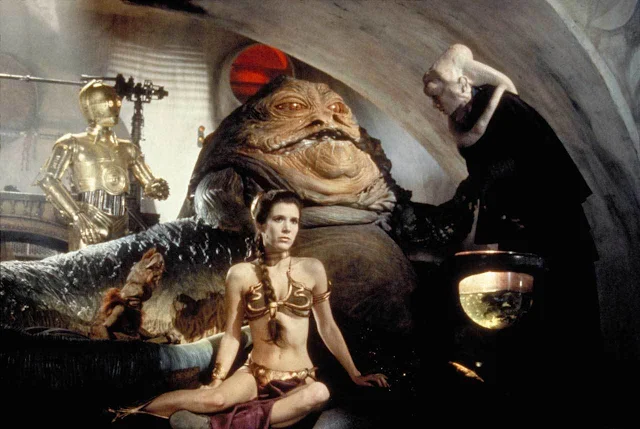
In Return of the Jedi, Princess Leia is captured by the vile gangster Jabba the Hutt and forced to serve as his slave girl. She is outfitted in a revealing gold bikini and chained up, serving as a decoration for Jabba's throne. This scene is infamous for its overt sexualization of Leia and has been the subject of much debate and criticism.


slave leia beach day


The gold bikini has become a cultural icon in its own right, with countless cosplayers and Halloween costumes featuring the outfit. It has also been referenced in popular media, such as the TV show Friends, where the character Rachel dressed up as "Slave Leia" for Ross's sexual fantasy.


leia bikini


Despite its iconic status, the sexualisation of Princess Leia in Return of the Jedi has been criticized for perpetuating harmful stereotypes and objectifying women. The scene reinforces the idea that women are meant to be objects of male desire, and it has been argued that it detracts from Leia's character development as a strong and independent leader.


slave bikini leia


Carrie Fisher, the actress who portrayed Princess Leia, has spoken publicly about her experiences filming the scene. In her memoir, The Princess Diarist, Fisher wrote about the discomfort she felt wearing the costume and performing the scene. She has described the outfit as "what supermodels will eventually wear in the seventh ring of hell."


prince leia wet in the water fisher bikini


Fisher has also been vocal about the pressures of being a sex symbol in Hollywood. She has spoken out about the double standards faced by women in the industry and the expectation that they should be both sexually attractive and talented. Fisher has been a champion for mental health awareness, and she has been open about her struggles with addiction and bipolar disorder.

While Princess Leia remains a beloved character in the Star Wars franchise, her sexualisation in Return of the Jedi continues to be a topic of discussion and criticism. The scene has sparked important conversations about the representation of women in media and the harmful effects of objectification.


star wars bikini Dejah Thoris comparison


It is worth noting that the infamous slave bikini outfit worn by Princess Leia in Return of the Jedi was not entirely original to the Star Wars franchise. The outfit was, in fact, inspired by a character named Dejah Thoris from the science fiction novel A Princess of Mars, written by Edgar Rice Burroughs in 1912.

Dejah Thoris is the Princess of Helium and a central character in the novel. She is described as wearing a revealing red silk outfit that leaves much of her body exposed. It is said that George Lucas, the creator of the Star Wars franchise, was a fan of the John Carter of Mars series and was inspired by Dejah Thoris' outfit when designing Princess Leia's slave bikini. The influence of science fiction on popular culture is undeniable, and the iconic slave bikini is just one example of how the genre has impacted mainstream media.


male cosplayer star wars bikini slave


Some fans love dressing up as Slave Bikini Leia because it allows them to showcase their fandom for the Star Wars franchise while also embodying a strong and iconic female character. Leia’s role as a rebel leader and her bravery in fighting against the Empire has inspired many fans. 

Additionally, her outfit as Slave Bikini Leia is often seen as a symbol of empowerment for some individuals, as it challenges traditional gender norms and allows them to express themselves in a way that they may not be able to do in their everyday lives. 

By embodying this character, fans are able to connect with their favorite franchise and feel a sense of belonging within the community of Star Wars enthusiasts.


sexy bikini cosplay star wars slave

Furthermore, Slave Bikini Leia has become an iconic and recognizable symbol within pop culture. Many fans enjoy cosplaying as this character as it allows them to pay homage to a classic and memorable moment in the Star Wars franchise. It is also an opportunity for fans to showcase their creativity and skills in creating a costume that accurately represents the character.
 
By donning the iconic gold bikini, fans are able to participate in a shared experience with others who appreciate the Star Wars franchise and its characters. Ultimately, dressing up as Slave Bikini Leia allows fans to express their love and admiration for the Star Wars franchise while also engaging in a fun and creative activity with others who share their passion.

sexy star wars cosplay bikini woman

fat male bikini jabba cosplay


07 April 2022

"Exploring the Symbolism of the Doomsday Clock in Watchmen"

The Doomsday Clock is a symbolic representation of how close humanity is to a global catastrophe, with the clock set to midnight representing the apocalypse. The clock was first introduced in 1947 by the Bulletin of Atomic Scientists, and since then has been updated periodically based on the perceived threat of nuclear war and other existential threats.

In the graphic novel Watchmen, the Doomsday Clock is a recurring motif that serves to highlight the central themes of the story. The story takes place in an alternate history where superheroes exist, and the world is on the brink of nuclear war between the United States and the Soviet Union.

doomsday clock yellow smiley face

The clock is first introduced in chapter two, where it is revealed that the clock has been moved two minutes closer to midnight due to increased tensions between the US and the Soviet Union. This sets the tone for the rest of the story, as the characters (or more so the reader) are constantly aware of the looming threat of nuclear annihilation.

The Doomsday Clock also serves to highlight the moral ambiguity of the characters in Watchmen. While many of the characters are ostensibly superheroes, they are flawed and often engage in violent or immoral behavior. The threat of nuclear war raises the question of whether the ends justify the means, and whether the preservation of humanity is worth sacrificing individual morals and ethics.

This is played out ending of both the novel and film - a catastrophic event is manipulated into effect by Ozymandias as a means to achieve peace and advert nuclear war.

The Yellow Badge as a symbol of the Doomsday Clock


The comedian's yellow badge is one of the iconic symbols in the graphic novel. The badge features a smiley face with a splatter of blood on it. The blood on the badge is arranged as the clock at the star of the story - 5 minutes to midnight.

The badge also plays a significant role in the story's plot, particularly in reference to the "Doomsday Clock," a symbolic representation of the world's proximity to nuclear war. The clock is a recurring motif throughout the story, serving as a visual reminder of the constant threat of global annihilation.

At one point in the story, the comedian's badge is found in his apartment by Rorschach, another character in the story. Upon examining the badge, Rorschach notices that there is a hidden smiley face on the back, which is only visible when the badge is folded in a certain way.

The discovery of the hidden smiley face leads Rorschach to investigate further and ultimately leads him to uncover a conspiracy that threatens to bring about nuclear war and destroy the world. The badge, therefore, serves as a symbol of the interconnectedness of the characters and the larger themes of the story, ultimately leading to its resolution.

29 March 2013

The Wit and Wisdom of C3PO: Memorable Quotes from the Star Wars Saga

C-3PO, the beloved protocol droid, is undoubtedly one of the most quotable characters in the Star Wars universe. From his snarky remarks to his panicked outbursts, C-3PO's lines have become iconic, and many of them have transcended the films themselves to become part of pop culture.

Perhaps one of the most memorable aspects of C-3PO's dialogue is his tendency to express worry and fear in the face of danger. His often hysterical outbursts, such as "We're doomed!" and "I'm programmed for etiquette, not destruction!" have become fan favorites and are often quoted in humorous contexts. Even his more serious lines, like "We seem to be made to suffer. It’s our lot in life," have become ingrained in the Star Wars lexicon and are often used to describe the struggles of everyday life.

c3po concept art McQuarrie

C-3PO's interactions with other characters also provide some of the most memorable moments in the Star Wars films. His constant bickering with R2-D2, including lines like "That malfunctioning little twirp, this is all his fault," and "Don't blame me. I'm an interpreter. I'm not supposed to know a power socket from a computer terminal," have become hallmarks of their relationship and have provided audiences with countless laughs over the years.

The Protocol Droid's Best Quotes

"We seem to be made to suffer. It’s our lot in life."
"I am C-3PO, human-cyborg relations."
"Don't call me a mindless philosopher, you overweight glob of grease!"
"Sir, the possibility of successfully navigating an asteroid field is approximately 3,720 to 1."
"I suggest a new strategy, R2: let the Wookiee win."
"I'm rather embarrassed, General Solo, but it appears that you are to be the main course at a banquet in my honor."
"Goodness! Han Solo! It is I, C-3PO! You probably do not recognize me because of the red arm."
"Wait! Oh my! What have you done? I'm backwards! You flea-bitten furball!"
"Taking one last look, sir, at my friends."

The Heart and Humor of the Galaxy

The Humor and Wit of C-3PO: His unique blend of humor and wit is a defining characteristic that has endeared him to fans worldwide. His snarky remarks and comical observations often provide much-needed levity in tense situations. Quotes such as "We seem to be made to suffer. It's our lot in life," showcase his knack for comedic timing.

The Voice of Reason: While often perceived as a fussing droid, C-3PO's lines carry a sense of wisdom and logic. Amidst the chaos of the galaxy, his quotes often serve as the voice of reason, urging characters to make thoughtful decisions.

The Emotional Heart: Beneath his metallic exterior lies a droid with a remarkable capacity for empathy and emotional connection. His quotes often carry a sense of vulnerability, capturing his longing for belonging and purpose, making him more than just a source of comic relief.

19 March 2010

Luke Skywalker's Star Wars Quotes: From Power Convertors to finding the good in a man who helped kill half the Galaxy....

Luke Skywalker is a character that has truly evolved throughout the Star Wars franchise. From his humble beginnings as a whiny farm boy dreaming of adventure and power converters to becoming a Jedi Master and mentoring the next generation of heroes, his journey has been full of memorable moments and iconic quotes.

Luke's early quotes are often remembered for their humor and relatability, such as his exasperated plea to his uncle in A New Hope, "But I was going to Toshi Station to pick up some power converters!" His youthful naivety and eagerness to leave his mundane life behind struck a chord with audiences and made him a beloved character.

luke and yoda empire

As Luke's journey progressed and he learned the ways of the Force, his quotes took on a deeper, more philosophical tone. His declaration in The Return of the Jedi, "I am a Jedi, like my father before me," has become one of the most iconic lines in the franchise, encapsulating Luke's growth as a character and his dedication to the ideals of the Jedi Order.

Luke's final appearance in the sequel trilogy saw him take on the role of mentor, passing on his knowledge and wisdom to the next generation of heroes. His quote to Rey in The Last Jedi, "This is not going to go the way you think," served as a warning of the challenges she would face and a reminder that the journey of a hero is never easy.

Luke Skywalker's quotability is a testament to his enduring appeal as a character. From his early days as a wide-eyed farm boy to his final moments as a wise and powerful Jedi Master, his quotes have resonated with fans of all ages and continue to be celebrated as some of the greatest in the Star Wars franchise.

Here's a list of some of the most iconic quotes by Luke Skywalker in the Star Wars films:

  1. "But I was going into Tosche Station to pick up some power converters!" - Luke Skywalker, Star Wars: Episode IV - A New Hope

This quote has become a classic meme among Star Wars fans and is often used to poke fun at whiny or entitled behavior. It also showcases Luke's youthful impatience and desire for adventure.

  1. "I'm Luke Skywalker. I'm here to rescue you." - Luke Skywalker, Star Wars: Episode IV - A New Hope

This quote is a defining moment for Luke, as he steps up to rescue Princess Leia and begins his journey as a hero. It also highlights his bravery and determination in the face of danger.

  1. "That's impossible!" - Luke Skywalker, Star Wars: Episode IV - A New Hope

This iconic line is uttered by Luke when he first hears about the Force and its abilities. It showcases his initial disbelief in the mystical power that will come to define his destiny.

  1. "I have a bad feeling about this." - Luke Skywalker, Star Wars: Episode V - The Empire Strikes Back

This is a classic Star Wars quote that has been used in almost every film in the franchise. It's a humorous nod to the series' adventurous tone and is often spoken by characters before a dangerous or uncertain situation.

  1. "I'll never join you!" - Luke Skywalker, Star Wars: Episode V - The Empire Strikes Back

Luke utters these words to Darth Vader during their lightsaber duel on Cloud City, cementing his heroic resolve and determination to stay true to his beliefs. It also sets the stage for his eventual confrontation with Vader in the next film. 

  1. "I am a Jedi, like my father before me." - Luke Skywalker, Star Wars: Episode VI - Return of the Jedi

This quote is a pivotal moment in the original trilogy, as Luke finally embraces his destiny as a Jedi and confronts Darth Vader with compassion and love. It highlights Luke's growth and maturity as a character, as well as his commitment to the Jedi way.

  1. "The Force is strong in my family. My father has it, I have it, my sister has it." - Luke Skywalker, Star Wars: Episode VI - Return of the Jedi

This quote provides important context for the Skywalker family's connection to the Force and their role in the Star Wars saga. It also highlights Luke's realization that he is not alone in his journey, and that he has a strong support system in his family.

  1. "I will not fight you." - Luke Skywalker, Star Wars: Episode VI - Return of the Jedi

This quote is a pivotal moment in Luke's final confrontation with Darth Vader, as he refuses to give in to anger and violence. It showcases Luke's commitment to the Jedi ideals of peace and compassion, even in the face of great danger.

vader luke fight empire artwork

  1. "No. No. That's not true. That's impossible!" - Luke Skywalker, Star Wars: Episode V - The Empire Strikes Back

This line is a memorable moment in the Star Wars franchise, as Luke learns the truth about his father's identity and confronts the realization that Darth Vader is actually Anakin Skywalker. It highlights Luke's emotional journey and showcases his shock and disbelief at this earth-shattering revelation.

  1. "I'm a Jedi, like my father before me." - Luke Skywalker, Star Wars: Episode VI - Return of the Jedi

Similar to the earlier quote, this line showcases Luke's embrace of his Jedi heritage and his willingness to carry on the legacy of his father. It also provides a satisfying conclusion to Luke's character arc in the original trilogy.

  1. "Amazing. Every word of what you just said was wrong." - Luke Skywalker, Star Wars: Episode VII - The Force Awakens

This line is a humorous moment in the sequel trilogy, as Luke mocks Han Solo's description of the events that took place after the fall of the Empire. It highlights Luke's disillusionment with the Jedi Order and his reluctance to become involved in the conflict between the First Order and the Resistance.

  1. "I've seen this raw strength only once before. It didn't scare me enough then. It does now." - Luke Skywalker, Star Wars: Episode VIII - The Last Jedi

This quote is a significant moment in the sequel trilogy, as Luke reflects on his past mistakes and warns Rey about the dangers of the dark side. It showcases Luke's wisdom and experience as a Jedi master, as well as his willingness to learn from his failures.

  1. "I'm not going to fail you. I'm not afraid." - Luke Skywalker, Star Wars: Episode VIII - The Last Jedi

This line is a powerful moment in the sequel trilogy, as Luke confronts Kylo Ren and refuses to back down in the face of danger. It highlights Luke's determination and courage, as well as his commitment to protecting the people he cares about.

luke hoth empire

  1. "I will not be the last Jedi." - Luke Skywalker, Star Wars: Episode VIII - The Last Jedi

This quote is a significant moment in the sequel trilogy, as Luke passes on his knowledge and wisdom to Rey and encourages her to continue the Jedi Order. It showcases Luke's dedication to the Jedi way and his belief in the power of hope and optimism.

  1. "No one's ever really gone." - Luke Skywalker, Star Wars: Episode IX - The Rise of Skywalker

This line is a poignant moment in the final installment of the Skywalker saga, as Luke encourages Rey to embrace her inner strength and believe in the power of redemption. It highlights Luke's enduring legacy and his belief in the potential for good in all people. 

02 March 2010

The influence of Dune on George Lucas

Frank Herbert's 1965 novel Dune is widely considered a masterpiece of science fiction, and its influence on the genre cannot be overstated.

It sold a giga ton of books. 

It's a damn good book, regardless of enjoying sci-fi and giant space worms. 


It is also widely acknowledged that George Lucas, the creator of the Star Wars franchise, drew inspiration from Dune when he wrote the script for the original 1977 Star Wars film. Heck, Lucas borrowed ideas from everywhere.

Common themes between the ᑐ ᑌ ᑎ ᕮ and Star Wars


The Chosen One


One of the most obvious similarities between Dune and Star Wars is the concept of a "chosen one" who is destined to bring balance to the universe. In Dune, this chosen one is Paul Atreides, the son of Duke Leto Atreides who is tasked with leading a rebellion against the evil Baron Harkonnen

In Star Wars, the chosen one is Luke Skywalker, who must defeat the Empire and restore balance to the Force. Both characters are young men with extraordinary abilities who are thrust into a conflict that they did not ask for, and both must come to terms with their destiny and the weight of their responsibilities.

[One could make a reallllly good argument that the sequel films made Ray the chosen one...]

Mysterious Forces


Another similarity between Dune and Star Wars is the use of a mystical force that can be harnessed by certain individuals to perform seemingly supernatural feats. In Dune, this force is known as the "spice trance" and is accessed through the use of the drug melange, which is found only on the desert planet of Arrakis. In Star Wars, this force is known as the Force and is accessed through meditation and training. Both forces allow individuals to manipulate reality in ways that seem impossible, and both are used by characters to perform incredible feats of strength, speed, and agility.

The influence of Dune on George Lucas

I hate sand, it gets every where etc


The desert planet of Arrakis, with its harsh environment and valuable natural resource, also served as inspiration for the planet Tatooine in Star Wars. Both planets are home to nomadic tribes and are ruled by powerful factions who are willing to do whatever it takes to maintain their power. In Dune, the ruling class is the Padishah Emperor, who seeks to control the spice trade, while in Star Wars, it is the Galactic Empire, which seeks to maintain its grip on the galaxy.

Space Slugs and Worms


space slug work star wars

Of Raiders and Fremen


The desert planet setting of Tatooine in Star Wars also includes a similar nomadic tribe of people known as the Tusken Raiders, who are akin to the Fremen in Dune. Both groups are portrayed as savage and dangerous, but also possess a deep connection to the land and an understanding of the harsh realities of their environment. Both the Fremen and Tusken Raiders also possess unique skills that make them formidable adversaries in battle.

Good v. Evil


Perhaps the most significant thematic similarity between Dune and Star Wars is the idea of a struggle between good and evil, with both works exploring the concept of how power corrupts and the lengths that people will go to in order to maintain their grip on power. 

In Dune, the Bene Gesserit sisterhood represents an ancient and secretive group who manipulate events behind the scenes, while the Harkonnen family represents the dark side of human nature, seeking power and control at all costs. In Star Wars, the Jedi Order represents the light side of the Force, while the Sith represent the dark side, seeking power and control for their own gain.

Also Jabba The Hutt is a big fat slug. Leto II Atreides is a worm in God Emperor of Dune.

dune influence in star wars

Did George Lucas acknowledge his borrowings from Dune?

While it is widely acknowledged that George Lucas drew inspiration from Frank Herbert's Dune when he wrote the script for the original Star Wars film, it is also known that Herbert was not pleased with the extent to which Lucas borrowed from his work.

In a 1979 interview with Omni Magazine, Herbert expressed his dissatisfaction with the similarities between Star Wars and Dune, saying:

"I understand that Star Wars is going to be one of the biggest money-making films ever... I'm not sure I like that. It's been my life for six years, and it's kind of like seeing someone else run off with your wife."

Herbert went on to explain that while he didn't begrudge Lucas his success, he was disappointed that he had not been approached for permission to use his ideas and concepts:

"I would have said no to most of it. It's not that I don't think Star Wars is fun, it's just that it's not science fiction. It's a fantasy set in space. It has a lot of elements of mythology and mysticism, which I don't believe are science fictional."

Herbert also criticized the way that Star Wars simplified and sanitized the themes and concepts he explored in Dune.

It is clear that while Herbert may have been flattered by the attention that Star Wars brought to his work, he was ultimately disappointed with the way that Lucas had used his ideas without permission and had simplified them for a mass audience.

influence dune star wars jessica concept

George Lucas has acknowledged that he drew inspiration from a wide range of sources when creating the Star Wars films

Here is a list of some of the most notable influences and the media they came from:

Flash Gordon serials - The Flash Gordon serials were a series of adventure films that were popular in the 1930s and 1940s. They featured heroic characters fighting against evil villains and often included futuristic technology and space travel. The Star Wars films were heavily influenced by the Flash Gordon serials, with their use of similar character archetypes and space-faring technology.

Akira Kurosawa's films - Akira Kurosawa was a Japanese filmmaker who directed many classic samurai films, including The Hidden Fortress, which was a major influence on the original Star Wars film. Lucas has acknowledged that the characters of R2-D2 and C-3PO were inspired by two bickering peasants from The Hidden Fortress, and the overall structure of the film was based on Kurosawa's storytelling style.

Joseph Campbell's The Hero with a Thousand Faces - The Hero with a Thousand Faces is a book by Joseph Campbell that explores the common themes and archetypes found in myths and stories from around the world. Lucas was heavily influenced by Campbell's ideas and used them as a framework for the story of Star Wars, with Luke Skywalker being the archetypal hero on a quest to save the galaxy.

The works of J.R.R. Tolkien - J.R.R. Tolkien's The Lord of the Rings was a major influence on the Star Wars films, particularly in the use of an epic, sweeping narrative that takes place across multiple locations and involves a large cast of characters. The character of Gandalf clearly serves as inspiration for Obi-Wan Kenobi. Indeed, when Lucas was creating the ANH script, he used experts from Lord of the Rings featuring Gandalf as place holder text!

Science fiction pulp magazines - Science fiction pulp magazines were a popular form of entertainment in the 1930s and 1940s and featured stories of adventure, space travel, and futuristic technology. Lucas has acknowledged that he was a fan of these magazines and that they influenced his vision for Star Wars and we haven't even started on the John Carter of Mars novels...

Lucas has also cited World War II films as an influence such The Guns of Navarone and The Dambusters.

About the author Jimmy Jangles


My name is Jimmy Jangles, the founder of The Astromech. I have always been fascinated by the world of science fiction, especially the Star Wars universe, and I created this website to share my love for it with fellow fans.

At The Astromech, you can expect to find a variety of articles, reviews, and analysis related to science fiction, including books, movies, TV, and games.
From exploring the latest news and theories to discussing the classics, I aim to provide entertaining and informative content for all fans of the genre.

Whether you are a die-hard Star Trek fan or simply curious about the world of science fiction, The Astromech has something for everyone. So, sit back, relax, and join me on this journey through the stars!