29 April 2024

The Man from Earth - thematic analysis

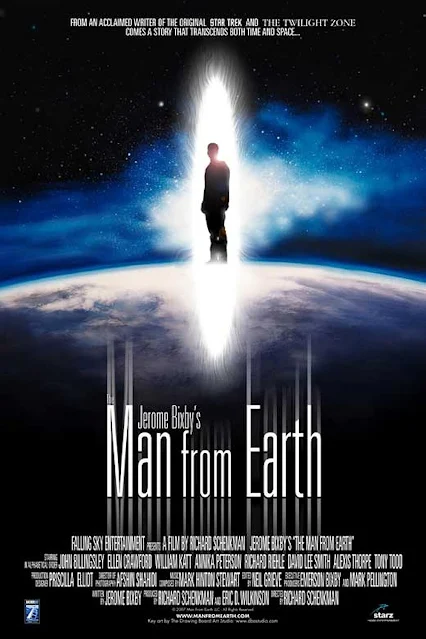
The Man From Earth is an intellectual science fiction drama directed by Richard Schenkman with a screenplay by Jerome Bixby, known for his work on classic sci-fi series like Star Trek. The film presents an unusual setting, primarily confined to a single room where profound philosophical discussions unfold among university professors and scholars.

This minimalist approach focuses on dialogue rather than action or special effects, making the film an outlier in its genre, similar to Primer or Coherence. Jerome Bixby's script, completed on his deathbed, serves as his final contribution to the sci-fi genre, encapsulating a lifetime of thematic exploration into a narrative that is as introspective as it is innovative.

The story revolves around John Oldman, a retiring university professor who reveals to his colleagues that he is actually a 14,000-year-old caveman who has survived through the centuries, adapting to each new age. The reveal prompts a series of intense debates among the group, covering topics from history and religion to science and morality, all driven by their varied reactions to John’s staggering disclosure.
The Man From Earth movie themes

What distinguishes The Man From Earth in the cinematic landscape is not just its contemplative nature, but also how it reached its audience. Initially released to little fanfare, the film gained a significant following through file-sharing networks, an unconventional path that sparked widespread interest and discussion.

This digital word-of-mouth phenomenon underscored the film’s appeal to a niche audience that appreciates cerebral narratives. The grassroots spread of the film through these networks is a testament to its resonating themes and the enduring appeal of thought-provoking storytelling.


One of the most compelling aspects of The Man From Earth is its exploration of immortality through the eyes of its protagonist, John Oldman. 

Immortality, often a subject relegated to the realms of fantasy and science fiction (check out The Highlander), is approached here with a grounded, philosophical lens. John's character serves as a conduit for examining the impact of eternal life on personal identity, human connection, and historical continuity. As he recounts his experiences from various historical eras, the film invites viewers to ponder the burdens and blessings of an unending life.

The narrative structure of the film closely mirrors the Socratic method, a form of cooperative argumentative dialogue that stimulates critical thinking and illuminates ideas. Each character in the film represents different philosophical and practical standpoints, providing a spectrum of responses to John's incredible claim. 

These dialogues not only propel the plot but also engage the audience in a broader philosophical debate concerning the nature of truth, the reliability of historical knowledge, and the existential solitude that might accompany an immortal being. 

Themes Analysis of The Man From  Earth

Humanity and Time

The Man From Earth intricately weaves the passage of time into its narrative fabric, presenting a unique perspective on how centuries can shape an individual's worldview and human relationships. John Oldman, as a character who has lived through millennia, provides insights into how historical events are experienced on a personal level, influencing and being influenced by the ever-changing human condition. 

The film prompts viewers to consider the implications of historical perspective on contemporary issues, questioning whether having such an expansive backdrop of experience could lead to wisdom or detachment.

Isolation and Loneliness

Despite his extensive lifespan, John's journey is marked by a profound sense of isolation and loneliness, themes that resonate deeply within the human psyche. 

The film explores the paradox of living forever but without the ability to form lasting human connections, as everyone around John ages and dies. This eternal solitude highlights the intrinsic value and inevitability of mortality in shaping human relationships. 

The character's eternal life becomes a lens through which the audience can explore their fears and curiosities about solitude, belonging, and the essence of human connection.

Skepticism and Belief

A central theme in The Man From Earth is the dynamic interplay between skepticism and belief, as John’s colleagues react in varying degrees of disbelief and acceptance to his story. This theme not only drives the narrative but also engages the audience in a reflection on the nature of belief itself.

What do we choose to believe and why?

How do our existing beliefs shape our reactions to new, challenging information?

The film uses this conflict to delve into the broader implications of epistemology, the study of knowledge and justified belief, making the audience question the foundations of their understanding of the world.

Change and Continuity

Throughout the film, there is a persistent exploration of what changes over time and what remains constant. While technology, societies, and landscapes evolve, human emotions, fundamental desires, and existential questions remain largely the same. 

John's character highlights the constants of human nature against the backdrop of changing historical contexts, suggesting that while the external world transforms, the core of human experience — the joys, sorrows, fears, and hopes — transcends time. This theme challenges the viewer to consider the balance between embracing change and recognizing the timeless aspects of their own nature.

Each of these themes is not only a reflection of the film's narrative depth but also a mirror for the audience to examine their perceptions of time, belief, change, and the human condition. 

The Man From Earth uses its minimalist setting and dialogue-heavy script to craft a compelling philosophical inquiry into these perennial questions, making it a profound study of both individual and collective human experiences.

Relevance to Contemporary Issues

The themes explored in The Man From Earth resonate deeply with a number of contemporary societal issues, shedding light on universal human concerns that are as relevant today as they were in the past. The film's philosophical discourse prompts us to reflect on our own societal norms, beliefs, and the nature of truth in an age dominated by information and misinformation alike.

The eternal perspective offered by John's character allows for a unique critique of modern societal norms. For instance, his insights into historical human behaviors and societies challenge contemporary views on progress and morality. The film subtly prompts viewers to question the inevitability of societal advancement and whether human nature fundamentally changes over time or remains constant despite technological and cultural evolution.

The Man From Earth also delves into the ethical dilemmas associated with immortality, knowledge, and the passage of time. John's reluctance to reveal his secret underscores the potential consequences of sharing knowledge that challenges established beliefs and paradigms. This poses ethical questions about the responsibility that comes with knowledge — whether certain truths are too burdensome to share, and how such truths might impact the fabric of society.

Character Study

John Oldman, the protagonist of The Man From Earth, is a character who epitomizes the eternal struggle between past and present, memory and identity. His life spans over 14,000 years, during which he has assumed numerous identities and witnessed the entirety of human history firsthand. Yet, despite his extraordinary experiences, John is portrayed with an acute sense of humanity and vulnerability. His decision to finally reveal his secret to his close friends opens a Pandora's box of ethical dilemmas and emotional conflicts.

He is not just sharing a fantastic tale but is also seeking relief from the burden of eternal solitude.

As the narrative unfolds, John grapples with the loneliness that comes from outliving everyone he has ever loved or befriended. His immortality, which might initially seem like a coveted gift, is portrayed as a profound curse that isolates him from the rest of humanity. This internal conflict is central to John's character arc—his need for connection and understanding from his peers contrasts sharply with his instinct to protect himself from rejection and disbelief.

His struggle is emblematic of the human condition: the tension between the desire to share one's truth and the fear of isolation it might bring.

Interactions and Impacts

The dynamics between John and his colleagues are pivotal in exploring the film’s deeper themes. Each character represents a different philosophical and emotional response to John’s revelation, thus enriching the narrative with a spectrum of human reactions to the inconceivable.

  • Edith: A devout Christian, Edith's reaction to John's story is one of deep distress and denial. Her response highlights the theme of belief systems challenged by conflicting narratives. Her struggle with John’s claims offers a poignant look at the conflict between faith and empirical reality, emphasizing the theme of personal belief in the face of overwhelming contradiction.

  • Dan: As a biologist, Dan approaches John's story with scientific skepticism and curiosity. His demands for proof and his attempts to rationalize John’s existence through scientific principles underscore the film’s exploration of skepticism. Dan’s perspective brings to light the scientific community's reliance on evidence and the challenges posed by extraordinary claims that defy conventional understanding.

  • Art: A historian and one of John's closest colleagues, Art reacts with a mixture of intrigue and skepticism. His knowledge of history makes him both a critical and a potentially sympathetic audience to John’s narratives. Art's interaction with John probes the theme of historical truth and the reliability of personal testimony as a historical document.

  • Sandy: Her developing romantic interest in John adds another layer to the narrative. Sandy's reactions provide insights into the human desire for connection and the complexities of forming relationships under extraordinary circumstances. Her openness to John's story contrasts with others' skepticism, illustrating the range of human emotion from doubt to acceptance.

Conclusion

The Man From Earth concludes with a lingering impact, leaving audiences to ponder the weight of its themes. The film’s ability to engage with profound philosophical questions through a minimalist setup is a testament to its thoughtful script and compelling character dynamics. 

As viewers reflect on the narrative and its themes, the film encourages a deeper appreciation for the complexities of human life and the timeless questions that continue to intrigue and challenge us.

By articulating these themes and their implications, the film not only enriches our understanding of narrative storytelling but also enhances our introspection about life’s perennial questions. The Man From Earth remains a poignant reflection on what it means to be human across the ages, making it a significant work for both philosophical discussion and personal contemplation.
22 April 2024

How the Spacing Guild is so powerful yet cedes control of the known universe to Paul Atredies

Lore Deep Dive

The Spacing Guild: The Monopoly That Sold the Universe

Frank Herbert's "Dune" is widely acclaimed as one of the most significant works in the science fiction genre, merging complex themes of ecology, politics, and spirituality. But at the center of this web sits an entity that controls the flow of all three: The Spacing Guild.

A key element of this intricate tapestry is the Spacing Guild, an organization that holds a monopoly on interstellar travel, essential to the socio-economic fabric of the universe. Navigators, transformed by their consumption of spice, possess the ability to foresee safe paths through the cosmos. This makes them indispensable for space travel and valuable assets in the universe’s power dynamics.

This capability extends beyond mere navigation. It serves as a crucial political tool within the galaxy's intricate power structures. By examining how Paul Atreides, a central figure in the Dune saga, manipulates these dynamics, we can delve into the strategic use of the Spacing Guild's resources in his quest for power and subsequent orchestration of a galaxy-wide Jihad.

How the Spacing Guild is so powerful yet cedes control of the known universe to Paul Atredies
The Guild holds the galaxy together, yet remains vulnerable to the source of its power.

I. The Spacing Guild and Its Monopoly on Space Travel

The Spacing Guild occupies a central position in the universe of "Dune," serving as the sole entity capable of facilitating interstellar travel. This monopoly is not merely a commercial advantage but a profound strategic asset that holds the entire interstellar economy and political structure in its grip. The Guild's exclusivity in space navigation is protected and reinforced by its secretive and highly specialized cadre of Navigators, who rely on the psychoactive spice melange to perform their duties.

Spice melange, the most valuable commodity in the universe, is the linchpin of the Guild’s power. Harvested on the desert planet of Arrakis, spice is essential not only for the extended lifespan and expanded consciousness it offers but also for the prescient abilities it provides to those who consume it in significant quantities. For the Navigators, spice consumption allows them to transcend normal space-time perception. It grants them the unique ability to foresee and navigate safe paths through folded space.

Navigators are the elite within the Guild, having undergone profound physical and mental transformations due to their heavy spice intake. These changes are not merely superficial; they represent a fundamental evolution that enables Navigators to perceive and manipulate the fabric of space-time. With their enhanced awareness, Navigators visualize potential dangers and opportunities in the space-time continuum, plotting courses that avoid celestial hazards and enemy blockades, thus ensuring safe and efficient travel between distant points in the galaxy.

This monopolistic hold on space travel affords the Guild unprecedented control over the movement of goods, armies, and information across the universe. Such control makes the Guild a key player in the political and economic arenas, able to influence planetary policies and interplanetary relations subtly or overtly. Their neutrality in political conflicts and their indispensable role in space travel make them a powerful and often untouchable entity within the complex social structure of the Dune universe.

In this way, the Spacing Guild uses its monopoly not just for economic gain but as a significant lever of power, influencing the outcomes of wars, the fates of planets, and the balance of power across the universe.

spice guild space navigators
A Navigator in their tank, submerged in Spice gas.

II. Navigators as Political Tools

The unique abilities of the Spacing Guild's Navigators not only ensure the monopoly over space travel but also elevate them to pivotal actors in the political theater of the "Dune" universe. Their capability to navigate through folded space, a feat that requires the foresight provided by the spice melange, transforms them into invaluable assets for political strategy and manipulation.

Navigators, with their enhanced prescient abilities, offer more than just safe passage through the cosmos. They provide strategic intelligence that is crucial in a universe where information is as potent a weapon as any fleet or army. Their foresight can predict the outcomes of military engagements, economic shifts, and political alliances, making them essential advisors to the ruling powers. This prescience places the Guild in a unique position to act as kingmakers or power brokers, subtly guiding the course of events from behind the scenes.

Control over interstellar travel grants the Spacing Guild a form of soft power that is unmatched. By regulating who can travel where and when, the Guild can effectively control economic sanctions, military reinforcements, and the flow of goods and information. This control extends to influencing the political stability of entire planets, as access to spice and space travel capabilities directly affects a planet's economy and its political hierarchy.

III. Paul Atreides and His Manipulation of the Guild

Paul Atreides' rise to power in Frank Herbert's "Dune" is a compelling study of strategic genius, exploiting existing power structures and turning potential weaknesses into strengths. Among his most crucial maneuvers is his mastery over the Spacing Guild's reliance on spice melange, which he uses to cement his control and launch his galactic Jihad.

Paul's journey from the young Duke of House Atreides to the Emperor of the Known Universe is marked by his acute awareness of the intricate dependencies within the Dune universe. His initial vulnerability turns into a strategic advantage as he gains control over Arrakis, the only source of spice melange. This control not only secures his power base but also gives him leverage over the Spacing Guild, which is utterly dependent on the continuous flow of spice for its operations and the sustenance of its Navigators.

Understanding the Guild's critical dependence on spice, Paul uses this as a bargaining chip to negotiate terms that favor his agenda. By threatening to destroy the spice if his demands are not met, Paul effectively holds the Guild, and thereby the whole galaxy, hostage. This bold strategy forces the Guild to comply with his directives, making them unwilling accomplices in his broader plans.

dune concept design space navigator pilot
Concept design illustrating the distorted physiology of the Navigators.

The launching of Paul's Jihad, a holy war that spreads across countless worlds, is made feasible by the Spacing Guild's network and capabilities. With the Guild under his influence, Paul can mobilize his armies with unprecedented speed and efficiency, allowing him to expand his empire rapidly. Paul's use of the Guild as a strategic tool highlights his mastery of political and military strategy, turning the table on traditional power dynamics and reshaping the galaxy in his image.

IV. Implications and Consequences

The ascendancy of Paul Atreides and his tactical manipulation of the Spacing Guild not only redefine the political landscape of the "Dune" universe but also bring profound long-term implications for interstellar politics and the stability of the galaxy.

Paul's dominance over the spice production on Arrakis places the Spacing Guild in an unprecedented position of vulnerability. The Guild, once a behemoth of political neutrality and economic power, finds itself at the mercy of a single ruler's whims. This shift dramatically alters the Guild's role from an independent power broker to a tool in Paul's expansive arsenal. The reduction of their autonomy challenges their long-standing position as a neutral entity, potentially inciting internal and external conflicts within the Guild.

Paul's use of the Guild as a strategic asset has far-reaching consequences for the political dynamics of the galaxy. It sets a precedent for how control over Arrakis and the spice can be leveraged, suggesting that future leaders may also use the spice as a political weapon. This realization could lead to increased conflicts over Arrakis, making it an even more contested zone than before.

The strategic manipulation of the Spacing Guild by Paul Atreides in Frank Herbert's "Dune" serves as a pivotal example of how control over a critical resource, spice melange, can be used to wield enormous power across an interstellar empire. It has also examined how Paul Atreides' astute use of these dynamics facilitated his rise to power and the execution of his ambitious galactic Jihad.

Paul's adept manipulation of the Spacing Guild underscores a central theme in "Dune": the intricate interplay of power, resource control, and destiny.
spacing guild navigator dune concept art
The immense size of the Guild Heighliners compared to standard frigates.

Conclusion

The repercussions of Paul's strategies extend beyond his immediate political and military goals. They prompt a reevaluation of the Guild's role and neutrality, instigating shifts in interstellar politics that would resonate through subsequent narratives in the "Dune" series.

These developments reflect broader themes relevant to any analysis of power and control, suggesting that the dynamics at play in "Dune" are not merely fictional constructs but allegories for real-world issues of resource management, political leverage, and strategic foresight.

In conclusion, "Dune" presents a complex universe where power is intricately linked to knowledge and control over critical resources. The Spacing Guild, with its monopoly over interstellar travel and its cadre of prescient Navigators, stands at the center of this power web. It is influenced and manipulated by those who understand and exploit the essential truths of the universe. Paul Atreides' mastery over these elements not only cements his legacy as a formidable leader but also serves as a compelling study of resource-based power dynamics that resonate across time and space, both in Herbert's universe and our own.

How Shutter Island slowly reveals the truth of DiCaprio's Teddy Daniels

Shutter Island, directed by Martin Scorsese and starring Leonardo DiCaprio (Inception, The Aviator), is a psychological thriller that thrives on uncertainty. Set in 1954, the film follows U.S. Marshal Teddy Daniels and his partner Chuck Aule as they travel to Ashecliffe Hospital, a remote psychiatric facility on Shutter Island, to investigate the disappearance of a patient. What begins as a standard mystery quickly spirals into something far more disturbing.

The story mirrors Teddy’s unraveling mind. Disorienting edits, strange behaviors, and continuity errors aren’t mistakes—they’re signals. From the very first frame, the audience is being led through a psychological maze built on shifting ground.

How Shutter Island slowly reveals the truth of Teddy Daniels

As the investigation deepens, the film reveals subtle but deliberate clues that something isn’t quite right. Teddy’s sense of control begins to erode, and reality slips.

From the start, the signs are there. Teddy’s seasickness on the ferry isn’t just physical—it’s a metaphor. His mind is already off balance. Chuck, his new partner, fumbles with his sidearm, an odd blunder for a U.S. Marshal. That moment quietly hints that Chuck might not be who he claims to be.

As the investigation gets underway, warning signs mount. A patient slips Teddy a note that says “RUN.” The message is cryptic, urgent—and possibly meant more as an internal alarm than a literal threat. Teddy also experiences vivid hallucinations. His dead wife, Dolores, appears in dreams, warning him about the island. He sees disturbing visions of his time liberating Dachau. These aren’t random—they’re symptoms.

His trauma is bleeding into his perception.

Then there's the now-infamous scene of the nurse who appears to drink from an invisible glass of water.

What about the nurse that drinks an imaginary glass of water? 

It happens quickly, but it's unsettling. That single frame, where the motion of drinking occurs with no glass present, is a gut-check from Scorsese. Not everything Teddy sees is real. The film is telling you: trust nothing.

Environmental cues reinforce this. Teddy is repeatedly denied access to key areas and records. Staff members are evasive, constantly redirecting his questions. Dr. Cawley, the hospital’s head psychiatrist, seems more interested in provoking Teddy than helping him. Even something as simple as lighting a cigarette is a clue—Teddy never has his own matches. 

Because patients aren’t allowed to.

As his investigation continues, Teddy zeroes in on a mysterious inmate named Andrew Laeddis—the man he believes set the fire that killed his wife. But the deeper he digs, the more fragmented his world becomes. The lighthouse becomes his obsession, a symbol of hidden truth.

Eventually, it all cracks open. In the film’s climactic reveal, Teddy learns he is Andrew Laeddis. He’s not a Marshal, he’s a patient. The investigation was never real. 

It was an elaborate role-play, orchestrated by the doctors as a last-ditch attempt to break through his delusion. 

Chuck? 

He’s actually Dr. Sheehan, his psychiatrist, playing along in the hope that Teddy will confront his reality.

But even after the truth is revealed, the film doesn’t settle. In the final scene, Teddy sits on the hospital steps with Dr. Sheehan. Calm. Composed. Then he asks the question that reframes the entire story: 

“Which would be worse—to live as a monster, or to die as a good man?”

It’s a line heavy with ambiguity. Does it mean Teddy has truly recovered, but chooses to pretend—opting for the comfort of his Marshal persona over living with the guilt of what he’s done? Or is this just another layer of the delusion, one final fantasy where he gets to go out on his own terms?

Either way, it’s tragic. And that’s the brilliance of Shutter Island. It doesn’t hand you easy answers. It leaves you stranded in the same place as its protagonist—unsure of what’s real, haunted by memory, and forced to question whether truth is something you face… or something you run from.

21 April 2024

What year is the Alien: Earth television series set?

The upcoming live-action Alien TV series, developed by Noah Hawley, the visionary behind Fargo and Legion, positions itself intriguingly within the established timeline of the Alien franchise. 

Scheduled to unfold towards the end of the 21st century, the series is strategically set a few years before the events of Prometheus and approximately three decades prior to the harrowing journey of the Nostromo in Ridley Scott's original 1979 film, Alien.

This placement in the timeline offers a fresh perspective by situating the narrative just as the infamous Weyland-Yutani Corporation begins to rise to prominence. 

The storyline promises to delve into the competitive corporate race to develop new android technologies, a central theme that connects deeply with the franchise’s lore of synthetic beings and their complex interactions with humans.

In a significant departure from previous entries in the series, which primarily unfolded on distant planets and space stations, this Alien series marks the first time the storyline will take place on Earth.

Noah Hawley’s revelation that the series will extend beyond a single season into a multi-season arc with a "three-act story" underscores an ambitious approach to exploring the Alien universe.
20 April 2024

How George Lucas convinced 20th Century Fox to green light 'The Star Wars' film in 1973

In the early 1970s, George Lucas, a filmmaker with a modest portfolio of TX-1138 and American Graffiti but a burgeoning vision, imagined a space saga that would eventually revolutionize both cinema and pop culture. 

Inspired by serialized science fiction such as Flash Gordon and grounded by the mythic structures articulated by Joseph Campbell, Lucas envisioned Star Wars as a cosmic adventure that could captivate audiences with its unique blend of space opera and epic storytelling.

Before Star Wars could become a cultural phenomenon, however, it first needed the backing of a movie studio capable of bringing Lucas's expansive universe to life. 

This essay explores the intricate journey Lucas embarked upon to secure this support, focusing particularly on his negotiations with 20th Century Fox.

Lucas’s challenge was not merely to sell a film idea; it was to convince skeptical studio executives to invest in a genre that, at the time, was often considered a risky and unprofitable venture. The negotiation process led to an innovative contract that was highly unusual for the 1970s, significantly granting Lucas the sequel and merchandise rights—a decision that would have profound implications for the film industry and define the modern blockbuster business model.

How George Lucas convinced 20th Century Fox to green light Star Wars

Early Star Wars Concepts and Pitching the Idea to Hollywood Executives

George Lucas's journey to making Star Wars began long before he approached any studio executives. Initially inspired by the classic space operas and adventure serials of his youth, Lucas aimed to create a modern myth that would offer an escape while imbuing deep, resonant themes that spoke across cultures and ages. 

The process of refining the concept and preparing his pitch would prove to be a daunting task, one that required not just creativity but an unyielding determination.

Lucas's first inkling of Star Wars came during his work on his previous film, American Graffiti. While American Graffiti was grounded in the nostalgic portrayal of 1960s Americana, Star Wars was to be a stark departure, transporting audiences to a galaxy far, far away. The initial script, then titled "The Star Wars," drew heavily from sources as diverse as the samurai films of Akira Kurosawa, the fantasy of J.R.R. Tolkien, and the fast-paced excitement of World War II air combat films. 

These influences blended into a narrative that combined political intrigue, epic battles, and a philosophical dichotomy between good and evil.

As Lucas refined his script, he was also aware of the need to succinctly convey the essence and commercial viability of his project to studio executives. His early pitches were met with skepticism and outright rejection. Science fiction was not seen as a profitable genre in the mid-1970s, perceived as limited to low-budget films with niche audiences. Lucas faced numerous rejections as he sought a studio willing to take a risk on his ambitious project.

Finding a Champion in Alan Ladd Jr.

It was not until Lucas pitched his project to Alan Ladd Jr., an executive at 20th Century Fox, that he found a receptive audience. Ladd, unlike his contemporaries, saw potential in Lucas's vision, recognizing the innovative nature of the script and the appeal of the fantastical universe it promised. Ladd’s belief in Lucas's vision was pivotal; he provided not just the initial approval but also the much-needed support within the studio to move the project forward.

The collaboration between Lucas and Ladd Jr. marked a critical turning point in the Star Wars saga. As we will explore in the following sections, this partnership was essential not only in getting the project off the ground but also in navigating the subsequent challenges of production and budgeting. The commitment of 20th Century Fox, spurred by Ladd's support, set the stage for one of the most iconic and influential creations in cinematic history.

Alongside Ladd Jr., there were others within Fox whose reactions to the Star Wars pitch ranged from skeptical to cautiously optimistic. 

This group included executives like Gordon Stulberg and Dennis Stanfill, the latter of whom was the president of Fox at the time and had a considerable influence on the studio’s strategic decisions. While Stulberg was more hesitant, concerned about the financial risks, Stanfill saw the potential for a significant payoff and ultimately decided to back Ladd Jr.'s judgment.

The Role of Ralph McQuarrie’s Concept Art


A pivotal turning point in convincing 20th Century Fox to invest in Star Wars came with the involvement of Ralph McQuarrie, whose visionary concept art provided tangible visuals that captured the essence of George Lucas’s sprawling space saga. 

McQuarrie's illustrations were instrumental in helping executives visualize the potential of the project, transforming abstract ideas into compelling images that suggested a cinematic experience unlike any other.

How George Lucas convinced 20th Century Fox to green light Star Wars

Ralph McQuarrie, an accomplished conceptual designer and illustrator, was brought on board by Lucas to help articulate the filmmaker's vision to both potential backers and the creative team. 

McQuarrie’s work encompassed key characters and settings, including iconic images of Darth Vader, C-3PO, and the desert planet of Tatooine. His art not only defined the look and feel of the Star Wars universe but also conveyed its epic scope and the innovative nature of its storytelling.

The persuasive power of McQuarrie’s art extended beyond the initial green-lighting of the project; it also influenced the level of funding and support Lucas received. With tangible illustrations to support the project’s potential, Fox executives were more willing to commit a significant budget to Star Wars. 

Negotiating the Contract

The negotiation of the Star Wars contract between George Lucas and 20th Century Fox is a landmark in film history, showcasing not only Lucas's vision but also his astute business acumen. These negotiations set precedents that would influence Hollywood contracts for decades to come.

Central to Lucas's negotiations was his insistence on retaining certain rights that were typically relinquished to the studios. He strategically focused on retaining sequel rights and, notably, merchandising rights. At the time, the potential of film merchandise was not fully recognized by major studios, which saw them as mere promotional tools rather than significant revenue streams. 

Lucas's foresight to secure these rights would later prove revolutionary, as the Star Wars franchise's extensive merchandising became a major aspect of its legacy and profitability.

To convince Fox to agree to these terms, Lucas made a significant concession: he accepted a lower salary for himself as director in exchange for these lucrative rights. 

How George Lucas convinced 20th Century Fox to green light Star Wars

This trade-off was indicative of his confidence in the project's success beyond just box office receipts. The budget negotiated for Star Wars was approximately $11 million, a modest sum by blockbuster standards, which placed Lucas under considerable pressure to deliver a commercially viable film under tight financial constraints.

Despite the support from Alan Ladd Jr. and other Fox executives, Star Wars faced considerable skepticism from within the broader Hollywood community, including doubts about its appeal and its potential to recover the invested capital.

The film industry was uncertain about the viability of advanced science fiction films, which had seen limited success in the past. Additionally, the complex storyline and unusual characters of Star Wars—such as a large, furry Wookiee and a villainous Sith Lord—were far from typical Hollywood fare.
Proving the Concept

Lucas's persistent belief in his vision, supported by McQuarrie's art and ILM's breakthroughs, slowly turned skepticism into anticipation. The innovative promotional campaigns, coupled with early screenings that garnered positive reactions, began to shift perceptions, setting the stage for what would become one of the greatest box office successes in cinema history.
Conclusion

The journey of Star Wars from an ambitious concept to a seminal film that changed the landscape of cinema is a testament to George Lucas's visionary direction, innovative production techniques, and strategic business decisions. 

By securing the necessary backing from 20th Century Fox, along with critical rights to sequels and merchandising, Lucas not only created a cultural phenomenon but also redefined the economic model of filmmaking. 

The success of Star Wars—commercially, culturally, and critically—highlighted the potential of the sci-fi genre and demonstrated the power of creative vision combined with entrepreneurial acumen. This essay has traced the critical steps and key figures involved in this groundbreaking process, showcasing how Star Wars was not just a film but a pivotal moment in Hollywood history.

The Star Wars concept art of Ralph McQuarrie

Ralph McQuarrie was an American conceptual designer and illustrator whose visionary work left an indelible mark on cinema, most notably through his contributions to the "Star Wars" franchise

Before his involvement with Star Wars, McQuarrie worked as a technical illustrator for Boeing, as well as for CBS News during the Apollo space missions, experiences which equipped him with a unique set of skills that he later applied to the realm of film design.

luke bacta tank concept art

Concept art plays a crucial role in film production. It involves creating visual designs that guide the realization of new worlds, characters, and objects, offering a tangible glimpse of the movie’s visual direction before actual production begins. 

original r2d2 c3po concept art mcquarrie

For science fiction films, especially those exploring unfamiliar, fantastical realms, concept art is critical in establishing a cohesive visual narrative that aligns with the director's vision.

Ralph McQuarrie’s contribution to the Star Wars franchise transcended mere artistic illustration; his work fundamentally shaped the aesthetic and narrative structure of the entire series, embedding his unique style into the visual lexicon of Star Wars and setting a standard that deeply influenced science fiction filmmaking.


The Birth of a Galaxy: McQuarrie's Early Influence

Initial Engagement with Star Wars: George Lucas, seeking to bring his imaginative space saga to life, enlisted Ralph McQuarrie to visualize his script for studio pitches. McQuarrie's involvement began with several key paintings that depicted various scenes from Lucas’s early scripts

These pieces were pivotal in convincing 20th Century Fox executives to green-light the project, as they illustrated the potential of Lucas's cinematic vision with a clarity and depth that words alone could not convey.

space tit cannon star wars

Ralph McQuarrie’s initial sketches and paintings were instrumental in defining the look of iconic Star Wars characters.

 His design for Darth Vader, originally conceptualized to include a breathing apparatus for surviving in space, evolved into the menacing black armor worn by the galaxy’s most notorious villain. 

original darth vader design sketch


McQuarrie also provided the first visual iterations of R2-D2 and C-3PO, drawing inspiration from a mix of human forms, robotic aesthetics, and practical effects capabilities of the time. 

early c3po star wars concept design

His interpretation of C-3PO was influenced by the robotic figure of Maria from Fritz Lang's "Metropolis," while R2-D2's design reflected a more functional and compact form.

c3po design inspiration metropolis


mcquarrie star wars sketch c3po design

Beyond characters, McQuarrie's designs for the film’s environments played a critical role in establishing the visual narrative. 

death star concept art star wars 1977 mcquarrie

His paintings of the Death Star conveyed the massive scale and ominous presence of the Galactic Empire’s superweapon. 

luke tatooine concept design

Tatooine, the desert home of Luke Skywalker, was brought to life through McQuarrie’s depictions of its barren landscapes and twin sunsets, creating a poignant backdrop that emphasized the theme of isolation and longing for adventure. 

These environments were more than mere backgrounds; they were characters in their own right, each contributing to the film's narrative and emotional depth.

falcon ideas design star wars mcquarrie

In each of these aspects, McQuarrie not only visualized George Lucas’s ideas but also imbued them with a distinctive aesthetic that became foundational to the Star Wars identity. 

x wing trench run design star wars

His early contributions were essential in setting the visual tone that would define the Star Wars universe, illustrating how critical concept art is in shaping the foundational elements of a cinematic project.

Architect of Dreams: Designing the Star Wars Aesthetic

Ralph McQuarrie's visual style was marked by a blend of futuristic sharpness and realistic detail that brought an unparalleled depth to the sci-fi genre. 

His professional background in technical illustration and aerospace design heavily influenced the mechanical and architectural elements of Star Wars, seen in the intricate details of spacecraft and the formidable architecture of the Empire's installations. 

sand crawler sketch design mcquarrie

McQuarrie's work was seminal in reinforcing the thematic underpinnings of Star Wars. His designs reflected the series' central contrasts—between the organic and the mechanical, the ragtag Rebel Alliance and the technologically superior Empire. 

This duality was visually expressed through his contrasting depictions of smooth, curved forms against harsh, angular structures. 

dog fight concept art star wars

For instance, his designs for the Millennium Falcon and Rebel X-wing fighters highlighted functionality and ruggedness, a stark contrast to the sleek, oppressive nature of Imperial starships and the Death Star.

millennium falcon concept design

Some of McQuarrie's concepts were so advanced that they were initially difficult to realize with the technology available during the original trilogy's production. For example, his vision for the Cloud City of Bespin featured vast, luminous interiors and sweeping vistas that would only fully come to life with advancements in CGI technology years later. 

His concept art not only set a visual standard but also pushed the boundaries of what could be achieved in cinematic special effects, laying the groundwork for future innovations in the industry.

bespin concept art star wars

Legacy in Frames: Lasting Impact on Star Wars and Beyond

Ralph McQuarrie's visionary work did not conclude with the original trilogy. His designs and conceptual frameworks continued to influence the Star Wars universe long after his direct involvement ended. 

vader luke empire strikes back concept

In the prequels, his early sketches were revisited to help maintain visual continuity, and elements of his designs were integrated into the look of new characters and settings. 

For example, his early concept art for Chewbacca was used to inspire the design of the Wookiees in "Revenge of the Sith"

More recently, McQuarrie's influence can be seen in the The Force Awakens and the Disney+ series "The Mandalorian," where his unused concept art for the original films was adapted to create new characters and environments, breathing life into his visions that had not been realized on screen before.

This early cantina art scene recycled the green goblin with a weapon into his hand to a brief cameo of the character in the Maz Kanata castle scene in The Force Awakens:

green goblin force awakens

This version of Chewbacca from 1975 ended up as the design inspiration for Garazeb "Zeb" Orrelios from the Rebels TV show: 


Ralph McQuarrie's contributions to the Star Wars franchise have profoundly shaped its aesthetic and narrative structure, embedding his unique style into the visual lexicon of the series and setting a standard that deeply influenced science fiction filmmaking. 

His visionary art not only brought George Lucas's ideas to life but also expanded the possibilities of cinematic art, influencing generations of filmmakers and audiences alike. McQuarrie's legacy continues to resonate, inspiring new creators and captivating fans around the world, cementing his role as a foundational figure in the evolution of visual storytelling. 

Through his work, McQuarrie has left an indelible mark on cinema, demonstrating the enduring power of imagination and technical prowess in crafting worlds that engage and inspire.
19 April 2024

Count Dooku: Character Study of Darth Tyranus

Count Dooku, known also as Darth Tyranus, is a pivotal character in the "Star Wars" universe, embodying the complexities and dualities of the galaxy's political and philosophical battles. Introduced in the prequel films, Dooku is a former Jedi Master who becomes a Sith Lord, playing a central role in the events leading up to the Clone Wars. 

His transformation from a respected Jedi into a formidable antagonist offers a unique perspective on the seductive nature of the dark side and the moral ambiguities faced by those in power.

As a character, Count Dooku serves as a bridge between the declining era of the Jedi Order and the rise of the Galactic Empire, orchestrating major conflicts and influencing key characters. His aristocratic demeanor, combined with his formidable skills in both diplomacy and combat, make him a figure of intrigue and menace. 

Portrayed by the legendary Christopher Lee (Lord of the Rings), Dooku's character is marked by a calm yet commanding presence, which adds a layer of sophistication and depth to his role as a villain.

COUNT DOOKU CHaRACTER STUDY

Early Representations (2002–2005)

"Star Wars: Episode II – Attack of the Clones" (2002)

The introduction of Count Dooku in "Star Wars: Episode II – Attack of the Clones" marked a significant expansion of the prequel trilogy's narrative. As a former Jedi turned Sith Lord, Dooku is presented as a charismatic leader who has become disillusioned with the corruption within the Galactic Republic and the perceived complacency of the Jedi Order. His defection and subsequent leadership of the Separatist movement position him as a central antagonist, challenging the heroes and complicating the political landscape of the galaxy.

During the film, Dooku's abilities as both a diplomat and a warrior are showcased. His encounters with key characters like Obi-Wan Kenobi reveal his persuasive skills and his deep knowledge of the Force. The climactic battle scene, where Dooku duels both Obi-Wan and Anakin Skywalker, further illustrates his prowess as a formidable Sith, highlighting his mastery of both lightsaber combat and dark side powers. 

This film sets the stage for his role in the unfolding saga, emphasizing his strategic mind and his impact on the galaxy's shift towards conflict.

"Star Wars: Episode III – Revenge of the Sith" (2005)

Count Dooku's role in "Star Wars: Episode III – Revenge of the Sith" is brief yet pivotal. His final duel with Anakin Skywalker serves as a crucial moment in Anakin's path towards the dark side. The fight underscores Dooku's skills and his importance to Palpatine’s plans, yet also his expendability as a tool in the larger scheme of the Sith. 

His death at the hands of Anakin, under Palpatine's manipulation, symbolizes the Sith Lord's cunning and the tragic fate of those who serve him.

This segment of Dooku's story also deepens the understanding of his complex relationship with the Sith and the Jedi, shedding light on his transformation and his ultimate betrayal by the very powers he helped to ascend. It highlights the manipulative nature of Palpatine and sets a precedent for the themes of betrayal and moral downfall that are central to the "Star Wars" prequel trilogy.

Expanded Universe and Animation

"Star Wars: The Clone Wars" (2008–2020)

Count Dooku takes on a more expanded and nuanced role in the animated series "Star Wars: The Clone Wars." Throughout the series, Dooku serves as a primary antagonist, directing the Separatist war effort against the Galactic Republic. His character is explored in greater depth, showing his tactical genius, ruthless strategies, and frequent engagements with both the Jedi and rival factions within the Sith.

Dooku's interactions with his apprentices, particularly Asajj Ventress and later Savage Opress, reveal much about his approach to the Sith philosophy and his manipulation skills. His willingness to discard allies when they are no longer useful or become a threat reflects the cutthroat nature of Sith mentorship and the precariousness of power within the dark side hierarchy.

The series also explores Dooku's diplomatic skills and his role in orchestrating political unrest. Episodes featuring his negotiations and secretive dealings provide insights into his broader strategic objectives, including his efforts to prolong the war and destabilize the galaxy, thus furthering Palpatine’s overarching plans.

Novels and Comics

The character of Count Dooku is further explored in various "Star Wars" novels and comics, which delve into his history and the complexities of his character. Notably, the audio drama "Dooku: Jedi Lost" and the novel "Dark Disciple," based on unproduced scripts from "The Clone Wars," offer deeper insights into his past as a Jedi, his departure from the Order, and his embrace of the dark side.

"Dooku: Jedi Lost" explores his aristocratic background on Serenno, his relationships with fellow Jedi, and his growing disillusionment with the Jedi Order, providing context for his eventual turn to the dark side. "Dark Disciple," on the other hand, focuses on his machinations as a Sith Lord and his influence on other characters within the galaxy, showcasing his enduring impact on the "Star Wars" narrative.

count dooku revenge sith beheading moment

Legacy and Influence of Count Dooku

Count Dooku's character, though primarily featured in the prequels and extended animated series, casts a long shadow over the entirety of the "Star Wars" saga, influencing events even beyond his lifetime. His legacy is examined through the consequences of his actions and decisions, especially how they serve as catalysts for some of the most pivotal moments in the series.

Dooku’s tutelage and manipulation of key figures such as General Grievous, Asajj Ventress, and even Anakin Skywalker play significant roles in their development and choices throughout the saga. His direct influence on Anakin, particularly during their confrontations, contributes to Anakin's eventual fall to the dark side. The skills and philosophies he imparts, coupled with his betrayal, leave a lasting mark on Anakin's psyche and decision-making processes, culminating in his transformation into Darth Vader.

As a leader of the Separatist movement, Dooku's strategies and decisions during the Clone Wars perpetuate the conflict, leading to countless battles and the eventual rise of the Galactic Empire. His ability to manipulate both political and military spheres ensures that the war escalates, serving Palpatine’s ultimate goal of dismantling the Republic and the Jedi Order. Dooku's actions thus indirectly contribute to the establishment of the Empire and the overarching narrative of the original trilogy.

Portrayal and Reception

The character of Count Dooku, as brought to life by Sir Christopher Lee in the "Star Wars" prequel films, and later expanded upon in various animated series and literary works, has left an indelible mark on the franchise. This section explores the portrayal of Dooku across different media, as well as the reception by audiences and critics, emphasizing how these elements contributed to the character's legacy within the "Star Wars" universe.

Christopher Lee’s portrayal of Count Dooku/Darth Tyranus in the prequel films is notable for its gravitas and sophistication, bringing an air of aristocratic menace to the character. Lee's performance, characterized by his deep, resonant voice and imposing presence, perfectly encapsulates Dooku's transformation from a respected Jedi Master to a formidable Sith Lord. His depiction adds layers of complexity to Dooku, making him a memorable and charismatic villain whose motivations and actions are both understandable and chilling.

Voice Acting in Animated Series

In "Star Wars: The Clone Wars," Count Dooku is voiced by Corey Burton, who adeptly captures the essence of Lee's portrayal while adding his own nuances to the character. Burton’s voice work enriches Dooku's character, providing depth and continuity across the series. 

His performances highlight Dooku’s manipulative tactics and political scheming, enhancing the character's role as a master strategist and villain.

In conclusion, Count Dooku stands as a testament to the rich character development and thematic depth that "Star Wars" offers. His story encourages viewers to ponder the nature of power and the consequences of choices in a universe where the boundaries between right and wrong are often blurred. His enduring impact on the series ensures that his character will continue to be discussed and analyzed by fans and scholars alike, securing his place as a quintessential element of the "Star Wars" legacy.

About the author Jimmy Jangles


My name is Jimmy Jangles, the founder of The Astromech. I have always been fascinated by the world of science fiction, especially the Star Wars universe, and I created this website to share my love for it with fellow fans.

At The Astromech, you can expect to find a variety of articles, reviews, and analysis related to science fiction, including books, movies, TV, and games.
From exploring the latest news and theories to discussing the classics, I aim to provide entertaining and informative content for all fans of the genre.

Whether you are a die-hard Star Trek fan or simply curious about the world of science fiction, The Astromech has something for everyone. So, sit back, relax, and join me on this journey through the stars!
Back to Top