18 April 2023

Totalitarian Control in "Equilibrium"

The 2002 science-fiction film "Equilibrium" is a poignant commentary on authoritarianism and the dangers of a society that suppresses individuality and emotions in favor of order and conformity. Set in a dystopian future, the film follows the story of John Preston, a high-ranking law enforcement officer in the totalitarian government that controls every aspect of citizens' lives.

Authoritarianism itself is a form of government or social organization in which individual freedom and rights are subordinated to the power and authority of the ruling class or government. In an authoritarian system, citizens have limited or no say in how they are governed and are often subjected to strict controls, censorship, and surveillance. The government typically uses force and fear to maintain its authority and suppress any opposition, and dissent or criticism is often met with punishment or repression. Common examples of such governments include the Nazi Regime, the USSR and Spain under Francisco Franco.

equilibrium film poster


One of the central themes of the movie is the suppression of human emotions and creativity in favor of order and control. Citizens are required to take daily doses of a drug called "Prozium" which suppresses all emotions, including love, happiness, and even grief. 

This creates a society that is devoid of any genuine human connection, where people merely go through the motions of life without experiencing any real joy or passion.

The film also highlights the dangers of censorship and the suppression of ideas. In the world of "Equilibrium," books, art, and music are all banned, and possession of any of these items is punishable by death. 

The government controls all media and propaganda, shaping citizens' perceptions and limiting their access to information. This leads to a society that is both intellectually and creatively stagnant, where people are deprived of the opportunity to explore new ideas and concepts.

The film also explores the idea of blind obedience to authority. The government in "Equilibrium" is a totalitarian regime that demands complete loyalty from its citizens, and anyone who questions or challenges its authority is swiftly dealt with. 

The law enforcement officers, including John Preston, are brainwashed from an early age to believe in the government's mission and are willing to do whatever it takes to uphold its laws, even if it means sacrificing their own humanity and personal values.

However, in classic Hollywood style, the film also shows that even in a society as repressive as the one in "Equilibrium," there are still individuals who are willing to rebel against the status quo and fight for their freedom.

These individuals, like John Preston, are often motivated by their own experiences of loss and suffering, which compel them to seek out a better life for themselves and others.

In some ways, the government of this film shares similarities with the film THX 1138 - in which the people are also required to take medication for their emotions and are subject to government control. 


13 April 2023

Fast Food Frenzy: 'Judge Dredd: The Burger Barons' Review

 Are you hungry for some action-packed adventure with a side of satire? Look no further than "Judge Dredd: The Burger Barons." In this episode from The Cursed Earth story line, writer John Wagner and artist Nick Percival team up to deliver a hilarious and thrilling tale that will leave you satisfied and wanting more.


As one of the most iconic characters in the world of comics, Judge Dredd needs no introduction. But in case you're new to the world of Mega-City One, here's a brief overview:

Judge Dredd is a tough-as-nails law enforcer in a dystopian future where crime is rampant and the law is enforced with an iron fist.
burger barons dredd
In "The Burger Barons," Judge Dredd is tasked with taking down a group of fast-food magnates who have taken over the city's food supply and are using their power to control the population.

John Wagner's writing is sharp and witty, blending humor and action seamlessly. The plot is fast-paced and engaging, with twists and turns that will keep you on the edge of your seat. But what really sets this comic apart is its satire. "The Burger Barons" takes aim at the American fast-food industry and its impact on society, delivering a biting critique that is both hilarious and thought-provoking.

Nick Percival's artwork is stunning, bringing Mega-City One to life with vivid colors and dynamic layouts. His character designs are top-notch, with each character looking distinct and memorable. Percival's action scenes are also a standout, with Judge Dredd cutting a fierce and imposing figure as he takes on the Burger Barons and their army of minions.

At its core, "Judge Dredd: The Burger Barons" is about the power of big business and the importance of standing up for what's right. The themes are relevant today, as we continue to grapple with the impact of corporate greed on our society. 

Critically, "The Burger Barons" has been well-received by both fans and critics alike. 
So, is "Judge Dredd: The Burger Barons" worth your time and money? 

Absolutely. Whether you're a die-hard fan of Judge Dredd or just looking for a fun and engaging read, this comic has something for everyone. It's relevant, hilarious, and action-packed, with top-notch writing and art. So go ahead, sink your teeth into "The Burger Barons" - you won't be disappointed.

The Dilemma of Judge Dredd: Upholding the Law or Acting Morally?

Judge Dredd is a classic comic book character that raises several ethical questions about the morality of justice, violence, discrimination, the role of the state, and the influence of society on morality.


Dredd operates in a dystopian world where there is no due process (as the reader would see it), and he serves as both judge, jury, and executioner. This creates a situation where one individual wields enormous power, which raises questions about the morality of absolute justice.


Here are some themes that Judge Dredd operates under that attempt to address these tensions, they are often used as grim political allegory.

  1. Absolute Justice

One of the most significant ethical questions raised by Judge Dredd's character is the idea of absolute justice. Dredd operates in a world where there is no due process or juries, and he serves as both judge, jury, and executioner. This creates a situation where one individual wields enormous power, which raises questions about the morality of absolute justice.


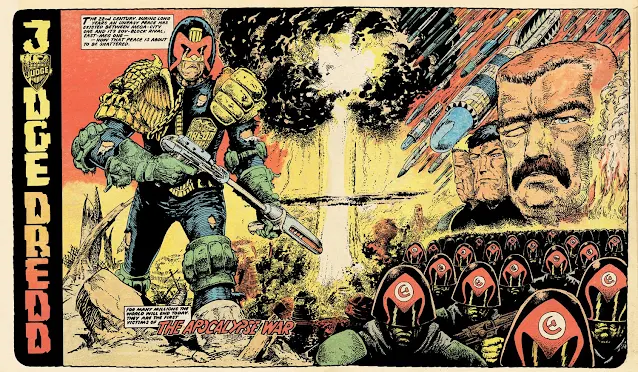
In the comics, we see several instances where Dredd's power as a judge is called into question. In "The Apocalypse War," Dredd is tasked with defending Mega-City One against a massive attack by the East-Meg One. In the heat of battle, Dredd is forced to make some tough decisions, including the use of lethal force against enemy soldiers. However, when he discovers that his own side is using illegal weapons (due to chemically induced block mania) that are killing innocent civilians, he turns against his own people, placing his commitment to justice above his loyalty to the state.


the apocalypse war dredd

  1. Use of Force

Another ethical question raised by Dredd is the use of force. Dredd often uses extreme force to stop criminals, including lethal force. This raises questions about the morality of using violence as a means to an end.


In the comics, we see Dredd using force in many different situations, from stopping a mugger on the street to taking on entire criminal organizations. In "The Day the Law Died," Dredd is faced with a corrupt judge who has taken over Mega-City One and is using his power to oppress the citizens. Dredd is forced to use deadly force against Judge Cal and his minions to restore order and protect the people.

  1. Law and Morality

Dredd's commitment to law and order above all else raises questions about the role of morality in the justice system. Is it more important to uphold the law or to act morally in a given situation?


In "The Judge Child Quest," Dredd is tasked with finding a young boy who is destined to be the next Chief Judge of Mega-City One. Along the way, Dredd is faced with several moral dilemmas, including whether to kill a giant mutated monster or spare its life. In the end, Dredd chooses to act morally and spare the monster, even though it puts him at odds with his fellow judges.


The Judge Child Quest


  1. The Role of the State

Dredd's actions also raise questions about the relationship between the state and the individual. Is it right for the state to have so much power over the lives of its citizens, even if that power is used to maintain order?


In "The Cursed Earth," Dredd is sent on a mission to deliver vital medicine to the citizens of Mega-City Two, which has been devastated by a deadly plague. Along the way, he encounters various factions, including a group of cannibals who have taken over a city. Dredd is forced to use deadly force to maintain order and complete his mission, but he also questions the morality of the state's power to decide who lives and who dies.

  1. Discrimination and Prejudice

Dredd's treatment of mutants and other marginalized groups in the comic raises questions about discrimination and prejudice. Is it moral to judge people based on their appearance or abilities, rather than their actions?


In "The Day the Law Died," Judge Cal institutes a policy of executing mutants on sight, leading to a massive uprising of mutants against the state. Dredd is forced to navigate a complex moral landscape, balancing his duty to uphold the law with his desire to protect innocent mutants from discrimination and violence.


  1. Society and Morality

The fact that Dredd is a product of his environment raises questions about the influence of society on morality. Is Dredd inherently moral, or is he simply following the rules of the society in which he lives?


In "America," we see the story of a young woman named America Jara, who becomes involved with a group of rebels who are fighting against the oppressive regime in Mega-City One. Dredd is tasked with bringing America to justice, but he begins to question his own beliefs and the society in which he lives.


 Ultimately, Dredd realizes that his own morality and sense of justice may not align with the laws of his society.

  1. Media and Morality

Finally, the fact that Dredd is a fictional character raises questions about the role of media in shaping our understanding of morality.

Do fictional characters like Dredd influence our moral beliefs, or are they simply a reflection of existing moral norms?


In "The Pit," Dredd is tasked with cleaning up a corrupt sector of Mega-City One, where judges and criminals have been working together for their own benefit. The story explores the ways in which the media can shape public perception of events and how individuals can use their power to control the narrative.


Overall, Judge Dredd raises many important ethical questions about justice, morality, and the role of individuals and society in shaping our understanding of these concepts. The comics provide a rich and complex universe in which these questions can be explored, with many relevant examples to draw upon. 

As readers, we are forced to confront these questions and consider our own beliefs and values in the process.


Why is Ashoka Tano hunting Grand Admiral Thrawn?

Grand Admiral Thrawn is a character who originally appeared in the Star Wars Legends books starting with Timothy Zahn's Heir to the Empire, which were considered part of the official Star Wars canon until Disney purchased Lucasfilm in 2012. After the purchase, Disney announced that they would be creating a new continuity for the Star Wars universe, known as the "new canon," which excluded the Legends books.

However, in 2016, Thrawn was reintroduced into the new canon through the animated series Star Wars Rebels. In the series, Thrawn is depicted as a highly intelligent and strategic member of the Imperial Navy who is tasked with hunting down the Rebels. 

grand admiral thrawn


Over the course of the series, Thrawn proves to be a formidable adversary for the Rebels, and his presence raises the stakes of the conflict.

During the series finale of Rebels, Ezra Bridger and Grand Admiral Thrawn are both pulled into hyperspace by a group of space-faring creatures known as the Purrgil. This leaves their ultimate fate uncertain, and it is this event that Ahsoka is referring to in The Mandalorian when she mentions that she is looking for Thrawn.

It is unclear what Ahsoka hopes to accomplish by finding Thrawn, but it is likely that she is hoping to learn more about Ezra's fate and possibly even rescue him. 

ashoka pose live action show


Ezra was a close friend of hers, and she may feel a sense of responsibility to try and help him if he is still alive. Additionally, Thrawn is a dangerous adversary who poses a threat to the galaxy, so Ahsoka may also be hoping to neutralize that threat.

Ahsoka's search for Thrawn sets up an intriguing storyline that is explored in the live-action Ashoka series.

Anakin Skywalker and Ashoka Tano's Journey - From Master and Apprentice to Rivals & Back

The relationship between Anakin Skywalker and Ashoka Tano is one of the most compelling and emotionally charged relationships in the Star Wars franchise. As Anakin's apprentice, Ashoka was not only a student, but she also became a close friend to him, and their relationship was one of the key dynamics explored throughout the Clone Wars animated series.

Their bond was built through shared experiences, and as they went on missions together, they developed mutual respect and admiration for each other. Anakin saw a lot of himself in Ashoka, and he took a paternal role towards her. Ashoka, on the other hand, looked up to Anakin as a mentor and trusted him implicitly.

anakin skywalker ashoka tano

The tension between the two came to a head during the events of the Clone Wars, where Ashoka was falsely accused of a crime she did not commit. This incident caused a rift between Anakin and Ashoka, as he struggled to reconcile his loyalty to the Jedi Order with his belief in her innocence. However, his loyalty to Ashoka prevailed, and he went to great lengths to clear her name, putting his own reputation and position within the Jedi Order at risk.

When Ashoka left the Jedi Order, Anakin was devastated, as he saw her as a surrogate daughter. This departure added a layer of complexity to their relationship, as they were no longer bound by the same institution, but their bond remained strong.

Their relationship took a dramatic turn in the Rebels animated series when Ashoka confronted Darth Vader, her former master, now consumed by the dark side. The emotional weight of their past relationship was palpable in their confrontation, as they both struggled with the reality of the other's transformation.

In the final season of the Clone Wars, the relationship between Anakin Skywalker and Ashoka Tano was brought to a new level of complexity and emotional depth. The season's storyline focused heavily on the Siege of Mandalore and Ashoka's involvement in the events leading up to Order 66 during with Vader truly lived as a villain.

One of the most significant moments in the season was the reunion of Anakin and Ashoka after a long separation. This meeting was highly emotional, as the two characters had not seen each other in years. Anakin was overjoyed to see his former apprentice and expressed his pride in her growth as a Jedi.

Their reunion was bittersweet, as Ashoka's departure from the Jedi Order had created a distance between them that was palpable. The show's creators used subtle visual cues, such as the characters' body language and the lighting of the scenes, to convey the complex emotions they felt towards each other.

As the Siege of Mandalore unfolded, the tension between Anakin and Ashoka grew as they struggled to navigate the challenges of the war. Anakin's loyalty to the Jedi Order was at odds with Ashoka's disillusionment with their actions, creating a rift between them.

Despite this tension, their bond remained strong, and they continued to work together to achieve their objectives. Ashoka proved herself to be a capable leader, and Anakin continued to support and guide her, even as he struggled with his conflicting loyalties.

The final episodes of the season were some of the most emotionally charged in the entire series. The events of Order 66 and the fall of the Jedi Order were devastating, and Anakin's transformation into Darth Vader was heartbreaking.

In the midst of this chaos, Ashoka's relationship with Anakin took on a new level of significance. As she confronted Darth Vader, she was not just fighting a former mentor, but also a symbol of everything that had gone wrong with the Jedi Order.

Their final confrontation was filled with raw emotion, and the show's creators used powerful visual imagery to convey the intensity of their relationship. The scene in which Ashoka removes Darth Vader's helmet and sees Anakin's scarred face for the first time was particularly poignant, as it highlighted the pain and loss that had come between them.

In the Rebels episode "Twilight of the Apprentice," the relationship between Anakin Skywalker, now Darth Vader, and his former apprentice, Ashoka Tano, reaches its climactic conclusion. Their final confrontation is a powerful and emotionally charged moment that illustrates the depth of their relationship and the impact it had on both characters.

As the two former Jedi face off against each other, the weight of their past relationship is palpable. Ashoka knows that the man she once knew and loved as her master is now consumed by the dark side, and she is determined to try to bring him back to the light. Darth Vader, on the other hand, sees Ashoka as a threat to his power and is determined to eliminate her.

anakin v tano

The confrontation between the two former Jedi is intense, with both characters using all their skills and abilities to gain the upper hand. The fight scenes are beautifully choreographed, highlighting the skills and fighting styles of both characters.

Throughout the confrontation, Ashoka tries to reach out to Darth Vader, appealing to his sense of humanity and hoping to bring him back from the dark side. She acknowledges the pain and suffering that he has experienced and tries to connect with him on a personal level, appealing to their shared history.

Darth Vader, however, is too far gone, and he refuses to be swayed by Ashoka's appeals. He is determined to eliminate her and remains committed to his allegiance to the dark side.

The outcome of their confrontation is left ambiguous, with viewers left to interpret the events that follow. Ashoka is seen limping away from the confrontation, and it is heavily implied that she survives the encounter. Darth Vader, on the other hand, is severely injured, but his fate is not explicitly shown.

Overall, the final confrontation between Anakin Skywalker and Ashoka Tano in "Twilight of the Apprentice" is a powerful moment that highlights the emotional complexity of their relationship. The fight scenes are stunning, and the emotional stakes are high as Ashoka tries to reach out to her former master and Darth Vader remains committed to the dark side. While the outcome of their confrontation is left ambiguous, it is clear that their relationship had a lasting impact on both characters, even after their paths diverged.

All is not lost...

The Ashoka show has created an addendum for this relationship. Ashoka, now an adult with much experience since their last meeting faces death at the hands of Baylan Skoll. Anakin, now a Force ghost, gives Ashoka the gift of the opportunity to not die by means of facing challenges within the World Between Worlds. In Shadow Warrior Anakin takes Ashoka through past shared experiences in The Clone Wars to try and give her insight.

Ultimately Anakin decides he must fight Lady Tano in a duel to the end. Anakin presents himself as a Sith Lord with his piercing yellow eyes and forces Ashoka to fight. She is able to relieve Anaakin of his saber. She tosses the saber aside, as Luke Skywalker did before his father in Return of the Jedi. The parallel has been made, and Ashoka has chosen to live. Force Anakin returns, happy with the choice his padawan has made. 

Ashoka is rescued by the Rebels from the ocean. As she awakes, her transformation is conveyed through her clothing and happy manner. She is now as, the fans call now her, Ashoka the White

This transformation is modeled somewhat on Gandalf the Grey's journey in Lord of the Rings. Indeed, keen fans will know that George Lucas used parts of Tolkien's text as stand-in for scenes with Obi-Wan in his initial draft of ANH.  
12 April 2023

The Wolves and the Force: Guardians of the World Between Worlds in Star Wars

The "World Between Worlds" is a fascinating concept in the Star Wars universe that introduces the idea of a mystical realm beyond time and space. This concept was first introduced in the animated television series Star Wars Rebels, in the episodes "Wolves and a Door" and "A World Between Worlds."

In the show, the World Between Worlds is depicted as a place where all moments in time and space converge, and where past, present, and future are interconnected. It is described as a nexus of pathways and portals, and is accessed through a mystical portal located on the planet Lothal.

The World Between Worlds is guarded by powerful creatures known as the "Wolves," who seem to have a deep connection to the Force. These wolves appear to be aware of the potential danger of meddling with time, and serve as protectors of the World Between Worlds.

wolves and a door ezra

The World Between Worlds is shown to have the power to allow users to access and interact with different points in time and space. In the show, the character Ezra Bridger enters the World Between Worlds and is able to witness events from the past and the future. He is also able to interact with characters from different points in time, including his mentor Kanan Jarrus and the former Jedi Ahsoka Tano.

However, the World Between Worlds is not without its dangers. The show suggests that meddling with time can have unpredictable consequences, and that altering the past can have serious repercussions for the future. It is also suggested that the World Between Worlds can be used for evil purposes, and that its power must be guarded and protected.

Overall, the concept of the World Between Worlds is a fascinating addition to the Star Wars universe, offering new insights into the nature of time and space in the galaxy far, far away. Its introduction in Star Wars Rebels has sparked much speculation and discussion among fans, and it remains an intriguing and mysterious aspect of the Star Wars lore.

Profile: Who is Ashoka Tano in Star Wars?

Ahsoka Tano is a fictional character from the Star Wars franchise, introduced in the 2008 animated film and subsequent television series Star Wars: The Clone Wars. She is a Togruta female, who served as a Jedi Padawan under the tutelage of Anakin Skywalker during the Clone Wars. After being falsely accused of a crime, she left the Jedi Order and later became a leader in the Rebellion against the Galactic Empire.

She's pretty cool and a fan favourite.

Physical Appearance:

Ahsoka is a Togruta, a humanoid species with distinctive head-tails called "montrals" and "lekku." Her montrals are striped in white and blue, and her lekku are white. She has yellow-green eyes, and her skin is a shade of reddish-brown. 

Ahsoka is about 1.6 meters tall. So she's taller than Tom Cruise. 

Right?

Ashoka Tano

Personality:

Ahsoka is known for her bravery, loyalty, and strong sense of justice. She is fiercely independent and unafraid to stand up for what she believes in, even if it means going against her superiors. She is also compassionate and empathetic towards others, often putting their needs before her own.

Early Life:

Ahsoka was born on the planet Shili and was discovered by Jedi Master Plo Koon at a young age. She was taken to the Jedi Temple on Coruscant, where she began her training as a Jedi Padawan. Ahsoka was assigned to Anakin Skywalker as his apprentice, and the two formed a close bond throughout the Clone Wars.

Role during the Clone Wars:

Ahsoka served as a commander in the Grand Army of the Republic during the Clone Wars. She fought in many battles and became known for her skill with a lightsaber and her tactical prowess. Ahsoka also helped to uncover a conspiracy within the Jedi Order known as the "Jedi Temple bombing" and was instrumental in stopping the plot.

Leaving the Jedi Order:

During the war, Ahsoka was accused of a crime she did not commit and was expelled from the Jedi Order. Although she was eventually cleared of all charges, the incident left a lasting impact on her, and she chose not to return to the Order.

Joining the Rebellion:

After leaving the Jedi Order, Ahsoka became disillusioned with the war and the Republic. She went into hiding, but was eventually recruited by the Rebellion to help fight against the Galactic Empire.

Post-Rebellion:

After the Rebellion, Ahsoka continued to fight against the remnants of the Empire. She also helped to train a new generation of Jedi, including Ezra Bridger and Kanan Jarrus. Ahsoka was also involved in the search for Ezra Bridger, who had disappeared with Grand Admiral Thrawn.

Powers and Abilities:

Ahsoka is a skilled Jedi, with impressive physical abilities and mastery of the Force. She is known for her dual-wielding lightsabers, which she can use to devastating effect in combat. Ahsoka also has a strong connection to the Force, allowing her to use it to sense the emotions and intentions of others.

Here's a list of the shows Ashoka Tano has appeared in

  • Star Wars: The Clone Wars (2008) - Ahsoka Tano makes her first appearance in the Star Wars franchise in this animated feature film.
  • Star Wars: The Clone Wars (2008-2020) - Ahsoka Tano is a main character in this animated television series that explores the events of the Clone Wars.
  • Star Wars: Rebels (2014-2018) - Ahsoka Tano appears in the second season of this animated television series as a recurring character.
  • Lego Star Wars: The Yoda Chronicles (2013) - Ahsoka Tano appears in this animated television film as a supporting character.
  • Star Wars: Forces of Destiny (2017-2018) - Ahsoka Tano appears in this animated web television series in several episodes.
  • The Mandalorian (2019-) - Ahsoka Tano appears in the second season of this live-action television series as a guest character.
  • Star Wars: The Rise of Skywalker (2019) - Ahsoka Tano makes a vocal cameo at the end of the film as one of the Jedi voices that speaks to Rey.
  • Ashoka (2023) - Tano stars in her own live action show on Disney +.

About the author Jimmy Jangles


My name is Jimmy Jangles, the founder of The Astromech. I have always been fascinated by the world of science fiction, especially the Star Wars universe, and I created this website to share my love for it with fellow fans.

At The Astromech, you can expect to find a variety of articles, reviews, and analysis related to science fiction, including books, movies, TV, and games.
From exploring the latest news and theories to discussing the classics, I aim to provide entertaining and informative content for all fans of the genre.

Whether you are a die-hard Star Trek fan or simply curious about the world of science fiction, The Astromech has something for everyone. So, sit back, relax, and join me on this journey through the stars!
Back to Top