10 April 2023

Dave Filoni - The Chosen One

Dave Filoni is an exceptional storyteller and a visionary director who has made an indelible mark on the Star Wars franchise. He is widely recognized as one of the most important creative forces behind the recent resurgence of Star Wars in popular culture.

He's a cowboy, baby!

david filoni star wars
Mr Filoni is known for his love of wolves...

Filoni's contributions to Star Wars are many and varied. 

He served as the supervising director of the beloved animated series Star Wars: The Clone Wars, which ran for six seasons from 2008 to 2014. 

Under his guidance, the show developed a huge following and became an integral part of the Star Wars canon. Filoni was also involved in the creation of the spin-off series Star Wars Rebels, which followed a new set of characters in the early days of the rebellion against the Empire.

Filoni's impact on the Star Wars universe goes beyond just animation. He has been heavily involved in the development of the live-action shows The Mandalorian and The Book of Boba Fett, both of which have been huge hits with fans and critics alike. He has also written and directed several episodes of The Mandalorian, including the season two finale, which featured the return of Luke Skywalker and was widely praised for its emotional impact.

One of the reasons that Filoni's work has resonated so deeply with Star Wars fans is his deep reverence for the original trilogy and his commitment to honoring its legacy. 

He has been vocal about his admiration for George Lucas and his desire to continue telling stories that feel true to the spirit of the original films. At the same time, Filoni has been unafraid to take risks and explore new corners of the Star Wars galaxy, introducing new characters and concepts that have enriched the franchise.

He is currently working on Ashoka as a series, having directed the episode 'The Jedi' in season 2 of The Mandalorian in which Ashoka was first introduced as part of a live action show. 

Here is a list of Dave Filoni's major contributions to Star Wars:

  • Star Wars: The Clone Wars (TV series, 2008-2020) - Supervising Director, Executive Producer, Writer, Voice Actor
  • Star Wars: The Clone Wars - The Lost Missions (TV series, 2014) - Supervising Director, Executive Producer, Writer
  • Star Wars Rebels (TV series, 2014-2018) - Executive Producer, Supervising Director, Writer, Voice Actor
  • Star Wars: Forces of Destiny (TV series, 2017-2018) - Executive Producer
  • Star Wars Resistance (TV series, 2018-2020) - Executive Producer, Writer, Creative Executive
  • The Mandalorian (TV series, 2019-present) - Executive Producer, Writer, Director
  • The Gallery: The Mandalorian (TV series documentary, 2020-present) - Executive Producer
  • Star Wars: The Bad Batch (TV series, 2021-present) - Executive Producer, Writer
  • Star Wars: Visions (TV series, 2021) - Executive Producer
  • The Book of Boba Fett (TV series, 2021-present) - Executive Producer, Writer, Director (upcoming)

THX 1138: Efficiency over Morality in the Bureaucratic Mindset

THX 1138 is a masterpiece of dystopian science fiction that explores profound themes and presents them with stunning visuals and innovative storytelling. The film's stark and cold aesthetic, combined with its focus on the dehumanization of individuals in a highly controlled and regimented society, creates a haunting and thought-provoking atmosphere that lingers long after the film ends.

George Lucas, the director of THX 1138 (and Star Wars baby!), demonstrates his mastery of world-building by creating a society that is utterly foreign, yet frighteningly believable. The government's control over every aspect of citizens' lives, from their emotions to their physical movements, is a stark reminder of the dangers of excessive technology and the loss of individuality. 

The film's depiction of a society that values rationality and efficiency over emotions and personal freedom is both fascinating and chilling, presenting a warning to humanity about the dangers of unchecked technological progress.

The film's protagonist, THX1138, is a remarkable character whose journey from a cold, emotionless worker to a passionate, rebellious individual is both inspiring and relatable. His relationship with LUH 3417, another dehumanized worker who awakens to the possibility of personal freedom, is both touching and heartbreaking, as they struggle to escape from a society that refuses to let them be who they truly are.
thx 1130 themes

Here's a discussion of the key themes of the film.

The process of reducing individuals to mere automatons in a society that is rigidly controlled and organized


In THX 1138, the society depicted is highly controlled and regimented, with individuals reduced to mere numbers and stripped of their individuality. The film is set in a dystopian future where citizens live in a highly controlled and sterile environment, with their daily routines and behavior dictated by a totalitarian government.

The dehumanization of individuals is evident in several ways throughout the film. Firstly, all citizens are referred to by a number instead of a name, erasing their individual identity and reducing them to a faceless entity within the system. They are also required to wear uniforms, which further dehumanizes them by removing any sense of personal expression or style.

Moreover, the society is highly automated, with robots performing many of the tasks that humans would traditionally do. This reduces the role of individuals in society, making them feel like cogs in a machine rather than valuable members of the community.

All of these factors work together to create a highly controlled and regimented society where individuals are reduced to mere cogs in a machine, lacking any sense of individuality or personal freedom. This dehumanization is a key theme in THX 1138, highlighting the dangers of a society where individuality is suppressed and controlled by a totalitarian government.

The devaluation of emotions and the emphasis on rationality and efficiency


In THX 1138, the society depicted is highly controlled, and individuality is strongly discouraged in favor of conformity and efficiency. One of the ways in which this is achieved is through the devaluation of emotions, which are seen as irrational and disruptive to the system. Instead, rationality and efficiency are emphasized as the primary values.

The characters in the film are conditioned from birth to suppress their emotions and conform to a strict set of rules and regulations. They are expected to perform their assigned tasks with precision and without complaint, and any emotional outbursts are seen as signs of instability or illness. This emphasis on rationality and efficiency leads to a dehumanization of the characters, who are reduced to mere cogs in a larger machine.

The film also explores the consequences of this devaluation of emotions. The characters are shown to be unable to form meaningful relationships or connections with each other, as they are discouraged from expressing any kind of emotional attachment. This lack of emotional connection and the resulting isolation and loneliness are depicted as a source of great pain and suffering for the characters.

Furthermore, the film suggests that the suppression of emotions is not only harmful to individuals but also to society as a whole. In one scene, a character who has stopped taking his emotion-suppressing drugs experiences a range of intense emotions, including joy, fear, and anger. This outburst of emotion disrupts the carefully controlled environment of the society, suggesting that the suppression of emotions is necessary for the functioning of the system.

The oppressive nature of the government and its use of propaganda to maintain control


In THX 1138, the government is depicted as an oppressive entity that seeks to control every aspect of its citizens' lives. The government enforces strict rules and regulations to ensure that individuals conform to a standardized way of living. The film portrays this through the use of propaganda, which is used to reinforce the government's authority and to control the thoughts and actions of the people.

One way that the government uses propaganda in the film is through the omnipresent use of television screens. These screens are used to broadcast a constant stream of messages that emphasize the importance of obedience and conformity. The messages are designed to instill fear and anxiety in the population, making them more likely to obey the government's rules and regulations.

Additionally, the government in THX 1138 uses propaganda to maintain its power by suppressing individuality and free thought. The government promotes a culture of conformity, where individuals are discouraged from expressing their own thoughts or ideas. This is evident in the way that THX's co-worker, LUH, is punished for expressing her love for THX. The government sees this as a threat to its authority and punishes her accordingly.

The oppressive nature of the government is also seen in the way that it controls people's emotions. In the film, citizens are required to take drugs that suppress their emotions, making them easier to control. The government uses this as a means of maintaining order and ensuring that individuals do not deviate from the norm.

A story of rebellion...


The potential for rebellion and resistance against an oppressive regime is a significant theme in THX1138. 

Despite the extreme control exerted by the government, the film suggests that rebellion and resistance are possible. As THX1138 begins to question the rigid system he is trapped in. He becomes curious about the outside world and starts to have emotions, which is forbidden. THX1138 eventually falls in love with his coworker LUH 3417 and decides to escape with her.

Their escape is complicated, and they encounter many obstacles, including the government's agents, who try to stop them. However, THX1138 and LUH 3417's determination and rebellious spirit enable them to continue with their plan. 

Bean counters


At the end of the film, the bureaucracy's decision to call off the chase for THX and LUH is a striking commentary on the dehumanizing nature of the society depicted in the film. The chase, which involves government agents pursuing the two fugitives across a variety of environments, is a significant plot point in the film, as it showcases the regime's determination to capture and punish anyone who dares to question their authority.

However, as the chase progresses, the bureaucracy becomes aware of the financial costs involved in continuing the pursuit. They calculate the cost of the fuel and resources required to maintain the pursuit and come to the conclusion that it is not financially feasible to continue. They issue an order to halt the pursuit, and the agents are instructed to stand down and return to their respective stations.

This decision by the bureaucracy to call off the chase is a powerful commentary on the values of the society in which the film is set. The bureaucracy's decision is not based on the ethical considerations of whether it is right or wrong to pursue THX and LUH but rather on a purely financial evaluation of the costs involved. This highlights the lack of humanity and morality in the regime's decision-making processes and emphasizes the value that the society places on efficiency and productivity over human life and individual freedom.

From Da Vinci to South Park: The Last Supper as a Cultural Touchstone

Leonardo da Vinci's 'The Last Supper' fresco painting has been referenced and reimagined in popular culture many times. While there are other Old Master paintings that exhibit a masterful use of composition, it is 'The Last Supper' that has captured the imagination of pop culture. This discussion will examine a few examples of the reimagining of 'The Last Supper' painting in different contexts.

the last super da vinci

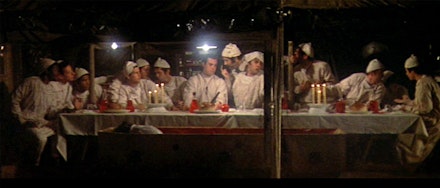
One example of 'The Last Supper' being reimagined is in Robert Altman's 1970 classic satire of the Korean War, MAS*H. In this film, the cast is arranged in a tableau that reflects the Last Supper, with Dr. Waldowski taking the place of Jesus at the center of the table. 

Waldowski is the company's dentist, who decides to commit suicide, but before doing so, he hosts a Last Supper-like dinner with his colleagues. This version of 'The Last Supper' has a happy ending, unlike the original.

m*a*s*h film last supper

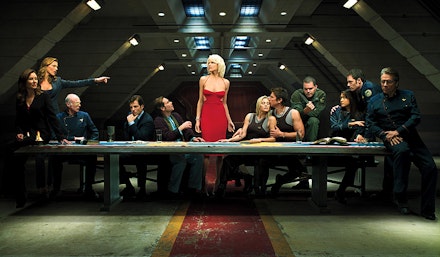
Another example is a promo picture created ahead of the fourth and final series of Ronald D. Moore's Battlestar Galactica, which features the characters positioned at a table with significant items, alluding to the missing Final Cylon who was yet to be unveiled... 

Adama and Roslin, who are kept apart by duty, but turned towards one another by love, are significant characters in this reimagined version.

battle star galactic last super homage

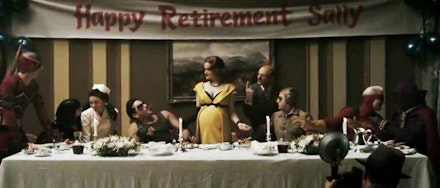
In Zack Snyder's film version of Alan Moore's graphic novel, Watchmen, there is a nod to 'The Last Supper' in the opening credit flash through costumed vigilante history. 

The pregnant Silk Spectre takes the central spot, while the bastard of a man, The Comedian is in the Judas position.

watchmen last super homage

The Simpsons' episode "Thank God It's Doomsday" from season 16 is another example of a reimagined Last Supper. The episode ends with a restored Moe's Tavern hosting a Last Supper-like line up, with drunkard Barney appearing to be the John figure.

Maybe it should be renamed "The Last Beers"?

the last supper homage simpsons


The Lost TV show promotional photo was taken in early January 2010, just before the final series of the show was revealed to the world. It featured most of the surviving cast members of the show gathered around the wing of a plane, staring at John Locke (played by Terry O'Quinn) in a possibly significant way.

At this point in the show's run, the audience was hooked on the mystery and intrigue that the writers had built up over the years. The photo was just another tantalizing hint at what was to come in the final season of the show. While the photo didn't end up having any significant impact on the show's storyline (other JJohn Locke being central to the plot and ending) it served as a testament to the show's ability to keep its audience guessing and engaged until the very end.

lost tv show last supper

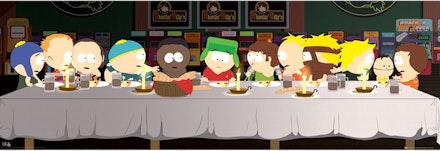
In the thirteenth season of South Park, Trey Parker and Comedy Central presented the episode 'Margaritaville', which satirized the ongoing global recession and the struggles of the industrialized west to fix it. The episode portrayed capitalism and the economy as a religion, with Kyle as its savior. The gang was posed in a Da Vinci-style depiction, but the reason for Ike's inexplicable happiness remains a mystery. As expected, Cartman assumed the Judas position, with pizza for food and an arcade as the setting. 

south park last supper

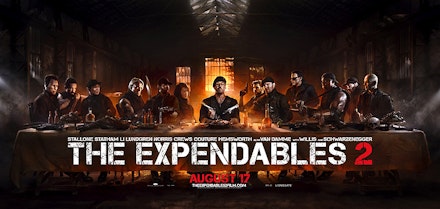
The poster for The Expendables 2 features the cast holding weapons, with Sylvester Stallone front and center, while the lone female presence takes the position of John. This reimagined version also features Chuck Norris' Booker, who plays the right-hand-man Peter, and Jason Statham's Lee Christmas.

the expendables 2 last supper

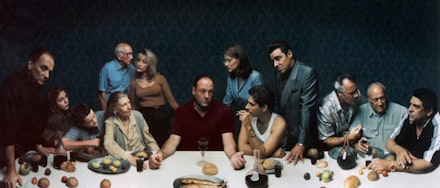
Lastly, in David Chase’s gangster drama, The Sopranos, a Last Supper promotional shot was released just before the program's second season. Photographed by Annie Leibovitz, the positions of the characters balance the two sides of Tony's life – his family and his "other" family.

sopranos last supper

Fade to black on Tony Soprano...


"Return of the Jedi - 40th Anniversary Poster"

"Return of the Jedi Anniversary Poster" celebrates the 40th anniversary of the iconic film that marked the end of the original Star Wars trilogy. The poster features characters such as Jabba the Hutt, speeder bikes, The Emperor, and Ewoks. With the full theatrical presentation of the film, fans can enjoy the saga's beloved sixth chapter for the first time in 26 years.


Matt Ferguson, the artist behind the poster, wanted to focus on the triumph of Luke and the Rebels, showcasing warmer colors such as green with red accents. The composition centers on two of the saga's most resonant and consequential figures, Luke and Vader, highlighting the pull between good and evil. The poster commemorating the film's return has been created to celebrate the 40th anniversary of this iconic film. 

Limited screenings of Return of the Jedi will be held in select theaters in the US, UK, and other regions from April 28. 
09 April 2023

Who are The Minute Men in Watchmen?

The Watchmen graphic novel, created by writer Alan Moore and artist Dave Gibbons, is set in an alternate reality where superheroes emerged in the 1940s and 1950s, and their presence dramatically altered the course of history. The Minutemen were the first superhero team in this universe, and their formation marked the beginning of the superhero phenomenon.

The Minutemen consisted of seven members, each with their unique abilities and personalities. Captain Metropolis (Nelson Gardner) was the leader of the group and acted as its strategist. Silk Spectre was a skilled fighter and the only female member of the team. Nite Owl was a gadget-based hero who used advanced technology to fight crime. The Comedian was a brutal and cynical figure who was willing to use violence to achieve his goals. Hooded Justice was a mysterious vigilante who used fear to strike fear into the hearts of criminals. Dollar Bill was a corporate-sponsored hero who used his financial resources to fight crime. Finally, Mothman was a psychologically disturbed hero who had a reputation for being 'unreliable'...

minutemen watchmen

Despite their differences, the Minutemen were united in their desire to fight crime and protect the innocent. However, personal tensions and political pressures eventually tore the team apart. The Comedian's brutal methods and controversial actions led to his expulsion from the team, while Hooded Justice's secret identity and ambiguous motivations caused suspicion and distrust among his teammates. These and other factors eventually led to the disbandment of the Minutemen in the 1950s.

Despite their dissolution, the Minutemen's legacy continued to influence the world of Watchmen. The second generation of heroes, including Rorschach, Dr. Manhattan, and Ozymandias, were all inspired by the Minutemen's exploits and their commitment to justice. The Minutemen's stories were retold in comic books and movies, and their iconic costumes and symbols became a part of popular culture.

Ultimately, the Minutemen represented the dawn of a new era in the world of Watchmen, a world where superheroes were both celebrated and feared, and where the line between heroism and villainy was often blurred.

The Minutemen participated in various events during their time as vigilantes in the Watchmen universe. Some of their key acts include:
  • Crime-fighting: The Minutemen were initially formed to fight crime in the streets of their city. They were known to be tough on crime and vigilant in their efforts to keep their city safe.
  • World War II: During World War II, the Minutemen served as patriotic symbols for the American people. Members like Captain Metropolis and Dollar Bill actively participated in the war effort by promoting the sale of war bonds and encouraging enlistment.
  • Hooded Justice was known for taking a harsher approach to crime-fighting, often dispensing vigilante justice outside of the law.
  • Silk Spectre's feminist activism: Silk Spectre, one of the few female members of the Minutemen, was known for her feminist activism, which she used to try and challenge gender stereotypes and advocate for women's rights.
  • The Comedian's involvement in dubious politics: He became involved in politics after the group disbanded. He worked as a government agent and was involved in some of the darker aspects of U.S. foreign policy where hr relished killing the Vietnamese.
Overall, the Minutemen were an influential group of vigilantes in the Watchmen universe, and their actions had a lasting impact on the world around them.


07 April 2023

The Comedian in "Watchmen": A Psychological Analysis

The Comedian, also known as Edward Blake, is a complex character in the graphic novel "Watchmen" by Alan Moore and Dave Gibbons. His actions and beliefs are often controversial and at times even despicable. However, understanding the psychology of The Comedian is essential to fully comprehend the themes and motifs presented in "Watchmen."

The Comedian's character is based on the idea of nihilism, the belief that life has no inherent meaning or purpose. This worldview is evident in his cynical and pessimistic attitude towards life. He sees the world as a joke, and humanity as a bunch of fools who do not understand their own insignificance in the grand scheme of things.

Throughout the graphic novel via non linear means, The Comedian's past is revealed through a series of flashbacks, which provide insights into his psychology. The most notable example is his involvement in the Vietnam War. The Comedian is shown committing heinous acts of violence against the Vietnamese, including the rape of a woman named Phuong. 

edward blake comedian themes

When confronted about his actions, The Comedian states that he was simply following orders, and that his actions were necessary to protect American interests. This is an example of his belief in the idea that nothing matters, and that morality is simply a construct created by society.

Another example of The Comedian's nihilistic worldview is his interaction with fellow vigilante Rorschach. When Rorschach confronts him about the morality of their actions, The Comedian responds with the infamous line: 

"It's all a joke. Everything anybody ever valued or struggled for...it's all a monstrous, demented gag."

This line encapsulates The Comedian's belief that life is meaningless, and that human actions have no real consequence in the grand scheme of things.

Furthermore, The Comedian's psychology is also shaped by his traumatic childhood experiences. In a flashback, it is revealed that he was born out of wedlock, and that his mother tried to abort him with a coat hanger. This experience left him with a deep sense of abandonment and emotional detachment, which is evident in his relationships with other characters throughout the novel.

The troubling relationship with Silk Spectre

the comedian relationship with silk spectre

The Comedian's relationship with Silk Spectre, also known as Laurie Juspeczyk, is a complicated and problematic aspect of "Watchmen." Their relationship is fraught with tension and violence, and it raises questions about the nature of consent and the dynamics of power in relationships. 

In the graphic novel, it is revealed that The Comedian attempted to rape Silk Spectre's mother, Sally Jupiter, in the past. This revelation understandably causes Silk Spectre to feel a deep sense of betrayal and disgust towards The Comedian. 

However, despite this history of violence and abuse, Silk Spectre continues to maintain a relationship with him. There are a few factors that contribute to this complicated relationship. Firstly, it is clear that Silk Spectre has a certain degree of emotional attachment to The Comedian. This is evident in the scene where she visits him in his apartment, and they share a tender moment where they dance to a slow song. 

It is suggested that Silk Spectre sees The Comedian as a father figure, and she is able to forgive him for his past transgressions to a certain extent. Another factor that contributes to the maintenance of their relationship is the nature of the world in which they live. "Watchmen" is set in an alternate history where superheroes are a real phenomenon, and the world is on the brink of nuclear war.

 In this context, it is suggested that relationships and morality are more fluid and complex than in the real world. The Comedian himself embodies this idea, as he is a deeply flawed and complex character who is nevertheless able to function as a hero in this world. Finally, it is worth noting that the power dynamics in their relationship are deeply problematic. 

The Comedian is a powerful and violent man who has a history of abusing women, and Silk Spectre is a young and vulnerable woman who is still trying to figure out her place in the world. This power imbalance is evident in the scene where The Comedian attempts to kiss Silk Spectre, and she responds by hitting him in the face. This scene highlights the tension and violence that exists in their relationship, and it raises important questions about the nature of consent and agency in relationships.

 In conclusion, The Comedian's relationship with Silk Spectre is a complicated and problematic aspect of "Watchmen." Despite his past transgressions, Silk Spectre is able to maintain a relationship with him due to a combination of emotional attachment, the nature of their world, and power dynamics. However, this relationship raises important questions about consent and agency, and it highlights the complex and sometimes violent nature of human relationships.

The Comedian's Badge as a metaphor for all that is wrong in the world of Watchmen

The yellow button in Alan Moore's graphic novel "Watchmen" is a powerful thematic device that serves multiple purposes throughout the story. At its most basic level, the button is a simple physical object that was once worn by The Comedian, one of the masked vigilantes who once patrolled the streets of New York City in the 1960s and 70s. However, as the story progresses, the button takes on a deeper meaning and becomes a symbol of many of the book's core themes.

One of the most important themes of "Watchmen" is the idea of legacy and the ways in which the past influences the present. The yellow button is a physical link between the present-day world of the story and the past of the masked vigilantes. 

It is a tangible reminder of the fact that the characters' actions in the past continue to reverberate through time, influencing the events of the present day. The button also represents the idea that the past can never truly be left behind, no matter how hard we try to move on from it.

Another key theme of "Watchmen" is the question of power and who has the right to wield it. The yellow button serves as a powerful symbol of this theme, as it is a physical representation of the power that the masked vigilantes once held over the city.

comedian yellow badge symbolism watchmen
  
The Comedian's legacy is a significant aspect of the story of Watchmen, and the smiley face button serves as a reminder of the character's violent actions and their impact on the world. The Comedian is a complicated character who embodies the darker side of heroism. He is willing to commit terrible acts in the name of what he believes is right (and even for his own cruel amusement) , and his actions have far-reaching consequences. The smiley face button on his uniform is a symbol of his legacy, which is one of violence and brutality.

The blood stain on the Comedian's badge is a powerful visual symbol that holds multiple interpretations and layers of meaning. One of the most prominent interpretations of the blood stain is that it resembles an arrow pointing from the center of the round smiley face into the upper left quadrant, which is often associated with the position of the minute hand on a clock pointing at 12 minutes to the hour. This interpretation is significant as it ties in with the overarching theme of the book, which is the looming threat of catastrophic destruction and the countdown to the end of the world, represented by the Doomsday Clock.

The idea of the blood stain representing the minute hand of a clock pointing at 12 minutes to the hour highlights the sense of urgency and inevitability that runs throughout the story. It suggests that time is running out, and that the world is perilously close to destruction. This interpretation is also supported by the fact that the Doomsday Clock is a recurring motif in the book, representing how close the world is to global catastrophe.

However, the blood stain can also be interpreted as a symbol of the flaw or taint that lies beneath the surface of things. The Comedian's badge is a symbol of law and order, but the blood stain suggests that this order is built on a foundation of violence and falsehood. This interpretation ties in with the book's broader themes of corruption, disillusionment, and the fragility of the social order. The blood stain serves as a reminder that things are not always as they seem, and that even the most seemingly stable structures can be built on shaky foundations.

The fragility of human life is another theme that the smiley face button represents. The button is shown juxtaposed with the bloodstains from the Comedian's murder, emphasizing the brutal and sudden nature of death. The button serves as a reminder that anyone can be a victim of violence or tragedy at any time. The fragility of human life is a recurring theme in the story, and the button serves as a visual representation of this theme.

The decay of society is a prevalent theme throughout Watchmen, and the smiley face button represents this decay. As the story progresses, the button becomes more and more worn and dirty, symbolizing the decay of society. The world in which the story takes place is one in which morality and humanity have been lost, and the smiley face button serves as a symbol of this decay.

Dr. Manhattan's detachment from humanity is another theme that the smiley face button represents. Dr. Manhattan wears a symbol similar to the smiley face button on his forehead, which symbolizes his detachment from humanity. Dr. Manhattan is a character who has evolved beyond humanity and has become a god-like figure. The button serves as a reminder of his past as a human and how he has transcended it.

The ultimate futility of heroism is a central theme in Watchmen, and the smiley face button serves as a symbol of this theme. The heroes in the story are unable to prevent the destruction of the world, and the smiley face button becomes a symbol of their failure to make a meaningful impact on the world around them. The button serves as a reminder that heroism is not always effective, and that sometimes, even the most heroic efforts can be futile.

yellow face symbol watchmen

The Comedian's Badge 'face' is used as a recurring motif throughout the entire graphic novel

The badge is a recurring motif in the graphic novel, Watchmen, and is used to represent different themes and ideas throughout the story. 

The use of the badge is first seen in Chapter I, page 5 when Rorschach fires his grappling gun, and the hook and resulting smoke trail resemble the pattern of the blood splatter. 

This sets the tone for the use of the badge as a symbol of violence and death. In Chapter II, page 7, when Hooded Justice prevents Blake from raping Sally Jupiter, Blake bleeds on his yellow jumpsuit in the same position he wears the badge at the time of his death, further reinforcing the idea of the badge being associated with death.

In Chapter II, page 14, when Blake is slashed across the face by the pregnant Vietnamese woman, some of his blood falls on the smiley badge, mimicking the familiar pattern. This highlights the idea that violence and death are recurring themes in the story. In Chapter II, page 17, the pattern of the liquid splatter on the Owlship resembles the smiley badge, showing how the badge has become a symbol of violence and destruction.

In Chapter III, page 18, a plug socket on a curbside recharge point for electric cars slightly resembles a yellow face with black eyes. There is a shadow at the top left, in the approximate position of the blood on the Comedian's badge, further emphasizing the recurring motif of violence.

In Chapter IV, page 19, on the close-up of the Comedian on the final panel, a drop of his sweat falls onto the same place of the badge as the blood droplet does, further connecting the badge to the Comedian's violent death.

In Chapter V, pages 7 and 22, a religious poster featuring Buddha with a yellow sun behind his head is spattered with a spot of blood. The blood marks the sun in the same position as the blood on the badge, and also covers the Buddha's left eye, suggesting that violence is present even in religious contexts.

In Chapter V, page 15, when Ozymandias is beating his would-be assassin, some blood flies in front of the yellow flower on his lapel, making it resemble the smile button. The position of the flower on Ozymadias' lapel is the same as the position of the badge on Blake's lapel at the time of his death.

In Chapter V, pages 20-21, the yellow shark that is stabbed in one eye by the protagonist of Marooned comes to resemble the smiley badge, further emphasizing the motif of violence and death.

In Chapter VI, page 25, the shape of the dogs' blood on Rorschach's chest resembles that of the blood splatter on the badge, showing how violence and death have become a part of Rorschach's identity.

In Chapter VII, the Nite Owl goggles, which are covered with dust except for a patch she wiped off which mimics the blood spatter, reflect the front of the Owlship, which mimics the smiley face. Dreiberg pictures the Comedian's bloody badge when he remembers Rorschach's warnings about a "mask killer," further emphasizing the motif of violence.

In Chapter VII, page 13, Dreiberg is cleaning the steam off of his right lens of his glasses. In the left lens, you can see a smiley face with the left eye darker, representing the blood splatter. In Chapter VII, page 18, when Dreiberg looks at the moon out of his window, two water droplets in the position of a pair of eyes and a cloud in the position of a mouth make it resemble a smiley face, connecting the motif of violence to the larger context of the story.

In Chapter XI, page 16: The smiley face can be seen on the surface of Jupiter after Dr. Manhattan's disappearance, with the Great Red Spot forming the smile and the Southern Equatorial Belt forming the eyes. The face also appears on the top of a salt shaker on the same page, with the salt grains forming the smile and the shaker's lid forming the eyes.

Chapter XI, page 25: Veidt's assistant, Lynx, wears a t-shirt with a smiley face on it. The smiley face has a bullet hole through the forehead, resembling the Comedian's badge. Chapter XI, page 28: On the last page of the graphic novel, a New Frontiersman employee finds Rorschach's journal and a drop of his blood falls onto the front cover, forming a smiley face.

The use of the badge as a recurring motif in Watchmen serves to tie together the different characters, events, and themes in the story. The blood splatter pattern on the badge is particularly significant, as it represents the violent and chaotic nature of the world in which the story takes place. The badge is also a symbol of the superhero genre, which is deconstructed and criticized throughout the graphic novel.

The badge is first seen in Chapter I, page 5, when Rorschach fires his grappling gun and the resulting smoke trail resembles the blood splatter pattern on the badge. This sets the tone for the rest of the story, as it establishes a link between Rorschach's violent actions and the violent world of Watchmen.

In Chapter II, page 7, Hooded Justice prevents the Comedian from raping Sally Jupiter, and the Comedian bleeds on his yellow jumpsuit in the same position he wears the badge at the time of his death. This foreshadows the Comedian's eventual death and links it to the badge.

Chapter II, page 14, shows the Comedian being slashed across the face by the pregnant Vietnamese woman, and some of his blood falls on the smiley badge, mimicking the familiar pattern. This reinforces the link between the badge and violence, and also suggests that the Comedian's violent past has caught up with him.

In conclusion, the smiley face button is a powerful symbol that represents various themes throughout the story of Watchmen. It serves as a reminder of the Comedian's legacy, the fragility of human life, the decay of society, Dr. Manhattan's detachment from humanity, and the ultimate futility of heroism. The button is a central and powerful image that ties together many of the story's themes and ideas.

About the author Jimmy Jangles


My name is Jimmy Jangles, the founder of The Astromech. I have always been fascinated by the world of science fiction, especially the Star Wars universe, and I created this website to share my love for it with fellow fans.

At The Astromech, you can expect to find a variety of articles, reviews, and analysis related to science fiction, including books, movies, TV, and games.
From exploring the latest news and theories to discussing the classics, I aim to provide entertaining and informative content for all fans of the genre.

Whether you are a die-hard Star Trek fan or simply curious about the world of science fiction, The Astromech has something for everyone. So, sit back, relax, and join me on this journey through the stars!
Back to Top