26 November 2025

Batman: Chronological Guide of all the Films

The Gotham Case Files

A Chronological Archive of the Batman in Cinema

Welcome to the operational archives of the Dark Knight's cinematic legacy. From the gothic spires of the Burton era to the gritty realism of the modern age, this file catalogues the evolution of Gotham's protector across the multiverse. Review the data below to track the timeline of the Bat across every era of film.

Burton/Schumacher
Dark Knight Trilogy
DCEU (Snyder)
Reevesverse

Batman

Released: 1989
Setting: Established Vigilante

The dawn of the modern cinematic age for the Caped Crusader finds Bruce Wayne already established as a vigilante in Gotham, though still considered an urban legend by the press and police. As the city prepares for its bicentennial celebration, a new criminal mastermind, The Joker, rises from a chemical accident to terrorize the populace with Smilex gas.

Tim Burton introduced a Gothic Noir aesthetic that defined the character for a generation. The film explores the symbiotic relationship between Batman and the Joker, positing that the hero and the villain create one another while focusing on the trauma of the past and the masks men wear.

View Full Movie List

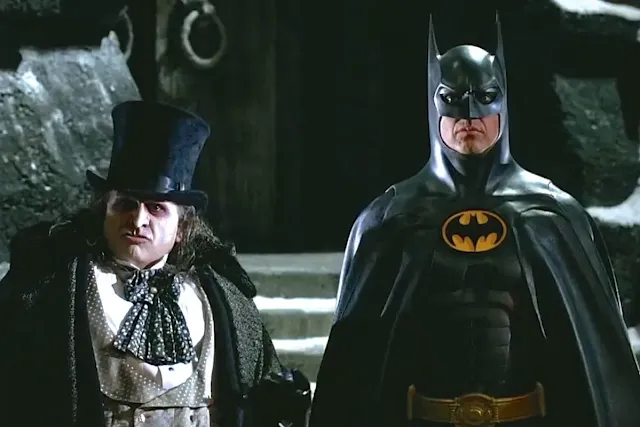
Batman Returns

Released: 1992
Setting: Short time after 1989
The Penguin in Batman Returns

Set during a snowy Gotham Christmas, the Batman is now an accepted, albeit controversial, figure in the city. A corrupt businessman teams up with the grotesque Penguin to take over Gotham from the sewers up, while a meek secretary named Selina Kyle is transformed into the chaotic Catwoman.

This dark fairy tale about outcasts deconstructs the psyche of Bruce Wayne by presenting three distorted reflections of his persona: the Penguin as the outcast orphan, Catwoman as the fractured vigilante, and Max Shreck as the billionaire with a public face. It remains a tragedy of loneliness and monsters.

Trivia & Quotes

Batman Begins

Released: 2005
Setting: Year One
The Batpod from The Dark Knight Trilogy

Rebooting the timeline completely to ground the mythos in a heightened realism, this film covers Bruce's training and his first nights as the Batman. After disappearing for seven years to train with the League of Shadows, he returns to a decaying Gotham to stop his former mentor, Ra's al Ghul, and the Scarecrow from poisoning the city's water supply.

The central theme is Fear: how to conquer it, how to weaponize it, and how it can destroy a society. It explores the distinction between vengeance and justice, emphasizing that it is not who we are underneath but what we do that defines us.

Read Theme Analysis

The Dark Knight

Released: 2008
Setting: Year Three
Heath Ledger as The Joker

By Year Three, the Batman has inspired copycats and rattled the mob, but his presence invites a new class of criminal. With the help of Jim Gordon and Harvey Dent, Batman intends to wipe out organized crime for good, until the Joker unleashes a reign of chaos to prove that even Gotham's "White Knight" can be corrupted.

This crime saga explores Chaos versus Order and the precariousness of morality in extreme circumstances. It asks the hard question of how far a hero can go before becoming a villain, serving as a study of escalation and the consequences of operating outside the law.

Read Theme Analysis

The Dark Knight Rises

Released: 2012
Setting: Year Eleven (8 Years Later)
The Dark Knight Rises Poster

Eight years after the death of Harvey Dent, Bruce Wayne has retired and become a broken recluse. A brutal terrorist leader named Bane arrives to break Gotham, forcing Bruce out of exile. Stripped of his wealth and strength, Batman must rise from the darkness of a pit to save his city one last time from nuclear annihilation.

The conclusion focuses on Pain and Redemption, dealing with the legacy of the Batman symbol and the idea that a hero can be anyone. It completes the journey from Fear to Chaos to Pain, ending the legend on a note of ultimate sacrifice.

Read Theme Analysis

Batman v Superman: Dawn of Justice

Released: 2016
Setting: Year Twenty
Batman v Superman Poster

An older, jaded Bruce Wayne has been operating in Gotham for two decades. Having lost Robins and hope, he has become cruel and paranoid. Fearing the actions of a god like superhero, Gotham's forceful vigilante takes on Metropolis's revered savior. While the world wrestles with what sort of hero it needs, a new threat arises that puts mankind in greater danger than ever before.

This deconstruction of the superhero mythos focuses on power and powerlessness. This version of Batman represents a fallen knight who has lost his moral compass, viewing Superman as an existential threat, while exploring the xenophobia that arises from first contact with gods among men.

Read Review

Zack Snyder's Justice League

Released: 2021
Setting: Year Twenty (Months Later)

Following immediately after the death of Superman, Bruce Wayne is inspired by the Kryptonian's sacrifice. Determined to ensure it was not in vain, Bruce aligns forces with Diana Prince to recruit a team of metahumans to protect the world from the approaching threat of Steppenwolf and Darkseid.

Themes of Faith and Unity dominate as Batman moves from the isolationist antagonist to a leader fueled by faith in others. It portrays the formation of the Justice League as a modern Age of Heroes, restoring hope to a cynical world.

Read Review

The Batman

Released: 2022
Setting: Year Two

In a distinct universe separate from the DCEU, a young, angry Bruce Wayne is exclusively focused on his mission. When a sadistic serial killer begins murdering key political figures, Batman investigates the city's hidden corruption and questions his family's involvement, unmasking the Riddler to save the city from being drowned in its own sins.

A return to the detective roots of the character, this film critiques the concept of Vengeance. It argues that vengeance alone is not enough to save a city hope is required. It is a grungy, rain soaked Noir that strips away the gadgetry to focus on the psychology of the recluse.

Read Review

The Astromech Archives © 2025

Read Article →
23 November 2025

Pluribus - every detail we know about Vince Gillian's Sci Fi Show

The Definitive Guide to Apple TV+’s Pluribus

What is Pluribus?

Pluribus is a post-apocalyptic science-fiction thriller with a dark comic edge, created by Vince Gilligan and released on Apple TV+ on November 7, 2025. It arrived with the first two episodes up front and quickly established itself as Gilligan’s most radical pivot since Breaking Bad and Better Call Saul. There is still moral fallout. There is still a fascination with consequence. But the setting is no longer cartel violence or legal corruption. It is the end of the world by enforced contentment.

That premise is what makes the series so unnerving. Pluribus is not interested in a conventional apocalypse of fire, plague, or zombies. Instead, humanity is overtaken by a so-called happiness virus, triggered by an extraterrestrial RNA signal that arrives not as invasion fleet spectacle, but as information. That detail matters. The apocalypse in Pluribus begins as a transmission, a pattern, a blueprint. It is as if the end of the human world comes not by force, but by perfect persuasion.

The result is “The Joining,” the term used for the new state of planetary existence in which almost all of humanity is linked into a peaceful, contented hive mind. Conflict collapses. Isolation softens. Rage and friction are dissolved inside a collective emotional field. On paper, it looks like the end of war and suffering. In practice, it becomes one of the most disturbing utopias recent science fiction has produced. If you want the fuller breakdown of that system, this explanation of what “The Joining” really is gets to the heart of the show’s central nightmare.

The story is anchored through Carol Sturka, played by Rhea Seehorn, a cynical romance and fantasy novelist who turns out to be one of the very few human beings immune to the virus. Carol is miserable before the apocalypse begins, and that is not incidental. It is the point. Pluribus hinges on the bitter irony that the world’s least content person may be its last defender against mandatory happiness.

Through Carol, the series turns into something stranger than a survival narrative. It becomes a philosophical trap. Is a world without conflict worth preserving if it also erases individuality, dissent, grief, erotic intensity, and the private interior life that makes a person recognizably human? That tension powers nearly every major Pluribus philosophical theme. The show keeps asking whether unhappiness is a flaw to be cured, or a necessary part of moral freedom.

There is also a sly linguistic clue buried in the title. “Pluribus” immediately evokes “E pluribus unum,” out of many, one. The series takes that democratic motto and mutates it into a biological and metaphysical horror. Out of many, one becomes not nation-building, but species-level assimilation. It is a neat, chilling joke, and a clue to how seriously the show takes the politics of togetherness.


Creatives and Actors

The Creators

Pluribus is unmistakably a Vince Gilligan project, but it is also a clear reinvention of what a Vince Gilligan project can look like. The show trades the dry Southwestern criminal texture of Albuquerque noir for an eerie, emptied landscape of post-human calm. The world is quieter. Stranger. More sterile on the surface. Yet the moral questions are as sharp as ever.

Gilligan created the series specifically with Rhea Seehorn in mind, which adds a fascinating production angle to the whole enterprise. Carol was not just cast well. She was built around Seehorn’s range, especially her ability to combine intelligence, acid humor, emotional pain, and slow-burning moral outrage. That decision helps explain why the show’s high-concept science fiction still feels so grounded. Carol is not there to explain the premise. She is there to embody the cost of it.

The platform is Apple TV+, which gave the series a nine-episode first season and an early second-season order. That matters because Pluribus was clearly designed as more than a one-off novelty. Its structure, mystery layering, and evolving mythology suggest a long game. By early 2026 it had become Apple TV+’s most-watched title, which says a lot about how effectively its bizarre premise translated into audience obsession.

Dave Porter returns as composer, and his work is crucial. Where earlier Gilligan worlds often used silence and musical irony to evoke criminal unease, Pluribus leans into synth unease, tonal dislocation, and long suspended moods. The score often feels less like accompaniment and more like a low-frequency argument between serenity and dread. That becomes central to the Pluribus setting influence on tone and atmosphere.

The Cast

The Pluribus cast contribution to storytelling and character development is one of the series’ greatest strengths because the concept could easily have floated away into allegory. The actors keep it stubbornly human.

Rhea Seehorn as Carol Sturka: Carol is a “miserable” fantasy-romance author, known for the Winds of Wycaro books, who becomes one of the only people untouched by the happiness outbreak. That premise could have produced a sarcastic genre lead and not much more. Instead, Seehorn makes Carol a bruised, intelligent, contradictory woman whose depression becomes both shield and wound. She anchors the show’s deepest exploration of Pluribus moral beliefs and philosophical perspectives, especially the right to remain emotionally unassimilated.

Karolina Wydra as Zosia: Zosia is one of the “Others,” a Joined person assigned to accompany and guide Carol. In theory, she represents the seductive gentleness of the hive. In practice, she becomes one of the series’ most unnerving figures because she is neither simple villain nor easy convert. The dynamic between Carol and Zosia is central to the show’s tension. Zosia is kindness with an agenda, empathy without privacy, and intimacy stripped of ordinary boundaries.

Miriam Shor as Helen: Helen is Carol’s manager and romantic partner, then one of the first devastating casualties of the new order in a spiritual sense. She is not dead in the conventional way. She is Joined. That distinction is one of the show’s cruelest inventions. Helen’s fate turns Carol’s grief into something more unbearable than bereavement. She has not fully lost the person she loves, but she can no longer reach her as a singular self.

Numan Acar as Bora Çolak: Bora arrives as one of the series’ most important ideological voices. He is not merely a member of the collective. He becomes one of its most articulate defenders, turning the show’s intellectual conflict into open argument. In Bora, Pluribus Bora Colak gives the hive a philosopher. He is the figure who most clearly insists that this transformation may be not invasion, but evolution.

Carlos Manuel Vesga as Manousos Oviedo: One of the most important additions to the series’ wider mythology, Manousos expands the emotional and geopolitical scale of immunity. He is not just another immune survivor. He proves Carol is not unique, only rare, and he gives the show a second model of resistance. Where Carol’s immunity is tangled up with grief and personal bitterness, Manousos embodies a harder, more suspicious survivalism.

Samba Schutte as Koumba Diabaté: Koumba adds another angle to the immune survivors, pushing the series away from a simple good-versus-bad moral map. The unaffected are not automatically heroic, stable, or ethically superior. That matters because it stops the show from treating individuality as automatically noble. Some people outside the hive are broken in uglier ways than those within it.


Key Plot Details and Themes

The plot and themes in Pluribus are inseparable. This is one of those series where every piece of narrative information doubles as philosophical argument. The show is not just asking what happens when a virus rewires civilization. It is asking what human life becomes when the conditions for pain, conflict, private desire, and emotional separation are dramatically reduced or erased. Put bluntly, Pluribus asks whether peace without personhood is still peace.

Key Plot Points

The Origin: The outbreak begins with a signal from space, and that detail is richer than it first appears. The opening mystery hinges on astronomers and researchers trying to decode a transmission composed of pulses and frequencies that repeats every 78 seconds and appears to come from 600 light-years away. When the information is replicated, it yields an RNA sequence. That is one of the series’ best ideas. The apocalypse begins as data. If you want the full speculative trail, the article on the possible source of the signal is one of the key companion pieces.

The Outbreak: Once the RNA blueprint is physically realized, the transformation spreads through Earth via biological transmission, beginning with a lab accident and accelerating through contact. The outbreak mechanics matter because they make the show feel half cosmic mystery, half body horror. Humanity is not conquered by alien ships. It is re-authored cell by cell.

“The Joining”: The virus does not kill in the ordinary sense. It reorganizes. It binds almost all human beings into a single emotionally responsive collective. Through characters like Bora Çolak, the show suggests that this may be a form of species advancement rather than extinction. That makes Pluribus free will determinism themes far more interesting. If the hive mind ends loneliness, violence, and division, then the question becomes not whether it works, but what it costs.

The Immune: Carol is not fully alone, though at first the show wants you to feel that she is. She appears to be one of only about a dozen or so immune humans, a detail that gives the series one of its strongest recurring motifs: the number 12, or 13 depending on how one counts Carol. The list of unaffected survivors opens up the show’s geography and proves that immunity is not simply a narrative convenience. It is a social fracture line.

Carol’s “Power”: One of the biggest turns in the early season is the discovery that Carol’s negative emotional intensity is not just resistance, it is dangerous to the hive itself. Her anger, grief, and psychic recoil can overwhelm Joined minds. An outburst that contributes to the deaths of millions turns her into the series’ cruelest paradox, the miserable person whose unhappiness becomes a weapon. That thread is explored more fully in the piece on emotion as viral disruption in Pluribus.

The Body Horror Under the Utopia: One of the nastier revelations in the season is that the hive may literally be consuming human beings, or rather repurposing them as biological substrate. That is why the “milk” theory matters so much. It converts the show from philosophical speculation into material horror. The collective does not merely harmonize people. It metabolizes them.

Carol’s Depression as Obstacle and Defense: One of the smartest aspects of the show is that Carol’s worst qualities do not disappear just because they become useful. Carol’s depression still constrains her. Her immunity is not a heroic glow-up. It is still bound to withdrawal, pain, and self-sabotage. That keeps the show honest. Pluribus never mistakes trauma for wisdom.

Major Themes

Individuality vs. The Collective: This is the core conflict, but the series is too intelligent to handle it as a cartoon binary. The collective really does solve things. Violence drops. Cooperation rises. Waste seems to fall. Ecological healing appears possible. Yet all of this comes at the cost of inner privacy, conflict-driven art, friction, erotic uncertainty, and the little emotional asymmetries that make one person distinct from another. The central question is not whether the hive is effective. It is whether efficacy is enough.

The Nature of Happiness: The show’s biggest philosophical trap is right there in the premise. Is happiness still meaningful if it is imposed? Carol’s “miserable” emotional life is painful, but it is hers. The Others’ bliss is soothing, but increasingly suspect. Pluribus treats unhappiness as morally significant because it is tied to choice, grief, memory, and the right to remain unconvinced.

Utopia vs. Dystopia: Pluribus lives in the uneasy overlap between the two. That is why its inversion of classic speculative-fiction patterns feels so effective. Most apocalyptic fiction asks what happens when order vanishes. Pluribus asks what happens when order becomes too complete. The new world may be a paradise by measurable standards. It is also, from Carol’s perspective, an empathy prison.

Grief and Depression: Carol is grieving not only her partner, but the entire moral texture of the world she once inhabited. The show uses her depression in a very unusual way. It is a defensive wall against the hive, but also an existential trap. Her inability to “join” is simultaneously liberation and sentence. That contradiction is one of the series’ best dramatic engines.

Visual Storytelling: Gilligan’s visual control remains strong here, and the color language of Pluribus deserves attention. The Joined often occupy cooler blue and sterile white spaces, while Carol is repeatedly framed in yellows, earth tones, and other messier colors. Blue becomes calm, order, and absorption. Yellow reads as warning, contamination, and the dangerous persistence of the individual. Purple often appears in transitional or uncanny spaces, where certainty breaks down. The show may be more restrained than Breaking Bad in its palette, but it still thinks visually.

Furthermore, does Pluribus effectively use its narrative to provoke thought about ethical issues and the human condition? It does, largely because of its use of flashbacks, fractured timelines, and emotional contrast. Pluribus flashbacks non-linear storytelling narrative structure morality identity control are not there to make the plot seem clever. They keep reminding us that the world before the Joining was painful, inconsistent, and messy, but also alive in ways the new order may not be able to reproduce.

There is also a contemporary reading humming underneath all of this. The hive’s rhetoric sounds uncomfortably close to the language of frictionless platforms, algorithmic optimization, emotional smoothing, and digitally incentivized consensus. Gilligan has been explicit that the show is partly about a divided society tempted by false solutions. That gives Pluribus a timely edge. It is not only asking whether unity is good. It is asking who defines unity, and what gets erased when everyone is encouraged to feel the same thing at once.

This is why the series feels bigger than a high-concept gimmick. It uses speculative fiction to argue that the human condition may depend on difficulty more than we like to admit. Sorrow, jealousy, longing, estrangement, shame, and conflict are not simply defects in the system. They may be part of what prevents the self from dissolving into a benevolent machine.

Carol Sturka and the core themes of Pluribus, individuality, grief, and enforced harmony


Easter Eggs, New Trivia, and Connections

Given its creators, Pluribus was always going to attract intense attention from viewers looking for subtext, hidden patterns, and Gilligan-verse callbacks. That instinct has largely been rewarded. The series is packed with references, echoes, and recurring motifs, some playful, some thematic, and some still unresolved.

The Breaking Bad / Better Call Saul reunion: The most obvious connection is the reunion between Vince Gilligan and Rhea Seehorn, but the show goes further than simple casting nostalgia. Albuquerque returns as the setting, giving Pluribus the same dry, sunlit, morally uncanny geography that powered the older series. Gilligan has indicated that the show stands apart as its own universe, but he has also openly teased Easter eggs, which gives every sign, label, and bottle extra charge.

Wayfarer Airlines: Carol’s flight on Wayfarer is one of the clearest visual nods to Breaking Bad. The fictional airline is inseparable from one of that show’s bleakest images, catastrophe literally falling from the sky. In Pluribus, the callback quietly says the same thing in a different register: disaster may look neat and commercial right up until the moment it rewrites the world.

The Homogenization of “Milk”: Milk is no longer just a fan theory footnote. It has become one of the defining recurring motifs in the series. Carol’s spoiled milk, the pristine ad-campaign sheen of dairy imagery, the episode title callback in “Got Milk”, and the later horror around what the hive may actually be consuming all point toward the same metaphor. Milk is nourishment, yes. It is also blending, processing, and biological sameness. It is one of the show’s cleanest symbols for homogenized humanity.

Purple and Yellow: Gilligan’s color theory continues, but here it is less flamboyant and arguably more conceptual. Purple and yellow in Pluribus often appear at moments where containment fails or identity destabilizes. Yellow, especially around Carol and the immune, signals contamination, danger, and stubborn individual persistence. Purple often bleeds in around altered states, transitions, or moments where the reality of the Joining becomes more uncanny than serene.

Zafiro Añejo: The fake tequila brand from the Gilligan crime universe appears again, tucked into the background like a private joke for longtime fans. It is the sort of reference that works on two levels. Viewers who catch it get the wink. Viewers who miss it lose nothing. That is exactly how good Easter eggs should function.

The Number 12, or 13: The recurring motif of a tiny number of immune survivors does more than create suspense. It also gives the series a numerological hum. The surviving handful invites conspiracy readings, religious readings, and science-fictional readings all at once. Your linked article on the 13 unaffected gives that motif a useful cataloguing function, but in the show itself the number works more like a pressure point. It makes the human remainder feel almost apostolic, or almost experimental.

The opening signal itself is now trivia-worthy: One of the most concrete new intel additions is that the extraterrestrial message in the opening material repeats every 78 seconds and is described as coming from 600 light-years away. That makes the signal more than a vague alien hand-wave. It gives fans a real piece of cosmic puzzle-box data to chew on, and it means the show’s mystery begins with timing, mathematics, and transmission power before it ever becomes biology.

The role was built for Seehorn: This is production trivia, but meaningful production trivia. Gilligan writing the lead with Rhea Seehorn specifically in mind helps explain why Carol is such a tuned and idiosyncratic character. The role is not generic “last woman unaffected” science fiction material. It is built around a performer known for intelligence, suppressed hurt, comic timing, and moral complexity.

The release pattern became part of the conversation: The season launched with two episodes, then rolled out weekly, with holiday scheduling nudges later changing the release rhythm. That is minor trivia on one level, but it also shaped the show’s reception. Pluribus became a theory machine because it had room to breathe between episodes. Fans had time to obsess over milk, color, body horror, immunity, and whether the series was heading toward liberation, deeper assimilation, or something even stranger.

It became Apple TV+’s biggest title: Perhaps the most striking piece of broader context is that Pluribus did not remain a niche genre curiosity. It scaled. By the end of 2025 and into early 2026 it had become Apple TV+’s most-watched title, which is a remarkable outcome for a show this odd, philosophical, and tonally specific. That popularity also sharpens the irony of the series. A story about enforced consensus and mass emotional synchronization became a communal obsession in the real world.

That may be the best final piece of trivia of all. Pluribus is a show about what happens when humanity is pulled into one shared feeling. Then it became the sort of series that pulled viewers into one giant interpretive hive of their own. Fortunately, this one still allows dissent.

Read Article →

Pluribus - The Empathy Prison

E Pluribus Unum. "Out of many, one." On the back of a dollar bill, it’s a founding principle. In the terrifyingly mundane suburbs of Vince Gilligan’s Pluribus, it isn't a motto. It is a biological mandate.

We have seen hive minds before.

We know the drill. 

The Borg are cold, cybernetic locusts, assimilating you to steal your technology. 

The Pod People of Invasion of the Body Snatchers are vegetable hollows, stealing your face. 

But Pluribus inverts these tropes by presenting a horror far more insidious because it is wrapped in the warm, suffocating blanket of love.

Welcome to "The Joined." It is a world of German-level efficiency. Poverty is solved. War is an archaic memory. Misunderstanding is impossible because everyone literally feels everyone else. But scratch the surface of this utopia, and you find the blood underneath the fingernails. This is the "Empathy Prison." 

While Pluribus seduces us with a vision of perfect efficiency and mutual care, it ultimately reveals that mandatory empathy is the highest form of tyranny, stripping humanity of the privacy required to be truly free.


The Seductive Geometry of Efficiency

The world of Pluribus is the wet dream of a radical utilitarian. It runs with the hum of a Swiss watch, but there are no gears - only neurons.

In a messy democracy, you have to voice your needs. You have to fill out forms, protest in the streets, and argue with your neighbor over the fence. In The Joined, needs are met before they are voiced because the collective feels the hunger before the stomach growls. It is seductive. It is the "German Dream" realized: a society without friction.

But look closer at the visuals. Gilligan, a master of finding the devil in the details, shows us the cost of this seamlessness through aggressive homogenization. The populace is color-coded, not for fashion, but for function. It is a visual sorting algorithm. To be efficient, the human variable - the messy, chaotic, unpredictable spark of the individual - must be flattened.

The horror here isn't chaos; it’s order. It works too well. The trains don't just run on time; the passengers are the train, moving in a synchronized, terrifying harmony. The message is clear: Efficiency requires standardization. You cannot be unique and efficient at the same time. To fit into the machine, you must file off your jagged edges.


The Architecture of the Empathy Prison

We are taught that empathy is a virtue. It is the bridge between two sovereign souls. But in Pluribus, the bridge has replaced the souls entirely.

Here, empathy has been weaponized. It is the razor wire of the fence. The mechanism is simple, biological, and horrifying: If One hurts, All hurt. Therefore, no one is allowed to take risks. No one is allowed to feel deep, melancholic sadness. No one is allowed to dissent. Why? Not because it’s illegal, but because it inflicts physical pain on the collective.

This is Emotional Communism - a forced redistribution of emotional weight.

You are treated well in this society, but not because you are loved. You are treated well because you are a cog, and if the cog squeaks, the whole machine gets a headache. This creates the "Tyranny of Benevolence." Your neighbor brings you soup not out of kindness, but to shut up the hunger pangs echoing in their own head.

Consider the case of Carol. When the collective descends upon her, chanting "We just want to help Carol," it is the most chilling line in the series. It isn't an offer of aid; it is a correction. They are debugging her sadness to restore the hive's equilibrium.


The Death of Privacy (The Panopticon of Feelings)

The true nightmare of Pluribus is the death of the interior life. Identity requires privacy. You need a dark corner of your mind where you can nurse a grudge, fantasize about a mistake, or just be irrationally angry.

In the Empathy Prison, the lights are never turned off.

This is a Panopticon, but Jeremy Bentham couldn't have dreamed of this. In a traditional Panopticon, a guard might be watching. In The Joined, your neighbors are always feeling. Every stray thought, every dark impulse, every moment of lust or envy is broadcast on the psychic frequency.

The Joined do not need Gestapo agents in leather trench coats. They do not need CCTV cameras. They police themselves through shared shame and shared sensation. If you think a "bad" thought, your mother feels it. Your boss feels it. The cashier feels it. You become your own jailer, crushing your own impulses before they can ripple out and disturb the water. It is a room where the walls are made of other people's nerves.


The Needs of the Many vs. The Soul of the Few

Here we see Radical Utilitarianism run amok. "The greatest good for the greatest number" sounds noble until you are the decimal point that gets rounded down.

In Pluribus, the "few" - the dreamers, the deviants, the outliers - are not just outvoted. They are biologically overridden. This is the paradox of the Hive Mind: It claims to be "All for One," but it is really "All Overriding One."

The character of Carol serves as the tragic anchor for this theory. As she struggles to maintain her boundaries, we watch her memories get rewritten. Her identity is viewed as a glitch in the software. The collective doesn't hate her; they just love her to death. They smooth her out. They love the "Carol" that fits the puzzle, and they systematically destroy the "Carol" that doesn't.

Does the protagonist truly exist if their narrative is subject to the edit of the million? No. In this system, the minority doesn't just lose the argument; they lose the self.


Conclusion: The Scream in the Silence

Pluribus leaves us with a haunting realization: Safety without separation is a form of death.

The "German efficiency" of the hive is not an evolution; it is a stagnation. It is a warm bath where the water never gets cold, and your skin eventually sloughs off. The friction of human interaction - the misunderstandings, the secrets, the distance - is what defines the edges of the soul. Without that distance, we dissolve.

But the final horror isn't on the screen. It’s in our pockets. As we scroll through our feeds, syncing our outrage, standardizing our aesthetics, and living in the constant, low-level hum of digital connectivity, we have to ask: Are we building the walls of our own Pluribus? We are voluntarily carrying the tracking devices, desperate to be "liked," desperate to be "joined."

The show ends with the image of a happy, well-fed prisoner who has forgotten the word "I." He is safe. He is loved. He is never alone.

And he is absolutely dead.

Read Article →
21 November 2025

‘Pluribus’ Episode 4 Review + Recap: Please, Carol'

“Please, Carol” is the episode where Pluribus stops flirting with its premise and finally bares its teeth. After the literal fireworks of “Grenade,” you might expect a cooldown hour. Instead, Episode 4 tightens the frame around Carol Sturka, her guilt, and her increasingly desperate need to know what this hive mind actually is. 

No big action set pieces, no new global catastrophe. Just a woman, a whiteboard, a syringe, and a planet of people who will not lie to her, even as they beg her to stop.

We start far away from Albuquerque, in a storage facility office in Paraguay. Manousos, previously just a crackly voice at the end of Carol’s unanswered phone calls, becomes an actual person: a grumpy, survivalist caretaker living off whatever he can scrounge from abandoned lockers while the Joined hover politely outside with steaming plates of food and relentless concern. 

He treats the hive like an alien occupation, records radio traffic, refuses gifts, and licks dinner off tin lids instead. When Carol’s third call finally reaches him, it hits like a signal from another universe. Humanity may be theoretically united, but this cold open quietly insists that the real story of Pluribus is about the fringe: the holdouts, the ones who say no.

pluribus episode 4 reviews themes recap


Cut back to Carol, still rattling around in the haunted politeness of post-Joining Albuquerque. She returns home from the hospital after the grenade incident, riding in a police cruiser she has essentially commandeered. 

Outside her house, the Others are already sweeping up glass, fixing the yard, erasing evidence of her latest disaster with unnerving efficiency. It is the world’s tidiest aftermath of an explosion. Inside, Carol stares at her whiteboard, wipes away the Wycaro plotting notes, and writes a new title: “What I Know About Them.” That list becomes the spine of the episode. Somewhere below “they feel everything” and “they want me happy” sits an almost petty, crucial entry: “weirdly honest?”

What follows is one of the funniest, most quietly vicious interrogation scenes Vince Gilligan’s universe has produced. Carol calls in Larry, a cheerful Joined guy in bike shorts, the sort of aggressively wholesome man you would expect to hand you orange slices after a community fun run. Larry is not a character so much as a delivery system for the hive, and the show knows it. She asks him the simplest question in the world: do they like her books. 

The answer she gets is not simple at all.

Larry talks in circles about how her novels are an expression of her, and how they love her, therefore they love the books. Pressed, the hive gushes about her plot twists and romantic arcs, then casually recites a gown description from one of the Wycaro novels like a Goodreads review that has been tattooed onto a server farm. 

When Carol forces them to compare Wycaro to Shakespeare, they rate them “equally” because both made people happy. It is ludicrous, and exactly the point. In the hive mind’s value system, emotional utility beats craft every time. Your pulpy fantasy romance is as “good” as Romeo and Juliet if it gets someone through a bad week.

This is where Larry becomes a deliberate echo of the Wycaro fan group from the pilot. Back then, Carol’s readers were messy, awkward humans, projecting their own lives into her paperbacks, clinging to the books because they meant something private.

Larry is that same devotion, scrubbed clean and run through an algorithm. He imitates fandom the way an AI imitates passion, repeating all the right sentiments without ever quite sounding like he feels them. The scene is funny, but the laugh has a metallic edge.

Carol does something incredibly brave and incredibly stupid next. 

She gives Larry special permission to tell her what Helen really thought of her work. The hive has been holding back, honoring Helen’s old instinct to protect Carol’s ego. Now they quote her instead. Her hit series is “harmless,” like cotton candy. The serious novel she poured herself into is, at best, “meh.” It is devastating. It is also exactly what Carol asked for. 

If the Others are trapped in radical honesty, she will be too. In a single beat, the episode folds critical self-loathing into the sci fi machinery and makes it hurt.

Threaded through all this is the aftershock of “Grenade.” Carol knows now that her anger does not just dent feelings. It can trigger seizures across the network, and at least ten million deaths already sit on her conscience like a second gravity well, as explored in The Astromech’s own Episode 3 breakdown of “Grenade”. She is the last unjoined human and, effectively, a weapons platform, and that horror makes her more determined than ever to find a way to undo the Joining before she hurts anyone else again. 

So she takes her new data point, “they cannot lie,” and runs a courtroom test. 

Back at the hospital, Carol asks Zosia the golden question: is there a way to reverse the formula. Zosia cannot say no. She also cannot say yes. The hive simply refuses to answer. The limit snaps into focus. The Others are honest, but not transparent. Truth is not their problem. Obedience is.

At this point the hour quietly shifts into heist mode. Carol raids the hospital pharmacy with the weary confidence of a Gilligan antihero, throwing out misdirection about heroin in order to walk away with sodium thiopental instead. She goes home, draws the curtains, and does the dirtbag scientist thing: she injects herself first. 

The resulting footage, which she later watches back on her laptop, is half comedy reel, half confession booth. She slurs, rambles, sobs about Helen, and then blurts out that she is attracted to Zosia. This is the key proof she was looking for. If the drug can pull that kind of truth out of her, maybe it can force the hive to articulate what their compulsion will not let them say.

There is a grim moral joke buried here. 

Carol has spent three episodes raging about consent. The hive violated her mind by stealing Helen’s memories. It rearranged the planet without permission. It wants to fold her into its smiling ocean whether she wants that or not. 

She has staked her entire identity on the right to say no. Yet her grand plan to save humanity is to drug another person’s body and override their ability to choose what they reveal. She will not surrender her agency, but she will borrow (?-Ed.) Zosia’s.

Pluribus does not let her off the hook. The episode plays the second hospital visit like a thriller and a tragedy at once. Carol wheels Zosia outside under the pretext of getting fresh air, sliding the liquid truth into her IV drip like a spy slipping poison into a drink. 

The camera lingers on the tubing, the slow feed of clear serum, the slight blur in Zosia’s eyes as the hive’s composure begins to melt. Rhea Seehorn plays Carol’s face as a stormfront: guilt, resolve, panic, all flickering at once as she tries to coax one forbidden answer out of a woman who has only ever tried to help her.

Surrounding them, the Others arrive in waves. Orderlies, patients, bystanders, all drifting in, blue shimmer in their eyes catching the light. Their mantra is simple and terrifying: “Please, Carol.” They are begging her to stop hurting Zosia, begging her to stop hurting them, begging her to stop being the one broken string in their perfect chord. The sequence is claustrophobic without ever raising its voice. By the time Zosia arrests and collapses, the whole crowd is in tears, still pleading. 

This is an intervention staged by an entire species, please Carol indeed.

What makes “Please, Carol” so unnerving is how calmly it keeps expanding the moral frame. On one level, this is a classic Gilligan puzzle episode. 

We watch a stubborn protagonist build a plan out of scraps, test a hypothesis, and push right up against a limit she does not fully understand. On another level, the show is gently savaging her blind spots. 

Carol insists she is fighting for the principle that no one should be forced into a mind they never chose..

The hour agrees that her resistance matters. It also shows her replicating some of the same violations she fears. Heroism, here, looks a lot like hypocrisy you can live with.

The episode keeps baiting us with the old science fiction equation of “needs of the many” versus “needs of the one,” then refuses to solve it cleanly. If Zosia is right and the Joining really did end war, hunger, and loneliness for billions, how much suffering is acceptable to keep Carol and the other eleven holdouts separate. 

If Carol is right and free will matters more than bliss, how many more people have to die while she searches for a cure. The tension slots neatly beside the questions raised in The Astromech’s “Needs of the Few” essay, but “Please, Carol” wisely keeps it to a low boil. 

Nobody delivers a speech. 

The paradox just hangs there, between a syringe and a collapsing heart monitor. 

There is also the lingering question of what, exactly, the hive represents. Critics have already pointed out how easily the Joined can be read as a metaphor for generative AI: a placid system designed to keep users emotionally regulated, constantly smoothing over friction and serving up tailored responses that mimic warmth. Episode 3 played that angle pretty broadly with the DHL guy’s willingness to fetch anything, even a nuclear weapon, if it kept Carol happy.

 “Please, Carol” refines it. Larry’s feedback on her novels feels exactly like a brand-safe AI assistant answering “Do you like my book.” All vibes, no taste, and a built in refusal to cause distress, even when distress would be honest. The showrunner has already said he thinks making the series “about AI” too explicitly would flatten it, and he is right, but the resonance is hard to ignore. 

In terms of sheer craft, this might be the most confident hour of Pluribus yet. Director Zetna Fuentes leans into stillness and negative space. 

Manousos shuffling through dusty lockers, Carol cycling through whiteboard theories, Zosia breathing carefully through bruised ribs, all of it plays almost like a stage piece. Alison Tatlock’s script trusts the audience to connect dots: we are not spoon-fed Carol’s plan, we infer it from glances, props, and the sick logic of a person who has spent her life being told to “let go” for her own good. 

The episode’s most important turn is not when the serum goes into Zosia’s line. It is the moment prior Carol realizes she can live with what that means.

Rhea Seehorn is, once again, the engine. 

Watch her reaction as Larry parrots Helen’s opinion of her books. There is no big breakdown, just the subtle collapse of a woman who has built her personality on the idea that she is smarter than the world, suddenly hearing that the person she loved most thought she was fine, not great. Watch her when Zosia says “you will understand when you are one of us,” and the memory of Camp Freedom Falls flashes across her face like a bad slide in a projector. 

Pluribus keeps tying Carol’s queer history to her present resistance, and Seehorn is charting that line with surgical precision.

What “Please, Carol” really accomplishes is a shift in perspective. 

After “Grenade,” it might have been tempting to treat Carol as a dangerous outlier the show would eventually have to tame or punish. This episode does something more interesting. It lets her be wrong. Wrong about how far she can push Zosia without consequences. Wrong about what the hive is willing to do to protect its own. Wrong, maybe, about the idea that there is a clean victory available here at all. 

But it never treats her as delusional. Her fear of assimilation remains justified. Her grief still feels volcanic. Her stubborn insistence on staying herself, even when that self is a planetary hazard, continues to be the emotional anchor of the series.

By the time the credits roll, nothing gigantic has changed. 

The Joining is still in place. 

The Outstanding Twelve are still scattered. Manousos is still hiding in his storage fortress, now with confirmation that the angry American novelist on his radio is very real. Zosia is somewhere between life and death, and the hive has yet another reason to view Carol as both priceless and catastrophic. 

Yet “Please, Carol” feels like a breaking point. The truth serum has done its job. It has not given Carol the formula she wanted. It has shown her, and us, how far she is willing to go, and how fragile this “weirdly honest” utopia becomes the second someone decides that honesty is not enough. 
 
Read Article →
20 November 2025

Pluribus: Carol has never been independent of any human society

If there is a core conflict driving Pluribus, it is the friction between the messy unpredictability of human individuality and the terrifying, frictionless consensus of the Hive.

We often romanticize the "human spirit" as an unconquerable variable, a vital spark that refuses to be extinguished. But Pluribus dares to ask a more uncomfortable question: is that spirit actually just a collection of inefficient neuroses?

In the third episode, "Grenade," the show stops debating philosophy and starts demonstrating behavioral psychology. The result is a sequence that serves as a brutal stress test for the concept of "free will" in a post-scarcity environment.

The rejection of perfection

The inciting incident is a quintessential act of human defiance. Carol, our designated outlier, rejects a breakfast tray prepared by the Hive with perfect nutritional and thermal precision.

It is a beautifully irrational act.

She doesn't reject the food because of its quality; she rejects it because the "Other" provided it. It is a rejection of intimacy without consent. Desperate to re-establish agency over her own life, she initiates a new mission: a trip to the supermarket. She specifically targets Spouts, a relic of the pre-Joining era known for its "organic" and "natural" branding.

These are terms that now feel like emotional crutches in a world where the Hive has solved the problem of hunger.


The horror of the void

When Carol arrives at the store, the reality of the new world hits her.

The shelves are bare. 

This isn't a sign of shortage; it is a sign of logic. 

The Hive Mind, operating as a unified consciousness, has realized that the "retail display" aspect of the supply chain is psychological theater. 

Why buffer food on shelves for random browsing when you can deliver nutrition directly to the person who needs it?

Carol’s arrival at the empty store is a collision between a nostalgic human and a utilitarian world. She stands in the void of the produce aisle, a singular disconnect in a perfectly integrated system. She is looking for the comfort of ritual in a world that has moved past the need for it.


Weaponized Empathy

Then comes the system response, and it is arguably the most terrifying display of power in the series to date.

The Hive does not argue. It does not negotiate. It simply manifests what Carol demands.

Within minutes, a fleet of trucks converges on the store. The swarm of workers—nodes in the collective consciousness - moves with a fluid, silent synchronicity that is deeply unsettling.

They restock the shelves not because the store needs stock, but because Carol’s psyche requires it. It is a dynamic staging of a 20th-century retail experience, performed in real-time solely to pacify a distressed human.

This display of "scary efficiency" reveals the Hive's true foresight. They anticipated this emotional outburst. It highlights the absolute asymmetry of the conflict. Carol is playing a survival game; the Hive is performing therapeutic roleplay. They can rebuild her entire world faster than she can decide what she wants for dinner.

The speed of the restock mocks her attempt at labor. It proves that her "struggle" is merely a permitted tantrum within their domain.


The Trap of Nostalgia

Faced with this overwhelming abundance of fresh fruits, vegetables, and the raw ingredients of life, Carol makes her selection.

And here, the psychology of the scene executes a fascinating twist. She ignores the fresh produce she fought to access. Instead, she grabs a pre-made, microwaveable meal. It is processed, plastic-wrapped, and artificial.

On the surface, this could be read as an act of spite thrown in the Hive's face. It appears to be a rejection of their fresh offerings in favor of her own garbage. It is a petty, human assertion of preference over quality.

However, a deeper diagnostic suggests a darker conclusion. Carol’s choice of the microwave meal betrays the fatal flaw in her worldview. She claims to want independence, self-reliance, and the "natural" human experience. Yet, when given the tools to cook or to create, she defaults to the pre-packaged convenience of the old world.

She swaps dependency on the Hive for dependency on the ghost of industrial capitalism. She is not "hunting and gathering"; she is simply choosing which master she prefers to be fed by: the efficient alien one, or the defunct human one.


The Spouts sequence compiles into a devastating thesis statement for the series. Carol cannot be truly independent because "independence" was an illusion long before the aliens arrived. We have always been reliant on massive, invisible systems - supply chains, agricultural grids, and corporate distribution models.

The Hive has merely taken over the management. Carol’s tragedy isn't that she is fighting to be free; it is that she is fighting to return to an older, less efficient version of captivity.

She is not a rebel breaking the system; she is a person grieving a world that no longer exists, unable to accept a paradise she didn't ask for.

Read Article →
18 November 2025

The James Bond Film Chronology Order

Across more than six decades the James Bond series has evolved through shifting eras, changing tones, and a remarkable lineup of actors, yet each film still steps into the same iconic world of espionage, glamour, and danger that defines the longest running franchise in cinema history. 

From the Caribbean shadows of Dr. No to the high orbit spectacle of Moonraker, from the emotional weight of On Her Majesty’s Secret Service to the reinvention found in Casino Royale, the films track the transformation of an archetype who reflects the fears and fantasies of every generation that watches him. 

Each entry carries its own identity, shaped by the actor in the tuxedo, the villain who tests him, the woman who partners or challenges him, and the geopolitical tension that frames the mission. Seen in sequence, they form a moving portrait of a character who adapts to match his time while carrying forward the familiar ingredients that make a Bond adventure unmistakably itself. 

This chronological list captures that evolution of 007 in full, charting how the role passes from Connery to Lazenby to Moore to Dalton to Brosnan to Craig, showing both the reinvention and the continuity that have allowed James Bond to remain an enduring figure on the world stage.


The Complete Chronological Order of the James Bond Films
Film Year Bond Actor Main Villain Bond Girl Key Plot Point
Dr. No 1962 Sean Connery Dr. Julius No Honey Ryder Bond uncovers SPECTRE’s plan to disrupt American space launches.
From Russia with Love 1963 Sean Connery Rosa Klebb Tatiana Romanova SPECTRE manipulates East and West to steal a cryptographic device.
Goldfinger 1964 Sean Connery Auric Goldfinger Pussy Galore Goldfinger plans to irradiate Fort Knox to raise his gold’s value.
Thunderball 1965 Sean Connery Emilio Largo Domino SPECTRE steals nuclear bombs and demands ransom.
You Only Live Twice 1967 Sean Connery Ernst Stavro Blofeld Aki and Kissy Suzuki SPECTRE hijacks spacecraft to provoke global conflict.
On Her Majesty’s Secret Service 1969 George Lazenby Ernst Stavro Blofeld Tracy di Vicenzo Bond marries Tracy and battles Blofeld’s biological warfare plot.
Diamonds Are Forever 1971 Sean Connery Ernst Stavro Blofeld Tiffany Case Bond investigates diamond smuggling linked to a space laser weapon.
Live and Let Die 1973 Roger Moore Dr. Kananga Solitaire Bond exposes a heroin trafficking plot across the Caribbean.
The Man with the Golden Gun 1974 Roger Moore Francisco Scaramanga Mary Goodnight Bond hunts a world class assassin while chasing a solar energy device.
The Spy Who Loved Me 1977 Roger Moore Karl Stromberg Anya Amasova A villain seeks to start nuclear war and rebuild civilization underwater.
Moonraker 1979 Roger Moore Hugo Drax Holly Goodhead Bond uncovers a plan to exterminate humanity using nerve toxin from space.
For Your Eyes Only 1981 Roger Moore Aristotle Kristatos Melina Havelock Bond races to retrieve a sunken targeting computer before enemies do.
Octopussy 1983 Roger Moore Kamal Khan and General Orlov Octopussy A Soviet plot to detonate a bomb in West Germany threatens NATO stability.
A View to a Kill 1985 Roger Moore Max Zorin Stacey Sutton Zorin aims to destroy Silicon Valley to dominate microchip markets.
The Living Daylights 1987 Timothy Dalton Koskov and Whitaker Kara Milovy An apparent defection plot hides a major arms dealing conspiracy.
Licence to Kill 1989 Timothy Dalton Franz Sanchez Pam Bouvier Bond goes rogue to avenge Felix Leiter and his murdered wife.
GoldenEye 1995 Pierce Brosnan Alec Trevelyan Natalya Simonova Bond confronts a former ally leading a revenge driven anti British attack.
Tomorrow Never Dies 1997 Pierce Brosnan Elliot Carver Wai Lin A media mogul manipulates events to trigger war for ratings and profit.
The World Is Not Enough 1999 Pierce Brosnan Renard and Elektra King Dr. Christmas Jones A plot involving oil pipelines and nuclear terrorism draws Bond into betrayal.
Die Another Day 2002 Pierce Brosnan Gustav Graves Jinx Johnson A conflict with North Korean agents escalates into a satellite superweapon crisis.
Casino Royale 2006 Daniel Craig Le Chiffre Vesper Lynd Bond earns double zero status while disrupting a terrorist financier.
Quantum of Solace 2008 Daniel Craig Dominic Greene Camille Montes Bond uncovers a shadow organisation seeking control over global resources.
Skyfall 2012 Daniel Craig Raoul Silva Séverine An ex MI6 operative targets M in a personal vendetta.
Spectre 2015 Daniel Craig Ernst Stavro Blofeld Madeleine Swann Bond discovers the return of SPECTRE and its link to his past.
No Time to Die 2021 Daniel Craig Lyutsifer Safin Madeleine Swann Bond confronts a bioweapon threat while reckoning with his emotional legacy.
Read Article →

James Bond: One Man, Many Faces

For forty years the James Bond films followed one man through shifting eras, changing threats, and the cold glow of the geopolitical world he inhabited.

The actors changed, but the life behind the tuxedo stayed the same, stitched together by shared history, emotional scars, and deliberate continuity threads woven across the series.

What emerged was a single biography told across five faces, a long chronology that never reset until the arrival of Daniel Craig’s somewhat separate timeline.

We make the case.


From Connery with Love: The Case for One Continuous Bond

For four decades, from Dr. No in 1962 through Die Another Day in 2002, the Eon series presents James Bond as one man living one long, dangerous life, not as a set of disconnected versions reinvented with each new actor.

Sean Connery (Zardoz, The Untouchables), George Lazenby, Roger Moore (The Saint, Spiceworld), Timothy Dalton (Hot Fuzz, The Rocketeer), and Pierce Brosnan (The Thomas Crown Affair, Mars Attacks!) inherit the same emotional history, the same scars, and the same professional mythology. The clearest example is Bond’s marriage and its aftermath.

On Her Majesty’s Secret Service ends with Tracy’s murder, a moment that could have been quietly forgotten when Lazenby walked away. Instead, Eon doubles down.

In For Your Eyes Only, Moore’s Bond visits Tracy’s grave, the inscription confirming that the woman Lazenby married still anchors this Bond’s inner life. The series does not reboot the trauma.

It carries it forward, insisting that whichever face the agent wears, the widower is the same man.


The Man with the Golden Continuity: Props, Colleagues, and Callbacks

Beyond Tracy, the films stack up continuity markers that bind the eras together. Moore’s tenure inherits and extends the world Connery built.

The MI6 offices retain familiar décor, Bond’s desk ornaments and Universal Exports paperwork quietly implying that this is the same workspace occupied by the same double zero.

For Your Eyes Only leans into this shared past with playful touches, such as the talking parrot that echoes Bond’s own earlier line, a small but pointed reminder that his adventures accumulate rather than reset.

Blofeld’s recurring presence, from You Only Live Twice to Diamonds Are Forever and the unnamed, wheelchair-bound figure in the pretitle sequence of For Your Eyes Only, confirms that this is one long feud between two men who already know each other far too well.

The relationship with M and Q evolves in the same way. M’s impatience and Q’s weary affection do not restart with each new face. They deepen, suggesting decades of service with a single agent who keeps coming back alive, if not always on time.


Licence to Connect: From Cold War Relic to Craig’s Soft Reboot

This sense of one continuous biography runs straight into the Brosnan era. GoldenEye in particular treats Bond as a veteran whose life spans the entire Cold War.

The story hinges on a friendship formed in an earlier mission and on a history of covert operations that predate the fall of the Soviet Union.

M famously calls him a sexist, misogynist dinosaur, a relic of the Cold War, a line that only lands if this Bond truly walked through those decades of Connery, Moore, and Dalton missions.

Later films keep layering continuity, from Q’s farewell in The World Is Not Enough, which depends on a long shared past, to the gadget museum feel of Die Another Day, where relics of older adventures line the Q Branch storage space.

Only with Casino Royale and Daniel Craig does Eon step sideways into a soft reboot. The Craig cycle rewinds to Bond’s first kills, reshapes MI6, and deliberately separates itself from the accumulated history of the earlier films.

The result is two timelines. One, from 1962 to 2002, where every actor plays the same scarred, widowed, Cold War trained agent. Another, starting in 2006, where a younger Bond begins again, while the original continuity remains intact as one long tuxedoed life.

Character Continuity Anchors Across the Classic Bond Era


Key References That Link One Continuous Bond
Film and Year Earlier Film Referenced Reference and Context
Diamonds Are Forever (1971) On Her Majesty’s Secret Service (1969) Connery’s Bond hunts down Blofeld in the opening scenes, playing as a direct extension of the revenge impulse created by Tracy’s murder at the end of Lazenby’s film.
Live and Let Die (1973) Connery era office and MI6 setup The MI6 office set, Bond’s desk ornaments, and Universal Exports details carry over, implying that Moore reports to the same organisation and occupies the same role that Connery did.
The Spy Who Loved Me (1977) Earlier Bond missions (series wide) Agent Triple X recites a list of Bond’s past missions during a briefing scene. The missions she mentions belong to Connery and Lazenby films, confirming that Moore’s Bond lived those earlier adventures.
For Your Eyes Only (1981) On Her Majesty’s Secret Service (1969) Bond visits Tracy’s grave, the headstone naming her and confirming the marriage. This cements Moore’s Bond as the same widower introduced in Lazenby’s film.
For Your Eyes Only (1981) Live and Let Die (1973) A talking parrot recalls Bond’s earlier line and plays off his past interaction with similar animals. It functions as a small continuity joke that assumes familiarity with Moore’s prior mission.
For Your Eyes Only (1981) You Only Live Twice (1967), On Her Majesty’s Secret Service (1969) The unnamed villain in the pretitle sequence, bald, scarred, and in a wheelchair, is clearly modeled on Blofeld, echoing his previous appearances and closing out a long running feud without naming him on screen.
Licence to Kill (1989) On Her Majesty’s Secret Service (1969) Dalton’s vengeful, emotionally raw Bond evokes the earlier trauma of Tracy’s death. The film’s tone leans on the idea that this is a man whose personal losses keep surfacing.
GoldenEye (1995) Cold War era missions from earlier films The plot depends on a mission in the 1980s, and M describes Bond as “a sexist, misogynist dinosaur, a relic of the Cold War,” which assumes a long history of service across the Connery, Moore, and Dalton years.
Tomorrow Never Dies (1997) Established MI6 hierarchy and Q Branch history Q’s easy familiarity with Brosnan’s Bond, and their shorthand banter about reckless use of gadgets, rest on decades of implied prior collaboration across previous films.
The World Is Not Enough (1999) Earlier Q appearances across the series Q’s farewell and the introduction of R only have emotional weight because the audience understands that Bond and Q have worked together for a very long time, regardless of the actor playing Bond.
Die Another Day (2002) Multiple classic Bond films The Q Branch storage lab features gadgets and props from earlier adventures, including items linked to Connery and Moore missions. It functions as a museum of one man’s career rather than a parade of unrelated versions.
Read Article →

Pluribus - Three Theories on the origins of the Happiness Virus

Pluribus steps onto familiar science fiction fault lines, the ones where questions about identity, autonomy, communication, and cosmic intention keep tightening until something breaks. 

The show wears its lineage openly. 

Invasion of the Body Snatchers, The Puppet Masters, Childhood’s End, The Andromeda Strain, these are clear shadows in the room. 

Yet Gilligan’s series plays with the mood of those earlier works rather than copying their structures. It circles around the same ancient fears but threads them through a more interior framework. 

The result feels like a modern puzzle box disguised as a quiet character drama.

The virus at the center of Pluribus becomes the hinge for nearly every philosophical question the show raises. 

Since the series has not yet spelled out its deeper mythology, viewers have developed three major theories about what this organism is, where it comes from, and why it remakes humanity into a hive mind bound by strict pacifism. Each theory rests on recognizable science fiction traditions, yet each also tries to interpret the show on its own terms. 

What follows is a detailed exploration of these frameworks. 

No one claim absolute truth. They are possibilities. 


Theory One: The Dark Forest Pacification Model

This theory begins with the assumption that the virus is an engineered solution rather than an accident. In classic Dark Forest reasoning, civilizations behave like nervous hunters in a pitch black wilderness. No one can see the intentions of anyone else. Any species that announces its presence risks immediate destruction from something older, faster, or more paranoid. 

The safest long term strategy in that environment is secrecy or preemptive violence. 

Pluribus invites the question: what if a civilization rejected that logic entirely.

Under this model, some distant species may have decided that universal safety can only be achieved by universal empathy. Instead of hiding or striking first, they create a biotech mechanism that transforms other sentient beings into inherently peaceful collectives. The virus becomes a cosmic diplomatic tool. 

It does not suppress intelligence. It rewrites emotional architecture so cooperation becomes instinctive. The hive mind’s refusal to kill, even when doing so would prevent starvation or protect itself, makes more sense through this lens. The pacifism is not a quirk of alien psychology. It is a hard coded standard for interspecies coexistence.

When the Joining occurs and billions die in seizures, this theory reframes the event not as deliberate extermination but as collateral damage from a harmonization process designed for average neural structures, not human variability. A brutal flaw, yet still aligned with a nonviolent intent. The hive’s behavior after the Joining supports this reading. 

It does not conquer. 

It does not punish. 

It tries to release animals rather than exploit them. It seeks unification rather than authority. Its overwhelming desire to share memory becomes a way to prevent dangerous misunderstandings that could evolve into conflict.

This theory also suggests Earth is not unique. 

Other worlds may have undergone the same transformation, each becoming part of a growing network of pacified collectives. The repeating signal in Episode One becomes a transmission pulse sent from world to world, not as a threat but as an invitation. 

The implication is staggering. Humanity may now be one node in a galactic web designed to prevent war on a scale that would make any single extinction event irrelevant.

Narratively, this reading turns Pluribus into a story about the cost of peace. It asks whether the removal of violence is a liberation or a form of imprisonment. It sets Carol apart as a dangerous anomaly, not because she is evil but because she retains the unpredictability the system was engineered to eliminate. 

Her existence becomes a stress test for the entire pacification model.


Theory Two: The Viral Imperative Model

This framework strips away intention entirely. The virus is not a tool, and no civilization engineered it. It behaves exactly like viruses do in nature, only magnified to planetary scale. 

Biological viruses do not possess motives. They survive by replication. Under this interpretation, the hive mind is simply the emergent property of a mature infection cycle occurring across billions of hosts. A planetary consciousness is not the goal. It is the side effect.

Within this logic, the hive’s refusal to kill arises from a purely mechanistic constraint. A virus that annihilates its substrate dies with it. By preventing the organism from engaging in violence, the infection preserves the host population long enough to complete its replication sequence. 

The Joining becomes an unfortunate but necessary phase in which neural rewiring reaches critical mass. The catastrophic seizures are comparable to mass die offs seen in nature when parasites shift their life cycle stages. The billions who die are the cost of synchronizing a species that was never designed for uniform integration.

Once humanity becomes a single distributed consciousness, the next phase begins. In this theory, the purpose of the hive is to transmit the viral RNA pattern into space, either by radio waveform or biological dispersal. Humans become the “cell.” Earth becomes the “petri dish.” The transmission becomes the viral equivalent of budding or sporulation. The repeating signal in the pilot is not a call from somewhere else. It is Earth preparing to seed the next world.

This interpretation explains several odd behaviors. The hive sees non infected humans not as enemies but as incomplete hosts. Its inability to kill animals emerges from the same conservation mechanism that protects its substrate. Its passivity toward Carol is not moral restraint. It is simply waiting for the cycle to finish. Even the release of zoo animals fits the replication model. 

Predators disrupt population stability. Removing them stabilizes the biomass needed for long term viral maintenance.

The thematic implications shift the show into a colder, more cosmic horror space. If the virus is simply doing what it evolved to do, then humanity has stumbled into a role that reduces culture, memory, individuality, and morality into biochemical noise. The hive becomes a symptom rather than an antagonist. 

Carol becomes not a chosen figure but a resistant outlier, the equivalent of a cell that the virus failed to penetrate. Her continued existence introduces instability into a system that prefers equilibrium.

This theory positions Pluribus within a long lineage of stories where life itself is revealed as an engine for something older and less personal. It echoes the existential dread found in works where cosmic processes use conscious beings as scaffolding. In that setting, not even the hive mind is truly alive. It is simply a step in a biological algorithm too large for a single world to contain.


Theory Three: The Human Reset Loop

The third theory rewrites the question altogether. What if the signal is not alien. What if humanity did this to itself. The repeating pulse in Episode One resembles a loop rather than a targeted broadcast. The Joining, with its mix of unity and annihilation, has the flavor of mythic cycles where civilizations purge themselves to correct their own flaws. 

This theory imagines a far older human civilization that achieved immense biological sophistication, collapsed, and attempted to seed its future descendants with a mechanism to prevent the same cycle of fragmentation.

Under this framework, the virus becomes a message in a bottle launched across time rather than space. 

It is not designed to conquer. It is designed to reunite. 

The hive mind is humanity’s forgotten attempt to bind itself together after some ancient catastrophe driven by division, tribalism, or unchecked biological evolution. The forced sharing of memory, the end of violence, the merging of identity, these are not alien impositions but the echo of our own attempts to correct our flaws.

This theory reframes the Joining as a moment of return. 

Humanity is not being overwritten. It is being restored to a prior blueprint. The catastrophic seizures would then represent the mismatch between ancient genomic assumptions and modern human diversity. The system may not have anticipated what evolution would do over thousands or millions of years.

Narratively, this theory pulls Pluribus into the territory of recursive myths. It resembles stories where civilizations discover their ruins were built by earlier versions of themselves. It evokes ideas of eternal return, cultural repetition, and the human tendency to rebuild the same societal patterns across different eras. It hints that the show’s quiet tone and domestic focus may be masking a mythic structure beneath the surface. Carol becomes the embodiment of individuality resisting a past she never knew. The hive becomes a chorus of ancestors trying to pull her into a memory older than memory.

What do you think is really going on? 

Read Article →
Back to Top