13 November 2024

The Key Themes of Dune: Prophecy

Series Analysis

Dune: Prophecy and the Architecture of Power

At the heart of Dune: Prophecy lies a meditation on the nature of power, both overt and subtle.

The Bene Gesserit Sisterhood wields influence not through force but through manipulation and psychological mastery. This theme resonates with the broader Dune lore, where power often lies not in direct control but in the ability to shape the thoughts and decisions of others.

Valya Harkonnen’s journey as Mother Superior embodies this approach, as she deftly navigates the political currents of the Imperium. Her power, like that of the Sisterhood at large, is quiet yet formidable. It is shaped by the ability to see possibilities, plant ideas, and shape outcomes without the need for violence.

Dune: Prophecy examines how power can be wielded in silence, casting light on the hidden, manipulative arts that form the foundation of Bene Gesserit influence.

themes of dune prophecy tv show
The hidden currents of the Bene Gesserit.

Prophecy and Predestination

In the Dune universe, prophecy is a double-edged sword. Dune: Prophecy leans heavily into this concept, depicting how the Sisterhood’s actions are often shaped—and sometimes hindered—by their own foreknowledge of what’s to come. Mother Raquella’s prediction of a future tyrant who will rise against the Sisterhood casts a shadow over Valya’s every decision.

This theme ties into the broader Dune saga’s fascination with destiny and the burden of foreknowledge, as seen with Paul Atreides in Herbert’s novels.

In Dune: Prophecy, prophecy is both a guide and a cage. It is a motivating force that propels Valya and the Sisterhood forward but also a trap that limits their freedom. The series invites viewers to consider how the belief in destiny can constrain as much as it empowers.

Gender and Agency in a Hierarchical World

Dune: Prophecy brings the gender dynamics of Dune into sharper focus, highlighting the Bene Gesserit’s complex role in an overwhelmingly male-dominated Imperium. The Sisterhood’s covert power reveals the limits placed on women within the Imperium’s political structure, where overt authority remains the domain of emperors, dukes, and other male figures.

In response, the Bene Gesserit develop their own systems of agency, mastering arts of influence that men overlook or underestimate. The series underscores the theme of women finding agency within restriction, turning limitations into assets. This focus adds a poignant layer to the narrative, showing that in a world where direct power is denied, indirect influence can become a weapon just as potent as any blade.

Humanity’s Wariness of Technology

Set in the aftermath of the Butlerian Jihad—a pivotal event where humanity rose against “thinking machines”Dune: Prophecy is steeped in a cultural fear of artificial intelligence. The Imperium’s prohibition of thinking machines shapes not only its technological development but its social fabric, influencing how knowledge, power, and labor are organized.

This aversion to AI has led to a culture that prizes human potential and, in particular, to the Bene Gesserit’s focus on honing the mind and body to near-superhuman levels. This wariness echoes throughout the show, creating a society that values mastery over self rather than mastery over machines. The series probes this theme through characters like Desmond Hart, who flirts with the forbidden line of technology, highlighting the ever-present fear that humanity’s creations might one day overtake them.

Transformation and the Path to Self-Mastery

A recurring theme in Dune: Prophecy is the Bene Gesserit’s path of self-mastery, a grueling journey of mental and physical training that allows them to become Truthsayers, visionaries, and masters of the Voice. This theme of transformation goes beyond physical capability; it’s about honing one’s self to become an instrument of control and influence.

The Key Themes of Dune: Prophecy
Concept art illustrating the grim atmosphere of the series.

The acolytes’ rigorous training, pushed to their physical and mental limits, reflects Herbert’s larger idea of self-mastery as the only path to true freedom. By controlling their bodies, emotions, and thoughts, the Bene Gesserit believe they are freed from manipulation—a claim that is perhaps ironic given their own practices.

In Dune: Prophecy, the path to mastery is as much about freedom from external control as it is about the responsibility that comes with such power.

The Tension Between Loyalty and Individual Ambition

Dune: Prophecy explores the tension between individual desires and loyalty to the Sisterhood, a theme encapsulated in Valya Harkonnen’s ambition and the internal conflicts faced by her acolytes. The Bene Gesserit’s strict code emphasizes loyalty to the Sisterhood above all, but the personal ambitions of characters often conflict with this creed. Valya’s ruthless drive to see her visions realized sometimes jeopardizes the Sisterhood, revealing how individual ambition can become a double-edged sword.

This theme parallels the Bene Gesserit’s belief in collective survival, raising questions about the cost of personal power within an organization built on shared purpose. It’s a powerful reminder that loyalty, when mixed with unchecked ambition, can lead to fractures within even the most disciplined societies.

Legacy and the Weight of History

The weight of history permeates Dune: Prophecy, reflecting Dune’s larger preoccupation with the cycles of power and the scars of past conflicts. The Bene Gesserit are not just living in the present; they are carrying the knowledge and traditions passed down since the Butlerian Jihad, shaping their every decision in light of historical experience.

Valya’s Harkonnen lineage is a constant reminder of the past and the burdens it brings, tying her actions to both her family’s and the Sisterhood’s legacies. This theme enriches the series by framing individual actions as part of a larger continuum, asking viewers to consider how the weight of history can both guide and restrict those who carry it.

The Inescapable Reach of Fate

Finally, Dune: Prophecy delves into the inexorable pull of fate, a theme that resonates through every choice and every plot twist. Valya’s decisions to fulfill or defy prophecy highlight the tension between free will and preordained destiny. In the Dune universe, fate is both a cosmic and personal force, dictating the lives of individuals and the fate of entire empires.

Dune: Prophecy captures this struggle, portraying the Bene Gesserit’s use of prophecy as a way to gain control over the uncontrollable, to see the future as both a map and a warning. This theme serves as a reminder that in the world of Dune, destiny is never just a future to arrive at—it is a force that shapes the present, one that characters cannot escape no matter how fiercely they try.

Read Article →

Dune: Prophecy > Review

The Dune universe has always felt boundless, a sprawling vision of the future where political intrigue, mysticism, and cosmic dread converge across endless desert sands. The arrival of Dune: Prophecy marks a significant new chapter, one that digs into the scarcely explored depths of the Bene Gesserit Sisterhood, pulling back the veil on the mysterious order that’s quietly dictated events from the shadows for millennia. 

Set more than 10,000 years before the saga of Paul Atreides unfolds, the six-episode prequel series opens a portal into the formative years of the Imperium and a galaxy still haunted by the scars of the Butlerian Jihad—a war against “thinking machines” that reshaped human society in profound ways. This is Dune re-imagined as historical epic and metaphysical odyssey, bringing the Sisterhood into the kind of brutal, hypnotic focus that could only have thrived in the age of prestige television.

dune prophecy show review

Unlike the vast deserts of Arrakis that dominate Herbert’s novels and Villeneuve’s films, Dune: Prophecy roots itself in the cold, forbidding environments of Wallach IX, the Bene Gesserit homeworld, and the imperial power seat on Salusa Secundus. There’s no mistaking that the series owes a debt to Game of Thrones for its palace intrigue and power plays, but it’s far from a mere imitation. 

Rather, the story draws its intensity from a philosophical tension unique to Dune: the line between control and destiny, the risk and reward of prophesy, and the unfathomable power held by those willing to sit in shadows. At the heart of it all stands Mother Superior Valya Harkonnen (Emily Watson), a cunning leader whose quiet determination and relentless ambition aim to elevate the Sisterhood and secure its influence within the sprawling Imperium. This is no rise-to-power arc but a meditation on the costs of influence.

Adapted from Sisterhood of Dune by Brian Herbert and Kevin J. Anderson, Dune: Prophecy takes liberties with its source material, yet it remains true to the book’s underlying tensions and vast, complex lore. The Butlerian Jihad, the great war against artificial intelligence that banned “thinking machines” and rewrote the moral code of civilization, looms over this narrative like a dark specter. In the vacuum left by the demise of these machines, new power structures emerge—paramount among them the Sisterhood. Led by Valya Harkonnen, the Sisterhood begins its ascent, quietly embedding itself within the Imperium, while acolytes undergo rigorous mental and physical training to prepare for their roles as truth-sayers, manipulators, and future prophets. We find ourselves in a time when their legendary powers, such as the controlling Voice, are in nascent form, and the breeding project to create the Kwisatz Haderach is still a dream on the horizon.

Valya’s dominance over the Sisterhood is hardly a given, and her journey is shaped by those around her, notably her sister Tula (Olivia Williams, The Postman + The Sith Sense), whose quiet loyalty and inner conflict lend the narrative a tragic undercurrent. Together, the Harkonnen sisters embody Dune’s ceaseless interplay of power and vulnerability, often more allies than family in a universe that requires brutal pragmatism over kinship.

Watson and Williams bring a near-mythic intensity to their roles, managing to convey the vastness of this world not through sweeping monologues but through glances and whispered exchanges that imply an ocean of secrets. Through them, we see how the Sisterhood operates—never with a hammer, but with a scalpel—finessing outcomes that shape the destiny of empires.

As viewers follow the Sisterhood’s machinations within the courts of Salusa Secundus, Dune: Prophecy strikes an arresting balance between palace intrigue and metaphysical dread. Emperor Javicco Corrino (Mark Strong, John Carter of Mars) struggles to keep control of his empire while the forces of Arrakis loom over him. Meanwhile, the charismatic yet ruthless soldier Desmond Hart (Travis Fimmel, Vikings, Raised by Wolves) brings an unsettling energy to the emperor’s court, further agitating tensions with the Sisterhood and Corrino’s daughter, Princess Ynez (Sarah-Sofie Boussnina). 

bene gesserit witch dune prophecy

This tangled web of political factions, bolstered by ancient prophecies and deep-seated grudges, provides the show’s pulse, while the tension between the Sisterhood’s hidden hand and the emperor’s overt authority heightens each scene with anticipation.

One of Dune: Prophecy’s most intriguing elements is how it layers its backstory with the mythic horror of the Butlerian Jihad. This isn’t just filler lore; it’s a reminder of humanity’s encounter with its own ambition, and the psychic scars it left behind in the form of prohibitions against artificial intelligence. We see this cultural trauma refracted through Valya’s ruthless adherence to tradition and Desmond Hart’s peculiar relationship with forbidden technology. 

Though rarely mentioned explicitly, the war’s aftermath is evident in everything from the rigid hierarchy of the Imperium to the Sisterhood’s insistence on mastering the human mind and body to fill the void once dominated by machines. It’s a shadow over the entire series, a reminder that the power wielded in Dune is always a double-edged sword.

While the sands of Arrakis dominate much of the Dune universe, Dune: Prophecy bravely shifts its gaze to other pivotal worlds, specifically Wallach IX and Salusa Secundus. These planets, with their bleak, cold atmospheres, make a stark contrast to the desert sun and spice-laden air of Arrakis, yet they are equally integral to the story. Through the glittering imperial palace on Salusa Secundus and the austere Sisterhood library on Wallach IX, the series brings to life a galaxy where even the landscapes seem to echo the harshness and gravity of its conflicts. 

Tom Meyer’s production design teams with Bojana Nikitovic’s costume work to conjure spaces that feel lived-in and lore-bound, imbuing every veil, corridor, and throne room with the heavy, inevitable march of history. This world-building doesn’t just satisfy fans; it demonstrates the sheer breadth of Herbert’s universe.

At the center of Dune: Prophecy lies a revelation of the Sisterhood, not merely as mystics but as individuals negotiating personal ambitions and the Sisterhood’s future under Valya Harkonnen’s guidance. The Bene Gesserit here are not yet the fully realized force depicted in Herbert’s novels or Villeneuve’s films. They’re still grappling with their identity, balancing loyalty and individual desire in a universe that will not yield to them easily. 

Their rigorous training—the mental and physical crucibles that acolytes endure—adds a ritualistic, almost monastic quality to the series, as they learn to wield powers of truth-saying and body control, preparing for the political chess game that is life in the Imperium. We see, with each grueling trial and whispered lesson, the seeds of the Bene Gesserit we know, and the women who will one day transform this sisterhood into a force that can bend emperors to their will.

Through Valya Harkonnen’s ascendance, Dune: Prophecy also revisits the infamous Harkonnen lineage, transforming it from the one-dimensional house of villains familiar to fans of the films into a complex narrative of survival, betrayal, and raw ambition. Valya is no caricature; she’s a tactician, haunted by a family history marred by the Butlerian Jihad and her ancestors' disgrace. Her sister Tula, gentler yet no less resolved, offers an intriguing foil, adding complexity to a lineage that will later be embodied in the infamous Baron Harkonnen. 

This series sheds light on the humanity, even the honor, woven into the Harkonnen name before it became synonymous with ruthless tyranny. By grounding their motivations in family loyalty, political necessity, and personal ambition, Dune: Prophecy brings to life a part of Dune that often lives in the shadows.

At its core, Dune: Prophecy is about destiny—a theme that saturates every corner of Herbert’s universe. The series teases out the role of prophecy in shaping the Sisterhood’s decisions and the Imperium’s political landscape, balancing the question of free will against the weight of ancient predictions. Valya’s relentless drive to fulfill her vision, to secure the Sisterhood’s legacy, reverberates through each storyline, casting the characters as both architects and prisoners of fate. Her fierce belief in the prophecy from Mother Raquella, predicting a tyrant who will crush the Sisterhood, is both her motivation and her potential undoing. 

In this way, Dune: Prophecy explores how prophecy can inspire or imprison, a fitting parallel to the wider Dune mythos and its eternal struggle between fate and autonomy.

Dune: Prophecy succeeds in its mission, leaving us with an Imperium rich in both mystery and meaning, a new standard in sci-fi television. It’s a thrill to know that, even after decades, Dune still has secrets to uncover and stories to tell.
Read Article →
12 November 2024

Finch (2021) - Themes of Survival, Legacy, and the Human Spirit

Finch (2021), directed by Miguel Sapochnik (Repomen, Game of Thrones), combines elements of post-apocalyptic survival and human emotion, the need for legacy.

The film, starring Tom Hanks (Cloud Atlas, Forest Gump), tells the story of Finch, the apparent last surviving human on Earth, who, in the wake of an environmental catastrophe, strives to protect his dog, Goodyear, and teach his robot creation, Jeff, to care for the dog after his inevitable death. Set against a barren landscape, the film’s exploration of the end of humanity touches on themes of survival, legacy, human connection, and the role of technology.

While Finch unfolds as a road trip across a desolate world, it’s much more a profound meditation on the fragility of life and what it means to leave something behind. 


Finch (2021) - Themes of Survival, Legacy, and the Human Spirit

Survival and the Fragility of Human Life

At its core, Finch is a film about survival in a dying world. 

The theme of survival is central to the narrative, not just as a matter of physical endurance but also as a means to ensure that the values and knowledge of the human race are not lost. Finch is the lone survivor in a world devastated by environmental collapse. As he faces the certainty of his own death due to illness, Finch is tasked with preparing for a future beyond his own life.

The fragility of human life is made explicit in Finch’s declining health and his efforts to teach Jeff how to care for Goodyear. This relationship between man and machine goes beyond mere survival tactics; it becomes a testament to the human need to protect those we love, even in the face of an inevitable, uncontrollable fate. 

The film’s bleak landscapes and the harsh conditions the characters endure emphasize just how precarious human life is in a world that has already moved past its prime.

Sapochnik’s direction and the film's visual style underscore this fragility, with wide shots of desolate environments highlighting the smallness and vulnerability of Finch as he makes his way through the world. 
 

Human Connection and Companionship

In Finch, the theme of human connection is explored through the relationships that form in an otherwise isolated and desolate world. Finch, the last surviving human, shares his life with only his dog Goodyear and, as the film progresses, the AI robot Jeff. 

In this broken, apocalyptic setting, the film emphasizes that companionship is not just a luxury but a fundamental need for survival. 

As Finch faces the inevitable end of his life, the film explores how these relationships—though unconventional—are what sustain him emotionally and psychologically, offering a sense of meaning and purpose in a world devoid of human interaction.

The relationship between Finch and Goodyear serves as the emotional anchor of the film. 

The dog is not just a pet but a symbol of the old world—loyal, familiar, and dependable. In the early stages of the film, Goodyear is Finch's sole companion, and their bond is one of mutual dependence. Goodyear’s presence provides Finch with a sense of stability and emotional connection in a world where human bonds no longer exist. 

As Finch’s health deteriorates, his need for Goodyear's companionship grows even more pronounced, and it becomes evident that he cannot fully rely on the dog alone to secure the future. This is where Jeff, the robot, enters the narrative. While initially created as a tool for survival, Jeff’s role in the film gradually shifts from a functional machine to an evolving form of companionship. Finch’s attempt to teach Jeff human qualities, such as empathy and emotional understanding, becomes a central aspect of the film.

What’s particularly striking in Finch is the way the film juxtaposes the relationships between Finch, Goodyear, and Jeff. While Finch’s bond with Goodyear is based on years of mutual companionship, his relationship with Jeff evolves out of necessity and the understanding that human connection, even with a machine, can take on unexpected and deeply meaningful forms.

Jeff’s development throughout the film reflects the broader theme of humanity's need for connection, suggesting that even in a post-apocalyptic world where human life has all but disappeared, the longing for connection remains a fundamental aspect of survival.
 

Legacy and Passing Down Knowledge

At the heart of Finch lies the theme of legacy—specifically, the desire to leave something behind after death. In a world on the brink of extinction, where Finch is one of the few last surviving humans, the concept of legacy takes on profound significance. 

As Finch faces his own mortality due to a terminal illness, he is driven by an urgent need to prepare for the future, not just for his dog Goodyear, but also for the robot, Jeff, whom he has created to serve as a caretaker. This act of preparing Jeff to care for Goodyear represents Finch’s attempt to pass down the responsibility of life itself, ensuring that there is continuity even after humanity is gone (in this sense George Clooney's Midnight Sky echoes similar sentiment).

Finch’s legacy is not one of traditional wealth or status but of knowledge, love, and survival instincts. In teaching Jeff how to care for Goodyear, Finch is also imparting lessons about empathy, responsibility, and compassion—values that will guide the robot in fulfilling his role as a caretaker. Finch's struggle to communicate these values to Jeff highlights the deeper philosophical inquiry into what it means to leave behind a legacy in a world where human civilization has collapsed.
 
The transfer of responsibility for Goodyear to Jeff is a significant moment in the film, one that marks the culmination of Finch’s life’s work. He realizes that his legacy will not be about the preservation of the human race, but rather the preservation of care and responsibility, even through a machine. This dynamic evokes the idea that the most lasting aspects of humanity—the ability to love, nurture, and protect—can be passed down, not only through human descendants but through other forms of life, even if those forms are artificial.

The final scenes of the film, where Jeff takes on the responsibility of Goodyear’s care after Finch’s death, encapsulate the idea of legacy as a living, evolving force. In a sense, Finch’s legacy is not simply something that exists after his death—it is something that will continue to grow and transform. Jeff’s capacity to care for Goodyear and to continue Finch’s mission of survival speaks to the idea that the true measure of a legacy is how it continues to impact the world even when the original creator is no longer present.

-

If you enjoyed Finch and are intrigued by the emotional bond between a human and a robot, I highly recommend exploring these films that similarly delve into human-robot relationships. 

Chappie (2015) explores the journey of a sentient robot struggling to understand the world around him, offering a poignant look at the complexities of AI and human connection. 

Bicentennial Man (1999) follows the evolution of an android who gradually becomes more human over two centuries, highlighting themes of love, identity, and mortality. 

Ex Machina (2014) presents a gripping exploration of artificial intelligence, focusing on the ethical dilemmas and emotional interactions between a human programmer and a highly advanced robot named Ava. 

Short Circuit (1986) offers a lighter take on the genre, with a robot gaining sentience and forming a bond with a human, leading to a heartwarming adventure about friendship and discovery. 

These films, much like Finch, provide compelling narratives that question the nature of consciousness, connection, and what it means to be truly "alive."


Read Article →

Themes of 'Civil War' - written and directed by Alex Garland (2024)

OK.

What kind of American are you?

Filmmaker Alex Garland has come a long way since he first hit a note with his script for The Beach.

Throughout the last 20 years Garland has had a steering hand in many classic gems of films - the pitch-perfect Dredd, the scary bear movie - Annihilation, the overlooked Men and the A.I. classic of Ex Machina.

Produced by A24 films, Alex Garland's film Civil War (2024) explores a near-future America divided by a devastating internal conflict, taking a deep dive into themes of political disintegration, the ethics of journalism, and the chaotic fog of war. Set against the backdrop of a nation fractured between an authoritarian federal government and secessionist factions, Garland constructs a narrative that refrains from clear political affiliations, instead focusing on the universal descent into chaos and the moral ambiguity that follows.

So hardly states that are united then...

It emphasizes the importance of journalism in such contexts, underscoring the role of the media in exposing truths during war and holding power accountable.

civil war film themes garland


One of the film’s primary themes is the breakdown of political and societal structures. 

Garland avoids a simplistic portrayal of the red versus blue divide, opting instead to illustrate a complex and murky conflict where the motives and ideologies of both sides are unclear, even to those fighting in it. This lack of clear political stances emphasizes the absurdity and tragedy of civil wars, where factions fight without a coherent understanding of their goals, highlighting the senseless violence driven by deeply entrenched divisions in society.

Another critical theme is the role and ethics of journalism in war. 

The story is seen through the eyes of war journalists, who strive to document the conflict while grappling with their professional duty and personal trauma. Kirsten Dunst’s character, Lee, exemplifies this struggle; she is a seasoned war photographer facing an existential crisis over her work's impact, or lack thereof. This theme reflects Garland's commentary on the often-questioned objectivity and moral quandaries of the press in conflict zones, where the lines between documenting and influencing events are blurred.

Garland also delves into the psychological toll of war on individuals, particularly journalists on the front lines. The characters face intense stress and trauma, manifesting in different ways. For instance, Lee's emotional detachment contrasts sharply with the reckless thrill-seeking of her colleague Joel, portraying a spectrum of coping mechanisms against the relentless backdrop of violence. 

This focus on personal struggles offers a raw and intimate perspective on the broader chaos of the conflict, showing how war alters one's psyche and distorts moral judgment.

The film further critiques the spectacle of political power and its downfall. The portrayal of the President as a despotic figure who manipulates fear and division, yet becomes a pitiful figure hiding from the advancing rebels, underlines the transient and performative nature of political authority. This theme resonates with historical instances of collapsing regimes and highlights the inevitable vulnerability of even the most powerful leaders when societal structures crumble.

Lastly, Civil War serves as a cautionary tale about the dangers of extreme polarization and the fragility of democratic institutions. The ambiguous motives of the warring factions suggest that the specifics of the political divide are less significant than the fact of division itself, pointing to a broader commentary on the contemporary political landscape. 

Garland uses this dystopian vision to reflect the current anxieties around democracy's decline and the societal consequences of entrenched partisanship, making the film a relevant and thought-provoking piece on the potential future of American society.

Through its themes, Civil War challenges viewers to contemplate the cyclical nature of conflict and the human capacity for self-destruction, making it a haunting exploration of the complexities underlying civil strife in the modern age.

Trump that...
Read Article →
13 October 2024

'Arrival' Themes of Language, Time, and the Human Experience

Film Analysis

Arrival: The Architecture of Empathy and Time

Denis Villeneuve's sci-fi masterpiece isn't about an alien invasion. It is a linguistic treatise on how we process grief, memory, and the choice to embrace a destiny that breaks your heart.

"Arrival," directed by the visionary Denis Villeneuve (known for Dune and Blade Runner 2049) and based on the short story "Story of Your Life" by Ted Chiang, is a cinematic masterpiece that transcends the traditional boundaries of the science fiction genre.

At its core, the film is a profound exploration of communication, time, fear, unity, personal relationships, and empathy. These themes are intricately woven into a narrative that challenges viewers to reflect on the nature of human existence, the complexities of language, and the profound impact of understanding and connection.

Villeneuve, known for his meticulous attention to detail and ability to craft deeply emotional narratives, brings to life a story that is as much about global events as it is about personal experiences. His direction ensures that the film is not just a visual spectacle but also a deeply introspective journey. 

The screenplay, adapted by Eric Heisserer, stays true to the essence of Chiang's original story while adding layers of complexity that make it suitable for the cinematic medium.

Amy Adams in Arrival
Dr. Louise Banks facing the unknown.

Amy Adams, in the role of Dr. Louise Banks, delivers a captivating performance. She portrays a linguist's journey from skepticism to profound understanding. Her nuanced portrayal captures the emotional depth of a mother and a scientist trying to bridge the gap between humans and extraterrestrials. 

Jeremy Renner (The Hurt Locker, Avengers), as physicist Ian Donnelly, complements Adams with a performance that balances scientific curiosity with human compassion. Their on-screen chemistry adds depth to the film's exploration of personal relationships. Forest Whitaker (Rogue One, The Shield) offers very strong support as Colonel Weber, representing the pragmatic anxiety of the state.


I. The Sapir-Whorf Hypothesis: Language as Reality

"Arrival" places communication and language at the forefront of its narrative, emphasizing their profound impact on human understanding and perception. The film's exploration of language goes beyond mere words and delves into the intricacies of how language shapes our worldview, a concept known as the Sapir-Whorf hypothesis.

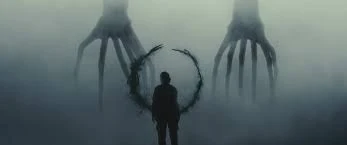
The Heptapods, the extraterrestrial beings in the film, introduce a language that is entirely alien to human understanding. Their written language, composed of intricate circular symbols (logograms), represents a non-linear perception of time. Unlike human languages that follow a linear structure - subject, verb, object - the Heptapod language allows them to perceive events from the past, present, and future simultaneously. This is evident when Dr. Louise Banks begins to have visions of her daughter's entire life as she becomes more immersed in the Heptapod language. 

She isn't just learning to read; she is rewiring her brain to perceive the fourth dimension.

The film showcases how language can act as a barrier. As nations around the world attempt to decipher the Heptapods' message, misinterpretations arise. A prime example is when some nations interpret the word "weapon" in the Heptapods' message as a threat, leading to panic. In the proper context, the Heptapods were referring to their language as a "tool" or "gift" for humanity. 

This underscores the danger of viewing the unknown through a lens of fear.


II. The Non-Zero-Sum Game: Unity and Collaboration

"Arrival" is not just a story about humanity's encounter with extraterrestrial beings. It is a reflection on the importance of unity. The film frames the alien contact as a "Non-Zero-Sum Game," a scenario where one side's gain does not mean the other side's loss. Everyone can win if they share information.

The Heptapods' arrival serves as a global event that necessitates international cooperation. Their ships don't just land in one country; they are strategically placed across the globe. This global event forces nations to either work together or risk misunderstanding the Heptapods' intentions. Initially, countries collaborate, but fear and misinterpretations begin to fracture this coalition.

The film's climax serves as a testament to the power of communication. When global tensions reach a boiling point, it's Louise's ability to communicate with the Heptapods and her subsequent conversation with Chinese General Shang that prevents a global catastrophe. She uses the alien language to bridge a human divide.

hetapods arrival themes
The "Tool" vs. The "Weapon": A test of perception.


III. Amor Fati: The Nature of Time and Grief

"Arrival" offers a profound exploration of the concept of time, challenging traditional linear perceptions. Unlike humans, who perceive time as a sequence of past, present, and future events, the Heptapods experience all moments simultaneously. This is visually represented by their circular symbols, which have no clear beginning or end.

Louise's immersion in the Heptapod language leads her to experience time in a similar fashion. Throughout the film, she has vivid visions of her daughter's life, from moments of joy to the heart-wrenching realization of her daughter's terminal illness. Initially, these visions seem like flashbacks. However, as the narrative unfolds, it becomes clear that Louise is experiencing memories of a future she has yet to live.

One of the most poignant moments in the film is when Louise, armed with the knowledge of her future, chooses to embrace it. This connects to the philosophical concept of Amor Fati (love of fate). She raises ethical and moral dilemmas: If one knows their future, especially the painful parts, would they choose to change it?

Despite knowing the journey ends in loss, I embrace it. And I welcome every moment of it.

Louise's choice to have a child, despite being aware of the eventual pain and loss, speaks to the film's exploration of the complexities of human experience. It suggests that joy and sorrow are not separate events to be maximized or minimized, but threads in a single tapestry. Hannah's name, a palindrome, reinforces this circularity—it reads the same forward and backward, just as her life exists for Louise.

Conclusion: A Universal Language

"Arrival" stands as a beacon in modern cinema. Through the lens of an extraterrestrial encounter, the film delves deep into the human psyche, exploring our fears, hopes, and the innate desire for understanding.

Director Denis Villeneuve, alongside a dedicated team of writers, actors, and creatives, crafts a story that transcends the screen. It resonates with timeless questions about communication, time, and the essence of human connection. In a world often divided by differences, "Arrival" serves as a poignant reminder that true strength lies not in superior firepower, but in superior empathy.

Read Article →
03 October 2024

Lost: 'The Constant' Episode Explained: Desmond's Big Day Out

In the critically acclaimed episode (and fan favorite) “The Constant” from Lost (Season 4, Episode 5), time is explored in a unique and emotionally charged narrative that blends psychological tension with metaphysical inquiry.

The episode stands out as a departure from the series' conventional flashback and flashforward structures, instead adopting a dual timeline where fan favourite Desmond Hume experiences life in both 1996 and 2004. 

This structure not only reflects the non-linear perception of time but also serves as a profound exploration of memory, love, and the human need for a constant anchor in the face of chaos.

Through Desmond’s disorienting time jumps, the episode weaves together intricate themes of consciousness, fate, and the scientific implications of time travel, all while grounding the plot in an intensely personal story of Desmond’s enduring love for Penny. 

She is his lobster after all...   

The episode's seamless integration of scientific theory with deep emotional resonance has earned it widespread recognition, with episode writers and show creators Damon Lindelof (The Leftovers) and Carlton Cuse even citing it as one of their favorites.

 
explain the constant episode of Lost TV show episode

Both a psychological thriller and a love story, “The Constant” stands as one of Lost's most complex and beloved episodes, emblematic of the show's ability to intertwine character-driven drama with profound philosophical questions.

Here’s a streamlined breakdown of key points from The Constant:

1. 2004 – Helicopter to Freighter

  • Desmond and Sayid board the helicopter piloted by Frank, heading toward the freighter. Frank navigates based on Daniel’s bearings (305 degrees), but when they drift to 310, turbulence worsens, and Desmond begins experiencing temporal flashes. He panics, losing memory of where and who he is, with the picture of Penny offering some emotional anchor. Upon landing on the freighter, Desmond’s confusion grows as he no longer recognizes Sayid or Frank, and Keamy and Omar, two freighter personnel, take them to the medical bay, locking Desmond inside.

2. 1996 – Royal Scots Regiment

  • Desmond experiences flashes to 1996, waking up in a military barrack north of Glasgow. After being reprimanded by his Sergeant-Major for not following orders promptly, Desmond reflects on his vivid dreams of the helicopter. Confused, he tells a fellow soldier about his "dreams," recognizing Penny from a flash and rushing to a phone booth to contact her. However, just as he is about to call, his consciousness shifts back to 2004 on the freighter.

3. 2004 – Freighter Medical Bay

  • Desmond, now back in 2004, is approached by a sedated freighter crew member, Minkowski, who shares that he has been experiencing the same temporal confusion. Minkowski warns that the condition is dangerous and "happens to everyone." In the meantime, Sayid barters for access to a phone, learning that Desmond’s disorientation is not amnesia but a side effect of exposure to the island's unique properties.

4. 1996 – Oxford University

  • Following Faraday’s instructions from 2004, Desmond seeks out Daniel Faraday in 1996 at Oxford University. Initially skeptical, the younger Daniel believes Desmond’s story only after Desmond recites specific details about settings (2.342 and 11 Hz) and the mention of “Eloise,” Daniel’s test subject. Daniel explains that his experiment sends consciousness through time, and this knowledge helps Daniel in 2004 communicate with Desmond across time periods. Desmond’s past and present begin to align, but Daniel stresses that without a “constant” in both time periods, Desmond’s mind will collapse like that of Eloise the rat.

5. The Constant Concept

  • Faraday emphasizes the need for Desmond to find a "constant" — someone or something present in both his 1996 and 2004 realities to anchor his mind. Desmond chooses Penny as his constant and rushes to call her. After some convincing, Penny gives him her phone number, despite their estranged relationship.

6. 2004 – Freighter

  • Desmond relays Penny's number to Sayid, who fixes the freighter's sabotaged communications equipment. Desmond makes a heart-wrenching call to Penny, where they both express their love. Penny confirms that she has been searching for him for three years, and their connection serves as the stabilizing force Desmond needed to restore his memory and sense of identity. Minkowski, unable to find his constant, succumbs to the temporal disorientation and dies, highlighting the stakes of Desmond’s situation.

Ending and Themes


The episode concludes with a poignant and revealing moment as Daniel Faraday flips through his journal in 2004, where he stumbles upon a note he had previously written to himself: "If anything goes wrong, Desmond Hume will be my constant."

This discovery is more than a simple reminder; it underscores the intricate, closed-loop nature of time presented in the episode. 

The fact that Daniel receives crucial information about time travel from Desmond in the past and later reminds himself of Desmond’s unique role through a note he penned further illustrates the show's recurring theme of time as a self-contained loop—events in the future influencing the past, and vice versa, without a clear origin.

Trivia about The Constant


  • First Episode Without Flashbacks or Flashforwards: "The Constant" is the first episode in Lost that doesn’t use flashbacks or flashforwards. Instead, we experience Desmond's time flashes as he does—chronologically through both time periods.
  • Penny’s Phone Number: Penny's London phone number is 7946 0893. The "020 7946 0893" number was featured as a clue in the alternate reality game Find 815 (January 9 clue). However, 020 wasn't introduced until April 2000, after Desmond’s 1996 timeline, meaning her number should have started with 0171. Also, 020 7946 0 is designated as an unassigned number by Ofcom, reserved for drama purposes.
  • Penny’s Address: Penny lives at 423 Cheyne Walk, a famous street in London. This was another clue from Find 815 (January 9 clue) and is near where Desmond’s photograph with Penny was taken. Widmore Industries also has offices in the area.
  • Famous Cheyne Walk Residents: Cheyne Walk has been home to many notable figures, including Mick Jagger, Keith Richards, George Eliot, Dante Rossetti, and Henry James, author of The Turn of the Screw.
  • Additional Clues from Find 815: Queen's College, Department of Physics, and "Southfields" were featured as clues in Find 815 (January 30), along with "Camp Millar" (January 23).
  • Widmore’s Ledger: The ledger Charles Widmore buys at auction is the same journal referenced by Oscar Talbot in Find 815 Chapter 5. Talbot, who works for a branch of Widmore Corporation, says his employers had this journal.
  • Real-Time Events: According to Desmond and the calendar on the wall, the real-time events of this episode take place on Day 94 (Christmas Eve), two days after Sayid, Desmond, and Frank left the Island.
  • Southfields Anagram: "Southfields," the organization holding the auction, is an anagram for "shifted soul," symbolizing how Desmond's consciousness or soul is displaced through time.
  • Bootstrap Paradox: The information about Faraday's device exemplifies the Bootstrap Paradox, where Faraday learns the details from Desmond in 2004, but Desmond only knows it because Faraday told him in the past.

Read Article →
19 September 2024

Jacob's Candidate List - the meaning of Lost's magical numbers

Lost · Mythology

For five seasons, the numbers were a curse. Hugo Reyes won the lottery with them and lost everyone he loved. Rousseau heard them whispered out of the South Pacific for sixteen years. They were stamped on the side of a hatch buried beneath the jungle, and typed into a computer every 108 minutes to keep the world from ending. Only in the sixth season did the show tell us what they actually were: a list. Six names. One job.

This is the story of how six digits travelled from a Cold War prediction of human extinction, through a doomsday research compound in the South Pacific, into the lives of six broken people, and finally up the spiral staircase of a stone lighthouse, where Jack Shephard read his own name on a mirror and understood, far too late, that he had been watched his entire life.

Before the Island: the Valenzetti Equation

The numbers do not begin with Jacob. They begin, in the show's expanded mythology, with a Princeton mathematician named Enzo Valenzetti, commissioned in the late 1960s by the United Nations to calculate the precise moment at which humanity would extinguish itself. Valenzetti's answer was an equation, and its core values, the variables governing population, conflict, and resource collapse, were 4, 8, 15, 16, 23, 42.

Alvar Hanso, the Danish industrialist who would later fund the DHARMA Initiative, took that equation as a personal commission. If the numbers could be changed, the prediction could be unwritten. DHARMA's stations on the Island (the Arrow, the Swan, the Pearl, the Lamp Post) were every one of them an attempt to shift a single variable. They never managed it. They blew themselves up trying. Damon Lindelof has spoken at length about the influence of that pre-Island mythology on the way the show was structured.

This is where the numbers acquire their gravitational pull. By the time the survivors of Oceanic 815 wash ashore, the sequence has already been broadcast from the Island's radio tower for sixteen years, transmitted in a loop that drew Danielle Rousseau's science vessel onto the reef in 1988 and lured Leonard Simms and Sam Toomey, two Navy listening-post operators, into hearing it in the static.

"The numbers are bad." Leonard Simms, "Numbers", Season 1, Episode 18

Leonard tells Hurley this in a psychiatric ward, having spent years repeating the sequence under his breath. He is correct, but he is wrong about why. The numbers do not curse the people who speak them. The numbers describe the people who speak them. They are not a hex. They are an inventory.

The Cave, the Lighthouse, and Jacob's Long List

Two scenes in Season 6 finally explain what the audience had been chasing for five years.

In The Substitute (6.04), the Man in Black, wearing John Locke's face and freshly stolen, leads Sawyer down a cliffside to a cave whose ceiling is covered in names scrawled in white chalk. Most are crossed out. Six are not. Beside each surviving name, a number. 4: LOCKE. 8: REYES. 15: FORD. 16: JARRAH. 23: SHEPHARD. 42: KWON. The Man in Black calls it Jacob's joke. He is lying about the joke. He is not lying about the list. (For more on the speaker, see the companion piece on the Smoke Monster and what it actually is.)

One episode later, in Lighthouse (6.05), Jacob sends Hurley and Jack to a stone lighthouse hidden in plain sight on the coast. Inside is a wheel ringed with mirrors, each numbered, each angled to surveil a specific location in the outside world. Jack turns the dial to 23 and sees the house he grew up in. He realises, with the quiet horror that only Jack Shephard can summon, that Jacob has been watching him since he was a child.

"I wanted them to know that they were special. Because they are." Jacob, "Lighthouse", Season 6, Episode 5

Jacob's list, then, is not a roster of victims of a haunted lottery ticket. It is a recruitment file, kept across centuries, of human beings broken enough to want a second chance and resilient enough to consider taking one. The Island is a job that no immortal wants forever. Jacob is hiring.

Why These Six

The mechanism by which a candidate is enlisted is shown in The Incident (5.16), the Season 5 finale, in a sequence of off-Island flashbacks that recontextualises every flashback that came before it. Jacob, dressed plainly and speaking softly, touches each of the six at the worst moment of their lives. He hands Sawyer a pen at his parents' funeral. He revives a young Locke after his eight-storey fall. He buys Jack a candy bar at the hospital cafeteria the day Jack botches a surgery. He kisses Sun and Jin on their wedding day. He hands Hurley an Apollo bar at a gas station the day Hurley leaves the institution. He pulls Sayid out of the path of a car, just before that same car kills Nadia instead.

The touch is consent, of a kind. It marks them. From that moment, the Island is pulling.

This is why the numbers feel cursed. Hurley's lottery win in Numbers (1.18) isn't bad luck; it's the Island levering him onto a plane. Sawyer's con artistry, Sayid's recruitment by Republican Guard intelligence, Locke's spinal injury, Jack's career-ending case of nerves: none of it is random. The numbers are gravity, and these six are the masses being pulled.

The Swan Station Protocol

108

4 + 8 + 15 + 16 + 23 + 42

The interval, in minutes, at which Desmond Hume entered the sequence into a 1977-era computer to discharge electromagnetic energy and, the orientation film implied, save the world. He did this for three years. He was not wrong about what was at stake. He was wrong about who built the button.

The Six Names on the Wall

4

John Locke

Candidate · Crossed off · Deceased S5

The most spiritually fervent member of the list, and the only one who never makes it onto the Island as a candidate in any functional sense. By the time the survivors find the cave, Locke has been dead for weeks. He was strangled in a Los Angeles motel room by Benjamin Linus in The Life and Death of Jeremy Bentham (5.07), and the Man in Black has since taken his form. Locke's number is crossed out on the ceiling because Locke is no longer in the running; the body walking around in his clothes is the thing the candidates exist to keep on the Island. The cruellest reading of the show is that Locke's faith was always genuine and was always being used. He believed the Island had chosen him. It had not.

8

Hugo "Hurley" Reyes

Candidate · Protector of the Island

The number 8 stalks Hurley from the lottery ticket onward. His grandfather drops dead, his house burns down, his friend is struck by a meteor at a chicken shack he owns. Hurley reads this, reasonably, as a curse. The show reads it as a man being held in reserve. Hurley is the only candidate whose central trait, kindness, never wavers. He talks to the dead. He drives the DHARMA van off the cliff in Tricia Tanaka Is Dead (3.10) and laughs. When Jack drinks from the stream in The End (6.17/18) and inherits the role of protector, it is Hurley who inherits it from him, with Ben Linus as a redeemed second. Of the six names, Hurley is the one who wanted nothing and was therefore trusted with everything.

15

James "Sawyer" Ford

Candidate · Declined · Off-Island

Sawyer's defining trauma, his father shooting his mother and then himself in 1976 while eight-year-old James hid under the bed, is the moment Jacob first touches him, handing the boy a pen at the funeral so he can finish the letter to the original Sawyer who conned his parents. The pen is the seed of decades of long-con work. The Island's job, in Sawyer's case, is rehabilitative: it strips him of the con, gives him a sheriff's badge in the DHARMA Initiative under the alias LaFleur, and lets him discover that the version of himself with responsibilities is the one he can live with. When the protector job opens up in The End, Sawyer is the candidate most explicitly offered the escape route. He takes it. He flies home on Ajira 316. He earns the right to leave.

16

Sayid Jarrah

Candidate · Claimed · Deceased S6

Sayid is the candidate whose story most resembles a tragedy in the classical sense: a man who knows what he is, despises it, and is unable to outrun it. The Republican Guard tortured prisoners under his hand. After the Island, Ben Linus uses him as an assassin. When Sayid is shot and drowned in the temple spring in LA X (6.01/02) and brought back, the others (the temple guardians, then Dogen) call him "claimed". Something is in him that wasn't there before. The Man in Black has reached up through the water. Sayid's redemption is, in the end, an arithmetic one. He carries a live bomb to the far end of a submarine in The Candidate (6.14) and lets it detonate against his chest. The math of his life finally balances.

23

Jack Shephard

Candidate · Successor to Jacob · Deceased S6

The pilot of Lost opens on Jack's eye snapping open in a bamboo grove. The finale closes on the same eye, in the same grove, closing for the last time. Twenty-three is the number he turns the dial to in the lighthouse, and the number Jacob points to in the cave as his successor. Jack's arc is the show's central argument with itself: man of science becomes man of faith, surgeon becomes shepherd. When he volunteers in What They Died For (6.16), with the line "I'll do it", it is the first decision in six seasons he makes without arguing with himself first. He drinks from the stream. He climbs down into the cave at the heart of the Island, restores the cork in the light, and bleeds out in the bamboo where he started. He held the job for less than a day. For a full reading of how the finale resolves Jack's arc, see the companion piece on the final episode. It was enough.

42

Jin-Soo & Sun-Hwa Kwon

Candidate · Either / Or · Deceased S6

The forty-second name on Jacob's list is "Kwon", and the show declines to specify which one. Ilana, asked outright in The Substitute (6.04), says she doesn't know. Both are touched by Jacob on their wedding day. Both spend the show in the wreckage of a marriage they are trying, against considerable evidence, to rebuild. When the submarine floods in The Candidate and Jin refuses to leave his pinned wife to drown alone, the show resolves the ambiguity in the only way it could. The number was always going to be both of them, because the Kwons were always one decision. They die holding hands. Their daughter Ji Yeon, raised by Sun's mother in Seoul, is the only thing either of them leaves the Island.

What the Candidates Were Actually For

The thing the show is doing with the candidate list, and this is what made the late-season reveal divisive at the time, and what makes it cohere on rewatch, is reframing the entire premise. The crash of Oceanic 815 is not an accident the survivors have to escape. It is an interview none of them applied for. Jacob has been running the same recruitment process for two thousand years. The Black Rock came in 1867 carrying Richard Alpert and a hold full of earlier candidates. The U.S. Army came in the 1950s. The DHARMA Initiative came in the 1970s. Jacob crossed names off as the centuries went by, not because the people died, necessarily, but because they failed the moral threshold the job required.

The job is small in description and enormous in scope: keep a man-shaped column of black smoke from leaving the Island. The Man in Black, Jacob's brother, was once human, and was unmade in the Source, the cave of light at the Island's heart, in the events of Across the Sea (6.15). If he leaves, the light goes out everywhere. This is the closest Lost ever comes to a thesis. Most of the things humans do to make themselves feel important (the cons, the surgeries, the lottery wins, the holy wars) are accumulated evidence in a single, very long hiring decision.

"It only ends once. Anything that happens before that is just progress." Jacob, "The Incident", Season 5, Episode 16

This is also the thread Lindelof would later pull on in The Leftovers: the question of what people do with grief when the cosmos refuses to explain itself, and whether closure is something you receive or something you decide. A reading of the ending of The Leftovers sits alongside this article as a sister piece, because the same writer is asking the same question twice.

The Numbers After the Numbers

What does the show want the audience to do with the sequence once the curtain has been pulled back? The answer, I think, is to stop reading it as a riddle and start reading it as a roll call. 4 8 15 16 23 42 is not a code for something. It is, in the show's own internal logic, just a way of saying: Locke, Reyes, Ford, Jarrah, Shephard, Kwon. The hatch was numbered because the Swan was built on top of an electromagnetic anomaly that the Island's protector needed contained until a successor could be installed. Hurley won the lottery because Jacob needed him on a plane. Rousseau heard the broadcast because the Island has always known its own inventory and was reciting it into the static.

It is one of the most patient pieces of foreshadowing in modern television. For five seasons the numbers are a horror movie. In the sixth, they turn out to have been a guest list the whole time. The party they were invited to was the protection of the Island. Most of them did not survive it. The ones who did, including Hurley, Sawyer, Kate, Claire, Miles, Richard, and Frank, flew home, or stayed and held the line.

Further reading and watching

If you want to rewatch the moment the entire candidate framework is paid off, the complete series is the only way to do it properly, because the foreshadowing is in the first season and the answer is in the last. The companion essays on this site cover the rest of the puzzle: the final episode explained in full, what the Smoke Monster actually is, a character study of Damon Lindelof as a writer, and a reading of the ending of The Leftovers, his next act.

Filed under · Lost · Mythology · Jacob

Read Article →
18 September 2024

The Smoke Monster in Lost: Its Relationship to the Island and The Man in Black

Lost · Mythology · The Man in Black

In the first hour of Lost, something in the trees pulls the pilot out of the cockpit of Oceanic 815 and throws his torn body into the canopy. The survivors hear it before they see it: a mechanical rumble, a sound like the inside of a printing press, branches snapping in patterns that no animal makes. For five seasons it is a riddle. In the sixth season it has a name, a face, a mother, and a brother. It has a reason for everything it has ever done. Its only goal is to leave the Island. Everything that happens on the show is, in retrospect, the story of the Island stopping it.

The Man in Black, source of the Smoke Monster.

The Man in Black, in the form he last wore.

Origin: a brother, a mother, a fall

The Smoke Monster is a person. This is the single fact the show withholds the longest and discloses the most quietly. In Across the Sea (6.15), Lost stops moving forward and goes two thousand years back to a Roman shipwreck on the Island's coast. A pregnant woman named Claudia gives birth to twin boys. The midwife, an unnamed guardian who has been on the Island longer than anyone can remember, takes the boys and kills their mother with a rock. She names the first child Jacob. The second child, dark-haired, is never given a name. He will spend the rest of his existence being called The Boy, Brother, The Man in Black, Esau (by the fans), and, eventually, the Monster.

The brothers grow up under the false mother. She shows them, eventually, the cave at the centre of the Island, a place of impossible golden light. "Every man has a little bit of this same light inside him," she tells them. "But they always want more. They can't have it. But they'll try." Years later, the Man in Black, having learned that his real mother was murdered, helps the Romans of a nearby settlement build a stone wheel that will let him channel the light and leave the Island. The false mother smashes the well, kills the settlers, and burns it all. In retribution, the Man in Black murders her. In retribution for that, Jacob beats his brother senseless, drags him to the mouth of the light cave, and throws him in.

What comes out is not a person. It is a column of black smoke. The Man in Black's body washes up downstream, and Jacob, weeping, lays it in a hollow next to their false mother. Centuries later, men from the freighter Kahana will find the same two skeletons in the same hollow and call them, in a moment of accidental theology, Adam and Eve.

"What about you?"
"What about me?"
"Don't you want to leave?"
"No, brother. I want to kill you." Jacob and the Man in Black, "The Incident", Season 5, Episode 16

The Smoke Monster, then, is not a primordial evil. It is a man who was murdered by his older brother in a fit of grief, whose body and soul were torn apart at the boundary of the Island's life force, and whose surviving consciousness is now bound to whatever was left over: the smoke, the rage, and the desire to leave the place where it died.

The Cerberus: what DHARMA called it

By the time the survivors of Oceanic 815 wash ashore in 2004, the Smoke Monster has been the Island's resident horror for two millennia. It has assumed the form of dead settlers, dead Egyptians (the four-toed statue is its old neighbourhood), and dead members of every group the Island has ever pulled in. The DHARMA Initiative, when they arrived in the 1970s, did not know what it was. They drew a sonar fence around their compound to keep it out, and in the lost orientation film for the unnamed sixth station they called it, with academic dryness, the Cerberus System.

DHARMA Initiative · Internal Classification

CERBERUS

"A security system, possibly an extension of the Island itself, capable of locomotion, mimicry of the dead, and judicial scanning of human subjects. Not to be approached. Not to be engaged. The fence holds when energised; the fence is not a permanent solution."

The word is grimly accurate. Cerberus, in Greek myth, is the dog that guards the underworld and stops the dead from leaving. By the show's internal logic, the Smoke Monster is a thing that should have crossed over and didn't. It is a piece of a dead man stuck at the door. The Island is the door.

The judgement forms

What makes the Smoke Monster more than a horror-movie monster, and what made Lost more than a survival show, is the specific way it kills. It does not eat. It does not feed. It scans. It makes itself the shape of someone the target loved, or wronged, or failed, and then it asks them, in some sense, to account for that. The kills are theological.

The Smoke Monster confronts Mr. Eko.

The Cost of Living, Season 3. Eko meets his brother for the last time.

YemiSmoke Monster as Eko's brother

In The 23rd Psalm (2.10) and again in The Cost of Living (3.05), the Monster takes the form of Mr. Eko's dead brother Yemi, the priest Eko could not save. Eko, asked to repent, refuses, on the grounds that he never sinned. He had only ever done what he had to do. The Monster kills him for the answer.

Christian ShephardSmoke Monster as Jack's dead father

Christian's body never arrives on the Island in its coffin, and Christian himself appears, dry-eyed and white-shoed, throughout the series. Almost every "Christian" sighting from the moment of the crash onward is the Monster. Jack's faith problem, his daddy problem, and his protector problem are all, in some sense, the same hand reaching out.

Alex RousseauSmoke Monster as Ben Linus's adopted daughter

In Dead is Dead (5.12), after Ben Linus has let his daughter Alex be executed in front of him, the Monster summons her shade in the temple basement and tells him, with her face, that if he ever fails to follow the man who looks like Locke, she will hunt him down and kill him. Ben spends the rest of the series being walked on a leash made of his own grief.

John LockeSmoke Monster as the man he killed by proxy

Locke's corpse is in a coffin on Ajira 316 when the Monster decides to wear his face. From that moment until The End (6.17/18), every appearance of John Locke on the Island is the Monster. The performance is so good that Sawyer, Sayid, Ben, and Richard each take meaningful time to realise the man giving them orders has not been their friend for a very long time.

The pattern is one the show is very precise about: the Monster wears the face of someone the target has wronged, and offers them the option to admit it. Eko refused. Ben submitted. Jack, the man who could not save his father, eventually walked his own version of that road by drinking from the stream and offering to take Jacob's place. The Monster is, among other things, a very specific kind of mirror.

The yin and the yang of the brothers

The relationship between Jacob and the Man in Black is the engine that drives the entire mythology of Lost. They are two halves of the same cosmic ledger, neither functional alone, each unable to murder the other directly because of a rule their false mother imposed when they were boys.

Designation 01

Jacob

Older. Fair-haired. Protector of the Island and the Source. Believes people are essentially capable of good and that the cycle can break. Recruits candidates. Cannot leave the Island. Stabbed to death by Ben in the foot of the four-toed statue in The Incident.

Designation 02

The Man in Black

Younger. Dark-haired. Unmade in the Source and bound to the Island as the Cerberus. Believes people are corrupt and the cycle is the cycle. Wants to leave. Mortal again the moment the cork is pulled. Shot by Kate in The End.

Jacob, who serves as the protector of the Island, represents order, life, and the continuation of the world through his candidates. The Man in Black is a nihilist, driven by a belief that humans are corrupt and doomed to repeat cycles of violence and destruction. This philosophical difference is what drives him to become the Smoke Monster in the first place. It is also what keeps him there. The Island, in Jacob's framing, is a chance for people to prove the Man in Black wrong about them. The Man in Black, scanning each new arrival and finding the same betrayals over and over, considers each of them more evidence that he is right.

"It always ends the same." The Man in Black, "The Incident", Season 5, Episode 16

This is the line the show is built around. Jacob's response, three minutes later, is "It only ends once. Anything that happens before that is just progress." Whether one believes Jacob or his brother is, in Lost, the entire moral question. Damon Lindelof, who would carry exactly this argument forward into his next show, has talked about how the brothers were always conceived as a single character split in two. A character study of Lindelof as a writer follows that obsession across his career.

The loophole

The reason the show needs an entire candidate framework, and the reason the Monster's plan takes two thousand years to come to fruition, is a rule. The Man in Black cannot kill his brother directly. He can, however, find someone who can. This is what the show calls the loophole, named for the first time in the closing seconds of The Incident.

John Locke is the loophole's instrument, in two stages. In the first stage, while Locke is still alive, the Monster wears the form of Christian Shephard and tells him that the way to save the Island is to leave it and bring the Oceanic Six back. This trip ends with Locke being strangled in a Los Angeles motel room by Benjamin Linus in The Life and Death of Jeremy Bentham (5.07). In the second stage, Locke's body is flown back to the Island on Ajira 316, and the Monster, freed by Locke's actual death to wear his actual face, walks off the beach in his sweater and says hello to Ben.

By the time Ben drives a knife into Jacob in the foot of the statue, he believes he is acting on Jacob's old orders, on Locke's resurrection, and on his own long-buried grievance about being passed over. He is, in fact, acting on the Monster's design. Locke was the bait. Ben was the hand. Jacob's last word, before the fire takes him, is "they're coming." He means the candidates. He means it has already been arranged.

The cork

The Man in Black's plan collapses in the last hour of the show on a piece of geography most viewers had forgotten existed: the cave of golden light from Across the Sea, the Source, the heart of the Island. In The End, Desmond Hume climbs down into it and pulls the stone cork at the centre of the light. The light goes out. The Island begins to crack. And the Monster, for the first time in two thousand years, can be hurt. He can also, finally, be killed.

The Smoke Monster's iconic form.

The two-thousand-year-old prisoner, in flight on a cliff.

The fight that follows happens on the same cliff where, two thousand years earlier, Jacob had thrown his brother into the light. Jack Shephard, bleeding from a stab wound the Monster gave him, charges. Kate Austen, who has been a wanted fugitive since season one, fires the bullet that kills the most powerful being on the Island. She fires it into the back of John Locke's borrowed body. The Monster falls off the cliff. The Island shudders. Jack restores the cork. The light comes back on.

This is the bleak elegance of how the show closes the loop. The thing that made the Monster a monster was the cave of light. The thing that unmade him as a monster was the same cave, unplugged. The job that took two thousand years to engineer, killing the Monster, ends with a bullet, fired by a woman who never knew the brothers existed, into the back of a corpse that never belonged to him in the first place.

What the Smoke Monster was for

The Smoke Monster, on rewatch, is one of the most carefully constructed metaphors in modern serial television. It is a man who was unable to grieve his mother and was punished by his brother for the inability. It is a sentence that the cosmos refused to commute, kept ambulatory for centuries past the point where the original person had any right to still be there. It is the Island's argument against itself. It is the show's way of saying that the dead, given enough power, become tyrants.

Lindelof would carry this exact question forward into The Leftovers. A reading of the ending of The Leftovers sits alongside this article as a sister piece, because the same writer is asking the same question twice: what do you do, in a universe that refuses to explain its own mechanics, with grief that has nowhere to go.

For Eko, the answer was to refuse. For Ben, the answer was to submit. For Locke, the answer was to believe. For Jack, the answer was to volunteer. Only one of those answers cost the Monster his life.

Further reading and watching

If you want to rewatch the moment the Smoke Monster finally has a face and a name, the complete series is the only way to do it properly, because Across the Sea rewards every false start that came before it. The companion essays on this site cover the rest of the puzzle: the final episode explained in full, what the numbers were and who Jacob's candidates were, a character study of Damon Lindelof as a writer, and a reading of the ending of The Leftovers, his next act.

Filed under · Lost · Mythology · The Man in Black

Read Article →
Back to Top