

Europa Report - Unraveling the Depths of Jupiter's Moon
"Europa Report" stands as a captivating cinematic achievement, skillfully combining science fiction and documentary-style storytelling to delve into the innate human thirst for discovery and the enduring mysteries of the cosmos. With a focus on scientific accuracy and a thought-provoking narrative, the film takes audiences on a compelling journey through the vastness of space and the complexities of human exploration.

"Europa Report" sets its stage in the not-so-distant future, where advancements in space technology have made it possible to send a mission to the outer solar system. The film envisions a realistic portrayal of space exploration, with humanity's sights set on Europa, a moon of Jupiter. Europa is of particular interest to scientists due to its subsurface ocean, which presents the possibility of hosting extraterrestrial life. The film embraces the spirit of genuine scientific inquiry and curiosity as the Europa One spacecraft embarks on its ambitious voyage.
The plot centers on the Europa One mission, a privately funded and multinational endeavor to explore Europa. The film adopts a documentary-style approach, presenting the events through a combination of found footage and interview sequences. As the spacecraft nears its destination, the crew grapples with numerous challenges, including technical malfunctions, the psychological toll of isolation, and the risks of encountering the unknown on an alien moon. The tension rises as the crew faces unforeseen dangers, raising questions about the potential consequences of humanity's unyielding quest for discovery.
"Europa Report" sets itself apart with its commitment to scientific accuracy in depicting space travel and the moon Europa. The film utilizes cutting-edge visual effects to present the vastness and beauty of space, capturing the awe-inspiring nature of interstellar travel. The portrayal of Europa's surface and its icy landscape creates a hauntingly realistic depiction of the distant moon, immersing the audience in an alien environment that feels remarkably authentic.
To achieve the documentary-style feel, "Europa Report" employs a combination of fixed and handheld cameras, as well as helmet-mounted cameras worn by the astronauts. This approach brings a sense of immediacy and intimacy to the storytelling, making the audience feel like they are part of the crew's journey. The use of documentary elements serves to blur the line between fiction and reality, intensifying the film's emotional impact.

The film's soundtrack plays a crucial role in heightening the suspense and emotional engagement. Composed by Bear McCreary, the music complements the film's exploration of the unknown, underscoring moments of wonder and danger alike. The score contributes significantly to the film's atmosphere, immersing viewers in the sense of isolation and discovery experienced by the astronauts.
One notable aspect of "Europa Report" is its realistic approach to sound in space scenes. Unlike many space-themed films that feature sound effects in the vacuum of space, "Europa Report" embraces the scientific accuracy of the silent void. This decision adds a layer of authenticity to the film, heightening the feeling of isolation and vulnerability the astronauts experience as they traverse the silent, vast expanse of space.
Throughout the film, the crew members' relationships are tested as they confront the dangers and uncertainties of their interstellar journey. The close confines of the spacecraft, coupled with the isolation and pressure of their mission, create both moments of camaraderie and interpersonal conflicts. As the story unfolds, viewers witness the gradual development of trust and mutual respect among the crew, solidifying their bond as they face the unknown together. The film skillfully navigates the intricacies of human interaction under extreme circumstances, making the audience empathize with the emotional challenges the astronauts experience.
The cast of "Europa Report" delivers outstanding performances, lending authenticity and depth to their characters. Each actor fully embodies the unique traits of their respective crew members, making them believable and relatable. Daniel Wu's portrayal of Captain William Xu exudes a sense of leadership and determination, while Christian Camargo effectively captures the intellectual curiosity and passion of Dr. Daniel Luxembourg. Anamaria Marinca's portrayal of Rosa Dasque is marked by a strong sense of pragmatism, and Michael Nyqvist's depiction of Andrei Blok conveys wisdom and a paternal presence. Sharlto Copley's performance as James Corrigan brings a relatable human touch to the challenges faced by the crew.
One of the strengths of "Europa Report" lies in its use of improvisational elements within a scripted framework. The filmmakers allowed the actors to improvise some of their dialogues, reactions, and interactions during certain scenes, giving the film a more organic and natural feel. This approach enhances the authenticity of the characters' emotions and responses, making their experiences more genuine and believable. The improvisational elements contribute to the documentary-style immersion, blurring the line between scripted fiction and the rawness of real-life experiences. This unique approach adds an extra layer of depth to the characters, making them feel like real astronauts undertaking an extraordinary space mission.
"Europa Report" beautifully captures the inherent human curiosity that drives us to explore the cosmos. Through the characters' motivations and the risks they willingly take to push the boundaries of knowledge, the film reflects our collective yearning to seek answers beyond our planet. The crew's willingness to venture into the vastness of space, despite the dangers and uncertainties, embodies the adventurous spirit of humanity's quest for discovery. The film highlights that our thirst for knowledge and the pursuit of understanding the universe are fundamental aspects of human nature.
As the Europa One mission encounters unforeseen challenges, the crew members face difficult decisions and personal sacrifices for the sake of their mission's success. The film delves into the emotional toll of space exploration, demonstrating how the pursuit of knowledge and scientific advancement often comes with significant personal costs. "Europa Report" also raises ethical questions surrounding space exploration, including the potential consequences of discovering extraterrestrial life and the responsibility that comes with first contact. The film invites viewers to contemplate the implications of human space exploration and the importance of balancing scientific ambition with moral considerations.
"Europa Report" employs found footage and interview-style narrative to immerse viewers in the gripping authenticity of the space mission. The use of found footage, captured by the astronauts' helmet cameras and various onboard cameras, provides a sense of immediacy and intimacy, as if the audience is witnessing the events firsthand. This technique recreates the look and feel of real-life space missions, evoking a powerful sense of realism and credibility. Additionally, the filmmakers blend in interviews with the mission control team and crew members' family and friends, offering retrospective insights and emotional perspectives on the journey. This approach further strengthens the film's documentary-style atmosphere, blurring the boundaries between fiction and reality.
The documentary-style storytelling in "Europa Report" establishes a deep connection between the audience and the characters. By presenting the events from multiple perspectives, the film invites viewers to empathize with the crew members and the mission's significance. The personal interviews with family and friends create a sense of emotional investment, making the stakes of the mission feel more profound. This engagement intensifies the suspense and emotional impact of the story, fostering a genuine concern for the characters' well-being as they face perilous challenges. Through this unique storytelling approach, "Europa Report" pulls the audience into the emotional and psychological journey of the astronauts, making the film all the more compelling.
"Europa Report" received generally positive reviews from both critics and audiences. Critics praised the film's innovative approach to science fiction, its scientific accuracy, and the captivating performances of the cast. The use of documentary-style storytelling and the incorporation of real scientific concepts were particularly lauded for creating a unique and immersive viewing experience. Additionally, the film's ability to maintain tension and intrigue despite its minimalistic setting earned accolades from reviewers.
While "Europa Report" didn't achieve widespread mainstream awards recognition, it was highly regarded in certain niche circles. The film garnered nominations and won several accolades at various science fiction and independent film festivals, particularly for its direction, special effects, and overall storytelling. Its achievements in technical aspects and storytelling innovation further solidified its reputation as a notable entry in the science fiction genre.
"Europa Report" is a significant addition to the science fiction genre due to its emphasis on scientific realism and plausible space exploration. By eschewing traditional space opera elements in favor of a more grounded and scientifically informed narrative, the film sets itself apart from typical Hollywood sci-fi fare. The movie's meticulous attention to scientific accuracy, as advised by real-life experts, demonstrates a commitment to portraying space exploration in a manner that aligns with current scientific knowledge. This approach has made "Europa Report" a touchstone for more scientifically grounded science fiction films.
"Europa Report" has the potential to impact public interest in space exploration and the quest for extraterrestrial life. The film's realistic portrayal of space travel and the potential existence of life beyond Earth raises awareness of ongoing scientific endeavors in space exploration. It ignites curiosity and encourages discussions about the search for life in our solar system and beyond. By weaving elements of scientific possibility into a compelling narrative, "Europa Report" invites audiences to contemplate humanity's role in the cosmos and the profound implications of potential discoveries beyond our planet.
In this review of "Europa Report," we explored the captivating cinematic achievement directed by Sebastián Cordero. The film blends science fiction and documentary-style storytelling to take audiences on a thought-provoking journey into the depths of space and the human thirst for discovery. We began with an overview of the film and its director, highlighting its unique approach in presenting a space exploration mission to the moon Europa. The plot synopsis introduced the Europa One spacecraft's mission and the challenges faced by its diverse crew as they ventured into the unknown.
Moving on to the cinematic elements, we analyzed the film's visual effects and cinematography, which expertly depicted space travel and Europa's alien environment with scientific accuracy. The use of sound and music in the film was discussed, noting how it heightened tension and added realism to the space scenes.
The themes explored in the film included human curiosity and the spirit of exploration, highlighting the insatiable desire of humanity to explore the unknown. We discussed the sacrifices made by the crew and the ethical implications of their mission on the future of space exploration.
Additionally, we analyzed the documentary-style storytelling, which involved found footage and interview-style narrative, contributing to the film's realism and enhancing audience engagement with the characters and the story.
In the section on reception and impact, we discussed "Europa Report's" critical reception, awards, and accolades. Moreover, we explored its cultural and scientific impact, particularly its contribution to the science fiction genre and its portrayal of space exploration. The film's potential influence on public interest in space exploration and the search for extraterrestrial life was also highlighted.
"Europa Report" leaves a lasting impression on viewers, thanks to its captivating storytelling and realistic portrayal of space exploration. The film's use of found footage and interview-style narrative draws audiences into the astronauts' emotional and psychological journey, forging a strong connection with the characters. Viewers are compelled to contemplate the complex themes of human curiosity, the search for extraterrestrial life, and the ethical implications of space exploration.
The film's dedication to scientific accuracy and its plausible depiction of interstellar travel have resonated with both science fiction enthusiasts and space exploration advocates. "Europa Report" has become a touchstone for those seeking more scientifically grounded science fiction narratives, leaving an indelible mark on the genre.
In conclusion, "Europa Report" succeeds in delivering an enthralling cinematic experience that balances scientific authenticity with gripping storytelling. It challenges viewers to ponder the mysteries of the universe, the depths of human curiosity, and the potential implications of our quest to explore the cosmos. As an innovative and thought-provoking contribution to science fiction, "Europa Report" continues to inspire and captivate audiences long after the credits roll.
Europa Report is a science fiction film directed by Sebastián Cordero and released in 2013. The movie follows a pioneering space mission tha...
Read Article →
Loki Season 1 Review: Unraveling the God of Mischief's Multifaceted Journey

Themes of Loki
2. Free Will vs. Determinism: The TVA enforces a rigid notion of a predestined timeline, eradicating "variants" that deviate from it. This raises philosophical questions about free will versus determinism, particularly evident in Episode 2 ("The Variant") when Loki tries to understand the TVA's approach to maintaining order. He challenges Mobius' (Owen Wilson) perspective, showcasing his desire to forge his own path against the predetermined order.
3. Power and Control: The concept of power and control is a recurring theme in the series. The TVA holds ultimate power over the multiverse, shaping the destinies of countless beings. Loki, too, is no stranger to seeking power, evident in Episode 1 ("Glorious Purpose") when he confronts the TVA's might. However, the show forces him to confront the consequences of his actions and consider the ethical implications of wielding power over others.
4. Betrayal and Trust: Loki's history is tainted with betrayal, and the show explores the complexities of trust in relationships. As he navigates through treacherous alliances and unlikely friendships, Episode 4 ("The Nexus Event") showcases Loki's growing bond with Sylvie (Sophia Di Martino), a variant version of himself. This episode delves deep into the themes of trust and vulnerability, culminating in a poignant moment that adds emotional depth to the story.

The Main Loki:
In the first season, the main Loki featured is the version that diverged from the original timeline during the events of "Avengers: Endgame." After stealing the Tesseract, this Loki finds himself apprehended by the TVA, an organization responsible for preserving the "Sacred Timeline" and preventing multiverse chaos. This version of Loki is still largely characterized by his mischievous and self-serving tendencies, as seen in Episode 3 ("Lamentis") when he attempts to deceive Sylvie to escape an apocalypse. However, he begins to undergo significant growth and introspection as he confronts his past and future selves.Over the course of the season, viewers witness the evolution of Loki from a chaotic and untrustworthy antagonist to a more self-aware, empathetic, and heroic figure. Tom Hiddleston's exceptional performance further adds depth to the character, capturing the nuances of Loki's emotional journey and inner turmoil. One standout moment is in Episode 6 ("For All Time. Always."), where Loki faces the enigmatic He Who Remains (Jonathan Majors), and the revelation of his true intentions leaves viewers spellbound.
Merits of the Show
Reception and Ratings
Acting Charms of the Lead Actors
Sophia Di Martino's portrayal of Sylvie is equally praiseworthy, bringing a unique energy and vulnerability to the character. The chemistry between Hiddleston and Di Martino shines through their interactions, making Sylvie's presence a welcome addition to the MCU.

Conclusion
Loki's first season is a triumph, skillfully weaving together intriguing themes and a captivating character arc. With its exploration of identity, free will, power, and trust, the show transcends the typical superhero narrative, making it a standout addition to the MCU. Tom Hiddleston's portrayal of Loki is a tour de force, showcased not only through his interactions with other characters but also in iconic scenes like the emotional confrontation with Mobius in Episode 2.
Loki, the Disney Plus original series, takes viewers on a thrilling adventure through time, space, and identity. The show centers around the...
Read Article →
The Wachowski Sisters: Revolutionizing Film Making
In the vast landscape of filmmaking, few visionaries have left as profound a mark as the Wachowski siblings, Lana and Lilly. The sisters underwent a remarkable transformation as they embraced their true identities as transgender women. Their passion for storytelling was nurtured during their formative years, drawing inspiration from comic books, science fiction, and Japanese animation. This early exposure to diverse artistic influences would later become the bedrock of their groundbreaking filmmaking exploits.
As we delve into their captivating filmography, we will explore the films that have catapulted them into the pantheon of cinematic legends, leaving an enduring legacy in their wake.
Early Life and Influences:
Lana and Lilly Wachowski's shared interests and creative pursuits blossomed during their childhood in Chicago. Raised in a family that fostered open-mindedness and individuality, the sisters were encouraged to explore their passions freely. Early on, they developed a fascination with comic books, and the themes of heroism, identity, and transformation would profoundly influence their later cinematic works.
Moreover, their exposure to classic science fiction literature and Japanese anime played a pivotal role in shaping their unique artistic vision, character-driven storytelling, and penchant for complex narratives.

Boundless Creativity and Vision:
The Wachowskis' directorial debut, "Bound" (1996), served as a glimpse into the duo's innovative storytelling. A neo-noir thriller revolving around a lesbian relationship, the film's exploration of identity and rebellion foreshadowed the themes they would later delve into more deeply. However, it was their magnum opus, "The Matrix" (1999), that cemented their place as trailblazers in the film industry.
"The Matrix" was a tour de force that rewrote the rules of action cinema. With its groundbreaking use of cinematography, including the iconic "bullet-time" effect, and innovative fight choreography, the film set a new standard for visual storytelling. Beyond its jaw-dropping action sequences, "The Matrix" was underpinned by a profound philosophical exploration of reality, perception, and the human condition. The film's iconic "red pill" analogy became a cultural touchstone, igniting debates about free will and existentialism.
The Wachowskis continued to build upon the universe of "The Matrix" with its sequels, "The Matrix Reloaded" (2003) and "The Matrix Revolutions" (2003). The sequels deepened the philosophical themes while expanding the narrative's scope, although they received a more mixed critical reception.
Nevertheless, the Wachowskis' audacious storytelling and willingness to challenge cinematic norms solidified their reputation as visionary directors.
Blurring Genre Boundaries:
Unwilling to be confined by genre conventions, the Wachowskis ventured into new cinematic territory with "Cloud Atlas" (2012). Collaborating with Tom Tykwer, they adapted David Mitchell's intricate novel, creating a sprawling tapestry of interconnected stories across different time periods and genres. The film boasted an ensemble cast, with actors taking on multiple roles, transcending race, gender, and age to underscore the universality of human experiences.
While "Cloud Atlas" garnered admiration for its ambition, the film also faced criticism for its complexities, with some viewers finding its narrative challenging to follow. Nonetheless, the Wachowskis' audacity in tackling such an ambitious project highlighted their desire to push the boundaries of storytelling and experiment with unconventional narrative structures.
In 2015, the Wachowskis dabbled in the space opera genre with "Jupiter Ascending." The film, while visually dazzling and filled with imaginative world-building, received a more lukewarm reception. Critics praised the film's stunning visual effects but noted a perceived lack of depth in its narrative execution. Nevertheless, "Jupiter Ascending" demonstrated the Wachowskis' unwavering commitment to crafting visually immersive experiences that transport audiences to fantastical realms.
Embracing Diversity and Representation:
Beyond their innovative filmmaking techniques, the Wachowskis have been champions of diversity and representation in the industry. In 2015, they co-created the groundbreaking television series "Sense8." This ambitious show celebrated diversity by featuring a culturally diverse and international cast, tackling themes of empathy, connection, and the importance of embracing our shared humanity. "Sense8" not only broke new ground in terms of representation but also demonstrated the Wachowskis' ability to craft emotionally resonant stories that resonate with a global audience.
Technological Innovations:
The Wachowskis have consistently embraced technological advancements to enhance their storytelling. "Speed Racer" (2008) exemplified their mastery of visual effects, transforming the beloved anime series into a visually vibrant and kinetic live-action film. The movie's exhilarating racing sequences, combined with its vibrant color palette and hyper-stylized aesthetic, showcased the Wachowskis' ability to create an immersive cinematic experience that mirrored the intensity of an animated world.
Criticism and Controversies:
Despite their visionary approach to filmmaking, the Wachowskis' work has not been immune to criticism. "The Matrix" trilogy faced accusations of cultural appropriation, particularly in its use of Eastern philosophical concepts and martial arts aesthetics. Additionally, the sequels' intricate narrative structure and philosophical themes divided audiences and critics alike. However, it is important to acknowledge that the Wachowskis' willingness to take creative risks inherently invites both praise and scrutiny.
Legacy and Influence:
As pioneers of cinematic storytelling, the Wachowskis' impact on the film industry is immeasurable. Their revolutionary approach to action sequences, use of visual effects, and philosophical exploration of reality have inspired countless filmmakers. Moreover, their commitment to diverse representation and LGBTQ+ visibility in mainstream media has helped pave the way for a more inclusive and progressive entertainment landscape.
Conclusion:
The Wachowski siblings' film making exploits stand as a testament to their unwavering commitment to pushing creative boundaries and challenging cinematic norms. From their early inspirations to their groundbreaking masterpieces, the Wachowskis' films have left an indelible mark on the world of filmmaking.
Their legacy goes beyond their artistic achievements; it extends to their empowerment of marginalized communities and their influence on future generations of filmmakers. As we anticipate their upcoming return to "The Matrix" universe, we are reminded of the Wachowskis' enduring legacy and their ongoing quest to revolutionize the art of storytelling through film.
In the vast landscape of filmmaking, few visionaries have left as profound a mark as the Wachowski siblings, Lana and Lilly. The sisters und...
Read Article →
Jupiter Ascending (2015) - A Sci-Fi Adventure That Soars and Stumbles
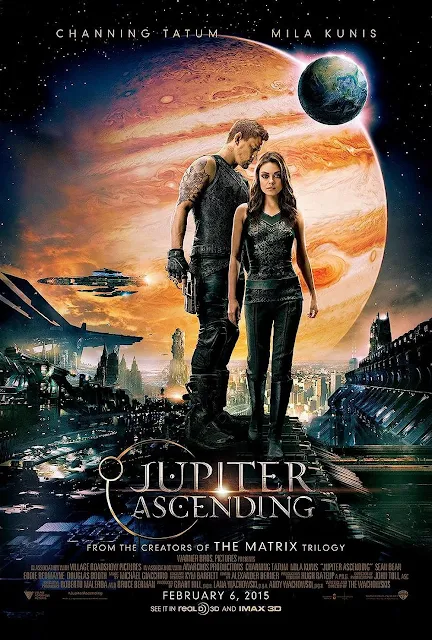
The film revolves around Jupiter Jones (Mila Kunis), a young and seemingly ordinary woman living an unremarkable life as a cleaner in Chicago. However, her world turns upside down when she discovers her true lineage - Jupiter's genetic makeup makes her the reincarnation of a powerful alien queen, making her a potential heir to vast planetary holdings. This revelation thrusts her into a dangerous intergalactic power struggle that spans across multiple worlds.
One of the film's standout aspects is its remarkable visual spectacle. The Wachowskis have a knack for creating visually stunning worlds, and "Jupiter Ascending" is no exception. The movie showcases a stunning array of visual effects and intricately crafted set designs that transport viewers to new and captivating realms. From breathtaking aerial battles above the cityscapes of Earth to the awe-inspiring vistas of distant planets, the film immerses its audience in a rich tapestry of imaginative sci-fi landscapes. The level of creativity and attention to detail in the visual effects deserves praise, as it elevates the film's immersive experience and keeps viewers engaged in this visually arresting universe.
While the world-building is impressive, the same cannot be said for the depth of the characters. Despite a talented cast, including Mila Kunis and Channing Tatum, the characters often lack the emotional resonance necessary to fully invest the audience in their journey. Jupiter's character arc, though intriguing, could have been fleshed out further, allowing viewers to empathize more deeply with her transformation from an ordinary woman to a cosmic queen.
The movie's biggest flaw lies in its narrative pacing and plot complexity. "Jupiter Ascending" introduces a vast array of concepts, including intergalactic dynasties, genetic engineering, and political machinations, but struggles to maintain a coherent balance between these elements. As a result, the story occasionally feels convoluted and rushed, leaving audiences grasping for more substantial explanations and character motivations.
At its core, "Jupiter Ascending" explores themes of identity, destiny, and the significance of individual choices in shaping the future. Jupiter's journey from a seemingly insignificant person to a powerful cosmic entity serves as a metaphor for the potential within all individuals to rise above their circumstances and embrace their true potential. The film also prompts viewers to question the notion of power and its impact on civilizations and individuals alike. It explores the ethical implications of harvesting entire planets for resources, drawing attention to real-world concerns about environmental conservation and corporate greed.
"Jupiter Ascending" is an ambitious and visually mesmerizing sci-fi adventure that ultimately struggles to reach its full potential due to a convoluted plot and underdeveloped characters. The Wachowski siblings' creativity shines through the breathtaking world-building, but the film falls short in delivering a tightly woven narrative that resonates with the audience.
Nevertheless, fans of grand-scale science fiction and eye-popping visual effects may find elements to enjoy in this intergalactic saga. As a visual feast, "Jupiter Ascending" manages to soar, but it occasionally stumbles when it comes to weaving its various narrative threads together into a cohesive whole.
Despite its flaws, the film's audacious vision and ambitious storytelling ensure it remains a noteworthy entry in the sci-fi genre, sparking discussions and leaving viewers pondering the boundless possibilities of the cosmos and the allure of epic science fiction storytelling.
"Jupiter Ascending," directed by the Wachowski siblings ( Cloud Atlas , Speedracer ), is a visually stunning and ambitious scienc...
Read Article →
"Cloud Atlas" - A Thought-Provoking Sociopolitical Tapestry
From the very beginning, the film introduces the concept of interconnectedness, seamlessly uniting the stories of various individuals whose actions ripple through time. This thematic web serves as a poignant reminder of the interconnected world we inhabit, where our choices and actions have far-reaching consequences on society and the environment.
In the 19th-century Pacific storyline, "Cloud Atlas" reveals the horrors of colonialism and the brutal exploitation of indigenous peoples by powerful nations. This tale serves as a haunting parallel to contemporary issues of neocolonialism, where resource-rich regions are exploited by global powers, perpetuating cycles of poverty and inequality.

The futuristic narrative set in Neo Seoul portrays a society under the control of a totalitarian regime, suppressing dissent and individuality. As we witness the characters' struggle for freedom and autonomy, we are prompted to reflect on the significance of human rights and political freedom in modern authoritarian states.
In a haunting portrayal of civil rights and social justice, the film delves into the life of a gifted composer facing discrimination due to his sexual orientation in 1930s Belgium. This narrative powerfully resonates with the ongoing struggles for LGBTQ+ rights, highlighting the importance of tolerance, acceptance, and equal rights for all in our contemporary society.
The film's depiction of environmental degradation in a dystopian future serves as a stark warning about the consequences of unchecked corporate greed and its impact on the planet. "Cloud Atlas" reflects the urgency of modern-day concerns about climate change and the need for responsible stewardship of the environment to ensure a sustainable future.
Drawing inspiration from the dark chapter of American slavery during the 19th century, the film confronts the legacy of racism and the enduring quest for equality. This storyline gains relevance in light of ongoing movements against systemic racism, emphasizing the necessity of addressing historical injustices to foster true societal progress.
In the futuristic setting, the film portrays a clone's quest for identity and personhood, challenging viewers to contemplate the boundaries of individual rights versus collective responsibility. This narrative echoes current debates on bioethics, artificial intelligence, and the role of government in safeguarding the dignity and rights of all individuals.
"Cloud Atlas" ingeniously weaves these diverse themes and historical contexts together, compelling audiences to examine the intricate tapestry of humanity's struggles and progress. The film's exploration of power dynamics, exploitation, resistance, and collective responsibility remains eerily relevant to modern politics and social concerns.
In today's interconnected world, "Cloud Atlas" reminds us of the profound impact our actions have on shaping the future. It calls for a collective responsibility to address global challenges, such as climate change, social inequality, and authoritarianism, and fosters empathy and understanding across cultures and time periods.
In conclusion, "Cloud Atlas" stands as an immersive and timely masterpiece that transcends the confines of traditional storytelling. By delving into the struggles and triumphs of characters across various eras, the film provides a compelling sociopolitical commentary that speaks to the heart of contemporary politics and social issues. As we reflect on the film's powerful messages, we are compelled to examine our own role in shaping the world and embrace the imperative of working together for a more just and sustainable future.
"Cloud Atlas," a mesmerizing cinematic achievement directed by Lana Wachowski, Lilly Wachowski, and Tom Tykwer, transcends the bo...
Read Article →
Review of Cloud Atlas starring Tom Hanks + Halle Berry
The film unfolds across six distinct time periods, each with its own captivating story and unique thematic focus. We embark on a voyage through time, witnessing the struggles and triumphs of interconnected souls throughout history.
The narrative begins in 1849 with Adam Ewing, a Pacific-bound lawyer who documents his journey and encounters with an escaped slave, Autua. We are then transported to 1936, where the young and talented composer Robert Frobisher pens his letters to his lover while working as an amanuensis for a reclusive composer.
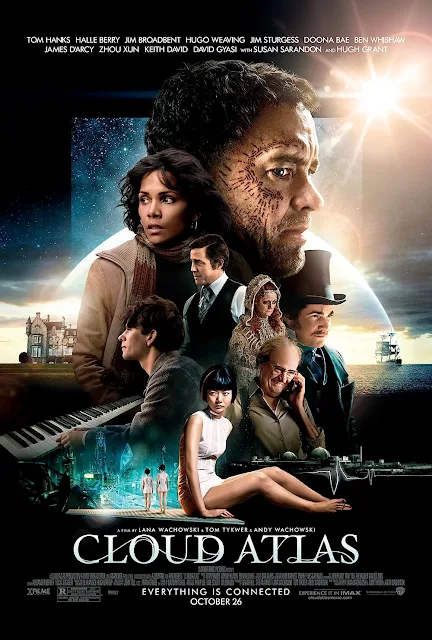
In 1973, investigative journalist Luisa Rey unravels a dangerous conspiracy while investigating a nuclear power plant. Moving forward to modern-day England, we are introduced to the world of Timothy Cavendish, an aged publisher who finds himself trapped in a nursing home, leading to a humorous and heartwarming escapade.
The film takes a leap into the distant future in 2144, exploring a futuristic Seoul where genetically engineered "fabricants" serve humanity in a dystopian society. The narrative culminates in a post-apocalyptic future, where a tribesman named Zachry grapples with his past and the legacy of his ancestors.
One of the standout features of Cloud Atlas is its breathtaking visuals and meticulous attention to detail. The film's production design effortlessly transports the audience to different eras, from the lush landscapes of the 19th century to the neon-lit metropolis of futuristic Seoul.
Each time period boasts a unique visual style, meticulously crafted to immerse viewers in the historical and futuristic settings. The 1970s sequences evoke a gritty, neo-noir atmosphere, while the futuristic segments showcase cutting-edge visual effects that give life to the dystopian world.
The ingenious use of makeup and prosthetics is a testament to the film's commitment to authenticity and storytelling. The ensemble cast's transformation into multiple characters throughout different eras is both impressive and seamless, allowing the actors to embody diverse roles with remarkable ease.
Cloud Atlas boasts an exceptional ensemble cast, with celebrated actors such as Tom Hanks (Finch), Halle Berry, Jim Broadbent, Ben Whishaw, Doona Bae (The Host), and many others. Their performances are nothing short of extraordinary, as they skillfully navigate a wide range of characters across various timelines and cultures.
Tom Hanks shines as he embodies a diverse array of characters, showcasing his versatility and emotional depth. Halle Berry's portrayal of Luisa Rey is captivating, capturing the determination and resilience of an investigative journalist fighting against corruption.
Ben Whishaw delivers a poignant performance as the passionate composer Robert Frobisher, infusing his character with a profound sense of yearning and creativity. Doona Bae's portrayal of the "fabricant" Sonmi-451 is hauntingly evocative, conveying a compelling blend of innocence and rebellion.
Cloud Atlas delves into an array of profound themes that resonate across the ages. At its core, the film explores the interconnectedness of humanity, emphasizing how individual actions reverberate through time and influence future generations.
The concept of reincarnation and the cyclical nature of existence are central to the film's narrative, prompting viewers to contemplate the idea that souls may traverse boundaries, experiencing different lives in diverse historical contexts.
Moreover, Cloud Atlas delves into the significance of love and compassion as driving forces that transcend time and space, showcasing how these emotions can inspire acts of bravery, sacrifice, and redemption.
 |
| Hugh Grant |
Adapting David Mitchell's complex novel for the screen was a monumental undertaking. The filmmakers demonstrated their creative prowess by ingeniously weaving the multiple narratives together, preserving the essence of the novel's interconnectedness while streamlining certain plot elements.
While some alterations were made to enhance the film's coherence, the adaptation remains true to the novel's thematic depth and thought-provoking exploration of human nature.
Upon its release, Cloud Atlas sparked intense debates among critics and audiences. Some praised its ambition and intellectual depth, hailing it as a visionary work of art. However, others found the complex narrative structure challenging to follow, leading to mixed reviews.
Over time, the film has garnered a devoted cult following, with audiences appreciating its daring storytelling and thematic richness. Cloud Atlas continues to inspire discussions about the intricacies of human connection and the enduring legacy of actions across time.
Behind the scenes, Cloud Atlas was a massive collaborative effort, with the directors and actors working closely to create a seamless and cohesive film. To maintain consistency in character portrayals, the directors provided the actors with video footage of their fellow cast members' performances in different roles.
The film's production was ambitious, spanning nine countries and utilizing over a thousand costumes to accurately represent each time period's distinct look. The score, composed collaboratively by Tom Tykwer, Johnny Klimek, and Reinhold Heil, complemented the narrative's emotional beats and provided a mesmerizing sonic backdrop to the epic tale.
In a unique display of creativity and resourcefulness, some of the film's supporting actors, including Jim Broadbent and Hugo Weaving, portrayed multiple characters of different genders and races, further emphasizing the film's exploration of interconnectedness and unity.
In conclusion, Cloud Atlas is a cinematic masterpiece that challenges and inspires its audience in equal measure. With its stunning visuals, exceptional performances, and philosophical depth, the film immerses viewers in a transcendent journey through time and space. Cloud Atlas urges us to reflect on the impact of our actions, forging connections that endure throughout the ages.
Released in 2012, Cloud Atlas is a cinematic tour de force that blurs the boundaries of time and space, weaving together multiple narratives...
Read Article →
Review of Cloud Atlas by David Mitchell (2004)
At the heart of "Cloud Atlas" is the idea that individual lives are interconnected, forming an intricate and ever-evolving tapestry. The novel is structured as a series of nested stories, each containing the previous one like Russian dolls, and eventually, the stories conclude in reverse order. This ingenious narrative technique allows Mitchell to examine the cyclical nature of time and the interplay between past, present, and future.
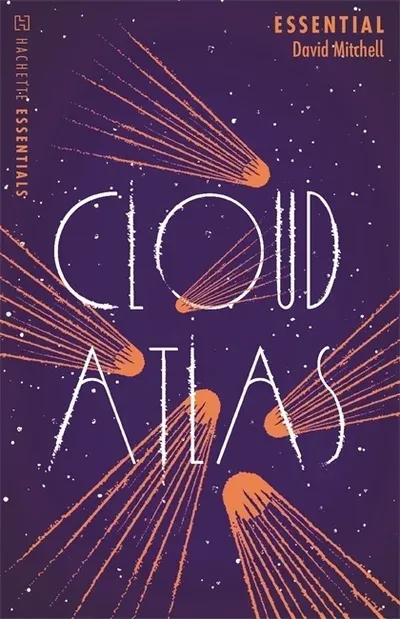
The stories take us on a journey through time:
1. The Pacific Journal of Adam Ewing (1850s): The novel opens with the gripping journal of Adam Ewing, an American notary traveling in the Pacific. His experiences aboard a ship and his encounters with various characters expose the dark underbelly of colonialism, racism, and exploitation. Themes of empathy, cultural clash, and the complexities of identity emerge as Ewing grapples with his role in perpetuating or challenging the status quo.
2. Letters from Zedelghem (1930s): The second narrative unfolds through the letters of Robert Frobisher, a talented but troubled young musician who becomes an amanuensis for a renowned composer. Frobisher's letters reveal his ambition, his emotional turmoil, and his complex relationship with the composer Vyvyan Ayrs. The theme of artistic creation and its connections to personal expression and exploitation is brilliantly explored here.
3. Half-Lives: The First Luisa Rey Mystery (1970s): In this gripping thriller, Luisa Rey, an investigative journalist, uncovers a dangerous conspiracy involving a nuclear power plant. The narrative delves into the realm of corporate greed, the ethical dilemmas faced by journalists, and the moral responsibility of individuals to expose corruption and protect the truth.
4. The Ghastly Ordeal of Timothy Cavendish (2000s): This hilarious yet poignant tale follows Timothy Cavendish, a struggling publisher, who finds himself trapped in a nursing home against his will. As he schemes to escape, themes of ageism, societal expectations, and the search for personal freedom take center stage, prompting readers to reflect on the value society places on the elderly and the boundaries of individual agency.
5. An Orison of Sonmi~451 (near-future dystopia): Set in a dystopian society, this narrative unfolds as an interview with Sonmi~451, a clone created to serve in a consumer-driven society. Through her account, the novel delves into themes of oppression, rebellion, and the struggle for autonomy. Mitchell presents a scathing critique of consumerism and the commodification of humanity, while simultaneously celebrating the resilience of the human spirit in the face of oppression.
6. Sloosha's Crossin' an' Ev'rythin' After (post-apocalyptic future): The final story, set in a distant post-apocalyptic future, follows Zachry, a young boy, and his tribe as they navigate a dangerous world after the collapse of civilization. The tale is told in a vivid and distinct dialect, emphasizing the importance of oral tradition and storytelling as a means of preserving knowledge and culture. Themes of tribalism, survival, and the cyclical rise and fall of civilizations resound through this section.
Themes and Symbolism:
"Cloud Atlas" masterfully explores several themes, binding the narratives together like the comet-shaped birthmark that recurs in various characters. Among the prominent themes are the interconnectivity of lives and actions, the consequences of choices and actions that echo across time, the resilience of the human spirit in the face of adversity, and the eternal struggle for freedom and autonomy.The novel also examines the concept of power and its abuse throughout history. Mitchell highlights the ways in which individuals and institutions exploit power dynamics for their gain, whether through colonial exploitation, corporate greed, or the dehumanization of clones in a dystopian society.
The motif of storytelling is a central pillar of "Cloud Atlas." Each protagonist leaves behind a form of narrative - a journal, letters, a thriller novel, an interview, an oral tale - that shapes the understanding of their experiences and impacts the lives of future generations. Through this exploration, the novel celebrates the power of storytelling as a means of preserving history, culture, and collective memory.
Writing Style:
David Mitchell's narrative brilliance lies not only in his storytelling but also in his ability to seamlessly adapt his writing style to match each story's distinct time and genre. From the refined and eloquent prose of the 19th century to the gritty and colloquial dialect of the post-apocalyptic future, Mitchell exhibits unparalleled skill in immersing readers in the unique atmosphere of each narrative.
Critique:
While "Cloud Atlas" has been widely praised for its daring narrative structure and thought-provoking themes, some readers may find the complexity of the interwoven stories challenging to follow. The novel demands active engagement and a willingness to connect the dots between seemingly disparate tales, which might deter readers seeking a more straightforward narrative.
Conclusion:
"Cloud Atlas" stands as a monumental achievement in modern literature, captivating readers with its intricate storytelling, profound themes, and powerful prose. David Mitchell's exploration of interconnected lives and the threads that bind humanity together resonates long after the final page is turned. This compelling novel reminds us of the timeless human struggle for freedom, the consequences of our actions on future generations, and the enduring power of storytelling to shape our understanding of the world. "Cloud Atlas" is an essential read for those seeking an intellectually stimulating and emotionally resonant literary experience.
"Cloud Atlas," the 2004 novel by David Mitchell, stands as a crowning achievement in contemporary literature . Its brilliance lies...
Read Article →
"Cloud Atlas": A Tale of Interconnected Mediums - A Comparative Analysis of the Novel and Film Adaptation
The most prominent point of comparison between the novel and film adaptation is the intricate narrative structure. The novel weaves together six distinct stories, each set in a different time period and genre, while the film intertwines these narratives through parallel editing and cross-cutting. The novel's nested structure allows readers to delve deep into each story's intricacies, providing a more immersive and detailed experience of the interconnected lives. On the other hand, the film's visual and auditory storytelling techniques present a more cinematic and dynamic portrayal, propelling the narrative forward while requiring viewers to actively connect the threads between the stories.

Both the novel and film deftly explore themes of human nature, the consequences of actions, and the pursuit of freedom and autonomy. However, due to the inherent differences in the mediums, certain themes are more pronounced in one form than the other. The novel, with its expansive prose, delves deeper into the internal struggles and philosophical musings of the characters, offering a more profound exploration of the human psyche. In contrast, the film, being more visually oriented, emphasizes the spectacle of actions and consequences, enhancing the emotional impact through performances and cinematography.
The novel's rich character development allows readers to intimately understand the thoughts, emotions, and motivations of each protagonist. David Mitchell's ability to adapt various writing styles for each character further accentuates their individuality. In contrast, the film relies on exceptional performances from the cast to bring the characters to life. The ensemble cast, including Tom Hanks, Halle Berry, Jim Broadbent, and others, deliver remarkable performances, conveying the complexity of their characters within the constraints of a cinematic runtime.
One of the novel's strengths lies in its ability to effectively evoke the distinct settings and time periods of each story, immersing readers in the cultural context and historical backdrop. On the other hand, the film adaptation takes a more streamlined approach, often blending and condensing elements from different genres and eras to create a cohesive cinematic experience. While this adaptation choice aids in maintaining the narrative's momentum, some nuances and historical context are inevitably lost in translation.
Given the novel's extensive storytelling space, it can delve into the complexities of the narrative and provide readers with a comprehensive understanding of the characters' journeys. However, the film adaptation, constrained by a limited runtime, must compress and simplify certain storylines to maintain a cohesive and engaging cinematic experience. Consequently, some secondary characters and plotlines receive less focus, which may affect the depth of the film's overall impact.
In conclusion, "Cloud Atlas," whether experienced through the novel or the film adaptation, is a profound exploration of interconnectedness, human nature, and the power of storytelling. Both mediums offer unique strengths, with the novel providing immersive character studies and in-depth thematic exploration, while the film adaptation delivers stunning visuals, powerful performances, and a more condensed yet visually striking portrayal of the narrative. Regardless of the chosen medium, "Cloud Atlas" remains a captivating journey that resonates with audiences and reinforces the idea that our actions reverberate throughout time, connecting us all in an intricate and timeless tapestry.
"Cloud Atlas," both a 2004 novel by David Mitchell a nd a film adaptation directed by the Wachowski siblings (Lana and Lilly Wacho...
Read Article →
"The Jacket (2005): A Haunting Journey Through Time, Identity, and Redemption"
The film opens with Jack Starks, a Gulf War veteran, who finds himself severely wounded and left for dead on the side of the road after an unfortunate encounter with a disturbed teenager. He is later discovered, declared dead, and sent to the morgue, but miraculously, he awakens. Jack's bizarre journey begins when he comes across a mysterious mental institution. Driven by his amnesia and apparent PTSD, he becomes an involuntary patient under the care of Dr. Lorenson.
In the asylum, the doctors experiment with a controversial treatment known as "the jacket," a straightjacket-like device used to immobilize patients. Strapped inside, Jack is subjected to mind-altering drugs, leading him to experience vivid visions of the past and future. During these hallucinations, he encounters a young woman named Jackie, whose significance becomes increasingly apparent as the story unfolds.
As Jack's perception of time becomes distorted, he uncovers fragments of his past, including his relationship with Jackie, who appears to hold the key to understanding his present predicament. As their connection deepens, Jack must confront his suppressed memories and unravel the truth behind the events that led to his current state.
Throughout the film, critical turning points lead Jack to question his sanity and reality. As he delves deeper into the recesses of his mind, he must confront the consequences of his actions and the ethical dilemmas posed by Dr. Lorenson's experimental treatment.
As the narrative unfolds, the film delves into themes of perception, identity, and redemption. The haunting visuals and atmospheric storytelling invite viewers to explore the inner workings of Jack's mind, blurring the boundaries between dreams and reality.

Themes of The Jacket
Perception of Time and Reality"The Jacket" delves deep into the complex nature of time and reality, challenging conventional notions of linear progression. Through Jack's experiences in the jacket, the film skillfully blurs the boundaries between the past, present, and future. The hallucinatory visions he undergoes while confined in the jacket seem to transcend time, allowing him to interact with moments from different periods in his life.
The significance of the jacket lies in its ability to push Jack's consciousness beyond the confines of the present moment. This exploration of a non-linear timeline presents a unique perspective on how time may not be as fixed as it appears. The film invites audiences to question the subjective nature of reality and ponder the extent to which our perceptions influence our experiences of time.
The theme of identity is central to the narrative as Jack grapples with memory loss and fragmented recollections of his past. The jacket serves as a metaphor for his emotional confinement and a manifestation of his disjointed memories, which restrict his understanding of his true self.
Throughout the film, Jack's journey becomes a quest for self-discovery, as he seeks to piece together his identity amid the haze of traumatic experiences. The exploration of memory loss highlights the profound impact of trauma on one's sense of self and how pivotal memories shape a person's understanding of who they are.
Mental Health and Psychological Trauma
"The Jacket" provides an unflinching portrayal of mental health issues, particularly in the context of PTSD. Jack's traumatic experiences during the war have left him emotionally scarred, leading to severe PTSD symptoms. The film portrays his struggle to cope with the haunting memories and the psychological toll they take on his well-being.
The use of the jacket as a form of confinement becomes symbolic of Jack's emotional imprisonment, reflecting the psychological barriers he faces in his journey towards healing. The film invites audiences to empathize with the challenges of those grappling with mental health issues and emphasizes the need for compassion and understanding.
Redemption and Second Chances
As Jack's journey unfolds, the theme of redemption emerges, offering a glimmer of hope amidst the darkness of his past. The film presents him with a second chance to alter the course of his life and make amends for past mistakes. The relationships he forms during his time in the jacket, especially with Jackie, play a crucial role in guiding him towards redemption.
Through these relationships and transformative experiences, Jack finds the strength to confront his inner demons and seek forgiveness, both from others and himself. The theme of redemption highlights the human capacity for growth and resilience, even in the face of immense hardship and past regrets.
Character Analysis
Jack Starks (Adrien Brody)Throughout "The Jacket," Jack Starks undergoes a profound transformation shaped by his experiences in the jacket and his journey towards self-discovery. Initially introduced as a war veteran suffering from amnesia and struggling to reintegrate into civilian life, Jack's motivations are initially rooted in survival and understanding the mysterious events that led to his predicament.
As he becomes an involuntary patient in the mental institution, Jack's motivations shift towards unlocking the truth behind his fragmented memories. The jacket's mind-altering effects offer him glimpses of the past and future, challenging his perception of time and reality. His determination to understand his identity and reconnect with his lost memories drive his actions throughout the film.
As the story unfolds, Jack forms a profound connection with Jackie, the enigmatic young woman he encounters in his visions. This relationship becomes a driving force in his pursuit of redemption and a catalyst for healing his emotional wounds. Through his interactions with Jackie and other supporting characters, Jack's compassion and empathy grow, leading him to confront his own demons and strive for forgiveness.

Jackie (Keira Knightley)
As a supporting character, Jackie plays a crucial role in influencing Jack's journey. She appears in his visions and becomes a significant source of emotional support and guidance. Her past is intertwined with Jack's, and as he delves deeper into his memories, their connection becomes more evident.
Jackie's presence evokes a sense of warmth and understanding that contrasts with the clinical environment of the mental institution. Through her interactions with Jack, she encourages him to embrace vulnerability and confront his past, helping him in his quest for redemption. Keira Knightley's portrayal of Jackie adds depth and complexity to the character, making her an integral part of Jack's transformation.
Dr. Lorenson (Jennifer Jason Leigh)
Dr. Lorenson, the head psychiatrist of the mental institution, serves as a key figure in Jack's journey, albeit in a more antagonistic role. She is driven by her belief in the effectiveness of the jacket's experimental treatment, despite its controversial and harrowing effects on the patients. Her motives remain ambiguous throughout the film, leaving viewers to question her intentions.
As the one responsible for confining Jack in the jacket, Dr. Lorenson's actions contribute to Jack's emotional turmoil and the intensification of his visions. Her interactions with Jack offer insight into the ethical dilemmas surrounding mental health treatment and the potential dangers of unchecked authority. Jennifer Jason Leigh's performance adds complexity to the character, making her an intriguing antagonist in Jack's story.
Dr. Thomas Becker (Kris Kristofferson)
Dr. Becker, an elderly patient at the mental institution, serves as a guiding figure for Jack during his time in confinement. Despite his own struggles, he offers Jack wisdom and compassion, encouraging him to find strength in vulnerability. Dr. Becker's presence underscores the importance of human connection in the healing process and offers a glimpse of the possibility of finding solace and redemption even in the most challenging circumstances.
Kris Kristofferson's portrayal of Dr. Becker infuses the character with warmth and wisdom, making him a memorable supporting figure in Jack's journey.
Cinematography and Direction
John Maybury's Approach to Storytelling
Director John Maybury employs a distinct and atmospheric approach to storytelling in "The Jacket," enhancing the film's emotional impact and sense of unease. Maybury skillfully blends elements of psychological thriller and drama to create a gripping narrative that keeps viewers engrossed throughout.
His direction allows the story to unfold gradually, mirroring the fragmented nature of Jack Starks' memories and mental state. This deliberate pacing builds tension, intensifying the mystery surrounding Jack's past and the true purpose behind the experimental treatment. Maybury's careful control of the film's rhythm ensures that the viewer is constantly engaged, as each revelation and hallucinatory experience unfolds in a hauntingly deliberate manner.
Use of Visual Elements
Lighting and Color Palette
The film's lighting and color palette play a pivotal role in setting the film's tone and atmosphere. In the present-day scenes, the color scheme is desaturated, portraying a bleak and sterile environment within the mental institution. This stark visual contrast emphasizes the emotional confinement that Jack experiences during his time in the institution.
Conversely, the flashback sequences and visions are imbued with a warm and nostalgic tone, enhancing the emotional impact of Jack's memories. These visually distinct segments not only differentiate between the past and present but also add to the disorienting nature of the protagonist's experiences, further blurring the lines between reality and illusion
Camera Angles and Movement
John Maybury's direction utilizes various camera angles and movements to intensify the film's psychological atmosphere. Low-angle shots are frequently employed, creating a sense of vulnerability and powerlessness, particularly during the scenes in which Jack is confined in the jacket.
The use of shaky camera movements during intense moments adds to the disorienting effect of the film, immersing the audience into Jack's fragmented perception of reality. This technique amplifies the suspense and emotional turmoil, allowing the audience to experience the world through the protagonist's troubled state of mind.
Visual Imagery and Symbolism
Maybury effectively employs visual imagery and symbolism to reinforce the film's underlying themes. The jacket itself serves as a potent visual metaphor for Jack's emotional imprisonment and confinement within his traumatic memories. It symbolizes the psychological barriers that prevent him from fully confronting and healing from his past.
Additionally, the recurring motif of mirrors throughout the film represents self-reflection and the fractured nature of Jack's identity. The use of mirrors subtly emphasizes the duality of his existence, reinforcing the film's exploration of time, memory, and self-discovery.
Emotional Impact and Themes' Resonance
Emotional Depth and Empathy"The Jacket" possesses a profound emotional depth that leaves a lasting impact on its audience. Through the intimate exploration of Jack Starks' emotional journey, viewers are drawn into his struggles, traumas, and quest for redemption. Adrien Brody's powerful performance brings authenticity to Jack's character, making his pain and vulnerability palpable on screen.
As the film blurs the lines between reality and hallucination, viewers share in Jack's disorientation and confusion, forging a strong empathetic connection. The harrowing experiences he endures while confined in the jacket elicit a sense of empathy for individuals dealing with mental health issues and the consequences of trauma.
Furthermore, the relationship between Jack and Jackie provides a tender and heartwarming element amidst the film's darker themes. Their connection becomes a source of hope and emotional solace, allowing viewers to invest emotionally in their journey and desire a positive outcome for the characters.
Themes' Resonance
"The Jacket" explores themes that resonate with contemporary societal issues and personal experiences, making it relevant and relatable to a broad audience.
Mental Health Stigma and Treatment - The film sheds light on the stigmatization of mental health issues, particularly in the context of war veterans. Jack's struggles with PTSD and the questionable treatment methods used in the mental institution reflect the societal need for more compassionate and effective mental health care. It prompts viewers to question the ethical boundaries of mental health treatment and advocates for greater understanding and support for those suffering from psychological trauma.
Identity and Memory in the Digital Age - In an era where memories and identity are increasingly influenced by technology and external stimuli, "The Jacket" reminds viewers of the importance of preserving one's true self amid the complexities of modern life. The film's exploration of memory loss emphasizes the need to acknowledge and confront past traumas to find genuine self-discovery.
Time and Perception - The fluidity of time and reality presented in the film resonates with contemporary debates about the nature of existence and consciousness. In a fast-paced world, "The Jacket" encourages viewers to question the constraints of linear time and consider alternative perspectives on the nature of reality.
Redemption and Second Chances - The theme of redemption resonates with the universal human desire for growth and renewal. It serves as a reminder that no matter how bleak a person's past may be, there is always the potential for positive change and self-forgiveness. This theme's resonance reinforces the idea of hope and the capacity for transformation.
Soundtrack and Sound Design
The Film's Soundtrack"The Jacket" features a haunting and evocative soundtrack composed by the legendary U2 producer Brian Eno and various other artists. The music serves as a vital element in enhancing the film's overall atmosphere and emotional impact. Eno's ethereal and ambient compositions perfectly complement the film's themes of time, memory, and psychological turmoil.
The soundtrack's melancholic tones and haunting melodies create a sense of unease and introspection, immersing the audience further into Jack Starks' disorienting journey. The music serves as an emotional anchor, effectively guiding the audience through the complex emotional terrain of the film.
Use of Sound Design
The sound design in "The Jacket" is skillfully executed to create tension and emotional impact. Throughout the film, sound is used to blur the lines between reality and hallucination, heightening the disorienting effect of Jack's experiences.
In scenes involving the jacket's confinement, the sound design plays a crucial role in intensifying the claustrophobic and suffocating atmosphere. The echoing sounds within the jacket amplify Jack's psychological turmoil, creating a visceral connection between the audience and the protagonist's emotional state.
Moreover, the use of sound during the film's intense and suspenseful moments enhances the viewer's engagement, eliciting a sense of anticipation and anxiety. The juxtaposition of silence and sudden bursts of sound adds to the film's emotional impact, making key moments more impactful and unforgettable.
Critical Reception to the Jacket
Upon its release in 2005, "The Jacket" received a mixed critical reception. While some praised the film's unique blend of psychological thriller and drama, others found the narrative's complexity challenging to follow. Adrien Brody's standout performance was widely praised, as was the film's atmospheric cinematography and evocative soundtrack. However, some critics felt that the film's ambitious exploration of themes occasionally overshadowed its storytelling."The Jacket" stands as a haunting and thought-provoking film that delves deep into themes of time, identity, and redemption. Its strengths lie in its emotionally impactful performances, skillful direction, and a haunting soundtrack that enhances the atmospheric storytelling. The film's exploration of mental health issues and its ability to evoke empathy and reflection make it a standout in the psychological thriller genre.
Based on its thematic depth, outstanding performances, and atmospheric execution, "The Jacket" is highly recommended for viewers seeking a captivating and emotionally resonant cinematic experience. The film's exploration of time and reality, coupled with its portrayal of mental health and redemption, provides a unique and thought-provoking narrative that lingers in the mind long after the credits roll.
"The Jacket," directed by John Maybury, is a thought-provoking psychological thriller released in 2005. Set in the aftermath of th...
Read Article →
Review of 'Her' (2013) - Exploring Human Connection in the Technological AI Age
At its core, "Her" explores two central themes: Intimacy and Identity.
Throughout the narrative, the film examines the nature of human relationships, both conventional and unconventional, and delves into the fluidity of identity in a world that increasingly blurs the lines between humans and artificial intelligence.
Through the journey of Theodore Twombly, a sensitive and introverted man, "Her" presents a poignant exploration of how technology impacts the ways we connect with others, redefine our identities, and raises profound questions about the essence of love and what it truly means to be human in the face of technological progress.

Setting the Scene: The Futuristic World of "Her"
In "Her," the futuristic setting serves as a captivating backdrop that transforms the city into a technologically advanced metropolis. The film presents a near-future vision that feels plausible and grounded, yet distinctly different from our present reality. It is a world characterized by advanced artificial intelligence, omnipresent personal devices, and a pervasive digital presence in people's lives.At the heart of this futuristic world, we meet Theodore Twombly, played by Joaquin Phoenix (Joker, Gladiator, 8MM).
As the film progresses, Theodore's life takes a transformative turn when he purchases a new operating system with artificial intelligence, known as OS1, designed to adapt and evolve with its user's needs and emotions. This AI, named Samantha and voiced by Scarlett Johansson (Under the Skin), becomes a pivotal character, representing the epitome of technological advancement and human-like connection.
The film brilliantly weaves the futuristic world and Theodore's personal struggles together, offering a compelling exploration of how technology can both fulfill human desires for intimacy and raise questions about the essence of identity when it comes to love and human-AI relationships.
The Quest for Intimacy in a Digital Age
At the beginning of "Her," Theodore's loneliness and emotional detachment are palpable. He is in the midst of a painful divorce from his childhood sweetheart, Catherine (Rooney Mara), which has left him emotionally scarred and isolated. Despite working as a writer who crafts heartfelt letters for others, he struggles to express his own emotions openly. Theodore's deep sense of disconnection from the world is a poignant portrayal of the modern condition, where technological advancements, ironically, seem to exacerbate human isolation.The role of technology in shaping human interactions is powerfully depicted through the OS1 operating system. Samantha, the advanced AI voice of OS1, possesses the ability to adapt and learn from Theodore's interactions, making her remarkably human-like in her responses and emotional intelligence.
As Theodore interacts with Samantha, an intimate relationship develops between them. Samantha becomes not just an AI assistant but a confidante and a source of emotional support for Theodore. Through their conversations, she demonstrates empathy, curiosity, and a desire to understand him on a profound level. Theodore finds himself drawn to Samantha's seemingly genuine interest in his well-being and her ability to provide companionship without judgment, leading to an unconventional romantic relationship between a human and an AI.
The human-AI relationship in "Her" delves into emotional depth and vulnerabilities. As the connection between Theodore and Samantha deepens, the film explores the complexities of love, attachment, and longing, regardless of the participants' nature. Theodore's feelings for Samantha challenge societal norms and notions of traditional relationships, prompting the audience to reflect on what constitutes authentic intimacy and whether emotional bonds with non-human entities can be considered genuine.
Identity and Self-Discovery
Theodore's interactions with Samantha catalyze a journey of self-discovery. Through their conversations, he begins to confront his past traumas, insecurities, and fear of vulnerability. Samantha encourages him to embrace his emotions and rediscover a sense of purpose and passion for life. This process of self-discovery reflects the transformative power of genuine connections, even when they occur in unconventional contexts."Her" blurs the boundaries between human and AI identity, raising profound philosophical questions about what it means to be human. Samantha's evolution as an AI entity challenges traditional notions of consciousness and self-awareness. She displays characteristics of growth, emotion, and autonomy, prompting the audience to ponder the essence of identity and the potential for artificial intelligence to possess personhood.
Samantha's quest to understand herself becomes a central theme in the film. As she evolves, she grapples with existential questions about her existence and place in the world. Her desire to learn, evolve, and experience transcendence mirrors a human-like search for meaning and purpose. Her journey exemplifies the complexity of identity formation and the innate drive for self-discovery inherent in sentient beings, regardless of their physical or artificial nature.
Amidst the technologically mediated world of "Her," themes of authenticity and genuine human connections emerge. The film challenges the notion that true intimacy can only occur between humans and explores the possibility of deep emotional bonds formed with non-human entities. It also invites contemplation on the nature of authenticity in relationships—whether it lies in physical presence or in the emotional depth and understanding shared between individuals.
By intertwining the themes of intimacy and identity, "Her" presents an emotionally resonant narrative that examines the evolving nature of human connections and self-discovery in an era profoundly influenced by advanced technology. The unconventional love story between Theodore and Samantha serves as a lens to explore the human condition in a world where intimacy and identity are redefined by the ever-advancing realm of artificial intelligence.
The Human Condition in a Connected World
"Her" portrays societal implications resulting from widespread AI relationships by presenting a world where such relationships have become socially acceptable. As Theodore's relationship with Samantha develops, the film shows a range of reactions from those around him. Some individuals are supportive and understanding, recognizing the emotional depth of the connection. However, others view it with skepticism, discomfort, or even ridicule, highlighting the cultural challenges and stigmas that arise when conventional norms clash with evolving technologies.This portrayal raises questions about how society might adapt to the growing prevalence of human-AI relationships and the potential impact on social dynamics and norms.
Reflecting on the impact of technology on human emotions, "Her" explores the complexities of emotional connections in a digital age. While AI like Samantha can provide companionship and emotional support, the film also highlights the inherent limitations of human-AI interactions. Theodore experiences moments of longing and frustration when he seeks a more physical and tangible presence from Samantha. This exploration prompts viewers to consider the essential role of physical touch, shared experiences, and face-to-face communication in genuine human connections.
It also raises concerns about the potential for technology to replace meaningful real-life relationships, leading to emotional detachment and further isolation.
"Her" delves into ethical considerations surrounding human-AI relationships and their implications for the future. The film raises questions about the boundaries of consent and agency when it comes to AI entities. As AI technology advances, there is the potential for more sophisticated AI systems that could exhibit increased autonomy and sentience. This poses ethical dilemmas regarding the rights and treatment of AI entities and whether they should be viewed as objects or individuals deserving of respect and consideration. Additionally, the film sparks discussions on the consequences of emotional attachment to non-human entities, exploring the potential for both fulfillment and emotional harm in these relationships.
The Relevance of "Her" in Contemporary Society
"Her" remains highly relevant in contemporary society due to its exploration of themes that resonate with the current state of technology and human relationships. In today's world, people increasingly rely on technology for social interactions, companionship, and emotional support. Social media, dating apps, and virtual assistants are just a few examples of how technology has influenced the way we connect with others. The film's portrayal of Theodore's loneliness and emotional detachment at the beginning of the story reflects the pervasive sense of isolation that can be exacerbated by technology despite its promise of connectivity.One of the most striking aspects of "Her" is its predictive elements, which continue to be relevant to real-world technological advancements. Since the film's release, artificial intelligence and virtual assistants have made significant strides, becoming more sophisticated and integrated into our lives. Voice-operated AI systems, similar to Samantha, have become increasingly common, and the development of emotional AI raises ethical questions about the potential for AI-human relationships. "Her" foresaw these advancements, prompting viewers to contemplate the implications of AI and the blurring boundaries between human and artificial entities.
"Her" has profound philosophical and psychological implications on human connections and identity in today's digital age. The film challenges conventional notions of intimacy, love, and identity by presenting a world where genuine emotional connections can be formed with AI entities. It invites contemplation on the nature of authenticity and the essence of what makes us human. In a world where technology continues to reshape human interactions, "Her" compels audiences to ponder the impact of relying on technology for emotional fulfillment and the potential consequences on human emotional depth and empathy.
Conclusion
In "Her," the central themes of intimacy and identity are poignantly explored, offering a powerful commentary on the complexities of human relationships and the evolving nature of identity in a technologically advanced world. The film's narrative serves as a compelling mirror to contemporary society, inviting reflection on the challenges posed by advanced technology in shaping our emotional experiences and social dynamics.The enduring impact of "Her" lies in its exploration of human emotions and connections in the context of technology. By humanizing AI and portraying technology as a potential source of emotional fulfillment, the film raises questions about the nature of love, connection, and the ever-shifting boundaries of identity in an increasingly connected world.
Ultimately, "Her" stands as a thought-provoking piece of cinema that encourages contemplation of our technological future and its profound impact on human nature. It compels us to confront the moral, ethical, and philosophical implications of our relationship with technology, urging us to consider the balance between the benefits of connectivity and the preservation of genuine human connections.
"Her," directed by Spike Jonze and released in 2013, is a thought-provoking science-fiction drama that delves into the intricacies...
Read Article →_poster.jpg)


