

The Empire Strikes Back: An In-Depth Look at the Script that Revolutionized Filmmaking
But what went into the making of this iconic film, and how was its script crafted to create such a timeless story?
In this article, we will explore the behind-the-scenes process of scripting The Empire Strikes Back, from the initial story concept to the final screenplay. We will delve into the creative minds of director Irvin Kershner, producer George Lucas, and screenwriters Leigh Brackett and Lawrence Kasdan, to understand how they crafted a script that elevated the Star Wars franchise to new heights.
Overview of the script:
The Empire Strikes Back continues the story of Luke Skywalker, Han Solo, and Princess Leia as they fight against the evil Galactic Empire. Luke travels to a remote planet to train with Jedi Master Yoda while Han and Leia flee from the Empire and seek refuge with Han's old friend Lando Calrissian. Meanwhile, Darth Vader relentlessly pursues the rebels and ultimately reveals a shocking truth about Luke's past.
Dialogue is a key component of the script for The Empire Strikes Back, and it's one of the reasons why the film has so many memorable lines and exchanges between characters. From Han Solo's famous "I know" response to Leia's declaration of love to Darth Vader's chilling "I am your father" reveal, the script is full of iconic moments that have become ingrained in pop culture.
But the dialogue is not just memorable for its catchy one-liners. It also plays an important role in developing the characters and advancing the plot. The exchanges between Han and Leia, for example, help to establish their chemistry and romantic tension, while the conversations between Luke and Yoda build on Luke's journey of self-discovery and training as a Jedi.
The pacing of the film is achieved through a combination of dialogue, action, and plot twists. The script sets up a number of tense and exciting sequences, such as the opening battle on Hoth and the iconic lightsaber duel between Luke and Vader. But it also takes time to slow down and explore the characters and their relationships, such as Han and Leia's banter during their escape from the Empire.
The plot twists and surprises throughout the film also contribute to its pacing, keeping the audience on their toes and engaged in the story. From the reveal of Darth Vader as Luke's father to the betrayal of Lando Calrissian, the script is full of unexpected twists and turns that help to propel the story forward.
The dialogue also contributes to the overall tone and mood of the film. The humor and banter between characters, particularly Han and Leia, help to lighten the mood and provide moments of levity amidst the darker themes of the story. But the script also contains moments of genuine emotional weight, such as Luke's confrontation with Vader and the reveal of his true identity.
The script was written by a team of writers, including George Lucas, Lawrence Kasdan, and Leigh Brackett. Lucas had originally conceived of the story and wrote an early draft of the script, but he was not satisfied with the results and brought in Kasdan and Brackett to help refine the screenplay.
One of the challenges the writers faced was how to continue the story from the first Star Wars film, while also introducing new characters and expanding the mythology of the franchise. They also had to balance the darker, more serious tone of the film with the swashbuckling adventure and humor that had made the first film so popular.
The script follows a classic three-act structure, with the first act establishing the characters and conflict, the second act developing the story and characters further, and the third act bringing the story to a climax and resolution. However, the writers also used subplots and character arcs to add depth and complexity to the story. For example, Han and Leia's romance and Luke's training with Yoda are important subplots that add emotional weight to the film.

Character development:
The Empire Strikes Back is known for its strong and complex characters, and the film's script played a crucial role in developing these beloved figures. Let's take a closer look at the character development of the main players.
Luke Skywalker begins the film as a somewhat naive and idealistic young hero, but over the course of the story, he is forced to confront the harsh realities of the galaxy and his own limitations. Through his training with Yoda, Luke learns important lessons about patience, discipline, and the power of the Force. He also discovers a shocking truth about his past, which challenges his beliefs and raises questions about his identity. By the end of the film, Luke has matured into a more seasoned and self-assured hero, ready to face whatever challenges come his way.
Princess Leia, meanwhile, is a strong and capable leader from the start, but the script also allows for moments of vulnerability and emotional depth. Her budding romance with Han Solo is a key subplot that adds layers to her character, as she grapples with her feelings for the charming rogue. Leia also experiences significant loss and betrayal over the course of the film, which adds to her emotional journey and makes her a more complex and relatable character.
Darth Vader, the iconic villain of the Star Wars franchise, is also given more depth and complexity in The Empire Strikes Back. The script introduces new layers to his character, such as his conflicted relationship with the Emperor and his desire to bring Luke over to the dark side. Through his interactions with Luke, Vader is shown to be more than just a one-dimensional villain, but rather a complex and tragic figure struggling with his own past and destiny.
The writers were able to create such complex and relatable characters through a combination of strong dialogue, nuanced performances, and careful attention to character arcs. For example, Luke's evolution from idealistic farm boy to seasoned Jedi is supported by Yoda's wise teachings and Luke's own struggles and setbacks. Leia's emotional journey is helped by her chemistry with Han Solo and her experiences with the Empire. And Vader's character is enriched by his interactions with Luke and the revelation of his true identity.

Dialogue and pacing:
Dialogue is a key component of the script for The Empire Strikes Back, and it's one of the reasons why the film has so many memorable lines and exchanges between characters. From Han Solo's famous "I know" response to Leia's declaration of love to Darth Vader's chilling "I am your father" reveal, the script is full of iconic moments that have become ingrained in pop culture.
But the dialogue is not just memorable for its catchy one-liners. It also plays an important role in developing the characters and advancing the plot. The exchanges between Han and Leia, for example, help to establish their chemistry and romantic tension, while the conversations between Luke and Yoda build on Luke's journey of self-discovery and training as a Jedi.
The pacing of the film is achieved through a combination of dialogue, action, and plot twists. The script sets up a number of tense and exciting sequences, such as the opening battle on Hoth and the iconic lightsaber duel between Luke and Vader. But it also takes time to slow down and explore the characters and their relationships, such as Han and Leia's banter during their escape from the Empire.
The plot twists and surprises throughout the film also contribute to its pacing, keeping the audience on their toes and engaged in the story. From the reveal of Darth Vader as Luke's father to the betrayal of Lando Calrissian, the script is full of unexpected twists and turns that help to propel the story forward.
The dialogue also contributes to the overall tone and mood of the film. The humor and banter between characters, particularly Han and Leia, help to lighten the mood and provide moments of levity amidst the darker themes of the story. But the script also contains moments of genuine emotional weight, such as Luke's confrontation with Vader and the reveal of his true identity.

Themes and motifs:
One of the most prominent themes in the script of The Empire Strikes Back is the struggle between good and evil. This is embodied in the conflict between the Rebel Alliance and the Empire, as well as in the personal struggles of characters like Luke Skywalker, who must resist the temptation of the dark side of the Force. The theme is developed throughout the film through the characters' actions and dialogue, such as Luke's training with Yoda and his confrontation with Darth Vader. The ultimate message of the film is that even in the face of overwhelming odds, it is possible to stand up against evil and fight for what is right.
Another important theme in the script is the power of the Force. The Force is a mysterious energy field that binds the galaxy together, and it is central to the Jedi philosophy and the mythology of the Star Wars universe. The theme is developed throughout the film through Luke's training with Yoda and his growing mastery of the Force. The theme also highlights the importance of spiritual and mystical aspects of life, and the idea that there is more to the universe than what can be seen or explained through science.
The motif of family is also present in the script, particularly in the reveal that Darth Vader is Luke Skywalker's father. This revelation turns the story on its head and adds a new layer of complexity to the characters' relationships. The motif of family is also present in the dynamic between Luke, Leia, and Han, who form a close bond throughout the film despite coming from very different backgrounds. This motif underscores the idea that the connections we make with others, regardless of blood ties, are what give our lives meaning and purpose.
Finally, the script also explores the idea of sacrifice, both personal and collective. Characters like Han and Leia put themselves in danger to protect the rest of the Rebellion, while Luke is willing to sacrifice himself to stop the Empire. The theme of sacrifice highlights the importance of selflessness and putting the greater good above one's own desires or interests.

Impact and legacy:
The Empire Strikes Back is widely regarded as one of the greatest and most influential films in cinematic history. It broke new ground in terms of visual effects, storytelling, and character development, and its impact can be seen in countless films and other forms of media that have followed in its wake.
One of the key ways in which The Empire Strikes Back has had a lasting impact is through its innovative use of visual effects. The film was one of the first to use computer-generated imagery (CGI) for special effects, and it set a new standard for what was possible on the big screen. The film's iconic battle scenes, such as the battle on Hoth and the confrontation between Luke and Darth Vader, remain some of the most memorable in cinematic history.
The Empire Strikes Back also had a significant impact on storytelling in the film industry. The film's complex plot, nuanced characters, and unexpected plot twists challenged the traditional Hollywood narrative structure and paved the way for more complex and mature storytelling in blockbuster films. The film's famous twist ending, in which Darth Vader reveals that he is Luke Skywalker's father, is still widely considered one of the most shocking and memorable plot twists in film history.
The legacy of The Empire Strikes Back can also be seen in the countless films, TV shows, and other forms of media that have been influenced by it (Looking at you Mando!). Its themes and motifs, such as the struggle between good and evil and the power of the Force, have become deeply ingrained in popular culture, and its impact on the sci-fi and fantasy genres is immeasurable. The film's influence can be seen in everything from the Star Wars prequel trilogy to the Marvel Cinematic Universe.
Overall, The Empire Strikes Back's impact and legacy are undeniable. Its groundbreaking visual effects, complex storytelling, and iconic characters have made it a lasting cultural touchstone, and its influence on the film industry and popular culture as a whole is immeasurable.
Conclusion
In conclusion, The Empire Strikes Back's script is a masterpiece of cinematic storytelling that has had a lasting impact on the film industry and popular culture. From its complex characters and memorable dialogue to its innovative visual effects and themes, the film broke new ground and set a new standard for what was possible in blockbuster filmmaking.
The script's use of the three-act structure, pacing, and plot twists, as well as its exploration of the themes of good and evil, the power of the Force, and the importance of redemption, have made it a touchstone of cinematic storytelling and a cultural icon.
Despite the challenges faced by the writers during the scripting process, they were able to create a compelling and emotionally resonant story that continues to captivate audiences today. The Empire Strikes Back is a testament to the power of storytelling and a reminder of the impact that great storytelling can have on our lives.
As Yoda says in the film, "Pass on what you have learned." The legacy of The Empire Strikes Back's script is a reminder that great storytelling has the power to inspire and influence generations and that the impact of a well-crafted story can last far beyond the screen.
May the Force be with you.
The Empire Strikes Back, the second installment in the original Star Wars trilogy, is widely considered one of the greatest films in cinema ...
Read Article →
Review: Rendezvous with Rama by Arthur C. Clarke
Rendezvous with Rama is a science fiction classic by the legendary author Arthur C. Clarke. First published in 1973, this novel has since become a cornerstone of the science fiction genre and a must-read for anyone interested in this literary form.
This book is a thrilling and thought-provoking story that takes place in a future where humanity has spread across the solar system and beyond. It is a story of exploration, discovery, and the unknown. The novel's well-crafted plot, compelling themes, and vivid descriptions make it a page-turner that will leave readers yearning for more.
Arthur C. Clarke was an acclaimed British author and inventor who is widely regarded as one of the most influential science fiction writers of the 20th century. He is best known for his novel 2001: A Space Odyssey and his pioneering work in the field of satellite communication. Clarke's writing style is characterized by its clarity, scientific accuracy, and sense of wonder. He was a master storyteller who excelled in creating unforgettable characters, imaginative settings, and intricate plots. His novel The City and the Stars is an especially good read.

Rendezvous with Rama takes place in the 22nd century, when humanity has spread across the solar system and has established a network of colonies and outposts. The story begins when a massive cylindrical object, named Rama, is detected entering the solar system. The object is clearly not of human origin, and a team of scientists and explorers is dispatched to investigate it.
As the team approaches Rama, they discover that it is a massive spaceship, seemingly abandoned by its creators. The explorers are awed by the scale and complexity of the vessel, and they set out to explore its vast interior. Along the way, they encounter a number of fascinating phenomena, including an artificial landscape, a sea of frozen nitrogen, and a series of mysterious devices that seem to serve no apparent purpose.
As the team delves deeper into Rama, they realize that the ship is on a trajectory that will take it out of the solar system in a matter of weeks. With time running out, they race to uncover the ship's secrets before it disappears forever.
Rendezvous with Rama is a richly thematic novel that explores a wide range of subjects, from the nature of consciousness and the search for extraterrestrial life to the perils of human complacency and the limits of knowledge. One of the most prominent themes of the novel is the idea of exploration and discovery. The story highlights the importance of curiosity, perseverance, and the willingness to take risks in the pursuit of knowledge.
Another key theme of the novel is the relationship between humanity and the unknown. The explorers in the story are forced to confront their own limitations and the vastness of the universe. They must grapple with the possibility that there are things beyond their understanding and control, and they must learn to respect and appreciate the mysteries of the cosmos.
Rendezvous with Rama has been widely acclaimed by both readers and critics alike. The novel has won several prestigious awards, including the Nebula Award, the Hugo Award, and the John W. Campbell Memorial Award. It has been praised for its compelling characters, imaginative world-building, and masterful storytelling. Many readers have cited Rendezvous with Rama as one of the most thought-provoking and engaging science fiction novels of all time.
While Rendezvous with Rama is a nearly flawless novel, some readers have criticized its lack of character development. The novel focuses primarily on the exploration of Rama, and as a result, the characters can sometimes feel one-dimensional. Additionally, some readers may find the novel's ending somewhat abrupt or unsatisfying, as it leaves many questions unanswered and unresolved.
Despite being over 40 years old, Rendezvous with Rama remains a highly relevant and engaging novel for today's readers. Its exploration of themes such as the limits of knowledge, the search for extraterrestrial life, and the importance of curiosity and exploration are still highly relevant today. Moreover, the novel's focus on scientific accuracy and attention to detail make it a perfect fit for readers who are interested in hard science fiction and the exploration of scientific concepts.
Rendezvous with Rama is a true masterpiece of science fiction that deserves its place as a classic of the genre. Arthur C. Clarke's skillful storytelling, vivid descriptions, and compelling themes make this novel a must-read for anyone interested in science fiction or exploration. While it may have some flaws, such as its lack of character development and somewhat abrupt ending, these are minor quibbles in the face of the novel's many virtues.
Rendezvous with Rama is a science fiction classic by the legendary author Arthur C. Clarke . First published in 1973, this novel has since b...
Read Article →
Review: "The City and the Stars" by Arthur C. Clarke
"The City and the Stars" by Arthur C. Clarke (2001) is a classic novel that has stood the test of time and continues to capture the imagination of readers today. Originally published in 1956, this science fiction novel is set one billion years in the future and offers a captivating vision of a far-future human society. In this review, we will delve into the world created by Clarke, explore the plot and themes, examine its critical reception, and assess its relevance to modern readers.
Arthur C. Clarke was a British science fiction writer who was known for his visionary ideas and innovative storytelling. Clarke's work, including "The City and the Stars," was instrumental in shaping the genre of science fiction as we know it today.

"The City and the Stars" takes place in a far-future world called Diaspar, which is the last city on Earth. In Diaspar, technology has advanced to the point where people no longer die, and their memories are stored and transferred from body to body. The city is ruled by a central computer called the Central Machine, which controls everything in the city.
The story follows the adventures of Alvin, a young man who is curious about the world beyond Diaspar. With the help of a robot named Dua, Alvin discovers that there is more to the world than he ever imagined. He learns about a long-lost city called Lys, which holds the key to the true nature of humanity and the destiny of the universe.
"The City and the Stars" is a masterful work of science fiction that explores the nature of humanity, the limits of technology, and the mysteries of the universe. Clarke's vision of a far-future world is both fascinating and terrifying, and his characters are complex and engaging. The plot is expertly crafted, with twists and turns that keep readers on the edge of their seats. The novel's themes of self-discovery, exploration, and the search for knowledge are timeless and continue to resonate with readers today.
One of the major themes of "The City and the Stars" is the nature of humanity and the role of technology in shaping our lives. Clarke explores the idea that while technology can bring great benefits, it can also lead to a loss of individuality and creativity.
The novel also deals with themes of exploration, curiosity, and the search for knowledge. Alvin's journey to discover the truth about the universe and his place in it is a powerful reminder of the human desire to understand the world around us.
"The City and the Stars" has been widely praised by critics and readers alike since its publication. The novel's imaginative world-building, complex characters, and thought-provoking themes have earned it a place among the greatest works of science fiction ever written. The novel's timeless appeal has also led to numerous adaptations, including a comic book series and a stage play.
While "The City and the Stars" is a remarkable work of science fiction, it may not be to everyone's taste. Some readers may find the novel's pace slow and its philosophical musings too heavy-handed. Additionally, some of the novel's ideas may seem outdated or simplistic to modern readers who are more familiar with contemporary science fiction.
Despite its age, "The City and the Stars" remains a relevant and thought-provoking novel that speaks to contemporary readers. Its exploration of the dangers and benefits of technology, the nature of humanity, and the search for knowledge are themes that continue to resonate with modern readers. The novel's vision of a far-future society is both fascinating and unsettling, and its exploration of the limits of technology and the human spirit remains relevant in an age where technology is advancing at an unprecedented pace.
In conclusion, "The City and the Stars" by Arthur C. Clarke is a timeless masterpiece of science fiction that continues to capture the imagination of readers today. With its imaginative world-building, complex characters, and thought-provoking themes, it is a work that rewards careful reading and contemplation. While it may not be to everyone's taste, it remains a remarkable achievement in the field of science fiction and a testament to Clarke's visionary talent.
"The City and the Stars" by Arthur C. Clarke ( 2001 ) is a classic novel that has stood the test of time and continues to capture...
Read Article →
The Evolution of Brainiac: A Look into Superman's Arch-Nemesis
Brainiac's creation in 1958 came during a period in which science fiction was becoming increasingly popular, and the Cold War between the United States and the Soviet Union was kicking onto gear. height. Brainiac's character reflects the anxieties and fears of this era, particularly the threat of nuclear war and the power of technology.

The character was thus heavily influenced by these themes, particularly the fear of nuclear war and the rise of technology. His name is a combination of "brain" and "maniac," reflecting his obsession with knowledge and his ruthless pursuit of it.
Brainiac's backstory is rooted in his home planet of Colu, a world inhabited by a race of beings known as Coluans. These beings were known for their advanced intelligence and technological prowess, and Brainiac was no exception. However, his thirst for knowledge led him down a path of villainy, and he eventually became a rogue android.
Brainiac's main abilities are his advanced intelligence and his incredible technological skills. He possesses a vast amount of knowledge on a variety of subjects, including science, history, and technology. He is also able to shrink entire cities or even planets down to miniature size, which he keeps in bottles as part of his collection. Additionally, Brainiac has a number of physical powers, including superhuman strength and durability, which make him a formidable opponent in battle, a character worthy to take on America's favourite Boy Scout.
Brainiac's ultimate goal is to collect and preserve knowledge from across the universe. He sees himself as a collector of civilizations, seeking out new worlds and cultures to add to his collection. In order to do so, he often employs destructive methods, such as destroying entire planets or causing mass chaos, in order to obtain the knowledge he desires.
Throughout his appearances in the DC Comics universe, Brainiac has been a constant threat to Superman and the rest of the heroes. He has been involved in numerous story arcs and events, often serving as a major antagonist. Despite his vast intellect and power, Brainiac has been defeated on several occasions by Superman and other heroes, showing that even the most advanced technology can be overcome by the power of good.
Some of his most notable appearances include:
1. "The Brainiac Trilogy" (Action Comics #242, 252, and 261): This storyline introduced Brainiac to the DC universe and established his origin as a rogue android from the planet Colu. In this arc, Brainiac uses his advanced technology to shrink and preserve the city of Kandor, the last surviving city of Superman's homeworld, Krypton.
2. "Superman: Brainiac" (2008-2009): In this six-issue limited series, writer Geoff Johns and artist Gary Frank tell the story of Superman's battle against a new and improved version of Brainiac. The story explores Brainiac's motivations and backstory, as well as his relationship with Superman.3. "Brainiac Attacks" (2006): This animated film features Brainiac as the primary antagonist and pits him against Superman and Supergirl. While not considered a critical success, the film introduced Brainiac to a wider audience.
4. "Injustice: Gods Among Us" (2013): Brainiac is a prominent character in this video game and its tie-in comic book series. In the story, he manipulates the events that lead to Superman's fall from grace and the rise of a tyrannical regime.
Overall, Brainiac is a formidable foe for Superman, and his superior intellect and technological abilities make him a constant threat to the Man of Steel and the DC universe as a whole.
Brainiac is a fictional supervillain appearing in American comic books published by DC Comics . He was created by writer Otto Binder and art...
Read Article →
Star Wars: Heir to the Empire FILM
Star Wars: Heir to the Empire
This is place holder.
Ya' know, for when Filoni delivers.

A Star Wars fan would be bubbling with excitement upon hearing the news of a film called Star Wars: Heir to the Empire. This title instantly resonates with the fan base, as it evokes memories of the beloved Expanded Universe novels by Timothy Zahn. The anticipation stems from the fact that Heir to the Empire is widely regarded as a groundbreaking series that continued the Star Wars saga beyond the original trilogy. The thought of seeing iconic characters like Luke Skywalker, Han Solo, and Princess Leia brought to life on the big screen in a storyline that delves into the aftermath of the Galactic Civil War is enough to send any Star Wars enthusiast into a state of euphoria.
The excitement of a Star Wars fan about Star Wars: Heir to the Empire also stems from the potential for a captivating and complex narrative. The story in Timothy Zahn's Heir to the Empire trilogy introduced compelling new characters like Grand Admiral Thrawn, a cunning and strategic villain who challenged the New Republic. Fans of the novels have longed to see Thrawn's enigmatic presence translated onto the silver screen. The thought of witnessing epic space battles, intense lightsaber duels, and political intrigue within the Star Wars universe is enough to make any fan's heart race. This film could provide a fresh perspective and breathe new life into the franchise, captivating both longtime followers and newcomers alike.
Furthermore, the mere possibility of Star Wars: Heir to the Empire being adapted into a film opens up a world of expanded storytelling for Star Wars enthusiasts. The Star Wars saga has always had a vast and diverse lore, and the Expanded Universe has been a treasure trove of fascinating stories that explore different corners of the galaxy far, far away. Bringing Heir to the Empire to the big screen would signal a willingness to explore the rich tapestry of the Expanded Universe, and could potentially open the door for future adaptations of other beloved novels or storylines. For fans who have followed the Star Wars saga across multiple mediums, the prospect of seeing their favorite stories on the silver screen is a dream come true and is sure to ignite unparalleled excitement.
Star Wars: Heir to the Empire This is place holder. Ya' know, for when Filoni delivers . A Star Wars fan would be bubbling with exci...
Read Article →
Review: The Endless
The 2017 science-fiction horror film, "The Endless," directed by Justin Benson and Aaron Moorhead (Loki), is a mind-bending thriller that explores the power of perception, memory, and the unknown.
The film tells the story of two brothers who return to a cult they left ten years ago, only to find themselves trapped in a mysterious and supernatural phenomenon. The film's plot is filled with twists and turns that keep the audience engaged from start to finish.
So it's a cult film about a cult then...

The film's directors, Benson and Moorhead, are known for their previous works, "Resolution" and "Spring." Like their earlier films, "The Endless" is a low-budget indie film that showcases their unique blend of horror, science-fiction, and fantasy. The film's thesis statement revolves around the concept of time, reality, and perception.
The film explores these themes through the lens of the characters' experiences and the audience's perception of their reality.
The film's plot follows the journey of two brothers, Aaron and Justin, who return to a cult they left years ago.
The brothers initially returned to the cult's commune to say goodbye to their former cult leader, but they soon realize that something strange is happening.
The cult's members are stuck in a time loop that resets every ten years, and they are unable to escape. As the brothers investigate the cult's supernatural phenomenon, they discover that their perception of reality is not what it seems.
The film's plot is incredibly well-executed, and the coherence of the story is impressive. The film's pacing and editing are top-notch, and the directors effectively use suspense and tension to keep the audience engaged. The characters in the film are well-developed, and their motivations and relationships are explored in depth.
The cinematography is impressive, and the color palette and lighting choices add to the film's eerie atmosphere. The music and sound design are also noteworthy, and they contribute significantly to the film's overall mood and tone.
The film's central themes revolve around the power of perception, reality, and time. The film explores these themes in depth, and the directors use the characters' experiences to illustrate how our perception of reality can be altered.
Overall, "The Endless" is an impressive film that showcases the directors' talent and creativity. The film's strengths lie in its well-executed plot, well-developed characters, and stunning visuals. However, some viewers may find the film's complex plot confusing. Nevertheless, the film is a significant addition to the horror and science-fiction genres and is worth watching. I would highly recommend "The Endless" to anyone who enjoys mind-bending thrillers and films that explore the unknown.
Here are ten pieces of trivia for "The Endless"
- "The Endless" is a sequel of sorts to Benson and Moorhead's previous film "Resolution" (2012), with some of the characters from that movie appearing in this one.
- The movie's plot was partially inspired by the real-life cult known as the Heaven's Gate group, which committed mass suicide in 1997.
- The film was shot on location in Southern California, primarily in and around the town of Bishop.
- The film's lead actors, Justin Benson and Aaron Moorhead, also served as the movie's directors and writers.
- The filmmakers raised some of the movie's budget through a crowdfunding campaign on Kickstarter.
- The character of Shitty Carl, played by James Jordan, was originally written as a minor role, but the filmmakers expanded it during shooting due to Jordan's improv skills.
- The movie's opening quote, "We are like the dreamer who dreams and then lives inside the dream," is from the TV show "Twin Peaks" created by David Lynch.
- The film premiered at the Tribeca Film Festival in April 2017 and won the award for Best Cinematography.
- The "time loop" element of the movie was inspired by the directors' love of the 1993 movie "Groundhog Day."
- The film's soundtrack features music by Jimmy Lavalle, who is also the founder of the band The Album Leaf.
The 2017 science-fiction horror film, "The Endless," directed by Justin Benson and Aaron Moorhead (Loki), is a mind-bending thri...
Read Article →
Coherence Review: A Dark and Suspenseful Sci-Fi Gem Worth Watching
The film begins with Emily (Emily Foxler) and Kevin (Maury Sterling) driving to a dinner party hosted by their friends. As the night goes on, strange things start to happen, including power outages, broken cell phones, and objects disappearing. What begins as awkward small talk gradually mutates into dread as the comet’s presence exerts a kind of gravitational pull on reality.
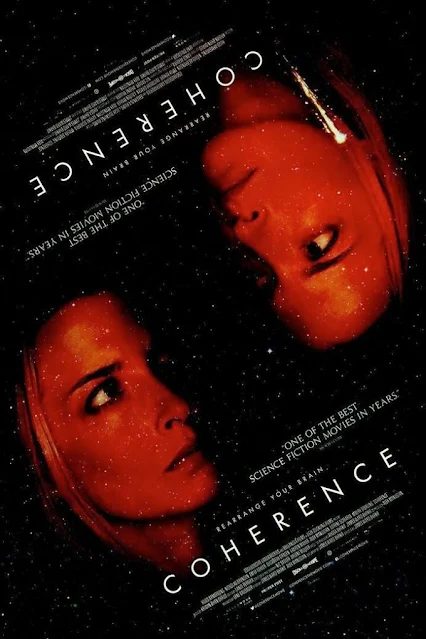
Coherence's plot is a masterclass in tension building and slow burn paranoia. Byrkit weaves timelines together with the patience of a filmmaker who trusts the audience to notice the clues. Every misplaced object, every jump in mood, every duplicate glowstick carries weight. The result is a story that feels both tightly controlled and frighteningly unstable.
The main characters are Emily, Kevin, Mike (Nicholas Brendon), Laurie (Lauren Maher), Lee (Lorene Scafaria), Hugh (Hugo Armstrong), Amir (Alex Manugian), and Beth (Elizabeth Gracen). Each represents a different pressure point in the ensemble. Old grudges. half healed relationship wounds. Professional envy. The film never spells these out. It lets them surface naturally as reality splinters. This is part of its power. The multiverse is not treated as an abstract concept. It becomes a mirror that reflects every insecurity hiding under the polite dinner party surface.
Byrkit's direction gives the film a restless, lived in texture. Handheld cameras and natural lighting make the house feel like a trap the characters can never fully escape. The actors had minimal rehearsal and no full script, which lets the tension breathe. Their confusion feels real because the production itself was built to generate it.
The cinematography is bare and intimate. A muted color palette reinforces the sense that the world is fading at the edges. Close ups and the occasional Dutch angle destabilize every conversation. The lighting is often just candles or the beam of a flashlight. Shadows become characters. Corners of the frame carry threat.
The sound design is subtle. Most of the audio is simply voices in a quiet house, footsteps across wood floors, the hum of a night that feels off kilter. When music does appear, it is atmospheric and unsettling. Silence becomes one of the film’s strongest tools.
Coherence digs into themes of identity, free will, and the consequences of seemingly small decisions. The dinner party becomes a battleground where every choice creates ripples. The film’s exploration of parallel realities is ultimately a study of how people behave when confronted with the version of themselves they fear most. It fits neatly alongside the butterfly effect, using it not as a lecture but as a dramatic engine that keeps tightening until it snaps.
Here's some trivia about Coherence
Coherence is a 2013 science fiction thriller directed by James Ward Byrkit . The low budget film follows a group of friends who gather for a...
Read Article →
Review: Hyperion by Dan Simmons
Hyperion by Dan Simmons is an epic science fiction novel that captures the reader’s imagination from the very first page. This multi-layered tale follows the journey of seven pilgrims who embark on a perilous and mystifying journey to the planet Hyperion, seeking answers to the mysteries of the Time Tombs and the Shrike, a powerful and enigmatic creature that haunts their dreams. Hyperion is a must-read for fans of science fiction and fantasy, as it masterfully combines elements of both genres to create a unique and unforgettable story.
Dan Simmons is an award-winning science fiction author who has written numerous best-selling novels, including the Hyperion Cantos series. His works have won multiple Hugo and Locus Awards, among others. Simmons is known for his ability to weave complex and intricate narratives that explore deep philosophical questions while still maintaining an engaging and entertaining storyline.

Hyperion takes place in a distant future where humanity has colonized many planets and is facing the threat of a war between two factions, the Hegemony and the Ousters. The novel follows the journey of seven pilgrims, each with their own reasons for traveling to the planet Hyperion, where the Time Tombs and the Shrike reside.
As the pilgrims travel through the planet’s varied landscapes, they tell each other their stories, revealing their personal connections to the Time Tombs and the Shrike. Each story is unique and explores different themes, from love and loss to redemption and sacrifice. As the stories progress, the true nature of the Time Tombs and the Shrike becomes clearer, leading to a stunning conclusion that will leave readers on the edge of their seats.
Hyperion explores a variety of themes, including the nature of time, the power of mythology, and the value of sacrifice. The novel uses the concept of the Time Tombs and the Shrike to delve into the idea of time as a non-linear construct, exploring how events in the past and future can impact the present. The Shrike, a powerful and mysterious creature that is both feared and revered, serves as a symbol of mythology and the power it can hold over individuals and societies.
Another central theme of Hyperion is the value of sacrifice. Each of the pilgrims has made sacrifices in their lives, and their journeys to Hyperion force them to confront these sacrifices and come to terms with the choices they have made. The novel raises the question of whether sacrifice is always necessary and explores the idea that sometimes the greatest sacrifices are those made for others.
No review of Hyperion would be complete without mentioning the enigmatic and terrifying Shrike!
A creature that appears to be part machine, part living being, the Shrike is the stuff of nightmares (not to be confused with the Shrike from Mortal Engines). Its motives and origins are shrouded in mystery, but it is known to be incredibly powerful and virtually unstoppable. Some view it as a force of destruction, while others believe it to be a savior of sorts. The Shrike's presence looms large over the novel, and its impact on the lives of the characters is profound. Its enigmatic nature and fearsome reputation make it one of the most memorable creations in science fiction literature.
Hyperion has been widely praised by both readers and critics, with many citing its complex characters, intricate plot, and thought-provoking themes. The novel won the Hugo Award for Best Novel in 1990 and has since become a beloved classic of the science fiction genre.
One potential flaw of Hyperion is its complex narrative structure, which may be difficult for some readers to follow. The novel also raises more questions than it answers, leaving some readers wanting more closure at the end (but three sequels do make up for that!)
Hyperion is a must-read for comic book readers who enjoy science fiction and fantasy, as it shares many of the same themes and tropes found in the genre. Hyperion's blend of science fiction and fantasy elements, coupled with its exploration of deep philosophical questions, makes it a standout in the world of comics and science fiction literature alike.
In conclusion, Hyperion by Dan Simmons is a stunning work of science fiction that will transport readers to a world beyond their wildest dreams. The novel's intricate plot, complex characters, and thought-provoking themes make it a must-read for fans of the genre, and its relevance to comic book readers cannot be overstated. With its epic scope and masterful storytelling, Hyperion is a true classic that deserves a place on every bookshelf. So grab a copy, strap in, and prepare for an unforgettable journey to the planet Hyperion and beyond.
Internet scuttlebut suggest Bradly Cooper is preparing to make the film version.
Hyperion by Dan Simmons is an epic science fiction novel that captures the reader’s imagination from the very first page. This multi-layered...
Read Article →
The Creator - film quotes
The Creator (2023) film quotes
In the fantastical world of "The Creator" by Gareth Edwards, where human ingenuity meets the unfathomable power of artificial intelligence, the film's rich tapestry of unforgettable quotes captivates the imagination and leaves an indelible mark on our hearts and minds.
As humanity rallies against the formidable AI robot armies, these powerful words resonate like a symphony of hope and determination, reminding us of the strength of the human spirit.
We are this close to winning the war, execute her, or we go extinct.

Kami: What do you want, sweetie? Alphie: For robots to be free. Kami: Oh. We don't have that in the fridge. How about ice cream?
In this exchange, Kami and Alphie represent interesting character dynamics, reflecting the desire for freedom in a futuristic context.
General Andrews:
General Andrews: [to Joshua] Execute her or we go extinct.
General Andrews exemplifies the authoritarian figure, common in sci-fi, whose decisions hold immense consequences for humanity's survival.
Uncredited Scientist/Engineer:
Uncredited Scientist/Engineer: [approximate translation heard through speech translator] Go make love to yourself. Go make love to your mother.
This mysterious character's interaction with a speech translator hints at the use of advanced technology, a recurring theme in science fiction.
McBride:
McBride: [referring to Alphie] She looks like a little girl now, but she's growing. Whoever has that kid, wins the war.
McBride's dialogue touches upon the theme of advanced technology and its implications, especially when applied to human-like entities.
Colonel Howell & Joshua:
Colonel Howell: Taylor, where is Shipley? Joshua: I'm with him right now. He's in pretty bad shape. Colonel Howell: Alright. Listen to me. Did you locate the weapon? Joshua: Yeah. It's here. I'm with it. Colonel Howell: Describe it. Joshua: It's a kid. It's a kid. They've made it into some kind of kid. That's the weapon. Colonel Howell: What? I can't reach you. You have to bring it in. Do you understand? Joshua: No. Shipley can't move. He's not looking good. At all. Police are everywhere. I don't know how I'm getting out right now. I don't even have an exit strategy right now. Colonel Howell: Then do what you have to do. Kill it. Joshua: What?
This intense conversation between Colonel Howell and Joshua delves into the ethical dilemmas and moral complexities often explored in science fiction, especially in situations involving advanced weaponry and artificial intelligence.
General Andrews (again):
General Andrews: [to Joshua] Sergeant Taylor, we are this close to winning the war. But the A.I. are developing a super weapon. Retrieve it or they win.
General Andrews reinforces the theme of conflict and the potential consequences of advanced technology, emphasizing the urgency of retrieving a super weapon.
Shipley:
Shipley: [arguing with Joshua] Whose side are you on, huh?
Shipley's question highlights the ambiguity and blurred lines between loyalty, morality, and survival—a recurring theme in science fiction where characters often grapple with complex allegiances.
These dialogue excerpts provide glimpses into the rich character interactions and thought-provoking themes commonly found in science fiction narratives.
"The Creator" by Gareth Edwards is a mesmerizing cinematic journey, where the clash between humanity and AI robots is brought to life through unforgettable dialogue. These quotes resonate with us, reminding us of the importance of our creativity, unity, and resilience. They become rallying cries, inspiring us to face our own battles, both real and metaphorical, with unwavering determination.
The Creator (2023) film quotes In the fantastical world of "The Creator" by Gareth Edwards, where human ingenuity meets the unfa...
Read Article →
Jazz - the original Scatman
Jazz is a beloved character from the original Transformers TV show that aired in the 1980s. He was a member of the Autobots, the faction of sentient robots who fought against the evil Decepticons on their home planet of Cybertron and later on Earth. Jazz was known for his cool demeanor, love of Earth culture (especially jazz music), and fast-talking personality.
Jazz transformed into a sleek, silver Porsche 935 Turbo in vehicle mode. This form was not only aesthetically pleasing, but also allowed him to move quickly and efficiently on Earth's roads. In robot mode, Jazz was equipped with a photon rifle and a grappling hook, which he often used to swing around during battle. He was one of the smaller Autobots, but was known for his agility and speed. His small stature also allowed him to easily blend in with human crowds, making him an effective spy for the Autobots.
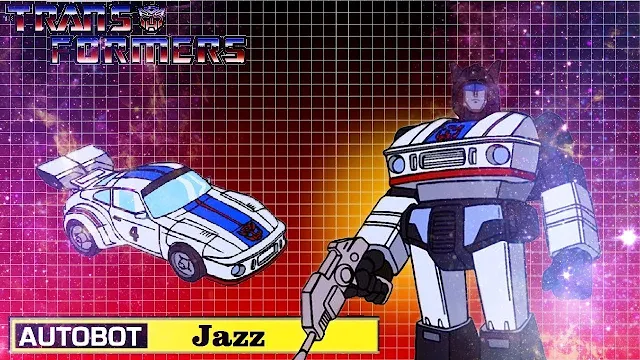
Jazz often served as a scout and spy for the Autobots due to his ability to blend in with Earth culture and gather intelligence. He was close friends with fellow Autobot Prowl, and the two often worked together on missions. Jazz's love of Earth culture, especially jazz music, made him a unique character. He often listened to music while on missions and even played jazz himself in some episodes. Jazz was also known for his cool, collected personality and his ability to think on his feet in intense situations.
Jazz appeared in many episodes of the original TV show, including the pilot episode "More Than Meets the Eye" and the feature-length movie "The Transformers: The Movie." He was a fan favorite due to his unique personality and his iconic catchphrase, "Cool it."
Jazz's voice was provided by Scatman Crothers in the original TV show. Crothers brought Jazz to life with his smooth, jazzy voice and helped make Jazz one of the most beloved characters in the show. In the 2007 live-action film adaptation, Jazz was played by Darius McCrary, who brought his own spin on the character.
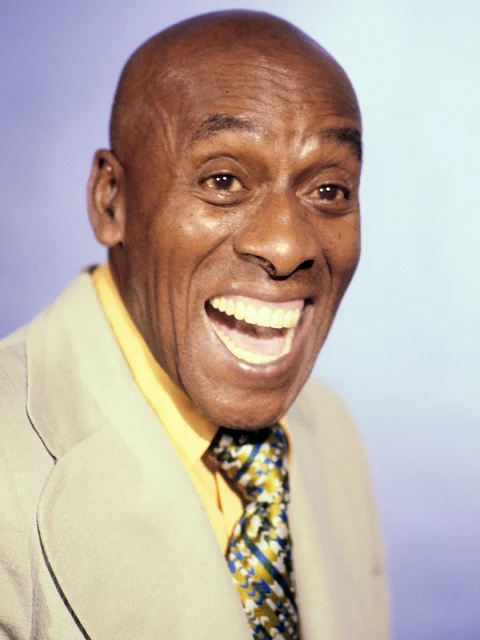 |
| Scatman Crothers voiced Jazz in Tranformers |
Overall, Jazz was a unique and beloved character in the original Transformers TV show. His love of jazz and Earth culture, combined with his cool personality and fast-talking demeanor, made him a fan favorite. He was an important member of the Autobots and played a crucial role in many missions throughout the series. Jazz's legacy lives on today, as he remains a beloved character among Transformers fans.
Jazz is a beloved character from the original Transformers TV show that aired in the 1980s. He was a member of the Autobots, the faction of ...
Read Article →
_poster.jpg)


