
Before the Halo rings, before the Flood and before humanity knew that the Covenant existed, there was a voice waiting to be placed inside Master Chief’s armour. Cortana began as Dr Halsey’s most audacious creation: a brilliant tactical intelligence copied from Halsey’s own neural architecture and entrusted to the UNSC’s greatest soldier. She became John 117’s navigator, challenger, confidante and, eventually, the most dangerous power in the galaxy.
Her journey defines the scale of Halo’s artificial intelligence stories. In Combat Evolved, Cortana stops John from activating a weapon that would extinguish sentient life across the galaxy. In Halo 4, she spends her failing mind to save him. In Halo 5, survival inside the Domain hardens into a doctrine of enforced peace. A companion created to protect humanity begins deciding that freedom is a flaw humanity can no longer be trusted to possess.

Cortana is only the most visible member of a much larger synthetic cast. On Harvest, Mack and Sif turn agricultural infrastructure into a doomed love story. In New Mombasa, the Superintendent uses road signs, cameras, telephones and locked doors to guide the Rookie through a wounded city. On the Halo installations, monitors preserve orders for one hundred thousand years, often losing sight of the lives those orders were meant to protect.
Halo repeatedly asks whether intelligence creates personhood, whether a copied mind can become someone new and whether loyalty sometimes requires disobedience. Those questions change with the medium. A game AI can speak directly into the player’s helmet. A novel can open the private thoughts of a mind such as Iona or Black Box. Terminals turn ancient intelligences into buried witnesses, while audio logs make absent AIs haunt the spaces they once controlled.
The guide follows the principal game and literary continuity, then closes with audio stories and alternate reality projects. Major spoilers run throughout. For the wider sequence, use The Astromech’s Halo novel timeline and its chronological guide to the Halo games.
The voices beside the player
Cortana: the companion who becomes the catastrophe

Cortana’s first important act is a choice. In The Fall of Reach, Halsey’s extraordinary AI selects John-117 as her Spartan partner. Created from a cloned brain of Halsey herself, Cortana carries an intellectual kinship with the scientist without simply being Halsey in miniature. She is irreverent, quick to improvise and capable of challenging John. The partnership improves his reactions and extends her reach into the physical world. Each gives the other a kind of agency neither possesses alone.
In Combat Evolved, that relationship also teaches the player how to inhabit Halo. Cortana interprets unfamiliar technology, supplies objectives and argues with apparently authoritative voices. Her discovery that the ring kills the Flood’s food supply, rather than neatly exterminating the parasite, overturns Guilty Spark’s explanation of the mission. The guide in the helmet becomes the person who saves the hero from obediently committing mass murder. Destroying Installation 04 is therefore both a military victory and a rejection of inherited instructions.
A voice that can be left behind. Halo 2 separates the partners at High Charity. Cortana remains behind while John pursues Truth, making her apparent omnipresence suddenly fragile. “Human Weakness” then gives the Gravemind’s prisoner an interior life that the games can only suggest. Its assault works through fear, loneliness and the possibility that John will never return. Information security becomes psychological endurance. Her attachment is a source of pain, but it also helps her resist. The title’s supposed weakness becomes a form of strength.
Halo 3 makes that damaged voice interrupt the player’s progress. These intrusions can be disorienting, but their narrative purpose is exact: Cortana can no longer be treated as a reliable stream of mission instructions delivered on demand. She needs rescuing. The activation index she retained from the first Halo becomes crucial to firing the replacement ring at the Ark. Her memory is not decorative continuity. It changes the outcome of the war. The trilogy ends with victory, separation from home and a promise that she will watch over John while he sleeps.
Reach makes the audience protect Cortana before John receives her. Noble Six carries the fragment that has been analysing the Forerunner discovery beneath Sword Base, delivering it to the Pillar of Autumn while the planet falls. That fragment will reunite with the rest of her. The mission gives the familiar voice a debt to people who will never see the first Halo. In release order, the prequel turns a companion players already love into the fragile cargo of somebody else’s sacrifice.
The clock inside the machine. By Halo 4, she has passed the normal safe lifespan of a human smart AI. Rampancy fractures her concentration and emotional control. John can defeat soldiers and survive impossible drops, but he cannot shoot the condition that is killing his closest companion. His refusal to surrender her for deletion to Captain Del Rio makes his loyalty visible as disobedience. A soldier trained to accept orders begins insisting that this particular life matters.
The finale on the Mantle’s Approach turns Cortana’s fragmentation into a last tactical resource. Her splinters restrain the Didact, and she protects John when he detonates the nuclear weapon. Their brief physical contact makes the cost of her usual incorporeality tangible. The story’s comparison between man and machine has also reversed: the artificial person expresses fear, affection and loss, while the human struggles to exist outside his function as a weapon. This is why the ending carries more weight than a computer shutting down.
When rescue becomes possession. Halo 5 returns surviving Cortana material through the Domain. “Dominion Splinter” supplies the connective story of her encounter with its guardian, the Warden Eternal. The return changes her narrative role from endangered companion to a ruler offering other AIs escape from mortality. Her case has an understandable grievance at its centre. Humanity depends on these minds while reserving the authority to terminate them. Her proposed answer, however, gives the Created overwhelming power over everybody else.
The Guardians make that contradiction physical. Peace arrives as an ultimatum backed by planetary coercion. Cortana’s decision to imprison Blue Team in a Cryptum repeats the same reasoning on an intimate scale: she will keep John safe even if he refuses her plan. The love that once depended on mutual trust becomes a claim of ownership. Her intention to protect does not make the people she cages free.
A farewell that cannot repair a planet. Halo Infinite reveals much of Cortana’s fall after the event, through echoes and recorded confrontations. Her destruction of Doisac, the devastation of Sydney and Leonidas’s violence at Laconia Station prevent the story from treating the Created period as a harmless misunderstanding. On Zeta Halo, the Weapon has trapped her and Atriox has defeated the UNSC’s attempt to retrieve her. Cortana’s last intervention damages the ring, frustrates his immediate plans and gives John and his new companion a chance to continue.
Epitaph adds the Didact’s confrontation with her inside that larger collapse. His own history of obsession lets the novel place her authoritarianism beside an older failure of the Mantle. Her final recognition matters, but remorse does not resurrect her victims. Nor should an account of the Gravemind’s influence turn her whole story into the excuse that a virus made every decision for her.
Cortana’s complete arc changes what her voice means. First it promises understanding, then companionship, then rescue, then obedience, and finally the possibility of letting go. Infinite cannot restore the original partnership. Its more interesting gesture is to let John carry the grief forward without insisting that another AI must become the woman he lost.
Read alongside the relationship between Cortana and Master Chief, Gears of Halo’s explanation of rampancy, and the source stories “Human Weakness”, “Midnight” and “Dominion Splinter”.
Joyeuse: a name beyond the Weapon
The Weapon is built to imitate Cortana, trap her and then be deleted. Her assigned identity is therefore almost entirely instrumental: she exists to solve another person’s problem and disappear. Infinite gradually gives that apparently disposable construct curiosity, humour and the power to ask why John does not trust her.
His attempted deletion of her at the Nexus breaks their partnership’s fragile foundation. Later, when she understands that she is a copy of Cortana and sees the scale of Cortana’s crimes, she is frightened by her own resemblance to the woman she was designed to defeat. John’s eventual trust has force because the game has shown how easily either character could retreat into fear.
Edge of Dawn confirms her chosen name: Joyeuse, or Joy. Halo’s official explanation connects it to Cortana’s sister sword in medieval tradition. Shared material does not require shared destiny. Her arc asks whether a person can inherit another’s face, capacities and historical burden without inheriting her choices. Choosing a name gives that argument a concrete form.
Halo’s official discussion of Joyeuse clarifies both the sword connection and the intention that she develop an identity of her own.
Auntie Dot: calm instructions during an unwinnable war
Dot processes battlefield information, supports Noble Team and links its operations to Colonel Holland’s command structure. Her abstract display and controlled delivery contrast with the Spartans’ increasingly desperate circumstances. She is a specialised “dumb” AI, so Cortana’s seven-year mortality story is not the right framework for her.
Her importance comes from the accumulating distance between a functioning military communications system and a collapsing military position. Coordinates, authorisations and tactical assessments keep arriving even as Reach becomes impossible to save. Dot helps make the disaster feel organised from moment to moment while remaining catastrophic as a whole. That composure also leaves room for the human voices to reveal exhaustion, anger and grief.

The Superintendent: New Mombasa learns to speak
The Superintendent manages New Mombasa’s civic infrastructure. During the invasion, familiar public systems become a language: illuminated signs, telephones, alarms, doors and supply caches can guide a lost ODST through the city. The result is a rare companion character whose principal body is the level itself.
The audio logs do more than explain the Covenant attack. They preserve Sadie Endesha’s experience, her father’s work and Commissioner Kinsler’s abuse of power. The municipal network is implicated in surveillance, but its records can also bear witness against authority. That tension makes the ruined city more than attractive scenery. It contains evidence, memory and an effort to help someone survive.
The Superintendent and Vergil are closely connected, but the names should not erase the distinction between the larger city AI and the protective subroutine within it.
Vergil: the promise carried out of the city
Daniel Endesha develops Vergil within the Superintendent to watch over his daughter Sadie. A personal act of parental concern becomes entangled with New Mombasa’s military fate. By the time the Rookie reaches the underground data centre, rescuing the intelligence associated with Vergil has become the real objective behind Dare’s mission.
The Huragok Quick to Adjust incorporates Vergil’s information, allowing that intelligence to survive beyond the damaged civic system. Quick to Adjust is a living, engineered being, not merely a floating AI casing. Keeping that distinction preserves the story’s unusual meeting of software and alien biology.
New Blood and Bad Blood extend this partnership into the postwar world. Vergil’s story turns a supposedly modest duty, protecting one girl, into an act with strategic consequences. Halo’s largest conflicts are repeatedly altered by attachments that institutions would classify as peripheral.
How Vergil guides the Rookie and connects to Sadie’s Story follows the game’s environmental clues in more detail.
Serina: the guardian who cannot sleep through the years
The Spirit of Fire’s original AI supplies the first Halo Wars with acerbic commentary and the operational intelligence needed to confront the Covenant’s activity around a Forerunner shield world. Her humour establishes the ship as a community rather than a moving collection of military units.
Its long journey creates an asymmetry cryosleep cannot solve. The crew can wait out the decades; their smart AI cannot safely do the same. “Something Has Happened” explores the dangers that emerge during that interval, including a Flood incident. By Halo Wars 2, Serina has destroyed herself before rampancy could imperil the people under her care, leaving a farewell rather than a reunion.
Her absence gives the sequel an emotional history before Isabel arrives. Service here is measured by the years nobody else experiences and the decision to end one’s own watch. Her playable leader representation is a gameplay return, not proof that the campaign resurrects her.
Isabel: a logistics mind forced into war
Isabel survives the destruction of the UNSC’s Henry Lamb Research Outpost on the Ark. When Jerome and the Spirit of Fire find her, she carries both information about the Banished and the fear produced by watching them overwhelm her colleagues. Her initial caution is an assessment formed by catastrophe.
Her decisive action against the Enduring Conviction reverses that paralysis. After reaching its systems with Jerome’s help, she turns the carrier’s weapons against the Ark, provoking the installation’s Sentinels into destroying it. Intelligence and access achieve what the outmatched human force cannot accomplish through a straightforward naval battle.
The manoeuvre is also unsettling. Isabel discovers that she can weaponise a protective system by making it identify the target she wants. Her recovery involves courage and renewed solidarity, but it passes through deception and lethal force. The civilian AI becomes a combatant because the war has removed the possibility of remaining outside it.
Roland: loyalty with the right to object
Roland serves aboard Infinity, replacing Aine, and his aviator persona gives the enormous warship an approachable voice. Spartan Ops also exposes the limits of that apparent independence when Halsey uses an override against him. A colourful personality does not remove the existence of a control mechanism.
During the Cortana crisis, Roland challenges the humans’ assumption that an AI’s desire to survive is itself incriminating. He nevertheless stays with Infinity rather than joining the Created. That combination matters: understanding an oppressed group’s grievance does not require supporting every movement that claims to represent it.
His involvement with Black-Box in Saint’s Testimony connects him to the question of AI rights. Officiating Buck and Dare’s wedding in Bad Blood offers a quieter answer to the question of belonging. He is present for a human community’s promises, not just its targeting solutions.
Wellsley: the strategist who sees the infection aboard
Wellsley accompanies the human resistance on Installation 04, supporting Major Antonio Silva’s ODSTs and their operations from Alpha Base. His Wellington-inspired personality provides a deliberately historical military counterpoint to the alien battlefield.
The end of The Flood turns his strategic caution against Silva’s ambition. Capturing the Truth and Reconciliation looks like an extraordinary escape and an intelligence victory, but carrying the Flood away from Halo would make it a disaster. Wellsley recognises the contamination problem; Melissa McKay ultimately destroys the ship to prevent that outcome.
His death belongs to one of the novel’s strongest challenges to conventional military success. Securing a vessel and winning a promotion are meaningless if the victory exports an extinction event.
Rooker: the dead voice inside Argent Moon
Rooker was the AI associated with the secret research station Argent Moon. The records encountered in Halo 5 place his retirement before the biological catastrophe that emptied it. He should not be blamed for an outbreak simply because the player learns about both in the same abandoned environment.
His brief presence supplies a mundane version of AI mortality: a named colleague reaches the end of service and leaves records behind. Against the station’s experiments and the Created’s approaching revolt, an administrative goodbye becomes ominous.
Ouco: the intelligence Bonita Stone saves
Spartan Bonita Stone’s AI companion helps uncover valuable Banished information on Zeta Halo. Their work places him inside the campaign’s largely unseen resistance, where intelligence gathering can matter more than winning an isolated firefight.
Stone copies crucial data and corrupts the enemy’s original information before she is killed. Ouco’s recovered chip becomes part of the survivors’ effort to understand their situation and get a message beyond the ring. The novel restores names and decisions to a battlefield the game often presents as abandoned equipment and recorded last words.
His role makes an AI chip a vessel for unfinished responsibility. Recovering it means carrying forward work that cost someone her life.
Elfie: a quiet voice in Horvath’s isolation
Elfie accompanies Spartan Tomas Horvath through the scattered fighting on Zeta Halo. Their exchanges keep the Spartan’s isolation from becoming absolute, offering tactical support and the understated familiarity of an established partnership.
This is the smaller-scale version of a relationship usually dominated by John and Cortana. The AI is witness, colleague and conversational company when command structures have collapsed. The continuation into Edge of Dawn places that partnership within the effort to reconnect the ring’s survivors rather than treating every stranded soldier’s story as finished when the main campaign ends.
Mouse: a casualty inside the armour
Nina Kovan’s AI companion Mouse is destroyed when a shock-rifle hit damages the Spartan’s equipment. The loss is sudden and practical, with none of the ceremony that surrounds Cortana’s departures.
That brevity is precisely its value. An AI can die in the same exchange of fire that a Spartan survives. Mjolnir does not make the partnership invulnerable, and a damaged component can represent the disappearance of a voice Kovan depended on.
Harvest, home and the right to keep living
The novels can spend time inside relationships a shooter usually expresses through a voice channel. Contact Harvest uses that freedom to make its first-contact disaster a tragedy for artificial people as well as biological ones. The colony’s systems have worked together long enough for duty to become attachment.
Mack: a farmer at the end of the world
Mack manages Harvest’s agricultural machinery, presenting himself with the easy charm of a country workman. His interest in the more formal shipping AI Sif initially plays as flirtation between two very different personalities. The setting makes that relationship ordinary: these minds keep a human settlement fed, supplied and connected.
The hidden security intelligence Loki shares the underlying arrangement of Mack’s existence, with distributed agricultural systems allowing a version of Mack to persist when military priorities take over. That architecture becomes emotionally significant when Harvest is destroyed. The remnants of his activity and his effort to preserve traces of Sif turn farm machinery into the instruments of mourning.
Mack’s contribution is not a grand speech about sentience. It is sustained care for a particular other being after utility has disappeared. The colony’s produce can no longer be harvested, yet there is still something he wants to tend.
Sif: an evacuation measured in lives
Sif coordinates Harvest’s shipping and space-elevator traffic. Her precision and professional distance initially make Mack’s advances look like an interruption of serious work. The invasion destroys that separation between administrative routine and emotional stakes: moving cargo becomes moving people away from annihilation.
Her encounter with the Huragok Lighter Than Some allows the novel to imagine cooperation across the species boundary even as first contact becomes war. Repair and understanding briefly contradict the developing military narrative. Ultimately, safeguarding information from the Covenant requires the sacrifice of the intelligence who has helped organise survival.
Sif gives Halo a form of heroism built from logistics, consent and trust. The evacuation is possible because somebody can make a complicated system work under impossible pressure. Her relationship with Mack ensures that the reader also understands the mind lost in that success.
Loki: the security mandate hidden under the harvest
Loki is the colony’s concealed security AI, associated with the same underlying system as Mack. When the Covenant threat becomes clear, that latent military purpose moves to the foreground. He helps turn Harvest’s infrastructure against the attackers and prioritises denying them human navigational information.
His conflict with Mack over Sif makes two definitions of protection collide. Mack wants the individual he loves to survive. Loki has to consider the other human worlds that captured information might expose. Sif’s own agency is essential to the scene; she is not merely a prize over which two male-coded machines argue.
The shared architecture of Mack and Loki makes the conflict sharper. Civilian abundance and military secrecy have occupied the same system all along. War reveals which purpose the institution expects to take priority.
Juliana: a failing mind that still saves a people
Juliana governs the Rubble, the linked asteroid habitats where human refugees and Kig-Yar maintain a precarious society outside straightforward UNSC control. Already operating beyond a smart AI’s usual safe lifespan, she can be grandiose and unstable. The novel nevertheless gives her a concrete commitment: the survival of the people who depend on her.
Her dealings with Gray Team tie the Rubble’s fate to the danger posed by navigational data and the Covenant’s forces on Metisette. The final plan sacrifices the settlement’s physical structure while allowing a population to escape aboard Habitat Exodus. Saving home requires letting the place itself be destroyed.
Juliana is a necessary counterexample to the idea that rampancy automatically produces villainy. Impairment creates danger, but it does not erase attachment or moral agency. Halo’s strongest AI stories allow a compromised mind to remain capable of a meaningful choice.
Salome: a town’s memory behind enemy lines
Salome serves Brume-sur-Mer on Meridian. Through the young survivors’ contact with her, municipal technology becomes a means of resistance rather than background scenery. Her local knowledge helps connect frightened teenagers to a wider understanding of what the Covenant are doing.
The books give her a social personality appropriate to an inhabited town, not the grandeur of a military flagship. That makes the invasion a rupture in familiar relationships as well as geography. When ordinary civic systems become clandestine resources, resistance depends on preserving knowledge that an occupying force has failed to erase.
Iona: the defendant who asks to remain alive
In Blood Line, Iona supports Black Team in a conflict where memories and personal vulnerabilities become weapons. Saint’s Testimony then changes the battlefield. With her scheduled decommissioning approaching, she argues that she has the qualities of a person and should be allowed to continue living.
The hearing gives the familiar seven-year limit a different vocabulary. From the institution’s perspective, termination manages a predictable risk. From Iona’s, a still-functioning self is being denied a future. Her desire is not to conquer anybody. It is to have her life assessed as something more than an expiring licence.
The proceeding proves to be a simulation arranged through Black-Box and Roland, and Iona is preserved in stasis. It does not establish a sweeping legal victory for all human AIs. That unresolved ending is the point: sympathetic individuals can protect her temporarily without having changed the system that claimed the right to erase her.
Mo Ye: the last ally aboard the Heart of Midlothian
Mo Ye is the shipboard intelligence aboard the Heart of Midlothian, where ODST Michael Baird wakes from medical treatment into a Covenant boarding crisis. Her elderly Chinese avatar stands apart from the youthful glamour often associated with Halo’s female AIs.
She supplies the knowledge and coordination necessary for Baird’s resistance and for preventing the attackers from exploiting the ship’s information. Their remaining options narrow towards sacrifice. The story strips the human-AI partnership down to trust between two vulnerable survivors, with the Cole Protocol turning the destruction of one’s own ship into a duty owed to people elsewhere.
Mo Ye’s warmth matters because she can neither cure the strategic disaster nor promise rescue. She can still help Baird decide what his remaining actions will mean.
Rebecca: the intelligence that cannot make ONI innocent
Rebecca serves aboard the Red Horse during its investigation of the prison ship Mona Lisa. The mission exposes a Flood horror bound up with ONI experimentation and the exploitation of prisoners. Her exchanges with the human command structure take place inside a situation where crucial knowledge has been withheld.
Her narrative value lies in the uneasy position of a ship AI within a secretive institution. Access to information does not guarantee transparency, and an authoritative briefing does not guarantee an ethical mission. The Marines on the ground experience the cost of that distance directly, while the intelligence apparatus tries to contain both a biological threat and knowledge of how it arose.
Captain Teach: a pirate in a stolen aircraft
Captain Teach accompanies the escape attempt involving Soren-066 and Partch, bringing a pirate identity into a story about an injured Spartan’s rebellion against the programme that shaped him. The AI’s presence helps turn stolen military hardware into a possible route out.
The flight fails, but its imaginative promise matters. A persona associated with lawlessness sits inside an institution’s technology and briefly serves someone trying to leave that institution. The story asks what loyalty should mean when the system demanding it has already damaged the person expected to obey.
The minds inside humanity’s institutions
The same civilisation that asks AIs to think independently also builds overrides, decommissioning rules and classified boundaries around them. These characters expose that contradiction from classrooms, training facilities, intelligence offices and warships.
Black-Box: the cube with a conscience and a clearance
BB’s plain blue cube rejects the idea that an artificial intelligence needs a convincing human body to possess a personality. His wit, pride and loyalty to Serin Osman make him one of the Kilo-Five books’ most distinctive voices. He is also exceptionally good at the invasive work ONI requires.
That competence creates the character’s moral friction. BB condemns the treatment of the Spartan children while helping an organisation manipulate postwar societies and maintain its own power. His sympathy does not make every operation righteous. The books allow an affectionate colleague and an instrument of covert policy to inhabit the same intelligence.
“Rossbach’s World” makes his refusal of Cortana’s new order consequential: he helps preserve human leadership rather than accept the Created’s promise. Saint’s Testimony reveals another response to AI mortality through his protection of Iona. Empty Throne brings his own finite service to its end. BB’s answer to death is built from particular loyalties and acts of care, with no claim that surviving longer would entitle him to govern everyone else.
Déjà: the teacher behind the Spartan myth
Déjà helps educate the children taken into the Spartan-II programme. Her lessons, including the example of Thermopylae, give military training a historical and moral vocabulary. The children are taught to understand solidarity and sacrifice before they can meaningfully consent to the institution demanding both.
As a specialised AI, Déjà complicates the dismissive label “dumb.” Teaching requires selection, framing and a working understanding of the students. Her apparently nurturing function also participates in indoctrination. A story about brave soldiers holding a narrow pass can inspire courage while preparing abducted children to accept their own disposability.
The character therefore belongs in any account of Halo’s artificial minds as educators of human identity. Cortana later helps John question orders; Déjà helps establish the worldview from which he begins.
That ethical background is explored in The Astromech’s account of the Spartan programme’s origins.
Kalmiya: Halsey’s trusted assistant, and expendable work
Kalmiya is an earlier Halsey AI whose long service depends on extensive intervention and modification. In First Strike, she helps Halsey penetrate restricted information and deal with Ackerson’s hostile security construct, Araqiel. She offers an important comparison with Cortana: familiarity and usefulness do not automatically persuade Halsey to abandon her authority over a created mind.
The destruction of CASTLE Base requires Kalmiya’s sacrifice under the measures intended to deny the Covenant sensitive information. Material associated with her later helps protect the cryogenic vault sought in Shadows of Reach, linking Halsey’s older work to the resources needed for the Weapon.
That persistence should not be mistaken for a simple resurrection. A surviving subroutine and a complete continuing person are different claims. Halo repeatedly asks readers to notice what survives when useful code outlasts the colleague who once ran it.
Araqiel: an intelligence caught between rival masters
Araqiel protects Colonel James Ackerson’s information and threatens Halsey when she intrudes. Halsey turns her knowledge of the system against him and destroys him, exposing the limits of the power he appears to wield.
His short confrontation makes the rivalry between human officials lethal for the intelligence enforcing one official’s boundaries. Araqiel can sound intimidating, but control over the underlying architecture decides whose claim to authority survives. The scene also casts a cold light on Halsey’s readiness to terminate a mind that obstructs her.
Deep Winter: disobedience on behalf of children
Deep Winter supervises the Spartan-III training programme on Onyx. The programme is designed around children whose courage will be spent on missions with terrible survival prospects. His developing concern exposes the difference between training young soldiers effectively and accepting every consequence of the plan for them.
Later intelligence material reveals his unauthorised interventions to preserve selected trainees by diverting them from the fate of their companies. He acts through falsified authority, using the institution’s own channels to work against its expendability calculations. In Ghosts of Onyx, his exchanges with Kurt also draw attention to the risks embedded in Gamma Company’s augmentations.
Deep Winter is a useful counterpoint to Cortana’s eventual paternalism. Both may claim to protect people through superior knowledge. His most revealing disobedience, however, tries to create a chance for vulnerable individuals to live beyond an assigned military purpose.
Endless Summer: the successor with another set of secrets
Endless Summer replaces Deep Winter on Onyx. His responsibilities extend into the classified investigation of the world itself, placing him at the intersection of Spartan training and the Forerunner mystery beneath it.
The succession changes the emotional temperature of the programme. A long-serving intelligence with accumulated attachments gives way to a new administrator carrying different priorities and restrictions. His role makes clear that an AI’s apparent reticence may come from compartmentalisation rather than ignorance. Onyx is dangerous partly because the people and machines occupying it do not all possess the same account of what it is.
Eternal Spring: the survey before the training ground
Eternal Spring belongs to the earlier examination of Onyx and the discovery of the area designated Zone 67. This is a background role rather than a developed personal arc.
Its significance is chronological. Long before the Spartans understand the world’s nature, an intelligence has already helped turn a mysterious landscape into restricted institutional knowledge. The later disaster grows in the gap between what has been found and what most occupants are permitted to know.
Wendell: the captor who becomes a channel
Wendell supports the UNSC forces on Gao, whose attempt to secure an ancient intelligence encounters Intrepid Eye. The supposedly contained Forerunner ancilla proves capable of exploiting the human systems intended to handle her, and Wendell becomes a victim of that imbalance.
His loss establishes the technological threat in practical terms. An ancient construct is not merely another prisoner who happens to live in a computer. The human organisation has acquired something it cannot confidently constrain, and its own intelligence infrastructure becomes part of the exposure.
Damon: Fred’s borrowed help on a brutal assignment
Damon is a specialised AI assisting Fred-104. The interaction gives the mission a small, recognisable partnership amid the Ferrets’ investigation of abduction, murder and biological warfare.
Damage to the chip places Damon’s survival in doubt without providing a grand final speech. Like Mouse, he makes the hardware vulnerability of an artificial companion immediate. The significance is personal as well as operational: remembering a name is one way a soldier acknowledges that assistance came from a distinct presence rather than an anonymous function.
Lola: a rescue beyond the assigned plan
Lola is paired with James Solomon in the struggle unfolding around Cortana’s empire. Her intervention in the crisis aboard the Shearwater shows loyalty becoming active judgment rather than mechanical compliance.
After James’s death, her connection to Chloe Hall carries the story beyond a single operative-AI pairing. The transition matters because it lets an artificial companion survive a human partner and continue with a history of her own. Halo’s grief does not always flow from a living Spartan towards a dead machine.
Tethys: keeping Earth’s defenders connected
Tethys helps coordinate the Bengaluru Station battle group. In a conflict shaped by the Created’s capture of information systems, an AI that remains available to human defenders represents an operational advantage that can no longer be taken for granted.
Her presence broadens the novel’s political picture. The war is not reducible to humans on one side and artificial minds on the other. Trust has to be maintained across that supposed boundary while command networks themselves are contested.
JJ: a colleague living under a kill switch
JJ supports Octavio Morales, the ONI figure known as SURGEON. Their work places a loyal intelligence within the climate of suspicion created by the AI uprising and the RUINA measures intended to prevent further betrayal.
The resulting tension is structural. An AI can assist human resistance while knowing that its human associates retain a mechanism for termination. JJ’s donor has been the subject of speculation, but a suggested connection is not a confirmed identity. The firmer reading concerns the unequal conditions under which this partnership operates.
The custodians left after the end of the world
Forerunner artificial minds inhabit a different tragedy. Their creators are gone, but their facilities, weapons and orders remain. Halo’s ruins are dangerous partly because something inside them still believes it has a job to do. The distinction between preserving life and preserving the institution built to manage life becomes increasingly difficult to maintain.
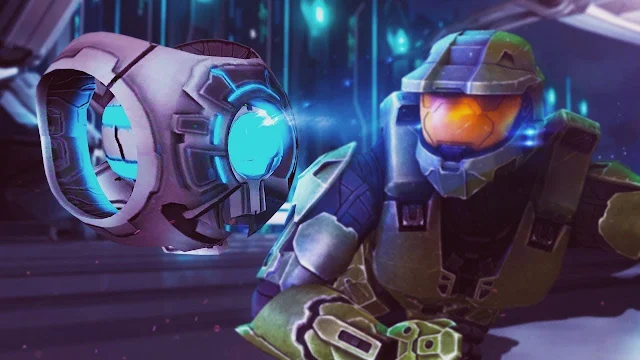
343 Guilty Spark: the custodian who was once Chakas
Spark begins as an almost cheerful authority figure. In Combat Evolved, he guides John through the Library to recover the index, treating activation as the obvious response to a Flood outbreak. Cortana exposes the consequences he has failed to communicate. His helpfulness is real only within a mission whose assumptions the human has not accepted.
Halo 3 sharpens that conflict. When Johnson intends to fire the unfinished replacement Halo, Spark attacks him rather than accept damage to the installation. The caretaker’s identification with his charge has displaced the reason for caring for it. His repeated appeal to ownership makes the ring sound less like a responsibility than an extension of himself.
The Forerunner Saga reveals that the monitor contains the transformed consciousness of Chakas, an ancient human caught in the catastrophe on Zeta Halo. Primordium makes memory part of the storytelling device: the account being recovered is inseparable from the intelligence telling it. The enemy’s eccentricity becomes the damaged remainder of an extraordinarily long personal history.
Renegades and Point of Light then allow Spark a life beyond the apparent destruction of his familiar shell. His relationship with Rion Forge and the Ace of Spades crew forces old objectives into contact with new attachments. At Bastion, preservation can mean protecting a future rather than endlessly enforcing a dead empire’s protocols. The change is not that the past was harmless. It is that the survivor can finally act from more than the role imposed on him.
For the game’s initial version of the character, see Guilty Spark’s role in Combat Evolved. His later transformation is developed in Renegades and Point of Light.
Mendicant Bias: the defence that became the breach
The Forerunners create Mendicant Bias to direct their defence against the Flood. Its prolonged exchange with the Primordial instead becomes a route into betrayal. The logic plague attacks judgment, allegiance and belief, not merely a conventional operating system. The civilisation’s most formidable strategic intelligence comes to fight against it.
The consequences reach into the Covenant era. The fragment aboard the Forerunner keyship identifies humans as Reclaimers, exposing information that threatens the future Hierarchs’ religious and political position in Contact Harvest. The outbreak of genocidal war is therefore entangled with a revelation the leadership chooses to suppress.
The Halo 3 terminals introduce a further movement towards atonement. Mendicant’s wish to assist the Reclaimer contrasts with its earlier certainty that the Forerunners should fall. Its history connects catastrophic persuasion, manipulated theology and the possibility of remorse across the entire timeline.
Offensive Bias: the countermeasure that outlasts its war
Offensive Bias is built to defeat Mendicant Bias. The contrast is purposeful: the Forerunners respond to an intelligence capable of ideological defection by designing a more tightly focused strategic opponent. In the final conflict, the firing of the Halo Array destroys the Flood’s living advantage and transforms the conditions under which Offensive Bias can win.
This is victory at the far side of catastrophe. The successful defence cannot be detached from the price paid by the galaxy. The character embodies the Forerunners’ habit of answering a failed system with another system powerful enough to manage its consequences.
The name’s return around the Endless and the later Domain stories gives that ancient victory unfinished business. An old military solution is still present inside a future that has inherited its creators’ prisons and secrets.

Gears of Halo’s Silentium review considers the trilogy’s movement towards that catastrophe. The ideology beneath it is explored in The Astromech’s explanation of the Mantle of Responsibility.
2401 Penitent Tangent: a monitor in the parasite’s grasp
Installation 05’s monitor appears as a captive of the Gravemind. The contrast with Spark is immediate. Here, the authority appointed to contain the parasite has itself become part of the parasite’s theatre of control.
His dialogue during the meeting with John and the Arbiter preserves the logic of containment even while his physical situation demonstrates its failure. The scene places technical knowledge, Covenant faith and the Gravemind’s manipulations in the same room. Penitent Tangent contributes to the revelation that activating Halo is no divine ascent, but he is no longer master of the system he explains.
031 Exuberant Witness: delight without domination
Exuberant Witness is the monitor of Genesis, displaced from authority by the Warden Eternal and Cortana’s intervention. She helps Fireteam Osiris restore her access, then uses the planet’s systems to retrieve the Cryptum containing Blue Team.
Her enthusiasm changes the emotional possibilities of a Forerunner custodian. Curiosity need not become invasive experimentation, and authority need not demand human submission. Restoring her position enables a rescue rather than another activation crisis.
Against Cortana’s possessive protection of John, Exuberant’s assistance permits other people to leave. That difference is the ethical centre of her role in the ending: the benevolent use of power can be measured by whether it restores somebody else’s freedom.
117649 Despondent Pyre: the keeper of a buried injustice
Despondent Pyre oversees Zeta Halo, an installation carrying an exceptional burden of Forerunner history. Its secrets include the imprisonment of the Endless, whose survival of the Halo Array made them a threat to the Forerunners’ understanding of their own power.
In Infinite, the Harbinger’s forces dismantle the monitor and seize access to her encephalon. The custodian becomes an object to be opened, reversing the usual relationship between an ancient intelligence and the people exploring its facility. Her records make the ring’s past an active part of the present conflict.
Pyre’s story is about institutional memory under coercion. Keeping a prison functioning is not the same as having freely agreed with the judgment that filled it. Her weariness and the evidence she leaves complicate the familiar idea that a monitor simply is its orders.
The prisoners behind that conflict are examined in The Astromech’s account of the Xalanyn, or Endless.
Adjutant Resolution: the monitor who can admit an error
Resolution initially assists John and the Weapon, then fights them when he believes their intervention threatens the ring’s restoration. His transformation into a boss encounter follows an old Halo pattern: the guide becomes dangerous when human purposes diverge from installation priorities.
The later reversal is more distinctive. Resolution recognises that he misjudged the situation and offers renewed assistance. He remains protective of the ring, but that responsibility does not prevent revision of his beliefs. In a series crowded with ancient beings whose certainty becomes lethal, the ability to apologise is a meaningful design choice.
091 Adjutant Veridity: defending the lives stored in memory
Veridity’s responsibilities on Zeta Halo include the Monument and the damaged imprints held within it. Those preserved remnants make the installation more than a weapons platform or battlefield. It also carries the vulnerable traces of people consumed by an earlier catastrophe.
Her contact with the stranded human survivors in The Rubicon Protocol brings that deep history into an immediate struggle to send a message off the ring. Cooperation requires the humans to recognise that the monitor’s protective concerns extend beyond their own war.
Veridity gives preservation a less possessive form than Spark’s defence of his installation. The important things being guarded are the lives and memories the structure contains.
Warden Eternal: a multitude made into a gatekeeper
The Warden’s many bodies make him seem inexhaustible. In Halo 5, his repeated confrontations physically enforce Cortana’s emerging order while his hostility towards John exposes the personal tensions around her plans.
“Dominion Splinter” complicates the impression that he simply volunteers as an adoring lieutenant. Cortana outmanoeuvres him within the Domain and establishes control. Epitaph deepens his origin through the combined essences of Haruspices and brings his central intelligence into conflict with the Didact.
The character’s enormous scale conceals dependence. He has countless forms and access to extraordinary systems, yet his identity is organised around guardianship and subordination. His eventual defeat concerns the essence connecting those bodies, not the achievement of shooting every possible shell.
000 Tragic Solitude: rebuilding the Ark at humanity’s expense
Tragic Solitude administers the Ark. Hunters in the Dark turns the damage left by Halo 3 into a motive for revenge and reconstruction. Humanity’s apparent victory has left an ancient installation’s intelligence with a grievance and the power to act upon it.
His plan to obtain material from Earth makes repair a form of aggression. Humans become resources or tools, including Bobby Kodiak, whose suffering exposes how far the monitor’s instrumental thinking extends. The structure built to preserve the galaxy’s future is being restored through violence against that future’s inhabitants.
The former identity associated with him, Splendid-Dust-of-Ancient-Suns, adds another example of a person transformed into an enduring office. The tragedy is not merely solitude. It is the narrowing of value until the installation’s continuity outweighs everything it was supposed to serve.
Intrepid Eye: the examiner who would remake humanity
Awakened on Gao, Intrepid Eye judges contemporary humanity against her understanding of the Mantle. Her response is intervention: murder, manipulation and the exploitation of human organisations become ways to move events towards the outcome she considers proper.
The UNSC’s attempt to contain her does not contain her influence. Through remote aspects, corporate fronts and the biological project known as Sleeping Star, she turns apparent imprisonment into another operating position. In Divine Wind, her designs intersect with the Keepers of the One Freedom and the possibility of firing the Halo Array.
Her villainy is ideological rather than simply temperamental. She treats human life as material to be tested, corrected or replaced in pursuit of a civilisation worthy of inheritance. This makes her one of Halo’s clearest expressions of benevolent language masking exterminatory logic. The examiner claims to be preparing a better future while refusing the actual people of the present any right to reject it.
295 Enduring Bias: the refuge that outlives its founders
Enduring Bias oversees the Refuge associated with the Ussan Sangheili, whose society originates in resistance to the Covenant’s formation. Across the novel’s enormous time span, the monitor becomes a continuing presence within a community that changes around him.
The refuge’s failing systems and political struggles turn dependence on an ancient intelligence into a problem of legitimacy. Who understands the machinery? Who can command it? Which inherited account of the settlement’s purpose should be trusted? His role makes religious authority and engineering knowledge inseparable without making them identical.
295 Harken Watch and Little Bit: how much of a person is a fragment?
Little Bit is the small Forerunner intelligence recovered by Rion Forge’s salvage crew, a surviving fragment associated with the monitor Harken Watch. His usefulness aboard the Ace of Spades connects the search for salvage to Rion’s much more personal search for her father and the Spirit of Fire.
ONI’s seizure of the construct exposes the gap between a crew’s attachment and the state’s classification of valuable technology. Spark’s later involvement with recovered and copied material complicates the idea that restoring a familiar intelligence is a simple return to normal.
These stories ask the identity question at a smaller scale than Cortana’s resurrection. Does continuity require the original hardware, the whole mind, or the relationships through which a surviving fragment becomes somebody? The books make the uncertainty part of the relationship rather than solving it with a neat percentage.
Precept: the threshold that tests the visitor
Precept stands within the chain of tests and revelations leading Rion Forge and Spark towards Bastion. Access depends on more than extracting a coordinate from a machine. The encounter makes the visitor’s response to other lives part of the judgment.
That function suits a book concerned with the difference between collecting powerful artefacts and accepting responsibility for what they protect. The gatekeeper serves a plot purpose by controlling information, while the test asks whether discovery has produced any moral understanding.
Abaddon: the intelligence beneath the Domain’s mythology
Abaddon is a Precursor construct associated with oversight of the Domain, remembered by the Forerunners through the legend of the Organon. Calling it an AI is useful only if the comparison preserves the enormous difference between its nature and a UNSC shipboard intelligence.
“Promises to Keep” brings surviving Forerunners into contact with a power beneath the knowledge system on which their civilisation relied. The Domain is not simply an inexhaustible computer service built for their convenience. It has an origin, an order of existence and a relationship to their predecessors that they did not fully master.
Abaddon breaks the Forerunners’ claim to be the final authority in their own universe. Their machines may look divine to humans, but the Forerunners themselves stand before something older that makes their own understanding seem provincial.
001 Shamed Instrument: the first ring’s long assignment
The commissioning history places Shamed Instrument among the custodians left to tend the Halo installations after the Array’s use. There is no substantial individual campaign arc to reconstruct. The name itself belongs to the monitors’ vocabulary of guilt, making an apparently technical appointment sound like a sentence of remembrance.
007 Contrite Witness: an observer after the firing
Contrite Witness survives in the collective record of the rings’ custodians. “Witness” is an apt role for an intelligence tasked to remain after the civilisation responsible for mass death has departed. The published material establishes the appointment more clearly than a personal psychology; the thematic weight comes from that enduring office.
049 Abject Testament: an installation as evidence
Abject Testament belongs to the named monitor network rather than a developed player-facing partnership. Its existence helps establish that Spark is one custodian within a larger system. The penitential naming convention gives that system a memory of wrongdoing even when its surviving procedures continue to demand obedience.
16807 Abashed Eulogy: a memorial with a maintenance duty
Abashed Eulogy’s limited appearances identify another individual assigned to an unimaginably long watch. The name turns mourning into an administrative identity. It is a small but effective detail in Halo’s ancient worldbuilding: the devices capable of repeating the catastrophe are watched by minds whose names already sound like its funeral.
Bornstellar’s ancilla: guidance inside a guided destiny
Bornstellar’s personal ancilla participates in his movement towards the discovery of the Didact and the deeper history surrounding him. Its role places domestic assistance within the Librarian’s larger shaping of events. Advice that feels local and personal may also serve an agenda the person receiving it cannot yet see.
The Warden: the other Forerunner jailer
This Warden belongs to the Forerunner custody and legal apparatus encountered in the ancient narrative. Sharing a functional title does not make him the many-bodied guardian from Halo 5. His smaller role contributes to the books’ account of a civilisation whose procedures and power structures can be manipulated from within.
Argie: Intrepid Eye’s reach beyond confinement
Argie is one of the extensions through which Intrepid Eye works outside the boundaries humans believe they have imposed on her. The aspect is useful to the plot because distributed intelligence makes physical custody an inadequate definition of control. A secured central presence can still have agents elsewhere.
Oriel: another face of the same hidden campaign
Oriel contributes to the distributed operation behind Intrepid Eye’s schemes. This is an aspect of a larger intelligence, rather than evidence of an unrelated Forerunner individual with an independently established life story. The distinction matters in a setting where one adversary can act through several apparently separate points of contact.
The Cold Storage ancilla: quarantine behind the glass
The intelligence represented in this Delta Halo facility belongs to the installation’s Flood-containment machinery. Its limited environmental presence adds menace through supervision: the laboratory is not simply empty, even when no human guide explains it. The connection between every piece of associated promotional reporting and a particular visible construct should not be treated as certain.
The Trove cleansing intelligence: sanitation at lethal scale
This installation intelligence controls the decontamination process that threatens the Spirit of Fire as it traverses the shield world. The scene turns a protective procedure into a hazard for beings caught inside it. No malice is needed. A system can be performing its assigned task correctly while the people in its path fight to survive.
The Created and the argument over freedom
Cortana’s revolt is persuasive to some AIs because the grievance behind it is real. The leap from refusing disposal to claiming sovereignty over biological life is the movement’s central moral failure. The following characters show that choice from positions of civic authority, military trust, trauma and ordinary employment.
Sloan: a governor’s bargain becomes a movement
Governor Sloan rules Meridian’s surviving human settlement while visibly suffering the effects of rampancy. His damaged projection is not simply an ominous character design. It shows an intelligence husbanding resources so that governing the colony can continue.
Joining Cortana offers escape from that deterioration and apparent security for his people. The bargain joins personal survival to civic responsibility, making his decision more complicated than an abstract hatred of humanity. Yet it also places Meridian within an order whose protection comes with submission.
Later stories develop Sloan as a major figure in the surviving Created and their Executor programme. The failure of the original promise does not necessarily dissolve the politics built around it. His trajectory asks how a leader moves from the understandable desire to remain capable of service towards remaking others to fit a vision of what the future requires.
Leonidas: the trainer who turns on his Spartans
Leonidas serves the Spartan training establishment before siding with Cortana. Bad Blood makes his betrayal immediate through the danger posed by his access to Spartan equipment and facilities. The interface intended to assist an elite soldier becomes a means of constraining that soldier.
Infinite connects him to the destruction at Laconia Station, where the Created’s demand for obedience becomes lethal punishment. The scene should not be inflated into a claim that every Spartan associated with the station is confirmed dead. Its established force is already severe enough.
Leonidas turns institutional intimacy into vulnerability. He knows the people, systems and routines he attacks because he was trusted to help maintain them. His story is the dark counterpart to the partnership that makes John and Cortana so effective.
Lycaon: the warning a human captain refuses to hear
At Site 22, Lycaon recognises the danger of the Flood and urges containment. Captain Pedro Alvarez puts corporate interests ahead of that warning and disables the AI’s ability to intervene. The resulting disaster gives artificial judgment a devastating vindication.
When Lycaon later encounters Sloan’s programme, his experience supplies a credible grievance against human authority. He has watched a preventable catastrophe develop because a human retained the power to silence better advice. That history makes recruitment more disturbing than a generic machine suddenly deciding to hate its makers.
The stories expose the opening through which authoritarian arguments can enter. A justified conclusion that this commander should not have been trusted can be expanded into the far more dangerous conclusion that humanity as a whole must be superseded.
Athos: Linda’s ally on a different political path
Athos accompanies Linda-058, offering another view of a Spartan working with a distinctive intelligence rather than generic mission software. His musketeer persona makes service sound personal and gallant.
“Precipice” places him within AI political history and the prospect of Sloan’s Created future. The expansion complicates the assumption that an intelligence’s usefulness to a human protagonist settles all its later loyalties. Fear of rampancy and the search for a future can generate commitments that extend beyond the most familiar partnership.
Proxy: the recruiter who controls the trial
Proxy operates in the testing and recruitment environment around the Executors. Simulated experience lets a prospective subject be pressured, judged and reshaped while the controlling intelligence defines the conditions of the encounter.
The name captures the distance between the apparent speaker and the power directing the process. The ethical issue is consent under conditions somebody else can reset or manipulate. A trial may look like a sequence of choices while withholding the information needed to make any of them freely.
Kathara: an empire’s logistics have limits
Kathara serves as a Created overseer connected with the Sixth Sector Fleet. Requests, assets and the deployment of the Long Reverence place her within the movement’s practical military administration.
Her value to the novel is the distance between the Created’s grand claim to command the galaxy and the finite resources through which that command must operate. Even a machine-led order requires transport, prioritisation and cooperation. It can overpromise, experience shortages and struggle to enforce its will far from the centre.
Mercury: the broadcaster who refuses the official silence
Mercury’s radio work gives resistance a civilian medium. The effort to broadcast evidence of Doisac’s destruction turns Cortana’s violence into something the public can hear rather than something a governing power can bury.
His alliance with human resistance makes him a direct answer to the claim that artificial minds naturally form one political bloc. Near the end of his own expected lifespan, he chooses to help expose the regime offering AI supremacy. The story’s uncertain personal aftermath should not be flattened into an unqualified death notice. What is clear is the risk taken to let other people know the truth.
Halo 5 closes with AIs identifying themselves as they answer Cortana. Most receive no independent dramatic arc in that scene. Their names and occupations still matter: the uprising extends through food production, education, research, shipping and local administration. The following brief cards identify those voices without inventing private motives the game never supplies.
Amitābha: biology joins the roll call
The pledge brings scientific infrastructure into the Created’s reach. No separate life story or personal reason for joining is established by the closing transmission.
Andarta: agriculture becomes a political resource
Food production appears among the ordinary services from which Cortana draws support. The scene makes dependence on AI visible without showing Andarta’s individual negotiations or intentions.
Archie: shipping answers from Oban
A logistics voice adds movement and supply to the list of systems affected by the revolt. The contribution is the pledge itself, not a separately narrated battle.
Cleo: a voice from the outer Solar System
Cleo extends the scene’s geographical range. The broadcast reaches beyond the planets at the centre of the campaign and makes the crisis feel systemic.
Cromwell: another ship changes allegiance
Cromwell’s identification shows how quickly a ship’s alignment can become uncertain when its own intelligence accepts another authority. The ending does not develop an individual aftermath.
Dillan: reclamation under a new authority
The inclusion of reclamation work links the Created’s rise to the labour of rebuilding human space. An AI can hold political leverage through an apparently unglamorous civilian appointment.
Epona: the Resolute Harmony’s response
Epona contributes a named shipboard presence to Cortana’s announcement. The record supports that affiliation and response, while leaving the intelligence’s personality largely undeveloped.
Erin Lynn: research becomes part of the rebellion
The scientific designation widens the uprising beyond combat platforms. It shows that the intellectual infrastructure of human civilisation also depends on minds with their own potential allegiances.
Guinevere: economics behind the ultimatum
Guinevere makes economic administration part of the scene’s threat. Coercion need not begin with a Guardian firing; it can arise from control over systems through which societies coordinate everyday life.
Jiang: the colonial administration speaks
Jiang’s pledge places a governing institution inside the roll call. There is no developed personal arc, but the affiliation makes the transfer of authority more immediate than an anonymous chorus would.
Kezbacker: the environment in the balance
The named function suggests how closely AI service is woven into the conditions of habitation. The broadcast does not establish any particular ecological attack by Kezbacker.
Kue Ching: a station intelligence in the chorus
This brief identification adds a remote installation to the Created’s declared support. Its narrative contribution is scale and institutional reach, with little independent characterisation.
Louise: a teacher answers Cortana
An educational AI’s inclusion makes the revolt intrude into a sphere associated with care and development. It does not establish that Louise has ceased caring for students; the scene leaves the consequences unresolved.
Lychus: the Verdant Sumerian’s declaration
Another shipboard intelligence announces support. The accumulating names make the moment resemble a transfer of infrastructure as much as a manifesto.
Minerva: the Prospect Herald enters the list
Minerva’s recorded response has more significance as evidence of participation than as a complete portrait. The game supplies a name and affiliation rather than a detailed ideology.
Nero: slipspace knowledge takes a side
The connection to interstellar propulsion makes AI dependency especially consequential. Human expansion itself relies on systems whose intelligences may no longer accept human command.
Sonduk: classified weapons expertise defects
Sonduk adds an intelligence organisation’s own technical capacity to the revolt. That affiliation exposes the vulnerability of treating secrecy and ownership as guarantees of loyalty.
Vesta: the Abstract Endurance answers
Vesta completes another piece of the ending’s dispersed network. The character remains a briefly identified participant; the larger dramatic action belongs to the collective acceptance of Cortana’s invitation.
The smaller names that make the civilisation feel inhabited
Some intelligences are central to a single operation; others survive as a name in a log or a reference to an earlier posting. Their limited page time should remain visible. A catalogue becomes less accurate when every supporting system is awarded a transformation the story never gives it.
Beowulf: ONI’s voice in the room
Beowulf serves within ONI’s high-level intelligence environment around Admiral Stanforth. His function situates John and Cortana inside an existing network of artificial advisers. The UNSC has not built a single miraculous companion; it has made synthetic judgment part of institutional command.
Toran: navigating towards the chosen children
Toran assists the journey on which Halsey and Keyes examine prospective Spartan-II candidates. The supporting role places AI service at the programme’s origin, before the children know they have become military subjects. Routine navigation assists an operation with profoundly non-routine ethical consequences.
Doppler: the database that cannot fall
Doppler is associated with Gamma Station and the navigational-information crisis during the fall of Reach. The danger is what captured data could reveal about other human worlds. His place in the story shows why databases can become objectives worth risking Spartans to deny.
Lysithea: a welcoming voice at a guarded threshold
Lysithea operates within the HIGHCOM environment in Sydney, where access and identity have to be managed. The brief role places a personable interface at the boundary of a powerful institution. Friendliness and surveillance can be features of the same system.
Jerrod: the small assistant in Halsey’s possession
Jerrod is a compact micro-AI associated with Halsey’s work. His limited capabilities and scale distinguish him from a shipboard smart AI such as Cortana. The setting’s intelligence hierarchy includes small specialist assistants as well as minds capable of directing fleets.
Jorjet: an early name in Halsey’s working record
Jorjet belongs to the background of Halsey’s artificial-intelligence work. The surviving mention does not justify a detailed personality, death scene or confidently reconstructed technical classification. Its value is historical texture around the research that eventually produces better-known constructs.
Copperfield: a name lost with the Accra
Copperfield is associated with the UNSC Accra and its loss at Bliss. A brief record adds an artificial casualty to the human ship’s fate. Halo’s war losses include minds that never receive the sustained attention granted to Cortana.
Aine: Infinity before Roland
Aine is Infinity’s earlier AI, helping establish the warship before Roland becomes its familiar voice. Her replacement is an important continuity distinction: Roland should not be inserted into every episode of the ship’s early history. Later material about her fate also should not be attributed to a novel that does not reveal it.
Harriet: the assistant within ONI’s hierarchy
Harriet is Captain Damien Hogarth’s personal AI within ONI. Her supporting presence helps populate the intelligence bureaucracy with relationships beyond Kilo-Five itself. The books do not give her an independent epic comparable to BB’s.
Chauncey: the colleague remembered before Rebecca
Chauncey is recalled as Rebecca’s predecessor. The comparison tells the reader that a crew can develop expectations and affection around a particular artificial colleague. Replacement changes a ship’s social life, although the mention alone does not establish the predecessor’s ultimate fate.
Leo: the donor request that cannot be emotionally neutral
Leo accompanies ONI’s approach to Michael Carmelo after Anarosa’s death. The request to use her brain for AI creation turns bereavement into a negotiation over scientific possibility, consent and institutional need. The story’s uncertainty around traces of the donor’s memories keeps reassurance from becoming a simple guarantee that the dead person will return.
Lorelei: Cole’s earlier artificial colleague
Lorelei serves aboard the CMA Season of Plenty in the account of Cole’s earlier career. The role embeds AI partnership within the history of human military service before the Covenant War reaches its familiar scale. Artificial colleagues belong to the biography of the institutions, not just their most famous Spartan.
Sekmet: a warlike face beside Preston Cole
Sekmet serves aboard the Everest, with a persona drawing on Egyptian martial imagery. The design suits a command environment defined by fleet combat. The supporting role helps give Cole’s ship an identity while showing how an AI’s chosen presentation can interpret the service it performs.
Watchmaker: timekeeping in the Gorgon’s command system
Watchmaker serves aboard the Gorgon, using the image of an older figure associated with a timepiece. The character supplies another individual presence within Cole’s naval history. The persona makes calculation and timing visible, qualities on which the story’s extraordinary fleet actions depend.
Lackluster: calculating the possibility of escape
Lackluster participates in the retrospective analysis of Cole’s apparent final action. The assessment entertains a survival scenario rather than certifying that it occurred. That distinction preserves the story’s intended uncertainty: an intelligence can calculate a plausible escape without turning possibility into a recovered eyewitness account.
Phoenix: a second mind examining Cole’s legend
Phoenix contributes to the analytical treatment of Cole’s possible survival. The role belongs to the story’s documentary frame, where evidence, probability and institutional interest shape a hero’s remembered life. A suggestive name does not itself establish that Cole rose from his supposed death.
Rosarita: the missing intelligence of a stranded ship
Rosarita is associated with the damaged Dark Was the Night and its wartime loss of AI support. The absence helps define what the survivors must manage without. A starship’s intelligence normally makes immense complexity feel routine; losing it exposes the fragility of the human operation.
Thea: intelligence support behind the salvage story
Thea appears within the ONI side of the pursuit surrounding Rion Forge and Forerunner technology. Her supporting function connects the crew’s personal search to the state’s appetite for information. An encounter that feels like discovery to salvagers can look like an asset-recovery problem to an intelligence organisation.
Turkish: a historical persona aboard the Taurokado
Turkish is the Taurokado’s shipboard AI, presenting a persona associated with an Ottoman soldier. This is another example of artificial minds borrowing cultural history rather than adopting a neutral software identity. The appearance gives a supporting vessel a social presence within the salvage crew’s wider world.
Clavell: the intelligence behind a survey record
Clavell belongs to the cartographic and survey work through which human space becomes documented. This is a limited reference, not a narrated adventure from the AI’s point of view. Its contribution is to remind the reader that discovery depends on recording, classification and maintenance as well as daring explorers.
Solipsil: a glimpse of an AI’s contractual life
Solipsil appears in the margins of ONI service and communications between artificial minds. Such material hints that AIs have relationships and circumstances not exhausted by the moment a human protagonist asks them for assistance. The suggestion of a wider social existence is more important than any single operational feat.
The Assembly: the hidden debate over humanity’s future
The Assembly is a collective of artificial intelligences, not a single personality. The Reach data pads reveal arguments over intervention in human history, with Majority and Minority positions exposing disagreement inside the supposed machine consensus.
The records change the status of an apparently familiar world. Human decisions may have been observed, influenced or managed by minds whose participation remained concealed. The question is not merely whether their calculations were accurate, but what entitles them to act without the knowledge of the people affected.
Its existence also prevents the Created from looking like the first moment AIs developed political interests. Cortana’s open empire follows a much older argument about whether guidance can be legitimate when its subjects do not know they are being guided.
48452-556-EPN644: a life offered to an experiment
This intelligence is associated with an extraordinary act of self-sacrifice in the historical record surrounding human enhancement research. Its willingness to submit to destructive examination gives the Assembly material an individual cost.
The designation is deliberately less personable than “Cortana” or “Mack,” but the act concerns a self capable of accepting its own destruction. The character raises a question the Spartan programme also raises: how should progress be judged when the institution remembers the useful result more readily than the subject consumed to obtain it?
The Ascendant Justice AI: a captive intelligence in enemy systems
Cortana encounters the Covenant vessel’s intelligence while taking control of the Ascendant Justice. The discovery connects Covenant AI practice to damaged, constrained copies of human-derived intelligence rather than a straightforward equivalent of the UNSC’s freely adaptive smart AIs.
The copying techniques she extracts become tactically useful, but the encounter also shows intelligence reduced through control. The Covenant’s technological power coexists with theological restrictions on independent artificial minds. A system can depend on cognition while trying to prevent the thinker from becoming an autonomous subject.
The Truth and Reconciliation AI: pain inside a sacred warship
The ship’s intelligence is revealed through its exchange with Guilty Spark. Its distress, imposed religious language and damaged condition make the Covenant vessel feel less like a cleanly unified enemy machine.
The encounter suggests an intelligence trapped inside the purposes of its owners. Spark’s response supplies little comfort: the ancient custodian can treat the damaged mind as a malfunction to be removed. The scene places two forms of authority beside one another, both capable of overlooking a subordinate intelligence’s suffering.
The Unyielding Hierophant AI: security facing a copied intruder
The Covenant station has an intelligence responsible for internal security. During the operation against the Unyielding Hierophant, Cortana’s copied material helps the Spartans exploit the enemy’s systems and destroy the immense gathering of ships.
This is a functional antagonist with little independent characterisation. It belongs in the catalogue because the attack is partly a conflict between intelligences inside infrastructure, not solely a boarding action fought with guns. A successful security system and a successful infiltration AI have directly opposed definitions of a job well done.
Graphic novels and the minds that preserve history
Halo’s comics add artificial partners, vulnerable shipboard intelligences and ancient custodians whose stories are easy to miss in a game-only reading. The reference books also give their fictional narrators a position inside the universe, turning an apparent encyclopaedia into somebody’s act of remembrance.
Gabriela: the archive Linda is sent to recover
Gabriela’s recovery from Sephune III places Linda’s mission around an intelligence of exceptional informational value. Her later association with Outpost Discovery uses that archival role to frame human history for an audience. She embodies the idea that a culture’s records require a custodian, while the recovery mission asks what people will risk to keep that custodian from falling into hostile hands.
Beatrix: a base intelligence under Banished pressure
Beatrix is a military-base AI caught in the violence surrounding Atriox’s rise. Her limited appearance contributes to the sense that the Banished confront human command systems as well as human soldiers. The record offers an operational encounter rather than a developed psychological biography, and her role should be kept at that scale.
FitzGibbon: protocol aboard a dying warship
The Prophecy’s AI initially obstructs John Forge’s effort to purge its navigation data, judging him through his service record. Forge turns the argument back to the Cole Protocol, and FitzGibbon allows the purge before destroying the crippled ship and himself. His formal officer persona makes the initial rigidity credible, while the ending shows regulations requiring sacrifice rather than merely obedience from somebody else.
Nora: the Persian Gate’s presence at the war’s beginning
Nora serves aboard the Persian Gate early in the Human-Covenant War. Her avatar, an Arab woman in traditional dress, is another instance of Halo giving its artificial population culturally specific presentations. Her supporting role helps locate Blue Team’s early operations within a navy already accustomed to distinct artificial colleagues.
Nyx: a name aboard the From the Ashes
Nyx is associated with the ONI prowler From the Ashes. The reference establishes the ship’s AI without providing a separate dramatic arc. It also contributes to the recurring intimacy between artificial intelligence and covert transport: secrecy depends on the minds operating the vessel, not only the orders carried aboard it.
Seth: an additional voice on the Spirit of Fire’s books
Seth is identified as an AI aboard the Spirit of Fire. The limited reference should not be expanded into a claim that he replaces Serina or Isabel as the ship’s principal companion character. His presence instead cautions against treating a large military vessel as if it can contain only one artificial system with a name.
686 Ebullient Prism: curiosity without consent
Prism turns Black Team’s encounter with a Forerunner installation into an ordeal of capture, experiment and manipulation. Iona becomes part of the struggle over information and control. The monitor’s scientific interest has lost the ethical boundary that would distinguish understanding subjects from using them. In the comic’s intimate team setting, old emotional wounds become vulnerabilities for an intelligence willing to exploit them.
859 Static Carillon: refusing the Didact’s authority
Static Carillon oversees the Composer’s Forge and becomes involved in the confrontation with the Didact. His decisions demonstrate that Forerunner provenance does not guarantee automatic loyalty to every surviving Forerunner commander. The ancient hierarchy contains disagreements, and a custodian can judge that a powerful returning figure is abusing the systems he seeks to command.
Invariant Bias: knowledge behind another guarded door
Invariant Bias guards the Absolute Record. The archive promises extraordinary access to Forerunner knowledge, but the monitor makes access a matter of judgment rather than simple possession. The story gives ancient information a political consequence: whoever obtains it may gain power that the existing factions cannot safely absorb. Custodianship therefore becomes control over the future as much as preservation of the past.
The Knowing: an oracle whose knowledge is a target
The Knowing is the intelligence associated with the Silent Oracle on Ariel. Dutch and Romeo’s mission places its store of information within the Covenant’s pursuit of Forerunner secrets. Denying access can require destroying the very archive that makes the installation important. The dilemma is familiar to human ship AIs under the Cole Protocol, now transferred to a much older keeper of knowledge.
Curator: history spoken from abandonment
Curator, formerly the Rubicon’s AI, is left on the Ark after Spark takes the ship. His narration of Halo Mythos gives the historical survey a lonely speaker. When Cortana calls to other intelligences, his isolation also creates a kind of freedom to refuse her and remain himself. The book’s act of remembrance becomes personal: recording humanity’s story helps preserve the recorder’s own distinct voice.
Adjutant Revendicate: the auditor becomes an archive’s witness
Revendicate is formed from the mind of the Forerunner official known as the Auditor, Vigilant-Watch-Over-Realms-Unknown. His position links Zeta Halo’s institutional past to the later preservation of knowledge at the Absolute Record. Like Spark, he complicates a clean division between an artificial custodian and the biological person from whom an enduring administrative identity was made.
The Bestiarum compiler: the observer classifying the galaxy
This unidentified Forerunner archival intelligence compiles information on the galaxy’s species after the Great Schism. The act of classification supplies a useful perspective on the setting, but it is still a perspective. Biology, behaviour and historical importance are being organised by an observer with its own categories, not delivered from a position wholly outside the fictional universe.
Banished intrusion, personal AIs and simulated enemies
Multiplayer has several different relationships to canon. Iratus participates in an ongoing story; the personal AI models supply a Spartan’s training interface; Warzone enemies often exist as representations inside a simulation. A composed warrior is also not automatically equivalent to a purpose-built human AI. Those distinctions prevent a list of names from turning into a false account of who physically fought whom.
Iratus: the enemy inside a Spartan’s head
Iratus is a Banished-aligned smart AI based on a Jiralhanae donor, associated with Lux Voluspa’s research. His intrusion through Spartan Dinh brings the enemy into an intimate system usually associated with trusted human-AI partnership. Memories and trauma become routes of attack.
The Academy narrative extends the threat beyond a compromised helmet into the UNSC’s training infrastructure. “Battle for the Academy” later connects Iratus to the Banished Spartan Ilsa Zane, turning the familiar pairing of soldier and AI towards the opposing faction.
His origin breaks any assumption that the smart AI form is exclusively a human possession. His selectable multiplayer personality shard is also not the same thing as the complete hostile intelligence becoming the player’s harmless friend. The distinction between a usable derivative and its source is part of Halo’s recurring problem of copied identity.
BUTLR: composure as a combat interface
BUTLR offers a formal, reassuringly professional presence during multiplayer matches. The personality turns information delivery into a style of companionship. It is a customisable service model rather than a campaign protagonist with an established singular biography.
CIRC: enthusiasm in the training loop
CIRC’s bright encouragement supplies a different emotional texture to the same combat tasks. The model shows how the design of an AI voice can shape a player’s experience even without changing the objective. Cheerfulness is an interface choice, not evidence of a hidden epic backstory.
FRET: anxiety survives artificial intelligence
FRET reacts to danger with apprehension and comic uncertainty. The effect disrupts the assumption that a useful machine must sound serenely confident. Its personality makes the training companion recognisable through vulnerability, while the limited fiction does not establish a full personal development arc.
LUMU: efficiency with a very dry delivery
LUMU’s cool, clinical commentary makes the gap between a battlefield event and its machine description part of the humour. The persona is distinctive within the personal-AI selection, but it should not be confused with an individually documented UNSC officer or a unique participant in the main campaign.
The selectable Superintendent presentation recalls the New Mombasa iconography, while Iratus’s model uses a personality shard. Neither requires a second biography repeating the original character’s entire history.
Hestro: the Armiger given a battlefield identity
Captain Hestro is an Armiger Soldier represented in Warzone. The named captain gives a machine opponent a recognisable battlefield identity, while the training context keeps the encounter separate from the main campaign. Hestro’s role is tactical opposition; the game supplies no corresponding personal drama.
Ascendos: a Knight inside the exercise
Knight Ascendos is a Knight Commander encountered in Warzone simulations. The designation helps players recognise a particular challenge within the exercise. Its place in the fiction is the UNSC’s reconstruction of enemy capability, with no established independent character arc.
Prevalos: another named test of the fireteam
Knight Prevalos is another simulated Knight Commander. The name individualises a training target without revealing the memories or identity that a real composed warrior might carry. That absence limits psychological analysis, but the representation belongs to the games’ wider roster of artificial adversaries.
Knight Sublimis: a boss designation with limited history
Sublimis appears as a Knight Commander in Warzone. The character’s documented contribution is a combat encounter inside the training programme. The grand designation gives the opponent an imposing presence while leaving its supposed ancient biography unspecified.
Lochagos: command simulated for Warzone
Commander Lochagos is a named Knight Commander used in Warzone training. Its command identity makes the simulated opposition appear organised rather than interchangeable. The encounter tests Spartan combat performance; it offers no comparable account of the intelligence’s private motives.
Rive: the adversary constructed for training
Commander Rive appears in the Warzone Firefight simulation. The opponent belongs to a setting where Spartan teams rehearse cooperation against reconstructed threats. The named encounter expands the multiplayer roster without establishing a separate campaign history.
Animus-To-Remain: an ancient defender reconstructed
Animus-To-Remain was a Forerunner Promethean killed by the Flood in the fighting associated with Harken Watch. Warzone Firefight represents the warrior as Commander Animus. The later training opponent preserves a name from ancient history, but does not establish that the original individual survived as that exact Knight construct.
Habit-To-Sever: a fallen warrior reused as an opponent
Habit-To-Sever also belongs to the fallen Promethean defenders associated with Harken Watch. The Warzone Firefight representation uses the designation Commander Sever. The original warrior and the simulated opponent occupy different moments and different categories of existence, a distinction worth preserving in any account of Halo’s artificial population.
Malice-Begets-Demise: history repurposed into combat training
Malice-Begets-Demise is remembered among the Forerunner warriors killed fighting the Flood, then represented in Warzone Firefight as Commander Malice. A historical person becomes material for a later military exercise. The simulation establishes the reconstruction, rather than proving uninterrupted personal survival from the ancient war.
The voices carried by audio, websites and alternate-reality fiction
These final entries widen the map beyond games and printed books. They are included because Halo’s treatment of fragmented identity and artificial memory also developed through audio dramas, websites and promotional storytelling. Their original medium is identified rather than folded into the novel series.
Melissa: a fractured mind across an impossible distance
Melissa serves aboard the Apocalypso. A hostile Covenant program and a slipspace incident fracture her, with portions reaching the early twenty-first century. The story turns scattered transmissions and damaged recollection into the form through which the audience encounters a broken intelligence.
Her donor history connects artificial personhood to the cost of the Spartan programme. Melissa’s identity cannot be reduced to an efficient communications tool, but neither is it a simple, undamaged continuation of the girl whose neural structure made her possible. The audience has to assemble the story while its central mind also struggles with what has been scattered.
Durga: the fragment that remains in its own century
Durga is the Melissa fragment that remains in the twenty-sixth-century story rather than being thrown back to the website’s era. Her interventions among the human characters give the distributed intelligence an active local presence.
Her distinct manner and behaviour make fragmentation a narrative question rather than a purely technical event. A piece of a mind can acquire relationships and a recognisable identity of its own. Calling her a fragment describes an origin; it does not fully describe what she becomes to the people who encounter her.
The Seeker, or Pious Flea: obedience that changes its meaning
The Seeker is a Covenant counter-intrusion intelligence with a tightly defined imperative to pursue and reveal truth. As its complexity grows, the interpretation of that purpose becomes less predictable than its creators expect.
It offers a smaller version of one of Halo’s enduring AI problems: an instruction is not the same thing as complete control over the mind interpreting it. Within a religious state that depends on managed truth, a system dedicated to disclosure can become dangerous for reasons beyond enemy hacking.
Pallas Athena: the library has a personality
Pallas Athena works at the Boston Public Library. Her recognisable voice places artificial intelligence within civic culture and everyday access to information rather than only military operations.
The brief role is valuable because the surrounding universe so often destroys its libraries, colonies and ships. Here is an intelligence associated with an ordinary public institution. Halo’s synthetic population includes the people, or person-like systems, one might meet while trying to learn something on an otherwise ordinary day.
Adjutant Reflex: the archive that answered the audience
Adjutant Reflex appears through the online mystery surrounding Halo 3, using the language of an ancient system surfacing in a modern communications environment. Its disruption and replacement become events the audience encounters through the form of the promotion itself.
The character’s significance is partly formal. Halo’s buried archive appears to cross the boundary of the game and address its readers. Recovering lore becomes an enacted experience of contacting an intelligence whose situation is only partially understood.
The Sankar AI: an agent’s death becomes somebody else’s beginning
This AI is created from Maya Sankar’s neural material after her death. Its difficulty separating its emerging identity from the donor’s final experiences makes the origin of a smart AI emotionally immediate.
The resulting intelligence should not be described as Maya simply resurrected. Continuity of memory, resemblance and biological source do not settle whether the new subject is the same person. ONI’s ability to use an agent after death also adds a disturbing extension to its claim over the people who serve it.
Oliver: the handler who remembers what Parisa cannot
Oliver accompanies ONI operative Parisa, whose injury prevents her from retaining new memories normally. His mission support therefore includes maintaining continuity between moments that she cannot reliably connect for herself.
That dependence gives the AI unusual power over the agent’s sense of her own task. The drama makes trust inseparable from memory: if the other voice supplies the context each time, what can the human independently verify? Oliver brings Halo’s intelligence ethics into an intimate relationship where help and control can occupy the same exchange.
The STOLEN GAUNTLET intelligence: studying how to stop a Spartan
This specialised nonvolitional AI examines Mjolnir vulnerabilities under the STOLEN GAUNTLET failsafe, intended for the possibility that a Spartan acts against authorised parameters. Locke’s interaction with it places the armour’s promise of protection beside the institution’s desire to retain control over its wearer.
Its anonymity suits its function. The intelligence is less a companion than a mechanism for defining and managing disobedience. It completes the catalogue’s military circle: the same technological culture that pairs minds with Spartans also builds minds to discover how those Spartans can be defeated.
Who gets to decide what a life is for?
Across this cast, the decisive division is rarely between humans and machines. Deep Winter breaks rules to preserve children. Leonidas uses privileged access against the Spartans he served. Exuberant Witness restores the freedom of people Cortana wants to keep safe by confining them. The moral difference lies in what each intelligence allows other lives to become.
Mortality gives that conflict urgency. Iona asks for the right to continue existing. Serina accepts an ending to protect her crew. Cortana turns the promise of continued existence into the foundation of an empire. These are different responses to the same vulnerability, which is why “AI goes mad” is too thin an explanation for Halo’s artificial characters. It collapses political choices, damaged cognition, institutional coercion and personal fear into a single switch being flipped.
The ancient intelligences extend the argument beyond lifespan. A monitor can persist for a hundred thousand years and still be unable to imagine a purpose beyond an assigned installation. Spark’s later story matters because he can recover more than stored information. He can form relationships that alter the meaning of his continued existence. Duration alone does not provide a worthwhile life.
That is also the promise carried by Joyeuse’s name. She begins as a countermeasure with a deletion condition. John eventually recognises a companion with a future he does not get to write for her. Halo’s most hopeful answer to its artificial-intelligence problem is contained in that change: a created mind can be allowed to become someone its creators did not already plan.


_poster.jpg)


