
THE ASTROMECH • MARVEL CINEMATIC UNIVERSE
Endgame Encore’s New Scenes Explained: How Doctor Doom Invades the Avengers’ Happy Ending
The door was supposed to stay closed. Steve Rogers had returned the Infinity Stones, passed his shield to Sam Wilson and finally found his way back to Peggy Carter. The camera left them dancing because, after a decade of postponement, the audience was allowed to believe that Captain America’s obligations had ended. The reported additions to Avengers: Endgame Encore put someone on the other side of that door.
That is the most revealing thing about this re-release’s promotional work for Avengers: Doomsday. Marvel is reopening the moments that made Endgame feel complete: Steve’s retirement, Bruce Banner’s hard-won reconciliation with the Hulk, and the sound of Tony Stark building the armour that began the MCU. Each becomes a point of entry for another crisis. Doctor Doom’s arrival starts by making closure look temporary.
Spoilers and reporting status • 23 September 2026
This essay discusses four additions described in advance screening reports, including the IGN reporting quoted below. It analyses reported footage, rather than claiming a personal screening. Accounts differ on credits placement and presentation formats. The scene descriptions are distinguished from interpretations of Doom’s plans, Steve’s responsibility and Loki’s intentions. Those larger questions remain open.
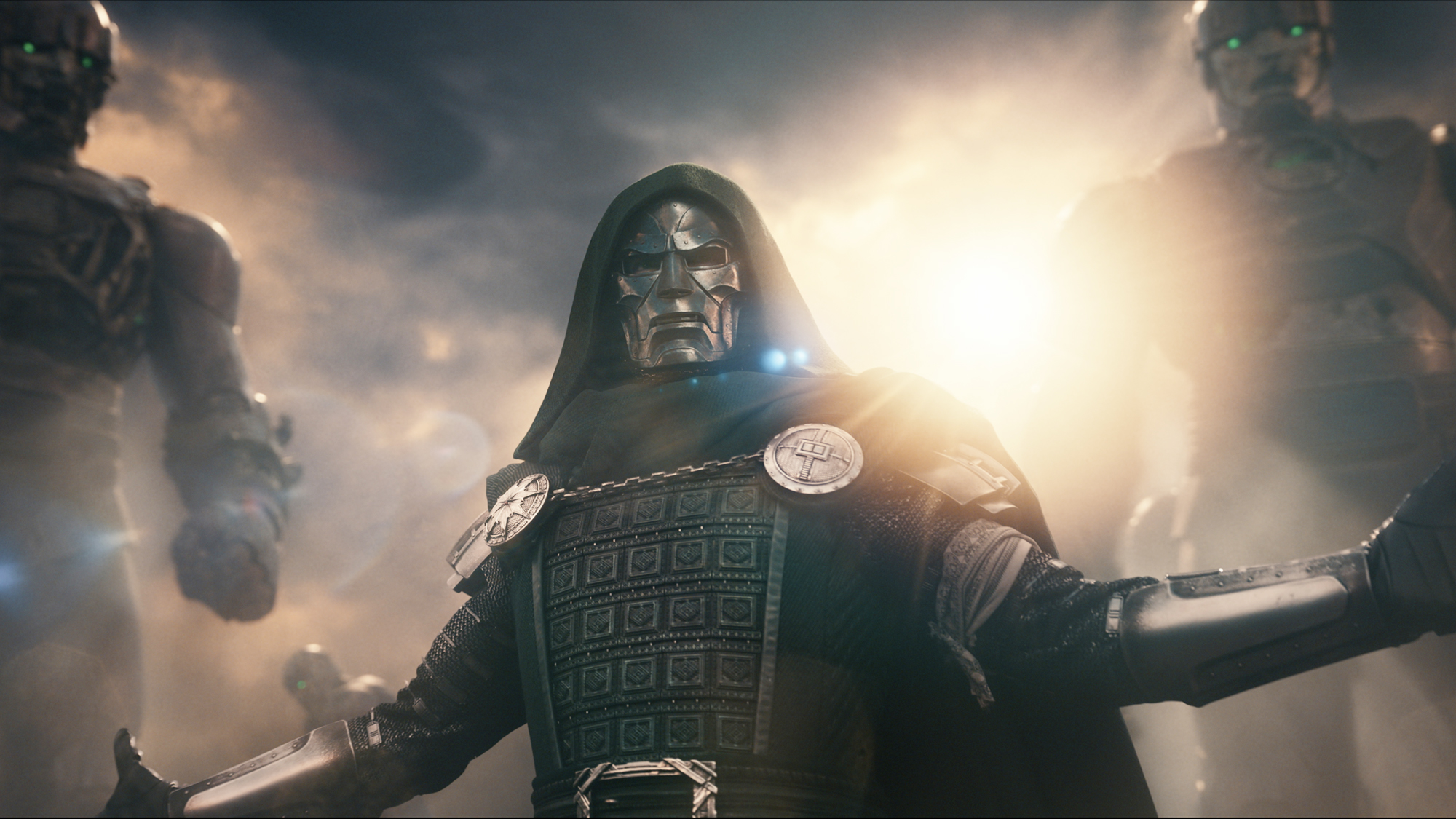
Doctor Doom in promotional imagery for Avengers: Doomsday. Image: Marvel Studios, via TechRadar. This is separate from the reported Encore footage.
What has reportedly been added?
The interrupted dance: Loki arrives at Steve and Peggy’s home, offering help.
Banner’s breached refuge: Doom reaches Bruce inside an underground bunker while he is attempting to control the Hulk.
A multiversal emergency: Mobius, Casey and Ouroboros witness colliding realities and Earths attacking one another.
A different man at the forge: Images of Doom making his mask accompany the hammering that originally closed Endgame.
These additions serve different purposes. Loki alters an existing ending. Banner supplies a new encounter. The TVA establishes the scale of the approaching disaster. The mask changes the emotional meaning of a familiar sound. Together, they offer returning viewers a route from the Infinity Saga into the next Avengers event, even if their place in the wider MCU chronology requires more explanation than a few minutes can provide.
Loki at the door: who gets to keep a happy ending?
In the reported extension of the final dance, a knock interrupts Steve and Peggy. Steve hides; Peggy answers. Loki appears and offers assistance to both of them. Steve emerges to discover that a former enemy has somehow found the private life he travelled through time to claim.
The reversal is rich. In The Avengers, Steve confronts a Loki who demands submission and treats human freedom as a mistake. The television series takes a branching version of that character towards the opposite conviction: individual lives deserve the chance to unfold. A Loki arriving to protect Steve’s unconventional future would bring that transformation directly into Captain America’s story. The distance between those positions is the substance of Loki’s MCU character arc.
Yet his TVA clothing cannot, by itself, date the encounter precisely within that arc. Time travel makes visual shorthand unreliable. Nor does an offer of help establish that Loki is there to arrest Steve, relocate his family or explain an incursion. Each remains a possible direction for the story.
The case against blaming Captain America
Miss Minutes’ reported warning about people remaining in their own universes invites viewers to connect Steve’s decision with the coming catastrophe. That is a provocative association. It is also insufficient evidence of causation.
Endgame establishes that changing the past does not simply rewrite the traveller’s original present. It also distinguishes the danger of removing an Infinity Stone from a reality from the broader business of travelling through time. Returning the Stones addresses that specific danger. It does not supply a comprehensive explanation of every possible branch, and branching itself has never been established as an automatic sentence of multiversal destruction.
There is a further complication: in the first season of Loki, the TVA says the Avengers’ time-travelling actions were supposed to happen. That organisation is hardly an infallible moral authority, but its own earlier account makes a blanket claim that the Time Heist was forbidden difficult to sustain. The existing Steve Rogers timeline problem gives Marvel room for explanation; it does not prove Steve broke existence.
The stronger dramatic possibility is that someone exploits his attachment. Steve has repeatedly accepted personal loss to protect strangers. Give him a home that can be threatened, and his next decision becomes much harder. Doom could use that vulnerability without Steve having caused the emergency at all.
There is a cost to reopening this ending. If the eventual story makes Steve’s first sustained act of self-care responsible for mass death, it risks turning an earned release from duty into a cosmic punishment. A more searching story would ask whether he can defend the life he chose while still recognising that everyone else’s family matters just as much. Peggy also needs a voice in that choice. Her future cannot function solely as Steve’s leverage point.
Doom collects Banner: the language of ownership
The Banner sequence reportedly finds Bruce recording his work inside a military bunker deep underground. Following another loss of control, he is attempting to suppress or stabilise his gamma-powered transformation. His isolation fails when the lights and recording equipment falter. Doom’s voice announces that he has come to collect him. Sounds of a transformation and a green, symbol-marked effect follow.
The supplied accounts vary over the apparatus and the exact mechanics of the exit. They support a threatening encounter. They do not establish that Doom absorbs Hulk’s strength, successfully enslaves him, or secures his agreement to join a team.
The word “collect” does much of the character work. It treats Banner as something already allocated a place in another man’s design. Where Nick Fury’s original recruitment proposition offered extraordinary people a shared purpose, Doom’s reported phrasing assumes possession. A scientist who has withdrawn because he fears harming people becomes vulnerable to someone who sees his usefulness first.
Why Bruce may matter more than the Hulk
Banner helped operate the Time Heist, discussed the consequences of removing a Stone with the Ancient One and used the Infinity Stones to restore the vanished. His experience places him at the intersection of scientific expertise, cosmic energy and practical responsibility for billions of lives. A Doom attempting to diagnose, exploit or survive an incursion crisis has several reasons to seek him out.
A coerced scientific alliance is therefore plausible. So is the simpler possibility that Doom wants a devastating weapon. Neither requires an MCU Illuminati adaptation, although the comics make that association tempting. Jonathan Hickman’s New Avengers uses the Illuminati to examine what powerful, intelligent people do when saving their own Earth appears to demand the destruction of another.
Doom pursues his own answer to that crisis in the comics. His later role in the 2015 Secret Wars and Battleworld gives a useful thematic precedent: preservation can become an argument for absolute rule. It does not tell us what job Banner will perform in the films. Predictions that he must become a Battleworld baron skip several unproven steps.
Bruce’s bunker also revisits one of his oldest wounds. In Endgame, his changed body suggests that years of conflict have produced a workable accommodation. This reported scene returns him to containment, surveillance and fear. Doom arrives at the exact point where Bruce doubts his own authority over his body. That is an effective introduction to a villain whose preferred solution is taking authority away from everyone else.
The green markings suggest a supernatural component, but resemblance to the Bifrost does not establish Asgardian technology. Doom’s comic history with sorcery offers ample precedent for a character who crosses the boundaries between engineering and magic.
The TVA watches worlds choose war
The reported TVA sequence brings Mobius, Casey and Ouroboros into an escalating emergency. Two Earths approach collision and launch attacks at one another. Earth-10005, associated with the Fox X-Men continuity, is identified in the accounts, alongside Earth-1127. Further alerts expand the disaster beyond a single pair of realities. Some reports describe thousands of simultaneous incursions.
The missiles are the important image. An incursion can be presented as an astronomical calamity, something heroes need enough power to stop. Earths firing at each other transform it into a moral crisis. Each population has reasons to survive. Each can describe the other as an existential threat. The same instinct that makes a hero defend a city can, under these conditions, become the justification for killing another world.
That is the disturbing inheritance from Hickman’s incursion stories. Intelligence offers ways to carry out terrible decisions without necessarily offering a way to escape them. A story built around competing Earths can ask what happens when the Avengers’ obligation to protect their home conflicts with the equal value of lives elsewhere.
Earth-10005’s involvement does not demonstrate that the X-Men personally ordered a strike or have already destroyed numerous universes. A planetary designation identifies a setting. Responsibility for a military decision needs its own evidence.
Loki’s sacrifice has limits, but it still matters
The ending of Loki season two leaves him sustaining branching timelines after the Temporal Loom’s destruction. It does not promise that every reality is immune to every future threat. Keeping those lives possible and preventing incursions are different problems. A later catastrophe can test the future he preserved without making his sacrifice meaningless.
The TVA’s institutional position matters, too. Its history includes the destruction of branches in the name of order. A warning from Miss Minutes should be read in that context, particularly given her involvement with He Who Remains. The audience should want to know who authorised the current message and what it leaves out before accepting it as a complete statement of cosmic law.
This is where Doom’s potential argument becomes dangerous. If the organisation watching the multiverse can catalogue catastrophe but cannot stop it, a man promising decisive intervention will find an audience. The bargain explored in Doom’s claim to the throne becomes imaginable: accept his command and something of your world may survive. Fear can make that offer persuasive long before anyone decides whether he is trustworthy.
The hammer falls again, and Tony’s memorial changes
The original Endgame closed its credits with metal striking metal, recalling Tony Stark’s work on his first suit in Iron Man. The reported Encore addition supplies a new image for that sound: Doom forging his mask.
It is an economical piece of audience manipulation. The familiar noise reaches back to the beginning of Robert Downey Jr.’s MCU history while the new image points towards his next role. A sound associated with ingenuity, escape and the birth of a hero becomes attached to an armoured ruler.
The casting makes the echo stronger. It does not prove that Victor is a Tony variant or that Marvel planned this connection in 2019. The effect works through audience memory whether or not the two characters ever acquire a literal relationship.
Why a sorcerer still needs a mask
There is no contradiction in Doom wielding magic and wearing sophisticated armour. His history as Victor von Doom combines scientific ambition, occult knowledge, bodily injury and political theatre. The armour gives those elements a single recognisable shape.
In his classic comic origin, facial scarring and the subsequent adoption of the mask connect his physical appearance to his inability to tolerate failure. Across retellings, the degree of disfigurement varies. The enduring feature is his need to control how he is seen. The mask permits an injured, fallible man to present an unchanging public face.
For a ruler, that face also performs authority. Doom can make himself look permanent, sealed and beyond appeal. Tony’s visible face repeatedly lets the films register doubt, exhaustion and affection beneath the machinery. An extended emphasis on Doom’s mask could deny the audience that access, making the armour a barrier to intimacy as well as a weapon.
Theories involving a dead wife, a mourning sash or a destroyed family may eventually prove relevant. The forging image alone establishes none of them. Its immediate achievement is clearer: a memorial to the MCU’s founding hero has acquired the silhouette of its next antagonist.
Selling the next Avengers film with the ending of the last
There is an obvious commercial logic to Encore. Familiar characters bring audiences back into cinemas, and unresolved questions encourage another ticket purchase. The artistic risk sits in the decision to place those questions inside a film that had already earned its farewell.
Steve’s dance originally released him from the machinery of the franchise. A visitor at the door reconnects him to it. The hammering allowed Tony’s story to echo after his death. Doom’s mask turns that echo towards a new product and a new conflict. Marvel gains momentum by spending some of the finality that made Endgame valuable.
Those choices can still produce a substantial story. Across the four reported additions, a coherent concern emerges: the fear of losing control. Steve has a life to protect. Banner fears his own body. The TVA faces events beyond its capacity. Doom makes a face that conceals vulnerability and approaches another person as an asset to acquire.
That pattern suggests a more compelling thematic direction than a simple escalation beyond Thanos. Endgame resolved its crisis through collaboration and sacrifice. A Doom-centred follow-up can examine the temptation to replace those difficult, fragile commitments with one commanding will. His most dangerous promise would be that nobody needs to endure such uncertainty again, provided they surrender the right to choose.
The test for Doomsday will be whether reopening these lives deepens them. Loki’s visit needs to matter to Peggy as well as Steve. Banner needs agency beyond being collected. The multiverse needs inhabitants whose deaths carry weight beyond a counter on a screen. Doom needs a conception of salvation frightening enough to justify borrowing Tony Stark’s final sound.
For now, that sound is the sharpest image in the reported material. The audience remembers a man building a way out of captivity. The new mask invites a question about how many people its maker intends to place under his control.
Reporting and further reading
The scene summaries draw on the supplied IGN report by Tom Phillips, checked against contemporary coverage from ComicBook.com and TechRadar. The thematic interpretations are this essay’s analysis. No leaked recordings are embedded.
For the comic foundations, continue with 11 Doctor Doom comics to read before Doomsday and Doom’s rivalry with the Fantastic Four. Explore the wider films and character histories in The Astromech’s MCU archive.
New Zealand release note: Event Cinemas lists Encore from 24 September and Doomsday from 17 December 2026. US reporting lists 25 September and 18 December respectively. Check the advertised extras for your individual session.


_poster.jpg)


