
Every road through Dune begins with a simple question and ends beneath several miles of sand. Frank Herbert built his saga as a machine of politics, ecology, religion and human memory. Denis Villeneuve translated its largest movements into images: a hand trapped inside a box, a voice that turns command into compulsion, a worm rising like a moving mountain, and a young duke accepting the holy war he once feared.
The most common questions about Dune therefore overlap. Ask whether Paul Atreides is a hero and you soon have to ask who manufactured his prophecy. Ask what the Bene Gesserit are and the answer leads to Jessica, the Voice, Feyd Rautha and the Kwisatz Haderach. Ask why Paul can see the future and the road eventually reaches blindness, tyranny and the Golden Path.
This guide distils those recurring questions into seven connected problems. It draws first from Frank Herbert’s six original novels, from Dune through Chapterhouse: Dune, then uses Villeneuve’s films to show how the same ideas have been sharpened for the screen. For a wider route through the books, characters, factions and adaptations, visit The Astromech’s Dune universe hub.

Is Paul Atreides a false messiah, a prophet, the Kwisatz Haderach, or a villain?
The short answer: Paul has genuine prescience and becomes the Kwisatz Haderach, but the Fremen messiah legend was planted by the Bene Gesserit. He consciously uses that manufactured faith to gain power. He is neither a simple fraud nor a clean hero.
Paul can perceive possible futures because he combines Bene Gesserit inheritance, Mentat discipline and immense exposure to spice. After drinking the Water of Life, he gains access to ancestral memory that male candidates were expected to enter. That makes him the Sisterhood’s long sought Kwisatz Haderach, born one generation earlier than planned. It does not prove that a god chose him.
The Lisan al Gaib prophecy has a more political origin. The Bene Gesserit’s Missionaria Protectiva seeded adaptable religious legends among vulnerable cultures so a stranded Sister could exploit them later. Jessica recognises those signs almost immediately. Paul resists the role because his visions show armies killing in his name, yet he eventually accepts the mantle of Mahdi and uses it against the Harkonnens and Emperor.
That is why Dune Messiah is essential. The first novel ends with Paul victorious; the sequel reveals the price. His jihad kills 61 billion people and turns a liberation movement into an imperial religion. Paul tries to limit the catastrophe he foresees, but he also chooses the road that protects his family, takes the throne and unleashes it. Villeneuve makes this warning harder to miss in Dune: Part Two. Chani’s refusal to celebrate his victory becomes the moral counterweight to the kneeling crowds.
Calling Paul evil flattens Herbert’s argument. Paul loves, grieves, fears and understands the damage he causes. His tragedy is that knowledge does not free him from power. It helps him rationalise power. His son Leto II later accepts an even more terrible transformation to impose the Golden Path, showing that the saga’s deepest danger lies in rulers who claim that only they can see what humanity needs.
Follow the prophecy: Is Paul Atreides a false prophet?, what the Kwisatz Haderach really is, and whether Paul becomes the villain of Dune Messiah.

What are the Bene Gesserit, are they human, who is Paul’s mother, and what is the Voice?
In plain terms: The Bene Gesserit are fully human women trained to master body, perception, politics and reproduction. Paul’s mother, Lady Jessica, is one of them. The Voice is their technique for identifying a listener’s psychological pressure points and issuing a command that is extremely difficult to resist.
The Sisterhood can appear supernatural because its disciplines have been refined across thousands of years. Prana bindu training gives a Sister precise control over muscle and nerve. Truthsayers read almost invisible physical reactions. Reverend Mothers survive the poisonous Water of Life by changing it within their bodies, a crisis that unlocks the memories of their female ancestors.
Their greatest project is political genetics. For generations they arrange marriages and bloodlines to produce the Kwisatz Haderach, a male able to reach places in ancestral memory unavailable to them. Jessica is ordered to bear Duke Leto a daughter who could be bred with Feyd Rautha. She bears Paul instead out of love for Leto, disrupting the plan. She is also the secret daughter of Baron Vladimir Harkonnen, which makes Paul the union of the enemy houses before he ever defeats Feyd.
The Voice is concentrated observation rather than magic. A trained user studies accent, fear, rank, habit and desire, then selects the exact pitch and cadence that will seize the target’s conditioned reflexes. Villeneuve gives it an almost physical force, but the films preserve Herbert’s central idea: control begins with knowing a person better than that person knows himself.
Jessica’s transformation in Dune: Part Two also exposes the cost of Bene Gesserit power. She drinks the Water of Life while pregnant, awakening Alia before birth, then helps turn Paul into the very messianic figure he fears becoming. Motherhood, religious survival and political manipulation become impossible to separate.
Enter the Sisterhood: The Sisterhood that runs the universe, how the Voice works, and Lady Jessica’s thematic character arc.
Did Feyd Rautha pass the Gom Jabbar test?
What the evidence shows: Villeneuve’s Dune: Part Two implies that Lady Margot Fenring tested Feyd with a gom jabbar and found him suitable, but it does not show him taking Paul’s hand in the box test. In Herbert’s novel, Margot seduces Feyd for his genes; he does not undergo a gom jabbar ordeal on the page.
Paul’s test asks whether pain will reduce him to animal reflex. He keeps his hand in the box while Reverend Mother Gaius Helen Mohiam holds the poisoned needle at his neck. Feyd’s film encounter has a different purpose. Margot isolates and seduces him, confirms that his bloodline can be preserved, and demonstrates that he can be controlled. The needle signals lethal Bene Gesserit authority, but the scene offers no evidence that he endured the same pain ritual as Paul.
Even a formal pass would not certify goodness. The test measures command over instinct. Feyd possesses discipline, appetite and a capacity for calculated violence. Those qualities make him valuable to the breeding programme and dangerous to everyone else. Paul and Feyd are genetic and dramatic mirrors: possible products of the same plan, divided by upbringing, loyalty and the uses to which they put self control.
Compare the candidates: What Paul’s Gom Jabbar test really measures and whether Feyd has prescience in Dune: Part Two.

What is Shai Hulud, and why do the Fremen worship the sandworms?
At the heart of it: Shai Hulud is the Fremen name for the immense sandworms of Arrakis. The words carry sacred meanings such as the Old Man of the Desert. The worms are worshipped because they embody the desert’s power and because the entire Fremen world, including the spice cycle, depends upon them.
A worm is more than a monster beneath the sand. Its life cycle creates the arid conditions in which mature worms can survive. Sandtrout trap planetary water below ground. Pressure builds around pre spice masses, eruptions scatter the material, and the desert eventually yields melange. The creature feared by spice harvesters is therefore inseparable from the substance that lets Guild Navigators cross interstellar space and allows the Imperium to exist.
For the Fremen, riding Shai Hulud is practical mastery and religious contact at once. Maker hooks lift the worm’s protective ring segments, causing it to roll and keep the exposed tissue away from abrasive sand. In Dune: Part Two, Paul’s first ride transforms an ecological skill into public proof that he belongs among the Fremen. Later he summons a colossal worm to assault the Emperor’s forces. Faith, environment and warfare converge in one creature.
The later novels reveal the cruel paradox inside the dream of a green Arrakis. Water and open vegetation destroy the conditions the worms require. As the planet changes, the old Fremen culture weakens with it. Leto II preserves the species by merging with sandtrout, turning his own body into the bridge between human history and a future generation of worms.
Go beneath the sand: Water, wealth and worms on Arrakis and how terraforming helps destroy traditional Fremen life.
What happens to Duncan Idaho, and why does he keep returning?
What happens to him: Duncan dies protecting Paul and Jessica in Dune, as he does in Villeneuve’s first film. The Bene Tleilax later recreate him as a ghola called Hayt. That resurrection becomes the first of many, making Duncan the human constant who survives across thousands of years of change.
In Dune Messiah, Hayt is presented to Paul as a gift designed to become a trap. He has Duncan’s body but no conscious memory of being Duncan. When Tleilaxu conditioning forces him toward an unbearable command, his old identity breaks through. His recovered memories prove that a ghola can regain the original person’s past, a discovery that transforms Tleilaxu power.
Leto II then commissions one Duncan after another during his 3,500 year reign in God Emperor of Dune. Each ghola begins as an idealised soldier from the Atreides past. Each eventually confronts a world that has moved beyond him and a ruler who uses loyalty as an instrument. Duncan repeatedly rebels, dies and returns.
By Heretics of Dune and Chapterhouse: Dune, the latest Duncan has restored the memories of his many ghola lives and developed abilities that even his makers did not fully anticipate. He escapes in a no ship with Sheeana, Scytale and the young Miles Teg. Herbert ends the original series with Duncan still moving beyond systems that want to breed, programme or own him.
Trace Duncan’s lives: Duncan Idaho’s complete arc across Frank Herbert’s novels and why Duncan keeps being resurrected.
How does Paul Atreides go blind, and why does he walk into the desert?
The crucial correction: Paul does not blind himself. A stone burner used by conspirators destroys his eyes in Dune Messiah. He continues to move by following an exact prescient vision, then walks into the desert after that vision fails and Chani dies.
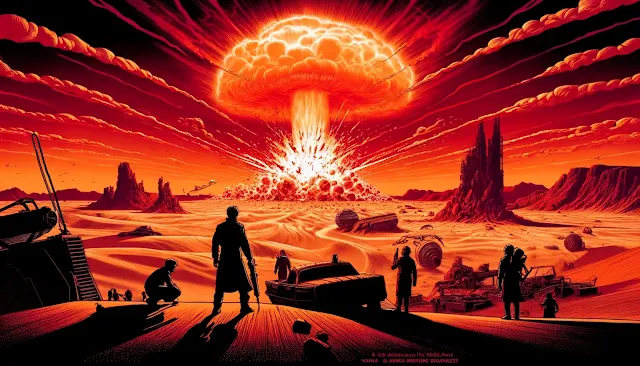
The stone burner is an atomic weapon that drives destructive energy down toward a planet’s core. Its flash blinds Paul and many nearby Fremen. Imperial convention would allow him to retreat from public life, but Paul shocks his followers by walking through Arrakeen as though he can still see. He is matching the world around him to a future already fixed in his mind.
This apparent miracle is also a prison. Paul can function only while reality follows the path he has foreseen. The birth of twins surprises him, Scytale threatens the newborns, and Paul briefly uses the infant Leto II’s eyes to strike back. Once the conspiracy is broken and Chani is dead, the vision that served as his sight is gone.
Fremen law requires the blind to enter the desert rather than burden the tribe. Paul accepts the custom and disappears into the sand, rejecting the palace and the religious machinery built around him. His choice reads as penance, escape and one last attempt to recover a fragment of Fremen honour. It cannot undo the empire created in his name.
Follow the aftermath: How Paul Atreides becomes blind and why the stone burner was used against him.
Why did Emperor Shaddam IV want House Atreides dead?
The political calculation: Duke Leto was becoming too popular with the Great Houses, while the troops trained by Duncan Idaho and Gurney Halleck were approaching Sardaukar quality. The Emperor feared a future rival and used House Harkonnen to destroy him without openly attacking a respected Great House.
Shaddam’s solution is the Arrakis transfer. He removes the profitable fief from the Harkonnens and gives it to House Atreides, knowing the Baron has prepared sabotage, betrayal and invasion. Imperial Sardaukar join the attack disguised in Harkonnen uniforms. If the plot succeeds, the ancient feud takes the blame and the Landsraad never receives proof that the throne has broken the balance of power.
Leto understands that Arrakis is a trap, but refusing the imperial command would destroy his political standing. He hopes to survive by winning Fremen loyalty and turning desert power against both Harkonnen wealth and Sardaukar force. Dr Wellington Yueh’s betrayal opens the shield wall before that plan can mature.
Villeneuve makes the conspiracy brutally legible. Dune: Part One frames the Atreides arrival as a funeral procession disguised as promotion. In Dune: Part Two, Paul forces the hidden Emperor to face the consequences. Shaddam tries to prevent a possible challenger and creates the messianic conqueror who takes his throne.
Open the imperial files: Why the Emperor plotted the destruction of House Atreides and how Paul exposes the Imperium’s rotten political core.
These questions all return to one Herbertian suspicion: any system that promises perfect control will eventually treat human beings as material. The Bene Gesserit turn bloodlines into a programme. The Emperor turns noble houses into pieces on a board. The Tleilaxu turn death into manufacture. Paul turns prescience into authority, then discovers that seeing a trap does not mean he has escaped it.
The sandworm stands outside that illusion. It cannot be persuaded by prophecy or intimidated by a throne. It responds to pressure, rhythm, water and territory. In the end, the most powerful creature in Dune is also the clearest reminder that politics remains subordinate to ecology. The desert does not care who calls himself emperor.
Continue through The Astromech’s complete Dune guide for the novel reading order, character studies, film analysis and the deeper history of the Imperium.


_poster.jpg)


